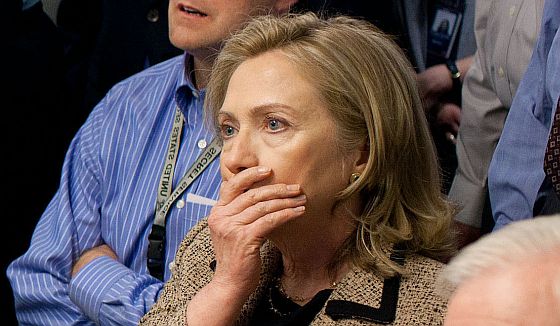
Benjamin Ferencz is a 92-year-old naturalized U.S. citizen, American combat soldier during World War II, and a prosecutor at the Nuremberg Trials, where he prosecuted numerous Nazi war criminals, including some responsible for the deaths of upward of 100,000 innocent people. He gave a fascinating (and shockingly articulate) 13-minute interview yesterday to the CBC in Canada about the bin Laden killing, the Nuremberg principles, and the U.S. role in the world. Without endorsing everything he said, I hope as many people as possible will listen to it.
All of Ferencz’s answers are thought-provoking — including his discussion of how the Nuremberg Principles apply to bin Laden — but there’s one answer he gave which I particularly want to highlight; it was in response to this question: “so what should we have learned from Nuremberg that we still haven’t learned”? His answer:
I’m afraid most of the lessons of Nuremberg have passed, unfortunately. The world has accepted them, but the U.S. seems reluctant to do so. The principal lesson we learned from Nuremberg is that a war of aggression — that means, a war in violation of international law, in violation of the UN charter, and not in self-defense — is the supreme international crime, because all the other crimes happen in war. And every leader who is responsible for planning and perpetrating that crime should be held to account in a court of law, and the law applies equally to everyone.
These lessons were hailed throughout the world — I hailed them, I was involved in them — and it saddens me to no end when Americans are asked: why don’t you support the Nuremberg principles on aggression? And the response is: Nuremberg? That was then, this is now. Forget it.
To be candid, I’ve been tempted several times to simply stop writing about the bin Laden killing, because passions are so intense and viewpoints so entrenched, more so than any other issue I’ve written about. There’s a strong desire to believe that the U.S. — for the first time in a long time — did something unquestionably noble and just, and anything which even calls that narrative into question provokes little more than hostility and resentment. Nonetheless, the bin Laden killing is going to shape how many people view many issues for quite some time, and there are still some issues very worth examining.
One bothersome aspect about the reaction to this event is the notion that bin Laden is some sort of singular evil, someone so beyond the pale of what is acceptable that no decent person would question what happened here: he killed civilians on American soil and the normal debates just don’t apply to him. Thus, anyone who even questions whether this was the right thing to do, as President Obama put it, “needs to have their head examined” (presumably that includes Benjamin Ferencz). In other words, so uniquely evil is bin Laden that unquestioningly affirming the rightness of this action is not just a matter of politics and morality but mental health. Thus, despite the lingering questions about what happened, it’s time, announced John Kerry, to “shut up and move on.” I know Kerry is speaking for a lot of people: let’s all agree this was Good and stop examining it. Tempting as that might be — and it is absolutely far easier to adhere to that demand than defy it — there is real harm from leaving some of these questions unexamined.
The Bahraini government has destroyed a number of mosques in continuation of its aggressive crackdown on pro-democracy protesters, a special Al Jazeera investigation has revealed.
At least 28 mosques and Shia religious institutions have been destroyed in the Gulf state since the crackdown on Shia-led protests began in Mid-March, the opposition group, Al Wefaq, told Al Jazeera’s Charles Stratford.
The Justice Ministry, however, said it was tearing down the mosques because they were not licensed. (Al Jazeera)
Adopting what might be called the Qaddafi defense, the head of Bahrain’s military claimed that the country’s brutal crackdown on dissent was entirely justified because the kingdom’s security forces had been confronted by young protesters under the influence of mind-altering drugs.
According to Bahrain’s state news agency, Sheik Khalifa bin Ahmed Al Khalifa said on Wednesday that “young people were given pills which affected their minds and made them do unusual things.” He also claimed “that Bahrain had been the victim [of] a conspiracy involving foreign agents and financing.” (New York Times)
Christopher Stokes writes: In Bahrain, to be wounded by security forces has become a reason for arrest and providing healthcare has become grounds for a jail sentence. During the current civil unrest, Bahraini health facilities have consistently been used as a tool in the military crackdown against protesters.
The muted response from key allies outside of the region such as the United States – which has significant ties to Bahrain, including a vast naval base in the country – can only be interpreted as acceptance of the ongoing military assault, which is backed by the Gulf Co-operation Council.
While the government and its supporters in Bahrain continue to refer to the protesters as rioters, criminals, extremists, insurgents or terrorists, the label that remains conspicuously absent for those who are wounded is “patient”. (The Guardian)
The Obama administration’s special Mideast envoy, former Sen. George Mitchell, is resigning after more than two largely fruitless years of trying to press Israel and the Palestinians into peace talks, U.S. officials said Friday.
The White House is expected to announce that the veteran mediator and broker of the Northern Ireland peace accord is stepping down for personal reasons, the officials told The Associated Press. The officials spoke on condition of anonymity ahead of an afternoon announcement that will follow a White House meeting between Mitchell and President Barack Obama.
There are no imminent plans to announce a replacement for Mitchell, the officials said, although his staff is expected to remain in place at least temporarily.
Mitchell’s resignation comes at a critical time for the Middle East, which is embroiled in turmoil, and the Israeli-Palestinian peace process, which has been moribund since last September and is now further complicated by an agreement between Palestinian factions to share power.
Obama will deliver a speech next Thursday at the State Department about his administration’s views of developments in the region, ahead of a visit to Washington by Israeli Prime Minister Benjamin Netanyahu. Jordan’s King Abdullah II also will travel to Washington next week. (AP)
On Thursday, The Palestinian Central Bureau of Statistics (PCBS) issued a report stating that more than 7000 Palestinians were killed by Israeli soldiers and settlers in the occupied Palestinian territories over the past ten years.
The PCBS said that 7342 Palestinians were killed in the period between September 29, 2000 and December 31, 2010.
The report stated that by the end of 2009, the number of Palestinians killed by Israeli fire arrived to 7235, including 2183 killed by Israeli fire in the West Bank. (IMEC)
Israeli security forces have clashed with Palestinians in several East Jerusalem neighbourhoods ahead of “Nakba Day” or “day of catastrophe” on Sunday.
The anniversary marks Israel’s 1948 declaration of statehood after which more than 700,000 Palestinians fled or were expelled in the war that ensued.
A correspondent for the AFP news agency saw four people hurt as police opened fire with rubber bullets at stone-throwing youths in Silwan. (Al Jazeera)
A 17 year-old was critically injured from live fire in East Jerusalem, and an American protester suffered serious head injury after being hit by a tear-gas projectile shot directly at him from close range.
Israeli military and police forces responded heavy handedly to demonstrations commemorating 63 years to the Palestinian Nakba (catastrophe) of 1948 today all over the West Bank and East Jerusalem. Morad Ayyash, a 17 year old from the Ras el-Amud neighborhood was shot in the stomach with live ammunition. He has reached the Muqassed hospital with no pulse and the doctors are now fighting for his life.
Tension also rose in the East Jerusalem neighborhood of Silwan, where 19 protesters have been injured and 11 were arrested. During the evening hours, large police forces raided houses in Silwan and carried out additional arrests. (Mondoweiss)
Khaled Diab writes: With the world’s attention focused on the tumultuous changes gripping Tunisia, Egypt, Yemen, Bahrain, Libya and Syria, one may be excused for thinking that all is quiet on the Palestinian-Israeli front.
So why haven’t Palestinian youth risen up like their counterparts elsewhere in the region to demand their rights?
Well, it is not for want of trying. Inspired by events in Tunisia and Egypt, and following the date-based example of counterparts elsewhere in the Arab world, a new youth movement dubbed by some as the March 15 movement has emerged in Palestine.
The date refers to the day when organisers employing social media, text messaging and word of mouth managed to draw thousands of protesters on to the streets of Ramallah and other parts of the West Bank, as well as Gaza City.
However, in contrast to other popular uprisings in the region, their demands were not wholesale regime change, despite the undoubted failings of both Fatah in the West Bank and Hamas in Gaza, and the absence of a democratic mandate for both parties.
“Our top priority is to end the divisions within Palestinian society. This is the only way to deal with the occupation,” explained Z, one of the founders of the movement in Ramallah, who wished to conceal his identity for professional reasons.
Some of the others involved in March 15 are also reluctant to reveal their identities, partly as an expression of the decentralised and “leaderless” approach preferred by Middle Eastern protesters tired of authoritarianism, and partly to avoid popping up on the radars of security services run by the PA, Hamas or Israel.
Despite its relative success on 15 March, the movement has not managed to replicate the most successful ingredient of the protests in Tunisia, Egypt, Yemen and Bahrain: constant pressure from the streets. This is partly due to the two-tiered nature of the oppression facing Palestinians, and the restrictions on their movement imposed by the occupation. “Unfortunately, we have two levels of repression in Palestine: Israeli and domestic,” says Z, who is in his early 20s.
In addition, there is the psychological barrier of widespread despair and disillusionment afflicting wide swaths of the population, which the Arab spring is just beginning to chip away at. Most Palestinians I have met since I moved to Jerusalem a few weeks ago speak enthusiastically and excitedly about the Egyptian revolution.
“The problem among Palestinians is that revolutions are nothing new, yet nothing changes or things get worse,” Z observes. “Neither uprisings nor negotiations have worked, Palestinians believe – we’re still under occupation.” (The Guardian)
Khaled Meshaal, the head of the political bureau of the Islamic resistance movement Hamas, said that for the time being Egyptians are not required to march to the Gaza Strip in support of the Palestinian cause.
Egyptian activists had called on Egyptians to march to the Gaza Strip through the Rafah border crossing on 15 May. The event, which has been dubbed “March to Palestine Day”, is intended to mark the 63rd anniversary of the declaration of the State of Israel.
In statements published on the official website of the Muslim Brotherhood in Alexandria, Meshaal said that, “advocating the cause by taking a political stance, sending relief aid, boycotting and sending prayers is a must at the moment. We do not ask you to march.” (Al-Masry Al-Youm)
Libyan state television has aired what it says is a statement by Muammar Gaddafi, in which the Libyan leader denies reports that he has been wounded.
In the audio message, broadcast on Friday evening, Gaddafi said he is alive and well despite air strikes from the NATO military alliance on his Bab al-Aziziyah compound in the capital, Tripoli, on Thursday.
Gaddafi said he is in a place where NATO bombs can not reach him. (Al Jazeera)
Concern is growing over a British-based photographer who has been missing for 39 days after being captured in Libya by forces loyal to Muammar Gaddafi.
Anton Hammerl, an award-winning photographer, was captured on 4 April and his family have had no concrete news about him since then.
The regime has, however, allowed access to three other journalists who were captured with him. (The Guardian)
Thousands of protesters in Syria defied a ferocious crackdown and returned to the streets Friday, even in towns that the military had besieged only days before, in a relentless contest of wills that a leading dissident described as an emerging stalemate.
For successive weeks, Fridays have served as a weekly climax in the challenge to President Bashar al-Assad’s rule. Calls for demonstrations this Friday came after a withering wave of repression that has killed hundreds and detained thousands in towns and cities stretching from the Mediterranean coast to Damascus’s outskirts and the poverty-ridden south.
While some of the country’s most restive locales remained relatively quiet — namely Baniyas on the coast and Dara’a in the south — protesters took to the streets in at least five neighborhoods in Homs, Syria’s third largest-city and a center of the two-month uprising. Activists said protests ranged in numbers from hundreds to thousands, and at least two people were killed when security forces opened fire.
“We don’t like you!” crowds chanted in Homs, referring to the president. “You and your party, leave us!” (New York Times)
Syrian forces carried out raids in towns on the outskirts of Damascus and a besieged city on the coast on Thursday, as the number of detainees surged in a government campaign so sweeping that human rights groups said many neighborhoods were subjected to repeated raids and some people detained multiple times by competing security agencies.
The ferocious crackdown on the uprising, which began in March, has recently escalated, as the government braces for the possibility of another round of protests on Friday, a day that has emerged as the weekly climax in a broad challenge to the 11-year rule of President Bashar al-Assad.
Residents have reported that hundreds of detainees are being held in soccer stadiums, schools and government buildings in various towns and cities across the country, some of them arrested in door-to-door raids by black-clad forces carrying lists of activists. (New York Times)
The neighbors watched helplessly from behind locked gates as an exchange of gunfire rang out at the police station. Then about 80 prisoners burst through the station’s doors — some clad only in underwear, many brandishing guns, machetes, even a fire extinguisher — as the police fled.
“The police are afraid,” said Mohamed Ismail, 30, a witness. “I am afraid to leave my neighborhood.”
Three months after the ouster of Hosni Mubarak, a crime wave in Egypt has emerged as a threat to its promised transition to democracy. Businessmen, politicians and human rights activists say they fear that the mounting disorder — from sectarian strife to soccer riots — is hampering a desperately needed economic recovery or, worse, inviting a new authoritarian crackdown.
At least five attempted jailbreaks have been reported in Cairo in the past two weeks, at least three of them successful. Other attempts take place “every day,” a senior Interior Ministry official said, speaking on the condition of anonymity because he was not authorized to talk publicly.
Newspapers brim with other episodes: the Muslim-Christian riot that raged last weekend with the police on the scene, leaving 12 dead and two churches in flames; a kidnapping for ransom of a grandniece of President Anwar el-Sadat; soccer fans who crashed a field and mauled an opposing team as the police disappeared; a mob attack in an upscale suburb, Maadi, that hospitalized a traffic police officer; and the abduction of another officer by Bedouin tribes in the Sinai.
“Things are actually going from bad to worse,” said Mohamed ElBaradei, the former international atomic energy official, now a presidential candidate. “Where have the police and military gone?” (New York Times)
Reports that the Gulf Cooperation Council (GCC) is considering some form of membership for two non-Gulf states – Jordan and Morocco – confirm that the conservative Sunni monarchies of the Middle East are closing ranks against Iran, Shiite-led Iraq and the democratic wave sweeping the region.
GCC secretary general Abdullatif al-Zayani made the announcement Tuesday after a summit of the six-member group affirmed support for Saudi and United Arab Emirates military intervention against predominantly Shiite pro-democracy protesters in Bahrain.
Zayani did not make clear whether Morocco and Jordan would be offered a second-tier membership in the GCC, which groups Saudi Arabia, Kuwait, Oman, the UAE, Qatar and Bahrain.
Foreign ministers from Jordan and Morocco will meet with GCC foreign ministers to “complete required procedures”, Zayani told reporters.
Founded in 1981 in the aftermath of Iran’s 1979 revolution and in the midst of the 1980-88 Iran-Iraq war, the GCC encourages economic and especially military cooperation among its members, which all border the Persian Gulf. In territorial terms, it would make more sense to offer membership to Iraq or Yemen than to Jordan or faraway Morocco.
However, the wave of popular unrest that has swept the region since January – and toppled once durable pro-Western authoritarian non- monarchies in Tunisia and Egypt – has spread anxiety among conservative Sunni monarchies already unsettled by the Shiite replacement of a Sunni regime in Iraq and by Iran’s slow but steady nuclear advancement. (IPS)
The Syrian military intensified a methodical, ferocious march across the country’s most restive locales on Wednesday, shelling the country’s third-largest city from tanks, forcing hundreds to flee and detaining hundreds more in what has emerged as one of the most brutal waves of repression since the Arab Spring began.
Homs, in central Syria near the Lebanese border, has become the latest target of the crackdown, which has already besieged and silenced, for now, the cities of Dara’a, in the fertile but drought-stricken southern steppe, and Baniyas, on the Mediterranean coast. Dozens of tanks occupied Homs, as black-clad security forces, soldiers and militiamen in plain clothes filtered through the industrial city of 1.5 million people. At least 19 people were killed there Wednesday, human rights groups said.
The crackdown in some neighborhoods alternated with the relative calm in the center of a city that is home to a Sunni Muslim majority and a Christian minority.
“We see the smoke rising in the sky after we hear the shells explode,” said Abu Haydar, a resident reached by telephone. “The sky was pretty quickly covered in smoke.”
In public statements and interviews, the government has acknowledged the crackdown, describing the military’s targets as militant Islamists and saboteurs. It said nearly 100 soldiers and members of the security forces had been killed, and American officials say that some protesters have indeed taken up arms.
In Washington, two Obama administration officials said that the United States still did not see a clear or organized opposition or another leader in Syria who could serve to unite the foes of the government of President Bashar al-Assad. (New York Times)
Joshua Landis writes: I am a pessimist about Syria’s future because the regime will dig in its heels and fight to the end. The Syrian opposition has successfully established a culture of resistance that is widespread in Syria and will not be eliminated. Even if demonstrations can be shut down for the time being, the opposition will not be defeated. Syria’s youth, long apolitical and appathetic, is now politicized, mobilized, and passionate. All the same, the opposition remains divided and leaderless, which presents great dangers for a post-Assad Syria.
It is hard to see any soft landing for the regime or the people. It is also hard to see how the regime will be brought down short of economic collapse and its inability to pay wages, which would lead to wider social defections and a possible splitting of the military, as happened in Lebanon and Libya. If the military splits, both sides would have ample firepower to do real damage. Large sections of Syria could fall out of state control. Regions not divided by sect could remain fairly quite and stable for a time if there is a unified political leadership to step into the vacuum. Otherwise competing parties will develop militias as happened in Iraq and Lebanon.
No foreign power will feel compelled to step in to protect the people or stop the fighting because no one will be responsible for “losing Syria.” Syria is a political orphan today.
The army has split in Syria once before. This happened in Feb 1954 at the end of Adib Shishakli’s rule. The army divided along geographic lines. The divisions in the North went with the opposition centered on the People’s Party based in Homs and Aleppo. The South stood by Shishakli. Fortunately, General Shishakli decided to leave the country and flew off to Saudi Arabia, helped by the US. He had a change of mind in mid air but the US prevented his return. Washington convinced Lebanon to refuse his jet landing rights. After a brief spell in Arabia, Shishakli migrated to Brazil, where a relative of a Druze man, for whose death Shishakli was responsible, assassinated him.
Syria’s great weakness is it lack of unity. This is why the Assad household has been able to rule for so long. Hafiz al-Assad was able to bring stability to Syria after 20 years of coups and political chaos by reverting to the use of traditional loyalties. He ended Syria’s period as a banana republic by placing his brother in charge of protecting the presidency and using tribal and sectarian loyalties to coup-proof the regime. Alawite faithful were carefully recruited to all the sensitive security positions in the Mukhabarat and military. The Sunni elite was grateful for the stability and was further brought in through the crafty use of graft and patronage. Rami Makhlouf is corrupt, but he is also the fixer for the Sunni merchant class. The way he brought the Sham Holding Company in to the circle of regime loyalists was a classic use of privilege and muscle to glue the elite families of Syria to the regime. They have made millions my accepting an offer that they could not refuse.
The Syrian opposition has always been divided between Arab nationalists, Islamist currents, liberals, and all those who disprove of the regime but are too conservative to take part in active opposition. Then there are the sectarian communities and the Kurds, class divisions, and the urban-rural split, not to mention the traditional rivalry between Damascus and Aleppo. The reason that the Assads have been so successful for so long is largely due to the inability of Syrians to unite around a common platform and national identity. The oppositions lack of unity does not augur well for a post Assad future, especially as the death toll mounts and the desire for revenge grows. (Syria Comment)
Yemeni forces have opened fire on demonstrators in three major cities, killing at least 18 and wounding hundreds in one of the fiercest bouts of violence witnessed in nearly three months of popular unrest aimed at toppling President Ali Abdullah Saleh.
The clashes between a defected faction of Yemen’s army and the republican guard, have raised fears that Yemen may be reaching a critical juncture as public fury continues to mount at the president’s refusal to step down.
Violence broke out in the capital when a throng of 2,000 protesters tore away from the main sit-in area at Sana’a University and surged en masse towards the cabinet building in downtown Sana’a with shouts of “God is great” and “Allah rid us of this tyrant”. (The Guardian)
Hamas is not a terror organization, Turkish Prime Minister Recep Tayyip Erdogan said in an interview with U.S. television late Wednesday, saying he felt the recently penned Palestinian reconciliation agreement was an essential step toward Mideast peace.
Erdogan’s comments came one day after Hamas Gaza strongman Mahmoud Zahar said that while his organization would accept a Palestinian state within 1967 borders, it would never recognize Israel, as a result of the damage such a move would do to Palestinian refugees in the “diaspora.”
Senior Israeli officials, led by Prime Minister Benjamin Netanyahu, have voiced opposition to Fatah’s new unity deal with Hamas, saying that a Palestinian government that included a terrorist group calling for Israel’s destruction could not be a partner for peace.
Speaking to Charlie Rose on Wednesday, however, the Turkish PM chimed in on the recently achieved unity agreement between rival Palestinian factions Fatah and Hamas, indicating that he did not feel Hamas was an obstacle in achieving Mideast peace. (Haaretz)
Palestinian President Mahmoud Abbas has told Egyptian officials that incumbent Prime Minister Salam Fayyad is his only candidate to head the burgeoning Palestinian unity cabinet, the London-based Arabic daily Al-Hayat reported on Thursday.
The report came after international donors were reportedly applying significant pressure on Abbas to retain Fayyad as prime minister, after earlier reports claimed the Palestinian prime minister would have to step down as a result of Fatah’s newly signed unity pact with former rivals Hamas. (Haaretz)
Muammar Gaddafi’s compound in Tripoli has been hit by Nato rockets again, a few hours after the veteran autocrat appeared in public for the first time in almost two weeks.
Gaddafi was shown on state television in a traditional brown robe addressing tribal leaders, whom he empowered to speak on behalf of a nation he has ruled with absolute power for almost 42 years.
The labyrinthine complex in the heart of the capital was struck at around 3am with five bombs and rockets that appeared to target military installations and bunkers.
A giant crater could be seen in the lawn in the middle of the complex, with one of the rockets having hit what appeared to be a bunker . Officials said six people were killed in the attack, including two Libyan reporters who had been interviewing supporters camped out at the scene.
“These locations were known to be command and control facilities engaged in co-ordinating attacks against civilian populations in Libya,” said a Nato official speaking from Brussels.
Libyan spokesman Moussa Ibrahim said the underground facility was not a bunker, but a sewage network. But following the strike, chanting Gaddafi supporters guarded a stairwell leading to the ruined site, having been told to let no reporters near it. Heat rose from a second smaller crater, where shattered reinforced concrete exposed a cavernous hole beneath. (The Guardian)
The Obama administration is stepping up its engagement with forces fighting Libyan leader Muammar Gaddafi, inviting opposition leaders to meet with U.S. officials at the White House Friday, while stopping short of recognizing their council as Libya’s legitimate government.
The White House said Mahmoud Jibril, a representative of the Libyan Transitional National Council, would meet with senior administration officials, including National Security Adviser Tom Donilon, as well as members of Congress. But there were no plans for President Barack Obama to meet with Jibril and his delegation.
France and Italy are among the nations that recognize the Council as Libya’s legitimate government. But White House press secretary Jay Carney said today that while the U.S. would continue consulting and assisting the opposition, giving the Council political legitimacy would be “premature.”
Defence Secretary Robert Gates, speaking with Marines, said the U.S. is keeping a “wary eye” on the opposition, and lacks clarity about exactly who the opposition is and what actions they may take long-term.
Still, the U.S. has been boosting its support for the opposition over the past month, including Obama’s authorization of $25 million in non-lethal assistance to the revolutionaries. The first shipment of that aid — 10,000 meals ready to eat from Pentagon stocks — arrived in the liberated city of Benghazi this week. The U.S. has also supplied some $53 million in humanitarian aid.
In addition, the administration has begun working with Congress to free up a portion of the more than $30 billion in frozen Gaddafi regime assets in U.S. banks so it can be spent to help the Libyan people. Senator John Kerry, a Democrat, who met with Jibril this week, said yesterday he was drafting legislation at the request of the White House that would allow that to happen.
The revolutionaries have said they need up to $3 billion in the coming months for military salaries, food, medicine and other supplies in order to keep fighting Gaddafi’s forces. They also say no country has sent the arms that they desperately need. (Libya TV)
Less than two weeks after U.S. special operations commandos killed Osama bin Laden, a resolution viewed as an expansion of the legal basis for the global war on terror is moving through Congress.
The House Armed Services Committee added language to the fiscal 2012 Defense Authorization bill on Wednesday that would define the current war on al Qaeda to include the Taliban and affiliated armed groups, affirming the U.S. District Court for the District of Columbia’s interpretation of the 2001 war resolution.
The committee began marking up the bill on Wednesday. It sets out the guidance for the U.S. defense budget.
The provision, known as the Authorization for the Use of Military Force, is key legislation used by lawyers for both President George W. Bush and President Obama as a legal basis for detaining terrorists without trial who are captured around the world. The legislation also was used to authorize U.S. drone strikes and special operations forces raids in countries where the United States is not formally at war.
Civil liberties groups have expressed worries that the new legislation, sponsored by Rep. Howard P. “Buck” McKeon, California Republican and committee chairman, significantly expands the scope of the global war on terror. (Washington Times)
When the Taliban ruled Afghanistan, they eschewed most modern technology, including television and music players.
But in the latest sign of the hardline movement’s rapprochement with at least some areas of the modern world, the Taliban have embraced microblogging.
Their Twitter feed, @alemarahweb, pumps out several messages each day, keeping 224 followers up to date with often highly exaggerated reports of strikes against the “infidel forces” and the “Karzai puppet regime”.
Most messages by the increasingly media-savvy movement are in Pashtu, with links to news stories on the elaborate and multilingual website of the Islamic Emirate of Afghanistan, as the Taliban’s shadow government likes to style itself. (The Guardian)
If there was one telling moment in Pakistan in the 10 days since Osama bin Laden’s death, when a Hollywood-style American assault on a suburban house left the country reeling, torn between anger, shame and denial, it occurred late one evening on a prime-time television show hosted by Kamran Khan.
Chatshow hosts are the secular mullahs of modern Pakistan: fist-banging populists who preach to the nation over supper, often through a rightwing lens. Khan, a tubby 50-year-old journalist with neat glasses and a small chin, is the biggest of them. Every night on Geo, the largest channel, he rails against “corrupt” civilian politicians and America, and lionises the armed forces; some colleagues nickname him “the brigadier”. But as the country seethed over Bin Laden last week, Khan tore off his metaphorical stripes and stamped them into the ground.
The army had failed its people, he railed. To Pakistan’s shame US soldiers had invaded the country; their finding Bin Laden in Abbottabad, two hours north of Islamabad, was a disgrace. The country’s “two-faced” approach to extremism had disastrously backfired, he said, reeling off a list of atrocities – New York, Bali, London, Madrid – linked to Pakistan. “We have become the world’s biggest haven of terrorism,” he declared. “We need to change.” Viewers watched in astonishment. The unprecedented attack targeted not only the army chief, General Ashfaq Kayani, but also the most sensitive policies of the military’s premier spy agency, the Inter-Services Intelligence Directorate (ISI). Feared, reviled and admired in equal measure, the ISI is considered the embodiment of army power in Pakistan, the object of hushed deference. But now, as one US official told me, “the world has changed”. And the ISI finds itself in the line of fire.
The Bin Laden debacle has triggered a blizzard of uncomfortable questions, the sharpest come from Washington. How, President Barack Obama wondered aloud last Sunday, could Bin Laden shelter for years in a garrison town that is home to three regimental headquarters, the local version of Sandhurst, and thousands of soldiers? One retired US officer who has served in the region told me he had been mulling the same question. “All those times we drove up to Abbottabad, and we could have taken out our pistols and done the job ourselves,” he said. The CIA chief Leon Panetta, meanwhile, says he didn’t warn the ISI about the special forces raid because he feared word might leak to the al-Qaida leader. Behind the pointed statements lies an urgent question: was the ISI hiding Bin Laden?
The answer may lie inside the ISI’s headquarters in Abpara, on the edge of Islamabad. The entrance, beside a private hospital, is suitably discreet: no sign, just a plainclothes officer packing a pistol who direct visitors through a chicane of barriers, soldiers and sniffer dogs. But inside, past the smooth electric gates, lies a neatly tended cluster of adobe buildings separated by smooth lawns and tinkling fountains that resembles a well-funded private university. Cars purr up to the entrance of the central building, a modern structure with a round, echoing lobby. On the top floor sits the chief spy: the director general Ahmed Shuja Pasha, a grey-haired 59-year-old three-star general. One American counterpart describes him as “brilliant and extremely intelligent . . . Thoughtful, pensive and extremely well read; if he was in the US military he would be a very successful officer.”
Pasha and the ISI are the heart of Pakistan’s “establishment” – a nebulous web of generals, bureaucrats and hand-picked politicians (not always elected ones) who form the DNA of Pakistan’s defence and security policies. It has at least 10,000 employees (some say twice as many), mixing serving army officers, many on three-year rotations from other services, with thousands of civilian employees, from suited analysts to beefy street spies. In theory they answer to the prime minister; in reality they are a tool of the army chief, Kayani. To supporters, the ISI safeguards national security – monitoring phones, guarding the country’s nuclear weapons. But to its many critics, the ISI is the army’s dirty tricks department, accused of abduction and assassination, vote-rigging and torture, and running Islamist terrorist outfits. “The ISI,” said Minoo Bhandara, an outspoken Parsi businessman who ran a brewery across the road from army headquarters before he died in 2008, “is an institution full of intelligence but devoid of wisdom.”
Shaukat Qadir, a retired brigadier and former president of the Islamabad Policy Research Institute, explains how Pakistan ended up at war with itself dealing with a tribal rebellion.
If we hark back in time, in 2001, the Pakistani Pashtun and all Afghans were celebrating US intervention in Afghanistan. It would liberate them from Taliban oppression. Within a year, American arrogance, their suspicion of all Afghans, their utter disregard for local customs and culture, could result in only one thing: Another Afghan freedom struggle from an oppressive foreign force. The US called it a resurgence of the Taliban and al Qaeda! In time it did become that, because the US converted a legitimate struggle for freedom from an army of occupation into ‘Taliban linked to al Qaeda.’
To return to my question — as they did when Afghans sought their freedom from the Soviet occupation, the Pakistani Pashtuns bordering Afghanistan, girded their loins to assist their Afghan brethren. This time, Pakistan did not want them to. And in 2004, we decided to kill the most outspoken of those Pashtuns, a wazir called Nek Muhammad.
His murder was the watershed. We had a rebellion on our hands because we were preventing our tribal Pashtun from assisting their Afghan brethren in their freedom struggle against an army of occupation: The Americans, of course. So all Pakistan suddenly became American, kafirs, legitimate targets for religious fanatics to kill, and we are more vulnerable and accessible for them to target. So we are faced with an existentialist threat and we die. This was the first gift we got from the US.
Without tracing all the history, where do we stand today as far as the US is concerned? Anybody, who is anybody in the US, is baying for our blood. We are traitors to them and branded American-kafirs by our enemy within. Obama now tells us that when the Navy SEALs came to get Osama, they were “in sufficient numbers and prepared to retaliate to any response by the police or Pakistan’s security forces”.
They also gifted us Raymond Davis, hundreds of him. When we agreed to give him back, it was on the condition that all other Raymonds also leave. The CIA has not forgiven us and recent drone attacks are again killing more civilians than militants. If the Raymonds can no longer stoke unrest in Pakistan, the drones can!
As far as the promised financial aid is concerned, we receive a mere trickle, each time with another threat of severance if we fail to obey our Lords and Masters in DC. Even the Coalition Support Fund (CSF), intended to compensate a small portion of the expense incurred by the military in this war that has been forced on us by the US and Musharaf’s capitulation, is long overdue by well over a billion dollars.
The US has its own litany of complaints but we have ours. Isn’t it time to file for divorce?
The New York Times gave readers a double-whammy of Syrian statements on Tuesday. Its correspondent in Beirut, Anthony Shadid, landed interviews with presidential adviser Bouthaina Shaaban and with Rami Makhlouf, the powerful maternal cousin of President Bashar Assad, who represents the financial front of the regime.
Shadid was allowed into Syria for only a few hours to conduct the interviews. You have to wonder whether this provoked much debate in the newspaper’s offices. The condition transformed the correspondent into a stenographer, and the New York Times into a platform, for the dual messages emanating from Damascus. This irked quite a few people. However, it’s also fair to say that Shadid has kept the Syria story on the front pages of his daily, at a moment when the attention in the United States has been drifting elsewhere.
What did Shaaban and Makhlouf say? The essence of Shaaban’s remarks was that the Syrian regime had gained the upper hand against the uprising. “I think now we’ve passed the most dangerous moment. I hope so, I think so,” she said. Shaaban repeated the government line that Syria faced an armed rebellion, and disclosed that she had been tasked with initiating a dialogue with dissidents. “We see [the Syrian events] as an opportunity to try to move forward on many levels, especially the political level,” she added.
Makhlouf’s comments sounded more ominous. “If there is no stability [in Syria], there’s no way there will be stability in Israel,” he warned. “No way, and nobody can guarantee what will happen after, God forbid, anything happens to this regime.” He observed that the regime had opted to fight, insisting that all its members were united: “We will sit here. We call it a fight until the end.” He also issued a transparent threat: “They should know when we suffer, we will not suffer alone.”
Some have suggested that the two messages reveal a split in the Syrian regime. That’s not convincing. The messages were not that different, and to put Shaaban on the same level as Makhlouf is absurd. Shaaban is viewed as a spokesman for the president, but she plays no central role in the Assad-Makhlouf constellation. She doubtless needed a green light to go ahead with the interview, one that required some measure of approval by Makhlouf and Assad’s younger brother Maher, both of whom have taken an eradication approach to the protests. Makhlouf, in turn, needed no authorization whatsoever.
What Shaaban said was likely intended to be interpreted in the United States as a marginally soft statement by Bashar Assad. In contrast, Makhlouf offered the harsher alternative if the president’s approach was rejected by the international community. It was a classic good cop, bad cop routine, and those familiar with Syrian manners will be little surprised by the ploy. That’s why it seems far-fetched to assume that we are witnessing a fundamental rift in Syria’s ruling family.
One of the great bluffs in the foreign policy community in the previous decade was that Israel would have no choice but to attack Iran’s nuclear facilities unless Washington stepped up and took military action first. With predictable frequency since the mid-1990s, reports emerged claiming that Israel was months, if not weeks, away from bombing Iran. And every time a new dire warning was issued, a new rationale was presented to convince the world that the latest Israeli warning was more serious than the previous one. The Israeli threats, however, were bluffs all along. Israel did not have the capacity to take out Iran’s nuclear facilities. But the huffing and puffing ensured that the American military option remained on the table; that Washington would not deviate from the Israeli red line of rejecting uranium enrichment on Iranian soil; and that the Iranian nuclear program was kept at the top of the international community’s agenda.
But the persistent bluffing also carried a price. The Israeli narrative on Iran has grown increasingly alarmist, desperate, and existential over the past 15 years. Inflating the Iranian threat served several purposes domestically. It provided Israeli Prime Ministers Yitzhak Rabin and Shimon Peres a rationale to push for peace with the Palestinians in the 1990s, while more recently Benjamin Netanyahu has used it to resist pressure from Washington to do just that. But the domestic benefits came at the price of limiting Israel’s options and flexibility vis-à-vis Iran. As Israeli politicians built up the Iranian threat and established a near-consensus that Tehran constituted an existential threat, it became increasingly difficult for any Israeli politician to walk back the threat depiction without losing critical political capital at home. As a result, there was a steady escalation of the threat depiction from Iran and no clear ways to de-escalate.
I wrote about this in the Forward in late 2007, pointing out that Israel was suffering from strategic paralysis due to its inability to adjust to the region’s new realities and walk back its alarmist position on Iran. Today, Israel’s strategic position in the region is at even greater risk. In the past few years, for instance, tensions have steadily increased between Israel and Turkey with the friction reaching a boiling point after the Gaza flotilla incident in 2010. As a result, the strategic alliance with Turkey seems to be lost for the foreseeable future. Now, with the fall of the Mubarak regime in Egypt, Israel has lost its most important Arab ally. Thus, the cost of the strategic paralysis is greater today than it was even a few years ago.
Cast your minds back to November. Barack Obama had received his “shellacking” in the midterm elections, as the Republicans regained a majority in the House of Representatives and seized control of 29 of the 50 state governorships. It was the worst midterm defeat for the Democrats since 1938. Just a week earlier the president’s approval ratings had fallen to a record low of 37%.
Fast forward six months, and the president is enjoying the “Bin Laden bounce”. His approval ratings stand at 52%, according to Gallup – up six points on April. Historians may look back on 1 May 2011, and the killing of Osama, as the day Obama secured his re-election.
But even before the al-Qaida leader was dumped in the ocean, Obama had reason to be optimistic. Just 18 months away from the next election he has no obvious or credible Republican opponent. So far, the listless lineup of potential presidential candidates resembles the characters from the bar scene in Star Wars – a motley collection of far-right loons, freaks and conspiracy theorists.
There’s the former senator, Rick Santorum, who once compared homosexuality to bestiality and paedophilia; former vice-presidential candidate Sarah Palin, who has said America must stand with “our North Korean allies”; Congresswoman Michele Bachmann, who believes carbon dioxide is “not a harmful gas, it is a harmless gas”; former governor Mitt Romney, who has said he won’t appoint Muslim-Americans to his cabinet; Tea Party Congressman Ron Paul, who wants to scrap income tax and abolish the education department; and former House speaker Newt Gingrich, who published a book last year titled To Save America: Stopping Obama’s Secular-Socialist Machine. Oh, and the “birther” billionaire Donald Trump.
The heart sinks. Lamenting the presidency of George W Bush, the late JK Galbraith once remarked: “I never thought I would yearn for Ronald Reagan.” The current Republican presidential field makes one yearn for Dubya.
The tragedy is that Obama needs to be held to account – but from a leftwing, not rightwing, direction.
Usually, when billionaires or millionaires give a large sum of money to a university, even a private one, they can specify where that gift will go — which department or function, facilities, new hires, dorms, or what have you. And it’s no secret that some of those big donations may lead to a little bit of wink-and-nudge affirmative action when it comes time for the little billionaires Jr. to apply to college.
But what these monied donors cannot do, what remains taboo in the academic world, is leverage that kind of gift to influence who gets hired and fired by the faculty and what they teach–until now, thanks to Charles G. Koch.
A recent op-ed in a Florida newspaper brought to light a shady deal by billionaire Koch, one of the Koch brothers, who donated a hefty million-dollar plus pledge to Florida State University, with some very big and ethically compromised strings attached.
According to the St. Petersburg Times‘ Kris Hundley’s thorough report:
A foundation bankrolled by Libertarian businessman Charles G. Koch has pledged $1.5 million for positions in Florida State University’s economics department. In return, his representatives get to screen and sign off on any hires for a new program promoting “political economy and free enterprise.”
Traditionally, university donors have little official input into choosing the person who fills a chair they’ve funded. The power of university faculty and officials to choose professors without outside interference is considered a hallmark of academic freedom.
Under the agreement with the Charles G. Koch Charitable Foundation, however, faculty only retain the illusion of control. The contract specifies that an advisory committee appointed by Koch decides which candidates should be considered. The foundation can also withdraw its funding if it’s not happy with the faculty’s choice or if the hires don’t meet “objectives” set by Koch during annual evaluations.
Again, to be clear, such conditional donations have been rejected by universities in the past, even when they were not political in nature.
David Ignatius writes: The ISI is, in the biblical phrase, a house with many mansions. What was known in one wing was not always shared with others. Indeed, if the ISI had transmitted information about sheltering bin Laden, U.S. intelligence almost certainly would have picked it up through surveillance.
Pakistani officials reject the allegation — rapidly becoming conventional wisdom in Washington — that they didn’t adequately pursue al-Qaeda. In interviews, they disclosed some new details that support their account. A U.S. official responded: “The Pakistanis indeed provided information that was useful to the U.S. government as it collected intelligence on the bin Laden compound. That information helped fill in some gaps.”
The Pakistani dossier starts with a joint CIA-ISI raid in the Abbottabad area in 2004, pursuing Abu Faraj al-Libi, often described as al-Qaeda’s No. 3 official. He was captured the next year in another joint operation in Mardan, west of Abbottabad.
The Pakistanis argue their telephone intercepts may have helped CIA analysts identify the courier who was sheltering bin Laden and trace him to the compound in Abbottabad. ISI officials, in particular, cite several calls in Arabic in 2009 that may have been crucial, including at least one from the general vicinity of Abbottabad.
Communications intercepts have always been crucial to U.S. operations against al-Qaeda. In some instances, such as wireless calls, the United States can collect signals unilaterally. But in intercepting some landline and Internet communications, the United States had secret official cooperation, according to a Pakistani source. The source says this led to the sharing of many hundreds of useful calls and numbers. (Washington Post)
William Saletan writes: One after another, elements of the U.S. account of Osama Bin Laden’s death have unraveled. First it was the human shields. Then the armed Bin Laden. Then the million-dollar mansion. Then the ongoing firefight.
Which parts of the story will unravel next? Here’s my guess: the 50-50 gamble and the improvised intelligence harvest.
The gamble has been a favorite administration theme. According to the official story, the CIA never had solid evidence that Bin Laden was in the Abbottabad compound. So President Obama had to go off by himself and make the tough call. He rolled the dice.
Sending U.S. ground troops into Pakistan did take guts. But the crux of the gamble story is that Bin Laden might not have been in the compound, in which case the raid would have been a risk for nothing.
A week ago, CIA Director Leon Panetta said his analysts had calculated a 60 percent to 80 percent chance that Bin Laden was in the compound. Then Obama, taping an interview for 60 Minutes, called it “a 55/45 situation.” Then National Security Advisor Tom Donilon went on the Sunday shows and claimed it had been “50/50.” As the number shrinks, the legend grows.
To convey the magnitude of the gamble, Obama asked 60 Minutes viewers to imagine the consequences if the SEALs had arrived at the compound to find that its occupant was a “prince from Dubai.” But that’s absurd. The CIA had found the compound by tracking Bin Laden’s couriers. It had studied the building and its inhabitants for months with satellite imagery, telephoto lenses, and eavesdropping devices. It knew that the men who owned and ran the compound were sons of a longtime Bin Laden associate and that their family had married into Bin Laden’s. And agency operatives had watched a third man—a tall man who never joined the other two men in their chores—take regular walks through an internal courtyard.
The only open question was the identity of the tall man. What the CIA knew for sure was that the compound and its inhabitants were linked to Bin Laden.
That’s important, because a major objective of the raid was to harvest intelligence from the compound. And that objective was attainable even if Bin Laden turned out not to be there. (Slate)
Spencer Ackerman writes: Osama bin Laden’s death was the end result of a massive investment in surveillance and spy tools that arose after the 9/11 attacks, designed to end the emergency that al-Qaida posed. But according to the chairman of the House intelligence committee, rolling back that huge security state after bin Laden’s death would not only miss an opportunity to destroy al-Qaida once and for all, it would effectively give bin Laden one last laugh.
“This is the time to step on the gas and break their back,” Rep. Mike Rogers, a Michigan Republican and former FBI agent, told the Council on Foreign Relations in a Wednesday speech. The choice, as he laid it out, is between ratifying the post-9/11 redefinition of liberty and security and getting attacked again.
“All the tools” of the security state created after the Twin Towers fell need to be retained, Rogers argued. The Patriot Act, whose most controversial surveillance provisions are to expire on May 27? Keep it. The doubling of intelligence cash, which now stands at $80 billion annually? Keep it. The explosion of drones and other spy technologies that “didn’t exist ten years ago?” Keep it all.
Rogers argued that lesson of the bin Laden raid is that ballooning the surveillance state paid off — and that scaling back spycraft just leaves the U.S. vulnerable. Back in the 1990s, the government viewed “the intelligence community as the opportunity for the peace dividend for the fall of the Soviet Union,” he said. “We see what a serious mistake that was.”
And there are even more spy advances on the horizon, Rogers said, like better methods for analysts to navigate the flood of drone and satellite data coming in every day. He didn’t give any specific examples, but the Air Force is building a supercomputer-in-sky inside a giant blimp that will crunch drone footage before beaming it down to soldiers on the ground.
Not many people are calling for an intelligence rollback — especially not right as a team of spies sifts through a trove of hard drives, removable media, recording devices and cellphones taken from bin Laden’s compound. Besides, al-Qaida these days is more of a global franchise of terror groups than a strict hierarchy. And it’s not like bin Laden’s former crew are the only terrorists on the block.
By contrast, Rogers’ remarks come as the House Armed Services Committee is considering a measure that would reauthorize and expand the war to unnamed affiliates of al-Qaida. But, some wonder, if bin Laden’s death doesn’t prompt a chance to reconsider the security state, whatever will? (Danger Room)
NATO carried out its most forceful attacks in weeks in Libya on Tuesday, part of an apparently coordinated push with rebel forces to bring an end to Moammar Gaddafi’s 41-year-long rule.
NATO warplanes pummeled command-and-control targets in four cities, including Tripoli and Gaddafi’s home town of Sirte. U.S. officials said NATO had increased the tempo of its airstrikes throughout the country, and members of the alliance spoke of improved targeting of dug-in loyalist forces, made possible in part by the presence of U.S. Predator drone aircraft.
The new assault appeared to reflect increased cooperation between NATO and the rebel army, allowing the rebels to make modest gains on the ground this week, particularly in and around the western city of Misurata. Although it was too early to tell whether the advances would mark a meaningful turning point in a conflict that has left the country divided since February, the progress “shows where the momentum lies,” said a European diplomat privy to NATO’s internal discussions.
“It is noteworthy that Gaddafi’s forces have not been able to mount a sustained attack for quite some time,” said the official, who spoke on the condition of anonymity to discuss ongoing military operations. He said the rebels’ recent success in Misurata was largely due to the fact that government troops had been forced to abandon entrenched positions, making them vulnerable to ground attack. (Washington Post)
leader Muammar Gaddafi has until the end of May to agree his exile before an arrest warrant from the International Criminal Court is issued, Italian Foreign Minister Franco Frattini said on Wednesday.
‘There are countries that in recent weeks have indicated… a willingness to welcome him,’ Mr Frattini said in an interview with RAI public radio.
‘It’s clear that if there is an international arrest warrant it would be more difficult to find an arrangement for the colonel and his family,’ he said.
‘This will happen by the end of May,’ he added.
Mr Frattini also said he believed there were ‘many defections’ from the regime underway, adding: ‘This shows we have probably arrived at a turning point.’ (AFP)
Three weeks ago, a traveler spotted a man’s body in the farmland on this city’s outskirts, shot twice in the head with his hands and feet bound. He had disappeared earlier that day, after visiting a market.
Ten days later, near the same spot, a shepherd stumbled upon the body of a second man, killed with a single bullet to the forehead. Masked, armed men had taken him from his home the night before, without giving a reason, his wife said.
The dead men, Nasser al-Sirmany and Hussein Ghaith, had both worked as interrogators for Col. Muammar el-Qaddafi’s internal security services, known for their brutality against domestic dissidents. The killings, still unsolved, appeared to be rooted in revenge, the families said, and have raised the specter of a death squad stalking former Qaddafi officials in Benghazi, the opposition stronghold.
The killings have unsettled an already paranoid city, where rebel authorities have spent weeks trying to round up people suspected of being Qaddafi loyalists — members of a fifth column who they say are trying to overthrow the rebels. If the violence continues, it will pose a stern challenge to a movement trying to present a vision of a new country committed to the rule of law, while potentially undermining hopes for a peaceful transition if Colonel Qaddafi surrenders power.
The rebels say their security forces are not responsible for the killings. Prosecutors here say they are investigating at least four attacks, including another murder in March, and they are exploring the possible involvement of Islamists who were imprisoned by the Qaddafi government and are now settling old scores. “It’s our responsibility to protect people,” said Jamal Benour, the justice coordinator for the opposition in Benghazi. “It’s important the killers are punished. The law is most important.”
But some here dismiss talk of Islamists, saying they believe the killings are being carried out by an armed group allied with the rebels, or possibly Qaddafi loyalists pretending to be. (New York Times)
Rebels in the contested western city of Misurata stormed the city’s airport on Wednesday afternoon, swarming over the grounds from the south and east and reclaiming it from the military of Col. Muammar el-Qaddafi.
Seizing the airport in Misurata, Libya’s third-largest city, which has been under siege for nearly two months, marked one of the most significant rebel victories in the Libyan conflict.
The airport and its approaches were the last remaining pieces of significant terrain in the city to be controlled by the Qaddafi soldiers. (New York Times)
Nick Clegg has backed a decision by the home secretary, Theresa May, not to open Britain’s borders to migrants fleeing the turmoil in Libya and North Africa.
Instead the Liberal Democrat leader said Italy should be offered practical assistance in helping those refugees and migrants who manage to complete the dangerous journey from Libya across the Mediterranean.
On Thursday May is to confirm Britain’s rejection of calls to take part in a European-wide “burden-sharing” scheme when she meets EU interior ministers in Brussels to discuss the north African situation. (The Guardian)
Simon Tsidall writes: Given the mad rush to war in Libya, when Britain and others suddenly decided Benghazi risked becoming the new Srebrenica, it is unsurprising that little or no thought was given to the seemingly unrelated question of sub-Saharan migration into the EU. But the law of unintended consequences is inexorable. What began as a quixotic fight in a faraway country has mutated into a life-or-death struggle on the tourist beaches of Europe. Apparently, nobody saw it coming.
The people dying in this war within a war are not Libyans, not the Gaddafi-ites, not the rebels. They are not the endlessly affronted residents of Lampedusa and other Italian and Maltese islands. Nor are they British or other Nato airmen. They are the people who always die first in such situations: the poor, the uneducated, the dark-skinned.
They are people from Eritrea and Somalia, from Chad and Niger, and from other sub-Saharan loser nations. And they are now being washed up daily on Europe’s shores, some just alive, others not so lucky – washed up in their hundreds and thousands, unknowing and blameless, the helpless collateral victims of the high-handed US-British-French decision to rid the world of Colonel Muammar Gaddafi and damn the consequences. (The Guardian)
Secret filming conducted by Al Jazeera has revealed shocking evidence of the brutal crackdown against pro-democracy protesters in the Gulf state of Bahrain.
An undercover investigation conducted by Al Jazeera’s correspondent, Charles Stratford, has unearthed evidence that Bahraini police carried out periodic raids on girls’ schools since the unrest began.
The government of Bahrain deployed security forces onto the streets on March 14 in an attempt to quell more than four weeks of protests.
A three-month “state of emergency” that was declared by King Hamad bin Isa Al Khalifa on March 15, is due to be lifted on June 1.
At the height of the protests, up to 200,000 people rallied against the government. The crackdown was an attempt to end the protests that demanded the end of the despotic rule of the Khalifah royal family.
In an interview “Heba”, a 16-year-old schoolgirl, alleges she, along with three of her school friends, were taken away by the police from their school and subjected to severe beatings while in custody for three consecutive days. (Al Jazeera)
Witnesses say Yemeni security forces and snipers have opened fire on thousands of anti-government protesters marching towars the cabinet building in Sanaa, the capital.
A doctor who treated some of the wounded said that at least one protester had been killed and dozens more wounded.
The doctor, who wished to remain anonymous, said that wounded protesters were still arriving at a field hospital where he was treating patients.
The protesters were calling for the resignation of Ali Abdullah Saleh, the country’s logtime president, when they came under fire on Wednesday. (Al Jazeera)
The adult sons of Osama bin Laden have lashed out at President Obama over their father’s death, accusing the United States of violating its basic legal principles by killing an unarmed man, shooting his family members and disposing of his body in the sea.
The statement said the family was asking why the leader of Al Qaeda “was not arrested and tried in a court of law so that truth is revealed to the people of the world.” Citing the trials of Saddam Hussein and Slobodan Milosevic, the statement questioned “the propriety of such assassination where not only international law has been blatantly violated,” but the principles of presumption of innocence and the right to a fair trial were ignored.
“We maintain that arbitrary killing is not a solution to political problems,” the statement said, adding that “justice must be seen to be done.”
The statement, prepared at the direction of Omar bin Laden, a son who had publicly denounced his father’s terrorism, was provided to The New York Times by Jean Sasson, an American author who helped the younger Bin Laden write a 2009 memoir, “Growing Up bin Laden.” A shorter, slightly different statement was posted on a jihadist Web site Tuesday. (New York Times)
India is ratcheting up pressure on Pakistan ahead of next week’s terrorism trial in the U.S., releasing a document that alleges the Inter-Services Intelligence spy agency was directly involved in the attacks on Mumbai in 2008.
The move comes as Pakistan is facing accusations from the U.S. and India that some element of the military must have helped hide al Qaeda chief Osama bin Laden, who was killed last week in a secret raid by U.S. Navy SEALs on a house only four kilometers from the elite Pakistan Military Academy in Abbottabad.
A court in Chicago will begin hearings this month in the trial of seven men alleged to have aided David Coleman Headley, the Pakistani-American who has pleaded guilty of scouting sites for the Mumbai attacks, which led to the deaths of more than 160 people, including six Americans. (Wall Street Journal)
India kicked off war games involving thousands of troops on Monday along its border with arch-rival Pakistan, which is still smarting from the US operation that killed Osama bin Laden.
A military spokesperson told reporters the six-day exercise, codenamed Vijayee Bhava (Be Victorious) was being held in the Thar desert region in the Indian state of Rajasthan.
“This exercise envisages sustained massed mechanised manoeuvres,” S D Goswami said, adding the drill involved an array of weaponry that India has acquired as part of its ongoing military modernisation programme.
More than 20 000 combat troops were taking part. (AFP)
In revelations that could further embarrass Pakistan, WikiLeaks has released a fresh set of US diplomatic cables that show how the country’s spy agency, the Inter-Services Intelligence (ISI), allowed militants to go to India to carry out strikes on targets chosen by the Pakistan army.
The revelations are part of nearly 800 interrogation reports of suspects held in Guantanamo Bay prison.
WikiLeaks, in one of the several cables that exposes ISI’s links to terror groups, quotes a US cable as saying that an Algerian Al Qaeda militant arrested in 2002 said that his mission was to “kill Indians in India”. (NDTV)
The US and Pakistan struck a secret deal almost a decade ago permitting a US operation against Osama bin Laden on Pakistani soil similar to last week’s raid that killed the al-Qaida leader, the Guardian has learned.
The deal was struck between the military leader General Pervez Musharraf and President George Bush after Bin Laden escaped US forces in the mountains of Tora Bora in late 2001, according to serving and retired Pakistani and US officials.
Under its terms, Pakistan would allow US forces to conduct a unilateral raid inside Pakistan in search of Bin Laden, his deputy, Ayman al-Zawahiri, and the al-Qaida No3. Afterwards, both sides agreed, Pakistan would vociferously protest the incursion.
“There was an agreement between Bush and Musharraf that if we knew where Osama was, we were going to come and get him,” said a former senior US official with knowledge of counterterrorism operations. “The Pakistanis would put up a hue and cry, but they wouldn’t stop us.” (The Observer)
Dozens of African migrants were left to die in the Mediterranean after a number of European military units apparently ignored their cries for help, the Guardian has learned. Two of the nine survivors claim this included a Nato ship.
A boat carrying 72 passengers, including several women, young children and political refugees, ran into trouble in late March after leaving Tripoli for the Italian island of Lampedusa. Despite alarms being raised with the Italian coastguard and the boat making contact with a military helicopter and a warship, no rescue effort was attempted.
All but 11 of those on board died from thirst and hunger after their vessel was left to drift in open waters for 16 days. “Every morning we would wake up and find more bodies, which we would leave for 24 hours and then throw overboard,” said Abu Kurke, one of only nine survivors. “By the final days, we didn’t know ourselves … everyone was either praying, or dying.”
International maritime law compels all vessels, including military units, to answer distress calls from nearby boats and to offer help where possible. Refugee rights campaigners have demanded an investigation into the deaths, while the UNHCR, the UN’s refugee agency, has called for stricter co-operation among commercial and military vessels in the Mediterranean in an effort to save human lives. (The Guardian)
The United Nations refugee agency has urged the crews of ships in the Mediterranean to keep watch for unseaworthy vessels carrying migrants from war-torn Libya after a report that a ship with 600 people on board broke up just off the port of Tripoli on Friday.
Witnesses in Tripoli said the ship was only 100 yards from shore when it broke up, Sybella Wilkes, a spokeswoman for the Geneva-based organization, said Monday. “It’s not clear how many people died or drowned,” she said, but 16 bodies — including those of two babies — had been recovered.
Refugees who left on another vessel later on Friday said they saw bodies and pieces of a ship in the water, said Laura Boldrini, a spokeswoman in Italy for the agency, the United Nations High Commissioner for Refugees.
Ms. Wilkes said there had been a “dramatic increase in the number of boats making this terrible journey,” as migrants, many of them from sub-Saharan Africa, tried to flee Libya’s turmoil, heading for sanctuary on the Italian island of Lampedusa. (New York Times)
The family photo albums, abandoned on the sand, lay open and fluttering in the desert wind. Around them were the personal items with which they had been packed: heaps of clothing, sandals, DVDs, combs, bottles of perfume, cooking utensils, razors, toothbrushes, several teapots, bundled blankets and a few biscuits, broken and dry. Every several yards a dropped suitcase rested on the dirt, looted bare.
War can strip those caught in its path to almost nothing, which is what happened to the people who had gathered here last Wednesday. They were African migrants caught in the conflict in Libya. They had long ago winnowed their meager possessions down, first to leave their small flats to move into tents, then to leave the tents to stand in line with a suitcase or two at this plot of bare desert, where they were told to wait for a ride to a ship. Here they stood until they ran. They dashed away so quickly and with such panic that they left behind the last things to which they had clung.
Like more than 10,000 other migrant workers in Misurata, they had been idled from work by the outbreak of war, and then cut off from routes overland toward home when the military of Col. Muammar el-Qaddafi put this city under siege. They had waited two months for an evacuation vessel to arrive in the city’s harbor and carry them out. (New York Times)
Rebel fighters made significant gains Monday against forces loyal to Col. Muammar el-Qaddafi in both the western and eastern areas of the country, in the first faint signs that NATO airstrikes may be starting to strain the government forces.
In the besieged western city of Misurata hundreds of rebels broke through one of the front lines late on Sunday, and by Monday afternoon were consolidating their position on the ground a few miles to the city’s west.
The breakout of what had been nearly static lines came after NATO aircraft spent days striking positions and military equipment held by the Qaddafi forces, weakening them to the point that a ground attack was possible, the rebels said.
While not in itself a decisive shift for a city that remained besieged, the swift advance, made with few rebel casualties, carried both signs of rebel optimism and hints of the weakness of at least one frontline loyalist unit. (New York Times)
The Syrian government has gained the upper hand over a seven-week uprising against the rule of President Bashar al-Assad, a senior official declared Monday, in the clearest sign yet that the leadership believes its crackdown will crush protests that have begun to falter in the face of hundreds of deaths and mass arrests.
The remarks by Bouthaina Shaaban, an adviser to Mr. Assad who often serves as an official spokeswoman, suggested that a government accustomed to adapting in the face of crises was prepared to weather international condemnation and sanctions. Her confidence came in stark contrast to appearances just two weeks ago, when the government seemed to stagger before the breadth and resilience of protests in dozens of towns and cities.
“I hope we are witnessing the end of the story,” she said in an hourlong interview, for which a reporter was allowed in Syria for only a few hours. “I think now we’ve passed the most dangerous moment. I hope so, I think so.” (New York Times)
The wife of Syrian dictator Bashar al-Assad may have fled to London with the couple’s three young children, it has been claimed.
Asma Assad, 35, was said to be living in a safe house in or near the capital.
British-born Mrs Assad, who is considered to be one of the most glamorous first ladies in the world, has not been seen in public since the start of the Arab Spring. (Daily Telegraph)
The European Union has listed 13 Syrian officials on the bloc’s sanctions list, including a brother and a wealthy and influential cousin of Bashar al-Assad, the president, and intelligence chiefs.
Maher al-Assad commands Syria’s Republican Guard and is considered the second most powerful man in the country.
The EU’s official journal, in which the full list was published on Tuesday, described Maher al-Assad as the “principal overseer of violence against demonstrators”.
The measures, asset freezes and travel bans, are part of a package of sanctions, including an arms embargo which went into effect on Tuesday, as part of EU efforts to try to force Syria to end violence against anti-government protesters. (Al Jazeera)
Harrowing testimony of torture, intimidation and humiliation from a doctor arrested in the crackdown on medical staff in Bahrain has revealed the lengths to which the regime’s security forces are prepared to go to quash pro-democracy protests.
Interviews obtained by The Independent from inside Bahrain tell of ransacked hospitals and of terrified medical staff beaten, interrogated and forced into signing false confessions. Many have been detained, their fate unknown.
Inspired by the pro-democracy protests which swept Tunisia and Egypt earlier this year, Bahrainis took to the streets in their thousands in February, demanding greater political rights and more equality for the Shia Muslim majority, ruled over for decades by a Sunni monarchy. (The Independent)
At least 30 people have died in Bahrain, protesters and medical workers are being put on trial, and prominent opposition politicians are being arrested—but the United States has yet to toughen its talk or impose sanctions on its Gulf ally.
Bahrain, a predominantly Shiite country ruled by a Sunni monarchy, plays host to the U.S. Navy’s Fifth Fleet. McClatchy reports today that the government has bulldozed dozens of Shiite mosques. Shiite women and girls have also been detained and abused, according to McClatchy. The State Department has said little about these matters publicly, except to tell McClatchy it’s “concerned by the destruction of religious sites” and is “extremely troubled by reports of ongoing human rights abuses” in Bahrain.
The Bahraini government announced last week it would charge nearly 50 doctors and nurses for treating injured pro-democracy protesters. We’d previously noted the government’s detention of medical workers along with protesters, activists and journalists. (ProPublica)
Wendell Steavenson writes: Last week an activist I know came to see me and showed me a series of pictures on his mobile phone: men throwing Molotov cocktails, blurred fireballs, and debris-strewn streets.
“Where was this?” I asked him, thinking they were pictures taken during the revolution. “Moski,” he said, naming a downtown area of Cairo known for its street traders, “a half an hour ago.” “I was nearly stabbed,” he added. Apparently two rival streets had gone to battle over some kind of shop-to-shop dispute, using rocks, bricks, and shotguns. Sixty people were injured. It happened the same day as a smallish crowd of pro-Mubarak supporters tried to celebrate his birthday outside of the state TV building (a favorite spot for demonstrations; soldiers use the first-floor balconies as watchtowers in case of serious trouble) and clashed with a rival crowd.
Yesterday, I went to a conference for parties and people hoping to form a broad umbrella committee to begin to address issues like the economy and the constitutional process during this interim period. I met Dr. Mohamed Ghonim, a wise, tortoise-looking man who is a famous kidney specialist and elder statesman of sorts for the liberal front of the revolution. He ruminated on the role of the Army, currently the de facto ruling authority. “As you know, security in general is bad. Every day there are two or three major things happening and nothing serious is done to contain these incidents. The economy is going in a negative way, downhill…”
I asked him if he thought that these incidents were being deliberately allowed to erupt.
“Of course. How can people stop the railway?” he asked, referring to the disruption in the upper Egyptian town of Qena at the end of April, when local people cut rail lines that link the north and south of the country, to protest the imposition of an unpopular governor. Ghonim said that law and order, in the hands of the military since the police are still not deployed in anything like their pre-revolutionary numbers, was being allowed to disintegrate, “Until you get to a critical point and then people say ‘oh please step in politically!’” (The New Yorker)
Hassan Nafaa writes: The tragedy at St. Marmina church in Imbaba on Saturday is not a new story. A young Muslim man from Asyut claims he married a Christian woman who converted to Islam five years ago, and that his wife’s brothers kidnapped her in recent months. The young man then claims he received a phone call that his wife is detained at an Imbaba church. The young man then goes to Imbaba and gathers a group of Muslims, most of them Salafis, from nearby mosques. Together they head to the church and instigated yet another incident of sectarian strife.
When the police learned of the gathering in front of St. Marmina church, they sought the assistance of Sheikh Mohammad Ali, a prominent local Salafi leader and a preacher at the nearby Toba mosque. Along with other religious leaders, Sheikh Ali went to the gathering outside the church and listened to the young man recount his story in the presence of some police officers. The sheikh did not buy the story and was especially skeptical about the fact that the young man did not file a police report immediately after the kidnapping. To Sheikh Ali, it appeared that someone was trying to incite sectarian tensions.
Sheikh Ali immediately told the protesters that the young Muslim man was lying. “Because they trust me, they believed me and began to chant: ‘Muslims and Christians are one,’” he said. Ali added that he accompanied an interior ministry official to the church to inform church leaders that the conflict was over.
“But Copts residing in nearby apartment buildings thought we were entering the church to search it, so they started to throw bottles at us. Then I heard gun fire and things escalated from there.”
Rumors quickly spread through the media and a group of young men in the area headed to an adjacent church and set it ablaze. Clashes broke out and by the end of the evening 12 people were dead and over 100 were injured.
There will be more rumors tomorrow about imaginary incidents of rape, theft, marriage, and divorce that will provoke both sides to engage in more violence to avenge the dignity of their religious group. Many will fail to see that their anger is unwarranted.
In all these cases, the solution is that suspected criminal – regardless political, sectarian or class affiliation – be subjected to a fair trial. Taking the law into our own hands to avenge crimes committed against our family, or sect deals a serious blow to the idea of a civilized society. (Al-Masry Al-Youm)
The US government has frozen the bank accounts belonging to Hatem Abudayyeh, a Palestinian community organizer and director of a social service organization serving the Arab community in Chicago, and his wife, Naima.
Meanwhile, several members of Congress have written to the Obama administration to express their concerns about violations in civil liberties as a result of earlier government actions toward Abudayyeh and other activists.
The freezing of the Abudayyeh family’s bank accounts on Friday, 6 May is the latest development in a secret grand jury investigation that has been launched by US District Attorney Patrick Fitzgerald’s office in Chicago. The freezing of the accounts has raised concerns that criminal indictments in the case may be imminent. (Electronic Intifada)
Glenn Greenwald writes: On Friday, government officials anonymously claimed that “a rushed examination” of the “trove” of documents and computer files taken from the bin Laden home prove — contrary to the widely held view that he “had been relegated to an inspirational figure with little role in current and future Qaeda operations” — that in fact “the chief of Al Qaeda played a direct role for years in plotting terror attacks.” Specifically, the Government possesses “a handwritten notebook from February 2010 that discusses tampering with tracks to derail a train on a bridge,” and that led “the Obama administration officials on Thursday to issue a warning that Al Qaeda last year had considered attacks on American railroads.” That, in turn, led to headlines around the country like this one, from The Chicago Sun-Times:
The reality, as The New York Times noted deep in its article, was that “the information was both dated and vague,” and the official called it merely “aspirational,” acknowledging that “there was no evidence the discussion of rail attacks had moved beyond the conceptual stage“ In other words, these documents contain little more than a vague expression on the part of Al Qaeda to target railroads in major American cities (“focused on striking Washington, New York, Los Angeles and Chicago,” said the Sun-Times): hardly a surprise and — despite the scary headlines — hardly constituting any sort of substantial, tangible threat.
But no matter. Even in death, bin Laden continues to serve the valuable role of justifying always-increasing curtailments of liberty and expansions of government power. (Salon)
David Axe writes: The early-morning raid that killed Osama bin Laden was, according to CIA Director Leon Panetta, “the culmination of intense and tireless efforts on the part of many dedicated agency officers.” Panetta also thanked the “strike team, whose great skill and courage brought our nation this historic triumph.”
But it’s unclear who was on the strike team — the 25 people aboard two specially modified Army helicopters. Most of the “trigger-pullers” were, apparently, Navy commandos from the famed SEAL Team Six.
At the “pointy end” — a Beltway euphemism for combat — the operation targeting bin Laden in Abbottabad, Pakistan, looked overwhelmingly military. But the months-long process of gathering intelligence and planning had a CIA flavor.
Indeed, President Barack Obama described it as agency-led. The intelligence community pinpointed bin Laden’s location. Panetta monitored the raid in real time from Langley. The assault team may have included CIA operatives. Senior administration officials called it a “team effort.”
But did the CIA have people on the ground in Abbottabad? It’s not an academic question. Exactly who was on the strike force that killed bin Laden has major policy implications.
CIA presence places the operation on one side of an increasingly fuzzy legal boundary between two distinct U.S. legal codes: one exclusive to the military and another that defines the terms of open warfare for the whole U.S. government.
The extent of the CIA’s involvement also has serious implications with regard to a chain of presidential executive orders that prohibit Americans from participating in the assassination of foreign leaders. (Politico)
White House has demanded that Pakistan hand over intelligence seized from Osama bin Laden’s compound as relations between the two allies hit a new crisis over the outing of America’s top spy in Islamabad.
Mark Carlton, the purported CIA station chief, was named by a Pakistani newspaper and a private television news network over the weekend, the second holder of that post in less than a year to have his cover blown by the media, presumed to have official consent.
The reports documented a meeting between Mr Carlton and the head of Pakistan’s spy agency, the Inter- Services Intelligence, suggesting that the information came from them.
Washington has refused to comment on the development, which comes amid worsening relations between the US and Pakistan over how bin Laden came to be sheltering in a fortified compound in a garrison town.
Anger is mounting in Pakistan over how the US was able to carry out the raid in Abbottabad without detection, with calls for the Government to resign. (The Times)
The prime minister’s statements, along with the publication of the name of the C.I.A. station chief, signaled the depths of the recriminations and potential for retaliation on both sides as American officials demand greater transparency and cooperation from Pakistan, which has not been forthcoming.
The Pakistani spy agency, Inter Services Intelligence Directorate, gave the name of the station chief to The Nation, a conservative daily newspaper, American and Pakistani officials said.
The name appeared spelled incorrectly but in a close approximation to a phonetic spelling in Saturday’s editions of The Nation, a paper with a small circulation that is supportive of the ISI. The ISI commonly plants stories in the Pakistani media and is known to keep some journalists on its payroll.
Last December, American officials said the cover of the station chief at the time was deliberately revealed by the ISI. As a result, he was forced to leave the country. (New York Times)
President Obama’s national security adviser demanded Sunday that Pakistan let American investigators interview Osama bin Laden’s three widows, adding new pressure in a relationship now fraught over how Bin Laden could have been hiding near Islamabad for years before he was killed by commandos last week.
Both the adviser, Thomas E. Donilon, and Mr. Obama, in separate taped interviews, were careful not to accuse the top leadership of Pakistan of knowledge of Bin Laden’s whereabouts in Abbottabad, a military town 35 miles from the country’s capital. They argued that the United States still regards Pakistan, a fragile nuclear-weapons state, as an essential partner in the American-led war on Islamic terrorism.
But in repeatedly describing the trove of data that a Navy Seal team seized after killing Bin Laden as large enough to fill a small college library, Mr. Donilon seemed to be warning the Pakistanis that the United States might soon have documentary evidence that could illuminate who, inside or outside their government, might have helped harbor Bin Laden, the leader of Al Qaeda, who had been the world’s most wanted terrorist.
The United States government is demanding to know whether, and to what extent, Pakistani government, intelligence or military officials were complicit in hiding Bin Laden. His widows could be critical to that line of inquiry because they might have information about the comings and goings of people who were aiding him. (New York Times)
It is the unknown frontline in Libya’s civil war, a rebel town besieged by Gaddafi’s forces but almost ignored by the outside world.
Rockets and Scud missiles pour down. Water is running short. Tens of thousands are desperately trying to flee.
But transfixed by the horrors of Misurata, the international community – and the Nato military alliance – have all but overlooked the closely parallel drama in the mountain towns of Zintan and Yafran, little more than an hour’s drive from the capital.
“We have been under fire for about an hour and a half now,” said one Zintan resident, Mustafa Haider, by telephone from the town on Friday afternoon.
“From the south, from the north, from the east, from everywhere. They fire with Grad missiles, Scud missiles, anything. They have tried to enter Zintan many times but they couldn’t.” Homes, schools, and the town’s main hospital had been hit, causing panic, he said. (Daily Telegraph)
Libya: end indiscriminate attacks in western mountain towns
Human Rights Watch says: Libyan government forces have launched what appear to be repeated indiscriminate attacks on mountain towns in western Libya, Human Rights Watch said today.
Accounts from refugees who fled the conflict say the attacks are killing and injuring civilians and damaging civilian objects, including homes, mosques, and a school. Human Rights Watch called on Libyan forces to cease their indiscriminate attacks on civilian areas.
Human Rights Watch interviewed more than 50 refugees from Libya’s western Nafusa mountains in Tunisia from April 26 to May 1, 2011, as well as doctors and aid workers assisting those in need. The refugees gave consistent and credible accounts of indiscriminate shelling and possible rocket attacks in residential areas of the rebel-controlled towns of Nalut, Takut, and Zintan. Human Rights Watch could not confirm the refugees’ accounts due to government restrictions on travel in western Libya but, taken together, they describe a pattern of attacks that would violate the laws of war.
Amnesty International says: At least 48 people have been killed in Syria by the security forces in the last four days, local and international human rights activists have told Amnesty International, as the crackdown on the coastal city of Banias intensified.
More than 350 people – including 48 women and a 10-year-old child – are also said to have been arrested in the Banias area over the past three days with scores being detained at a local football pitch. Among those rounded up were at least three doctors and 11 injured people taken from a hospital.
“Killings of protesters are spiralling out of control in Syria – President Bashar al-Assad must order his security forces to stop the carnage immediately,” said Philip Luther, Amnesty International’s Deputy Director for the Middle East and North Africa.
Amnesty International has compiled the names of 28 people who were apparently shot dead by security forces on Friday and those of 12 others killed over the last three days.
The organization now has the names of 580 protesters and others killed since mid-March, when protests against the government of President Bashar al-Assad began.
The Syrian government is continuing its weeks-long crackdown on anti-government demonstrations, arresting opponents and deploying troops in protest hubs.
Rami Abdul-Rahman, director of the Syrian Observatory for Human Rights, said security forces were carrying out house-to-house raids targeting demonstration organisers and participants.
He said Monday’s raids were focused in the central city of Homs, the coastal city of Baniyas, some suburbs of the capital, Damascus, and villages around the southern flashpoint city of Deraa.
Live Blog Syria
Another activist said gunfire was heard in the town of Moadamiya, just west of the capital, Damascus, as troops carried out arrests. (Al Jazeera)
Ten years ago, as the main thrust of Egyptian society and the legal sphere was moving towards amending the constitution to make it more democratic and just, the collective brain of the regime’s inner circle was working in the opposite direction: twisting laws to fit the interests of the inner few — the oligarchs who had both wealth and political influence.
Steel magnate Ahmed Ezz, who is facing trial Today, Saturday, on charges of illegal profiteering and misuse of public funds, along with dozens of businessmen and officials considered to be close to the ousted regime, perfectly represents the marriage of wealth, party politics and undue power. Ezz became one of the first symbols that the Egyptian people decided to bring down after the January 25 Revolution.
On the night of 28 January, the headquarters of Ezz Steel in the Mohandeseen district was destroyed, along with other government headquarters and police stations, symbolising the downfall of the old regime.
“At the time he came to buy Alexandria National Iron and Steel Company (now Al-Ezz Al-Dekheila Steel Company) we had never heard of Ahmed Ezz,” said Ali Helmy, former chairman of the National Iron and Steel Company.
“The first time I met Ezz was in 1999 when Atef Ebeid, minister of the public enterprise sector at that time, invited managers of steel companies for a business dinner at a small factory in Sadat City producing galvanised iron,” recounted Helmy. “We were introduced to Ezz, a young engineer and owner of the factory.”
A few months later, continues Helmy, Ezz has already bought three million shares, accounting for LE456 million ($76.7 mln), of the Alexandria National Iron and Steel Company, and after a few months, he was appointed chairman of the company: first base for what would later become a great empire.
Ezz was born in 1959 to a family that was wealthy but not overly rich. After having graduated from the Faculty of Engineering at Cairo University in the mid-1980s, he worked as a percussionist in one of the most famous music bands at that time, Moudy and Hussein. At the time, Ezz had shown no interest in business until in 1995 his father, a steel trader, bought him a small plot of land in Sadat City and helped him build a steel factory.
His friendship with Gamal Hosni Mubarak, son of Egypt’s then president, helped to make his fortune, culminating in the buying of a huge amount of shares in Gamal’s 1998 Future Generation Foundation (FGF), a non-profit organisation that provided courses for young people to prepare them for entry to the workforce.
Several leading figures in Egypt‘s private sector, including Ahmed El-Maghrabi, former minister of tourism, and Rachid Mohamed Rachid, former minister of trade and industry were involved, and both now face trial.
From that point on, Ezz accompanied Gamal to all meetings and despite being a newcomer to politics, gradually became a familiar political face.
In 1999, the Alexandria National Iron and Steel Company faced a financial crisis due to dumped steel imports from Ukraine and other Eastern European countries coming into Egypt. Ezz quickly offered to buy shares in the troubled joint stock company. “For some reason, the biggest figures in the government helped Ezz finalise this deal,” said Helmy.
According to a 2007 report on Strategic Economic Trends by Al-Ahram Centre for Political and Strategic Studies, In 1999, Ezz bought some 540,000 shares in less than a month. Ezz had seized more than three million shares of the company, accounting for 27.9 per cent of total shares.
By the late 1990s, Ezz started his acquisition move in the steel market, through a strategy of taking loans from the biggest banks to buy shares in steel companies.
In 1999, Ezz was appointed chairman of the National Iron and Steel Company, despite the fact that he hadn’t paid back the loans he had taken from Egypt’s major banks, according to the same report.
“The National Bank of Egypt and Bank of Cairo (Egypt’s largest public banks) favoured Ezz because of his relationship with Gamal Mubarak and helped him get the loans, while denying credit to viable businesspeople who lacked the right political pedigree; they had for instance refused to issue loans for the same company bought by Ezz (Alexandria National Iron and Steel Company) a few months earlier to help it get out of its devastating financial crisis,” said Helmy.
“Ezz’s strategy from that time on was to take loans from Egyptians banks, buy shares and take a greater role in the steel market, but the thing is, he never gave a loan back. He would pay older loans by getting new loans,” elaborates Helmy. (Ahram Online)
Ali Abunimah writes: By deciding to join the US-backed Palestinian Authority led by Mahmoud Abbas, Hamas risks turning its back on its role as a resistance movement, without gaining any additional leverage that could help Palestinians free themselves from Israeli occupation and colonial rule.
Indeed, knowingly or not, Hamas may be embarking down the same well-trodden path as Abbas’ Fatah faction: committing itself to joining a US-controlled “peace process”, over which Palestinians have no say – and have no prospect of emerging with their rights intact. In exchange, Hamas may hope to earn a role alongside Abbas in ruling over the fraction of the Palestinians living under permanent Israeli occupation in the West Bank and Gaza Strip.
Whether Hamas realises it or not, it has effectively entered into a coalition with Israel and Abbas to manage the Occupied Territories, in which Hamas will have much responsibility, but little power. (Al Jazeera)
Saeed Kamali Dehghan writes: No Iranian president has ever dared to challenge the supremacy of Ali Khamenei’s two-decade-long leadership as publicly as Mahmoud Ahmadinejad did recently in an extraordinary power struggle between him and the ayatollah.
The unprecedented confrontation at the top of the Iranian regime began only a month ago when Khamenei, the supreme leader, intervened in a cabinet appointment by reinstating a minister who had initially resigned “under pressure from Ahmadinejad”.
In reaction to the reinstatement of Heydar Moslehi, the intelligence minister at the centre of the row, Ahmadinejad apparently staged an 11-day walkout from the presidential palace and refused to chair cabinet meetings.
At first glance, Ahmadinejad’s feud with the ayatollah seemed like a conventional disagreement between two leaders of one country but in Iran, where Khamenei is described as “God’s representative on Earth”, Ahmadinejad’s opposition was extremely serious. (The Guardian)
Osama bin Laden warned in his final audio tape recorded before being killed by American commandos there will be no US security before the Palestinians live in security, an Islamist website reported Sunday.
Addressing US President Barack Obama, he said: “America will not be able to dream of security until we live in security in Palestine. It is unfair that you live in peace while our brothers in Gaza live in insecurity.”
“Accordingly, and with the will of God, our attacks will continue against you as long as your support for Israel continues,” he warned in a message posted on Shamikh1.net, a conduit for Al-Qaeda communications.
The founder of Al-Qaeda said he had tried to send a “message” to the United States through Nigerian Umar Farouk Abdulmutallab, who tried to explode a bomb on a Detroit-bound US airliner in December 2009.
“If it were possible to send you messages by way of words, we would not have had to use planes to send them to you,” he said.
“So the message we wanted to convey through the plane of our hero, the fighter Umar Farouk, may God be with him, confirms a previous message which had been sent to you by our heroes of September 11,” he said in a clear reference to the September 11, 2001 attacks against the United States.
The audio recording lasting 1.02 minutes had no reference to the recent popular Arab uprising.
However, jihadists had said that the tape, made a week before bin Laden’s death, would have a message for the Arab Spring.
Another branch of the terror network, Al-Qaeda in the Islamic Maghreb (AQIM), gave bin Laden credit for the popular Arab revolutions and asked followers to turn their “grief into action” against the West.
“Do not cry for him… Instead rise and go on his path… Rise and thwart the American Zionist Western unjust aggression with all of your power and energy,” the AQIM said in a statement.
“These events that are storming through the Arab region are only a fruit among the fruits of jihad in which the Sheikh (bin Laden) had a prominent role,” the AQIM said. (AFP)
There’s little sign of an end to the conflict in Libya, nearly two months after Western fighter jets began bombing leader Moammar Gadhafi’s forces. The disorganized anti-Gadhafi rebels have been unable to break out of their stronghold of Benghazi in eastern Libya despite the air support.
With signs of a military deadlock, some in the West are calling for a renewed focus on isolating the Libyan dictator financially and politically. But NATO commanders leading the war effort caution patience and insist there has been more progress than meets the eye.
Everything points to a prolonged stalemate in Libya. In the east, the front is static: Gadhafi’s forces are dug in near the important oil ports of Brega and Ras Lanuf. In the west, the dictator’s forces are shelling the town of Zintan and are in firm control of Tripoli, the capital. In Misrata, the rebel’s main western enclave, Gadhafi’s forces still control the airport and all access to the city except the port, which Gadhafi has tried to mine and which he sporadically shells with heavy artillery.
But to U.S. Air Force Maj. Gen. Mark Ramsay, the glass is half full. NATO’s chief of operations and intelligence says Gadhafi now is unable to effectively command his forces in the field. Take communications: Gadhafi, he says, now has to use unsecured phones and couriers.
“He has to resort to all sorts of measures that no military professional wants to resort to,” Ramsay says. “I wouldn’t say he’s in the 1860 cavalry mode, but it’s getting pretty close to that.” (NPR)
Military forces loyal to Col. Muammar el-Qaddafi struck the fuel terminal of this rebel-controlled city early Saturday with ground-to-ground rockets, igniting a fire that threatened the city’s fuel supply.
The barrage struck shortly after midnight, when rockets began landing and exploding in several areas of the terminal, officials there said.
At least one rocket hit a set of three mammoth tanks, which ruptured and burst into a fireball. The fire settled into a leaping blaze that towered overheard, visible for miles. Its glow illuminated the eastern section of the city throughout the night. Residents woke to a thick, drifting cloud of black smoke.
The attack on the terminal was another escalation against the besieged city, and the second pinpoint attack by Colonel Qaddafi’s forces in two nights.
Residents woke Friday to the news that Misurata’s port, its only lifeline to the outside world, had been peppered with antitank land mines.
At the fuel terminal, a small contingent of firefighters worked throughout the night and the day trying to contain the fire, which had destroyed all three storage tanks in one section of the terminal, but had not spread.
“We want to protect the other tanks from exploding,” said Mufta Youssef, one of the firefighters, after backing away from the containers’ blackened remains for a break from the heat.
No one was wounded in the attack or the firefighting effort, officials said.
The tanks contained diesel fuel and gasoline — each roughly 6,000 cubic meters, or 1.5 million gallons — said Muftah Bazina, the terminal’s director.
The effect on the city’s energy supply was not immediately apparent. Misurata has been cut off from new sources of fuel since the uprising against the Qaddafi government began in February. But it began the siege with large reservoirs of diesel fuel and gasoline, and so far there have not been shortages. (New York Times)
How do you teach in schools where history books omitted revolutions, geography books had few maps and children learned never to question authority?
Libyan rebels are having to come up with responses to those and related issues as they try to reopen schools in rebel-held Benghazi where in the past much of the curriculum was devoted to the wisdom of longtime ruler Colonel Muamma Gaddafi.
Before the uprising against him began in February, “Mushtama” and “Fikr-al-Jamahiri” weekly lessons based on the Gaddafi doctrine were mandatory and the leader’s thinking permeated everything from history to Arabic textbooks, rebels say.
Schoolchildren studied insights from Gaddafi’s Green Book, which famously includes lines like “Women menstruate every month or so, while men, being male, do not” and were quizzed on topics like “Why was Gaddafi’s 1969 revolution successful?”
The correct answer to that, students learned, lay in four points, the first point being that it was planned in secret.
“It was really shameful that you had to memorise and repeat all the things it said as if you were convinced of it,” said Brayka Tarhouni, a doctor who was told to repeat her second year of university after passing all her medical subjects but failing Fikr-Al-Jamihiri.
Those subjects will no longer be taught when schools reopen, but rebel officials said there is much more to overhaul.
“My son in fourth grade was being taught about the Stone Age in history class,” said Hanal el-Gallal, who oversees education issues for the local council in the rebel base of Benghazi.
“History was completely distorted. If you ask any Libyan about historical events, they wouldn’t know about it.
“They don’t know anything about World War One, World War Two or the French Revolution. He (Gaddafi) was scared of any story that might make people stand up for their rights.” (Reuters)
Egypt’s military rulers have detained 190 people in connection with the clashes between Muslims and Christians in Cairo in which at least 12 people have been killed and more than 230 others wounded.
The situation remained tense on Sunday, a day after violence first erupted in the Egyptian capital’s northwestern neighbourhood of Imbaba.
Witnesses said the clashes broke out after a mob of ultraconservative Muslims marched on a Coptic Christian church in Imbaba.
The march began over an apparent relationship between a Coptic woman and a Muslim man, amid reports that the woman was being held inside against her will and prevented from converting to Islam.
The verbal clash soon developed into a full-fledged confrontation where the two sides exchanged gunfire, firebombs and stones, and another church nearby was set on fire. (Al Jazeera)
Two Muslim religious leaders were asked to leave a commercial airliner in Memphis – and were told it was because the pilot refused to fly with them aboard.
Masudur Rahman and another imam had already been allowed to board their Delta Connection flight from Memphis, Tennessee, to Charlotte, North Carolina before they were asked to get off the plane.
Ironically, the two men were headed to a North American Imams conference discussing Islamophobia or fears of Islam and discrimination against American Muslims.
Racism? Masudur Rahman and Mohamed Zaghloul were removed from a flight to North Carolina because the pilot did not want to fly with them
‘It’s racism and bias because of our religion and appearance and because of misinformation about our religion.’ Mr Rahman said. ‘If they understood Islam, they wouldn’t do this.’
Mr Rahman said he and Mohamed Zaghloul, of the Islamic Association of Greater Memphis, were cleared by security agents and boarded the plane for an 8.40am departure.
The aircraft pulled away from the gate, but the pilot then announced the plane must return, Mr Rahman said.
When it did, the imams were asked to go back to the boarding gate where they were told the pilot was refusing to accept them because some other passengers could be uncomfortable. (Daily Mail)
As Barack Obama continues his campaign of targeted killing — this time with a failed attempt to assassinate the American-born cleric, Anwar al-Awlaki, in Yemen — many Israelis regard this as a vindication of their own approach to eliminating their enemies.
As far as Jerusalem is concerned, President Barack Obama’s decision to assassinate Osama bin Laden constitutes a declared, if delayed, acknowledgment on the part of the Americans of the Israeli argument that targeted attacks on senior members of organizations are a necessary modus operandi in the struggle against terrorism. According to former director of Military Intelligence Maj. Gen. (res. ) Aharon Ze’evi-Farkash, bin Laden’s assassination reflects the administration’s understanding that it is impossible to separate the leader from the operational stratum below him.
The way the operation was carried out in Pakistan also carries significant implications for the objective of deterrence – not only in terms of the meticulous collection of intelligence and the impressive performance by the forces involved, but also with regard to the decision to dispatch a ground force and not carry out a remote-controlled aerial attack. The “close-up” assassination deprived the terrorist organizations, from Hamas to Al-Qaida, of the ability to claim that the West is cowardly and afraid to endanger its people in face-to-face combat. The methods used also helped avoid the killing of noncombatants and, of course, made it possible for the administration to ascertain that bin Laden had indeed been killed, though there will always be those who claim it was an American trick. The United States, for its part, is exempt from at least one Israeli concern: No one is about to send Obama and his officers to The Hague.
Maj.-Gen. Yoav Galant, the former head of the IDF’s Southern Command, spoke this week – for the first time publicly since the government retracted its decision to appoint him chief of staff – about the significance of assassinations in reference to bin Laden’s killing.
“Those who say that these operations don’t have an impact are mistaken,” said Galant, who personally participated in such operations as a longtime navy commando and later as head of the Southern Command. “The liquidation of terror leaders prevents terror attacks and influences the organizations.”
There are two categories of targets killed this way. The first is field operatives, people like Hezbollah’s military commander Imad Mughniyeh, reportedly killed by Israel in 2008 in Damascus, or Ali Mahmoud Mabhouh, the Hamas weapons smuggler reportedly killed by Israel in Dubai in 2010.
Their deaths are believed to have dealt critical blows to their respective organizations, to the point that over three years later, Israel still believes Hezbollah has yet to find an appropriate replacement for Mughniyeh.
Then there are symbolic figures whose assassination can have an effect on a terrorist group. This was the case in 2004 with the assassination of Sheikh Ahmed Yassin, the wheelchair-bound Hamas spiritual leader who was killed by an IAF missile as he left a mosque in the Gaza Strip.
Bin Laden’s death resembles Yassin’s in this respect, since while he was a leader at one point of a clear hierarchical organization, in the years since the 9/11 attacks, he has served more in the position of symbolic figurehead.
Hillary Clinton witnessing the operation to kill Osama bin Laden. Is this an expression of horror at the sight of seeing parents executed in front of their children?
Osama bin Laden’s daughter cradled the head of her wounded mother in the room where the al-Qaida leader had just been killed.
“I am Saudi,” she told Pakistani security officials shortly after US special forces had flown away with the terrorist’s bloodied body. “Osama bin Laden is my father.”
The 12-year-old had herself been injured by a piece of flying debris in her foot or ankle during the night-time raid on Bin Laden’s compound in Abbottabad, northern Pakistan, but she was comforting her father’s fifth wife, Amal Ahmed al-Sadah, 29, who was shot in the calf by commandos as they closed in on Bin Laden.
The woman lay quietly, her head in the girl’s lap, though she seemed conscious, the officials told the Guardian. Across the room stood another woman, hands tied behind her back and mouth taped, aged around 30 and possibly Bin Laden’s doctor from Yemen.
The tip on bin Laden’s whereabouts came in back in 2010. You have to assume the house was under surveillance. If they thought they “bagged him” they would be watching closely and choosing the right time to deep six the target (I actually wrote this lead paragraph sentence before reading this “Breaking News” from the Washington Post: “CIA had secret outpost in Abbottabad”).
“The CIA maintained a safe house in the Pakistani city of Abbottabad for a small team of spies who conducted extensive surveillance over a period of months on the compound where Osama bin Laden was killed by US special operations forces this week (US officials),” the newspaper reported.
Both Afghan agents and Pakistani intelligence now say they told the US about the house as early as 2009.
So, they knew he was there. That was a reason drones weren’t used.
The CIA wanted a more controlled high profile and dramatic intervention for public consumption, for what, in the end, was a marketing campaign – marketing the centrality of the agency’s role in a war whose main audience is not on the battlefield, but in the homeland.
They needed a heroic narrative to revive support for a war they have been losing, and a scalp to sell to a conflict-weary and disillusioned population. It is no surprise that the Seals labelled OBL “Geronimo”, reviving memories of fighting guerrilla-style Indian wars. Muslim renegades are apparently our new “savages”.
Consider the following scenario. A group of Irish republican terrorists carries out a bombing raid in London. People are killed and wounded. The group escapes, first to Ireland, then to the US, where they disappear into the sympathetic hinterland of a country where IRA leaders have in the past been welcomed at the White House. Britain cannot extradite them, because of the gross imbalance of the relevant treaty. So far, this seems plausible enough.
But now imagine that the British government, seeing the murderers escape justice, sends an aircraft carrier (always supposing we’ve still got any) to the Nova Scotia coast. From there, unannounced, two helicopters fly in under the radar to the Boston suburb where the terrorists are holed up. They carry out a daring raid, killing the (unarmed) leaders and making their escape. Westminster celebrates; Washington is furious.
What’s the difference between this and the recent events in Pakistan? Answer: American exceptionalism. America is subject to different rules to the rest of the world. By what right? Who says?
Consider another fictive scenario. Gangsters are preying on a small mid-western town. The sheriff and his deputies are spineless; law and order have failed. So the hero puts on a mask, acts “extra-legally”, performs the necessary redemptive violence and returns to ordinary life, earning the undying gratitude of the local townsfolk, sheriff included. This is the plot of a thousand movies, comic-book strips, and TV shows: Captain America, The Lone Ranger, and (upgraded to hi-tech) Superman. The masked hero saves the world.
Films and comics with this plot-line have been named as favourites by many presidents, as Robert Jewett and John Shelton Lawrence pointed out in The Myth of the American Superhero and Captain America and the Crusade Against Evil. The main reason President Obama has been cheered to the echo across the US, even by his bitter opponents, is not simply the fully comprehensible sense of closure a decade after the horrible, wicked actions of September 11 2001. Underneath that, he has just enacted one of America’s most powerful myths.
The Palestinian factions have reached a power-sharing deal – albeit a fragile one. Regional developments helped, affecting the calculations of both Fatah and Hamas. The role of post-Mubarak Egypt and its emerging independent regional policy cannot be underestimated. Israel’s current government, though, is key to the glue binding Fatah and Hamas together. While the peace process has long been moribund, the Netanyahu government’s refusal to indulge in the make-believe of possible progress rendered obsolete even Fatah’s well-honed capacity to suspend disbelief.
Yet if the deal is to last, the Palestinian factions will eventually have to address substance: their national goals and the strategies to be pursued in attaining them. A real political dialogue will force both Fatah and Hamas out of their respective comfort zones. Fatah will have to elaborate a post-negotiation and (one imagines ) non-violent plan for freedom, and decide how such a plan co-exists or breaks with existing donor and international relations, including coordination with Israel. Hamas will have to confront the requirements of international law (including abandoning the use of violence against civilians ), and ultimately resolve its own verbal acrobatics regarding a Palestinian state alongside Israel – if a serious deal becomes available.
Not surprisingly, unity is also popular in Israel. Israeli unity that is. Palestinian unity has been met with almost blanket condemnation at the political level. But in reacting to Palestinian developments, we Israelis should first of all be asking what the problem is that we need to address. For the Netanyahu government that major problem, apparently, is Israel’s international image and the prospect of pressure being exerted on Israel to advance peace. In the community of nations, Israel’s standing has further plummeted under the tutelage of Foreign Minister Avigdor Lieberman. The intra-Palestinian deal therefore offers a delightful opportunity for Israel to register some big points on the “Who’s to blame for no peace?” scorecard and to fend off any such pressure.
Israel’s challenge, though, goes way beyond public relations. Israel’s challenge is how to adapt, shape and secure its future in this region.
For that reason alone, we would benefit from our own national reconciliation dialogue, one focused on what Israel’s aspirations and strategies should look like.
As tectonic plates shift around us, Israel is clinging to an illusion, namely that when and if the Palestinians are ready, Israel will be able and willing to deliver a dignified two-state solution. The truth is less comforting. Currently there is no political path to an Israeli governing majority that could deliver a mutually acceptable two-state outcome. And there is no status quo: Israel’s predicament is deteriorating, not stable. It is time for Israel to engage in the exercise that Palestinians have begun, and to ask what it is that we really want for ourselves.
This website or its third-party tools use cookies, which are necessary to its functioning. By closing this banner, you agree to the use of cookies.