Category Archives: Issues

News roundup — May 18

Hamas deputy foreign minister talks about Israel

ROBERT SIEGEL (NPR host): And I’d like to ask you to begin with what has been a major difference between Fatah and your group, Hamas. Ismail Haniyeh, the prime minister of the Hamas government in Gaza, spoke the other day of the Palestinians’, and I quote, “great hope of bringing to an end the Zionist project in Palestine.”

About a week earlier, Hamas leader Khaled Mashaal said in Cairo that the goal of your movement is a Palestinian state in the West Bank and Gaza with Jerusalem as its capital. Which is it that Hamas seeks, a two-state solution alongside Israel or an end to the state of Israel altogether?

GHAZI HAMAD (Deputy Foreign Minister, Hamas): I think there is all kind of contradictions because maybe people understand that the occupation is a reflection of the Zionist movement, and I think the declaration of Hamas is very clear. We accept the state and ’67 borders. This state should be independent. It was chosen as the capital for Palestine and the right of return for the refugees.

But I think that Israel will not accept this because Israel reject all the demands of the Palestinian people because they believe that they have to have a Jewish state and Jerusalem is the capital of Israel and no right of return. So I think we’ll still have a big struggle and big disputes.

SIEGEL: But just to clarify, if Israel were to accept a two-state solution in which Palestine would be in Gaza and the West Bank and have its capital in Jerusalem, is that an acceptable aim that Hamas is striving for, or is that in and of itself insufficient because there would still be a state of Israel?

Mr. HAMAD: Look, we said frankly we accept this state and ’67 borders, but the question now should be directed to Israel. We need clear answer from Israel because Netanyahu said that we will not go back to the ’67 borders. We will not (unintelligible) settlements. So we still the victims of the occupation. (NPR)

US slaps sanctions on Syria’s Assad for abuses

The United States slapped sanctions on Syrian President Bashar Assad and six senior Syrian officials for human rights abuses over their brutal crackdown on anti-government protests, for the first time personally penalizing the Syrian leader for actions of his security forces.

The White House announced the sanctions Wednesday, a day before President Barack Obama delivers a major speech on the uprisings throughout the Arab world. The speech is expected to include prominent mentions of Syria.

The Obama administration had pinned hopes on Assad, seen until recent months as a pragmatist and potential reformer who could buck Iranian influence and help broker an eventual Arab peace deal with Israel. (AP)

Tanks shell Syrian town as West piles on pressure

Tanks shelled a Syrian border town for the fourth day Wednesday in a military campaign to crush demonstrations against President Bashar al-Assad, under mounting Western pressure to stop his violent repression of protesters.

Troops went into Tel Kelakh Saturday, a day after a demonstration there demanded “the overthrow of the regime,” the slogan of revolutions that toppled Arab leaders in Egypt and Tunisia and challenged others across the Middle East.

Assad had been partly rehabilitated in the West over the last three years but the United States and European Union condemned his use of force to quell unrest and warned they plan further steps after imposing sanctions on top Syrian officials. (Reuters)

The war in Libya’s western mountains

“While much attention has been focused on rebel efforts in eastern Libya and in the city of Misurata, rebels have held control of most of the Nafusah Mountain region since the unrest began in February,” my colleagues Sergio Peçanha and Joe Burgess explain in the introduction to a fascinating, richly informative graphic on the fighting there.

Last month, after the rebels in these remote mountains made an unexpected show of strength, seizing a border post along the Tunisian frontier, my colleague Scott Sayare reported that “the region’s isolated hamlets were among the first to join the uprising,” fueled by simmering resentment from a Berber community which was neglected by Col. Muammar el-Qaddafi’s Arab nationalist regime.

Despite the fact that even rebel fighters in the region estimate their ranks at just a few hundred ill-equipped and untrained young men, they have someone held off attempts by government forces to reimpose Tripoli’s rule. (New York Times)

Libyan rebel government works to boost legitimacy

NATO kept up its bombing campaign against Libyan leader Moammar Gadhafi over the weekend, hitting missile launchers and other targets around Tripoli. The rebels say they welcome military support, but they would like something more: formal diplomatic recognition for their transitional government.

Some special guests flew in recently for the rebels’ weekly pep rally in Benghazi — delegates from areas of western Libya that are still under Gadhafi’s control. The delegates came to take their seats in the 30-seat National Transitional Council — a kind of proto-parliament.

Eastern Libyans like Mansour Makhlouf are glad to see them.

“Gadhafi’s people are spreading rumors that we are divided. But we’re not divided — we are all brothers,” Makhlouf says. (NPR)

War crimes prosecutor seeks Gaddafi warrant

The International Criminal Court’s chief prosecutor has asked a three-judge panel to issue arrest warrants for Libyan leader Muammar Gaddafi, his second-eldest son, Saif al-Islam, and his intelligence chief, Abdullah Senussi.

Luis Moreno-Ocampo described the evidence against the three men as “very strong” in a press conference on Monday and said he believed Libyans eventually would turn them over to the court.

The filing against Gaddafi comes just three months into the uprising against his 41-year rule, which evolved from peaceful protests in major cities to an armed rebellion based out of the east. Gaddafi’s regime has brutally attempted to suppress the opposition movement by shelling rebellious cities, and imprisoning and torturing those who speak out. (Al Jazeera)

Radio free Benghazi – the war of words

For hours and hours, I didn’t know what to make of it: Tribute FM is the first ever English language radio station in Libya. And it sounds just like Magic. Diana Ross . . . the Jackson Five . . . the Temptations . . . some German rap . . . Easy Like Sunday Morning . . . just as you’re nodding along, thinking “this is nice, I wonder if they have a phone-in,” you remember: this is probably the most radical statement of a successful revolution coming out of any radio, anywhere in the world. It is a huge moment for a country in which not just English but most European languages have been invisible for decades.

Before Muhammad, Aman and two others launched Tribute in Benghazi last week, “English wasn’t frowned on, it was completely illegal,” Muhammad tells me by phone. “It was taken out of schools, it got to the point where nothing in English was available in the city. You couldn’t advertise in English, you couldn’t read a newspaper in English.”

It is a measure of how isolating this was for young Libyans that setting up a radio station would be such a priority as the fighting continues, the stream of refugees is unabated and Gaddafi has not, as yet, surrendered. (The Guardian)


Facebooktwittermail

How Jewish supremacists created Israel

During an era in which Israel is used to getting a free ride in the Israel-friendly American press, it’s worth recalling that it wasn’t always like this.

Clifton Daniel went on to become the New York Times‘ managing editor, but back in 1947 he was the paper’s Middle East correspondent and reported from Jerusalem on the Zionists’ rise to power — an ascent that was assured because Western Jews shared the same form of superiority that other Western colonialists exercised in asserting control over the rest of the Middle East, his informants told this reporter.

If Zionists and their allies these days are tireless in declaring that Israel is the historic homeland of the Jewish people, the Jews who actually created Israel were in no doubt that they are engaged in an enterprise of colonization. Jewish settlers, outnumbered by the indigenous population, would only be able to take control of Palestine through a program of Jewish domination. They intended to assert power through persuasion if possible, but by force if necessary.

PALESTINE JEWS MINIMIZE ARABS

Sure of Superiority, Settlers Feel They Can Win Natives by Reason or Force
By Clifton Daniel
Special to THE NEW YORK TIMES

JERUSALEM, March 19 — Palestine’s Zionists are generally confident that relations with their Arab neighbors can be satisfactorily adjusted once the country’s political status has been settled.

If not confident, they rarely allow themselves to be troubled by the problem, being usually preoccupied with issues they consider more urgent. That attitude, which has been manifested in numerous conversations that I have had in the past three weeks with everyday citizens of all degrees, has developed in spite of the fact that the presence of the Arab majority is fundamentally the largest obstacle to the achievement of Zionism’s national aims.

It is an attitude shared by almost everyone, no matter which of the many proposed political solutions he may advocate. A non-party professional man of Rehovoth summarized it when he said: “Give use time, give us peace and give us a policy.”

Surprised at Mention

Talking to Jews in ordinary walks of life — not Zionist leaders — one gets the impression that relations with the Arabs are not among there major concerns. Some were even surprised that in the present circumstances the subject should be discussed.

Their unconcern seems to be the product of several factors. First of all, they feel, although not boastfully, that as a people they are superior to the Arabs in skill and education. “Look at an Arab village and a Jewish settlement side by side,” one of them remarked recently. “There is a difference of 200 or 300 years.”

Another man stated the difference even more bluntly when he described the Western Jew as bearing the same relation to the Oriental Arab as the white man to the native in a colonial system. Some of the chauvinistic youth carry this feeling of superiority so far as to despise the Arab as an inferior.

Whatever the degree of their superiority complex, however, the Jews are certainly confident of their ability to bring the Arabs to terms — by persuasion if possible, by might if necessary. The program of the largest terrorist group, the Irgun Zvai Leumi, is to evacuate the British forces from Palestine and declare a Zionist state west of the Jordan, and “we will take care of the Arabs.”

Some of this confidence may be whistling in the dark. In any case the usual emphasis is not on might but persuasion. There appears to be a sincere belief among Zionists that their settlement in Palestine has conferred large and tangible benefits on the indigenous population. Everyone can cite an example from their own experience.

“I would be deceiving you if I told you that we are consciously thinking about improving the condition of the Arabs all the time,” one man told me. “Naturally we devote our first and best efforts to our own people coming from Europe. We help the Arabs incidentally — largely by example. As a result of our example they are freeing themselves from feudalism.”

Sure Arabs Are Grateful

The Zionists are convinced that the Arabs are grateful for the improvements introduced by Jews and would so express themselves if not incited by the politicians to make a show of hostility.

Wherever Arabs are left to their own inclinations, Zionists frequently tell you, they show themselves friendly. They make a ceremony of welcoming new Jewish settlements, often bringing coffee and food on the first day. They sit side by side with Jews in public markets, work in Jewish enterprises, buy from Jewish stores in spite of the Arabs’ anti-Zionist boycott, and deal with Jewish banks. Their inherent willingness to get along with Jews is the primary article of the Zionists’ faith.

Nevertheless, Arab-Jewish relations are admitted by Zionists to be almost entirely commercial. The relationship is usually one of buyer and seller, employer and employee. The cultural gulf, Zionists say, is such that social relationships are virtually impossible. Simple country Arabs sometimes invite their Jewish neighbors to their traditional festivities but the invitations are admittedly seldom returned.

Look for Common Interests

“Wherever there are common interests relations are good,” one Zionist observed. A young skilled workman who had joined his Arab colleagues in a strike against the Iraq Petroleum Company in Haifa explained his cooperation by saying: “We have common interests.”

There is a belief that areas of common interest would be enlarged if the political irritant could be removed from Arab-Jewish relations.

A leader of the diamond industry in Tel Aviv contended that substantially enlarging the Jewish community in Palestine was the only way of coming to a settlement with the Arabs. His theory was that the Arabs would either ignore or try to crush a numerically inferior community and that immigration was the only means of bettering the Zionists’ bargaining position.

Neither he nor virtually any other Zionist with whom I talked would consider being subject to the Arab majority in Palestine. They wish to feel secure in their culture, religion and economy and to be free to develop a Zionist national home in their own way without restrictions.

Some Jews in Palestine have already attained that feeling of freedom from the restrictive presence of Arabs. In Nevah Ilan the Arab problem did not seem to exist for the young, husky French settlers, mostly veterans of the resistance.

Nevah Ilan, established four months ago, is almost literally up in the clouds, and the Arabs are far below. Eager, enthusiastic and optimistic, the settlers are absorbed in the task of restoring life to a barren but beautiful hill. Almost their only contact with their neighbors has been one visit by an Arab, who showed great interest in their plans and methods.

Tel Aviv Self-Contained

The all-Jewish metropolis of Tel Aviv is self-contained and separated from the rest of the country. The average resident has no daily contact with the majority element of the country — a fact that is probably true of most Jews in Palestine.

Tel Aviv residents do not worry about the Arab problem, a young journalist there said. They do not consider it insurmountable.

“Perhaps we do not have enough contact with the Arabs,” a business man mused somewhat self-reproachingly.

(Thanks to Yousef Munayyer at The Jerusalem Fund for featuring this New York Times article in this post.)

Facebooktwittermail

Here comes your non-violent resistance

M.S., at The Economist‘s Democracy in America blog, writes:

For many years now, we’ve heard American commentators bemoan the violence of the Palestinian national movement. If only Palestinians had learned the lessons of Gandhi and Martin Luther King, we hear, they’d have had their state long ago. Surely no Israeli government would have violently suppressed a non-violent Palestinian movement of national liberation seeking only the universally recognised right of self-determination.

Palestinian commentators and organisers, including Fadi Elsalameen and Moustafa Barghouthi, have spent the last couple of years pointing out that these complaints resolutely ignore the actual and growing Palestinian non-violent resistance movement. For that matter, they elide the fact that the first intifada, which broke out in 1987, was initially as close to non-violent as could be reasonably expected. For the most part, it consisted of general strikes and protest marches. In addition, there was a fair amount of kids throwing rocks, as well as the continuing threat of low-level terrorism, mainly from organisations based abroad; the Israelis conflated the autochthonous protest movement with the terrorism and responded brutally, and the intifada quickly lost its non-violent character. That’s not that different from what has happened over the past couple of months in Libya; it shows that it’s very hard to keep a non-violent movement non-violent when the government you’re demonstrating against subjects you to gunfire for a sustained period of time.

In any case, if you’re among those who have made the argument that Israelis would give Palestinians a state if only the Palestinians would learn to employ Ghandhian tactics of non-violent protest, it appears your moment of truth has arrived. As my colleague writes, what happened on Nakba Day was Israel’s “nightmare scenario: masses of Palestinians marching, unarmed, towards the borders of the Jewish state, demanding the redress of their decades-old national grievance.” Peter Beinart writes that this represents “Israel’s Palestinian Arab Spring”: the tactics of mass non-violent protest that brought down the governments of Tunisia and Egypt, and are threatening to bring down those of Libya, Yemen and Syria, are now being used in the Palestinian cause.

So now we have an opportunity to see how Americans will react. We’ve asked the Palestinians to lay down their arms. We’ve told them their lack of a state is their own fault; if only they would embrace non-violence, a reasonable and unprejudiced world would see the merit of their claims. Over the weekend, tens of thousands of them did just that, and it seems likely to continue. If crowds of tens of thousands of non-violent Palestinian protestors continue to march, and if Israel continues to shoot at them, what will we do? Will we make good on our rhetoric, and press Israel to give them their state? Or will it turn out that our paeans to non-violence were just cynical tactics in an amoral international power contest staged by militaristic Israeli and American right-wing groups whose elective affinities lead them to shape a common narrative of the alien Arab/Muslim threat? Will we even bother to acknowledge that the Palestinians are protesting non-violently? Or will we soldier on with the same empty decades-old rhetoric, now drained of any truth or meaning, because it protects established relationships of power? What will it take to make Americans recognise that the real Martin Luther King-style non-violent Palestinian protestors have arrived, and that Israeli soldiers are shooting them with real bullets?

Facebooktwittermail

A Palestinian awakening and an Israeli nightmare

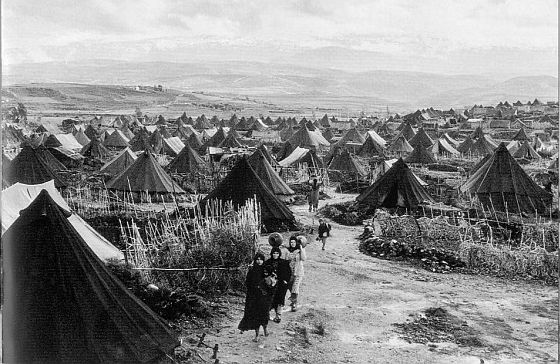
A refugee crisis that has lasted for 63 years following the ethnic cleansing of Palestine in 1948.

Peter Beinart writes:

Why did thousands of Palestinians yesterday converge upon Israel’s borders? Partly because Syria’s war-criminal leader, Bashar al-Assad, and his ally, Hezbollah, wanted them to. But there’s more to it than that. Palestinians also marched from Jordan and Egypt, whose governments did their best to stop the protests. In fact, they marched from every corner of the Palestinian world, in a tech-savvy, coordinated campaign. What hit Israel yesterday was the Palestinian version of the Arab spring.

Something fundamental has changed. I grew up believing that we—Americans and Jews—were the shapers of history in the Middle East. We created reality; others watched, baffled, paralyzed, afraid. In 1989, Americans gloated as the Soviet Union, our former rival for Middle Eastern supremacy, retreated ignominiously from the region. When Saddam Hussein tried to challenge us from within, we thrashed him in the Gulf War. Throughout the 1990s, we sent our economists, law professors and investment bankers to try to teach the Arabs globalization, which back then meant copying us. In a thousand ways, sometimes gently, sometimes brutally, we sent the message: We make the rules; you play by them.

For Jews, this sense of being history’s masters was even more intoxicating. For millennia, we had been acted upon. Mere decades earlier, American Jews had watched, trembling and inarticulate, as European Jews were destroyed. But it was that very impotence that made possible the triumph of Zionism, a movement aimed at snatching history’s reins from gentiles, and perhaps even God. Beginning in the early 20th century, Zionists created facts on the ground. Sometimes the great powers applauded; sometimes they condemned, but acre by acre, Jews seized control of their fate. As David Ben-Gurion liked to say, “Our future does not depend on what gentiles say but on what Jews do.” The Arabs reacted with fury, occasional violence, and in Palestine, a national movement of their own. But they could rarely compete, either politically or militarily. We went from strength to strength; they never missed an opportunity to miss an opportunity.

That world is gone. America and Israel are no longer driving history in the Middle East; for the first time in a long time, Arabs are. In Tahrir Square, Egypt’s young made a revolution. President Obama bowed to reality and helped show Hosni Mubarak the door; Benjamin Netanyahu stood athwart history, impotently yelling stop. Now Egypt’s leaders are doing its people’s will, bringing Hamas and Fatah together in preparation for elections. Hamas and Fatah are complying because they fear their own Tahrir Square. They sense that in Palestine too, a populist uprising stirs; that’s part of what yesterday’s marches were about. For American and Israeli leaders accustomed to Palestinian autocrats and Palestinian terrorists, this is something new. Netanyahu and his American backers are demanding that Obama rewind the clock, but he can’t. The Palestinians no longer listen to functionaries like George Mitchell. They have lost faith in American promises, and they no longer fear American threats. Instead, they are putting aside their internal divisions and creating facts on the ground.

Al Jazeera reports:

At least 353 people were injured, one of them critically, when Egyptian security forces attacked a pro-Palestine demonstration outside the Israeli embassy in Cairo on Sunday night, according to witnesses and the Health Ministry.

Activists told Al Jazeera that army and internal security troops used tear gas, rubber-coated bullets and live ammunition to disperse thousands of protesters who had gathered to mark the 63rd anniversary of the “Nakba” or “catastrophe” – the day in 1948 that Israel declared its independence and thousands of Palestinians fled or were expelled form their homes.

At least two protesters were shot by live ammunition, while others were hospitalised after inhaling tear gas or being hit by rubber-coated steel bullets, some of which penetrated the skin, witnesses said.

Facebooktwittermail

Palestinians killed in Nakba clashes

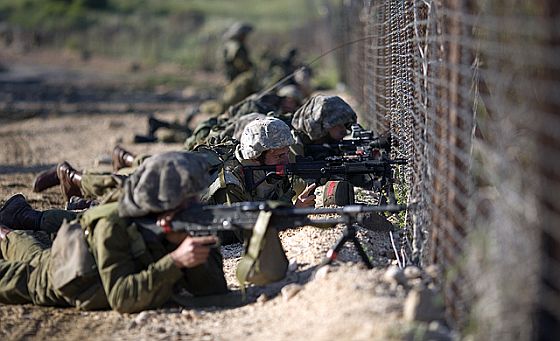
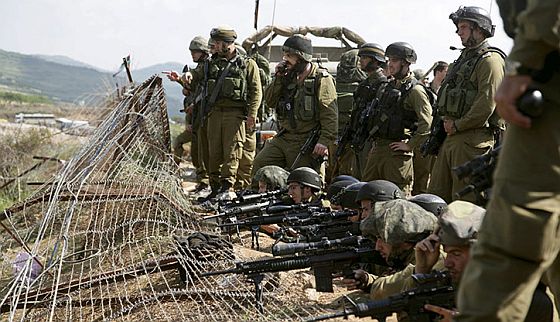
Israeli soldiers stand at the border fence between Israel and Syria as demonstrators approach the village of Majdal Shams in the Golan Heights

Al Jazeera reports:

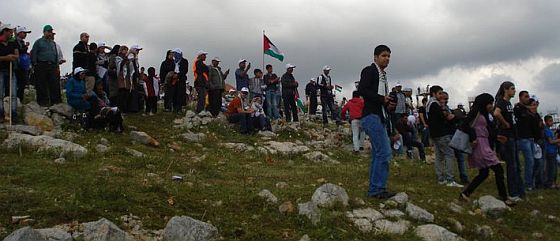
Several people have been killed and scores of others wounded in the Gaza Strip, Golan Heights, Ras Maroun in Lebanon and the Israeli-occupied West Bank, as Palestinians mark the “Nakba”, or day of “catastrophe”.

The “Nakba” is how Palestinians refer to the 1948 founding of the state of Israel, when an estimated 700,000 Palestinians fled or were expelled following Israel’s declaration of statehood.

At least one Palestinian was killed and up to 80 others wounded in northern Gaza as Israeli troops opened fire on a march of at least 1,000 people heading towards the Erez crossing between the Gaza Strip and Israel.

A group of Palestinians, including children, marching to mark the “Nakba” were shot by the Israeli army after crossing a Hamas checkpoint and entering what Israel calls a “buffer zone” – an empty area between checkpoints where Israeli soldiers generally shoot trespassers, Al Jazeera’s Nicole Johnston reported from Gaza City on Sunday.

Hasan Abu Nimah writes:

Sixty years ago in Battir, my small hillside village near Jerusalem, I witnessed the chaotic collapse of the British Mandate administration in Palestine and the beginning of the Nakba.

The previous months had been decisive ones for the fate of Palestine, although we did not yet know it. The Jews, fed up with British procrastination in fulfilling Balfour’s promise of letting them transform our homeland into their “national home,” launched a bloody campaign of terror both against the British and the Arabs. The Jewish militias targeted the British to speed up their departure from Palestine, and hit the Arabs to quell the rising resistance to Zionist colonization. Violence broke out in early 1947, after the British announced that they would leave Palestine by 15 May 1948. When the United Nations passed its partition resolution on 29 November 1947, the violence began to lurch into full-scale war.

Battir’s 1,200 inhabitants were wracked by uncertainty. There were hopes that things would turn out all right, but fear dominated as the atmosphere became bleaker by the day.

I vividly remember the stories of horror which haunted the people of Battir, such as the attack on the railway station in Jerusalem on 21 October 1946. The train was their lifeline to the city where they marketed their produce and bought their supplies. People also walked to Jerusalem and often traveled by car on the unpaved road that ran parallel to the railway line, though that was much harder. A few months earlier a Jewish bomb attack on Jerusalem’s King David Hotel, which served as the British headquarters, killed 91 people and injured dozens. Later, after the partition vote, when the Zionist forces began their armed campaign to seize Palestine, fighting erupted between Arabs and Jews in the land they both claimed.

Electronic Intifada has created an interactive map showing the Palestine villages destroyed in Nakba.

Noam Sheizaf writes:

I never heard the word Nakba before the nineties. It was simply not present in the Israeli language, or in the popular culture. Naturally, we knew that some Arabs left Israel in 1948, but it was all very vague. While we were asked to cite numbers and dates of the Jewish waves of immigration to Israel, details on the Palestinian parts of the story were sketchy: How many Palestinians left Israel? What were the circumstances under which they left? Why didn’t they return after the war? All these questions were irrelevant, having almost nothing to do with our history—that’s what we were made to think.

Occasionally, we were told that the Arabs had left under their own will, and it seemed that they chose not to come back, at least in the beginning. Years later, I was shocked to read that most of the notorious “infiltrates” from the early fifties were actually people trying to come back to their homes, even crossing the border to collect the crops from their fields at tremendous risk to their life – as IDF units didn’t hesitate to open fire.

We were made to think they were terrorists…

It’s hard to explain the mechanism which makes some parts of history “important” or some elements of the landscape “interesting.” I can only say that looking back, I understand how selective the knowledge we received was. But there is more to this. I think we all chose not to think about those issues. Even after the New Historians of the nineties made the term Nakba a part of modern Hebrew and proved that in many cases, Israel expelled Palestinians from territories it conquered in ‘48, we were engaged in the wrong kind of questions, such as the debate on whether more Palestinian were expelled or fled. The important thing is that they weren’t allowed to come back, and that they had their property and land seized by Israel immediately after the war (as some Jews had by Jordan and Syria, but not in substantial numbers). Leaving a place doesn’t make someone a refugee. It’s forbidding him or her from coming back that does it.

Facebooktwittermail

Post-Mitchell, the air of resignation on Israel-Palestine might linger

Daniel Levy writes:

On hearing the announcement of Senator George Mitchell’s resignation as special envoy for Middle East peace, I skype-messaged the news to a friend in Israel known for her biting sarcasm. Her response was quick in coming and did not disappoint: “Mitchell is still the envoy, who knew?”

There’s been quite a lot happening in the Middle East recently, and the Israeli-Palestinian equation has not been left untouched. Yet the special envoy for Middle East peace has not been to the Middle East since mid-December.

Sen. Mitchell was prone to remind audiences that in his last stint as a peace envoy, working on Northern Ireland, he had “700 days of failure and one day of success.” Resignation day marked Sen. Mitchell’s 842nd day on the Middle East peace beat, but this time around there were no “days of success.” Mitchell’s original appointment came on Obama’s second full day of office and was greeted in certain quarters with some enthusiasm and hope (including by this writer). In 2001, working with a strong back-office, he had produced the Sharm El-Sheikh Fact-Finding Committee Report, noteworthy for its depth and sophistication of analysis. It is hard not to conclude that this time around, Sen. Mitchell has disappointed.

Not all of the blame belongs at Mitchell’s door, of course. Throwing an envoy at a problem, even one with a distinguished record, is no substitute for a smart, strategic policy. Apparently the first misstep of the Obama administration on Mideast peace was its failure to step back and conduct a thorough review of what had already been tried, why things were so stuck, and to look at the structural flaws in the peace process they had inherited.

Facebooktwittermail

Muammar Gaddafi is hoping that a ‘dignified’ exit will halt air strikes

The Guardian reports:

From his hiding place in Tripoli, Colonel Muammar Gaddafi is desperately trying to pave a way for an exit from public life.

Sources say the veteran autocrat’s grand plan is to retire to a godfather-like role in the nation he has ruled for more than 40 years and then allow institutions to grow that will eventually replace his hold on power.

This, he hopes, will convince Nato to stop its two-month campaign of almost nightly air strikes, which have decimated Libya’s military and defences and reinforced a rebellion that is steadily eroding the country’s power base.

Interviews with four regime members have confirmed that Gaddafi knows his time is up. “But he isn’t going to run away to Venezuela,” one official said. “He wants to move to the background and lead a dignified life. He himself has said he wants to be like the Japanese emperor, or Castro.”

“He knows and we know that Libya doesn’t have a future through imposing his cult of personality on the people and the world,” said a second official. “There is no question that the country needs reforms, many reforms.”

Facebooktwittermail

Amnesty International hails WikiLeaks and Guardian as Arab spring ‘catalysts’

The Guardian reports:

The world faces a watershed moment in human rights with tyrants and despots coming under increasing pressure from the internet, social networking sites and the activities of WikiLeaks, Amnesty International says in its annual roundup.

The rights group singles out WikiLeaks and the newspapers that pored over its previously confidential government files, among them the Guardian, as a catalyst in a series of uprisings against repressive regimes, notably the overthrow of Tunisia’s long-serving president, Zine al-Abidine Ben Ali.

“The year 2010 may well be remembered as a watershed year when activists and journalists used new technology to speak truth to power and, in so doing, pushed for greater respect for human rights,” Amnesty’s secretary general, Salil Shetty, says in an introduction to the document. “It is also the year when repressive governments faced the real possibility that their days were numbered.”

But, Shetty adds, the situation in the Middle East and North Africa, and elsewhere, remains unpredictable: “There is a serious fightback from the forces of repression. The international community must seize the opportunity for change and ensure that 2011 is not a false dawn for human rights.”

Facebooktwittermail

Secret desert force set up by Blackwater’s founder

The New York Times reports from Abu Dhabi, in the United Arab Emirates:

Late one night last November, a plane carrying dozens of Colombian men touched down in this glittering seaside capital. Whisked through customs by an Emirati intelligence officer, the group boarded an unmarked bus and drove roughly 20 miles to a windswept military complex in the desert sand.

The Colombians had entered the United Arab Emirates posing as construction workers. In fact, they were soldiers for a secret American-led mercenary army being built by Erik Prince, the billionaire founder of Blackwater Worldwide, with $529 million from the oil-soaked sheikdom.

Mr. Prince, who resettled here last year after his security business faced mounting legal problems in the United States, was hired by the crown prince of Abu Dhabi to put together an 800-member battalion of foreign troops for the U.A.E., according to former employees on the project, American officials and corporate documents obtained by The New York Times.

The force is intended to conduct special operations missions inside and outside the country, defend oil pipelines and skyscrapers from terrorist attacks and put down internal revolts, the documents show. Such troops could be deployed if the Emirates faced unrest in their crowded labor camps or were challenged by pro-democracy protests like those sweeping the Arab world this year.

The U.A.E.’s rulers, viewing their own military as inadequate, also hope that the troops could blunt the regional aggression of Iran, the country’s biggest foe, the former employees said. The training camp, located on a sprawling Emirati base called Zayed Military City, is hidden behind concrete walls laced with barbed wire. Photographs show rows of identical yellow temporary buildings, used for barracks and mess halls, and a motor pool, which houses Humvees and fuel trucks. The Colombians, along with South African and other foreign troops, are trained by retired American soldiers and veterans of the German and British special operations units and the French Foreign Legion, according to the former employees and American officials.

In outsourcing critical parts of their defense to mercenaries — the soldiers of choice for medieval kings, Italian Renaissance dukes and African dictators — the Emiratis have begun a new era in the boom in wartime contracting that began after the Sept. 11, 2001, attacks. And by relying on a force largely created by Americans, they have introduced a volatile element in an already combustible region where the United States is widely viewed with suspicion.

Facebooktwittermail

Iranian ‘feud’: Much ado about nothing?

Sharmine Narwani writes:

A public spat between Iran’s Supreme Leader Ayatollah Ali Khamenei and the country’s president Mahmoud Ahmadinejad made the international headlines last week. Politics is rarely ever a harmonious business in any country, so why the brouhaha over this particular stand-off?

To be sure, the disagreement itself was an unusual occurrence. Khamenei’s very public reinstatement of Intelligence Minister Heydar Moslehi – citing Maslehat or the “greater good of the nation”, no less – shortly after Ahmadinejad removed him, could only be viewed as a tough dressing down. And then Ahmadinejad unexpectedly raised the stakes further by boycotting cabinet meetings for eleven days.

The whole point of a Supreme Leader – or Velayat-e-Faghih – as conceived by the Islamic Revolution’s founders, is that he is the ultimate arbiter over both state and religious affairs.

Ahmadinejad’s defiant snit was a direct challenge to the authority of the Supreme Leader. It served to catapult the affair into the political stratosphere, and he was eventually forced to back down.

But there’s more to this. Tehran sits at the epicentre of a geopolitical struggle between two battling regional worldviews. One “bloc” is comfortable with the existing US and Israeli hegemony in the Middle East and consists of many of the autocratic leaders now being swept away in the Arab Spring. The other is the Iran-led “Resistance Bloc” that seeks to end this foreign hegemony and embrace regional and national self-determination.

Facebooktwittermail

Time for Obama to stand up in support of Arab freedom

Rami G. Khouri writes:

What is it about free Arabs that Barack Obama, Hillary Clinton and other leading Western officials still do not fully understand or embrace?

I am troubled that every few months, we hear a drum roll of anticipation building up to a moment when we are told to expect a defining speech, or a new statement, or another initiative, or just a really heartfelt television interview in which the United States will clearly define its policy toward, well, toward many things – in fact, toward an entire, ever-changing constellation of moving targets in the Middle East that seem to deeply confound the United States government at the historic moment when Arabs en mass are agitating for their own liberty and rights. It is troubling to see those who claim to ring the bell of freedom for all humankind prove hesitant to apply a freedom-promoting foreign policy across the entire Arab world.

This is not purely an American issue, to be fair, as Europeans, Turks and other freedom-loving democrats have also supported the Arab revolts for freedom and citizenship rights with selectivity and serial hesitancy. So what should we make of the fact that we now hear that President Barack Obama will give a major speech next week outlining his country’s approach to the Middle East and the wider Islamic world in the wake of the killing of Osama Bin Laden?

We will listen to a fine speech once again, one ear cocked toward his speech, the other toward what Arab men and women are doing throughout the Middle East as they fight, suffer and die in the thousands now to achieve the liberty and democracy that Obama and others keep telling us comprise the shared values that unite us all.

Yet Washington’s attitude to the Arab Spring reflects a wider problem across much of the Western world that I personally experience daily in my assorted discussions with journalists, officials, diplomats and researchers. It is the same old and ugly problem of double standards in many Western governments’ treatment of Arab issues.

In this case, the problem is simply that the epic Arab struggle for liberty, rights and dignity is perceived by many abroad as a television drama that is captivating, even thrilling – but one that remains peculiarly detached from the world of Western powers and, more importantly, remains beyond that realm of people, political movements and social forces that the West can embrace with the same clarity and force with which, for example, it embraced the Soviet dissidents in the 1970s and 1980s. The Arab citizen’s right to liberty is neither clear nor consistent in Western eyes. When it touches on the realms of Israel or oil, especially, Arab liberty becomes the victim and ward of greater Western interests.

Facebooktwittermail

Obama’s Middle East cluelessness

Scott McLeod writes:

Friday’s announcement of George Mitchell’s planned resignation as the U.S. mediator in the Arab-Israeli conflict appears to be yet another sign of the disarray and failure in President Obama’s handling of the Middle East. Recently, two articles provided a troubling inside look at the ineptitude that makes Mitchell’s departure unsurprising. A New Yorker piece on the Arab Spring by Ryan Lizza describes Obama’s navigation between realists and idealists, and tags him (per the article’s title) as “The Consequentialist.” Perhaps “The Cluelessist” is more like it.

Lizza’s article this month and “Obama Seeks Reset in the Arab World” by Mark Landler in the New York Times this week relay the narrative of the president’s spinmeisters: the Middle East poses devilishly complicated challenges, and Obama is struggling with them as well as can be expected. Lizza lets an Obama adviser get away with making the concept of “leading from behind” sound like a tool of noble statesmanship rather than a cowardly cop-out. Yet, as Obama prepares to give a foreign policy speech as early as next week, the reporting in these two articles — and now Mitchell’s resignation — add up to an unflattering portrait of a White House wandering the Middle East without a map.

One of the signs is the White House’s effort to erase Obama’s misjudgments from the record. In Egypt, the truth is that the White House failed to see the writing on the wall and foolishly stood by the brutal and corrupt Mubarak regime to the end. As Lizza writes, “Obama decided not to call for Mubarak to step down… Obama’s instinct was to have it both ways.” While Obama supposedly sympathized with the protesters, he clearly didn’t want to alienate other pro-American dictators or risk destabilization in a major Arab country that had made peace with Israel.

Facebooktwittermail

Storm over Syria

Malise Ruthven writes:

“Damascus has seen all that has ever occurred on earth, and still she lives,” wrote Mark Twain after visiting Syria’s capital in the 1860s. “She has looked upon the dry bones of a thousand empires, and will see the tombs of a thousand more before she dies.”

The turmoil in Syria, where hundreds of unarmed protesters have been mown down by the forces of President Bashar al-Assad, who comes from the country’s Alawi minority, is much more menacing than the generally peaceful revolutions in Tunisia and Egypt, from which the Syrian protesters drew their initial inspiration. The regime of Zine el-Abidine Ben Ali in Tunisia capitulated in the face of spontaneous demonstrations sparked by the self-immolation of a twenty-six-year-old man who had been reduced to scratching out a living as a humble street vendor. Ben Ali, along with his hated wife and family, chose to go into exile before a single shot had been fired.

In Egypt, if press reports are to be believed, the generals unseated President Hosni Mubarak after tank commanders refused his orders to fire on civilians. The Egyptian revolution, which has seen some resistance from the military and police, has now taken a constitutional turn, with the country approving a series of amendments that could lead to the emergence of a parliamentary democracy. Much will depend on the willingness of the military to allow an open political process to take place.

The Syrian government’s response to the Arab world’s turbulent spring, by contrast, has been both violent and vacillating. Its initial response was to characterize the protests across the country as the result of a global conspiracy fomented by a clutch of unlikely allies, including the US, Israel, and Arab enemies in Lebanon, Saudi Arabia, and Qatar, working with former regime officials and homegrown Salafists, or fundamentalists. Then President Assad tried to defuse the opposition by receiving protest delegations and announcing the lifting of long-standing emergency laws, apparently acknowledging the existence of legitimate grievances. But this proved no more than a gesture. In effect the government’s response has been contradictory to the point of incoherence: as the Brussels-based International Crisis Group points out in a report released on May 3:

The regime has lifted the emergency law but has since allowed the security services to conduct business as usual, thereby illustrating just how meaningless the concept of legality was in the first place. It authorises demonstrations even as it claims they no longer are justified and then labels them as treasonous. It speaks of reforming the media and, in the same breath, dismisses those who stray from the official line. It insists on ignoring the most outrageous symbols of corruption. Finally, and although it has engaged in numerous bilateral talks with local representatives, it resists convening a national dialogue, which might represent the last, slim chance for a peaceful way forward.

Over seven hundred people have been killed so far, more than a hundred of them in the southwestern city of Deraa, near the Jordanian border, where the Omari mosque—a center of resistance—has been closed to worshipers after being shelled by tanks and taken over by snipers. Some ten thousand people are now said to have been detained by elite security forces backed by the army. According to Amnesty International, detainees have been beaten with sticks and cables, and sometimes deprived of food. Unlike in Libya there are no NATO forces to protect Syria’s cities or parts of the country from the murderous attacks inflicted by a regime that is now losing the last threads of international legitimacy. Assad has a more effective army than Qaddafi and powerful friends in Iran, Lebanon, and Iraq.

In contrast to Libya, military action in defense of Syria’s beleaguered population would barely attract a shred of international support. While the Arab League voted unanimously for the no-fly zone to protect the people of Benghazi, in the case of Syria it has not even mentioned the country by name, merely declaring that pro-democracy protesters “deserve support, not bullets.”

Facebooktwittermail

Captive soldiers tell of discord in Libyan army

C J Chivers reports from Misrata:

The army and militias of Col. Muammar el-Qaddafi, who for more than two months have fought rebels seeking to overthrow the Libyan leader, are undermined by self-serving officers, strained logistics and units hastily reinforced with untrained cadets, according to captured soldiers from their ranks.

In interviews this week in a rebel-run detention center where more than 100 prisoners from the Libyan military are housed, the prisoners consistently described hardships in the field and officers who deceived or failed them. They spoke bitterly of their lot.

While some showed signs of mistreatment or of making statements to ingratiate themselves with their captors, the accounts of their logistical and tactical problems portrayed a Libyan force suffering from growing problems in a war that began as a mismatch, settled into stalemate and has recently shown signs of rebel advance.

On one hand, Libyan military units and militias went to war with clear material and organizational advantages, equipped with tanks, armored personnel carriers, artillery, rockets and vast stores of munitions. They arrived to battle with trained snipers and mortar, rocket and artillery crews.

On the other, the Libyan Defense Ministry thickened the ranks with veterans recalled to duty in poor physical condition and cadets with almost no combat training or experience.

Then, after facing weeks of airstrikes and a growing rebel force, some of these units were cut off, prisoners said, and officers betrayed the rank and file.

“The commanders told us, ‘Stay here and we will be back with more ammunition,’ ” said a cadet who claimed to have been pressed into service as an untrained infantryman last month, and was assigned to the fight for this city’s center. “But they did not come back, and the rebels surrounded us and we had to put down our weapons and quit.”

Facebooktwittermail