Category Archives: Issues

School bombing exposes Obama’s secret war inside Pakistan

The Times:

The discovery of three American soldiers among the dead in a suicide bombing at the opening of a girls’ school in the northwestern Pakistan town of Dir last week reignited the fears of many Pakistanis that Washington was set on invading their country.

Barack Obama has banned the Bush-era term “war on terror” and dithered about sending extra troops to Afghanistan, but across the border in Pakistan, the US president has dramatically stepped up the covert war against Islamic extremists.

US airstrikes in Pakistan, launched from unmanned drones, are now averaging three a week, triple the number last year. “We’re quietly seeing a geographical shift,” an intelligence officer said.

For the past month drones have pounded the tribal region of North Waziristan in apparent retaliation for the murder of seven CIA officers in Afghanistan by a Jordanian suicide bomber working with the Pakistani Taliban.

At TomDispatch, Pratap Chatterjee wrote:

In recent years, many commentators and pundits have resorted to “the Vietnam analogy,” comparing first the American war in Iraq and now in Afghanistan to the Vietnam War. Despite a number of similarities, the analogy disintegrates quickly enough if you consider that U.S. military campaigns in post-invasion Afghanistan and Iraq against small forces of lightly-armed insurgents bear little resemblance to the large-scale war that Presidents Lyndon B. Johnson and Richard Nixon waged against both southern revolutionary guerrillas and the military of North Vietnamese leader Ho Chi Minh, who commanded a real army, with the backing of, and supplies from, the Soviet Union and China.

A more provocative — and perhaps more ominous — analogy today might be between the CIA’s escalating drone war in the contemporary Pakistani tribal borderlands and Richard Nixon’s secret bombing campaign against the Cambodian equivalent.


Facebooktwittermail

Gates scoffs at Iran nuclear claim

The New York Times reports:

As Iran’s foreign minister met with the chief of the United Nations’ nuclear watchdog agency here, the United States and Germany rejected Iran’s assertion that it was close to accepting an international compromise on its nuclear program.

Western officials expressed deep skepticism toward Tehran’s contention that a deal was close for having uranium enriched abroad for Iran’s controversial nuclear program.

The director general of the International Atomic Energy Agency, Yukiya Amano, said that the Iranians presented no new proposal or counterproposal during a meeting on the sidelines of a security conference here Saturday.

“Dialogue is continuing,” Mr. Amano said. “It should be accelerated. That’s the point.”

Defense Secretary Robert M. Gates said that actions by Iranian leaders did not back up their conciliatory public statements. “Based on the information that I have, I don’t have the sense we are close to an agreement,” he said at the conclusion of talks with Turkish leaders in Ankara.

Julian Borger adds:

The Tehran government has a gift for the theatrical. The arrival of the foreign minister, Manouchehr Mottaki, at the Munich Security Conference was confirmed at the very last moment, and since he got here, Mottaki has held it in the palm of his hand. On Friday night he claimed a deal on Iran’s uranium was close, but then added that it was up to Iran to decide how much of its enriched uranium would be included in the deal. Jam tomorrow, but perhaps not very much.

Today, Mottaki elaborated on his theme at some length, without saying a whole lot more. Asked whether Iran was still willing to export the 1200 kg of low enriched uranium (LEU) provisionally agreed in Geneva last October, he slipped into the opaque language of the bazaar.

It is very common in business, for the buyer to talk about the quantity, while the seller only offers the price. We determine the quantity on the basis of our needs, and we will inform the [international] bodies about our requirements. Maybe it is less than this quantity you have already mentioned [1200kg] or maybe a little more than that quantity that we may need for our reactor.

Mottaki also said that Iran’s nuclear experts had studied the time interval it would take to turn Iranian LEU into 20% enriched uranium in the form of fuel rods, and endorsed that interval. The talk in Geneva was that this would take a year. A few days ago in a television interview, President Mahmoud Ahmadinejad talked of four to five months. Mottaki did not make it clear which time-scale he was talking about.

The Jerusalem Post reports:

An Israeli attack on Iran’s nuclear program will neither completely stop Teheran’s nuclear march, nor bring down the ayatollahs’ regime, according to former Swiss ambassador to Iran Tim Guldimann.

Speaking to The Jerusalem Post on the sidelines of this week’s Herzliya Conference, Guldimann, who knows the Iranian way of thinking well, expressed – as a personal opinion – his deep concern about the military option against Iran.

Guldimann was Swiss ambassador to Iran and Afghanistan from 1999 to 2004. As ambassador to Teheran, Guldimann – now senior adviser and head of the Middle East Project at the Center for Humanitarian Dialogue, Geneva – represented US interests in Iran, acting as a go-between. He gained notoriety for a memorandum he transmitted to the US in 2003, which posited an alleged Iranian proposal for a broad dialogue with the US, with everything on the table – including full cooperation on nuclear programs, acceptance of Israel and the termination of Iranian support for Palestinian armed groups. The proposal was rejected by the Bush administration.

According to Guldimann, the position that unless the international community stops Iran’s nuclear program, Israel would have to do it alone is based on the unproven assumption that Iran will actually go down the road of having a nuclear weapon at its disposal.

“My understanding is that they will not go as far as that. If you say that there is [in Iran] a clear policy of achieving a nuclear capability, I would fully agree. You can define that as a breakout period. But will they make a political decision to produce a bomb? Such a breakout is an absolutely different question,” he says.

The Washington Post says:

China on Thursday threw a roadblock in the path of a U.S.-led push for sanctions against Iran, saying that it is important to continue negotiations as long as Iran appears willing to consider a deal to give up some of its enriched uranium.

“To talk about sanctions at the moment will complicate the situation and might stand in the way of finding a diplomatic solution,” Chinese Foreign Minister Yang Jiechi said at a conference in Paris.

The Guardian reports:

Iran has launched a ­research rocket carrying a mouse, two turtles and worms into space – showing that the country can defeat the west in the battle of technology and that it will soon send its own astronauts, President Mahmoud Ahmadinejad saidtoday.

Iranian state television broadcast images of officials placing the animals inside a capsule in the Kavoshgar 3 (explorer in Farsi) rocket before blast-off, although it did not report where or when the launch took place. The Iranian Students News Agency said the capsule had successfully returned to Earth with its “passengers”.

Western powers fear the technology used by Iran’s space programme to launch satellites and research capsules could also be used to build long-range intercontinental missiles. A US defence expert said the launch underlined the closeness of Iran’s space and military programmes.

Facebooktwittermail

U.S. deaths in Pakistan fuel suspicion

Time magazine reports:

By killing three U.S. soldiers in a bomb attack in a remote corner of northwest Pakistan on Wednesday, Feb. 3, the Taliban scored a political jackpot. With anti-American sentiment cresting in Pakistani public opinion, the presence of the three American trainers in a convoy passing through Koto village when it was struck by a roadside bomb has set off a flurry of questions and even wild conspiracy theories about the U.S. presence in the country. The news left Islamabad in a difficult position, deepened suspicion of the U.S. and further strained an already troubled relationship.

The trainers’ presence had been Pakistan’s worst-kept secret. They’re here at the invitation of the paramilitary Frontier Corps, the front-line force in the battle against the Pakistan Taliban, to help improve its poor counterinsurgency capability. In 2008, Washington dispatched 100 military personnel to train Pakistani officers, who would in turn pass on their skills to rank-and-file soldiers; but local sensitivities precluded the Americans from being given direct access to the troops. As U.S. special envoy Richard Holbrooke told reporters in Washington, “There is nothing secret about their presence there.”

Noah Shachtman adds:

The U.S. military has 200 troops on the ground in Pakistan. That’s about the double the previously-disclosed number of forces there. It’s a whole lot more than the “no American troops in Pakistan” promised by special envoy Richard Holbrooke. And let’s not even get into the number of U.S. intelligence operatives and security contractors on Pakistani soil.

The troop levels are one of a number of details that have emerged about the once-secret U.S. war in Pakistan since three American troops were killed yesterday by an improvised bomb. The New York Times reports that the soldiers were disguised in Pakistani clothing, and their vehicle was outfitted with radio-frequency jammers, meant to stop remotely-detonated bombs. “Still, the Taliban bomber was able to penetrate their cordon. In all 131 people were wounded, most of them girls who were students at a high school adjacent to the site of the suicide attack,” the paper reports.

Facebooktwittermail

Deal with the Taliban pragmatists — not the elusive ‘moderates’

Michael Semple, a fellow at the Carr Centre for Human Rights Policy at Harvard Kennedy School, says that an attempt to cut a deal with the Taliban should not be conceived as an effort to peel away moderates:

The people with whom any deal would have to be done, those Taliban prepared to contemplate accommodation, have a sense of their movement as a moral force that emerged to fight anarchy and corruption in civil war Afghanistan in an honourable tradition of jihad. They are deeply suspicious of apparent US support for the commanders and warlords against whom they were pitted well before 2001. Reluctant to accept that it was the alliance with al-Qaeda which turned the world against them, they resent their labelling as terrorists. They have a host of grievances, from persecution of Taliban who stayed in Afghanistan to the Guantánamo experience and the United Nations blacklists, which they point to as evidence that neither the US nor the Kabul government can be trusted.

Nevertheless, Taliban pragmatists claim they have little problem with an eventual break from al-Qaeda, that they will accommodate other Afghan political forces and that their stance on social issues is unlikely to be a block to agreement. Quizzed on justice and impunity, they protest that their record is no worse than the current Kabul government. The pragmatists do not expect to renounce jihad but to redefine it. They will not surrender but they hope that the Taliban movement might be rehabilitated as a moral Islamic force inside the Afghan political system.

Facebooktwittermail

The war of terror

At Slate, Dahlia Lithwick writes:

…what was once tough on terror is now soft on terror. And each time the Republicans move their own crazy-place goal posts, the Obama administration moves right along with them.

It’s hard to explain why this keeps happening. There hasn’t been a successful terror attack on U.S. soil since 9/11. The terrorists who were tried in criminal proceedings since 9/11 are rotting in jail. The Christmas Day terror attack was both amateurish and unsuccessful. The Christmas bomber is evidently cooperating with intelligence officials without the need to resort to thumbscrews. In a rational universe, one might conclude that all this is actually good news. But in the Republican crazy-place, there is no good news. There’s only good luck. Tick tock. And the longer they are lucky, the more terrified Americans have become.

I’ve always argued that it’s misleading and dangerous to treat “terror” and “terrorism” as synonyms.

As “the war on terrorism” quickly became “the war on terror” — a contraction that generally seems to have been be viewed as nothing more than a tabloid construction — terror was treated as an inescapable consequence of terrorism, such that there was supposedly no reason to distinguish between the objects of our fear and the fear itself.

The problem with arguing that our fears have grown out of proportion to the threats is that all it will take is for there to be another major terrorist attack in America (note in, not on — the whole country is never in jeopardy of attack) and the fear-mongers will trumpet that they have been vindicated. Indeed, they will inevitably blame — alongside the attackers — those who previously suggested that America’s fears were overblown.

The alternative argument — one that no populist has the courage to press — is that in response to the 9/11 attacks, America plunged into a shameful state of national hysteria.

Al Qaeda presented a challenge to this country in 2001. It tried to find out whether nineteen men were capable of making 600 million knees wobble. It accomplished that feat with resounding success.

The spectacle of a whole nation being so easily terrorized had two immediate effects.

It demonstrated to jihadists that their presupposition that it is quite easy to make Americans afraid was well-founded.

And it led others (mostly Americans themselves) to view American fear as fertile ground in which commercial, political and military opportunities of incalculable value could easily be cultivated.

At no point did anyone of national stature step up and say to the American people: get a grip on yourselves. You should neither capitulate to the terrorists nor to the fear-mongers since they both have the same objective: they want to make you live in fear.

The fear-mongers say that the only way of averting fear is to feel safe and secure. That’s true — but only for about the first ten years in life. After that, as we mature we must learn how to live in a dangerous world without becoming enslaved by our own fears.

So, the first rule when it comes to dealing with terrorism is to remember that we are adults and that life demands a sufficient measure of courage such that we don’t shriek every time someone shouts boo!

Once we have a national consensus on our need to act like adults, then we proceed with all the practical and necessary steps to avoid becoming sitting ducks. Counter-terrorism then becomes a matter of prudence — not a vice for gripping the national psyche.

Facebooktwittermail

Off with his head!

Matthew Yglesias writes:

If the President wants to do something like implement a domestic policy proposal he campaigned on—charge polluters for global warming emissions, for example—he faces a lot of hurdles. He needs majority support on a House committee or three. He also needs majority support on a Senate committee or three. Then he needs to get a majority in the full House of Representatives. And then he needs to de facto needs a 60 percent supermajority in the Senate. And then it’s all subject to judicial review.

But if Scooter Libby obstructs justice, the president has an un-reviewable, un-checkable power to offer him a pardon or clemency. If Bill Clinton wants to bomb Serbia, then Serbia gets bombed. If George W Bush wants to hold people in secret prisons and torture them, then tortured they shall be. And if Barack Obama wants to issue a kill order on someone or other, then the order goes out. And if Congress actually wants to remove a president from office, it faces extremely high barriers to doing so.

Whether or not you approve of this sort of executive power in the security domain, it’s a bit of a weird mismatch. You would think that it’s in the field of inflicting violence that we would want the most institutional restraint. Instead, the president faces almost no de facto constraints on his deployment of surveillance, military, and intelligence authority but extremely tight constraint on his ability to implement the main elements of the his domestic policy agenda.

This kind of presidential power looks “weird” if viewed from a constitutional vantage point but maybe not as weird as an expression of American culture.

Having moved to this country twenty years ago from the country that America successfully wrestled its independence from, it’s often struck me that Americans did not fully reject the concept of monarchical rule; they simply wanted a kind of modified monarchy.

First off, the monarch would need to be a native — a vehement “no” to foreign rule.

Next, the monarch would need to be one of the people, be elected and not restricted to a line of inheritance. It wasn’t that Americans did want a king; they simply wanted everyone to be able to nurture the fantasy that some day they too might become the king.

But dynasties are OK. In fact, the occasional dynasty helps burnish the executive’s regal image.

And what’s more befitting of the powers of an American king than that he should be able to occasionally proclaim: “Off with his head!”

Who knows, maybe in a few years the old regal custom of hosting public executions will be re-instituted. No doubt they’d get excellent ratings on cable news.

Facebooktwittermail

Murder with impunity

Glenn Greenwald writes:

… even if you’re someone who does want the President to have the power to order American citizens killed without a trial by decreeing that they are Terrorists (and it’s worth remembering that if you advocate that power, it’s going to be vested in all Presidents, not just the ones who are as Nice, Good, Kind-Hearted and Trustworthy as Barack Obama), shouldn’t there at least be some judicial approval required? Do we really want the President to be able to make this decision unilaterally and without outside checks? Remember when many Democrats were horrified (or at least when they purported to be) at the idea that Bush was merely eavesdropping on American citizens without judicial approval? Shouldn’t we be at least as concerned about the President’s being able to assassinate Americans without judicial oversight? That seems much more Draconian to me.

It would be perverse in the extreme, but wouldn’t it be preferable to at least require the President to demonstrate to a court that probable cause exists to warrant the assassination of an American citizen before the President should be allowed to order it? That would basically mean that courts would issue “assassination warrants” or “murder warrants” — a repugnant idea given that they’re tantamount to imposing the death sentence without a trial — but isn’t that minimal safeguard preferable to allowing the President unchecked authority to do it on his own, the very power he has now claimed for himself? And if the Fifth Amendment’s explicit guarantee — that one shall not be deprived of life without due process — does not prohibit the U.S. Government from assassinating you without any process, what exactly does it prohibit?

Greenwald makes a series of excellent points but I would add one major point that really should come in front of the whole discussion: the idea that a legal distinction should be made between American citizens and non-Americans is a thoroughly un-American idea.

The Declaration of Independence does not say:

We hold these truths to be self-evident, that all Americans are created equal, that they are endowed by their Creator with certain unalienable Rights, that among these are Life, Liberty and the pursuit of Happiness.

It didn’t say “Americans”, it said “all men” — a declaration of what were taken to be universal human values.

To be concerned about whether the president has claimed to right to murder Americans is really missing the point. What in practice this and the former president are doing is not exercising any kind of specially fabricated legal right; they are committing murder exclusively where they believe they can get away with it.

Assassinations taking place in the tribal areas of Pakistan, in Yemen and Somalia, are all occurring in environments whose lawlessness means that US government officials can be reliably confident that they can act with relative legal impunity.

Facebooktwittermail

The world according to Bronner is a Jewish one

Philip Weiss writes:

Toward the end of Ethan Bronner’s appearance at Vassar last night, a woman in the aisle melted down yelling at him. “What I’m hearing from you is only one side. Your son is in the IDF. You are Jewish… The way you talk is totally pro-Israel.” Then Fanny Prizant of Woodstock demanded, What is it about the New York Times? Why don’t they have someone else to at least put across the other side of the story?
Prizant was quite upset, and I found myself nodding in agreement. It had been a bizarre evening. It was like a lecture in a Hitchcock film, the setting a gaunt Edwardian-era hall at an upstate NY college, and only a few people in the room are in on the story and the man on the stage is clueless. Prizant’s was the third or fourth hostile question. I wondered why Bronner went through with the lecture to begin with. He must be a little masochistic, or he has a strong sense of journalistic duty. That is how he came off, as a dutiful New York Timesman, a little hectic, with little sense of the new American scene. When the story of his son being in the Israeli army broke, I said it was going to dog him and the Times, and you can see that that is happening.

The problem isn’t the son. It’s Bronner’s degree of identification with Israel. I kept looking at my watch waiting for him to say One Palestinian Name. Finally it came at about minute 45: university president Sari Nusseibeh. I’m pretty sure it was the first mention of any Palestinian he knows. The world according to Bronner is a Jewish one. There was the friend who invited him to an orthodox Westchester congregation. His writer friend in Israel who counseled him to tell Jewish audiences back here that Israel is an apartheid state (and to tell college audiences the opposite; Israeli dissimulation). There was a string of Israeli generals and officials’ names. Meridor, Ben Gurion, Barak, Netanyahu. And Michael Oren–favorably of course.

Facebooktwittermail

The CIA: a continuing threat to U.S. persons or interests?

The Director of National Intelligence Dennis Blair reassured the House Intelligence Committee yesterday that he understands that killing Americans is a “very sensitive issue” and that the agency must always “get specific permission” to do so.

I wonder how much comfort that provides to the family of Jim and Veronica “Roni” Bowers and their two children, six-year-old son Cory and infant daughter Charity, who under the CIA’s watch were shot down by the Peruvian Air Force while flying over Peru in 2001. Veronica Bowers and her daughter Charity were killed. The video below shows what happened:

ABC News reports:

…for almost nine years, the CIA misled Congress, the White House and the dead woman’s parents about how and why the agency defied the rules established to make sure innocent people were not killed.

“I want to know the truth,” Garnett Luttig, father of Roni Bowers, told ABC News. “I want to know why. I wonder why my baby’s gone. Don’t they understand that?”

Said Gloria Luttig, Roni’s mother, “I want somebody to have to stand up and say I was responsible. I want him to know what a mother’s heart is like.”

On Wednesday, the CIA said its nine-year long investigation had determined that 16 CIA employees should be disciplined, including the woman then in charge of counter-narcotics.

Many of them are no longer with the CIA, and one of those involved said his discipline was no more than a letter of reprimand placed in his file, which he was told would be removed in one year.

So what are we to understand from DNI Blair? That while the CIA engages in extrajudicial killings, it does so with great caution but if mistakes are made, those responsible certainly face the risk of receiving a letter of reprimand?

Either we live in a land governed by law or we don’t. A determination by an intelligence operative is by no stretch of the imagination a substitute for due process.

Facebooktwittermail

Israeli report claims $2bn stolen from Palestinians

Jonathan Cook writes:

Over the past four decades Israel has defrauded Palestinians working inside Israel of more than US$2 billion (Dh7.4bn) by deducting from their salaries contributions for welfare benefits to which they were never entitled, Israeli economists revealed this week.

A new report, “State Robbery”, says the “theft” continued even after the Palestinian Authority was established in 1994 and part of the money was supposed to be transferred to a special fund on behalf of the workers.

According to information supplied by Israeli officials, most of the deductions from the workers’ pay were invested in infrastructure projects in the Palestinian territories – a presumed reference to the massive state subsidies accorded to the settlements.

After the recent easing of restrictions on entering Israel under the “economic peace” promised by Benjamin Netanyahu, the Israeli prime minister, nearly 50,000 Palestinians from the West Bank are working in Israel and continue to have such contributions docked from their pay.

Complicit in the deception, the report adds, is the Histadrut, the Israeli labour federation, which levies a monthly fee on Palestinian workers, even though they are not entitled to membership and are not represented in labour disputes.

Facebooktwittermail

On Israel-Palestine, no more of the same

Yossi Alpher:

President Obama and Mr. Mitchell must recognize that in the current regional strategic lineup, Syria is more relevant than Palestine. Syria’s president, Bashar al-Assad, declares himself ready to deal. A Syrian-Israeli process has a better chance of getting underway than a Palestinian-Israeli process. A successful Syrian-Israeli effort offers the United States, Israel and the moderate Arab states immediate benefits by reducing Iran’s penetration of the Levant, weakening its regional proxies and allies and rendering the U.S. withdrawal from Iraq — a major strategic event of the coming year — more likely to succeed. The mere fact of Israel-Syria negotiations would hurt Hamas, thereby strengthening Mr. Abbas.

Such a potential payoff justifies applying some pressure if necessary on Mr. Netanyahu. It justifies the risk of failure. And it justifies devoting more U.S. diplomatic energy to Damascus instead of Ramallah.

A second revised priority should address Hamas itself. It’s time to recognize that all the strategies mustered against the Hamas “emirate” in Gaza since the takeover of June 2007 have failed. The economic warfare policy invoked by Israel, the Quartet powers — the European Union, the United States, Russia and the United Nations — and Egypt has punished 1.4 million Gazans, impoverished the moderate middle class and empowered and enriched Islamist smugglers, yet has failed to dislodge the Hamas regime. It is plainly counterproductive. Israel’s use of military force in Gaza, most recently a year ago, may have bought it some deterrent time but proved devastating for its international image. Egypt finally acknowledges that its mediation efforts with Hamas have failed. And the fiction that the P.L.O. will soon return to power in Gaza is just that — a fiction.

Facebooktwittermail

How to talk to a jihadist

Andrew Sullivan:

Watching senators and pundits huff and puff about Mirandizing terrorists when they should apparently be declared enemy combatants and tortured at length is a depressing spectacle. To see political leaders in the West have such a low view of the American judicial system and such an elevated view of the world-historical significance of these pathetic, twisted, religious nutjobs … well, they look like a bunch of scaredy cats to me. What the hell happened to “Live Free Or Die?” What happened to the confidence of a society that its ancient traditions are perfectly capable, indeed precisely tailored, to cut down to size these narcissistic, fundamentalist celebrity-seekers?

Which reminds me. One of the high points in the West’s defense against these losers was the trial of one Richard Reid, an unspeakably ugly and deeply stupid Brit whom Dick Cheney decided should – gasp – be treated as a terrorist under the criminal law in the months after 9/11. Not an enemy combatant to be flown to Gitmo and tortured. A terrorist brought to justice in the light of day. Eight years later, Cheneyites are drumming up panic that the Obama administration would do exactly the same thing for exactly the same reasons. But that they have lost their shit is no reason for the rest of us to lose ours.

Facebooktwittermail

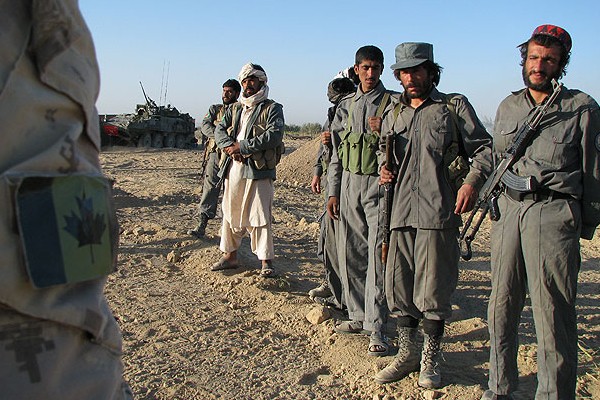
‘It’s better to join the Taliban; they pay more money.’


When President Obama announced his 30,000-strong troop surge in December he said: “these additional American and international troops will allow us to accelerate handing over responsibility to Afghan forces and allow us to begin the transfer of our forces out of Afghanistan in July of 2011.”

It was another example of what has become all too familiar: Obama’s ability to govern like Bush without sounding exactly like Bush. He might as well have simply reused Bush’s line and said: “As Afghan forces stand up, we will stand down.” The difference in language is trivial. The real difference between now and 2005 when Bush said that in reference to Iraqi forces is that it turns out Bush’s objective was a bit more realistic.

Consider Rod Nordland’s portrayal or the way the Afghan National Police force is shaping up:

The NATO general in charge of training the Afghan police has some tongue-in-cheek career advice for the country’s recruits.

“It’s better to join the Taliban; they pay more money,” said Brig. Gen. Carmelo Burgio, from Italy’s paramilitary Carabinieri force.

That sardonic view reflects a sobering reality. The attempts to build a credible Afghan police force are faltering badly even as officials acknowledge that the force will be a crucial piece of the effort to have Afghans manage their own security so American forces can begin leaving next year.

Though they have revamped the program recently and put it under new leadership, Afghan, NATO and American officials involved in the training effort list a daunting array of challenges, as familiar as they are intractable.

One in five recruits tests positive for drugs, while fewer than one in 10 can read and write — a rate even lower than the Afghan norm of 15 percent literacy. Many cannot even read a license plate number. Taliban infiltration is a constant worry; incompetence an even bigger one.

Now consider this description of the resistance that US Marines are facing in Helmand Province:

In areas where they have built bases, the Marines have undermined the Taliban’s position. But the insurgents have consolidated and adapted, and remain a persistent and cunning presence.

On the morning of the sweep, made by Weapons Company, Third Battalion, First Marines, a large communications antenna that rose from one compound vanished before the Marines could reach it. The man inside insisted that he had seen nothing. And when the Marines moved within the compounds’ walls, people in nearby houses released white pigeons, revealing the Americans’ locations to anyone watching from afar.

The Taliban and their supporters use other signals besides car horns and pigeons, including kites flown near American movements and dense puffs of smoke released from chimneys near where a unit patrols.

“You’ll go to one place, and for some reason there will be a big plume of smoke ahead of you,” said Capt. Paul D. Stubbs, the Weapons Company commander. “As you go to the next place, there will be another.”

“Our impression,” he added, “is the people are doing it because they are getting paid to do it.”

The people are getting paid… right.

You don’t have to be a Holywood screenwriter to see this description — the smoke signals, pigeon alerts and so forth — as a classic image of resistance. The foreign fighters are better armed, but the resistance fighters have the home-turf advantage — they’re being protected by the civilian population. Do the civilians have to get paid for their services? Conceivably, but I kind of doubt it. More likely it simply comes down to knowing who are “our boys”.

Facebooktwittermail

Israeli commander: ‘We rewrote the rules of war for Gaza’

From The Independent:

A high-ranking officer has acknowledged for the first time that the Israeli army went beyond its previous rules of engagement on the protection of civilian lives in order to minimise military casualties during last year’s Gaza war, The Independent can reveal.

The officer, who served as a commander during Operation Cast Lead, made it clear that he did not regard the longstanding principle of military conduct known as “means and intentions” – whereby a targeted suspect must have a weapon and show signs of intending to use it before being fired upon – as being applicable before calling in fire from drones and helicopters in Gaza last winter. A more junior officer who served at a brigade headquarters during the operation described the new policy – devised in part to avoid the heavy military casualties of the 2006 Lebanon war – as one of “literally zero risk to the soldiers”.

The officers’ revelations will pile more pressure on Israeli Prime Minister Benjamin Netanyahu to set up an independent inquiry into the war, as demanded in the UN-commissioned Goldstone Report, which harshly criticised the conduct of both Israel and Hamas. One of Israel’s most prominent human rights lawyers, Michael Sfard, said last night that the senior commander’s acknowledgement – if accurate – was “a smoking gun”.

A policy of “zero risk to the soldiers” — think about that. Isn’t that exactly what the infamous Rabbi Yitzhak Shapira believes in — a rabbi, it should be noted, who has been portrayed as being a fanatic and an extremist.

This is how the views of Shapira, head of the Od Yosef Chai Yeshiva, were described in the Jerusalem Post a few days ago:

In sharp contrast to the Goldstone Report, which criticizes the IDF for purportedly committing “war crimes” against Palestinians during Operation Cast Lead, Od Yosef Chai’s criticism of the IDF is totally different.

IDF battlefield ethics are seen as immoral not because they allow for the killing of innocent bystanders but because they force Jewish soldiers to needlessly endanger themselves to protect gentiles.

The measures taken by the IDF to protect non-combatants, such as using ground forces to weed out terrorists embedded in highly populated civilian areas so as to minimize collateral damage, are viewed by Shapira as downright evil, because they lead to the needless injury or death of Jewish soldiers.

So, Shapira should be relieved to hear that Jewish soldiers were not put at unnecessary risk — though he’d hardly need to have waited a year to figure that out, since the war’s casualty figures (six soldiers killed, not including four killed by friendly fire) make it transparent that Israel minimized its risks. Indeed, as the Independent report reveals, one of the principal ways the operation kept soldiers out of harms way was through heavy reliance on drone attacks.

“Most of the guys taken down were taken down by order of headquarters. The number of enemy killed by HQ-operated remote … compared to enemy killed by soldiers on the ground had absolutely inverted,” an Israeli soldier told Yedhiot Ahronot.

Since the Independent has, at least in part, run Yedhiot Ahronot‘s own story, hopefully the Israeli newspaper can muster the courage to print the rest of it.

Facebooktwittermail

Avi Shlaim – Blair: Gaza’s great betrayer

From The Guardian:

The savage attack Israel ­unleashed against Gaza on 27 December 2008 was both immoral and unjustified. Immoral in the use of force against civilians for political purposes. Unjustified because Israel had a political alternative to the use of force. The home-made Qassam rockets fired by Hamas militants from Gaza on Israeli towns were only the ­excuse, not the reason for Operation Cast Lead. In June 2008, Egypt had ­brokered a ceasefire between Israel and Hamas, the Islamic resistance movement. ­Contrary to Israeli propaganda, this was a success: the average number of rockets fired monthly from Gaza dropped from 179 to three. Yet on 4 November Israel violated the ceasefire by launching a raid into Gaza, killing six Hamas fighters. When Hamas ­retaliated, Israel seized the renewed rocket attacks as the ­excuse for launching its insane offensive. If all Israel wanted was to protect its citizens from Qassam rockets, it only needed to ­observe the ceasefire.

While the war failed in its primary aim of regime change in Gaza, it left ­behind a trail of death, devastation, ­destruction and indescribable human suffering. Israel lost 13 people, three in so-called friendly fire. The Palestinian death toll was 1,387, including 773 civilians (115 women and 300 children), and more than 5,300 people were injured. The ­entire population of 1.5 million was left traumatised. Across the Gaza Strip, 3,530 homes were completely ­destroyed, 2,850 severely damaged and 11,000 suffered structural damage.

The UN Relief and Works Agency for Palestinian Refugees, tending to the needs of four million Palestinian ­refugees, stated that Gaza had been “bombed back, not to the Stone Age, but to the mud age”; its inhabitants ­reduced to building homes from mud after the fierce 22-day offensive.

War crimes were committed and possibly even crimes against humanity, documented in horrific detail in Judge Richard Goldstone’s report for the UN human rights council. The report ­condemned both Israel and Hamas, but reserved its strongest criticism for Israel, accusing it of deliberately targeting and terrorising civilians in Gaza. The British government did not take part in the vote on the report, sending a signal to the hawks in Israel that they can continue to disregard the laws of war. Gordon Brown’s 2007 appointment as a patron of the Jewish National Fund UK presumably played a part in the adoption of this ­pusillanimous position.

One year on, the Gaza Strip, one of the most densely populated areas on earth, continues to teeter on the verge of a humanitarian disaster. Israel’s ­illegal blockade of Gaza, in force since June 2007, restricts the flow not only of arms but also food, fuel and medical supplies to well below the minimum necessary for normal, everyday life. Reconstruction work has hardly begun because of the Israeli ban on bringing in cement and other building materials to Gaza. Thousands of families still live in the ruins of their former homes. Hospitals, health facilities, schools, government buildings and mosques cannot be rebuilt. Nor can the basic ­infrastructure of the Gaza Strip, including Gaza City’s sewage disposal plant. Today, 80% of Gaza’s population ­remain dependent on food aid, 43% are unemployed, and 70% live on less than $1 a day.

Facebooktwittermail

Blair lied in build-up to Iraq invasion, claims Clare Short

From The Times:

The former development secretary was scathing about Mr Blair’s failure to ask Washington to delay the invasion despite warnings that the military and aid officials were not ready.

“I think he was so frantic to be with America that all that was thrown away. If he had done that, his place in history and the UK’s role in the world would have been so much more honourable,” she said.

She told that inquiry that she believed Mr Blair genuinely believed he was right to overthrow Saddam. “I am not saying he was insincere. I think he was willing to be deceitful because he thought it was right.”

(Note: The Sky News clip appearing above is different from the one appearing at the top of the Times article – the latter includes interesting comments from Short on Britain’s need to re-conceive what it means to have a “special relationship” with the United States.)

Facebooktwittermail

The Iraqi oil conundrum

At TomDispatch, Michael Schwartz writes:

How the mighty have fallen. Just a few years ago, an overconfident Bush administration expected to oust Iraqi dictator Saddam Hussein, pacify the country, install a compliant client government, privatize the economy, and establish Iraq as the political and military headquarters for a dominating U.S. presence in the Middle East. These successes were, in turn, expected to pave the way for ambitious goals, enshrined in the 2001 report of Vice President Dick Cheney’s secretive task force on energy. That report focused on exploiting Iraq’s monstrous, largely untapped energy reserves — more than any country other than Saudi Arabia and Iran — including the quadrupling of Iraq’s capacity to pump oil and the privatization of the production process.

The dream in those distant days was to strip OPEC — the cartel consisting of the planet’s main petroleum exporters — of the power to control the oil supply and its price on the world market. As a reward for vastly expanding Iraqi production and freeing its distribution from OPEC’s control, key figures in the Bush administration imagined that the U.S. could skim off a small proportion of that increased oil production to offset the projected $40 billion cost of the invasion and occupation of the country.

All in a year or two.

Almost seven years later, it will come as little surprise that things turned out to cost a bit more than expected in Iraq and didn’t work out exactly as imagined. Though the March 2003 invasion quickly ousted Saddam Hussein, the rest of the Bush administration’s ambitious agenda remains largely unfulfilled.

Facebooktwittermail

Iran says ready to send uranium abroad as UN wants

From the Associated Press:

Iran said on Tuesday it was ready to send its uranium abroad for further enrichment as requested by the U.N.

President Mahmoud Ahmadinejad announced the decision in an interview with state Iranian television.

He said Iran will have “no problem” giving the West its low-enriched uranium and taking it back several months later when it is enriched by 20 percent.

The decision could signal a major shift in the Iranian position on the issue.

Facebooktwittermail