Category Archives: Issues

Reconsidering America’s place in the world

In Nader Mousavizadeh‘s interesting analysis on America’s failure to deal effectively with so-called “rogue states”, he begins by pointing out that the world that created such states is gone:

Obama came into office thinking that a more responsive diplomacy could rally global support for the old Western agenda, but that’s not enough. What’s needed, more than a change in tone or a U.S. policy review, is a new set of baseline global interests—neither purely Western nor Eastern—defined in concert with rising powers who have real influence in capitals like Rangoon, Pyongyang, and Tehran. This requires a painful reconsideration of America’s place in the world. But it promises real help from rising powers in shouldering the financial and military burden of addressing global threats.

Today countries large and small, well behaved and not, are looking for partners, not patrons. Where Washington looks to punish rogues, seeking immediate changes in behavior, rival powers are stepping in with investment and defense contracts, and offering a relationship based on dignity and respect. This is the story of China in Burma, Russia in Iran, Brazil in Cuba, and so on down the line. And given that the core institutions of global governance—the U.N. Security Council, the World Bank, and the IMF—are unwilling to grant the new powers a seat at the decision-making table, it’s not surprising that they feel no obligation to back sanctions they’ve had no say in formulating.

Far from being coy about their newfound independence, the rising powers are asserting their status with increasing strength. During a recent state visit, Brazilian President Luiz Inácio Lula da Silva stood beside President Mahmoud Ahmadinejad of Iran and declared bluntly: “We don’t have the right to think other people should think like us.” These words resonate more deeply outside the Western world than new calls for unity against the rogues. Days earlier, Ahmadinejad had been hosted by Turkey’s Prime Minister Recep Tayyip Erdogan, who had embraced his neighbor at a summit of Islamic nations and insisted that Iran’s nuclear program was “peaceful.” Predictably, the Western press attacked both Lula and Erdogan for betraying democratic values and solidarity, missing the point entirely. Established democrats like Lula and Erdogan are not siding with Ahmadinejad, supporting his government’s violent crackdown on protesters or its covert nuclear programs. Rather, they are demonstrating their intention—and, more important, their ability—to have a say in who the rogues are and how they should be dealt with.

Facebooktwittermail

Israeli officers get ‘slap on wrist’ for white phosphorus use in Gaza

From The Times:

Israel has reprimanded two senior army officers who were responsible for firing white phosphorus artillery shells at a UN compound during last year’s offensive in Gaza.

In the first admission of any wrongdoing the Israeli military found that Brigadier-General Eyal Eisenberg and Colonel Ilan Malka were guilty “of exceeding their authority in a manner that jeopardised the lives of others”.

The Israeli report was in response to a damning UN investigation into the Gaza war, which concluded that both Israel and Hamas, the Palestinian group, had committed war crimes and possible crimes against humanity and which called on both sides to investigate the conduct of their forces.

An Israeli defence official said that its internal investigation could lead to further disciplinary action against soldiers involved in the 22-day offensive. The two officers disciplined yesterday were served a mild reprimand and had a “note” placed in their personal files noting their involvement. One defence official described the punishment as a “slap on the wrist.”

Facebooktwittermail

The New Intifada

As one pompous ass said to another on Monday: “I can think of few peoples who have contributed more to Western civilization than our two peoples. In both Rome and in Jerusalem, the foundations of Western culture were laid.”

Italian Prime Minister Silvio Berlusconi, at the beginning of a three-day tour of Israel, responded to this self-flattering compliment from Israel’s Prime Minister Benjamin Netanyahu by saying: “We are here to show our recognition and our pride in the fact that we are part of a Judeo-Christian culture that is the basis for European culture.”

Many Israelis might express political contempt for Europe — a reputed well-pool of rising anti-Semitism — yet they still cling to European culture. To be told by a European, as an Israeli diplomat recently was, “we have nothing in common with you,” cuts right to the bone. Without its cherished European and Western identity, Israel has nothing.

This doesn’t say much about European virtues, yet the fact that with increasing frequency prominent Israelis struggle to maintain even a superficially civil bearing, is pushing them outside Europe’s cultural embrace. Israelis are becoming the new barbarians.

Aluf Benn writes:

In a speech at a conference not long ago, an Israeli diplomat serving in a European capital touted Israel’s hoary PR line, distinguishing between “the only democracy in the Middle East” and its autocratic Arab neighbors. “We share common values,” the Israeli told the Europeans. To his surprise, a member of the audience stood up and replied to him: “What common values? We have nothing in common with you.”

In diplomatic conversations, Europeans are critical of Israel because of the Gaza blockade, the construction in the Jewish settlements, the home demolitions in East Jerusalem, the pervasive loathing of the right-wing government and even the social gaps and the way Israel is moving away from the European welfare-state model.

The Netanyahu-Lieberman government is nearly always described as “hard-line” in the foreign media. This is not entirely fair: The government of Ehud Olmert and Tzipi Livni went to war in Lebanon and Gaza and built thousands of apartments for Jews in East Jerusalem and the West Bank settlement blocs – many more than did Netanyahu, who has refrained from employing military force and has declared a 10-month freeze on settlement construction. But they liked the Kadima government because Olmert and Livni made the right noises about their desire for peace and a final status agreement, whereas they don’t believe Netanyahu when he talks about “two states for two peoples.” The fact that Olmert and Livni achieved nothing in the negotiations makes no difference. It’s the intentions that count.

Netanyahu and his aides have answers to the accusations against Israel. The blame for the Gaza blockade lies squarely with the Palestinians, who chose Hamas to reign over them and kidnapped soldier Gilad Shalit. “You are worrying about the humanitarian rights of 1.5 million Palestinians in Gaza. You should be worrying about one Israeli who is being held there,” Netanyahu’s people tell UN representatives.

In East Jerusalem, the government is hiding behind Mayor Nir Barkat and the planning and construction institutions, which are approving building plans for Jews and home demolitions for Palestinians. And for the diplomatic stagnation, it is blaming Palestinian Authority President Mahmoud Abbas, who is refusing to renew the talks.

There is one little problem: The world isn’t buying Israel’s explanations and it isn’t prepared to condemn Palestinian obduracy.

Political scientists Shaul Mishal and Doron Mazza warn of a “white intifada” — apparently they didn’t notice: the West isn’t white anymore — but even if their warning is misnamed, their fear is not misplaced.

The threats to Israel’s legitimacy emanating from the West, may well turn out to be much potent than loudly heralded threats to Israel’s existence coming from the East.

Facebooktwittermail

Greedy bastards

Michael Kinsley, smart as always:

[Rush Limbaugh] said on his radio show that President Obama may be appealing to anti-Semitism with his recent populist criticism of banks and bankers. “There are a lot of people,” Limbaugh said, “when you say banker, people think Jewish.” He didn’t mention Goldman Sachs. Abe Foxman, longtime head of the B’nai Brith Anti-Defamation League, declared that Limbaugh’s remark was “offensive and inappropriate” and “borderline anti-Semitic.” Limbaugh and his defenders protest that Limbaugh clearly was referring to other people, “people who have–what’s the best way to say–a little prejudice about them,” and not endorsing such views himself. And the transcript bears him out.

By Foxman’s standard, even to mention that many bankers are Jewish is anti-Semitic (even though it’s true), and attributing this view to others (while professing to be worried about it) is no excuse This may be over-the top. We live in a culture of umbrage, in which everybody seems to be taking offense at something somebody else says. Foxman is one of the nation’s foremost umbragists.

However, Limbaugh’s supporters make too much of the fact that, read literally, his remarks took the form of defending Jews against unfair maligning. There can be something creepy about “philo-semitism,” or a professed special fondness for Jews. Even when it is sincere (as it may well be in Limbaugh’s case), it rests on an acute feeling of “otherness” about Jews that makes many Jewish Americans rightly uncomfortable.

Sometimes the stereotype about Jews and money takes a harsher form: Jews are greedy, they lie, cheat and steal for money, they have undue influence with the government, which they cultivate and exploit ruthlessly, and so on. In recent weeks, many have said this sort of thing about Goldman Sachs, but with no reference to Jews. Are they all anti-Semites? No. It ought to be possible to criticize Goldman in the harshest possible terms–if you think that’s warranted–without being tarred as an anti-Semite. (Many of Goldman’s harshest critics, unsurprisingly, are Jewish. Jews can be anti-Semites, too.)

Yesterday, I made the pointed observation that Goldman Sach’s CEO, Lloyd Blankfein, appears to meet the CIA’s requirements for becoming the target of a Predator attack: that such an individual poses “a continuing threat to US persons or interests.”

That observation deserves three points of clarification:

1. No, I am not suggesting that the CIA or anyone else “take out” Blankfein. I neither support extrajudicial killing nor even the death penalty.

2. I freely confess that I harbor a prejudice – but it’s not against Jews; it’s against greedy bastards. I don’t give a fig whether any particular greedy bastard happens to be a Jew or a Gentile.

3. My loathing for greedy bastards does not rest on a simple Marxist belief in a need for the equitable distribution of material wealth. Rather, it springs from seeing the corrosive effect on human culture that derives from attaching excessive value to material things.

Yes, we have been fleeced by men like Blankfein, but much worse we have been led to believe that they are models of success – that they and their values deserve the power to shape the society in which we live and the culture that we create. We have been led to forget that the things of real value are things we can certainly lose, but never buy or own.

Facebooktwittermail

Rabbi Yitzhak Shapira’s Jewish supremacism

Rabbi Yitzhak Shapira, was detained for questioning by the Shin Bet (Israel Security Agency) in connection with the burning of a mosque in Yasuf, a village near Nablus, in December. He is head of the Od Yosef Chai Yeshiva in Yitzhar, and is a disciple of Rabbi Yitzhak Ginsberg. The Jerusalem Post reports:

While religious Zionists are primarily concerned with the issue of evacuating settlements, the students at Od Yosef Chai also see IDF ethics as problematic because they are based on “western” or “Christian” morality that equates Jewish lives with those of non-Jews.

In sharp contrast to the Goldstone Report, which criticizes the IDF for purportedly committing “war crimes” against Palestinians during Operation Cast Lead, Od Yosef Chai’s criticism of the IDF is totally different.

IDF battlefield ethics are seen as immoral not because they allow for the killing of innocent bystanders but because they force Jewish soldiers to needlessly endanger themselves to protect gentiles.

The measures taken by the IDF to protect non-combatants, such as using ground forces to weed out terrorists embedded in highly populated civilian areas so as to minimize collateral damage, are viewed by Shapira as downright evil, because they lead to the needless injury or death of Jewish soldiers.

In his preface to the controversial book Torat Hamelech [The King’s Torah], authored by Shapira and Rabbi Yosef Elitzur, Ginsberg points out the tremendous need to illuminate the fundamental differences between Jew and gentile “at a time when we are obligated to conquer [the land of Israel] from our enemies so that we can act as we need to in the spirit of Torah and so that we can strengthen the spirit of the nation and its soldiers.”

Some of the guidelines mentioned at the back of the book in a section entitled “Conclusions – Chapter Five: The Killing of Gentiles in War,” include the following: “There is a reason to kill babies [on the enemy side] even if they have not transgressed the seven Noahide Laws [to believe in God, not to commit idolatry, murder, theft or adultery, to set up a legal system, and not to tear a limb from a live animal] because of the future danger they may present, since it is assumed that they will grow up to be evil like their parents….”

Facebooktwittermail

Covering up homicide

In his State of the Union speech, President Obama said: “… in the last year, hundreds of al Qaeda’s fighters and affiliates, including many senior leaders, have been captured or killed — far more than in 2008.”

He could have said “we have killed…” just to make it clear that he includes himself as an actor, not an observer, in the killing process. And he could also have said “and we killed a bunch of innocent bystanders as well.” But maybe when it comes to al Qaeda, there is in Obama’s mind no such person as an innocent bystander. Maybe the children, wives and grandparents are “affiliates”.

In Pakistan the concept of an innocent bystander has not been abandoned and what Obama touts as great success is perceived as an ongoing unrelenting massacre.

Here are some of the latest damning numbers – numbers that no doubt many an American journalist will hesitate to report because they haven’t been confirmed by the holiest of sources, the Pentagon:

Afghanistan-based US predators carried out a record number of 12 deadly missile strikes in the tribal areas of Pakistan in January 2010, of which 10 went wrong and failed to hit their targets, killing 123 innocent Pakistanis. The remaining two successful drone strikes killed three al-Qaeda leaders, wanted by the Americans.

The rapid increase in the US drone attacks in the Pakistani tribal areas bordering Afghanistan can be gauged from the fact that only two such strikes were carried out in January 2009, which killed 36 people. The highest number of drone attacks carried out in a single month in 2009 was six, which were conducted in December last year. But the dawn of the New Year has already seen a dozen such attacks.

Note that all of these Predator attacks came after the CIA team widely reported as having been responsible for Predator targeting had been killed in the Khost bombing.

Now if it became known that the US government was responsible for sending gunmen into restaurants where mafia-style they left their targets riddled with bullets in front of horrified onlookers, even if there were no innocent bystanders killed, there would be public outrage. The government would be accused of having stooped to using the methods of gangsters.

Instead, we fire missiles, destroy the restaurant and kill everyone in it and even if it turns out the target had already left, somehow it’s OK. It was an innocent mistake. It happened in a distant country. We’ll never hear the names of the dead.

Facebooktwittermail

Lloyd Blankfein: a continuing threat to U.S. persons or interests?


From The Times:

Goldman Sachs, the world’s richest investment bank, could be about to pay its chief executive a bumper bonus of up to $100 million in defiance of moves by President Obama to take action against such payouts.

Bankers in Davos for the World Economic Forum (WEF) told The Times yesterday they understood that Lloyd Blankfein and other top Goldman bankers outside Britain were set to receive some of the bank’s biggest-ever payouts. “This is Lloyd thumbing his nose at Obama,” said a banker at one of Goldman’s rivals.

Goldman Sachs is becoming the focus of an increasingly acrimonious political and financial showdown over the payment of multimillion-pound bonuses. Last week the US President described bonuses paid out by some banks as “the height of irresponsibility” and “shameful”.

The LA Times reports that Anwar al Awlaki, an American radical cleric, may be about to have his name added to the CIA’s hit list. In other words, if it is determined on the basis of current intelligence that he poses “a continuing threat to US persons or interests” then the CIA has, under a presidential order, the legal authority to kill him. Al Awaki has been linked to the Ft Hood massacre and the failed Christmas Day airline plot.

So here’s the question: is Anwar al Awlaki capable of doing more harm to America than the CEO of Goldman Sachs?

Let’s face it, Goldman Sachs might have weathered the financial crisis better than any of its competitors but that’s not by virtue of being squeaky clean. And let’s be objective, the harm done to the US economy and to millions of American families as a result of the rapacious business practices of Wall Street’s investment bankers far exceeds the damage done by al Qaeda.

When the economic bomb exploded, America was the point of impact with collateral damage strewn across the planet. Tall buildings might not have suddenly fallen, nor airliners exploded in balls of fire, yet lives have been lost, futures destroyed and security shattered while individuals like Lloyd Blankfein are still able to cast their eyes across the wasteland and conclude: sure, I deserve a $100 million more. It’s mine for the taking.

Facebooktwittermail

How Israelis learned to brutalize Palestinian children

Women in the Israeli Defense Forces break their silence:

A female soldier in Sachlav Military Police unit, stationed in Hebron, recalled a Palestinian child that would systematically provoke the soldiers by hurling stones at them and other such actions. One time he even managed to scare a soldier who fell from his post and broke his leg.

Retaliation came soon after: “I don’t know who or how, but I know that two of our soldiers put him in a jeep, and that two weeks later the kid was walking around with casts on both arms and legs…they talked about it in the unit quite a lot – about how they sat him down and put his hand on the chair and simply broke it right there on the chair.”

Even small children did not escape arbitrary acts of violence, said a Border Guard female officer serving near the separation fence: “We caught a five-year-old…can’t remember what he did…we were taking him back to the territories or something, and the officers just picked him up, slapped him around and put him in the jeep. The kid was crying and the officer next to me said ‘don’t cry’ and started laughing at him. Finally the kid cracked a smile – and suddenly the officer gave him a punch in the stomach. Why? ‘Don’t laugh in my face’ he said.”

Facebooktwittermail

Israel is very pleased with the cage in which it has trapped Obama

Zvi Bar’el in Haaretz:

Speeches, so it turns out, are an excellent substitute for policy. There’s no solution to the problem of radical Islam? Talk about reaching out in friendship to moderate Islam. The Israeli-Palestinian conflict is stuck? Talk about the legitimate rights of the Palestinians. The war on Al-Qaida is not progressing? Speak of building a nation in Afghanistan. Iran is being impudent? Issue an elegant warning. Wait a year. Let it be forgotten and then make another speech. Erase all that did not succeed, bypass the major crises and continue on to the next year.

Indeed, President Barack Obama’s State of the Union address reveals that what stirred the world’s imagination during the past year, what led to his being awarded the Nobel Peace Prize, what caused sandstorms in Middle Eastern and Muslim states and sowed terror in Israel – simply popped like a bubble. Not a single word on the Middle East peace process. Only a restrained “promise” to Iran’s leaders of “growing consequences.” No new outstretched arm to moderate Islam. A word about human rights? Nothing. Just let us make it through the year in peace.

The great vision came down to local politics. To fighting against tribes, gangs, or, in the case of Israel, nationalist parties. Whoever thought that Obama would fulfill the message of Arab-Israeli peace can, like Obama, kick himself for nurturing lofty expectations. But if Obama can chalk up his meager achievements in the Middle Eastern marketplace to inexperience – as if every U.S. president has to reinvent the wheel – that doesn’t absolve the Israelis from paying the bill.

Gideon Levy:

Looking at the way the right acts makes one go green with envy and want to learn from them. Four hundred criminal cases opened against opponents of the 2005 Gaza Strip disengagement, people who threw oil, acid, garbage and stones at soldiers and police, were closed last week and their criminal record expunged. Fifty-one MKs voted in favor of the closure, nine against. That is the true map of Israeli politics (and society). Only about seven percent of the lawmakers believed that this was a worthless and dangerous decision. All the rest agreed with it, or did not bother to vote or take an interest.

Neither did anyone think to apply a similar rule to 800 protesters against Operation Cast Lead, who were arrested and charged, perhaps because they are Arabs, nor to the dozens arrested for protesting in the East Jerusalem neighborhood of Sheikh Jarrah, perhaps because they are leftists. Left-wing demonstrators never acted as violently as the settlers do, but no one thinks about pardoning them. Not even a semblance of equality before the law, not even the appearance of justice for all – that is unnecessary in a place where public shame no longer exists.

Robert Fisk:

Area C doesn’t sound very ominous. A land of stone-sprinkled grey hills and soft green valleys, it’s part of the wreckage of the equally wrecked Oslo Agreement, accounting for 60 per cent of the Israeli-occupied West Bank that was eventually supposed to be handed over to its Palestinian inhabitants.

But look at the statistics and leaf through the pile of demolition orders lying on the table in front of Abed Kasab, head of the village council in Jiftlik, and it all looks like ethnic cleansing via bureaucracy. Perverse might be the word for the paperwork involved. Obscene appear to be the results.

Palestinian houses that cannot be permitted to stand, roofs that must be taken down, wells closed, sewage systems demolished; in one village, I even saw a primitive electricity system in which Palestinians must sink their electrical poles cemented into concrete blocks standing on the surface of the dirt road. To place the poles in the earth would ensure their destruction – no Palestinian can dig a hole more than 40cm below the ground.

Inside Israeli land grabs, Real News Network:

Uri Avnery:

He hops here and he hops there. Hops to Jerusalem and hops to Ramallah, Damascus, Beirut, Amman (but, God forbid, not to Gaza, because somebody may not like it). Hops, hops, but doesn’t take anything out of his pouch, because the pouch is empty.

So why does he do it? After all, he could stay at home, raise roses or play with his grandchildren.

This compulsive traveling reveals a grain of chutzpah. If he has nothing to offer, why waste the time of politicians and media people? Why burn airplane fuel and damage the environment?

Facebooktwittermail

Why the Taliban won’t be bought off

Sun Tzu wrote:

It is said that if you know your enemies and know yourself, you will not be imperiled in a hundred battles; if you do not know your enemies but do know yourself, you will win one and lose one; if you do not know your enemies nor yourself, you will be imperiled in every single battle.

When people talk about buying off the Taliban on the principle that every man has his price, they are making what through the centuries has been recognized as the greatest mistake in warfare: to have inadequate respect for your enemy.

There’s no question that the adversary in Afghanistan fights with the conviction that he has God on his side and that an imbalance in military power has been more than compensated for by divine help. Why would such a fighter trade God for gold? To imagine that he would is to treat his faith as a charade.

Representatives from nearly 70 countries showed up in London on Jan. 28 for a one-day conference on how to save Afghanistan. President Hamid Karzai was there, gamely offering “peace and reconciliation” to all Afghans, “especially” those “who are not a part of Al Qaeda or other terrorist networks.” He didn’t mention why the Taliban would accept such an offer while they believe they’re winning the war. Others at the conference had what they evidently considered more realistic solutions—such as paying Taliban fighters to quit the insurgency. Participants reportedly pledged some $500 million to support that aim. “You don’t make peace with your friends,” said U.S. Secretary of State Hillary Clinton. True enough. But what if your enemies don’t want peace?

My Newsweek colleague Sami Yousafzai laughs at the notion that the Taliban can be bought or bribed. Few journalists, officials, or analysts know the Taliban the way he does. If the leadership, commanders, and subcommanders wanted comfortable lives, he says, they would have made their deals long ago. Instead they stayed committed to their cause even when they were on the run, with barely a hope of survival. Now they’re back in action across much of the south, east, and west, the provinces surrounding Kabul, and chunks of the north. They used to hope they might reach this point in 15 or 20 years. They’ve done it in eight. Many of them see this as proof that God is indeed on their side.

Facebooktwittermail

How the US sustains corruption in Afghanistan

How the US sustains corruption in Afghanistan in order combat the insecurity caused by people enraged by the corruption.

The meeting in a muggy tent at Kandahar Airfield was dragging on when a lieutenant colonel with the Army Corps of Engineers broke in with an uncomfortable question.

“I’m not sure how to put this,” he told some 40 American soldiers and civilians gathered here two weeks ago in the heart of Taliban territory. A commander of the Afghan border police had offered to give the U.S. military prime land at a crossing with Pakistan to build a waiting area for supply vehicles needed for President Obama’s troop increase. The same man, U.S. officials believe, earns tens of millions of dollars a year trafficking opium and extorting cargo trucks.

The lieutenant colonel wanted to know: “Does anyone else see this as a problem?”

The silence that followed revealed a basic dilemma the United States now faces in the war in Afghanistan. After eight years of dropping bombs and killing insurgents, the new American military strategy makes explicit the need to fight corruption to build a more legitimate Afghan government. But corruption is a complicated enemy. American officers may want to remove or marginalize shady local officials such as Col. Abdul Razziq, the 33-year-old police commander in the town of Spin Boldak. Yet, when that goal comes up against other imperatives — maintaining short-term security, gathering intelligence on the Taliban or moving supply trucks over the border — fighting corruption often loses out.

Facebooktwittermail

Why the defense and oil industries must be in love with Iran and al Qaeda

The Obama administration is quietly working with Saudi Arabia and other Persian Gulf allies to speed up arms sales and rapidly upgrade defenses for oil terminals and other key infrastructure in a bid to thwart future military attacks by Iran, according to former and current U.S. and Middle Eastern government officials.

The initiatives, including a U.S.-backed plan to triple the size of a 10,000-man protection force in Saudi Arabia, are part of a broader push that includes unprecedented coordination of air defenses and expanded joint exercises between the U.S. and Arab militaries, the officials said. All appear to be aimed at increasing pressure on Tehran.

The efforts build on commitments by the George W. Bush administration to sell warplanes and antimissile systems to friendly Arab states to counter Iran’s growing conventional arsenal. The United Arab Emirates and Saudi Arabia are leading a regionwide military buildup that has resulted in more than $25 billion in U.S. arms purchases in the past two years alone.

Facebooktwittermail

Obama’s secret prisons

Obama’s secret prisons

One quiet, wintry night last year in the eastern Afghan town of Khost, a young government employee named Ismatullah simply vanished. He had last been seen in the town’s bazaar with a group of friends. Family members scoured Khost’s dust-doused streets for days. Village elders contacted Taliban commanders in the area who were wont to kidnap government workers, but they had never heard of the young man. Even the governor got involved, ordering his police to round up nettlesome criminal gangs that sometimes preyed on young bazaar-goers for ransom.

But the hunt turned up nothing. Spring and summer came and went with no sign of Ismatullah. Then one day, long after the police and village elders had abandoned their search, a courier delivered a neat, handwritten note on Red Cross stationary to the family. In it, Ismatullah informed them that he was in Bagram, an American prison more than 200 miles away. U.S. forces had picked him up while he was on his way home from the bazaar, the terse letter stated, and he didn’t know when he would be freed.

Sometime in the last few years, Pashtun villagers in Afghanistan’s rugged heartland began to lose faith in the American project. Many of them can point to the precise moment of this transformation, and it usually took place in the dead of the night, when most of the country was fast asleep. In the secretive U.S. detentions process, suspects are usually nabbed in the darkness and then sent to one of a number of detention areas on military bases, often on the slightest suspicion and without the knowledge of their families.

This process has become even more feared and hated in Afghanistan than coalition airstrikes. The night raids and detentions, little known or understood outside of these Pashtun villages, are slowly turning Afghans against the very forces they greeted as liberators just a few years ago. [continued…]

Facebooktwittermail

Segregation blues

Segregation blues

I spent the day in Nazareth recently, doing a story about Israeli Arabs in hi-tech, and when I got in the car with the (Jewish) photographer to leave, I said to him, “Isn’t it a relief to talk to Arabs as regular people?” He smiled in agreement.

I had the same feeling when I was doing a story on B’Tselem, the anti-occupation NGO in Jerusalem, and found myself making coffee in the kitchen next to an Arab woman who was getting a glass from the cupboard or something. We were together for about a minute, I don’t remember any conversation, any particular notice we took of each other. It was only afterward that I felt this revelation: For a minute, I wasn’t living in a segregated country. For a minute, the sharing of space with an Arab, as equals, was unremarkable.

This is a vision of life in this country as most Jews and Arabs, I think, wish it could be – and it’s so amazingly rare. We cross paths, but usually on opposite sides of a counter or standing next to each other in line. With few exceptions, we live in segregated neighborhoods, our kids go to segregated public schools, they play in segregated parks.

Nearly 25 years ago, not long after I moved to Israel, I rented an apartment in the Kababir neighborhood of Haifa, right on the informal border between the Jewish section and Arab section. The building had two Arab families along with about 10 Jewish families. I’d see one of the Jews talking with one of the Arabs in front of the building, griping about the plumbing, about the noise – the things neighbors talk about. I got to know one of the Arab families, and once they invited me in to their apartment.

It’s only in the decades since then that I’ve realized how rare an experience that was for an Israeli Jew. [continued…]

Holocaust remembrance is a boon for Israeli propaganda

Israel’s bigwigs attacked at dawn on a wide front. The president in Germany, the prime minister with a giant entourage in Poland, the foreign minister in Hungary, his deputy in Slovakia, the culture minister in France, the information minister at the United Nations, and even the Likud party’s Druze Knesset member, Ayoob Kara, in Italy. They were all out there to make florid speeches about the Holocaust.

Wednesday was International Holocaust Remembrance Day, and an Israeli public relations drive like this hasn’t been seen for ages. The timing of the unusual effort – never have so many ministers deployed across the globe – is not coincidental: When the world is talking Goldstone, we talk Holocaust, as if out to blur the impression. When the world talks occupation, we’ll talk Iran as if we wanted them to forget.

It won’t help much. International Holocaust Remembrance Day has passed, the speeches will soon be forgotten, and the depressing everyday reality will remain. Israel will not come out looking good, even after the PR campaign. [continued…]

Facebooktwittermail

Remember the illegal destruction of Iraq?

Remember the illegal destruction of Iraq?

British political news has been consumed for the last several weeks by a formal inquiry into the illegality and deceit behind Tony Blair’s decision to join the U.S. in invading Iraq. Today, Blair himself is publicly testifying before the investigative commission and is being grilled about numerous false claims he made in the run-up to the war, not only about Iraqi weapons programs (his taxi-cab-derived “45-minutes-to-launch!!” warning) and Saddam’s ties to Al Qaeda, but also about secret commitments he made to join the U.S. at a time when he and Bush were still pretending that they were undecided and awaiting the outcome of the U.N. negotiations and the inspection process.

A major focus of the investigation is the illegality of the war. Some of the most embarrassing details that have emerged concern the conclusions by the British Government’s own legal advisers that the invasion of Iraq would be illegal without U.N. approval. The top British legal officer had concluded that the war would be illegal, only to change his mind under substantial pressure shortly before the invasion. Several weeks ago, a formal investigation in the Netherlands — whose government had supported the invasion — produced the first official adjudication of the legality of the war, and found it illegal, with “no basis in international law.”

As Digby notes, all of this stands in stark and shameful contrast to the U.S., which pointedly refuses to “look back” or concern itself with whether it waged an illegal (and horribly destructive) war. The British inquiry has been widely criticized for being too passive and deferential and lacking any credible threat of accountability (other than disclosure of facts). Still, one can barely even imagine George Bush and Dick Cheney being hauled before an investigative body and forced, under oath, to testify publicly about what they did as a means of determining the legality or illegality of that war. [continued…]

Facebooktwittermail

If I were Jewish…

If I were Jewish…

We live with the feeling that death is always with us. Whether that feeling is good or not, I don’t know. It is always hanging over us, and here in Auschwitz you see how it became an industry, an industry of death. The Germans started it all and we are perpetuating it.

I thought a lot about whether this March of the Living is good or bad, this death industry…

We perpetuate death, and that’s why we will never become a normal people, because we emphasize death and what happened. We have to remember, no doubt, but we live too much in it, and it is preventing us from being normal people.
~ An Israeli assistant class teacher accompanying a party of Israeli teenagers on a March of the Living trip Poland.

There’s a kind of pathological narcisism, navel contemplation, when you are the richest, wealthiest, most successful ethnic group in the United States — you’ve got the world on a platter — and you sit around and you’re talking about anti-Semitism, it’s just kind of shameful I think.
~ Norman Finkelstein

If I were Jewish…

There will no doubt be some Jewish readers who see that line and instantly take offense.

You cannot know, cannot understand, cannot truly grasp what it means to have the experience of being Jewish. Why? Because of the Holocaust. Because this happened to my people, not yours.

To a degree I have to respect that point of view. Indeed, my response to the Holocaust is one that centers on a dread of human brutality rather than what it would mean to identify myself as belonging to a persecuted people.

Yet the thought, “if I was Jewish…” was triggered by watching a remarkable film: Defamation.

This documentary by the Israeli film-maker Yoav Shamir came out early last year and now it can and should be viewed in its entirety at PULSE.

If I were Jewish and a parent and I had a teenage son or daughter who came and asked me, which of these two films do you think it is most important that I watch: Schindler’s List or Defamation? I’d say: it depends whether you prefer to be told about or to reflect upon who you are.

Yoav Shamir’s film, at turns profound and irreverent, is above all a call for reflection on the meaning of Jewish identity. Among its many insights is that for many secular Jews the Holocaust now serves as a buttress against a loss of identity.

Perhaps most disturbing is to witness young Israelis going through an indoctrination process in which the Holocaust and the specter of anti-Semitism are being used to keep fear and hatred alive.

In the following segment, teenage Israelis are being prepared for a trip to Poland where they are told they will need the protection of secret service agents and should avoid contact with the locals:

Later in the film, Shamir talks to a girl about her reaction to visiting Auschwitz and she describes the hatred it evokes. She says:

When you see it you say: ‘I want to kill the people who did this!’…

Who would you like to kill?

Who would I like to kill? All of them…

Who is all of them?

The Nazis, our enemies who did this.

But you know they are dead…

Yes, but they have heirs, they may be different but they’re there.

Never forgive, never forget — an expression that has been turned into a mantra as though this is the only way of remembering and honoring the dead. In reality it has become a chain of anger, anchored to the past.

Ultimately the question of what it means to be Jewish is a question whose answer matters as much to the non-Jew as it does to the Jew.

If either believes that this identity is circumscribed by an unbridgeable divide then we will indeed have an unending conflict.

Facebooktwittermail

Did The American Conservative just get hacked by Zionists?

Did The American Conservative just get hacked by Zionists?

Philip Weiss drew my attention to an article that caught Andrew Sullivan‘s eye: Jihadism, anti-Jihadism and Palestine by Daniel Larison. It appears at Pat Buchanan’s The American Conservative. But if you follow the link at this time (1.20 PM Eastern) you won’t find much — just a GoDaddy.com placeholder.

TAC got hacked. By who?

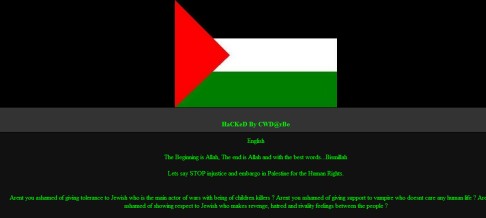
This is where it gets interesting. The Google cache page shows this — a statement by an ostensibly Turkish pro-Palestinian hacker/group. Here’s a screenshot:

If that looks familiar it’s probably because you read about the hacking of The Jewish Chronicle in Britain a week ago. The text and image appear to be the same:

There is one difference — the claim of authorship. The hackers of the Chronicle identified themselves as “PALESTINIAN MUJAHEEDS” whereas the TAC hackers used this name: “HaCKeD By CWD@rBe”.

So what can we infer? Some Turkish pro-Palestinians don’t know much about the American media? Perhaps.

The American Conservative is certainly a counter-intuitive target to pick. It’s one of the few American publications that acknowledges the legitimacy of the Palestinian cause and it is by no stretch of the imagination an Israel-friendly publication.

So who might the Palestinian Mujaheeds be? A Google search indicates that the name had never shown up until the Jewish Chronicle attack.

The equation between Palestinians and Mujahadins is a strange one to make — unless that is you happen to be an anti-Jihadist of the type that figures in Daniel Larison’s article. He writes:

The Palestinian cause generates remarkable reactions in Western anti-jihadists. For most of them, it is an article of faith that Palestinians, or at least the organized factions that speak for them, are just about as bad and hostile to “the West” as Al Qaeda itself, and so there is no point in attempting to make any deal with them. As far as they are concerned, the correct response is to back Israeli policies to the hilt, and to throw up as many obstacles to anyone here at home who would attempt to use U.S. influence to change those policies. The Bush-era habit of lumping together every Islamic revolutionary, militant and terrorist group under some catch-all term of “Islamofascism” made it easier to lump all these causes together, which is oddly enough exactly what jihadists would like, and once they were lumped together they could be that much more easily demonized together.

Now is that the kind of statement that a pro-Palestinian Turk believes should be blocked from public viewing? It’s conceivable but rather improbable. Much more plausible is the idea that a pro-Israeli hacker finds the expression of such views particularly unpalatable.

It’s not always possible to judge who you are dealing with simply by seeing the colors on the flag that they choose to waive.

Meanwhile, as TAC deals with the damage done by “HaCKeD By CWD@rBe”, be sure to look at Daniel Larison’s piece which I’ve reposted here. It’s essential reading.

Facebooktwittermail

Jihadism, anti-Jihadism and Palestine

Jihadism, anti-Jihadism and Palestine

A lot of ink has been spilled since 9/11 trying to argue that bin Laden doesn’t really care about Palestine. But that’s always been silly — nobody knows what he “really” cares about, and it doesn’t especially matter since he talks about it a lot and presents it as a major part of his case against the United States. An Israeli-Palestinian peace agreement surely would not convince bin Laden or al-Qaeda and its affiliated movements to give up their jihad — but it would take away one of their most potent arguments, and one of the few that actually resonates with mass publics. Marc Lynch (via Andrew)

One of the reasons there has been a consistent effort to deny that Bin Laden has any “real” interest in the Israeli-Palestinian conflict is that such an interest, sincere or not, suggests jihadist groups are fueled by U.S. and allied policies, or at least that they successfully exploit U.S. and allied policies for propaganda purposes. Washington would then be faced with at least one of two unpalatable truths. Either our policies are correct and necessary, but strategically disastrous in their effects on Arab and Muslim public opinion and jihadist recruiting, or they are and incorrect and unnecessary while also being strategically disastrous. Washington would then have to decide if it wants to live with perpetual, low-level conflict occasionally exploding into major military campaigns every decade, or if it wants to make enough policy changes (and push our allies to make similar changes) to reduce that conflict to a bare minimum.

For most of the last decade, our preference in and out of government has been to deny that U.S. and allied policies had anything to do with jihadist attacks and their ability to recruit and win sympathizers. This acknowledgement would be to “blame the victim,” so that even if it were the correct analysis it was politically incorrect to say it out loud. Instead we have been treated to a whole host of explanations for why jihadist violence exists and why it tends to be directed at the U.S. and our allies. The lamest of these has been rather popular, namely the claim that “they hate us for our freedom,” or modernity or secularism or whatever it is that the person making the argument finds worthwhile about the West and sees lacking in Muslim countries. Then, of course, there is the trusty appeal to the enemy’s insanity. Unlike us, they are not really rational, and so their actions cannot be explained by referring to anything so mundane and normal as political grievances.

Finally, there is the religious essentialist argument that jihadism is what Islam requires at its core, and therefore there is no way to weaken it without some dramatic transformation of the entire religion. This last argument has won more sympathizers because the people trying to challenge it inevitably go to the opposite extreme and simply ignore or dismiss past Islamic conquests as having nothing to do with Islam. If the essentialist argument really held up, however, Algerians would still be attacking France, Central Asian Muslims would still be warring against the Russians, and Saudis would have been attacking American targets long before the 1990s. We do see cases where separatist movements involving Muslim populations’ breaking away from non-Muslim states become intertwined with and dependent on jihadist groups, because these are the groups providing assistance and because they lend an extra religious and ideological veneer to the conflict that wins the separatists more sympathy abroad. As a general rule, when the cause of the political grievances has disappeared, violent resistance also disappears.

Anti-jihadists like to invoke one or more of these arguments. I am reminded again of a quote from George Kennan in which he described the flaws of the popular anticommunism of his day. His words apply to popular anti-jihadism almost perfectly:

They distort and exaggerate the dimensions of the problem with which they profess to deal. They confuse internal and external aspects of the communist threat. They insist on portraying as contemporary things that had their actuality years ago [bold mine-DL]….And having thus incorrectly stated the problem, it is no wonder that these people consistently find the wrong answers.

Even when anti-jihadists are willing to acknowledge that Al Qaeda uses the grievances of Muslim populations in Iraq or Palestine for propaganda purposes, they will usually hold that changing policy or addressing those grievances to minimize the effectiveness of the propaganda is a form of capitulation. We are supposed to be engaged in “global counterinsurgency,” but we must take little or no account of the stated motivations of jihadists and the reasons why many millions more sympathize with their immediate goals while often deploring the means they use.

The Palestinian cause generates remarkable reactions in Western anti-jihadists. For most of them, it is an article of faith that Palestinians, or at least the organized factions that speak for them, are just about as bad and hostile to “the West” as Al Qaeda itself, and so there is no point in attempting to make any deal with them. As far as they are concerned, the correct response is to back Israeli policies to the hilt, and to throw up as many obstacles to anyone here at home who would attempt to use U.S. influence to change those policies. The Bush-era habit of lumping together every Islamic revolutionary, militant and terrorist group under some catch-all term of “Islamofascism” made it easier to lump all these causes together, which is oddly enough exactly what jihadists would like, and once they were lumped together they could be that much more easily demonized together.

On the whole, it seems that the more sympathetic to or at least understanding of Palestinian grievances a Western observer is, the less willing he is to endorse standard anti-jihadist arguments. Likewise, the more one agrees with anti-jihadist arguments, the more reflexively hostile to Palestinian grievances one tends to be. When most Western anti-jihadists hear that Bin Laden has tied the Christmas bomber attack to the cause of Palestine and specifically to the treatment of Gaza, or when they learn that the bomber who killed the seven CIA operatives claimed that the Gaza operation early last year had driven him to jihadism, the conclusion they draw is not that there was and is something wrong with U.S. and Israeli policies with respect to Palestinians. There is no sudden revelation that the inexcusable blockade of Gaza is politically unwise as well as morally wrong.

On the contrary, the support Bin Laden expresses for the Palestinian cause makes that cause seem to most Western anti-jihadists to be that much more indistinguishable from Al Qaeda’s goals and therefore that much more antithetical to Western interests. This might very well be another purpose in Bin Laden’s exploitation of Palestinian grievances: to harden Western audiences against Palestinian claims even more by linking his cause to Palestine, which will make Americans in particular less interested in supporting an administration that tries to exert pressure in support of a peace settlement. Bin Laden would like to appropriate the Palestinian cause, which Palestinians definitely do not want, and most Western anti-jihadists would like nothing more than to let him have it. So while Lynch is right that resolving this conflict would deprive jihadists of one of their great sources of effective propaganda, our own anti-jihadists will do their utmost to thwart all efforts to that end.

Facebooktwittermail