Category Archives: Issues

Brother of Afghan leader is said to be on CIA payroll

Brother of Afghan leader is said to be on CIA payroll

Ahmed Wali Karzai, the brother of the Afghan president and a suspected player in the country’s booming illegal opium trade, gets regular payments from the Central Intelligence Agency, and has for much of the past eight years, according to current and former American officials.

The agency pays Mr. Karzai for a variety of services, including helping to recruit an Afghan paramilitary force that operates at the C.I.A.’s direction in and around the southern city of Kandahar, Mr. Karzai’s home.

The financial ties and close working relationship between the intelligence agency and Mr. Karzai raise significant questions about America’s war strategy, which is currently under review at the White House.

The ties to Mr. Karzai have created deep divisions within the Obama administration. The critics say the ties complicate America’s increasingly tense relationship with President Hamid Karzai, who has struggled to build sustained popularity among Afghans and has long been portrayed by the Taliban as an American puppet. The C.I.A.’s practices also suggest that the United States is not doing everything in its power to stamp out the lucrative Afghan drug trade, a major source of revenue for the Taliban.

More broadly, some American officials argue that the reliance on Ahmed Wali Karzai, the most powerful figure in a large area of southern Afghanistan where the Taliban insurgency is strongest, undermines the American push to develop an effective central government that can maintain law and order and eventually allow the United States to withdraw.

“If we are going to conduct a population-centric strategy in Afghanistan, and we are perceived as backing thugs, then we are just undermining ourselves,” said Maj. Gen. Michael T. Flynn, the senior American military intelligence official in Afghanistan. [continued…]

Editor’s CommentAndrew Exum says this is the most important article on Afghanistan you’ll read this week:

Why, you ask? Because if this is true, and if the CIA is empowering Ahmed Wali Karzai at the same time in which NATO/ISAF is saying abusive local power-brokers are a threat to mission success, then this is yet another example of NATO/ISAF carrying out one campaign in Afghanistan while the CIA carries out another — with both campaigns operating at cross purposes to one another. I should say here that I am in no position to confirm or deny this report. I can, however, say that numerous military officials in southern Afghanistan with whom I have spoken identify AWK and his activities as the biggest problem they face — bigger than the lack of government services or even the Taliban. And so if AWK is “the agency’s guy”, that leads to a huge point of friction between NATO/ISAF and the CIA.

At some point, the CIA’s Congressional overseers — who’ve already complained that they have been misled by the agency on multiple occasions — should start asking some fundamental questions about the institution.

In this decade the CIA has had a central role in the biggest intelligence failure the US has ever had; it has implemented a torture program; operated ghost prisons; conducted kidnapping operations; and provided support for drug warlords. The list could I’m sure be made much longer. At what point will the conclusion be drawn that this Cold War anachronism does more to threaten than protect America’s national security?

Gunmen attack UN workers in Kabul

Taliban gunmen stormed a guest house in central Kabul on Wednesday morning, killing six United Nations employees and two Afghan security officials, according to U.N. officials, the police and the Afghan Interior Ministry.

One of those killed was an American security guard who battled the attackers as they came through the front gate in the predawn hours, according to an American who was staying in the guest house and who joined in the gun battle before shepherding 25 other residents to safety.

The police said one of the victims, a woman, had been shot in the head, and another burned to death. A cellphone video taken by a security official and seen by a reporter showed just the head and torso of a third victim, apparently cut in half when one of the attackers detonated his suicide vest. [continued…]

Editor’s Comment — While the Taliban say this attack is intended to deter people from assisting in the November 7 runoff election it clearly also challenges the concept of a strategy based on protecting the most populated parts of Afghanistan. Reinforce the perception that the center of Kabul is unsafe and it gets hard to promote the idea that anywhere can be made safe.

Add to that the fact that the Taliban has the upper hand even when outnumbered by 12 to 1 and the argument that tens of thousands more American troops will enhance security becomes increasingly implausible.

A crash course in democracy

The decision by both Afghan President Hamid Karzai and his main rival, former Foreign Minister Abdullah Abdullah, to accept a runoff election is a welcome development that provides the Afghan government with an opportunity to restore its damaged credibility. The runoff election now faces two main challenges: making the process more credible and ensuring the election actually contributes to security. Setting Nov. 7 as the date for the election makes both impossible.

Nationwide elections in any country are logistically difficult. In Afghanistan, they’re a nightmare. Funds need to be mobilized (the last elections cost more than $500 million), new poll workers need to be hired (or fired), observers have to be recruited, voters reassured, and security forces redeployed. Because ballots are often transported by donkey, it could take weeks to distribute them to Afghanistan’s remotest areas. A mad rush will be the only way to get all of this done, and such haste will not contribute to a credible process.

The first step in ensuring a credible election, therefore, is to postpone the date for the runoff. [continued…]


Facebooktwittermail

Who decided to go to war in Gaza (WHEN) and why?

Who decided to go to war in Gaza (WHEN) and why?

I want to know how and why it was decided to embark on Operation Cast Lead in the Gaza Strip and to expand it into a ground offensive. I want to know if the decisions were affected by the Israeli election campaign then underway and the change in U.S. presidents. I want to know if the leaders who launched the operation correctly judged the political damage it would cause Israel and what they did to minimize it. I want to know if those who gave orders to the Israel Defense Forces assumed that hundreds of Palestinian civilians would be killed, and how they tried to prevent this.

These questions should be at the center of an investigation into Operation Cast Lead. An investigation is necessary because of the political complexities that resulted from the operation, the serious harm to Palestinian civilians, the Goldstone report and its claims of war crimes, and the limits that will be imposed on the IDF’s freedom of operation in the future. There is no room to argue that the government should be allowed to govern without interference and investigations, with the public passing judgment at the ballot box. The government changed after the Gaza operation and the questions remain troublesome.

The investigations by the army and Military Police are meant to examine soldiers’ behavior on the battlefield. They are no substitute for a comprehensive examination of the activities of the political leadership and senior command, who are responsible for an operation and its results. It’s not the company or battalion commanders who need to be investigated, but former prime minister Ehud Olmert, Defense Minister Ehud Barak, former foreign minister Tzipi Livni, Chief of Staff Gabi Ashkenazi, and the heads of the intelligence chiefs and Foreign Ministry, who were party to the decisions. It is also important to investigate Barak and Livni’s election campaign advisers to find out if and how the campaign affected the military and diplomatic efforts. [continued…]

Editor’s Comment — Aluf Benn raises lots of important questions. One that he leaves out is this: Did Israel’s preparations for a war on Gaza in the first half of 2008 indicate that the truce with Hamas that began on June 18 last year was accepted by Israel in bad faith?

At the beginning of Operation Cast Lead, Haaretz reported:

Sources in the defense establishment said Defense Minister Ehud Barak instructed the Israel Defense Forces to prepare for the operation over six months ago, even as Israel was beginning to negotiate a ceasefire agreement with Hamas. According to the sources, Barak maintained that although the lull would allow Hamas to prepare for a showdown with Israel, the Israeli army needed time to prepare, as well.

The political line has always been “we had no choice,” but the truth might be that Israel’s leaders had made their choice for war well before it became “inevitable”.

Benn asks: “Who decided to bomb the flour mill and sewage treatment center in Gaza, and why?” Again, the question of when such facilities were added to a target list is extremely important. If the preparations that Barak referred to included drawing up target lists of this type then Israel would appear to have knowingly planned and committed war crimes, breaking the Fourth Geneva Convention that prohibits collective punishment.

One of the “lessons” of the 2006 war on Lebanon was that Israel didn’t have carefully developed target lists — that it quickly ran out of military targets and thereafter capriciously sought new and ill-conceived targets. That would imply that most of the targets in Gaza had been selected well before a single missile had been fired.

Facebooktwittermail

A letter from Afghanistan that every American must read

A letter from Afghanistan that every American must read

“… I have lost understanding of and confidence in the strategic purposes of the United States’ presence in Afghanistan. I have doubts and reservations about our current strategy and planned future strategy, but my resignation is based not upon how we are pursuing this war, but why and to what end. To put simply: I fail to see the value or the worth in continued U.S. casualties or expenditures or resources in support of the Afghan government in what is, truly, a 35-year old civil war.” From Matthew P Hoh, Senior Civilian Representative, Zabul Province, Afghanistan, in his letter of resignation to the State Department.

For weeks, President Obama and his advisers in the White House and from the Pentagon have been wrestling over the formulation of a revised strategy for Afghanistan. Central to that debate has been the question of how to respond to Gen Stanley McChrystal’s request for tens of thousands more American troops.

But perhaps the most important question — one which the president and his advisers have no doubt studiously avoided asking — is whether this war is worth fighting.

Matthew Hoh, a former US Marine captain who fought in Iraq, and who later served as a civilian State Department representative in the Zabul province of Afghanistan, in a letter of resignation submitted in early September, provided a definitive statement on the war’s failure — in its conception, its execution, and its aims. Rarely, if ever, has such an damning indictment of this war been so clearly and powerfully expressed.

The Washington Post reported:

The reaction to Hoh’s letter was immediate. Senior U.S. officials, concerned that they would lose an outstanding officer and perhaps gain a prominent critic, appealed to him to stay.

U.S. Ambassador Karl W. Eikenberry brought him to Kabul and offered him a job on his senior embassy staff. Hoh declined. From there, he was flown home for a face-to-face meeting with Richard C. Holbrooke, the administration’s special representative for Afghanistan and Pakistan.

“We took his letter very seriously, because he was a good officer,” Holbrooke said in an interview. “We all thought that given how serious his letter was, how much commitment there was, and his prior track record, we should pay close attention to him.”

The Post has published Hoh’s letter in a printable format [PDF] which is likely to result in the whole letter not being widely read. In order to encourage readers to absorb the full force of this testimony, I’ve reproduced the letter in full below — the only place (as far as I’m aware) that it can currently be found on the web in a user-friendly format.

“We are spending ourselves into oblivion”

Dear Ambassador Powell,

It is with great regret and disappointment I submit my resignation from my appointment as a Political Officer in the Foreign Service and my post as the Senior Civilian Representative for the U.S. Government in Zabul Province. I have served six of the previous ten years in service to our country overseas, to include deployment as a U.S. Marine officer and Department of Defense civilian in the Euphrates and Tigris River Valleys of Iraq in 2004-2005 and 2006-2007. I did not enter into this position lightly or with any undue expectations nor did I believe my assignment would be without sacrifice hardship or difficulty. However, in the course of my five months of service in Afghanistan, in both Regional Commands East and South, I have lost understanding of and confidence in the strategic purposes of the United States’ presence in Afghanistan. I have doubts and reservations about our current strategy and planned future strategy, but my resignation is based not upon how we are pursuing this war, but why and to what end. To put simply: I fail to see the value or the worth in continued U.S. casualties or expenditures or resources in support of the Afghan government in what is, truly, a 35-year old civil war.

This fall will mark the eighth year of U.S. combat, governance and development operations within Afghanistan. Next fall, the United States’ occupation will equal in length the Soviet Union’s own physical involvement in Afghanistan. Like the Soviets, we continue to secure and bolster a failing state, while encouraging an ideology and system of government unknown and unwanted by its people.

If the history or Afghanistan is one great stage play, the United States is no more than a supporting actor, among several previously, in a tragedy that not only pits tribes, valleys, clans, villages and families against one another, but, from at least the end of King Zahir Shah’s reign, has violently and savagely pitted the urban, secular, educated and modem of Afghanistan against the rural, religious, illiterate and traditional. It is this latter group that composes and supports the Pashtun insurgency. The Pashtun insurgency, which is composed of multiple, seemingly infinite, local groups, is fed by what is perceived by the Pashtun people as a continued and sustained assault, going back centuries, on Pashtun land, culture, traditions and religion by internal and external enemies. The U.S. and NATO presence and operations in Pashtun valleys and villages, as well as Afghan army and police units that are led and composed of non-Pashtun soldiers and police, provide an occupation force against which the insurgency is justified. In both RC East and South, I have observed that the bulk of the insurgency fights not for the white banner of the Taliban, but rather against the presence of foreign soldiers and taxes imposed by an unrepresentative government in Kabul.

The United States military presence in Afghanistan greatly contributes to the legitimacy and strategic message of the Pashtun insurgency. In a like manner our backing of the Afghan government in its current form continues to distance the government from the people. The Afghan government’s failings, particularly when weighed against the sacrifice of American lives and dollars, appear legion and metastatic:

• Glaring corruption and unabashed graft;
• A President whose confidants and chief advisers comprise drug lords and war crimes villains, who mock our own rule of law and counternarcotics efforts;
• A system of provincial and district leaders constituted of local power brokers, opportunists and strongmen allied to the United States solely for, and limited by, the value of our USAID and CERP contracts and whose own political and economic interests stand nothing to gain from any positive or genuine attempts at reconciliation; and
• The recent election process dominated by fraud and discredited by low voter turnout, which has created an enormous victory for our enemy who now claims a popular boycott and will call into question worldwide our government’s military, economic and diplomatic support for an invalid and illegitimate Afghan government.

Our support for this kind of government, coupled with a misunderstanding of the insurgency’s true nature, reminds me horribly of our involvement with South Vietnam; an unpopular and corrupt government we backed at the expense of our Nation’s own internal peace, against an insurgency whose nationalism we arrogantly and ignorantly mistook as a rival to our own Cold War ideology.

I find specious the reasons we ask for bloodshed and sacrifice from our young men and women in Afghanistan. If honest, our stated strategy of securing Afghanistan to prevent al-Qaeda resurgence or regrouping would require us to additionally invade and occupy western Pakistan, Somalia, Sudan, Yemen, etc. Our presence in Afghanistan has only increased destabilization and insurgency in Pakistan where we rightly fear a toppled or weakened Pakistani government may lose control of nuclear weapons. However, again, to follow the logic of our stated goals we should garrison Pakistan, not Afghanistan. More so, the September 11th attacks, as well as the Madrid and London bombings, were primarily planned and organized in Western Europe; a point that highlights the threat is not one tied to traditional geographic or political boundaries. Finally, if our concern is for a failed state crippled by corruption and poverty and under assault from criminal and drug lords, then if we bear our military and financial contributions to Afghanistan, we must reevaluate our commitment to and involvement in Mexico.

Eight years into war, no nation has ever known a more dedicated, well trained, experienced and disciplined military as the U.S. Armed Forces. I do not believe any military force has ever been tasked with such a complex, opaque and Sisyphean mission as the U.S. military has received in Afghanistan. The tactical proficiency and performance of our Soldiers, Sailors, Airmen and Marines is unmatched and unquestioned. However, this is not the European or Pacific theaters of World War II, but rather is a war for which our leaders, uniformed, civilian and elected, have inadequately prepared and resourced our men and women. Our forces, devoted and faithful, have committed to conflict in an indefinite and unplanned manner that has become a cavalier, politically expedient and Pollyannaish misadventure. Similarly, the United States has a dedicated and talented cadre of civilians, both U.S. government employees and contractors, who believe in and sacrifice for their mission, but have been ineffectually trained and led with guidance and intent shaped more by the political climate in Washington, D.C. than in Afghan cities, villages, mountains and valleys.

“We are spending ourselves into oblivion” a very talented and intelligent commander, one of America’s best, briefs every visitor, staff delegation and senior officer. We are mortgaging our Nation’s economy on a war, which, even with increased commitment, will remain a draw for years to come. Success and victory, whatever they may be, will be realized not in years, after billions more spent, but in decades and generations. The United States does not enjoy a national treasury for such success and victory.

I realize the emotion and tone of my letter and ask you excuse any ill temper. I trust you understand the nature of this war and the sacrifices made by so many thousands of families who have been separated from loved ones deployed in defense of our Nation and whose homes bear the fractures, upheavals and scars of multiple and compounded deployments. Thousands of our men and women have returned home with physical and mental wounds, some that will never heal or will only worsen with time. The dead return only in bodily form to be received by families who must be reassured their dead have sacrificed for a purpose worthy of futures lost, love vanished, and promised dreams unkept. I have lost confidence such assurances can anymore be made. As such, l submit my resignation.

Sincerely,

Matthew P. Hoh
Senior Civilian Representative
Zabul Province, Afghanistan

cc:
Mr. Frank Ruggiero
Ms. Dawn Liberi
Ambassador Anthony Wayne
Ambassador Karl Eikenberry

This letter was addressed to:
Ambassador Nancy J. Powell
Director General of the Foreign Service and Director of Human Resources
U.S. Department of State
2201 C Street NW

Facebooktwittermail

Where have all Israel’s friends gone?

“Where have all the friendships gone…”

Among all the members of our political, military and media establishments who are now suggesting an “inquiry”, there is no one – literally not one – who means by that a real investigation. The aim is to deceive the Goyim and get them to shut up.

Actually, Israeli law lays down clear guidelines for such investigations. The government decides to set up a commission of investigation. The president of the Supreme Court then appoints the members of the commission. The commission can compel witnesses to testify. Anybody who may be damaged by its conclusions must be warned and given the opportunity to defend themself. Its conclusions are binding.

This law has an interesting history. Sometime in the 50s, David Ben-Gurion demanded the appointment of a “judicial committee of inquiry” to decide who gave the orders for the 1954 “security mishap”, also known as the Lavon Affair. (A false flag operation where an espionage network composed of local Jews was activated to bomb American and British offices in Egypt, in order to cause friction between Egypt and the Western powers. The perpetrators were caught.)

Ben-Gurion’s request was denied, under the pretext that there was no law for such a procedure. Furious, Ben-Gurion resigned from the government and left his party. In one of the stormy party sessions, the Minister of Justice, Yaakov Shimshon Shapira, called Ben-Gurion a “fascist”. But Shapira, an old Russian Jew, regretted his outburst later. He drafted a special law for the appointment of Commissions of Investigation in the future. After lengthy deliberations in the Knesset (in which I took an active part) the law was adopted and has since been applied, notably in the case of the Sabra and Shatila massacre. [continued…]

Jordan’s ties with Israel turn cold

Jordan and Israel mark 15 years of peace today, but ties between both countries are cooler than ever.

Since the right-wing Israeli government of Benjamin Netenyahu took office in May, Jordan has been left further disappointed with its neighbour.

“Our relation is getting colder,” King Abdullah told Israel’s daily Haaretz newspaper this month. “Let’s remember that the peace treaty was signed as part of a process to achieve comprehensive peace. And the full potential of not just Jordanian-Israeli relations, but the whole region, will not be realised unless comprehensive peace is achieved.” [continued…]

Facebooktwittermail

Rory Stewart: The T. E. Lawrence of Afghanistan – UPDATED

Rory Stewart: The T. E. Lawrence of Afghanistan

What would [Rory] Stewart’s version of muddling through in Afghanistan look like? While General Stanley McChrystal’s counterinsurgency plan calls for more than 100,000 American troops, and Joe Biden’s bare-bones counterterrorism proposal reportedly keeps troop numbers around their current level of 68,000, Stewart believes the foreign-troop presence in Afghanistan should actually be reduced–all the way down to 20,000. Those troops would then be used exclusively to fight Al Qaeda terrorists; the Taliban would no longer be an enemy. At the same time, while Stewart’s plan envisions continued aid to Afghans to support electricity, water, health, education, and agriculture development, the United States would cease with its state-building project and essentially leave the Kabul government to its own devices.

Stewart’s plan stems from his strange mixture of pessimism and optimism. On the one hand, he argues that the Afghan central government lacks the strength or legitimacy to actually run the country, nor does he have much faith in the ability of the United States to help it on those counts. “I have some friends in Afghanistan who will say, ‘If the U.S. government is infinitely flexible, capable, superbly informed, able to deliver programs precisely in every rural area, and its soldiers are able to avoid killing anybody and can identify exactly which tribal chief at the sub-district level to deal with, everything will be fine,’” Stewart says. “To which my answer is, ‘That’s a big if, and that’s not how our bureaucracies and administrations work.'” But Stewart also believes that things in Afghanistan aren’t as precarious as some fear. “There’s a certain kind of worst-case scenario view that Afghanistan is like this horrendous nightmare and, if we don’t get in there and sort it out, we’ll have global jihad, we’ll have a completely destabilized region, terrorists will have their hands on Pakistan’s nuclear arsenal, American credibility will be finished forever,” Stewart says. “And these are not really, I think, fully developed positions.”

Under a “muddling through” plan, Stewart concedes that the Taliban might take some provincial capitals in Southern Afghanistan, but he believes that the Hazara, Tajik, and Uzbek populations are stronger than they were in 1996 and, thus, would be able to keep the Taliban out of their areas. He also thinks it would take a minimal foreign military presence to prevent the Taliban from marching into Kabul. With the Taliban confined to certain parts of Afghanistan and its ability to exploit the ideology of religious resistance lessened due to the absence of a substantial foreign military presence, the rest of the country would, with substantial foreign assistance, be able to develop. Although his walk across Afghanistan led Stewart to believe that the country is, in some respects, ungovernable, it also gave him great faith in individual Afghans, on whom he depended for food, lodging, and frequently directions. (He didn’t carry a detailed map on his trek, since it might have made people think he was a British spy.) “We do consistently overestimate our own capacity and underestimate the capacity of others,” he says. “In every case, Afghans are more competent, more canny, more capable than we acknowledge, and we are less so.” [continued…]

UPDATE: Editor’s Comment — Readers who have been following the extraordinary career of Rory Stewart may be interested to hear that yesterday he took the first step in the next chapter: he was selected as the Conservative Party candidate for the English constituency of Penrith and The Border. This is a safe Conservative seat and with the Labour Party struggling in the polls, Stewart stands a good chance of not only entering Parliament after the next general election in Britain but quite likely gaining a position in the next British government. Talent is no guarantee of success in politics, but it will be interesting to see how far Stewart advances and what he might accomplish.

Taliban demand election boycott

The Taliban called on Afghans to boycott the upcoming presidential elections runoff and threatened to attack polling sites, sparking fears that thousands of voters will stay home on election day.

“The Islamic Emirate of Afghanistan urges the people of Afghanistan to not participate in the elections, and once again prove that they are true believers,” the group said in a statement emailed to the Wall Street Journal, using a name referring to the Taliban and allied groups.

“All mujahedeen are ordered to do their best to disrupt the elections and carry out attacks on enemy outposts and prevent people from going to the polling centers,” the statement continued. The group hinted that they would target election workers and voters. “If anyone, including the participants and the workers, gets harmed they have only themselves to blame, since the Islamic Emirate warned them in advance.” [continued…]

Afghan challenger considers runoff boycott

The challenger to President Hamid Karzai is considering boycotting the upcoming runoff if his demands are not met to remove the leaders of Afghanistan’s election commission who he believes are biased against him, campaign officials said Sunday.

Despite his public promises that he will participate in the Nov. 7 runoff, Abdullah Abdullah has been discussing the possibility of pulling out, an outcome that could create a new political crisis and throw the legitimacy of any new government into question. His aides argue that it would be dangerous to enter an election that might reproduce the massive fraud that discredited the vote in August.

Abdullah’s main running mate, Homayoun Shah Assefy, said that it was clear that the United States and the international community would resist such a boycott but that it might be necessary if the Independent Election Commission is not purged of its prominent Karzai supporters. [continued…]

Facebooktwittermail

As occupier, Israel must face up to Goldstone report

As occupier, Israel must face up to Goldstone report

Goldstone was born in June 1967. I am not referring to the judge from South Africa, but to his report, or more precisely, the notion that Israel needs a synonym for the soul-searching it must carry out after 42 years of occupation. In the 575 pages of the report that is loaded with details, names, numbers, a list of weapons, interrogation methods and articles of international law, three paragraphs hide among the conclusions on pages 521 and 522, numbered 1674 to 1676. Here lies the explanation for the tragic results of Operation Cast Lead.

In those paragraphs Goldstone uses the term “continuum” to establish that the operation cannot be understood on its own without assessing it as part of a chain of events, which also includes the complete closure of the Gaza Strip for three years, the policy of razing homes, the arrests, the interrogations and torture, not only in the Gaza Strip but also in the West Bank and East Jerusalem. In short, Operation Cast Lead is not an “incident.” It is a link in a chain as old as the occupation itself.

The equation Israel is demanding – between those wounded in the Gaza operation and those wounded in Sderot, between the Qassams and the F-16s, between the mortars and the tank that killed three of Dr. Ezzeldeen Abu al-Aish’s daughters, between Hamas and Israel – betrays a poor understanding of the report’s essence. Goldstone puts the symptom under the microscope and derives the illness. The result is a textbook whose title should have been “A manual for the occupier in the fifth decade.” [continued…]

Whatever Bibi wants, Bibi gets

Barack Obama is a rookie. At least, this is what the Israeli prime minister seems to think. So far, Benjamin Netanyahu has been able to maximize his gains at the expense of the U.S. president and the Palestinians while solidifying his own position in the process.

Consider last month’s trilateral meeting on the sidelines of the U.N. General Assembly. After months of tough and very public statements by top U.S. officials, Netanyahu was able to get the leader of the free world to concede on a settlement freeze and gave nothing in return. For Israeli hawks and their allies in the United States, this was a victory. But it did not come without costs, even leaving aside the effect on Palestinian Authority President Mahmoud Abbas’s domestic popularity. Heads of state around the world paid attention, and surely some of them thought of Obama: This man is a pushover. [continued…]

Jordan to Israel: Temple Mount violence derails peace efforts

Jordan warned Israel Police and religious Jewish radicals on Sunday that further provocation in the compound that houses the al- Aqsa Mosque in Jerusalem would “fuel violence in the region and jeopardize peace efforts”.

Clashes between Israeli police and youths armed with rocks broke out Sunday at the Noble Sanctuary/Temple Mount compound where the mosque is located. The confrontation was apparently sparked by calls by radical Jewish clerics to their followers to go up to the compound, and by calls by radical Muslim clerics for their followers to defend the site. [continued…]

Israel confirms settlers ramping up West Bank construction

The defense establishment confirmed that in recent weeks West Bank settlers have been making a noticeable effort to expedite construction, in an attempt to maximize the “facts on the ground” before the United States and Israel reach an agreement on a settlement freeze.

A senior security source said this week that the defense establishment’s view on the situation was reflected in reports published in Haaretz last Friday, which stated that extensive construction is currently being carried out in at least 11 settlements. [continued…]

Facebooktwittermail

Karzai rules out sharing power

Karzai rules out sharing power

President Hamid Karzai’s team shifted aggressively into campaign mode Saturday and ruled out any possibility of a power-sharing deal with challenger Abdullah Abdullah ahead of a runoff election in two weeks…

Snow and freezing weather could make voting impossible in some parts of the country. And many people say there is not enough time to replace and vet election officials to prevent fraud. Karzai initially received 54 percent of the vote, but nearly one-third of his votes were considered rigged and he finished with 49 percent.

“When you have a million-odd votes thrown out, you’ve got to ask yourself, what was the IEC doing and who is going to be held accountable?” said Saad Mohseni, an owner of a prominent media company in Afghanistan.

Election officials plan to reduce the number of polling places from about 6,300 to about 5,800 in an attempt to prevent fraud in volatile areas where votes were recorded at stations that never opened.

One senior Western diplomat, speaking on the condition of anonymity because he was not authorized to speak to the media by name, said there was “way over a 50-50 chance” that the runoff would be held despite the potential problems. [continued…]

If this is progress, what would an Afghan disaster look like?

U.S. commanders on the ground are not setting nearly as much store by the election saga as are their political overlords in Washington. Gen McChrystal is making clear that Mr Obama can no longer afford to delay the issue of reinforcements, stressing that simply stopping the Taliban from extending its control over much of the countryside in the south and east will require 40,000 more troops – and he would prefer 80,000. Moreover, logistical constraints mean they can be introduced only at a rate of around 4,000 a month.

The war may look unwinnable to any student of history, but Americans often imagine themselves immune to history’s rules, and Mr Obama doesn’t want to go into the next election being pilloried for “losing” Afghanistan (not that the Taliban will necessarily sweep back into Kabul, but they could do a pretty good job of surrounding the cities and choking Nato supply lines).

So it’s a safe bet that Mr Obama will escalate US military involvement, even as he promises increasingly sceptical Democrats that the Afghan security forces are being “trained” to take over security in the near future. This, too, is something of a fiction: when 4,000 US Marines deployed in Helmand shortly before the election, they took with them 400 Afghan troops who showed little appetite for getting out among the people. Close to 100,000 Afghan troops have been trained, but how effective they are in fighting the Taliban is anybody’s guess. [continued…]

How they convinced Karzai

What perhaps finally brought Karzai into the real world was [Rahm] Emanuel going public with a statement on October 18—which Kerry had been privately drumming into Karzai for days—that Obama would not commit to sending any more US troops to Afghanistan until there was a “legitimate” and “new” government in Kabul.

The underlying message was that if Karzai still refused to listen he could be held responsible for allowing Afghanistan to go down the tubes or be taken over by the Taliban. Even though Karzai has a gigantic ego and was still in a state of denial, he could not get around that one.

Kerry, Eikenberry, and Emanuel had one thing going for them that others working the Afghan shift in the White House—Richard Holbrooke, Joe Biden, James Jones, General David Petraeus, and even Obama himself—did not have. These three had never criticized Karzai in public before. Karzai intensely dislikes the other White House players because they have hurt his ego by dishonoring him and criticizing him in public. Over such knowledge and niceties does the world turn and turn again. [continued…]

Facebooktwittermail

Top Iran official says West’s nuclear plan a coverup for theft

Top Iran official says West’s nuclear plan a coverup for theft

The powerful speaker of Iran’s parliament Saturday derided a Western-backed proposal to transfer the bulk of the country’s enriched-uranium stockpile abroad as a trick meant to rob Iran of its nuclear fuel.

“My guess is that the Americans have made a secret deal with certain countries to take [low-]enriched uranium away from us under the pretext of providing nuclear fuel,” Ali Larijani, who is close to supreme leader Ayatollah Ali Khamenei, told the Iranian Students News Agency. “We hope Iranian officials will pay due attention to this issue.”

Larijani, who once served as Iran’s chief nuclear negotiator, is the highest-ranking official to explicitly question the plan, which would push Iran’s enriched-uranium stockpile below the threshold necessary to make a single nuclear bomb. [continued…]

Facebooktwittermail

Iraq ministries targeted in car bombings; over 130 dead

Iraq ministries targeted in car bombings; over 130 dead

For the second time in two months, synchronized suicide car bombings struck at the heart of the Iraqi government, severely damaging the Justice Ministry and Provincial Council complexes in Baghdad on Sunday, killing at least 132 people and raising fresh questions about the government’s ability to secure its most vital operations.

The bombers apparently passed through multiple security checkpoints before detonating their vehicles within a minute of each other, leaving the dead and more than 520 wounded strewn across a busy downtown district. Blast walls had been moved back off the road from in front of both buildings in recent weeks.

It was the deadliest coordinated attack in Iraq since the summer of 2007 and happened just blocks from where car bombers killed at least 122 people at the Foreign and Finance ministries this August. [continued…]

Facebooktwittermail

Insurgents putting up a tough fight in Waziristan operation, analysts say

Insurgents putting up a tough fight in Waziristan operation, analysts say

Pakistan’s offensive in the Taliban stronghold of South Waziristan has met with significant resistance from insurgents, who have retaken one large town, targeted military vehicles with roadside bombs and held off the army’s attack helicopters with antiaircraft fire, U.S. military analysts said Friday.

The heavy fighting has slowed the advance of an estimated 36,000 to 40,000 Pakistani troops into the heart of the contested tribal region bordering Afghanistan, according to a detailed briefing on the week-old ground operation by researchers at the American Enterprise Institute (AEI), a Washington think tank. Meanwhile, the report said, insurgents continue to coordinate suicide bombings and assassinations outside Waziristan.

But the large government force, aided by U.S. drone strikes and intelligence, outnumbers the insurgents and is expected to maintain its methodical, three-pronged push in an attempt to capture key territory held by the umbrella group Tehrik-e-Taliban Pakistan in the tribal stronghold of slain insurgent leader Baitullah Mehsud. [continued…]

Facebooktwittermail

Justice Richard Goldstone interviewed by Bill Moyers

Justice Richard Goldstone – Part One

RICHARD GOLDSTONE: As I say, I accept the right of Israel, absolutely, to defend itself. But let me give you an example. Assuming the United States fighting Taliban, started bombing the whole food infrastructure of the people in the area where Taliban are- plowing up fields, bombing food factories, I don’t believe that this would be accepted as legitimate by the people of the United States.

BILL MOYERS: Do we need to change the rules of war in fighting terrorism?

RICHARD GOLDSTONE: Not at all, and you know, it struck me when I heard that Prime Minister Netanyahu suggested that the law of war needs to be changed. It seems to me to contain an implicit acceptance that they broke the law that now is, and that’s why it needs to be changed. [continued…]

Justice Richard Goldstone – Part Two

Facebooktwittermail

Iran delays reply on nuclear plan

Iran delays reply on nuclear plan

Iran will respond to a proposed deal on its controversial nuclear programme by the middle of next week, it has told the UN’s atomic energy agency.

Agency chief Mohammed ElBaradei said he hoped the answer would be “positive”.

The UN watchdog had suggested exporting most of Iran’s enriched uranium to Russia and France for further refining. [continued…]

Facebooktwittermail

Bomb hits outside suspected Pakistani nuclear-weapons site

Bomb hits outside suspected Pakistani nuclear-weapons site

A suicide bomber attacked a suspected nuclear-weapons site Friday in Pakistan, raising fears about the security of the nuclear arsenal, while two other terrorist blasts made it another bloody day in the country’s struggle against extremism.

Increasingly daring and sophisticated attacks by terrorists allied with al Qaida on some of Pakistan’s most sensitive and best-protected installations have led to warnings that extremists could damage a nuclear facility or seize nuclear material.

Pakistan’s nuclear sites are mostly in the northwest of the country, close to the capital, Islamabad, to keep them away from the border with archenemy India, but that places them close to Pakistani Taliban extremists, who are massed in the northwest. Al Qaida has made clear its ambitions to get hold of a nuclear bomb or knowledge of nuclear technology. Several other sites associated with Pakistan’s nuclear weapons have been hit previously. [continued…]

Facebooktwittermail

The myth of the runoff

The myth of the runoff

iven the deeply disingenuous press conference on Tuesday in which world leaders congratulated Hamid Karzai for agreeing to obey the law he has sworn to uphold, the question of whether a second round of elections will be more credible than the first is largely irrelevant.

Chances are there will not be a second round; weather and logistics could easily combine to torpedo the effort, and the challenger Dr. Abdullah Abdullah has already hinted that he is open to talks “if winter should make a second round impossible.”

A runoff is in no one’s interests. The Afghan people are tired and disgusted, and no second round is going to redeem the democratic process in their eyes. The turnout is likely be miniscule – under 20 percent – making any talk of government legitimacy more than a little absurd. [continued…]

Facebooktwittermail

Goldstone challenges US over Gaza report

Goldstone challenges US over Gaza report

Judge Richard Goldstone told Al Jazeera on Thursday that he is still waiting for the U.S. to back up its claim that his report on the war in Gaza has a number of flaws.

“The Obama administration joined our recommendation calling for full and good-faith investigations, both in Israel and in Gaza, but said that the report was flawed,” Goldstone told Al Jazeera.

The UN commission chairman said that if Washington points out the flaws, he would be ready to respond. “I have yet to hear from the Obama administration what the flaws in the report that they have identified are. I would be happy to respond to them, if and when I know what they are,” he said.

Israel’s attacks will lead to its isolation

Israel has been dealing one blow after another to the rest of the world. While China has still not recovered from Foreign Minister Avigdor Lieberman’s absence from the reception at its Tel Aviv embassy – a serious punishment for China’s support for the Goldstone report – France is licking its wounds after Prime Minister Benjamin Netanyahu “vetoed” a visit by the French foreign minister to Gaza. And Israel has dealt another blow: Its ambassador in Washington, Michael Oren, will boycott the conference next week of the new Israel lobby J Street.

China, France and J Street will somehow get by despite these boycotts, Turkey will also recover from the great vacationers’ revolt, and we can expect that even the Swedes and Norwegians will recover from Israel’s loud reprimands. But a country that attacks and boycotts everyone who does not exactly agree with its official positions will become isolated, forsaken and detestable: North Korea of today or Albania of yesterday. It’s actually quite strange for Israel to use this weapon, as it is about to turn into the victim of boycotts itself.

Israel strikes and strikes again. It strikes its enemies, and now it strikes out at its friends who dare not fall exactly in line with its official policies. The J Street case is a particularly serious example. This Jewish organization rose in America along with Barack Obama. Its members want a fair and peace-seeking Israel.

That’s their sin, and their punishment is a boycott. [continued…]

‘U.S. to stand by Israel in the fight against Goldstone report’

President Peres on Wednesday harshly condemned the Goldstone report and told the U.S. envoy to the United Nations, Susan Rice that, “It is outrageous that a respected institution like the United Nations provides a platform to spread lies and stories about Israel.”

The Goldstone report accuses Israel Defense Forces and Palestinian militants of war crimes and possible crimes against humanity during their Dec. 27-Jan. 18 conflict in the Gaza Strip.

The report also calls on the UN Security Council to refer the matter to the International Criminal Court at The Hague, which could prosecute Israeli officials for war crimes.

“The United Nations provides a stage for Ahmmadinejad, who threatens to annihilate Israel, and lets him stand judge,” continued Peres. “This is nothing short of ridiculous.”

Rice promised that the United States will continue to stand by Israel as a loyal friend in the fight against the Goldstone report. [continued…]

U.S., EU pile on pressure for Israel to create own panel on Gaza op

The United States and a number of important EU countries are pressing Israel to establish an independent commission of inquiry into the findings of the Goldstone report on last winter’s Gaza offensive.

British Prime Minister Gordon Brown and French President Nicholas Sarkozy, for example, have written a letter on the subject to Prime Minister Benjamin Netanyahu, and messages have been sent through diplomatic channels, in phone calls and in Netanyahu’s meetings with senior American and European officials, said a senior official in Jerusalem.

Netanyahu has yet to take a stance in debates in the cabinet and security cabinet on the issue, let alone decide on the matter. No decision is expected in the next few days, according to a source in the Prime Minister’s Bureau.

The main supporters of establishing a commission are Deputy Prime Minister Dan Meridor and Attorney General Menachem Mazuz, while the main opponents are Defense Minister Ehud Barak and Deputy Prime Minister Eli Yishai. [continued…]

Hamas: investigate attacks on Israeli civilians

Hamas authorities in the Gaza Strip should promptly implement the recommendations of the Goldstone report on Gaza by conducting credible investigations into serious laws-of-war violations by Palestinian forces, Human Rights Watch said in a letter sent October 20, 2009, to Prime Minister Ismail Haniya.

The United Nations Fact-Finding Mission on the Gaza Conflict, led by Justice Richard Goldstone, called on Hamas and Israel to investigate within six months alleged violations of the laws of war by their respective forces. The report said that Palestinian rocket attacks against Israeli population centers should be investigated as war crimes. The UN Human Rights Council voted on October 16 to endorse the recommendations of the Gaza report. [continued…]

Why we report on ‘open’ societies

Responding to Robert Bernstein’s NYT op-ed

Human Rights Watch was saddened to read in The New York Times on October 20, 2009 that its founding chair, Robert L. Bernstein, feels he must “join the critics” of our work on Israel. We fundamentally disagree with Mr. Bernstein’s views.

Human Rights Watch does not believe that the human rights records of “closed” societies are the only ones deserving scrutiny. If that were the case, we would not work on US abuses in Guantanamo Bay, police abuse in Brazil, the “untouchables” in India, or migrants in South Africa. “Open” societies and democracies commit human rights abuses, too, and Human Rights Watch has an important role to play in documenting those abuses and pressing for their end.

Human Rights Watch does not devote more time and energy to Israel than to other countries in the region, or in the world. We’ve produced more than 1,700 reports, letters, news releases, and other commentaries on the Middle East and North Africa since January 2000, and the vast majority of these were about countries other than Israel. Furthermore, our Middle East division is only one of 16 research programs at Human Rights Watch. The work on Israel is a tiny fraction of Human Rights Watch’s work as a whole.

It is not the case that Human Rights Watch had “no access to the battlefield” after the Israeli operation in Gaza in January 2009. Although the Israeli government denied us access, our researchers entered Gaza via the border with Egypt and conducted extensive interviews with victims, eyewitnesses, United Nations officials, local authorities, and others. As in war zones around the world, we also visited attack sites, analyzed ballistics evidence, photographed wounds, and examined autopsy and other medical reports.

Mr. Bernstein brought his concerns about our work on Israel to a full meeting of the Human Rights Watch Board of Directors in April. The board unanimously rejected his view that Human Rights Watch should report only on closed societies, and expressed its full support for the organization’s work.

Human Rights Watch stands fully behind the work we have done on Israel and around the world. [continued…]

Facebooktwittermail

Afghanistan seen through the Wakhan Corridor

Afghanistan seen through the Wakhan Corridor

The Afghanistan that Lindsey Graham, Joseph Lieberman, John McCain and seemingly countless other politicians have been visiting at taxpayer expense recently might as well be on Mars, so different is it, apparently, from the Afghanistan that Jean-Claude Muller, special councilor for international cultural matters to Luxemburg’s prime minister, Jean-Claude Juncker, and I visited just this past month.

As professional linguists, we were ostensively doing linguistic field work in Afghanistan’s Wakhan Corridor (we are researching a book provisionally entitled “The Tongues of the Taliban: How They Get Their Intelligence”). We funded the expenditure ourselves, and as linguistic researchers have no particular political axes to grind.

The Wakhan Corridor is that strange-looking panhandle in far northeastern Afghanistan that is strategically sandwiched between Tajikistan to the north and Pakistan’s awesomely snow-bound Hindu Kush to the south and that also abuts briefly and precariously on China. It is a demilitarized-zone creation of the 19th century Great Game that was viciously played out between Imperial Russia and the British Empire. It is an arbitrary creation and therefore geographically reflects the roots of many of modern Afghanistan’s current ills.

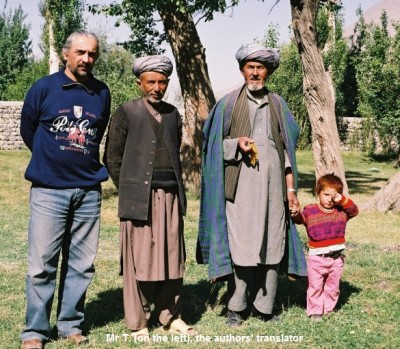
We entered Afghanistan from Tajikistan by walking unescorted across the no-man’s land at the Oxus River border station at Eshkashem. We were dressed as civilians and carried our own packs: no vehicles, no flak jackets, no body guards, just plain folks. We were, however, accompanied by our impressive guide and translator, whom we shall simply call Mr. T., a Tajik native of Khorug and a speaker of Tajik and Russian (he spent four years studying film at the academy in Moscow and, like all other Tajiks in his age group, served in the Russian army), as well as Dard; but his native language is Shugni, which is also widely spoken across the Oxus from Khorug in Afghanistan, as is Tajik: there are as many Tajiks (four and a half million) in Afghanistan as in Tajikistan. Then, too, Mr. T. had spent eleven years in Afghanistan working for Focus.
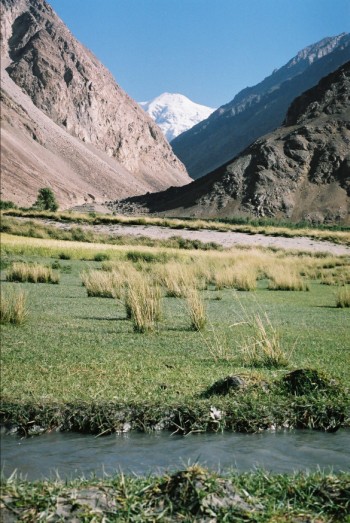
We were following the same route through the corridor that Marco Polo took just over seven centuries ago. We stayed with locals (so-called ‘homestays’); sometimes with major landholders, once with a highly respected local “pasha” and once in a hostel supported by the Aga Khan Foundation, but also often enough with people of very, very modest circumstances (the country’s per capita GDP is currently about $60.00). In every situation, the boundless hospitality and cordiality were overwhelming. Just as you initially begin to think the US ought to have left this godforsaken place yesterday, it’s finally the people that bind your heartstrings to it.

Clearly, we had all the advantages over “official” visitors pointed out by Joseph Kearns Goodwin in his “Afghanistan’s Other Front” and then some: not only could we move about freely as civilians in an ordinary van with an Afghan driver and thus be far less “likely to intimidate and more likely to elicit candor” than highly marked official visitors, the very advantages Goodwin stresses, but we also had one-on-one conversational access and abilities, something our military and politicians have woefully lacked for decades.

The Wakhan Corridor is a heady ethnic and linguistic mix coupled with profound religious differences: Ismailis fervently loyal to the Aga Khan, the 49th Imam, who saved them from certain starvation during the civil war in Tajikistan; Shiites; covert Buddhists; remnants of pre-Islamic paganism reminiscent of that in Ladakh and Nepal; and even vestiges of Zoroastrianism. And this corridor is what all of Afghanistan might have been and might still hope to be: safe and pleasant, even if initially dirt poor, with no evidence of a Taliban or al Qaeda and devoid of the corruption and rampant system of bribes that plagues the rest of the country. Then, too, we saw no poppies in the Wakhan Corridor, and we walked many fields.

Despite such diversity in the Wakhan Corridor, there was a unanimous belief that the Afghan government is simply an outrageous band of crooks on the take and that Hamid Karzai is chief among them. This disgust cut across all linguistic, age and belief groups. It was barely below the surface of any discussion, as was the question of when the “foreigners” would leave. There was no blaming the Russians, nor even our guide, Mr. T., who, as a Tajik, was clearly from the “wrong” side when talk turned to the Soviet era. The wreckage of that period is plain to see: discarded tank turrets decorate many of Eshkashem’s street corners. Most significantly, while there was a firm awareness of local pride of place, there was no patriotic fervor for an Afghanistan, seemingly a very alien concept for many.
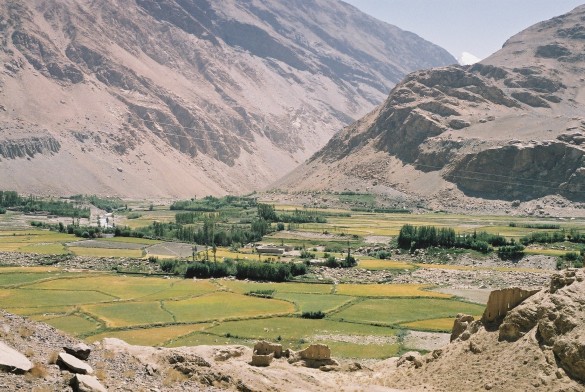
The answer to the the questions of what to do about the rampant corruption on the one hand and the Taliban/al Qaeda on the other hand that plague Afghanistan … and the answer to these questions is clearly not more boots on the ground (just ask the Russians about that one … with an estimated cost of some $82 billion and the loss of their empire; though you can’t very well ask the 16,500 British troops slaughtered at the Khyber Pass in just one engagement in 1842, and the Brits didn’t get the message until the disastrous Third Anglo-Afghan War in 1919) or elaborate training programs (Anti-bribing 101?) or monitoring all those police checkpoints where palms are greased, lies within the Wakhan Corridor itself and just across the Oxus River in Tajikistan’s Autonomous Gorno-Badakhshan Region, still known by its Soviet abbreviation GBAO.

The GBAO is just as culturally and linguistically heterogeneous as the Wakhan Corridor, if not more so. But once you leave the bribe-free GBAO, for which a separate visa is required in addition to that for entering Tajikistan, the police checkpoints and corruption start all over again: drivers from the GBAO are routinely racially profiled by Dushanbe’s traffic cops and required to hand over bribes. Once I convinced our Kyrgyz driver to trade his skull cap for my baseball cap, we started being waved past Dushanbe’s checkpoints.

In the end, it was Tajikistan’s disastrous civil war that raged for five years from 1992 until 1997 and that claimed more than 60,000 lives and uprooted more than a million refugees that left the GBAO independent, proud, united and with a clear and collective vision for a future, a vision that finally sees prosperity within its grasp from increased tourism and from providing a trade corridor for neighboring China; the Pamirs are set to become the hub of a new Silk Road, and, get this, it is the Chinese who are building the road system (lamentably with their prisoners, of which they have millions, who receive only food and lodging for their efforts).

For us as a nation, it should be abundantly clear that once people gain their independence and couple that independence with a sense of collective purpose and goals, then peace and (bribeless) prosperity usually follow.

Afghanistan per se is a fictitious socio-political unit that, by and large, was engendered in the wake of the 19th century’s Great Game; any resemblance to Iraq is real. As we see it, given the successes of the Wakhan Corridor and the GBAO, an effective solution to current woes would be to convert Afghanistan into a federation of largely autonomous “cantons” divided along ethno-linguistic lines (and even those of religious persuasion) and then encourage cross-border communication and cooperation between and among related groups; so, for example, between Tajiks on both sides of the Oxus River divide, between Belochis on both sides of the Afghan-Iran border, and so on.

We should also look for creative and novel non-military solutions such as replacing poppy cultivation with saffron cultivation (virtually economically equivalent crops), encouraging local handicraft co-operatives, whether operated by women or not (as has been successfully done in the GBAO), building rural schools along the lines of Greg Mortenson, engaging a variety of non-military players such as His Highness the Aga Khan in socio-political decision making, and so on. And we should largely absent ourselves to let Afghan diversity flourish once again. Going blindly down the same paths of militant aggression as did the Russians and British will surely once again end in ever greater disasters, even more so when we have so clearly failed at cultural understanding and linguistic communication.

Dr. Thomas L. Markey, Tucson, Arizona
Dr. Jean-Claude Muller, Institut archéologique du Luxembourg

Facebooktwittermail

War fever at the New York Times: a five-day log

War fever at the New York Times: a five-day log

When five days pour forth a lead story on the way “a coordinated assault” of the Taliban and Al Qaeda in Pakistan has caused a grave risk to American interests; a lead about the serious counter-offensive mounted by Pakistan; a flash suitable for any date but run as a lead concerning the heroin trade of the Taliban (“Vast Network Reaps Millions from Drugs”); the launching of a serial memoir by a reporter “Held Captive by the Taliban,” which will extend to five parts; a flattering stoic-soldier profile of General McChrystal in the Times Magazine; a Pakistan follow-up suggesting that Pakistan’s army’s now fights well but is “meeting strong resistance” from the Taliban and cannot win without help; a sequence of three stories by different hands, tracing with approval the acquiescence of President Hamid Karzai in calls for a run-off (the very agreement the administration made a precondition for expanded American commitment); two op-eds over three days by military men not of the highest rank, urging escalation; and a reckless “scoop,” filled sparsely with random and often anonymous interviews regarding the supposed discontents within the armed forces at the length of the administration’s pause — when all this is the fruit of five days’ harvest at the Times, the conclusion draws itself. The New York Times wants a large escalation in Afghanistan. The paper has been made nervous by signs that the president may not make the big push for a bigger war; and they are showing what the rest of his time in office will be like if he does not cooperate. [continued…]

Obama’s war logic

The White House logic that a decision on sending further troops would have to wait for the election debacle to be resolved is faulty, however. And Defense Secretary Robert Gates was among those willing to point that out. “We’re not just going to sit on our hands, waiting for the outcome of this election and for the emergence of a government in Kabul,” Gates said Tuesday. “The outcome of the elections and the problems with the elections have complicated the situation for us. But the reality is, it’s not going to be complicated one day and simple the next.”

Indeed, for purposes of creating a representative government as the foundation of U.S. counterinsurgency strategy, the key flaw of Afghanistan’s August election was not the widespread ballot fraud; it was the fact that almost 3 out of 4 voters didn’t show up at the polls because of the Taliban security threat. So, while a runoff election might satisfy the fraud complaints, it won’t make the resulting government much more representative unless millions more voters show up at the polls this time. But the deteriorating security situation and limits of the appeal of both candidates give little reason to expect that the rerun would see a voter surge; turnout in a runoff, if anything, could be even lower.

What’s more, despite the findings of the electoral commission, there’s widespread doubt in Kabul over whether a runoff vote will actually proceed. A power-sharing deal between Karzai and Abdullah is considered the much more likely outcome. But in reality, the manner in which the electoral stalemate is resolved doesn’t substantially alter the basic choice facing Obama: either send tens of thousands more U.S. troops, which U.S. commander General Stan McChrystal says are necessary simply to halt the Taliban’s advance, or draw down to a policing operation against al-Qaeda and abandon the goal of defeating the Taliban. [continued…]

Everything you have been told about Afghanistan is wrong: the three great falacies

Every military counter-insurgency strategy hits up against the probability that it will, in time, create more enemies than it kills. So you blow up a suspected Taliban site and kill two of their commanders – but you also kill 98 women and children, whose families are from that day determined to kill your men and drive them out of their country. Those aren’t hypothetical numbers. They come from Lt. Col. David Kilcullen, who was General Petraeus’ counter-insurgency advisor in Iraq. He says that US aerial attacks on the Afghan-Pakistan border have killed 14 al-Qa’ida leaders, at the expense of more than 700 civilian lives. He says: “That’s a hit rate of 2 per cent on 98 per cent collateral. It’s not moral.” It explains the apparent paradox that broke the US in Vietnam: the more “bad guys” you kill, the more you have to kill.

There is an even bigger danger than this. General Petraeus’s strategy is to drive the Taliban out of Afghanistan. When he succeeds, they run to Pakistan – where the nuclear bombs are.

To justify these risks, the proponents of the escalation need highly persuasive arguments to show how their strategy slashed other risks so dramatically that it outweighed these dangers. It’s not inconceivable – but I found that, in fact, the case they give for escalating the war, or for continuing the occupation, is based on three premises that turn to Afghan dust on inspection. [continued…]

Facebooktwittermail

Waziristan or bust: Pakistan army in fight for the state’s survival

Waziristan or bust: Pakistan army in fight for the state’s survival

After nine suicide attacks in just eleven days that killed 160 people, including many from the security forces, the Pakistan army has finally started its long awaited offensive in South Waziristan where the Pakistani Taliban are based. The success of the offensive, against the backdrop of a serious civil-military division in Pakistan and unresolved debate in Washington, could be critical for the fate of Pakistan which is financially broke and politically paralyzed.

The army and the civilian government are once more at odds over policy towards the US and India, the insurgency in Baluchistan, and how to deal with militant Punjabi groups who are linked to the Taliban. Moreover, still unresolved and now an issue of growing international concern, is the sanctuary being given to Afghan Taliban in Pakistan.

Dozens of soldiers and police officers have been killed in suicide attacks from October 5 to 15 that included an embarrassing 22 hour siege of the army headquarters in Rawalpindi and the deaths of eight soldiers and three simultaneous attacks on police training camps and intelligence offices in Lahore. The spate of attacks could have been designed to prevent or delay the expected army offensive on its stronghold, but they also aimed to topple the government, impose an Islamic state, and, if possible, get hold of Pakistan’s nuclear weapons. [continued…]

Facebooktwittermail