Category Archives: Palestinians

Donors help keep Palestinians in cages

Charlotte Silver writes:

“Israel besieges us, puts us in cantons — in cages — and the international community is feeding us in these cages. It’s anything but developmental and it’s helping Israel’s colonization, ethnic cleansing and dispossession,” Dr. Samia Botmeh said, as she sat in her office in the Center for Development Studies (CDS) at Birzeit University near Ramallah in the occupied West Bank.

Despite the massive amounts of development aid that have been poured into the West Bank, the productive capacity of the Palestinian economy — measured by examining the agricultural and manufacturing sectors — is half that of 1994, and accounts for no more than 12 percent of employment. While the World Bank and Palestinian Authority boast an 8 percent growth in gross domestic product (GDP), real per capita income is still 8.4 percent lower than what it was in 1999, signifying that the GDP growth is not reflective of income growth for the average Palestinian.

Egypt provides an elucidative comparison. Two decades of serious neo-liberal reforms produced a GDP growth in Egypt that was similarly applauded by the International Monetary Fund (IMF): between 2006 and 2008, GDP grew 7 percent and there was a 4.6 percent spike in 2009 alone. However, as was made stunningly clear at the end of January, the country’s GDP growth had not trickled down to the majority of the people: unemployment had actually increased and 40 percent of the population lived on less than two dollars per day.

Facebooktwittermail

Abbas calls for a Palestinian Awakening in September

Marc Gopin and Aziz Abu Sarah write:

In his speech to the Central Council of the PLO in Ramallah, Palestinian President Mahmoud Abbas announced his strategy to end the occupation. The President stressed in his speech that he will not retreat from seeking recognition of the Palestinian state from the United Nations. Abbas had been under enormous pressure to withdraw the request for recognition of a Palestinian State on borders of June 1967. He announced that 122 nations are already in favor of the draft submitted to the UN. Concerning US opposition, he referred to the fact that this has not been communicated in a formal manner.

President Abbas surprised many of his listeners when he spoke about another element of his strategy. Perhaps for the first time Abbas highlighted clearly his vision of the Palestinian people’s active participation to achieve the dream of a Palestinian state. He called upon the Palestinian people to go out to the streets and demonstrate in an Arab-style revolution.

I insist on popular resistance, and insist it is an unarmed popular resistance so no one misunderstand us. We follow the example demonstrated in the Arab Awakening, which says, ‘Selmiya, Selmiya’, ‘Peaceful, Peaceful.’

The Arab Awakening in Egypt and Tunisia proved that popular masses in the streets, shoulder-to-shoulder in a coherent, peaceful movement, can accomplish anything. What seemed impossible in the past is possible today.

The challenge is that most of the Palestinian demonstrations until now have focused on fighting the Separation Wall, and on resisting the expansion of the settlements at the expense of Palestinian villages. These protests are still limited in the number of participants, and they do not exceed tens of protestors, or hundreds in the best scenarios. This is not enough to create the political change that is necessary now.

President Abbas did not hide his disappointment about the Palestinian popular resistance movement’s inability to grow to a national level.

We talk about the Resistance, but when we see what is happening in these demonstrations, frankly we don’t find anyone talking about it.

Clearly, he wants to see this grow on a national level, and he wants this reality to become an established fact that will impact the global conversation and debate about the future of Palestine.

The success of the Palestinian Popular Resistance movement has apparently become a key factor in the Palestinian strategy for achieving independence. The diplomatic efforts to gain recognition worldwide are going to be fruitless if they are not coupled with a strong nonviolent movement in the Palestinian territories, which will make the march to independence an irresistible and newsworthy drama of unprecedented proportions.

Facebooktwittermail

In Middle East tumult, new hope for Palestinian cause

The New York Times reports:

In the Palestinian refugee camp of Shatila, a corner of Beirut bearing the scars of massacres and an enduring despair, the words of a young barber hinted at an emerging optimism about what the Arab revolts could mean for a central issue of the last half century in the Middle East: the fate of Palestinians.

The barber, Mohammed Assad, was not naïve; life here is too grim for that. But in a region whose politics are being recalculated, he celebrated the rising influence of popular will on governments that long ignored it.

“There is hope,” he said.

In all the tumult of the Arab revolts, one of the most striking manifestations of change is a rejuvenated embrace of the Palestinian cause. The burst in activism in Egypt, Lebanon and even Tunisia has offered a rebuttal to an old bromide of Arab politics, that authoritarian leaders cynically inflamed sentiments over Israel and Palestine to divert attention from their own shortcomings.

But the embrace of the issue also helped confirm its status as a barometer of justice and freedom for many Arabs and Muslims. And now, the demands of an empowered public raise the possibility of a significant change in the region’s foreign policies which, at least tacitly, capitulated to the dictates of the United States and Israel.

“We always said, ‘If you want to liberate Palestine, you need to liberate yourselves,’ ” said Gamal Eid, founder of the Arabic Network for Human Rights Information, in Cairo.

In Tunisia, activists have insisted on an article in the Constitution banning normalization with Israel and making support for Palestinians state policy. Through a vibrant social media network, Lebanese and Palestinian youths have organized marches and sought ways to have a greater say in decisions of the Palestinian leadership. Protesters in Egypt have urged officials to let boats sail from Egyptian ports to break the partial blockade against Gaza; one boat docked in Alexandria last month before the Israeli military boarded and seized it.

“Even if the revolutions fail to achieve full and thorough regime change, there is no Arab government that can ignore its people now,” said Rashid Khalidi, a professor of modern Arab studies at Columbia University. “All the rulers — the kings of Morocco and Jordan, all the dictators and all the autocrats — they’re scared blind of their own people.”

Facebooktwittermail

‘Israel is inadvertently becoming a part of the Middle East’

Amira Hass reports:

Palestinian social leaders believe the social protests that have erupted throughout Israel are largely influenced by the Arab Spring, contending Israelis must realize they too are suffering due to the occupation and money spent on settlements in the West Bank.

Israelis are imitating the Arab world, and West Bank Palestinians believe this to be a good thing. According to the Ma’an news agency, 14,032 (nearly 75%) of the 18,722 readers who responded to their online survey, believe that what is happening in Israel’s streets is influenced by and imitating the “Arab Spring”.

“Israel is inadvertantly becoming a part of the Middle East,” said sociologist Honaida Ghanim, who researches Israeli society, adding that “this is the power of bottom-up activity, when the country’s ideologists aren’t consulted.”

Ghanim wasn’t surprised when the protests began. As an Israeli citizen, born in Marja and General Director of “MADAR” the Palestinian Forum for Israeli Studies, the sociologist is well acquainted with Israeli polarization. However, she is certain that the recent events in Egypt and Tunisia had a large impact on the Israeli protest movement.

Sufian Abu Zaida is a member of Fatah and former prisoner, who currently teaches about Israeli society in the Birzeit University and the Al-Quds Open University. He was born in Jabaliya, a refugee camp in the Gaza Strip, to a family of refugees from the town Burayr (today Bror Hayil).

The Palestinian teacher promises to remind his students next year that “this might be the first thing Israelis learnt from Arabs. They have always presented themselves as the only positive ray of light in a pitch black Middle East. Suddenly there is something to learn from these retards.”

Ghanim cited additional sociological factors as part of the impetus for change in Israel, saying “on the one hand, there is neo-liberalism and globalization that have resulted in an unacceptable gap between the wealth of the state and individuals and the harshness of life for the masses. On the other hand, these are similar tools – online social networks, with Facebook heading the list, which had a far-reaching effect on the media.”

Despite this, there isn’t much interest among the Palestinians in the protest occupying Israel for over three weeks. “We are a people in perpetual struggle with the government, three weeks of protest are not long enough to seriously catch our attention,” said Nariman al-Tamimi, from Nabi Salih, and Afaf Ghatasha, a feminist activist and member of the Palestinian People’s Party.

However, they are both impressed – as are other Palestinians –that the Israeli movement is geared toward improving the already high level standard of living in Israel in comparison to that of most Palestinians. Israelis are making “demands that are luxuries,” according to Ghatasha.

Facebooktwittermail

Tent 1948

Abir Kopty writes:

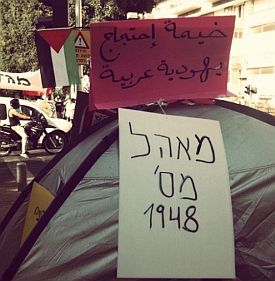
If you are Palestinian, it will be difficult to find anything to identify with in Tel Aviv’s tents’ city, until you reach Tent 1948. My first tour there was a few days ago, when I decided to join Tent 1948. Tent 1948’s main message is that social justice should be for all. It brings together Jewish and Palestinian citizens who believe in shared sovereignty in the state of all its citizens.

For me, as Palestinian, I don’t feel part of the July 14 movement, and I’m not there because I feel part, almost every corner of this encampment reminds me that this place does not want me. My first tour there was pretty depressing, I found lots of Israeli flags, a man giving a lecture to youth about his memories from ’48 war’ from a Zionist perspective, another group marching with signs calling for the release of Gilad Shalit, another singing Zionist songs. This is certainly not a place that the 20% of the population would feel belong to. The second day I found Ronen Shuval, from Im Tirtzu, the extreme right wing organization giving a talk full of incitement and hatred to the left and human rights organizations. Settlers already set a tent and were dancing with joy.

The existence of Tent 1948 in the encampment constitutes a challenge to people taking part in the July 14 movement. In the first few days, the tent was attacked by group of rightwing activists, who beat activists in the tent and broke down the Palestinian flag of the tent. Some of the leaders of the July 14 movement have said clearly that raising core issues related to Palestinian community in Israel or the occupation will make the struggle “lose momentum”. They often said the struggle is social, not political, as if there was a difference. They are afraid of losing supporters if they make Palestinian issues bold.

The truth is that this is the truth.

The truth is, this is exactly what might help Netanyahu, if he presses the button of fear, recreates the ‘enemy’ and reproduce the ‘security threat’, he might be able to silence this movement. The problem is not with Netanyahu, he is not the first Israeli leader to rely on this. The main problem is that Israelis are not ready yet to see beyond the walls surrounding them.

Facebooktwittermail

Israeli army attacks Dutch street band with tear gas

Palestine News Network reports:

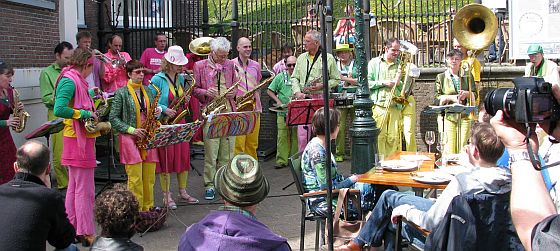
The Dutch street orchestra ‘Fanfare van de Eerste Liefdesnacht’ (the First Night of Love Brass Band) from Amsterdam was attacked with tear gas today by the Israeli army during their performance in the Palestinian village Kufr Qadum near Nablus, northern West Bank.

The bands tour of Palestine is designed to be interactive, working with children from a refugee camp in the east of Bethlehem and having them play along with the band and dancing in the streets together.

The musicians were confronted with tens of soldiers who shot tear gas cannisters from behind their military jeeps during the musical performance. They then found themselves surrounded with snipers. Several members of the band were injured and suffered from tear gas inhalation.

Kufr Qadum is a village near Nablus that has suffered in recent years from radical jewish settlers who have attacked the villagers, cut down olive trees and set fire to fields. The roads that lead to the village are often blocked by Israeli military checkpoints.

The Dutch music orchestra has travelled around the West Bank for a duration of two weeks to perform in towns, villages and refugee camps. The band consists of 25 musicians with different musical instruments. They were invited by the town council of Kufr Qadum to perform in the village.


Fanfare van de Eerste Liefdesnacht performing ‘Unadikum’ at Yabous Festival in East Jerusalem

Facebooktwittermail

Philip Weiss responds to DailyKos censorship and smear

At Mondoweiss, Philip Weiss writes:

DailyKos has acted to ban commenters from linking to Mondoweiss, charging me with anti-Semitism. It is a disgraceful smear and hides DailyKos’s real anxiety: it cannot deal with the issue of Palestinian human rights, any more than the Democratic Party can, and so Israel supporters are striking at me.

Their point of attack is my repeated insistence on talking about the large Jewish presence in the American establishment and the importance of Jewish money in the political process. Such an attack was inevitable, and in that sense I welcome it. For while these are delicate issues, they are important ones. I have often expressed my own discomfort with them, and yet I advance them in the discourse because as a journalist I recognize that they meet an ancient test of what is newsworthy: these issues are new, true, and important. Were they merely new and true, I would ignore these issues. But their importance has put them in my road, and I can’t shy away from discussing them, and DK’s smear gives me an opportunity to revisit my thinking.

Why is the Jewish prominence in the American establishment an important issue? For a few reasons. 1, it is a development I witnessed myself and celebrate as a Jew. When I was growing up, we were excluded from the turrets of the American system by anti-Semitism. Today that is not the case. Jews should recognize this new reality, celebrate it, and yes, allow it to affect our consciousness of our unfolding historical position in western society. 2, It deeply affects Middle East policy, which is the true source of my difference with Daily Kos; I believe you cannot talk about the Israel lobby without addressing the Jewish presence in the establishment. And following directly from that, 3, the Jewish presence is not neutral– no, sadly (and because of the Holocaust), my community has been indoctrinated with Zionism.; as J Street’s Steven Krubiner said the other night, Jewish identity education includes Loving Israel. Well, I think Zionism is a form of anachronistic nationalism that has served to oppress the Palestinians and helped lead my own country into war, and in seeking to uproot Zionism inside Jewish life, I have repeatedly pointed out that the ideological basis of Zionism is the idea that we are unsafe in the west, a claim that is patently absurd in the face of our achievement in the United States and our prominence in the establishment– which everyone knows about and accepts, but DailyKos finds it anti-Semitic even to mention.

Facebooktwittermail

When is Palestine’s Arab revolution?

Larbi Sadiki writes:

‘Parity of esteem’ is the name of the game – and finding a way to overcome inter-communal conflict matters. It matters because the Arab state has failed three basic tests: provision of security, provision of welfare, and distribution of power.

However, as the literati carry on unpacking the still-unfolding Arab revolution, one dimension is missing from this ongoing investigation which must be highlighted: The Palestinian corollary.

Observers have been hasty in dismissing Palestine from the Arab revolution. I argue here that it was one of many dynamics, definitely one of the final straws that broke the back of an already heavily weighed down camel.

Two betes noires of international politics loomed large, by negation and denial, in much of the early diagnosis of the Arab revolution.

Islamists and the Palestinian cause were written off as inconsequential in the Arab revolution. The first is of issue to secularists, Westernisers and many Westerners. The second is of concern for those concerned about the Arab revolution’s implications for Israel.

Facebooktwittermail

Palestinian teens arrested by Israelis for playing soccer?

Mairav Zonszein reports:

While Israelis are busy pitching tents across the country, in the East Jerusalem neighborhood of Silwan, life under occupation goes on as usual, far away from the media’s eyes. In the shocking footage below, taken with a surveillance camera last Friday, July 22, Palestinian teens playing soccer in the street are suddenly abducted by Israeli soldiers in an undercover vehicle and hauled away. Whether guilty of stone throwing or not, this is not the way to go about conducting justice in a country’s capital.

As Sloveninan philosopher Slavoj Zizek has expressed many times, when there are no big headlines in the news about confrontations between Israelis and Palestinians, one should assume the mundane atrocities of daily occupation are taking place, in what is a very asymmetrical conflict.

Facebooktwittermail

‘Please continue to be with us’ –a Palestinian’s letter to int’l supporters

Mondoweiss has a letter from a Palestinian woman to the supporters of Palestine:

I would like to talk to you as the voice of the thousands of Palestinians who appreciate what you are doing. You who have a great commitment to human rights and who actually act upon your beliefs, you risk your life to both witness and tell the truth of what you see. You are a group of people who understand what is happening in the holy land and have decided to dedicate your time, money and energy to the issue. You demonstrate that religion nor race is important when it comes to standing up for the rights of human beings. And every step you take justice and humanity wins.

I want you to trust that your actions are making a difference and changing the violence we see here in our land. Your solidarity is helping fuel our nonviolent fight. Palestinians face many kinds of violence and torture. However, being ignored is the worst punishment of all. Those who refuse to hear and see us are just as bad as those who occupy us. Those who stand in solidarity with us send a strong message of humanity and are helping us to overcome our suffering. In the middle of all this crisis, your help puts a smile on our face. From this smile you will always be welcome in our hearts even if you are unable to enter our land.

Your solidarity reminds the world that we are all one human family and that we Palestinians are still part of it. Please do not give up. Even if your boats do not make it to the shores of Gaza or if your planes refuse to fly, the unseen effects are still huge.

I want to say thank you for all that your work involves. Thank you for booking your tickets, taking time off from work, leaving your loved ones, and for all of the other small things, I am truly grateful.

Please continue to be with us, hand in hand, in our non-violent struggle. We need to reach the end of the path of occupation and your presence on this journey is crucial, we cannot make it alone.

I hope one day to share a coffee with you in my home or in yours, for when this day comes we will have reached our freedom.

Facebooktwittermail

Palestinians are preparing for September, but is Israel?

Avi Issacharoff and Amos Harel write:

In a little more than two months, the United Nations General Assembly is scheduled to discuss the Palestinian Authority’s request for recognition of a Palestinian state within the June 4, 1967 boundaries. But for now, the Palestinian public is preoccupied with a range of other issues that have nothing to do with the occupation, the settlements or a popular uprising.

On Sunday, a World Cup preliminary qualifying match between Palestine and Afghanistan, played at Al-Ram stadium north of Jerusalem, ended in a 1-1 draw. In a previous round the Palestinians won 2-0, thus keeping their hopes alive, and now need a win against Thailand to move into the next round.

That same day, Palestinian Prime Minister Salam Fayyad announced that civil servants would receive only half their salaries because funds promised by Arab donor states have not arrived. And on Tuesday, Hebron held elections for its chamber of commerce. Nearly 2,000 residents voted in what was perceived as a cross-clan battle of generations over the city’s economic future. Not a word was said about an intifada or the occupation.

Also on Sunday, however, the Ramallah-based Palestinian Center for Policy and Survey Research, headed by Dr. Khalil Shikaki, conducted a simulation exercise relating to the September vote. The participants, past and present senior figures from the PA and Fatah, assumed the roles of representatives of the PA and the U.S. administration, and other key international figures. Three Israelis were also invited (including one of this column’s co-authors ), who, alongside a Palestinian academic, played the Israeli government. Senior Hamas figures in the West Bank were invited to participate but refused because of the Israeli presence. The proceedings were held in Arabic.

In the first scenario, on the day of the UN vote, the United States and the European Union present separate initiatives to have the matter struck from the General Assembly agenda. Washington suggests recognizing a Palestinian state without setting its borders or capital; the EU suggests postponing the vote by a year, recognizing that negotiations between Israel and the Palestinians will be based on the 1949 armistice lines, and stipulating that if the parties do not reach an agreement within a year, the EU will recognize a Palestinian state within the 1967 boundaries, with Jerusalem as its capital. The Palestinian team rejects both initiatives. The Israeli team accepts the U.S. proposal and rejects the EU proposal.

The second scenario predicts an outburst of violence the day after the UN vote: The Israeli army kills seven Palestinians at a demonstration at Qalandiyah, north of Jerusalem. In response young, albeit unarmed Palestinians hold another demonstration there, and block the road to the Beit El settlement. Simultaneously, Islamic Jihad launches Grad rockets from Gaza into Be’er Sheva.

The second scenario seemed a bit far-fetched at first. However, a poll Shikaki released 10 days ago casts things in a different light: It showed that 65 percent of respondents support the UN initiative. Moreover, 52 percent say they will take part in “peaceful” demonstrations and processions to Israeli checkpoints after the vote; 76 percent want the PA to be active in Area C (which is under full Israeli control ) after the state is recognized – for example, by building airports, roads and housing, and deploying security forces – even if this means a confrontation with Israel. Fully 75 percent support the deployment of Palestinian security forces at the Allenby Bridge across the Jordan River, even if this means the West Bank’s only access to the outside world will be closed for a few months. In other words, it is hard to say who will set the tone: the public or the leadership.

The third scenario has dozens of Palestinians killed and hundreds wounded by Israeli fire in West Bank demonstrations a few weeks after the UN vote. Meanwhile, rockets are being fired at Sderot and Ashkelon, the Palestinian security services are preparing to deploy in Area C and the Allenby Bridge, and the Israel Defense Forces has begun to take action against PA forces.

In this simulation the Israeli side proposes a cease-fire followed by direct negotiations on the basis of the 1967 boundaries, in return for Palestinian recognition of Israel as the Jewish state. The PA rejects this outright as unacceptable.

The Palestinian team’s curiosity was piqued when the “Israeli” side established a national unity government with opposition leader Tzipi Livni. Seeming somewhat enthusiastic, the Palestinians noted that this might change the picture, since Livni is trusted by Palestinian President Mahmoud Abbas and his aides. However, the enthusiasm faded when it became clear that Foreign Minister Avigdor Lieberman would remain in the government (Lieberman was played outstandingly by a Palestinian ).

The simulation was broken off prematurely due to lack of time. Still, a number of interesting conclusions can be drawn from it. First, a new intifada is not inevitable. A flare-up may occur in September or shortly afterward, but much depends on the behavior of the IDF and the police; minimizing the casualties will help contain a confrontation. While there were relatively few participants earlier this year in the Nakba Day (commemorating 1948 ) and Naksa Day (commemorating 1967 ) protests, the September events will be on a larger scale.

The second conclusion is that the Palestinian leadership, like the Israeli government, does not want a violent, all-out confrontation.

Third, public opinion on both sides, along with the Arab and Israeli media, will play a crucial role (even more than in the past ) vis-a-vis the leaders’ policy at this critical time – which may also reflect something about the character of the leaders on both sides.

The fourth conclusion is that bringing Livni into the government, even one led by Benjamin Netanyahu, could substantially change the relationship with the Palestinians.

And the final conclusion: It’s very possible that Netanyahu will decide to undertake the same measures he is avoiding at present (i.e., a renewed construction freeze in the settlements, or negotiations on the basis of the 1967 boundaries ) after blood is shed.

Facebooktwittermail

Dangerous middle-aged Englishwoman enters Israel — security forces on high alert

Haaretz reports:

A group of 25 people suspected to be pro-Palestinian activists arrived at Ben-Gurion International Airport on Friday night, and were expected to be denied entry to Israel.

The suspected activists arrived on a Lufthansa flight from Frankfurt late Friday night, after their flight’s departure was delayed due to runway improvement work being conducted at Ben-Gurion International Airport on Friday evening from 19:00 to 22:00.

The activist aboard the plane were not on the list of 342 blacklisted passengers submitted by the Transportation Ministry to foreign airlines on Thursday, and as such were able to board the plane.

Earlier in the day, police called Friday’s operations at Ben-Gurion Airport “successful” as most of the activists were identified and taken for questioning during the afternoon hours.

Not including those passengers who arrived on the Lufthansa flight, a total of 310 arriving passengers were questioned by the Immigration and Population Authority. Sixty-nine of those passengers were found to be “fly-in” activists and were denied entry to Israel. The others were found to be regular tourists and were permitted entry.

At this time, four of the 69 activists have been deported to their home countries. The rest have been sent to detention facilities until they can be deported.

Ten of the activists arrived on an easyJet flight, while another 20 came on an Alitalia flight. The rest arrived on other flights.

Israel has thus far been successful in preventing the entry of 200 passengers wishing to come to Israel as part of the Welcome to Palestine campaign, which had organized a “fly-in” to the Middle East this weekend for solidarity visits in the Palestinian territories.

Israel Police estimate that the bulk of events related to the pro-Palestinian ‘fly-in’ have ended.

Facebooktwittermail