Category Archives: Palestinians

Tony Judt: Israel is a country fast losing touch with reality

On July 6, 2010, a month before Tony Judt died and shortly after Israel’s deadly attack on the Mavi Marmara, he was interviewed by Merav Michaeli, a columnist for Ha’aretz.

Merav Michaeli: How do you see Israel’s actions in the Flotilla affair?

Tony Judt: The characterization that comes to mind is “autistic.” Israel behaved in a way that suggests it is no longer fully able to estimate, assess or understand the way other people think about it. Even if you supported the blockade (I don’t) this would be an almost exemplary case of shooting oneself in a painful part of the anatomy.

Firstly because it alienates Turkey, who Israel needs in the longer run. Secondly because it was undertaken in international waters and largely at the expense of civilian victims. Thirdly because it was an overreaction. Fourthly because it had the predictable effect of weakening the case for a blockade rather than strengthening it.

In short, this is the action of a country which is fast losing touch with reality.

Michaeli: The raid on the flotilla was far from being the worst of Israel’s behavior over 40 years of occupation, yet the international response to it was the most grievous. Why do you think that is?

Judt: I agree. But what happens in small West Bank towns, in the Israeli Parliament, in Gazan schools or in Lebanese farms is invisible to the world. And Israel was always very good at presenting the argument from “self-defense” even when it was absurd. I think that Israel’s successful defiance of international law for so long has made Jerusalem blind and deaf to the seriousness with which the rest of the world takes the matter.

Finally there is the question of cumulation. From the Six Day War to Lebanon, from Lebanon to the settlements, from the settlements to Gaza, Israel’s credibility has steadily fallen – even as the world’s distance from Auschwitz (the favorite excuse) has lengthened. So Israel is far more vulnerable today than it would have been twenty five years ago.

Michaeli: What do you tell those who say Israel has willingly withdrawn from Gaza and everything that has happened since proves the Israeli claim that there’s no partner for an agreement?

Judt: I tell them that they are talking nonsense, or else prevaricating. Israel withdrew from Gaza but has put it under a punishment regime comparable to nothing else in the world. That is not withdrawal. And of course we all know that there are those who would like to give Palestinians “independence” but exclude Gaza from the privilege. That too was part of the purpose of the withdrawal.

There is a partner. It may not be very nice and it may not be very easy. It’s called Hamas. In the same way the provisional [Irish Republican Army] was the only realistic “partner for peace” with whom London could negotiate; Nelson Mandela (a “terrorist” for the Afrikaaners until his release) was the only realistic “partner for peace”; the same was true of “that terrorist” ([according to Winston] Churchill) Gandhi; the well-known “murderous terrorist” Jomo Kenyatta with whom London fought a murderous war for five years before he became “a great statesman”; not to mention Algeria. The irony is that Washington knows this perfectly well and expects negotiations with Hamas within five years. After all, Israel virtually invented Hamas in the hope of undermining the PLO; well, they succeeded. But they are the only ones who can’t see what has to happen.


Facebooktwittermail

Erdogan calls for a secular Egypt

Al-Masry Al-Youm reports:

Turkish Prime Minister Recep Tayyip Erdogan on Monday called on Egyptians to adopt a secular constitution, noting that secularism does not mean renouncing religion.

A secular state respects all religions, Erdogan said in an interview with the private satellite TV channel Dream before heading to Egypt for a two-day visit.

“Do not be wary of secularism. I hope there will be a secular state in Egypt,” Erdogan said.

He stressed that people have the right to choose whether or not to be religious, adding that he is a Muslim prime minister for a secular state.

Erdogan said Egypt needs to meet some requirements for establishing a modern state, including better management of human resources, more attention to education, improved management of financial resources and eliminating corruption.

Today’s Zaman reports:

Erdoğan, visiting Egypt at the start of a North Africa tour, said Israel continued taking steps that undermine its own legitimacy, noting that it killed nine Turks on an aid ship trying to break the blockade of Gaza last year and more recently shot dead five Egyptian soldiers.

He reiterated that a UN report defending the Israeli blockade of Gaza as legal was “null and void” for Turkey and insisted that Turkey’s relations with Israel will not return to normal unless Israel apologizes for the 2010 raid, pay compensation for families of the victims and lifts the blockade of Gaza.

“Turkey does not recognize the Gaza blockade,” Erdoğan said, reiterating that Turkey will take measures to ensure freedom of navigation in the eastern Mediterranean and vowed that Turkey will press for an International Court of Justice review of the blockade.

“States, just like individuals, have to pay the price for murders, for acts of terrorism they committed so that we can live in a more just world,” he said.

The Turkish prime minister also said the Israeli-Palestinian conflict was a “matter of humanity” and added that the current status quo can no longer be maintained. He vowed support for Palestinian efforts for recognition at the UN General Assembly. “Our Palestinian brothers should be able to have their own state. It is time for the flag of Palestine to fly at the UN,” he said, calling on the Arab League countries to support the Palestinian bid.

The paper also reports:

Turkey’s Military Electronics Industry (ASELSAN) has produced a new identification friend or foe (IFF) system for Turkish jet fighters, warships and submarines and the new software, contrary to the older, US-made version, does not automatically identify Israeli planes and ships as friends, a news report said on Tuesday.

The new IFF has already been installed in Turkish F-16s and is expected to be installed in all Navy ships and submarines, the report, published in Turkish daily Star, said. It will be fully operational when it is installed in all military planes, warships and submarines.

The F-16 jet fighters, purchased from the US, came with pre-installed IFF software that automatically identifies Israeli fighters and warships as friends, disabling Turkish F-16s from targeting Israeli planes or ships. ASELSAN-made IFF will allow Turkish military commanders to identify friends and foes on the basis of national considerations.

Turkey was unable to make modifications to the friend or foe identification codes in US-made F-16s, while Israel was given a different version of the software allowing Israeli authorities to make modifications. Israel was also authorized to view the version given to Turkey, according to Star.

Facebooktwittermail

Jordan king: Palestinians have more secure future than Israel

Haaretz reports:

Jordanian King Abdullah II said Monday that Israel’s position in the Middle East has deteriorated in the wake of the recent wave of Arab uprisings, telling a group of intellectuals that the Palestinians now have a “more secure future” than Israel.

Israel’s position is “more problematic than it has been in the past”, Abdullah told the group of authors and academics gathered at the royal palace in Amman, according to Army Radio.

The Jordanian king told the group that he had expressed these views on a recent visit to the United States. An Israeli intellectual told the king that he believed that the Arab Spring would serve Israeli interests, whereupon Abdullah answered he felt that the opposite would be true.

King Abdallah also related to proposals advocated by some Israeli rightists that his country fulfill the national aspirations of the Palestinian people. Abdallah called this so-called “Jordanian option” an unacceptable fantasy plan. He said that Jordan can never take the place of a substitute Palestinian homeland.

The king added that no American or European official has ever pressured him to support a solution to the Palestinian refugee problem that would come at the expense of the kingdom, according to Israel Radio.

Facebooktwittermail

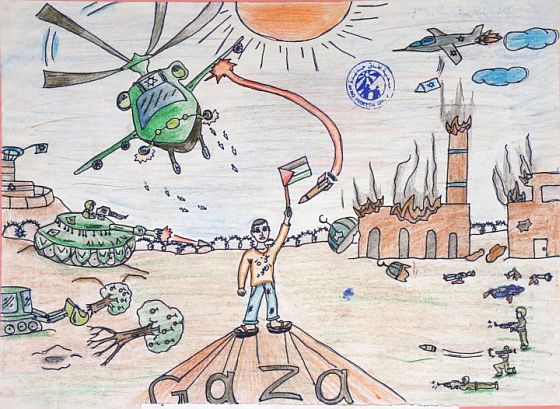
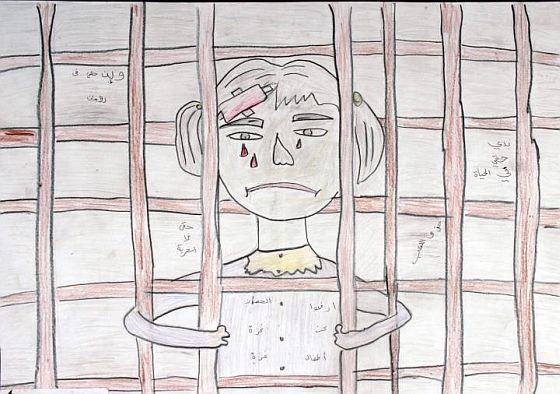
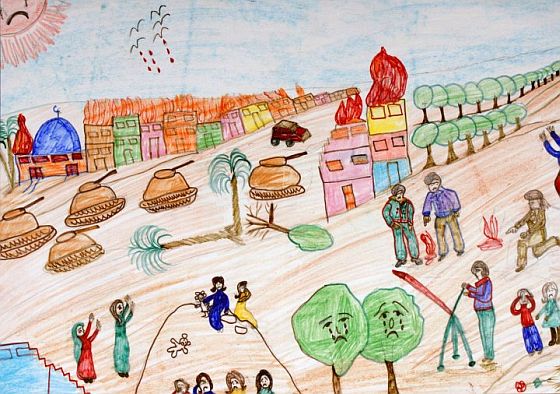
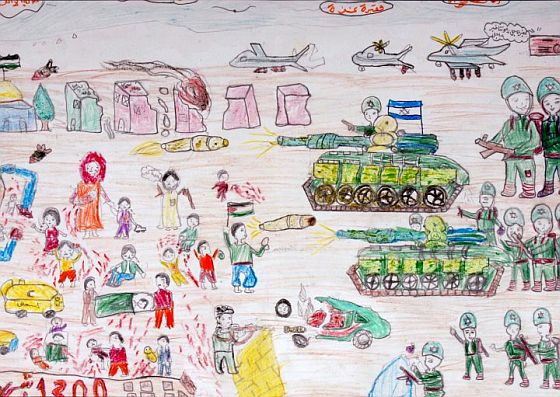
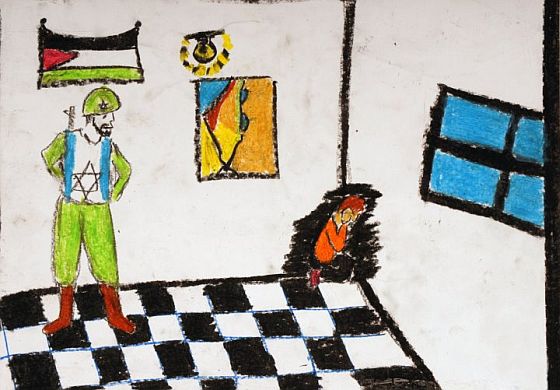
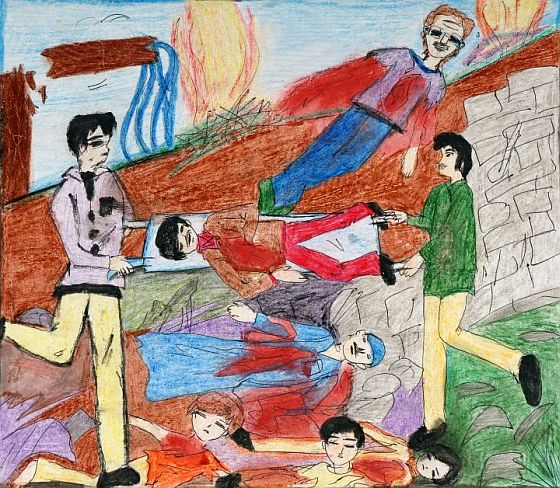
‘A Child’s View From Gaza’ — art the Israel lobby doesn’t want you to see

Cecilie Surasky at MuzzleWatch writes:

Berkeley, CA’s Middle East Children’s Alliance broke the news yesterday that the exhibit of children’s artwork from Gaza that they had worked on for months with Oakland’s Children’s Museum of Art was suddenly canceled by the board before the planned September 24 opening reception. The show featured drawings by children about Israel’s infamous Operation Cast Lead, the military assault of December 2008-January 2009 that led to the deaths of some 1,400 Palestinians, over 300 of them children.

(Check regularly at mecaforpeace.org for updates and planned actions- they won’t be taking this lying down.)

MECA said in a statement:

The Museum of Children’s Art in Oakland (MOCHA) has decided to cancel an exhibit of art by Palestinian children in the Gaza Strip. The Middle East Children’s Alliance (MECA), which was partnering with MOCHA to present the exhibit, was informed of the decision by the Museum’s board president on Thursday, September 8, 2011. For several months, MECA and the museum had been working together on the exhibit, which is titled “A Child’s View From Gaza.”

MECA has learned that there was a concerted effort by pro-Israel organizations in the San Francisco Bay Area to pressure the museum to reverse its decision to display Palestinian children’s art.

Barbara Lubin, the Executive Director of MECA, expressed her dismay that the museum decided to censor this exhibit in contradiction of its mission “to ensure that the arts are a fundamental part of the lives of all children.”

“We understand all too well the enormous pressure that the museum came under. But who wins? The museum doesn’t win. MECA doesn’t win. The people of the Bay Area don’t win. Our basic constitutional freedom of speech loses. The children in Gaza lose,” she said.

“The only winners here are those who spend millions of dollars censoring any criticism of Israel and silencing the voices of children who live every day under military siege and occupation.”

More artwork can be viewed at the Middle East Children’s Alliance Facebook page.

Facebooktwittermail

As ties with Turkey collapse, Israeli politicians, media and intelligence push for more conflict

Max Blumenthal writes:

The “Periphery Doctrine” has been a cornerstone of Israel’s strategic approach to the Middle East since the state’s foundation. Devised by David Ben Gurion and Eliahu Sassoon, an Israeli Middle East expert who became Israel’s first diplomatic representative in Turkey, the doctrine was based on maintaining alliances with non-Arab states and ethnic minorities in the region as a counterweight to pan-Arabism. Though three countries — Iran, Ethiopia, and Turkey — became key regional allies of Israel, Ben Gurion was keenly aware that the relationships were temporary, and could not substitute for peace with Israel’s Arab neighbors (something Ben Gurion ironically tried to manufacture through his “activist” foreign policy of unilateral military strikes and disproportionate force). From Turkey’s perspective, the relationship with Israel was never a proper strategic alliance, but rather a means of establishing leverage against nationalistic Arab governments.

This week’s events delivered the death knell to the terminally ill Periphery Doctrine. Following the Palmer/Uribe report’s factually flawed claims about the legality of Israel’s siege on the Gaza Strip and Israeli Prime Minister Benjamin Netanyahu’s refusal to apologize for Israel’s execution-style massacre of 9 activists on the deck of the Mavi Marmara — “We need not apologize!” the Prime Minister boomed three times during a recent press conference — the Turkish government significantly downgraded its relations with Israel. Turkey not only expelled Israel’s ambassador from Ankara, it suspended all military relations between the two states. Turkish Prime Minister Recep Tayyip Erdogan has suggested further sanctions will follow, exposing Netanyahu’s bravado as empty and self-destructive.

Though Netanyahu claimed today in a speech that “we sincerely want improved relations” with Turkey, he reiterated his refusal to apologize. The optics of the speech, which featured Netanyahu addressing a crowd of naval officers and hailing the bravery of the commandos who stormed the Mavi Marmara, were calculated to project an image of defiance. Meanwhile, elements in the Israeli political arena, security establishment and media are cultivating public opinion for an open conflict with Turkey, and with no apparent shortage of enthusiasm.

Facebooktwittermail

Israel’s idea of ‘tolerance’ when facing non-violent Palestinian protesters

Reuters reports:

Brigadier-General Michael Edelstein, the officer crafting Israel’s counter-demonstration doctrines, said troops were now better equipped and trained to police the occupied West Bank and the boundaries with Gaza, Lebanon and Syria.

“The balance has changed. We have more means that we can use, therefore the use of lethal weapons will decrease,” he told foreign reporters in a briefing.

He said there was no plan to reinforce military garrisons, which had been practicing non-lethal riot control techniques.

Israel has also invested heavily in riot-dispersal gear including accurate tear-gas launchers, high-powered loudspeakers that emit an intolerable buzzing noise, and cannons for dousing crowds with water or a foul-smelling liquid known as “skunk.”

The objective, Edelstein said, was “to be able to handle riots while diminishing casualties on both sides.”

Asked if this meant that Israeli forces, accused in the past of shoot-on-sight policies against Palestinians, would now show more tolerance, he said: “Much more tolerance.”

Facebooktwittermail

Wikileaks: Israeli army thinks violence is the best response to non-violence

Joseph Dana writes:

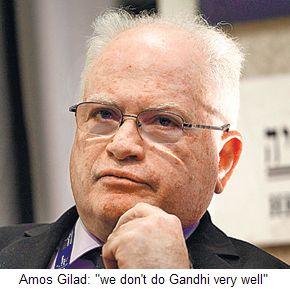
In a new wikileaks cable, Director of Policy and Political-Military Affairs at the Israel Ministry of Defense, Maj. General (reserves) Amos Gilad, told American government officials, ‘we don’t do Gandhi very well’ in reference to unarmed demonstrations taking place throughout the West Bank and specifically in Nabi Saleh. The cable confirms that the Israeli army has, in recent months, decided to increase violent pressure on the demonstrations ‘even [if the] demonstrations appear peaceful.’

In the cable, titled “IDF PLANS HARSHER METHODS WITH WEST BANK DEMONSTRATIONS” and labeled confidential, the Israeli army is portrayed as fed up with the demonstrations and likely to engage in harsh repression if the demonstrations continue or grow.

The cable sent February 12, 2010:

C O N F I D E N T I A L TEL AVIV 000344

SIPDIS

E.O. 12958: DECL: 02/12/2020
TAGS: PREL MOPS KWBG IS
SUBJECT: IDF PLANS HARSHER METHODS WITH WEST BANK
DEMONSTRATIONS

Classified By: Deputy Chief of Mission Luis G. Moreno for reasons 1.4 (
b) and (d).

¶1. (C) In meetings with U.S. officials on February 4, OC
Central Command MG Avi Mizrachi expressed frustration with
on-going demonstrations in the West Bank, which he believes
are being orchestrated to increase tensions. Mizrachi, whose
area of responsibility includes all of the West Bank and
Central Israel, warned that the IDF will start to be more
assertive in how it deals with these demonstrations, even
demonstrations that appear peaceful.

¶2. (C) After visiting two of these “so-called peaceful
demonstrations,” Mizrachi said he did not know what they were
about; the villages were not near the barrier and they had no
problems with movement or settlers. Mizrachi asserted that
the Palestinian villagers also do not know the reason for the
demonstrations and said that they were only demonstrating
because they were told to do so.

¶3. (C) Mizrachi warned that he will start sending his trucks
with “dirty water” to break up these protests, even if they
are not violent, because they serve no purpose other than
creating friction. (NOTE: dirty water is a reference to the
IDF’s chemically treated water that duplicates the effects of
skunk spray. End note.) Mizrachi said he heard rumors that
Palestinian PM Salam Fayyad was planning to attend one of
these protests, adding that if Fayyad gets sprayed with dirty
water, it will make everyone look bad.

¶4. (C) On orders from Mizrachi, West Bank commander BG
Nitzan Alon and West Bank civil administrator BG Poli
Mordechi reportedly met with the Palestinian security force
commanders recently to deliver a strong message that they
must stop these demonstrations or the IDF will. Mizrachi
asserted that he would prefer not to break up these
demonstrations, but will if he must. Many of the
demonstrations are organized by “suspicious people,” Mizrachi
said, and he plans on arresting organizers of demonstrations
that “serve no purpose” beyond exciting the population.

¶5. (C) COMMENT: Less violent demonstrations are likely to
stymie the IDF. As MOD Pol-Mil chief Amos Gilad told USG
interlocutors recently, “we don’t do Gandhi very well.” The
IDF impatience with these demonstrations may also be
connected to the recent arrests of foreign NGO workers with
expired or solely tourist visas who have been attending, and
often organizing, the protests. The GoI reportedly ceased
issuing B1 work visas to the foreign staff of NGOs working in
the occupied territories; for several months now it has
restricted them and their families to B2 visitor visas with
varying durations and sometmies limited to single-entry. On
February 10, officials from the MOI immigration enforcement
unit (the “Oz” unit) told PolOff that they made the arrests
of NGO workers in the West Bank at the request of the IDF.
However, the court ruled that the Oz unit cannot operate
beyond the Green Line, and subsequently released the
detainees, who were mostly European. The Oz unit officials
told PolOff that they will not challenge that ruling and have
no further operations planned in the West Bank. END COMMENT.
Cunningham

Facebooktwittermail

The problem with Palestinian political leadership

Ben White writes:

For a few months now, discussion of Palestine/Israel has focused on the looming UN vote on Palestinian statehood, but this is obscuring more fundamental problems in the Palestinian political arena – of which the forthcoming UN vote is a symptom.

In three critical areas, there are significant flaws hampering Palestinian political leadership.

The first is a legitimacy deficit. Both the Fatah-dominated Palestinian Authority and Hamas have, with the most generous interpretation, a minority mandate from the Palestinian people. The last elections of any sort took place in 2005-2006, and overdue local elections have been indefinitely postponed. And even if presidential or parliamentary elections in the West Bank and Gaza were to take place tomorrow, they would still exclude Palestinian refugees. The Palestine Liberation Organisation (PLO) remains a potential vehicle for democratic decision-making, but serious reform is still not on the horizon.

The second critical problem is a lack of creativity and strategic thinking when it comes to tactics. This has a number of root causes which are beyond the scope of this article but the main point is a marked inability to adapt to circumstances with regard to the kind of smart resistance most appropriate for confronting Israeli colonisation. This is more than simply an issue of “violent” versus “nonviolent” (a discussion often plagued by patronising western double standards).

Fear of losing control over the course of events can be one factor inhibiting an openness to change – which brings us to the third problematic area: a focus on power for its own sake rather than for the achievement of a specific goal.

This criticism applies to both Fatah and Hamas, though the former has been guilty of it for a longer period of time and with more devastating consequences. Over the past five years or so, the conflict between these two factions has frequently resembled a fight for who can occupy the Bantustan palace, rather than who can serve most effectively the unfinished Palestinian revolution.

This fight for fake authority has resulted in a dangerous phenomenon: the harassment of youth activists (such as the 15 March movement) and dissidents in the West Bank and Gaza. The growing expressions of dissatisfaction, particularly from young Palestinians, have contributed to a hardening grip on power by two regimes that fear they stand to lose from an overhauled democratic system.

Facebooktwittermail

New Palestinian strategy document will make it difficult for U.S. to oppose UN vote

Akiva Eldar writes:

Prime Minister Benjamin Netanyahu is probably aware that when it comes to a media event, like a speech at the UN General Assembly, President Shimon Peres doesn’t have to be asked twice to sacrifice himself for the nation. Someone who has been watching the honorable president for decades once told me that Peres is blessed with a unique characteristic: He always knows how to adjust reality according to his needs at the time.

So Peres will easily be able to convince himself that the nation ‏(if not the entire universe‏) is demanding that he travel to New York next month to represent the prime minister at the assembly declaring a Palestinian state. But this time Peres is expected to face opposition from close associates.

“How can Peres promise the world that Netanyahu has accepted the two-state solution based on the 1967 borders when he himself has long since lost his faith in Netanyahu’s intention of reaching such an agreement?” asked one of them. The source adds, “Can the president repeat the words he said in the spring of 2009 at the AIPAC conference in Washington, to the effect that Netanyahu wants to make history and peace is his primary interest?”

It’s true that Netanyahu is making history. On his watch the UN General Assembly is expected to recognize an independent Palestinian state by a huge majority. The wording of the draft, crafted in recent days by the Fatah leadership, is designed to enable even “problematic” countries such as Germany, Italy, the Netherlands and the Czech Republic to climb on board, or at least abstain.

This version will make it difficult for the United States and the Marshall Islands, and even for Israel, to explain their votes against the proposal. Instead of recognizing Palestine within the 1967 borders, it will state that the permanent borders will be determined in negotiations with Israel based on the borders of June 4, 1967. This approach made it possible to enlist the support of leading moderates in Hamas, who claim that recognition of the 1967 borders before the signing of a final-status deal means waiving the claim to the right of return.

Several of those people are signatories to a new strategic position paper, drafted by more than 50 Palestinian government officials, researchers and advisers − members of the Palestine Strategy Group. This is the forum that in 2008 composed a document recommending that the leadership transfer the conflict to the United Nations.

The new document presents the Palestinian strategy both before and after the UN vote.

Among the participants in the group’s workshops over the past year in Jericho, Gaza and Istanbul were Omar Abdel Razek, the former finance minister in the Hamas government in the West Bank, and Nasser al-Shaer, that government’s education minister. Next to them sat senior Fatah officials including associates of Palestinian President Mahmoud Abbas − former Foreign Minister Nabil Shaath and senior adviser Mohammad Shtayyeh. Other signatories are Naser al-Kidwa, a former Palestinian observer at the United Nations, Fatah Deputy Secretary General and Communications Minister Sabri Saydam, and former economics minister and businessman Mazen Sinokrot.

Already in the preface, the authors stress that “strategic unity,” now greatly enhanced by the reconciliation process, is a key condition for putting together an effective strategy. The document’s starting point: Given the Israeli government’s intransigence, the option of settling the conflict via bilateral negotiations − the path pursued by the Palestinian leadership for 20 years − is no longer available.

Most of the document’s authors support the option of an independent Palestinian state within the 1967 borders, with Jerusalem as its capital and a fair arrangement that will fulfill the right of return and the compensation of the Palestinian refugees. The document rejects the possibility of continuing the status quo, maintaining that the endless negotiations provide cover for expanding the settlements and consolidating the occupation. The authors also erase from the agenda the option of a Palestinian state with temporary borders and limited sovereignty, under effective Israeli control.

If the strategy of a diplomatic struggle for Palestinian independence − including sanctions, turning to the International Criminal Court and nonviolent resistance as in Egypt and Tunisia − does not change the situation, the group recommends switching to what the document calls Plan B: dismantling the Palestinian Authority and restoring responsibility for the West Bank’s inhabitants to Israel. The authors are not ignoring the price their public would pay for that, but wonder what honorable option would remain.

If it turns out that this option is unattainable, the authors recommend working toward a model of a binational state or democratic state without distinction between Israel and Palestinian citizens. Another possibility is a confederation between Jordan and the Palestinian state.

The authors recommend explaining to the Israelis that they must forget the plan for unilateral withdrawal from the West Bank, with restrictions on the movement of Palestinians, and the dream of annexing Gaza to Egypt and the West Bank to Jordan.

They hope their neighbors will understand that the realistic alternatives to a genuine negotiated settlement will be far worse for Israel’s security.

Most participants in the workshops rejected an armed struggle against a foreign occupation and especially the use of violence against civilians. But the authors warn that a change in strategy from an attempt to achieve political independence to a conflict like the anti-apartheid struggle in South Africa will play into the hands of extremists in the region.

“Should this happen, not just Israel’s legitimacy will be under threat, but its very existence, ” they conclude. “And this will have been brought about by Israel itself.”

Facebooktwittermail

IDF training Israeli settlers ahead of ‘mass disorder’ expected in September

Haaretz reports:

The IDF has conducted detailed work to determine a “red line” for each settlement in the West Bank, which will determine when soldiers will be ordered to shoot at the feet of Palestinian protesters if the line is crossed. It is also planning to provide settlers with tear gas and stun grenades as part of the defense operation.

The IDF is currently in the process of finalizing its preparations for Operation Summer Seeds, whose purpose is to ready the army for September and the possibility of confrontations with Palestinians following the expected vote in favor of Palestinian statehood at the UN General Assembly.

According to a document acquired by Haaretz, the main working assumption of the defense establishment is that a Palestinian declaration of independence will cause a public uprising “which will mainly include mass disorder.”

The document states the disorder will include “marches toward main junctions, Israeli communities, and education centers; efforts at damaging symbols of [Israeli] government.

Also, there may be more extreme cases like shooting from within the demonstrations or even terrorist incidents. In all the scenarios, there is readiness to deal with incidents near the fences and the borders of the State of Israel.”

As part of its preparations, the IDF is investing a great deal of effort in preparing the settlers for the incidents, with the main concern being confrontations between Israeli settlers and the Palestinians.

Yesterday the army held training sessions for the chief security officers of settlements at a military installation near Shiloh. In recent weeks the IDF has been training the readiness squads of settlements at the Lachish base, which is used as a command training center ahead of September.

The main message the army is issuing is that the demonstrations will be controlled and that the army has sufficient forces in order to deal with every disturbance. In order to be sure, there is also a decision, in principle, to equip the chief security officers of settlements with the means for dispersing demonstrations. These would include tear gas and stun grenades, although that would create a logistical problem as there’s a shortage of means for firing that type of ammunition.

Moreover, as part of the preparations, staff work was performed in which the commander of the platoon responsible for defending each settlement patrolled the area with the chief security officer of the settlement, in order to identify weak points.

The army is establishing two virtual lines for each of the settlements that are near a Palestinian village. The first line, if crossed by Palestinian demonstrators, will be met with tear gas and other means for dispersing crowds.

The second line is a “red line,” and if this one is crossed, the soldiers will be allowed to open fire at the legs of the demonstrators, as is also standard practice if the northern border is crossed.

Facebooktwittermail

How Israel takes its revenge on boys who throw stones

The Independent reports:

The boy, small and frail, is struggling to stay awake. His head lolls to the side, at one point slumping on to his chest. “Lift up your head! Lift it up!” shouts one of his interrogators, slapping him. But the boy by now is past caring, for he has been awake for at least 12 hours since he was separated at gunpoint from his parents at two that morning. “I wish you’d let me go,” the boy whimpers, “just so I can get some sleep.”

During the nearly six-hour video, 14-year-old Palestinian Islam Tamimi, exhausted and scared, is steadily broken to the point where he starts to incriminate men from his village and weave fantastic tales that he believes his tormentors want to hear.

This rarely seen footage seen by The Independent offers a glimpse into an Israeli interrogation, almost a rite of passage that hundreds of Palestinian children accused of throwing stones undergo every year.

Israel has robustly defended its record, arguing that the treatment of minors has vastly improved with the creation of a military juvenile court two years ago. But the children who have faced the rough justice of the occupation tell a very different story.

“The problems start long before the child is brought to court, it starts with their arrest,” says Naomi Lalo, an activist with No Legal Frontiers, an Israeli group that monitors the military courts. It is during their interrogation where their “fate is doomed”, she says.

Sameer Shilu, 12, was asleep when the soldiers smashed in the front door of his house one night. He and his older brother emerged bleary-eyed from their bedroom to find six masked soldiers in their living room.

Checking the boy’s name on his father’s identity card, the officer looked “shocked” when he saw he had to arrest a boy, says Sameer’s father, Saher. “I said, ‘He’s too young; why do you want him?’ ‘I don’t know,’ he said”. Blindfolded, and his hands tied painfully behind his back with plastic cords, Sameer was bundled into a Jeep, his father calling out to him not to be afraid. “We cried, all of us,” his father says. “I know my sons; they don’t throw stones.”

In the hours before his interrogation, Sameer was kept blindfolded and handcuffed, and prevented from sleeping. Eventually taken for interrogation without a lawyer or parent present, a man accused him of being in a demonstration, and showed him footage of a boy throwing stones, claiming it was him.

“He said, ‘This is you’, and I said it wasn’t me. Then he asked me, ‘Who are they?’ And I said that I didn’t know,” Sameer says. “At one point, the man started shouting at me, and grabbed me by the collar, and said, ‘I’ll throw you out of the window and beat you with a stick if you don’t confess’.”

Sameer, who protested his innocence, was fortunate; he was released a few hours later. But most children are frightened into signing a confession, cowed by threats of physical violence, or threats against their families, such as the withdrawal of work permits.

When a confession is signed, lawyers usually advise children to accept a plea bargain and serve a fixed jail sentence even if not guilty. Pleading innocent is to invite lengthy court proceedings, during which the child is almost always remanded in prison. Acquittals are rare. “In a military court, you have to know that you’re not looking for justice,” says Gabi Lasky, an Israeli lawyer who has represented many children.

There are many Palestinian children in the West Bank villages in the shadow of Israel’s separation wall and Jewish settlements on Palestinian lands. Where largely non-violent protests have sprung up as a form of resistance, there are children who throw stones, and raids by Israel are common. But lawyers and human rights groups have decried Israel’s arrest policy of targeting children in villages that resist the occupation.

In most cases, children as young as 12 are hauled from their beds at night, handcuffed and blindfolded, deprived of sleep and food, subjected to lengthy interrogations, then forced to sign a confession in Hebrew, a language few of them read.

Israeli rights group B’Tselem concluded that, “the rights of minors are severely violated, that the law almost completely fails to protect their rights, and that the few rights granted by the law are not implemented”.

Israel claims to treat Palestinian minors in the spirit of its own law for juveniles but, in practice, it is rarely the case. For instance, children should not be arrested at night, lawyers and parents should be present during interrogations, and the children must be read their rights. But these are treated as guidelines, rather than a legal requirement, and are frequently flouted. And Israel regards Israeli youngsters as children until 18, while Palestinians are viewed as adults from 16.

Facebooktwittermail

173 Israeli investigations in the wake of the killing of 5,518 Palestinians

Gideon Levy writes:

Firas Qasqas was a gardener. Thirty-two years old and the father of three daughters, he came from his village with his family to visit his brother-in-law, who had moved to a new home in Ramallah. After an especially rainy, stormy night they woke up to a glorious sunny day and decided to go for a hike in the gorgeous valley of olives opposite the house. Yes, there are also Palestinians who love nature.

They were three hikers – Firas and his two brothers-in-law – when they saw a herd of deer fleeing down the slope. They knew that behind the herd there would also be people coming but it did not occur to them that on the heels of the deer would come hunters – in this case, people hunters. Very soon they saw a group of soldiers coming down to the valley. A few minutes later the soldiers started firing two or three rounds at them, from a very long range. Firas fell, bleeding to death. He managed to reassure his brothers in law and tell them everything was fine, they shouldn’t worry. But not long after that he started to gurgle and foam covered his mouth. At the hospital in Ramallah the young gardener expired.

That was in the winter of 2007, a relatively quiet winter. A few days after the killing I came to the valley of olive trees with his brother-in-law Jamil Mator, who was with Firas when he died. Hundreds of meters had separated the shooters and their victim. Far from there, at the dead man’s home in the village of Battir, I met the black-garbed young widow Majida and the three little orphaned girls. As her daughters blew soap bubbles inside the small room, Majida asked simply: “I want to know why he was killed because I don’t know.” And the bubbles (and the tears ) filled the room.

I too wanted to know why Firas was killed. The Israel Defense Forces Spokesman, as usual, said everything was in order. The soldiers discerned “suspicious behavior,” the three Palestinians were seen “doing something with the ground,” before the shooting they were “properly warned,” the incident was investigated “at all levels,” the conclusions have been “implemented” and the material has been sent “for review by the military prosecution.”

Four years have elapsed since then and Firas’ death has been forgotten. Since then I have reported on dozens more cases of killing in the West Bank, nearly all of which of course were sent for review by the military prosecution, which is usually the decisive phase on the way to burying the material of investigation of the truth in the IDF.

And now my colleague Haim Levinson published an astonishing piece of news in yesterday’s Haaretz. The military prosecution has decided to try the commander of a company in the reserves, Shahar Mor, “a well-known educator in the religious Zionist community,” who shot Firas in the back from a great distance and killed him.

It took the prosecution nearly four years to investigate such a clear case, the details of which cried out from the soil of the valley where the shooting of an unarmed person from an illegal distance occurred, without any danger to the soldiers, without any justification. Even this indictment would not have happened had not B’Tselem – The Israeli Information Center for Human Rights in the Occupied Territories intervened again and again, demanding the shooter be brought to trial. And this is such a rare occurrence. Data from Yesh Din – Volunteers for Human Rights show that only 8 percent of the investigations that were opened in the dark years of 2002-2009 culminated in an indictment. Only 14 people have been tried and there have been only 173 investigations in the wake of the killing of 5,518 individuals.

This is how the law enforcement mechanism of the IDF looks, with its army of investigators, prosecutors and judges, which is nothing but a ridiculous simulacrum of a justice system. In the four years that have elapsed dozens more Palestinians have been killed in the West Bank, not counting the Gaza Strip, some of them not guilty of anything. In Haaretz I documented the death of a paralyzed bean seller in Nablus, a 71-year-old accountant in Balata, a 19-year-old student in Tekoa, a woman demonstrator in Bil’in, a Palestinian policeman from Bethlehem, a laborer from the Far’a refugee camp, a laborer from the village of Sa’ir and a driver from Jerusalem who was going to pick up his family for a vacation in Eilat and was killed by scandalous shooting at his car. All of them were guilty of nothing and were killed for no reason. All of these cases are under investigation by the military prosecution, strenuous investigation that will be completed four years from now, or maybe in 40. During this time the educator, Company Commander Mor, went about teaching his students. No doubt he taught them “values,” love of the land and Jewish morality, as only religious Zionism can do. At the same time, one can guess, his conscience did not bother him much about the criminal killing of Qasqas the gardener.

Facebooktwittermail

Israeli army hasn’t the faintest idea who launched the Eilat attacks

The Real News Network‘s Lia Tarachansky asked IDF Spokesperson Lt. Colonel Avital Leibovitz how the IDF reached their conclusions about who was responsible for Thursday’s attacks near Eilat in southern Israel.

Tarachansky: On what are you basing your conclusion that this group [the Popular Resistance Committees] is responsible for the terror attacks?

IDF Spokesperson: We did not say that this group was responsible for the terror attack. We based this on intelligence information as well as some facts that [we] actually presented an hour ago to some wires and journalists. Some of the findings that were from the bodies of the terrorists, and they are using for example Kalashnikov bullets and Kalashnikov rifles are very common in Gaza —

Tarachansky: Many terrorist groups use Kalashnikovs —

IDF Spokesperson: No, not many terror groups. I’m not saying — I’m referring to the terrorists that came from Gaza.

Tarachansky: Prime Minister Netanyahu said today that the group that was responsible for the terror attack was the one that was eliminated [in Gaza] and you’re saying that’s not the case?

IDF Spokesperson: I don’t know what he said [when speaking on Israeli national television] — I’m not Prime Minister Netanyahu. I’m saying that the group came from Gaza and I’m giving you proof why it came from Gaza — how we know it came from Gaza. This is all I’m saying.

The Kalashnikov is the most widely available weapon on the planet. According to Jane’s Infantry Weapons 2009/2010 this rifle is in use in over 70 countries. An estimated 20% of all firearms available worldwide are of the Kalashnikov family.

So, the IDF says it “knows” the gunmen came from Gaza because they were using Kalashnikovs. That’s about as logical as saying they know they came from Gaza because they appeared to be Arabs.

Why then is Israel now bombing Gaza? Simply because it bombs Gaza every chance it gets. It bombs Gaza knowing that Washington will never object. It bombs Gaza because whenever Jews are killed the easiest form of revenge is to kill Palestinians — even when those particular Palestinians most likely have nothing whatsoever to do with the deaths that triggered this particular cycle of violence.

Facebooktwittermail

Anti-Arab sentiment in Israel

Eli Ungar-Sargon writes:

Over the past three years, my wife Pennie and I have been working on a documentary film about the Israeli-Palestinian conflict. During our second production trip to the region, one of the many remarkable people we encountered was Uri Davis. He is one of a handful of Israelis who has built a life for himself among the Palestinians of the West Bank. This made him a very interesting subject for our film, which examines the practical and moral failings of the two-state solution.

During our interview with Davis, one of the questions we asked was whether he had encountered any anti-Semitism in the West Bank. The question was motivated by a desire on our part to address a narrative — prevalent among American and Israeli Jews — which claims that anti-Semitism is an obvious feature of Palestinian culture.

As these two groups are an important part of our target audience, we felt that it was our responsibility to address this perception. Who better to ask about the veracity of this narrative than a Jew living among Palestinians? Davis answered by saying that although Palestinian anti-Semitism does exist, it is a marginal phenomenon, while anti-Arab sentiment among Israelis is a mainstream phenomenon. Shortly after the interview, it occurred to us that we could either substantiate or disprove Davis’s provocative statement with our cameras.

Trailer for the upcoming documentary “A People Without a Land”:

Facebooktwittermail

Thousands of Palestinian refugees in Syria flee during military assault

The New York Times reports:

United Nations officials said Tuesday that as many as 10,000 residents of a Palestinian refugee neighborhood in the Syrian port city of Latakia had fled during a four-day assault, as security forces carried out more arrests and intimidation in what residents said was a government attempt to rebuild a wall of fear in one of Syria’s largest cities.

Latakia, on the country’s Mediterranean coast, is the third locale to bear the full brunt of military and security forces this month, though the government has also persisted in its crackdown on the suburbs of Damascus and Homs, the third-largest city. The violence has provoked international condemnations that have grown sharper, but still stopped short of demanding that President Bashar al-Assad step down.

On Tuesday in Washington, Secretary of State Hillary Rodham Clinton said it was more effective to forge international consensus against Mr. Assad — as well as intensify economic pressure through sanctions — than for the United States alone to lead the way.

“It’s not going to be any news if the United States says Assad needs to go,” Mrs. Clinton said at the National Defense University. “O.K., fine, what’s next? If Turkey says it, if King Abdullah says it, if other people say it, there is no way the Assad regime can ignore it.”

The United Nations Relief and Works Agency, which assists Palestinian refugees, said that it had no information on the whereabouts of the Latakia Palestinians. Activists have said many of the displaced have left for the countryside or Aleppo, Syrian’s second-largest city, to the northeast.

“A forgotten population has now become a disappeared population,” said Christopher Gunness, spokesman for the agency in Jerusalem, calling the situation “very, very worrying.”

Reuters reports:

Syria’s crackdown on government opponents has deeply embarrassed the Palestinian group Hamas, which is anxious not to anger its backers in Damascus while at the same time hoping not to alienate its supporters at home.

President Bashar al-Assad’s five-month purge of protesters has gathered pace since the start of August, causing thousands of Palestinians to flee a refugee camp in the city of Latakia this week as Syrian security forces attacked the area.

Ordinary Palestinians watching from a distance in the West Bank and Gaza Strip have been swift to denounce the violence, but the Islamist group Hamas has itself said nothing and tried to prevent public displays of anti-Syrian sentiment.

“If they keep silent they will score points with the Syrian regime,” said political analyst Talal Okal, explaining that such a stance could be politically costly in the Palestinian Territories, especially in Gaza, which is ruled by Hamas.

“The people will not accept it and will see it as a betrayal of the Palestinian refugees in Syria,” he added.
A number of Hamas leaders, including its chief, Khaled Meshaal, moved to Syria after they were expelled from Jordan in 1999. From there they hone their strategy against arch-foe Israel and are relatively free to move around the region.

But the Sunni Muslim group’s dependence on Assad, who is from Syria’s minority Alawite community, is proving a boon for some Hamas’ rivals, who have been highly critical of the violence that rocked the Al Raml refugee camp.

Facebooktwittermail

U.S. impotent in face of Middle East events

Zvi Bar’el writes:

How long will the Syrian protesters wait until the United States and its allies deign to intervene in their slow massacre? What is the critical mass of people who must be killed for the “international community” to act? When there’s an earthquake, countries jostle each other to be visibly first in line with rescue forces for the victims; when thousands were killed in Darfur, the “community” went into deep hibernation until roused to assist.

In Syria, the barometer of bloodshed is still not a cause for concern. Condemnation, scolding and a few weak sanctions made it clear to President Bashar Assad that he’s still far from danger. Against Muammar Gadhafi, Washington quickly raised a military coalition. It called on Hosni Mubarak to resign; in Yemen it stirred things so as to prevent the return of its president, Ali Abdullah Saleh, to Sana’a. And in Syria? The key statement, “Assad has to go,” is still stuck in Washington’s throat.

The rational explanations for American restraint are not to be taken lightly: concern over Iran’s response; the desire to avoid putting a Western umbrella over a popular revolt so as not to impair its legitimacy; concern over the status of the United States in the Middle East if it finds itself facing a new front after Iraq and Afghanistan. Indeed, Washington must take “the day after” into consideration. But understanding for the considerations of “the day after” is what makes possible a murderous “today.”

Facebooktwittermail