Category Archives: Palestinians

Want to visit the Palestinian prison camp (the West Bank)? Israel says you can’t — it’s a provocation.

Haaretz reports:

Security forces detained 30 pro-Palestinian activists attempting to enter Israel on board easyJet and Alitalia flights on Friday as part of an attempt to stymie an influx of activists into the country.

Ten of the activists were on board the easyJet flight, while the remaining 20 were flying with Italian airline Alitalia. Earlier in the day, police arrested six Israelis who arrived at the airport with signs reading “Free Gaza”.

The flights landed at Ben-Gurion International Airport Friday afternoon, however when it became clear that there were activists on board the planes were diverted to a runway further away from the airport and the activists were detained by police.

Israel has thus far been successful in preventing the entry of 200 passengers wishing to come to Israel as part of the Welcome to Palestine campaign, which had organized a “fly-in” to the Middle East this weekend for solidarity visits in the Palestinian territories.

The 200 activists were on a list of 342 blacklisted passengers scheduled to arrive in Israel later Thursday and early Friday, submitted by the Transportation Ministry to foreign airlines on Thursday.

Earlier Friday, two American citizens planning to take part in the pro-Palestinian “fly-in”, were refused entrance to Israel after landing at Ben-Gurion Airport, and were sent on an outbound flight back to Greece.

The women, wearing “fly-in” T-shirts, flew in from Athens and were stopped by the Israeli police, who decided to decrease security presence at the airport on Thursday evening, saying it no longer expects mass fly-in activists, because most of them had been already stopped abroad.

The women were questioned and after stating the reason for their visit, Israel Police sent them on an outbound flight due to their intention to create provocations and disrupt the peace.

Facebooktwittermail

Pro-Palestinian activists ‘at large’ inside Israel

In the days before hundreds of pro-Palestinian activists tried invade Israel on board an Air Flotilla, five managed to get past security and are on the loose inside Israel. The future of the Jewish state could be in jeopardy.

Noam Sheizaf reports:

Panic. There is no other way to describe the Israeli reaction to a plan organized by a few activists—no more than a thousand, according to the most generous estimates—to try and travel to the West Bank via Ben Gurion International Airport. A handful of those visitors arrived (five of them have already been deported), and it seems that the whole country has gone mad.

Haaretz has reported a special deployment of hundreds of police officers and special units both inside and outside the terminals, “in case one of the arrivals tries to set himself on fire.” The Petach Tikva court, in charge of the airport area, is to have more arrest judges on alert, and the minister for Hasbara (propaganda) Yuli Edelstein demanded that the government take no chances, “because we should remember what happened on 9/11.”

All this, lets not forget, in order to welcome between a few dozen to a few hundred Westerners (most of them quite old, according to reports), who would arrive on separate flights and on different hours, who went through extensive security checks before boarding their planes, and who openly declared their intentions to visit the Palestinian territories. This is the national threat that has captured all the headlines for some days now in a country armed with one of the strongest armies in the world as well as an extensive arsenal of nuclear bombs.

Gideon Levy writes:

The danger is tangible. It is approaching our shores at alarming speed. It is approaching us from the air, from the sea and from the land and nobody can stop it. Someone must do something, quickly. Warning, danger! Israel is losing its senses.

We had not yet finished celebrating our victories – killing those who sought to cross the border on Nakba Day, thwarting the flotilla to Gaza, not handing bodies over to the Palestinians and saving Amir Peretz from a British prison – when we were already forced to prepare for the next existential threat: activists flying in from Europe.

Here’s a safe bet: We’re going to win another sweeping victory. The public security minister said “hooligans,” the police commissioner promised that “we won’t treat them gently.” The prime minister held a special “security” consultation before taking off for Romania and hundreds of policemen and security guards, both uniformed and plainclothes, as well as Shin Bet and Mossad agents deployed in Ben-Gurion Airport.

Our next great victory is already assured. Early yesterday afternoon, our forces scored their first triumph on the battlefield: Five activists were expelled.

If it weren’t so sad, it would be funny. Israel is becoming grotesque. Nonviolent demonstrators, some of them well-wishers, who pose no threat to Israel’s security, wish to go to Gaza, some by sea and some by air. Yet they are being portrayed as enemies of the state and of the people, not to mention of all humanity. Israel is employing its entire arsenal of tricks to prevent them from carrying out their legitimate protest.

First Israel magnifies the danger, then it legitimizes all means against it. And finally, it glorifies the achievement of destroying it.

Meanwhile, a high profile panel of experts which recently met in Jerusalem debated whether President Obama is showing enough love for Israel.

Elliott Abrams, former senior White House adviser in the George W. Bush administration, asserted: “There is no great love in his heart for Israel.” At the same time, Abrams felt assured that America as a nation has enough love for Israel thanks to tens of millions of right-wing Christians who will only vote for pro-Israel candidates.

Members of the panel connected to the current administration countered that it too is overflowing with the devotion that Israelis have come to expect from Washington.

“The notion that Obama does not have the requisite love, or cares in his kishkas [guts], defies the facts,” said [former Florida Democratic Congressman Robert] Wexler, today the president of the S. Daniel Abraham Center for Middle East Peace in Washington.

Former IDF spokesman Ruth Yaron countered that even with all that, Israelis want to feel the love, not just hear that the president has done a great deal for security cooperation.

“I’m not questioning his love,” she said. “I would say please make sure this love is not only felt, but also seen by countries around us.”

Without feeling secure in this love and a feeling that Israel will never be left to “walk alone,” the country would be less willing to take risks, Yaron said.

This dimension of the Israeli psyche – of wanting to feel, and not only hear, about the love – was dismissed as “neurosis” by [Martin] Indyk, who today is vice president of the Brookings Institution.

Saying that Obama is not a “warm and cuddly guy,” and calling him “no drama Obama,” Indyk said that the only intimate relationship Obama has with any foreign leader is with Russian President Dmitry Medvedev.

Calling Yaron’s description of Israel’s psyche the picture of a “neurotic nation,” Indyk said, “It’s time to grow up. We should get over the question of whether he loves me or he loves me not, and focus on question of finding a solution to conflict with the Palestinians.

“When Israel decides by itself to solve that problem, it will have the overwhelmingly cuddly support of the US president.”

Facebooktwittermail

Is Palestine next?

Adam Shatz writes:

No one in the Arab world was watching the news more closely than the Palestinians during the revolutions in Tunisia and Egypt. The first emotion they experienced was disbelief; the second – particularly when they saw Palestinian flags being raised in Tahrir Square – was relief that they were no longer alone. Arab lethargy has been a virtual article of faith among Palestinians, who felt that their neighbours had betrayed them in 1948 and had done nothing to help them since. The Palestinian national movement, which rose to prominence under Yasir Arafat’s leadership in the late 1960s, was defined in large part by its belief that Palestinians had to rely on themselves. Mahmoud Darwish was not the only one to note that during the siege of Beirut in 1982, when Israel invaded Lebanon in an attempt to crush the PLO, tens of thousands of Israelis protested in Tel Aviv but the Arabs were too busy watching the World Cup Final to take to the streets.

The old Arab order was buried in Tahrir Square. Young revolutionaries rose up against a regime which for three decades had stood in the way of Palestinian aspirations. It seemed too good to be true and some pundits in Palestine wondered whether it wasn’t an American conspiracy. But it wasn’t, and Palestinians began to re-examine what had been one of their most disabling convictions: the belief that the US controls the Middle Eastern chessboard, and that the Arab world is powerless against America and Israel. ‘There has been a kind of epistemic break,’ a young Palestinian said to me. The excitement among Palestinians sometimes seems to be mixed with unease, even envy: the spotlight has been stolen from them. As a Hamas councilwoman in Nablus put it, ‘For 60 years they were watching us. Now we are watching them.’ But Palestinians have prided themselves on being the vanguard of protest in the Arab world and they will not be content to remain spectators for long.

In the absence of a state and an army, Darwish wrote in one of his best-known poems, Palestinians live in a ‘country of words’. The conversation that they are having is only beginning to translate into action. What was clear to me during the three weeks I spent recently in the West Bank is that the Arab revolutions have emboldened them to ask for more, both from Israel and from themselves, even if that means preparing for a much longer struggle.

Facebooktwittermail

U.N. slams Israel for lethal reply to protesters along Lebanese border

The Wall Street Journal reports:

The United Nations sharply criticized Israel for using live ammunition in May against Palestinian protesters who tried to scale an Israeli security fence on the Lebanese border, according to a U.N. report reviewed by The Wall Street Journal.

The confidential report to the U.N. Security Council, dated Friday, also accuses Israel of violating the 2006 cease-fire agreement that ended the six-week conflict between Israel and Hezbollah, the Lebanese Shiite group. The May 15 incident near Maroun al-Ras, Lebanon, led to seven deaths and 111 injuries.

The report also accuses about 1,000 protesters of a group of 10,000 that day of violating the cease-fire by carrying out a “provocative and violent act.”

The report appears to have further strained relations between the U.N. and Israel and is likely to increase Israel’s isolation amid an international campaign to challenge its policies on the occupied territories.

The U.N. blamed Israel for turning too quickly to live ammunition to stop the protesters advancing on the Israeli border. “Other than firing initial warning shots, the Israel Defense Forces did not use conventional crowd-control methods or any other method than lethal weapons against the demonstrators,” the report said. It added that the act “constituted a violation of [the cease-fire] resolution and was not commensurate to the threat to Israeli soldiers.”

Facebooktwittermail

The ethnic cleansing of Palestinians along Greater Israel’s eastern frontier

The Washington Post reports:

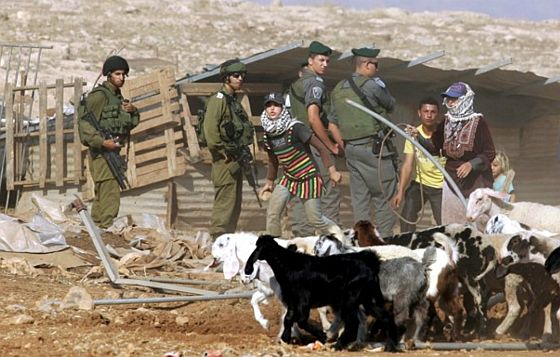
The Israeli troops and bulldozers arrived in the early morning and quickly got to work, tearing down shelters made of plastic netting and poles that had served as homes for about 100 people in this impoverished Bedouin community in the parched Jordan Valley.

The aftermath of the sweep last month against what Israeli authorities said were illegally built structures was still visible on a recent afternoon. Battered appliances, broken furniture, tattered clothing and other belongings that residents said they were prevented from removing were strewn in the dirt piled on the collapsed dwellings.

People took cover from the baking sun in makeshift tents constructed from the remains of their former homes and in others supplied by the Palestinian Red Crescent Society. Mobile tanks and electricity cables temporarily strung across the ground were the only sources of water and power.

“We have nowhere else to go,” said Talib Abayat, sitting in the shade of a lone tree.

The desolate scene reflected the state of the neglected Palestinian communities of the Jordan Valley, an area that amounts to more than a quarter of the West Bank but remains largely under Israeli control, with wide gaps between the resources allocated to Palestinians and Israeli settlers.

Running along the West Bank’s border with Jordan, the Jordan Valley has long been considered an area of strategic importance by Israel, and Prime Minister Binyamin Netanyahu has demanded a long-term military presence there as part of any future peace deal with the Palestinians.

Israeli settlements housing about 9,400 people line the road through the valley, scattered among ramshackle villages and encampments where about 80,000 Palestinians live. Nowhere in the West Bank is the contrast more stark between the settlements, with their intensively irrigated farmland, red-roofed homes and streets shaded by shrubs and trees, and the dusty Palestinian communities and their fields, dependent on limited water supplies.

A series of demolition operations last month underlined Israel’s claim to the area, which a recent poll showed most Israelis believe is part of Israel, not occupied territory, and populated mostly by Israelis. The poll was commissioned by the Association for Civil Rights in Israel.

Palestinian Prime Minister Salam Fayyad has asserted that there can be no Palestinian state without the Jordan Valley, which he called the Palestinian breadbasket. Yet with more than 70 percent of the area under Israeli control — designated as state land, military firing zones or nature reserves — the Palestinian Authority has little influence over the region’s development and the use of its resources.

Facebooktwittermail

Tahrir’s journey to Palestine

Helena Cobban writes:

The moment that Hosni Mubarak stood down from the Egyptian presidency and it was apparent that his hastily appointed vice-president, the long-time intelligence chief Omar Suleiman, would not be succeeding him, it was clear that much would be changing in Middle Eastern politics — including for Palestinians.

Easily the most populous Arab state, and one with a central location abutting Israel/Palestine, Egypt has always had the potential to play a huge role on the Palestinian issue. That role was lessened after Egyptian President Anwar Sadat split with the PLO leaders after the 1978 Camp David accords. But in recent years, Mubarak had become a linchpin in U.S. and Israeli efforts to steer Palestinian politics in a direction amenable to them.

Mubarak and Suleiman had two major ways to exert direct influence over Palestinian politics. First, Egypt has the only land border with the Gaza Strip other than the Strip’s much longer border with Israel. The sole legal crossing point on that border, at Rafah, years ago became the only way that most Gaza Palestinians could ever hope to travel between the Strip and the outside world. (Goods, by contrast, are not allowed through Rafah. Under the 1994 Paris Agreement between Israel and the PLO, all goods going into or out of Gaza must go through crossings that go to Israel.) Cairo’s control over Rafah has given it a huge ability to put pressure on Gaza’s 1.6 million people and the elected Hamas mini-government that administers the Strip.

In addition, in recent years, Egypt got the full backing of the United States and Israel to play the role of primary interlocutor in all efforts to heal the rift between Hamas and its main rivals in Mahmoud Abbas’s Fateh. But as Suleiman and Mubarak had long been firmly in Abbas’s camp, it surprised no one to see the reconciliation efforts that Suleiman periodically launched come to nothing — and Fateh and Hamas remained deeply divided.

So the departure of Mubarak and Suleiman from power in Cairo was huge for the Palestinians — especially those trapped for many years inside Gaza, which has been described by many as an open-air prison.

Facebooktwittermail

Why every flotilla succeeds and the siege of Gaza will end

Is it possible to break the siege of Gaza if no one notices?

As an exercise in directing global attention to the plight of a population subject to collective punishment, the first flotilla in August 2008 was a bit of a flop — even though it reached Gaza.

In the Jerusalem Post, Herb Keinon cynically wrote at the time:

Ever since the Free Gaza Movement made known its intent a few weeks ago to set sail for the Gaza Strip to “break” the Israeli blockade, it was clear that the two boatfuls of professional left-wing demonstrators and tag-along journalists were after one thing: a huge media event.

Nothing, therefore, would have given them a greater media buzz than if a couple of Israel Navy boats stopped them on the high seas, arrested the protesters (hopefully, from the point of view of the organizers of the protest, with some gratuitous brutality), and dragged the Greek-registered vessels into the Ashdod port.

Imagine the footage, imagine the images, and imagine the public relations bonanza for those few “brave souls” on the sea-weary vessels. Israel would, undoubtedly, have faced a public relations drubbing. So by deciding to let the boats through, the government deprived the protesters of the huge media event they so obviously wanted.

Indeed, instead of footage of heavyhanded Israelis stopping boats carrying an 81-year-old American nun and the sister-in-law of former British prime minister Tony Blair leading the nightly news broadcasts in the West on Saturday night, the story of the boats’ arrival in Gaza barely made a blip on the CNN, Fox, or Sky news broadcasts. With the world’s eyes still glued to the Olympics in Beijing, and the media focusing on US presidential candidate Barack Obama’s choice of Joe Biden as his vice presidential nominee, the Gaza blockade-running story didn’t register in the electronic media.

And in the written press, the protesters didn’t fare that much better. The New York Times ran a small piece on page 16 on Sunday; The Washington Post on page 12; and The St. Louis Post-Dispatch relegated it to a three-paragraph brief. As media events go, this one was not particularly successful.

But — as Keinon also noted — the story was not over. Indeed.

What the flotilla organizers understood was that whatever the outcome, each challenge to the siege could in fact never fail. Ships could succeed by reaching Gaza, or succeed without reaching Gaza by exposing Israel to the eyes of the world as a cowardly bone-headed bully.

The only solution to Israel’s problem was and remains the one that it refuses to entertain: backing itself out of a dead-end policy that by any metric one wants to use, has been a demonstrable failure — a policy which hasn’t weakened Hamas; hasn’t turned Gaza’s population against its rulers; hasn’t made Israel safer; and above all has brought Israel’s global image to an all-time low while callously inflicting yet more suffering on the Palestinian people.

The Israeli columnist, Asaf Gefen, suggested this week:

If the Marmara that took part in the previous sail sought to present Israel’s brutality to the world (and managed to do so, thanks to our kind assistance,) it appears that the current flotilla was meant to present Israel’s stupidity.

At this time already, when it’s still unclear whether and when the ships shall arrive, it appears that this objective had also been fully achieved.

But now that the flotilla appears stuck in Greece, can’t Netanyahu claim victory? Some Israeli reporters seem to think so:

Prime Minister Benjamin Netanyahu sometimes seems almost too arrogant and self assured for his own good. However, unlike in most instances, this weekend he actually has justification for his haughtiness.

Really?

Look at The Audacity of Hope as it chugged out of a Greek harbor yesterday and ask yourself: what kind of prime minister and what kind of nation could feel threatened by this kind of challenge?

The need to subjugate others; the obsession with existential threats; the insatiable hunger for loving affirmations; and the fear of equality between Jews and non-Jews — all of this exposes Israel’s intrinsic weakness, a weakness that cannot be overcome by belligerence, isolation or warfare.

In truth, nothing threatens Israel more than its own fear of the world.

It’s time not just for Israel to end the siege of Gaza but for Zionists to break out of their own self-made prison.

Facebooktwittermail

The power that we have to make change when our governments are silent

Huwaida Arraf, Gaza Freedom Flotilla organizer, interviewed by PalestineStudiesTV:

I’ve talked a lot with the Israeli media and told them that for their viewers/listeners/readers, this should not be perceived as anti-Israel or anti-Jewish. There are Israelis on our action; there are Jews from different countries. Part of our action — a quarter of the American boat are Jewish Americans that are participating, because this is about equality of people — respecting everybody’s human rights irrespective of race, religion or ethnicity, and so we reject Israel’s efforts to make it about “us” or “them” as if we want to attack Israelis in any way. No, they can very much stand with us and it’s for their future as well as it is for Palestinians’ future…

While we are sailing towards Gaza, this action is not just about Gaza. Yes we want to open it, we want to end this prison-like closure of Gaza, but what’s happening in Jerusalem — the ethnic cleansing of Jerusalem, Palestinians being kicked out of their homes so that Jewish families can move in — that’s not any less severe. The continued confiscation of property in the West Bank; the demolition of large areas of land; the building of the apartheid wall — this is illegal, this is also repressive. And the situation of Palestinians inside Israel, inside the 1948 territories where — I also am an Israeli citizen, a Palestinian-Israeli — I am not treated as an equal because I am not Jewish. This is all part of what I call a colonial apartheid regime, and this needs to be dismantled if we are going to ever see peace in the region.

So while we are sailing towards Gaza, this more than just about Gaza. And I’ll go so far as to say this more than just about Palestine — it is about what people can do. Because this is very much a grass-roots, global civil society action. It is the power that we have to make change when our governments are silent. It’s about what we do every single day to create the kind of world that we want to live in. And so I hope that everyone that listens or sees what we are doing can recognize that and can decide in their own way how they can contribute.

Facebooktwittermail

Israel cannot thwart Palestinian people-power

Haaretz reports:

As September draws nearer, the Israel Defense Forces has been conducting drills in order to contend with the possibility of a mass civilian uprising in the West Bank in the wake of the Palestinian bid to seek unilateral recognition in the United Nations.

“A non-violent protest of 4,000 people or more, even if they only march to a checkpoint or a settlement, and especially if the Palestinian police does not deter them, will be unstoppable,” one IDF officer claims. “Such a great number of determined people cannot be stopped by tear gas and rubber bullets.”

Another high ranking IDF official serving in the territories claimed that “if we are to face protests similar to those in Egypt or Tunisia, we will not be able to do a thing.”

On Tuesday, the Central Command completed its General Staff workshop which included all company officers and higher-ranking officials in both regular and reserve service who are set to serve in the West Bank by the end of the year. The officers attended lectures on dealing effectively with disorderly conduct and viewed presentations on protest-dispersal methods by both IDF and border police.

“At the end of the day, the decision is in the hands of the political echelon,” claims another commander, “it is fairly obvious that if there will be no progress on peace talks, the Palestinian police with whom we work very closely to prevent infiltrations will lose their patience.”

Facebooktwittermail

Why the flotilla matters to people in Gaza

Ashley Bates reports from Gaza:

To most Gazans the flotilla mission is not really about bringing in a small amount of humanitarian aid. Rather, it is about drawing world attention to Israel’s continued entrapment of 1.6 million people who are just as human as people everywhere else in the world.

“All the international people who [were] coming [in] the flotilla [last year], the Turkish people, … they lost their life to reach Gaza, they really … reached not only to Gaza; they reached … all the heart[s of] the human and the free people in the world — their message really reached and they succeed[ed],” says a Gazan fisherman. “And even the second flotilla we hope to reach safely to Gaza, but if even they didn’t succeed and Israel stop them, really their message [will] succeed and they reach actually.”

Awaiting the Flotilla in Gaza from Ashley Bates on Vimeo.

Facebooktwittermail

Passengers on the US boat to Gaza speak out

As the Israeli government does everything it can to prevent the second flotilla to Gaza from setting sail and while the US State Department has effectively given Israel a green light to use any means — peaceful or violent — to prevent the flotilla from reaching its destination, passengers on board the American boat, The Audacity of Hope, describe why they are going.

Facebooktwittermail

With the Gaza blockade-breaking flotilla

Joseph Dana writes from Athens:

Amid the economic and social upheaval of Greece’s beleaguered capital city, where demonstrators have been protesting government-imposed austerity measures, forty activists from across the United States began training this week to nonviolently confront the Israeli military blockade of Gaza. The Americans are part of a flotilla of ten ships—from France, Ireland, Canada, Norway, Greece, Sweden and other countries—planning to set out for Gaza’s main seaport in the next week to relieve the siege.

With an age gap of sixty years between the youngest and oldest passenger, the diverse group of Americans have taken over a hotel in a trendy Athens neighborhood for days of nonviolence training and preparation.

Israel has stated that it will enforce its naval blockade by any political, military and economic measures at its disposal. This week it submitted an urgent request to UN Secretary General Ban Ki-moon asking for international cooperation in stopping the flotilla. Ban embraced the Israeli government’s position, arguing in a public statement that aid should be delivered to Gaza only through “legitimate crossings and established channels,” all of which are controlled by Israel. Ban added that the flotilla is not helpful in assisting the economy of Gaza and encouraged organizers to cancel their voyage.

Facebooktwittermail

Message to Obama from the Gaza-bound ship Audacity of Hope

On June 14, the passengers on The Audacity of Hope sent this letter to Pres. Obama. Copies went to UN Secretary General Ban Ki-moon and 12 members of the Administration and Congressional leadership. Call the White House – 202-456-1111 – and tell them you agree with the letter and expect the U.S. to take action to uphold the rights of peaceful citizens to safe passage on the seas.

Dear Mr. Obama:

We are writing to inform you that 50 unarmed Americans will soon be sailing in a U.S. flagged ship called The Audacity of Hope as part of an international flotilla to Gaza.

Our peaceful demonstration will challenge Israel’s blockade of Gaza, which has effectively imprisoned 1.6 million civilians, almost half of whom are under the age of 16. The blockade has impoverished the people of Gaza, deprived them of needed materials and supplies to rebuild their lives after the Israeli attack of late 2008 – early 2009, impeded those who are ill or infirm from seeking outside medical aid, and prevented students from seeking education outside of Gaza. 45% of the working age population is unemployed.

In addition to 36 passengers, 4 crew, and 10 members of the press, our boat will carry thousands of letters of support and friendship from people throughout the U.S. to the women, children and men of Gaza. There will be no weapons of any sort on board. We will carry no goods of any kind for delivery in Gaza. Our mission is from American civil society to the civil society of Gaza. We do not serve the agenda of any political leadership, government or group. We are engaged solely in non-violent action in support of the Palestinian people and their human rights.

In our country’s great tradition of citizen activists taking nonviolent action to stand up to injustice, we sail in the hope that our voyage will show the people in Gaza that they are not alone, and that it will call attention to the morally and legally indefensible collective punishment of a population of civilians.

Mr. President, you have noted the unsustainability of the Gaza blockade. And your administration has spoken boldly in support of peaceful demonstrations throughout this “Arab Spring.”

As U.S. citizens we expect our country and its leaders to help ensure the Flotilla’s safe passage to Gaza – as our country should support our humanitarian demand that the Gaza blockade be lifted. This should begin by notifying the Israeli government in clear and certain terms that it may not physically interfere with the upcoming Flotilla of which the U.S. boat—The Audacity of Hope — is part. We—authors, builders, firefighters, lawyers, social workers, retirees, Holocaust survivors, former government employees and more—expect no less from our President and your administration.

Our boat will sail from the eastern Mediterranean in the last week of June. We shall be grateful to you for acting promptly and decisively to uphold the rights of civilians to safe passage on the seas.

Sincerely,

The passengers of The Audacity of Hope: Nic Abramson, Hagit Borer, Linda Durham, Ridgely Fuller, Libor Koznar, Richard Lopez, Carol Murry, Gabe Schivone, Len Tsou, Johnny Barber, Regina Carey, Debra Ellis, Megan Horan, Melissa Lane, Ken Mayers, Robert Naiman, Kathy Sheetz, Alice Walker, Medea Benjamin, Gale Courey Toensing, Hedy Epstein, Kathy Kelly, G. Kaleo Larson, Ray McGovern, Henry Norr, Max Suchan, Paki Wieland, Greta Berlin, Erin DeRamus, Steve Fake, Kit Kittredge, Richard Levy, Gail Miller, Ann Petter, Brad Taylor, Ann Wright

On Wednesday, the State Department sent out a “travel advisory” urging Americans not to participate in the Gaza Freedom Flotilla. According to the statement, U.S. citizens are advised against traveling to Gaza by any means, including via sea, noting that previous attempts to enter Gaza by sea “have been stopped by Israeli naval vessels and resulted in the injury, death, arrest, and deportation of U.S. citizens.”

“Apparently, the State Department subscribes to the view that Israel’s anticipated violence against unarmed protesters is an immutable act of nature,” said Hagit Borer, a professor of Linguistics at the University of Southern California and a passenger on the U.S. boat. “This is a remarkable attitude, coming from a government that provides the Israeli government with billions of dollars in military aid and routinely uses its veto to protect the Israeli government from censure of its occupation policies by the UN Security Council.”

Passengers on the boat noted that the U.S. State Department has a legal obligation to act to protect U.S. citizens when they are traveling abroad. “So far, U.S. government officials have failed to use their influence to discourage Israeli authorities from ordering a physical assault on us,” said Just Foreign Policy policy director Robert Naiman, another passenger on the U.S. boat. “Of course, State Department officials have an obligation to speak out against threats to attack us. It is deeply disappointing that they have so far failed to do so.”

[Source: USTOGAZA. Follow on Twitter.]

Facebooktwittermail

Interview: Mazin Qumsiyeh on popular resistance and breaking the spell of fear

Electronic Intifada has an interview with Mazin Qumsiyeh:

In his latest book Popular Resistance in Palestine: A History of Hope and Empowerment, Mazin Qumsiyeh counters the conventional wisdom promoted by the Israeli propaganda machine and the mainstream Western media, which conflates the Palestinian struggle against occupation with “terrorism.” Qumsiyeh, a former professor of genetics who taught at Yale and Duke universities, returned to his native village of Beit Sahour near Bethlehem in the occupied West three years ago. He currently blogs at Popular Resistance. The Electronic Intifada contributor David Cronin interviewed Qumsiyeh about his new book and activism.

David Cronin: You were arrested in May in the West Bank village of al-Walaja. I’ve seen a video on YouTube, in which — a moment before the arrest — you are pleading with Israeli soldiers not to use violence against peaceful protesters. What were the circumstances that led you to make that appeal?

Mazin Qumsiyeh: I saw a group of soldiers run up a hill and grab a young guy and start beating him. They were using pepper spray against his head and mouth, even though he didn’t do anything. I walked a few steps so that I was close to him, then they pushed me down.

The accusation that was leveled against me was that I had participated in an illegal demonstration. But it was the presence of soldiers there that was illegal, not the presence of people in the village of al-Walaja.

DC: What happened after your arrest?

MQ: For 24 hours, I was taken to various detention facilities in different places. It was 24 hours of harassment and without any sleep. That was the biggest part of it. When I finally got to the actual prison [Ofer], the prison itself was not that bad in terms of treatment. They tried to get me to sign a paper saying I was not mistreated. I said: “I’m not signing any papers. Go to hell.”

DC: How many times have you been arrested?

MQ: It depends how you define “arrested.” Israel can hold you for hours and hours, days and days, without [charging] you. I have been arrested [and] charged three times. In terms of detention [I have been held], maybe 10 or 12 times.

It has always been for short periods of two days, things like that. When I get arrested, the Israeli government gets thousands of letters, hundreds of inquiries. Palestinian young people, who don’t have the kind of international network that I have, tend to be mistreated more and can be kept in administrative detention for months.

DC: After living in the United States for 27 years, you returned to Palestine three years ago. Why did you decide to go home?

MQ: It was a question of where I could be the most useful [to the Palestinian struggle]. Up to three years ago, I felt I could be more useful outside Palestine. Then, my feeling was that I could be more useful in Palestine. It was a subjective feeling, rather than an objective or scientific feeling.

DC: In your latest book, you explain how both nonviolent resistance and armed struggle involve sacrifice and that neither is risk-free. You appear, though, to have a preference for nonviolent resistance. Can you explain why?

MQ: Whether one uses armed struggle or nonviolence, the aim has to be to liberate oneself. Nobody engages in these things because they love to do these things. My own personal judgment is that the moral issue must enter into the equation. Of course, other people may have a different judgment. And while I respect their backgrounds, I also respectfully may disagree with the tools used.

Facebooktwittermail

Eyes open in Gaza, June 2011

Helena Cobban writes:

The Gaza Strip is a heavily urbanized sliver of land, some 30 miles long, that nestles against the southeast corner of the Mediterranean and that for many reasons– including the fact that more than 75% of its 1.6 million are refugees from within what is now Israel– has always been a crucible for the Palestinian movement. In the 1950s, Yasser Arafat and his comrades founded the secular nationalist movement Fateh here. In the 1970s, Sheikh Ahmed Yassin, a local preacher, founded the network of Islamist organizations that later became Hamas, right here in Gaza. In 1987, Gaza was where the overwhelmingly nonviolent First Intifada was first ignited…

On a recent Wednesday morning, I sat in the neat, second-story office of the Palestinian Center for Human Rights with its deputy director, a grizzled veteran of the rights movement called Jaber Wishah. We were discussing the prospects for the reconciliation agreement that Fateh and Hamas concluded in Cairo on May 3. Wishah said he hoped that the agreement would result in the formation of a ‘national salvation government’ that could end and reverse the many kinds of assault that the Israeli government has sustained against the Palestinians of the occupied territories: primarily, the multi-year siege that suffocates the Gaza Strip’s 1.6 million residents and the continuing land expropriations and regime of deeply abusive control that Israel maintains over the 2.6 million Palestinians of the West Bank.

“We desperately need this salvation government, to halt the deterioration of our situation,” Wishah said.

Like all the politically connected Palestinians I talked with during my three-day visit to Gaza, Wishah stressed that the key factor that was now– however slowly– starting to ease the harsh, five-year rift between Hamas and Fateh was the fall of Hosni Mubarak’s regime in neighboring Egypt.

Gaza’s longest land border is the one lined (by Israel) with high concrete walls, hi-tech sensors, and a series of watchtowers with machine-gun nests that can fire automatically if any Palestinian approaches any closer than 500 meters to the wall. Gaza’s shorter border is the one with Egypt that, since 2006, has been the only way that Gaza’s people– or rather, a carefully screened subset of them– can ever hope to travel outside the tiny Strip, whether for business, studies, or family reunions. So long as Mubarak and his widely loathed intel chief Omar Sulaiman were still in power in Cairo, they used their power over Egypt’s Rafah crossing point with Gaza to maintain tight control over the Strip and they worked with Israel, the United States, and their allies in Fateh to squeeze Gaza’ss Hamas rulers as hard as they could. Many Arab governments have long expressed support for intra-Palestinian reconciliation. But they (and the western powers) were always content to let Egypt take the lead in brokering all reconciliation efforts. To no-one’s surprise, so long as Mubarak and Sulaiman were in charge in Cairo, those efforts went nowhere. [Continue reading…]

Facebooktwittermail