Undercover Israeli intelligence officers appeared on national television Saturday to talk about assassinating Palestinians in a program broadcast on Israel’s Channel 10.
Oren Beaton presented a photo album of Palestinians he killed during his time as a commander of an undercover Israeli unit operating in the northern West Bank city of Nablus.
Beaton explained that he kept photos of his victims.
“This is a photo of a Palestinian young man called Basim Subeih who I killed. This is another young man. I shredded his body, and the photo shows the remnants of his body,” he said.
The TV program also featured an undercover agent referred to as “D”, who openly admitted killing “wanted Palestinians.”
He complained of suffering from post traumatic stress disorder and said that the state had rejected his demands for compensation.
The Channel 10 presenter appealed to the Israeli government to meet the agent’s demands.
“Those are the Shin Bet agents we only hear about and never see, and thanks to them we live safely,” she said.
The Ofer Israeli military court sentenced popular protest coordinator Naji At-Tamimi to one year of imprisonment and a fine of 10,000 shekels ($2,914), his colleagues said.
Naji and Basem At-Tamimi were taken by Israeli forces from their homes in April and held without charge.
Naji was charged with inciting and participating in rallies and organizing demonstrations against Israeli land confiscation and settlement building. Israel has declared such demonstrations illegal.
In a statement released shortly after the sentencing was handed down, the Popular Struggle Committee in Nabi Saleh, where Naji is from, said it rejected Israel’s characterization of the protests as illegal, and said it considered the sentencing of Tamimi for his role in the protests as a “violation of the law,” noting it prevented Palestinians from defending their property.
Israel has started mobilizing its embassies for the battle against UN recognition of a Palestinian state in September, ordering its diplomats to convey that this would delegitimize Israel and foil any chance for future peace talks.
Envoys are being asked to lobby the highest possible officials in their countries of service, muster support from local Jewish communities, ply the media with articles arguing against recognition and even ask for a call or quick visit from a top Israeli official if they think it would help.
Foreign Ministry Director General Rafael Barak and the heads of various ministry departments sent out classified cables outlining the battle plan to the embassies over the past week, after earlier ordering all the country’s diplomats to cancel any vacations planned for September. The contents of the cables reached Haaretz and are reported here in full.
“The goal we have set is to have the maximum number of countries oppose the process of having the UN recognize a Palestinian state,” Barak wrote to Israel’s ambassadors in his cable, which was sent June 2. “The Palestinian effort must be referred to as a process that erodes the legitimacy of the State of Israel…
“The primary argument is that by pursuing this process in the UN, the Palestinians are trying to achieve their aims in a manner other than negotiations with Israel, and this violates the principle that the only route to resolving the conflict is through bilateral negotiations.”
Each envoy was ordered to prepared a focused plan for the country in which he or she serves and present it to the Foreign Ministry by today, June 10.
Hamas will participate in any future Palestinian government, a senior official from the Islamist group said Thursday, refuting press reports that it might opt not to take part in a future administration.
“Nothing would prevent us” from participating in any government after new elections, Salah al-Bardaweel, a high-ranking Hamas leader in the Gaza Strip told the German Press Agency DPA.
The comments came after earlier media reports Thursday that Hamas might exclude itself from a future government – even if it won in elections – if that helped such a government to avoid international isolation.
“This is totally incorrect and totally untrue,” said al- Bardaweel, arguing that the reports were intended to isolate Hamas politically and diplomatically.
After four years of turbulent rule in the Gaza Strip, the Islamic militant group Hamas is weighing a new strategy of not directly participating in future governments even if it wins elections — an approach aimed at avoiding isolation by the world community and allowing for continued economic aid.
Hamas officials told The Associated Press the idea has gained favor in recent closed meetings of the secretive movement’s leadership in the West Bank, Gaza, Egypt and Syria, and that it helped enable last month’s reconciliation agreement with the rival Fatah group of Palestinian President Mahmoud Abbas.
Talks on implementing that accord have dragged on, particularly over the makeup of a “unity government.” The agreement envisions a government of nonpolitical technocrats — in line with Hamas’ emerging thinking — but Abbas wants to retain current premier Salam Fayyad, a respected economist viewed by Hamas as a political figure.
The new approach reflects both the group’s rigidity and its pragmatism: On the one hand, Hamas refuses to meet widespread global demands that it accept Israel’s right to exist; on the other, its leaders grasp the price Palestinians would pay if the Islamic militants emerged fully in charge of a future government.
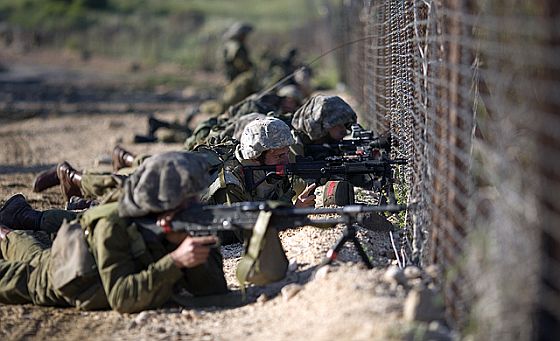
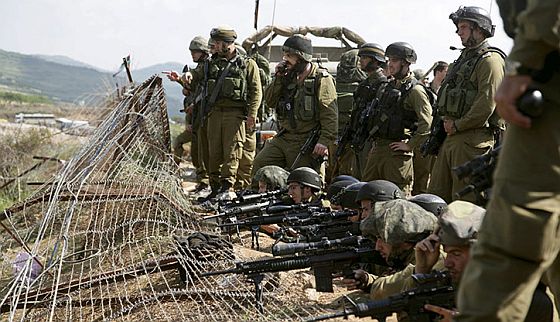
IDF Chief of Staff Lieutenant-General Benny Gantz has ordered the increased deployment of security forces across all Israel’s borders starting Friday and pending the conclusion of all “Naksa Day” events.
The Palestinians are planning a series of events to mark “Naksa Day” – the 44th anniversary of the Six Day War – starting Sunday.
Most disconcerting, as far as Israel is concerned, are calls by pro-Palestinian supporters – issued mostly on social media website – for Palestinians to march on and possibly storm all of Israel’s borders.
When an international flotilla sails for Gaza this month to challenge Israel’s naval blockade of the Palestinian territory, among the boats will be an American ship with 34 passengers, including the writer Alice Walker and an 86-year-old whose parents died in the Holocaust.
A year ago, nine people in a flotilla of six boats were killed when Israeli commandos boarded a Turkish boat in international waters off the coast of Gaza. The Israelis said their commandos were attacked and struck back in self-defense, but the Turks blamed the Israelis for using live ammunition. The raid soured relations between Israel and Turkey and intensified pressure on Israel to end the naval blockade.
Organizers said the new flotilla, scheduled to leave in late June from a port they would not identify, had at least 1,000 passengers on about 10 boats. One boat will carry Spaniards, another Canadians, another Swiss and another Irish.
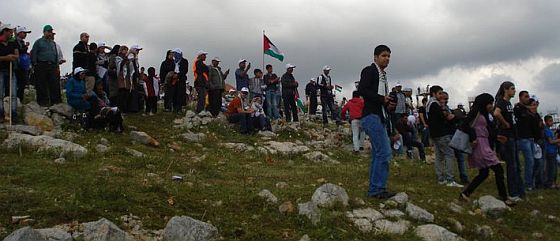
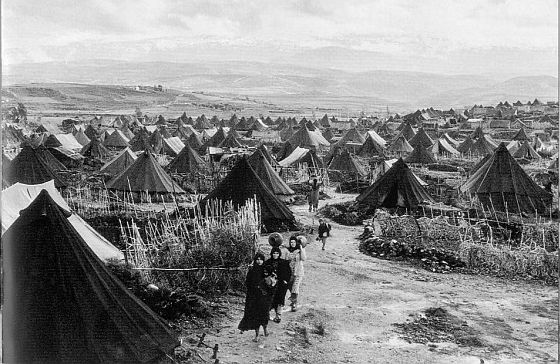
At 10:30 on May 15, two battalions of Israeli combat soldiers opened fire with tear gas and rubber bullets on hundreds of unarmed Palestinian demonstrators at the Qalandia checkpoint dividing Ramallah from Jerusalem, sending people scrambling into the adjacent refugee camp. These were the opening shots of Israel’s response to protests commemorating the Nakba, the Arabic word for catastrophe, used to define Israel’s creation of 750,000 Palestinian refugees in 1948. By nightfall Israeli soldiers had killed thirteen Palestinian refugees and wounded hundreds with live fire on its borders with Lebanon, Syria, Gaza and inside the West Bank.
The May 15 demonstrations reinvigorated the long-alienated Palestinian refugee community; although it is 70 percent of the Palestinian population, it has been largely shut out of the negotiations process with Israel. The emerging unity was on display at Qalandia, where youth trying to symbolically march from Ramallah to Jerusalem wore black T-shirts with the slogan “Direct Elections for the Palestine National Council, a Vote for Every Palestinian, Everywhere.” The PNC is the legislative body of the Palestine Liberation organization and is responsible for electing its executive committee. Traditionally, seat allocation in the PNC has been divided to represent the influence factions within the PLO, of which Hamas is not a member.
The Nakba protests have been the largest so far of a growing Palestinian youth revolt. The protests—launched with unity protests on March 15 in the Palestinian Authority–controlled West Bank and Hamas-governed Gaza Strip—are the Palestinian response to the outbreak of revolutions in Egypt and Tunisia. While it is a new development, this manifestation of popular anger against Palestinian Authority concessions in the failed negotiations process—shockingly revealed with Al Jazeera’s January release of top-secret negotiation minutes, known as the Palestine Papers—and Israel’s practice of divide and rule has been simmering under the surface for the past three years.
“The unity agreement between Fatah and Hamas gave people hope to be here today and continue with this new phase of struggle,” said Fadi Quran, a founding organizer of the March 15 movement, amid the clashes with Israeli soldiers at the Qalandia checkpoint. “It showed us that something was possible and we must continue,” he added, coughing from tear gas.
I watched Benjamin Netanyahu’s speech to Congress with a guy named Fadi Quran. He recently graduated from Stanford, where he double-majored in physics and international relations. He lives in Ramallah, where he’s starting an alternative energy company. And he just might rock our world.
Quran is helping to coordinate a raft of Palestinian youth organizations—located in the West Bank, Gaza Strip, Jordan, Lebanon and Syria—all united around one goal: to create a Palestinian Tahrir Square. They organized the unity march that helped pressure Fatah and Hamas to reconcile. Ten days ago, they organized the Nakba Day protests in which refugees marched on Israel’s borders.
What they’re doing isn’t exactly new. Palestinians in the West Bank have been conducting regular nonviolent protests for many years now, often against the separation barrier that stands between them and their fields. But Egypt and Tunisia made Quran and his colleagues realize that nonviolence was possible on a much larger scale. Not everyone in his movement believes in peaceful resistance as a matter of principle, he admitted sheepishly. But they all believe it represents the right strategy. They’ve been studying the civil rights movement and Gandhi’s struggle against the British and the movement that peacefully brought down Slobodan Milosevic in Serbia. No one wants a second intifada, he insisted. “It hurt us much more than the Israelis.”
When I asked Quran what his movement believes, I expected to hear about borders and refugees and Jerusalem. Instead, he began talking about John Rawls and John Locke, a social contract between the government and the governed. A Palestinian government that denies his rights, he insisted, is as offensive as an Israeli one. When I pressed him on whether his colleagues want two states—one Palestinian, one Jewish—or a secular binational one, he seemed strangely agnostic. He said that in an ideal world one democratic state would be better, before adding that of course such a state would have to guarantee the safety and cultural autonomy of Jews. (One of his inspirations, he said, was Martin Buber, the Jewish philosopher who advocated a binational state in the 1920s and 1930s). When I said I didn’t consider a binational state very realistic, he conceded the point, before noting that in the age of Netanyahu and Lieberman, most Palestinians don’t consider a two-state solution very realistic either.
Musa Abumarzuq, deputy head of Hamas’s political bureau in Damascus, writes:
The birth of the Cairo reconciliation agreement between Fatah and Hamas was slow and painful. But Palestinians welcomed its arrival. The tragic division which occurred in our national movement constituted a chapter we hope will never happen again. It never occurred to us that a time would come when we would turn against fellow Palestinians.
Today, the reconciliation exposes the Israeli occupation as the real spoiler of peace. The Israelis have reneged on every agreement signed with the Palestinian Authority. Now we have forged this historic agreement and buried the hatchet, they are threatening our people with dire consequences.
While we were ensconced in Cairo trying to finalise the agreement, Israel embarked on a diplomatic offensive to persuade European governments to withdraw economic assistance to the Palestinian Authority.
As western governments have, individually and collectively, welcomed the democratic changes taking place in the Middle East, they should support a similar transformation in Palestine. Any attempt to short change my people would have no legitimacy. The events marking the 63rd anniversary of the Nakba have shown that no amount of victimisation, wars and blockade will deter us from the path of freedom. The world must remember the core issue of our cause is the right of every refugee to return to their home – a right enshrined in international law. As others were allowed to exercise this right, we demand the same for our people.
Last weekend, as tens of thousands of unarmed refugees marched toward Israel from all sides in a symbolic effort to reclaim their right of return, the world suddenly discovered the power of Palestinian nonviolence. Much like the “Freedom Flotilla,” when nine activists were killed during an act of nonviolent international disobedience almost a year ago, the deaths of unarmed protesters at the hands of Israeli soldiers drew the world’s attention to Palestine and the refugee issue.
The world shouldn’t have been so surprised. The truth is that there is a long, rich history of nonviolent Palestinian resistance dating back well before 1948, when the state of Israel was established atop a depopulated Palestine. It has just never captured the world’s attention the way violent acts have.
Indeed, by the issuance of the Balfour Declaration in 1917, well before the establishment of the state of Israel, and during a period when the Jewish population of historic Palestine had yet to reach 10 percent, the native Arabs of Palestine could already see that their hopes for self-determination — in a homeland where they constituted a vast majority — were being jeopardized by their soon-to-be colonial master.
Resistance to Zionism during this period was characterized by various efforts led by elite members of Arab society who raised awareness about the dangers Zionism posed. Just before the war, Palestine saw a huge spike in new newspapers, and writers and editors such as Ruhi al-Khalidi, Najib Nassar, and Isa al-Isa regularly zeroed in on the threat of Zionism to Palestinian life. Diplomatic efforts to lobby the mandatory government ensued while concurrently peasants occasionally clashed with the European newcomers, but violence was largely localized and communal and took place amid larger, more peaceful, and political efforts to resist Zionist aims.
ROBERT SIEGEL (NPR host): And I’d like to ask you to begin with what has been a major difference between Fatah and your group, Hamas. Ismail Haniyeh, the prime minister of the Hamas government in Gaza, spoke the other day of the Palestinians’, and I quote, “great hope of bringing to an end the Zionist project in Palestine.”
About a week earlier, Hamas leader Khaled Mashaal said in Cairo that the goal of your movement is a Palestinian state in the West Bank and Gaza with Jerusalem as its capital. Which is it that Hamas seeks, a two-state solution alongside Israel or an end to the state of Israel altogether?
GHAZI HAMAD (Deputy Foreign Minister, Hamas): I think there is all kind of contradictions because maybe people understand that the occupation is a reflection of the Zionist movement, and I think the declaration of Hamas is very clear. We accept the state and ’67 borders. This state should be independent. It was chosen as the capital for Palestine and the right of return for the refugees.
But I think that Israel will not accept this because Israel reject all the demands of the Palestinian people because they believe that they have to have a Jewish state and Jerusalem is the capital of Israel and no right of return. So I think we’ll still have a big struggle and big disputes.
SIEGEL: But just to clarify, if Israel were to accept a two-state solution in which Palestine would be in Gaza and the West Bank and have its capital in Jerusalem, is that an acceptable aim that Hamas is striving for, or is that in and of itself insufficient because there would still be a state of Israel?
Mr. HAMAD: Look, we said frankly we accept this state and ’67 borders, but the question now should be directed to Israel. We need clear answer from Israel because Netanyahu said that we will not go back to the ’67 borders. We will not (unintelligible) settlements. So we still the victims of the occupation. (NPR)
The United States slapped sanctions on Syrian President Bashar Assad and six senior Syrian officials for human rights abuses over their brutal crackdown on anti-government protests, for the first time personally penalizing the Syrian leader for actions of his security forces.
The White House announced the sanctions Wednesday, a day before President Barack Obama delivers a major speech on the uprisings throughout the Arab world. The speech is expected to include prominent mentions of Syria.
The Obama administration had pinned hopes on Assad, seen until recent months as a pragmatist and potential reformer who could buck Iranian influence and help broker an eventual Arab peace deal with Israel. (AP)
Tanks shelled a Syrian border town for the fourth day Wednesday in a military campaign to crush demonstrations against President Bashar al-Assad, under mounting Western pressure to stop his violent repression of protesters.
Troops went into Tel Kelakh Saturday, a day after a demonstration there demanded “the overthrow of the regime,” the slogan of revolutions that toppled Arab leaders in Egypt and Tunisia and challenged others across the Middle East.
Assad had been partly rehabilitated in the West over the last three years but the United States and European Union condemned his use of force to quell unrest and warned they plan further steps after imposing sanctions on top Syrian officials. (Reuters)
“While much attention has been focused on rebel efforts in eastern Libya and in the city of Misurata, rebels have held control of most of the Nafusah Mountain region since the unrest began in February,” my colleagues Sergio Peçanha and Joe Burgess explain in the introduction to a fascinating, richly informative graphic on the fighting there.
Last month, after the rebels in these remote mountains made an unexpected show of strength, seizing a border post along the Tunisian frontier, my colleague Scott Sayare reported that “the region’s isolated hamlets were among the first to join the uprising,” fueled by simmering resentment from a Berber community which was neglected by Col. Muammar el-Qaddafi’s Arab nationalist regime.
Despite the fact that even rebel fighters in the region estimate their ranks at just a few hundred ill-equipped and untrained young men, they have someone held off attempts by government forces to reimpose Tripoli’s rule. (New York Times)
NATO kept up its bombing campaign against Libyan leader Moammar Gadhafi over the weekend, hitting missile launchers and other targets around Tripoli. The rebels say they welcome military support, but they would like something more: formal diplomatic recognition for their transitional government.
Some special guests flew in recently for the rebels’ weekly pep rally in Benghazi — delegates from areas of western Libya that are still under Gadhafi’s control. The delegates came to take their seats in the 30-seat National Transitional Council — a kind of proto-parliament.
Eastern Libyans like Mansour Makhlouf are glad to see them.
“Gadhafi’s people are spreading rumors that we are divided. But we’re not divided — we are all brothers,” Makhlouf says. (NPR)
The International Criminal Court’s chief prosecutor has asked a three-judge panel to issue arrest warrants for Libyan leader Muammar Gaddafi, his second-eldest son, Saif al-Islam, and his intelligence chief, Abdullah Senussi.
Luis Moreno-Ocampo described the evidence against the three men as “very strong” in a press conference on Monday and said he believed Libyans eventually would turn them over to the court.
The filing against Gaddafi comes just three months into the uprising against his 41-year rule, which evolved from peaceful protests in major cities to an armed rebellion based out of the east. Gaddafi’s regime has brutally attempted to suppress the opposition movement by shelling rebellious cities, and imprisoning and torturing those who speak out. (Al Jazeera)
For hours and hours, I didn’t know what to make of it: Tribute FM is the first ever English language radio station in Libya. And it sounds just like Magic. Diana Ross . . . the Jackson Five . . . the Temptations . . . some German rap . . . Easy Like Sunday Morning . . . just as you’re nodding along, thinking “this is nice, I wonder if they have a phone-in,” you remember: this is probably the most radical statement of a successful revolution coming out of any radio, anywhere in the world. It is a huge moment for a country in which not just English but most European languages have been invisible for decades.
Before Muhammad, Aman and two others launched Tribute in Benghazi last week, “English wasn’t frowned on, it was completely illegal,” Muhammad tells me by phone. “It was taken out of schools, it got to the point where nothing in English was available in the city. You couldn’t advertise in English, you couldn’t read a newspaper in English.”
It is a measure of how isolating this was for young Libyans that setting up a radio station would be such a priority as the fighting continues, the stream of refugees is unabated and Gaddafi has not, as yet, surrendered. (The Guardian)
During an era in which Israel is used to getting a free ride in the Israel-friendly American press, it’s worth recalling that it wasn’t always like this.
Clifton Daniel went on to become the New York Times‘ managing editor, but back in 1947 he was the paper’s Middle East correspondent and reported from Jerusalem on the Zionists’ rise to power — an ascent that was assured because Western Jews shared the same form of superiority that other Western colonialists exercised in asserting control over the rest of the Middle East, his informants told this reporter.
If Zionists and their allies these days are tireless in declaring that Israel is the historic homeland of the Jewish people, the Jews who actually created Israel were in no doubt that they are engaged in an enterprise of colonization. Jewish settlers, outnumbered by the indigenous population, would only be able to take control of Palestine through a program of Jewish domination. They intended to assert power through persuasion if possible, but by force if necessary.
PALESTINE JEWS MINIMIZE ARABS
Sure of Superiority, Settlers Feel They Can Win Natives by Reason or Force
By Clifton Daniel
Special to THE NEW YORK TIMES
JERUSALEM, March 19 — Palestine’s Zionists are generally confident that relations with their Arab neighbors can be satisfactorily adjusted once the country’s political status has been settled.
If not confident, they rarely allow themselves to be troubled by the problem, being usually preoccupied with issues they consider more urgent. That attitude, which has been manifested in numerous conversations that I have had in the past three weeks with everyday citizens of all degrees, has developed in spite of the fact that the presence of the Arab majority is fundamentally the largest obstacle to the achievement of Zionism’s national aims.
It is an attitude shared by almost everyone, no matter which of the many proposed political solutions he may advocate. A non-party professional man of Rehovoth summarized it when he said: “Give use time, give us peace and give us a policy.”
Surprised at Mention
Talking to Jews in ordinary walks of life — not Zionist leaders — one gets the impression that relations with the Arabs are not among there major concerns. Some were even surprised that in the present circumstances the subject should be discussed.
Their unconcern seems to be the product of several factors. First of all, they feel, although not boastfully, that as a people they are superior to the Arabs in skill and education. “Look at an Arab village and a Jewish settlement side by side,” one of them remarked recently. “There is a difference of 200 or 300 years.”
Another man stated the difference even more bluntly when he described the Western Jew as bearing the same relation to the Oriental Arab as the white man to the native in a colonial system. Some of the chauvinistic youth carry this feeling of superiority so far as to despise the Arab as an inferior.
Whatever the degree of their superiority complex, however, the Jews are certainly confident of their ability to bring the Arabs to terms — by persuasion if possible, by might if necessary. The program of the largest terrorist group, the Irgun Zvai Leumi, is to evacuate the British forces from Palestine and declare a Zionist state west of the Jordan, and “we will take care of the Arabs.”
Some of this confidence may be whistling in the dark. In any case the usual emphasis is not on might but persuasion. There appears to be a sincere belief among Zionists that their settlement in Palestine has conferred large and tangible benefits on the indigenous population. Everyone can cite an example from their own experience.
“I would be deceiving you if I told you that we are consciously thinking about improving the condition of the Arabs all the time,” one man told me. “Naturally we devote our first and best efforts to our own people coming from Europe. We help the Arabs incidentally — largely by example. As a result of our example they are freeing themselves from feudalism.”
Sure Arabs Are Grateful
The Zionists are convinced that the Arabs are grateful for the improvements introduced by Jews and would so express themselves if not incited by the politicians to make a show of hostility.
Wherever Arabs are left to their own inclinations, Zionists frequently tell you, they show themselves friendly. They make a ceremony of welcoming new Jewish settlements, often bringing coffee and food on the first day. They sit side by side with Jews in public markets, work in Jewish enterprises, buy from Jewish stores in spite of the Arabs’ anti-Zionist boycott, and deal with Jewish banks. Their inherent willingness to get along with Jews is the primary article of the Zionists’ faith.
Nevertheless, Arab-Jewish relations are admitted by Zionists to be almost entirely commercial. The relationship is usually one of buyer and seller, employer and employee. The cultural gulf, Zionists say, is such that social relationships are virtually impossible. Simple country Arabs sometimes invite their Jewish neighbors to their traditional festivities but the invitations are admittedly seldom returned.
Look for Common Interests
“Wherever there are common interests relations are good,” one Zionist observed. A young skilled workman who had joined his Arab colleagues in a strike against the Iraq Petroleum Company in Haifa explained his cooperation by saying: “We have common interests.”
There is a belief that areas of common interest would be enlarged if the political irritant could be removed from Arab-Jewish relations.
A leader of the diamond industry in Tel Aviv contended that substantially enlarging the Jewish community in Palestine was the only way of coming to a settlement with the Arabs. His theory was that the Arabs would either ignore or try to crush a numerically inferior community and that immigration was the only means of bettering the Zionists’ bargaining position.
Neither he nor virtually any other Zionist with whom I talked would consider being subject to the Arab majority in Palestine. They wish to feel secure in their culture, religion and economy and to be free to develop a Zionist national home in their own way without restrictions.
Some Jews in Palestine have already attained that feeling of freedom from the restrictive presence of Arabs. In Nevah Ilan the Arab problem did not seem to exist for the young, husky French settlers, mostly veterans of the resistance.
Nevah Ilan, established four months ago, is almost literally up in the clouds, and the Arabs are far below. Eager, enthusiastic and optimistic, the settlers are absorbed in the task of restoring life to a barren but beautiful hill. Almost their only contact with their neighbors has been one visit by an Arab, who showed great interest in their plans and methods.
Tel Aviv Self-Contained
The all-Jewish metropolis of Tel Aviv is self-contained and separated from the rest of the country. The average resident has no daily contact with the majority element of the country — a fact that is probably true of most Jews in Palestine.
Tel Aviv residents do not worry about the Arab problem, a young journalist there said. They do not consider it insurmountable.
“Perhaps we do not have enough contact with the Arabs,” a business man mused somewhat self-reproachingly.
(Thanks to Yousef Munayyer at The Jerusalem Fund for featuring this New York Times article in this post.)
For many years now, we’ve heard American commentators bemoan the violence of the Palestinian national movement. If only Palestinians had learned the lessons of Gandhi and Martin Luther King, we hear, they’d have had their state long ago. Surely no Israeli government would have violently suppressed a non-violent Palestinian movement of national liberation seeking only the universally recognised right of self-determination.
Palestinian commentators and organisers, including Fadi Elsalameen and Moustafa Barghouthi, have spent the last couple of years pointing out that these complaints resolutely ignore the actual and growing Palestinian non-violent resistance movement. For that matter, they elide the fact that the first intifada, which broke out in 1987, was initially as close to non-violent as could be reasonably expected. For the most part, it consisted of general strikes and protest marches. In addition, there was a fair amount of kids throwing rocks, as well as the continuing threat of low-level terrorism, mainly from organisations based abroad; the Israelis conflated the autochthonous protest movement with the terrorism and responded brutally, and the intifada quickly lost its non-violent character. That’s not that different from what has happened over the past couple of months in Libya; it shows that it’s very hard to keep a non-violent movement non-violent when the government you’re demonstrating against subjects you to gunfire for a sustained period of time.
In any case, if you’re among those who have made the argument that Israelis would give Palestinians a state if only the Palestinians would learn to employ Ghandhian tactics of non-violent protest, it appears your moment of truth has arrived. As my colleague writes, what happened on Nakba Day was Israel’s “nightmare scenario: masses of Palestinians marching, unarmed, towards the borders of the Jewish state, demanding the redress of their decades-old national grievance.” Peter Beinart writes that this represents “Israel’s Palestinian Arab Spring”: the tactics of mass non-violent protest that brought down the governments of Tunisia and Egypt, and are threatening to bring down those of Libya, Yemen and Syria, are now being used in the Palestinian cause.
So now we have an opportunity to see how Americans will react. We’ve asked the Palestinians to lay down their arms. We’ve told them their lack of a state is their own fault; if only they would embrace non-violence, a reasonable and unprejudiced world would see the merit of their claims. Over the weekend, tens of thousands of them did just that, and it seems likely to continue. If crowds of tens of thousands of non-violent Palestinian protestors continue to march, and if Israel continues to shoot at them, what will we do? Will we make good on our rhetoric, and press Israel to give them their state? Or will it turn out that our paeans to non-violence were just cynical tactics in an amoral international power contest staged by militaristic Israeli and American right-wing groups whose elective affinities lead them to shape a common narrative of the alien Arab/Muslim threat? Will we even bother to acknowledge that the Palestinians are protesting non-violently? Or will we soldier on with the same empty decades-old rhetoric, now drained of any truth or meaning, because it protects established relationships of power? What will it take to make Americans recognise that the real Martin Luther King-style non-violent Palestinian protestors have arrived, and that Israeli soldiers are shooting them with real bullets?
Why did thousands of Palestinians yesterday converge upon Israel’s borders? Partly because Syria’s war-criminal leader, Bashar al-Assad, and his ally, Hezbollah, wanted them to. But there’s more to it than that. Palestinians also marched from Jordan and Egypt, whose governments did their best to stop the protests. In fact, they marched from every corner of the Palestinian world, in a tech-savvy, coordinated campaign. What hit Israel yesterday was the Palestinian version of the Arab spring.
Something fundamental has changed. I grew up believing that we—Americans and Jews—were the shapers of history in the Middle East. We created reality; others watched, baffled, paralyzed, afraid. In 1989, Americans gloated as the Soviet Union, our former rival for Middle Eastern supremacy, retreated ignominiously from the region. When Saddam Hussein tried to challenge us from within, we thrashed him in the Gulf War. Throughout the 1990s, we sent our economists, law professors and investment bankers to try to teach the Arabs globalization, which back then meant copying us. In a thousand ways, sometimes gently, sometimes brutally, we sent the message: We make the rules; you play by them.
For Jews, this sense of being history’s masters was even more intoxicating. For millennia, we had been acted upon. Mere decades earlier, American Jews had watched, trembling and inarticulate, as European Jews were destroyed. But it was that very impotence that made possible the triumph of Zionism, a movement aimed at snatching history’s reins from gentiles, and perhaps even God. Beginning in the early 20th century, Zionists created facts on the ground. Sometimes the great powers applauded; sometimes they condemned, but acre by acre, Jews seized control of their fate. As David Ben-Gurion liked to say, “Our future does not depend on what gentiles say but on what Jews do.” The Arabs reacted with fury, occasional violence, and in Palestine, a national movement of their own. But they could rarely compete, either politically or militarily. We went from strength to strength; they never missed an opportunity to miss an opportunity.
That world is gone. America and Israel are no longer driving history in the Middle East; for the first time in a long time, Arabs are. In Tahrir Square, Egypt’s young made a revolution. President Obama bowed to reality and helped show Hosni Mubarak the door; Benjamin Netanyahu stood athwart history, impotently yelling stop. Now Egypt’s leaders are doing its people’s will, bringing Hamas and Fatah together in preparation for elections. Hamas and Fatah are complying because they fear their own Tahrir Square. They sense that in Palestine too, a populist uprising stirs; that’s part of what yesterday’s marches were about. For American and Israeli leaders accustomed to Palestinian autocrats and Palestinian terrorists, this is something new. Netanyahu and his American backers are demanding that Obama rewind the clock, but he can’t. The Palestinians no longer listen to functionaries like George Mitchell. They have lost faith in American promises, and they no longer fear American threats. Instead, they are putting aside their internal divisions and creating facts on the ground.
At least 353 people were injured, one of them critically, when Egyptian security forces attacked a pro-Palestine demonstration outside the Israeli embassy in Cairo on Sunday night, according to witnesses and the Health Ministry.
Activists told Al Jazeera that army and internal security troops used tear gas, rubber-coated bullets and live ammunition to disperse thousands of protesters who had gathered to mark the 63rd anniversary of the “Nakba” or “catastrophe” – the day in 1948 that Israel declared its independence and thousands of Palestinians fled or were expelled form their homes.
At least two protesters were shot by live ammunition, while others were hospitalised after inhaling tear gas or being hit by rubber-coated steel bullets, some of which penetrated the skin, witnesses said.
Several people have been killed and scores of others wounded in the Gaza Strip, Golan Heights, Ras Maroun in Lebanon and the Israeli-occupied West Bank, as Palestinians mark the “Nakba”, or day of “catastrophe”.
The “Nakba” is how Palestinians refer to the 1948 founding of the state of Israel, when an estimated 700,000 Palestinians fled or were expelled following Israel’s declaration of statehood.
At least one Palestinian was killed and up to 80 others wounded in northern Gaza as Israeli troops opened fire on a march of at least 1,000 people heading towards the Erez crossing between the Gaza Strip and Israel.
A group of Palestinians, including children, marching to mark the “Nakba” were shot by the Israeli army after crossing a Hamas checkpoint and entering what Israel calls a “buffer zone” – an empty area between checkpoints where Israeli soldiers generally shoot trespassers, Al Jazeera’s Nicole Johnston reported from Gaza City on Sunday.
Sixty years ago in Battir, my small hillside village near Jerusalem, I witnessed the chaotic collapse of the British Mandate administration in Palestine and the beginning of the Nakba.
The previous months had been decisive ones for the fate of Palestine, although we did not yet know it. The Jews, fed up with British procrastination in fulfilling Balfour’s promise of letting them transform our homeland into their “national home,” launched a bloody campaign of terror both against the British and the Arabs. The Jewish militias targeted the British to speed up their departure from Palestine, and hit the Arabs to quell the rising resistance to Zionist colonization. Violence broke out in early 1947, after the British announced that they would leave Palestine by 15 May 1948. When the United Nations passed its partition resolution on 29 November 1947, the violence began to lurch into full-scale war.
Battir’s 1,200 inhabitants were wracked by uncertainty. There were hopes that things would turn out all right, but fear dominated as the atmosphere became bleaker by the day.
I vividly remember the stories of horror which haunted the people of Battir, such as the attack on the railway station in Jerusalem on 21 October 1946. The train was their lifeline to the city where they marketed their produce and bought their supplies. People also walked to Jerusalem and often traveled by car on the unpaved road that ran parallel to the railway line, though that was much harder. A few months earlier a Jewish bomb attack on Jerusalem’s King David Hotel, which served as the British headquarters, killed 91 people and injured dozens. Later, after the partition vote, when the Zionist forces began their armed campaign to seize Palestine, fighting erupted between Arabs and Jews in the land they both claimed.
Electronic Intifada has created an interactive map showing the Palestine villages destroyed in Nakba.
I never heard the word Nakba before the nineties. It was simply not present in the Israeli language, or in the popular culture. Naturally, we knew that some Arabs left Israel in 1948, but it was all very vague. While we were asked to cite numbers and dates of the Jewish waves of immigration to Israel, details on the Palestinian parts of the story were sketchy: How many Palestinians left Israel? What were the circumstances under which they left? Why didn’t they return after the war? All these questions were irrelevant, having almost nothing to do with our history—that’s what we were made to think.
Occasionally, we were told that the Arabs had left under their own will, and it seemed that they chose not to come back, at least in the beginning. Years later, I was shocked to read that most of the notorious “infiltrates” from the early fifties were actually people trying to come back to their homes, even crossing the border to collect the crops from their fields at tremendous risk to their life – as IDF units didn’t hesitate to open fire.
We were made to think they were terrorists…
It’s hard to explain the mechanism which makes some parts of history “important” or some elements of the landscape “interesting.” I can only say that looking back, I understand how selective the knowledge we received was. But there is more to this. I think we all chose not to think about those issues. Even after the New Historians of the nineties made the term Nakba a part of modern Hebrew and proved that in many cases, Israel expelled Palestinians from territories it conquered in ‘48, we were engaged in the wrong kind of questions, such as the debate on whether more Palestinian were expelled or fled. The important thing is that they weren’t allowed to come back, and that they had their property and land seized by Israel immediately after the war (as some Jews had by Jordan and Syria, but not in substantial numbers). Leaving a place doesn’t make someone a refugee. It’s forbidding him or her from coming back that does it.
On hearing the announcement of Senator George Mitchell’s resignation as special envoy for Middle East peace, I skype-messaged the news to a friend in Israel known for her biting sarcasm. Her response was quick in coming and did not disappoint: “Mitchell is still the envoy, who knew?”
There’s been quite a lot happening in the Middle East recently, and the Israeli-Palestinian equation has not been left untouched. Yet the special envoy for Middle East peace has not been to the Middle East since mid-December.
Sen. Mitchell was prone to remind audiences that in his last stint as a peace envoy, working on Northern Ireland, he had “700 days of failure and one day of success.” Resignation day marked Sen. Mitchell’s 842nd day on the Middle East peace beat, but this time around there were no “days of success.” Mitchell’s original appointment came on Obama’s second full day of office and was greeted in certain quarters with some enthusiasm and hope (including by this writer). In 2001, working with a strong back-office, he had produced the Sharm El-Sheikh Fact-Finding Committee Report, noteworthy for its depth and sophistication of analysis. It is hard not to conclude that this time around, Sen. Mitchell has disappointed.
Not all of the blame belongs at Mitchell’s door, of course. Throwing an envoy at a problem, even one with a distinguished record, is no substitute for a smart, strategic policy. Apparently the first misstep of the Obama administration on Mideast peace was its failure to step back and conduct a thorough review of what had already been tried, why things were so stuck, and to look at the structural flaws in the peace process they had inherited.
The adult sons of Osama bin Laden have lashed out at President Obama over their father’s death, accusing the United States of violating its basic legal principles by killing an unarmed man, shooting his family members and disposing of his body in the sea.
The statement said the family was asking why the leader of Al Qaeda “was not arrested and tried in a court of law so that truth is revealed to the people of the world.” Citing the trials of Saddam Hussein and Slobodan Milosevic, the statement questioned “the propriety of such assassination where not only international law has been blatantly violated,” but the principles of presumption of innocence and the right to a fair trial were ignored.
“We maintain that arbitrary killing is not a solution to political problems,” the statement said, adding that “justice must be seen to be done.”
The statement, prepared at the direction of Omar bin Laden, a son who had publicly denounced his father’s terrorism, was provided to The New York Times by Jean Sasson, an American author who helped the younger Bin Laden write a 2009 memoir, “Growing Up bin Laden.” A shorter, slightly different statement was posted on a jihadist Web site Tuesday. (New York Times)
India is ratcheting up pressure on Pakistan ahead of next week’s terrorism trial in the U.S., releasing a document that alleges the Inter-Services Intelligence spy agency was directly involved in the attacks on Mumbai in 2008.
The move comes as Pakistan is facing accusations from the U.S. and India that some element of the military must have helped hide al Qaeda chief Osama bin Laden, who was killed last week in a secret raid by U.S. Navy SEALs on a house only four kilometers from the elite Pakistan Military Academy in Abbottabad.
A court in Chicago will begin hearings this month in the trial of seven men alleged to have aided David Coleman Headley, the Pakistani-American who has pleaded guilty of scouting sites for the Mumbai attacks, which led to the deaths of more than 160 people, including six Americans. (Wall Street Journal)
India kicked off war games involving thousands of troops on Monday along its border with arch-rival Pakistan, which is still smarting from the US operation that killed Osama bin Laden.
A military spokesperson told reporters the six-day exercise, codenamed Vijayee Bhava (Be Victorious) was being held in the Thar desert region in the Indian state of Rajasthan.
“This exercise envisages sustained massed mechanised manoeuvres,” S D Goswami said, adding the drill involved an array of weaponry that India has acquired as part of its ongoing military modernisation programme.
More than 20 000 combat troops were taking part. (AFP)
In revelations that could further embarrass Pakistan, WikiLeaks has released a fresh set of US diplomatic cables that show how the country’s spy agency, the Inter-Services Intelligence (ISI), allowed militants to go to India to carry out strikes on targets chosen by the Pakistan army.
The revelations are part of nearly 800 interrogation reports of suspects held in Guantanamo Bay prison.
WikiLeaks, in one of the several cables that exposes ISI’s links to terror groups, quotes a US cable as saying that an Algerian Al Qaeda militant arrested in 2002 said that his mission was to “kill Indians in India”. (NDTV)
The US and Pakistan struck a secret deal almost a decade ago permitting a US operation against Osama bin Laden on Pakistani soil similar to last week’s raid that killed the al-Qaida leader, the Guardian has learned.
The deal was struck between the military leader General Pervez Musharraf and President George Bush after Bin Laden escaped US forces in the mountains of Tora Bora in late 2001, according to serving and retired Pakistani and US officials.
Under its terms, Pakistan would allow US forces to conduct a unilateral raid inside Pakistan in search of Bin Laden, his deputy, Ayman al-Zawahiri, and the al-Qaida No3. Afterwards, both sides agreed, Pakistan would vociferously protest the incursion.
“There was an agreement between Bush and Musharraf that if we knew where Osama was, we were going to come and get him,” said a former senior US official with knowledge of counterterrorism operations. “The Pakistanis would put up a hue and cry, but they wouldn’t stop us.” (The Observer)
Dozens of African migrants were left to die in the Mediterranean after a number of European military units apparently ignored their cries for help, the Guardian has learned. Two of the nine survivors claim this included a Nato ship.
A boat carrying 72 passengers, including several women, young children and political refugees, ran into trouble in late March after leaving Tripoli for the Italian island of Lampedusa. Despite alarms being raised with the Italian coastguard and the boat making contact with a military helicopter and a warship, no rescue effort was attempted.
All but 11 of those on board died from thirst and hunger after their vessel was left to drift in open waters for 16 days. “Every morning we would wake up and find more bodies, which we would leave for 24 hours and then throw overboard,” said Abu Kurke, one of only nine survivors. “By the final days, we didn’t know ourselves … everyone was either praying, or dying.”
International maritime law compels all vessels, including military units, to answer distress calls from nearby boats and to offer help where possible. Refugee rights campaigners have demanded an investigation into the deaths, while the UNHCR, the UN’s refugee agency, has called for stricter co-operation among commercial and military vessels in the Mediterranean in an effort to save human lives. (The Guardian)
The United Nations refugee agency has urged the crews of ships in the Mediterranean to keep watch for unseaworthy vessels carrying migrants from war-torn Libya after a report that a ship with 600 people on board broke up just off the port of Tripoli on Friday.
Witnesses in Tripoli said the ship was only 100 yards from shore when it broke up, Sybella Wilkes, a spokeswoman for the Geneva-based organization, said Monday. “It’s not clear how many people died or drowned,” she said, but 16 bodies — including those of two babies — had been recovered.
Refugees who left on another vessel later on Friday said they saw bodies and pieces of a ship in the water, said Laura Boldrini, a spokeswoman in Italy for the agency, the United Nations High Commissioner for Refugees.
Ms. Wilkes said there had been a “dramatic increase in the number of boats making this terrible journey,” as migrants, many of them from sub-Saharan Africa, tried to flee Libya’s turmoil, heading for sanctuary on the Italian island of Lampedusa. (New York Times)
The family photo albums, abandoned on the sand, lay open and fluttering in the desert wind. Around them were the personal items with which they had been packed: heaps of clothing, sandals, DVDs, combs, bottles of perfume, cooking utensils, razors, toothbrushes, several teapots, bundled blankets and a few biscuits, broken and dry. Every several yards a dropped suitcase rested on the dirt, looted bare.
War can strip those caught in its path to almost nothing, which is what happened to the people who had gathered here last Wednesday. They were African migrants caught in the conflict in Libya. They had long ago winnowed their meager possessions down, first to leave their small flats to move into tents, then to leave the tents to stand in line with a suitcase or two at this plot of bare desert, where they were told to wait for a ride to a ship. Here they stood until they ran. They dashed away so quickly and with such panic that they left behind the last things to which they had clung.
Like more than 10,000 other migrant workers in Misurata, they had been idled from work by the outbreak of war, and then cut off from routes overland toward home when the military of Col. Muammar el-Qaddafi put this city under siege. They had waited two months for an evacuation vessel to arrive in the city’s harbor and carry them out. (New York Times)
Rebel fighters made significant gains Monday against forces loyal to Col. Muammar el-Qaddafi in both the western and eastern areas of the country, in the first faint signs that NATO airstrikes may be starting to strain the government forces.
In the besieged western city of Misurata hundreds of rebels broke through one of the front lines late on Sunday, and by Monday afternoon were consolidating their position on the ground a few miles to the city’s west.
The breakout of what had been nearly static lines came after NATO aircraft spent days striking positions and military equipment held by the Qaddafi forces, weakening them to the point that a ground attack was possible, the rebels said.
While not in itself a decisive shift for a city that remained besieged, the swift advance, made with few rebel casualties, carried both signs of rebel optimism and hints of the weakness of at least one frontline loyalist unit. (New York Times)
The Syrian government has gained the upper hand over a seven-week uprising against the rule of President Bashar al-Assad, a senior official declared Monday, in the clearest sign yet that the leadership believes its crackdown will crush protests that have begun to falter in the face of hundreds of deaths and mass arrests.
The remarks by Bouthaina Shaaban, an adviser to Mr. Assad who often serves as an official spokeswoman, suggested that a government accustomed to adapting in the face of crises was prepared to weather international condemnation and sanctions. Her confidence came in stark contrast to appearances just two weeks ago, when the government seemed to stagger before the breadth and resilience of protests in dozens of towns and cities.
“I hope we are witnessing the end of the story,” she said in an hourlong interview, for which a reporter was allowed in Syria for only a few hours. “I think now we’ve passed the most dangerous moment. I hope so, I think so.” (New York Times)
The wife of Syrian dictator Bashar al-Assad may have fled to London with the couple’s three young children, it has been claimed.
Asma Assad, 35, was said to be living in a safe house in or near the capital.
British-born Mrs Assad, who is considered to be one of the most glamorous first ladies in the world, has not been seen in public since the start of the Arab Spring. (Daily Telegraph)
The European Union has listed 13 Syrian officials on the bloc’s sanctions list, including a brother and a wealthy and influential cousin of Bashar al-Assad, the president, and intelligence chiefs.
Maher al-Assad commands Syria’s Republican Guard and is considered the second most powerful man in the country.
The EU’s official journal, in which the full list was published on Tuesday, described Maher al-Assad as the “principal overseer of violence against demonstrators”.
The measures, asset freezes and travel bans, are part of a package of sanctions, including an arms embargo which went into effect on Tuesday, as part of EU efforts to try to force Syria to end violence against anti-government protesters. (Al Jazeera)
Harrowing testimony of torture, intimidation and humiliation from a doctor arrested in the crackdown on medical staff in Bahrain has revealed the lengths to which the regime’s security forces are prepared to go to quash pro-democracy protests.
Interviews obtained by The Independent from inside Bahrain tell of ransacked hospitals and of terrified medical staff beaten, interrogated and forced into signing false confessions. Many have been detained, their fate unknown.
Inspired by the pro-democracy protests which swept Tunisia and Egypt earlier this year, Bahrainis took to the streets in their thousands in February, demanding greater political rights and more equality for the Shia Muslim majority, ruled over for decades by a Sunni monarchy. (The Independent)
At least 30 people have died in Bahrain, protesters and medical workers are being put on trial, and prominent opposition politicians are being arrested—but the United States has yet to toughen its talk or impose sanctions on its Gulf ally.
Bahrain, a predominantly Shiite country ruled by a Sunni monarchy, plays host to the U.S. Navy’s Fifth Fleet. McClatchy reports today that the government has bulldozed dozens of Shiite mosques. Shiite women and girls have also been detained and abused, according to McClatchy. The State Department has said little about these matters publicly, except to tell McClatchy it’s “concerned by the destruction of religious sites” and is “extremely troubled by reports of ongoing human rights abuses” in Bahrain.
The Bahraini government announced last week it would charge nearly 50 doctors and nurses for treating injured pro-democracy protesters. We’d previously noted the government’s detention of medical workers along with protesters, activists and journalists. (ProPublica)
Wendell Steavenson writes: Last week an activist I know came to see me and showed me a series of pictures on his mobile phone: men throwing Molotov cocktails, blurred fireballs, and debris-strewn streets.
“Where was this?” I asked him, thinking they were pictures taken during the revolution. “Moski,” he said, naming a downtown area of Cairo known for its street traders, “a half an hour ago.” “I was nearly stabbed,” he added. Apparently two rival streets had gone to battle over some kind of shop-to-shop dispute, using rocks, bricks, and shotguns. Sixty people were injured. It happened the same day as a smallish crowd of pro-Mubarak supporters tried to celebrate his birthday outside of the state TV building (a favorite spot for demonstrations; soldiers use the first-floor balconies as watchtowers in case of serious trouble) and clashed with a rival crowd.
Yesterday, I went to a conference for parties and people hoping to form a broad umbrella committee to begin to address issues like the economy and the constitutional process during this interim period. I met Dr. Mohamed Ghonim, a wise, tortoise-looking man who is a famous kidney specialist and elder statesman of sorts for the liberal front of the revolution. He ruminated on the role of the Army, currently the de facto ruling authority. “As you know, security in general is bad. Every day there are two or three major things happening and nothing serious is done to contain these incidents. The economy is going in a negative way, downhill…”
I asked him if he thought that these incidents were being deliberately allowed to erupt.
“Of course. How can people stop the railway?” he asked, referring to the disruption in the upper Egyptian town of Qena at the end of April, when local people cut rail lines that link the north and south of the country, to protest the imposition of an unpopular governor. Ghonim said that law and order, in the hands of the military since the police are still not deployed in anything like their pre-revolutionary numbers, was being allowed to disintegrate, “Until you get to a critical point and then people say ‘oh please step in politically!’” (The New Yorker)
Hassan Nafaa writes: The tragedy at St. Marmina church in Imbaba on Saturday is not a new story. A young Muslim man from Asyut claims he married a Christian woman who converted to Islam five years ago, and that his wife’s brothers kidnapped her in recent months. The young man then claims he received a phone call that his wife is detained at an Imbaba church. The young man then goes to Imbaba and gathers a group of Muslims, most of them Salafis, from nearby mosques. Together they head to the church and instigated yet another incident of sectarian strife.
When the police learned of the gathering in front of St. Marmina church, they sought the assistance of Sheikh Mohammad Ali, a prominent local Salafi leader and a preacher at the nearby Toba mosque. Along with other religious leaders, Sheikh Ali went to the gathering outside the church and listened to the young man recount his story in the presence of some police officers. The sheikh did not buy the story and was especially skeptical about the fact that the young man did not file a police report immediately after the kidnapping. To Sheikh Ali, it appeared that someone was trying to incite sectarian tensions.
Sheikh Ali immediately told the protesters that the young Muslim man was lying. “Because they trust me, they believed me and began to chant: ‘Muslims and Christians are one,’” he said. Ali added that he accompanied an interior ministry official to the church to inform church leaders that the conflict was over.
“But Copts residing in nearby apartment buildings thought we were entering the church to search it, so they started to throw bottles at us. Then I heard gun fire and things escalated from there.”
Rumors quickly spread through the media and a group of young men in the area headed to an adjacent church and set it ablaze. Clashes broke out and by the end of the evening 12 people were dead and over 100 were injured.
There will be more rumors tomorrow about imaginary incidents of rape, theft, marriage, and divorce that will provoke both sides to engage in more violence to avenge the dignity of their religious group. Many will fail to see that their anger is unwarranted.
In all these cases, the solution is that suspected criminal – regardless political, sectarian or class affiliation – be subjected to a fair trial. Taking the law into our own hands to avenge crimes committed against our family, or sect deals a serious blow to the idea of a civilized society. (Al-Masry Al-Youm)
The US government has frozen the bank accounts belonging to Hatem Abudayyeh, a Palestinian community organizer and director of a social service organization serving the Arab community in Chicago, and his wife, Naima.
Meanwhile, several members of Congress have written to the Obama administration to express their concerns about violations in civil liberties as a result of earlier government actions toward Abudayyeh and other activists.
The freezing of the Abudayyeh family’s bank accounts on Friday, 6 May is the latest development in a secret grand jury investigation that has been launched by US District Attorney Patrick Fitzgerald’s office in Chicago. The freezing of the accounts has raised concerns that criminal indictments in the case may be imminent. (Electronic Intifada)
This website or its third-party tools use cookies, which are necessary to its functioning. By closing this banner, you agree to the use of cookies.