Category Archives: war in Afghanistan

New Taliban code: Don’t kill civilians, don’t take ransom

New Taliban code: Don’t kill civilians, don’t take ransom

US commanders in Afghanistan aren’t the only ones worried that civilian deaths are costing them hearts and minds. The Taliban, which has planted bombs in schools and occasionally burned its opponents alive, has put out a new code of conduct for militants that appears to be an attempt to project a softer image to the Afghan people.

The little blue booklet, “The Islamic Emirate of Afghanistan’s Rules for Mujahideen,” is sort of a Scouts codee for the Taliban. Approved by Mullah Omar, titular head of the Afghan Taliban. Mujahideen or “holy warriors” are urged not to discriminate on the basis of ethnicity and to always behave “properly” with civilians. Suicide-bombing should only be used on high-value targets, and avoiding civilian casualties is paramount, the booklet says.

“Every member of the Mujahideen must do their best to avoid civilian deaths, civilian injuries and damage to civilian property. Great care must be taken,” the booklet urges Taliban fighters. “Suicide attacks should only be used on high and important targets. A brave son of Islam should not be used for lower and useless targets.” [continued…]

Losing Afghanistan’s drug war

Why give up on poppy eradication?
Last year the Afghan government eradicated 5,000 hectares of about 159,000 that were cultivated. More than 70 military and militia men were killed and a couple of hundred million dollars were spent—tens of thousands of dollars per hectare—to destroy 3 percent of the crop. Eradication is supposed to have a double function: first, to reduce cultivation; and second, to deter farmers from planting. But nobody is deterred by a 3 percent risk. The money would be better spent on development assistance, like hospitals and schools.

You’ve suggested that Afghanistan produces much more opium than the world actually consumes.
Oh, yes. Since 2005 the Afghans have cultivated almost twice world demand. The bottom should have fallen out of the opium market. It has not. And we have been wondering what happened to the opium, where it is. Now, in a number of military operations in the southern provinces, NATO troops have found huge amounts, which is evidence that the Taliban have been sitting on huge stockpiles. [continued…]

Facebooktwittermail

In Afghanistan, U.S. may shift strategy

In Afghanistan, U.S. may shift strategy

The top U.S. commander in Afghanistan is preparing a new strategy that calls for major changes in the way U.S. and other NATO troops there operate, a vast increase in the size of Afghan security forces and an intensified military effort to root out corruption among local government officials, according to several people familiar with the contents of an assessment report that outlines his approach to the war.

Gen. Stanley A. McChrystal, who took charge of U.S. and NATO forces in Afghanistan last month, appears inclined to request an increase in American troops to implement the new strategy, which aims to use more unconventional methods to combat the growing Taliban insurgency, according to members of an advisory group he convened to work on the assessment. Such a request could receive a chilly reception at the White House, where some members of President Obama’s national security team have expressed reluctance about authorizing any more deployments.

Senior military officials said McChrystal is waiting for a recommendation from a team of military planners in Kabul before reaching a final decision on a troop request. Several members of the advisory group, who spoke about the issue of force levels on the condition of anonymity, said that they think more U.S. troops are needed but that it was not clear how large an increase McChrystal would seek. [continued…]

Facebooktwittermail

Meet the Taliban’s new leader

America’s new nightmare

In all likelihood, you’ve never heard of Mullah Baradar. The only Taliban leader most people know is Mullah Mohammed Omar, the unworldly, one-eyed village preacher who held the grand title amir-ul-momineen—”leader of the faithful”—when he ruled Afghanistan in the late 1990s. Omar remains a high-value target, with a $10 million U.S. bounty on his head. But he hasn’t been seen in at least three years, even by his most loyal followers, and rarely issues direct orders anymore. In his place, the adversary that American forces are squaring off against in Afghanistan—the man ultimately responsible for the spike in casualties that has made July the deadliest month for Coalition soldiers since the war began in 2001—is Baradar. A cunning, little-known figure, he may be more dangerous than Omar ever was.

In more than two dozen interviews for this profile, past and present members of the Afghan insurgency portrayed Baradar as no mere stand-in for the reclusive Omar. They say Baradar appoints and fires the Taliban’s commanders and governors; presides over its top military council and central ruling Shura in Quetta, the city in southwestern Pakistan where most of the group’s senior leaders are based; and issues the group’s most important policy statements in his own name. It is key that he controls the Taliban’s treasury—hundreds of millions of dollars in -narcotics protection money, ransom payments, highway tolls, and “charitable donations,” largely from the Gulf. “He commands all military, political, religious, and financial power,” says Mullah Shah Wali Akhund, a guerrilla subcommander from Helmand province who met Baradar this March in Quetta for the fourth time. “Baradar has the makings of a brilliant commander,” says Prof. Thomas Johnson, a longtime expert on Afghanistan and an adviser to Coalition forces. “He’s able, charismatic, and knows the land and the people so much better than we can hope to do. He could prove a formidable foe.” [continued…]

U.S. weighs private army to protect Afghan bases

The U.S. military is mulling a plan to build a private army to protect bases throughout Afghanistan. On July 10, the Army issued a request for information from companies interested in bidding on an Afghanistan-wide security contract. While a formal solicitation has not been launched, the idea would be to provide security services for approximately 50 or more forward operating bases or command outposts throughout Afghanistan.

Use of private security contractors to protect bases is not new: In Iraq, the U.S. military hired guards to provide fixed-site security at installations throughout the country. Old joke from Iraq: Q: What’s the password to get into the dining facility? A: Jambo, rafiki! (”Hello, friend!” in Swahili — lots of Ugandans were employed as private guards in Iraq.)

As we’ve reported before, Afghanistan has also seen a surge in demand for private security contractors. Back in November, the government issued a solicitation for armed guards to protect installations in southern Afghanistan. In January, U.K. security firm Aegis won a contract to run Afghanistan’s “armed contractor oversight directorate,” which is responsible for keeping tabs on armed contractors hired by the U.S. military, much like the Reconstruction Operations Center in Iraq. Companies like Blackwater Xe have long provided contracted air services. [continued…]

Facebooktwittermail

Iraq veterans find Afghan enemy even bolder

Iraq veterans find Afghan enemy even bolder

In three combat tours in Anbar Province, Marine Sgt. Jacob Tambunga fought the deadliest insurgents in Iraq.

But he says he never encountered an enemy as tenacious as what he saw immediately after arriving at this outpost in Helmand Province in Afghanistan. In his first days here in late June, he fought through three ambushes, each lasting as long as the most sustained fight he saw in Anbar.

Like other Anbar veterans here, Sergeant Tambunga was surprised to discover guerrillas who, if not as lethal, were bolder than those he fought in Iraq.

“They are two totally different worlds,” said Sergeant Tambunga, a squad leader in Company C, First Battalion, Fifth Marines.

“In Iraq, they’d hit you and run,” he said. “But these guys stick around and maneuver on you.”

They also have a keen sense of when to fight and when the odds against them are too great. Three weeks ago, the American military mounted a 4,000-man Marine offensive in Helmand — the largest since President Obama’s troop increase — and so far in many places, American commanders say, they have encountered less resistance than expected.

Yet it is also clear to many Marines and villagers here that Taliban fighters made a calculated decision: to retreat and regroup to fight where and when they choose. And in the view of troops here who fought intensely in the weeks before the offensive began, fierce battles probably lie ahead if they are to clear the Taliban from sanctuaries so far untouched. [continued…]

Facebooktwittermail

How the Bush administration tried to cover up mass murder

How the Bush administration tried to cover up mass murder


AfghanMassGrave.org

Dr. Jennifer Leaning, Nathaniel Raymond and Dr. Nizam Peerwani of Physicians for Human Rights discuss with Terry Gross their investigation of the alleged massacre of hundreds or possibly thousands of Taliban and Al Qaeda prisoners at Dasht-i-Leili in Afghanistan in December 2001.

Nathaniel Raymond [Physicians for Human Rights]: Our consuming fear from day one, Terry, was that any evidence there was going to be removed and/or destroyed. We were also deeply concerned about witnesses who had spoken to journalists such as Newsweek, to the United Nations and to others and now sadly we know two things: One, we know that there is clear evidence — our forensic team documented [this] in 2008 — of tampering at the site. And we also have satellite imagery which shows that in 2006, less than a month approximately after we filed a Freedom of Information Act request in US federal court, there is one large hole present at the site and what appears to be a hydrolic excavator and a truck digging what becomes the second large trench that our forensic team found in 2008. But for me, and I want to make this very clear, the great tragedy in this case has been the loss of the witnesses.

We now know through State Department documents we received through Freedom of Information Act request that at least four witnesses — innocent men who were bulldozer drivers and truck drivers — have been tortured, killed and disappeared.

Terry Gross: Nathaniel, your Freedom of Information Act files related to the mass grave — your request was made in June of 2006 — and I know you had a lot of trouble getting the Freedom of Information files, although you finally got them. What kind of trouble did you have?

NR: Well, the trouble that Physicians for Human Rights had was the Bush administration did not want to release any documents and so with the help of Ropes and Gray, a law firm in Washington, we were able to pressure them to release the documents and we started receiving them in 2008 and what we found was frankly jaw dropping.

In a November 2002 State Department intelligence report there was a body count and it was from a three-letter redacted intelligence source, which means we couldn’t see who was reporting it, but whoever was reporting it was identified by three letters [editor’s wild guess: possibly a combination of the letters “C”, “I” and “A”]. And this three-letter source said at least 1,500 to as many as 2,000 had died as part of the massacre.

And what we also learned, which was very hard for us at Physicians for Human Rights to see, is that the US government had confirmation that at least four witnesses had been tortured, killed and/or disappeared.

TG: What does it say to you that within these Freedom of Information Act files there was a source, whose name was redacted, who actually gave an estimated body count in this mass grave?

NR: Speaking with former Bush administration officials, that source was an agency. And we still do not have confirmation about what US intelligence agency that was, but it was absolutely outrageous. The fact that the US government would be saying there was no grounds for a US investigation, no grounds for security of the site, no grounds for protection of witnesses, but they had a body count for years, and they had clear evidence that people — innocent bystanders in this case — were being killed and they did nothing. [continued…]

Afghan massacre: the convoy of death (video)

Facebooktwittermail

Taliban claims responsibility for new wave of attacks in Afghanistan

Taliban claims responsibility for new wave of attacks in Afghanistan

Sowing security fears less than a month before presidential elections, a wave of gunmen and suicide bombers staged coordinated attacks in two eastern cities Tuesday that killed at least six Afghan security officers and eight of the insurgents during hours of chaotic fighting.

The commando-style assaults in the provincial capitals of Jalalabad and Gardez, targeting a U.S. military base and several Afghan government compounds, demonstrated the insurgents’ ability to mount sophisticated, multi-pronged attacks over a wide geographical area. The Taliban claimed responsibility for the attacks, which began moments apart in midmorning. [continued…]

Pakistan objects to U.S. plan for Afghan war

Pakistan is objecting to expanded American combat operations in neighboring Afghanistan, creating new fissures in the alliance with Washington at a critical juncture when thousands of new American forces are arriving in the region.

Pakistani officials have told the Obama administration that the Marines fighting the Taliban in southern Afghanistan will force militants across the border into Pakistan, with the potential to further inflame the troubled province of Baluchistan, according to Pakistani intelligence officials.

Pakistan does not have enough troops to deploy to Baluchistan to take on the Taliban without denuding its border with its archenemy, India, the officials said. Dialogue with the Taliban, not more fighting, is in Pakistan’s national interest, they said. [continued…]

Facebooktwittermail

Pentagon seeks to overhaul prisons in Afghanistan

Pentagon seeks to overhaul prisons in Afghanistan

A sweeping United States military review calls for overhauling the troubled American-run prison here as well as the entire Afghan jail and judicial systems, a reaction to worries that abuses and militant recruiting within the prisons are helping to strengthen the Taliban.

In a further sign of high-level concern over detention practices, Adm. Mike Mullen, the chairman of the Joint Chiefs of Staff, sent a confidential message last week to all of the military service chiefs and senior field commanders asking them to redouble their efforts to alert troops to the importance of treating detainees properly.

The prison at this air base north of Kabul has become an ominous symbol for Afghans — a place where harsh interrogation methods and sleep deprivation were used routinely in its early years, and where two Afghan detainees died in 2002 after being beaten by American soldiers and hung by their arms from the ceiling of isolation cells. [continued…]

Facebooktwittermail

The counter-terrorists – 7/19

Internal rifts on road to torment

In April 2002, as the terrorism suspect known as Abu Zubaida lay in a Bangkok hospital bed, top U.S. counterterrorism officials gathered at CIA headquarters in Langley, Va., for a series of meetings on an urgent problem: how to get him to talk.

Put him in a cell filled with cadavers, was one suggestion, according to a former U.S. official with knowledge of the brainstorming sessions. Surround him with naked women, was another. Jolt him with electric shocks to the teeth, was a third.

One man’s certitude lanced through the debate, according to a participant in one of the meetings. James E. Mitchell, a retired clinical psychologist for the Air Force, had studied al-Qaeda resistance techniques.

“The thing that will make him talk,” the participant recalled Mitchell saying, “is fear.” [continued…]

A response to General Dostum

Dostum asserts that “it is impossible that Taliban or Al-Qaeda prisoners could have been abused.” In fact, preliminary investigations carried out shortly after the alleged killings by highly experienced and respected forensic analysts from Physicians for Human Rights established the presence of recently deceased human remains at Dasht-e Leili and suggested that they were the victims of homicide.

I was a human rights investigator in northwestern Afghanistan in February 2002. At the time, numerous witnesses spoke of seeing several trucks dumping what appeared to be human remains in Dasht-e Leili, while others told of detainees being held for days in overcrowded shipping containers without food, water, or medical care, and, in some instances, being shot while inside the containers. [continued…]

Afghan massacre: the convoy of death (video)

Facebooktwittermail

Afghanistan – 7/19

Americans won’t accept ‘long slog’ in Afghanistan war, Gates says

After eight years, U.S.-led forces must show progress in Afghanistan by next summer to avoid the public perception that the conflict has become unwinnable, Defense Secretary Robert M. Gates said in a sharp critique of the war effort.

Gates said that victory was a “long-term prospect” under any scenario and that the U.S. would not win the war in a year’s time. However, U.S. forces must begin to turn the situation around in a year, he said, or face the likely loss of public support. [continued…]

Taliban release video of captured US soldier

The Taliban have released a video of a US soldier kidnapped outside a US base in Afghanistan almost three weeks ago.

Shaven-headed and emotional, the soldier, named by the Pentagon today as Private Bowe Bergdahl, 23, of Idaho, pleads for American troops to return home.

A US military spokesman in Kabul condemned the video as propaganda and a breach of the rules of war.

In the 28-minute video, which the militants released via the internet yesterday, Bergdahl is shown with a razed head, a light beard and wearing a grey shalwar kameez. [continued…]

Facebooktwittermail

Re-dismantling the terrorist infrastructure again

White House debate led to plan to widen Afghan effort

President Obama’s plan to widen United States involvement in Afghanistan came after an internal debate in which Vice President Joseph R. Biden Jr. warned against getting into a political and military quagmire, while military advisers argued that the Afghanistan war effort could be imperiled without even more troops.

All of the president’s advisers agreed that the primary goal in the region should be narrow — taking aim at Al Qaeda, as opposed to the vast attempt at nation-building the Bush administration had sought in Iraq. The question was how to get there. [continued…]

Obama outlines Afghan strategy

President Obama introduced his new strategy for Afghanistan and Pakistan yesterday with a threat assessment familiar from the Bush administration. “The terrorists who planned and supported the 9/11 attacks,” he said, are continuing to devise plots designed to “kill as many of our people as they possibly can.”

Elements of the Obama plan to “disrupt, dismantle and defeat” al-Qaeda in Pakistan and vanquish its Taliban allies in Afghanistan also struck notes from the past. More U.S. troops, civilian officials and money will be needed, he said. Allies will be asked for additional help, and local forces will be trained to eventually take over the fight. Benchmarks will be set to measure progress. [continued…]

Editor’s Comment — By basing a war strategy on the objective of disrupting, dismantling and defeating al Qaeda, Obama is resting on solid political ground.

The question that everyone resolutely refuses to address is this: where’s the evidence that al Qaeda’s capacity to operate is bound together with its ability to maintain some sort of infrastructure in north western Pakistan? Why should we not assume that if another 9/11 type attack is being planned that it may well emanate from a location far removed from al Qaeda’s historical base? In terms of the threat of attacks on the US, what’s happening in some discreet enclave in Karachi or Manila or Melbourne or Toronto or London or even New York may matter much more than the tribal territories.

At the same time, what happens to Pakistan and Afghanistan will certainly be affected by the extent to which the West provides jihadists, insurgents and tribal fighters the foundation for coming together to combat a common enemy.

Pakistan and Afghan Taliban close ranks

After agreeing to bury their differences and unite forces, Taliban leaders based in Pakistan have closed ranks with their Afghan comrades to ready a new offensive in Afghanistan as the United States prepares to send 17,000 more troops there this year.

In interviews, several Taliban fighters based in the border region said preparations for the anticipated influx of American troops were already being made. A number of new, younger commanders have been preparing to step up a campaign of roadside bombings and suicide attacks to greet the Americans, the fighters said.

The refortified alliance was forged after the reclusive Afghan Taliban leader, Mullah Muhammad Omar, sent emissaries to persuade Pakistani Taliban leaders to join forces and turn their attention to Afghanistan, Pakistani officials and Taliban members said. [continued…]

Afghan strikes by Taliban get Pakistan help, U.S. aides say

The Taliban’s widening campaign in southern Afghanistan is made possible in part by direct support from operatives in Pakistan’s military intelligence agency, despite Pakistani government promises to sever ties to militant groups fighting in Afghanistan, according to American government officials.

The support consists of money, military supplies and strategic planning guidance to Taliban commanders who are gearing up to confront the international force in Afghanistan that will soon include some 17,000 American reinforcements.

Support for the Taliban, as well as other militant groups, is coordinated by operatives inside the shadowy S Wing of Pakistan’s spy service, the Directorate for Inter-Services Intelligence, the officials said. There is even evidence that ISI operatives meet regularly with Taliban commanders to discuss whether to intensify or scale back violence before the Afghan elections. [continued…]

White House won’t rule out troops for Pakistan war

President Obama has just laid out his new war strategy. And he’s made it clear that the fight is both in Afghanistan and Pakistan. So I asked Dennis McDonough, with the National Security Council: Does that mean U.S. ground forces in Pakistan? Or more drone attacks? “I’m not going to comment on the notions you laid out there,” he answered, during a White House conference call with bloggers.

But during a separate press conference, Bruce Reidel, who recently completed a strategy review of the region for the White House, offered some hints. “Thus far, our policy sees Afghanistan and Pakistan as two countries, but one theater of operations for our diplomacy, and one challenge for our overall policy,” he said. “We have very concrete proposals for increasing economic assistance to Pakistan, proposals that have already been put forward by the Congress. We’re also looking at what we can do on the military side.” [continued…]

Bomber strikes in Pakistani mosque, killing dozens during prayers

A suicide bomber attacked a crowded mosque in northwest Pakistan on Friday, setting off explosives as a cleric intoned the holy prayers, bringing the roof crashing down and killing scores of people in what was the bloodiest attack this year.

The attack was unleashed in an area where there has been intense activity by Pakistani security forces aimed at protecting the critical Khyber Pass supply route for American forces in Afghanistan. Occurring only hours before President Obama unveiled a new strategy against militants in Afghanistan and Pakistan, it raised questions about Pakistan’s ability to counter the threat from Al Qaeda and the Taliban. [continued…]

The Accidental Guerrilla: Fighting Small Wars in the Midst of a Big One by David Kilcullen

An American patrol ambushed by the Taliban in Uruzgan province on May 19, 2006 found its foes growing in number as the firefight continued. Local farmers working in nearby fields rushed home to get their weapons and join in. In Afghanistan, young men like doing that sort of thing.

The episode exemplifies David Kilcullen’s thesis: that many Muslims who take up arms against the West in Iraq, Afghanistan and indeed Europe are not committed ideologues. Instead, they are young men alienated variously by foreign intrusion, corrupt government, local factionalism and grievances, bitterness about globalisation; or simply enthused by a belief in the dignity of combat.

At the heart of this significant book is the author’s declaration that terrorism cannot be addressed by military means alone; that for American or British soldiers merely to kill insurgents is meaningless. He urges policies based upon securing and succouring populations, not on enemy body counts. [continued…]

A conversation with David Kilcullen

Pakistan is 173 million people, 100 nuclear weapons, an army bigger than the U.S. Army, and al-Qaeda headquarters sitting right there in the two-thirds of the country that the government doesn’t control. The Pakistani military and police and intelligence service don’t follow the civilian government; they are essentially a rogue state within a state. We’re now reaching the point where within one to six months we could see the collapse of the Pakistani state, also because of the global financial crisis, which just exacerbates all these problems. . . . The collapse of Pakistan, al-Qaeda acquiring nuclear weapons, an extremist takeover — that would dwarf everything we’ve seen in the war on terror today. [continued…]

Facebooktwittermail

GUEST CONTRIBUTOR – John Robertson: Surging into a perfect storm?

Surging into a perfect storm?

The British Independent‘s report Friday that new President Obama may be about to cut Afghan president Karzai adrift ought to be enough to make any informed observer physically ill – not because Karzai has been any great shakes as a leader (rampant corruption, plus a brother up to his neck in the Afghan narco-trade), but because it provides evidence of yet one more piece of a huge train-wreck – or maybe a perfect storm – that is slowly but surely approaching. And it has the potential to make the debacle in Iraq pale in comparison. Continue reading

Facebooktwittermail

EDITORIAL: Who comes first?

Who comes first?

The tribal areas of western Pakistan along with the least developed parts of southern and eastern Afghanistan have become the epicenter of international handwringing.

On one level, “the problem” revolves around government military forces being constrained by an international boundary, while their opponents can use that constraint to their advantage. On another level, there’s a struggle to find a suitable balance between bullying and helping as Nato pursues its bomb and build strategy.

The one constant is that no one seems to think that the indigenous population has the preeminent right to determine its own future.

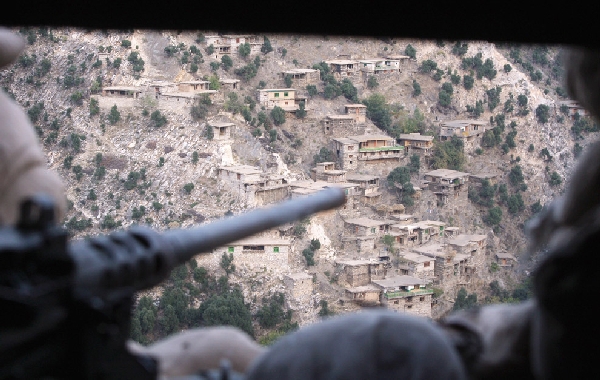
Consider the Korengal Valley in eastern Afghanistan and the people who inhabit this rugged terrain. A fascinating photographic essay in the Boston Globe last week sheds light on some of the inherent contradictions in western efforts to impose a military solution on a topographical reality.

Look at the human craft in the physical structure of this mountainside settlement — something that might not be immediately apparent when viewing this hamlet down the barrel of a gun:

Note, there are no roads. To the western eye, this is a development problem.

At the same time it is also an extraordinary indigenous accomplishment. Men and women and donkeys alone did all the heavy lifting. But instead of admiring the ability of people to master the art of survival in a challenging environment, we regard them as living in a state of deprivation. With a road, life would be better — or so we think.

But do they want a road? Apparently not. The report says: “U.S. and Afghan officers tried to convince the [Korengal Valley] elders to accept a new paved road through the Korengal Valley as part of a large American development project. The elders refused the road, however, saying that they would prohibit anyone in their valley from working on the project.”

What would a road provide for the people of Korengal? Most predictably, the means for Americans to establish larger and more heavily equipped military bases. Beyond that, a road would provide the means to tame a harsh environment. It would diminish the value of the resilience of those who for centuries have survived without a road.

Where a people invest their pride, we see their backwardness and then are perplexed when they spurn our goodwill. We suffer from the burden that dogs every evangelist: how can you insult someone and help them at the same time?

Meanwhile, the narrative that drives out all others is that Afghanistan is now in a downward spiral with the Talilban having established control over a substantial portion of the country.

Counterinsurgency expert, David Kilcullen, tells The New Yorker:

We have built the Afghan police into a less well-armed, less well-trained version of the Army and launched them into operations against the insurgents. Meanwhile, nobody is doing the job of actual policing—rule of law, keeping the population safe from all comers (including friendly fire and coalition operations), providing justice and dispute resolution, and civil and criminal law enforcement. As a consequence, the Taliban have stepped into this gap; they currently run thirteen law courts across the south, and ninety-five per cent of the work of these courts is civil law, property disputes, criminal matters, water and grazing disputes, inheritances etc.—basic governance things that the police and judiciary ought to be doing, but instead they’re out in the countryside chasing bad guys. Where governance does exist, it is seen as corrupt or exploitative, in many cases, whereas the people remember the Taliban as cruel but not as corrupt. They remember they felt safer back then. The Taliban are doing the things we ought to be doing because we are off chasing them instead of keeping our eye on the prize—securing and governing the people in a way that meets their needs.

Kilcullen could have said, “The Taliban have established law and order across much of southern Afghanistan. What can we learn from their success?”

Most importantly, in a war that was originally billed as being driven by a moral imperative, how has it come to pass that in this “good war” our allies are corrupt while our opponents are able to establish some system of justice?

To ask such a question is not to excuse the brutality of the Taliban, but merely underline how utterly lost we have become in a country and a region we insist on trying to reshape even while it still eludes our understanding.

Facebooktwittermail

FEATURES & EDITOR’S COMMENT: America needs a better Qaeda narrative

Amid policy disputes, Qaeda grows in Pakistan

Administration lawyers and State Department officials are concerned about any new authorities that would allow military missions to be launched without the approval of the American ambassador in Islamabad. With Qaeda operatives now described in intelligence reports as deeply entrenched in the tribal areas and immersed in the civilian population, there is also a view among some military and C.I.A. officials that the opportunity for decisive American action against the militants may have been lost.

Pakistani military officials, meanwhile, express growing frustration with the American pressure, and point out that Pakistan has lost more than 1,000 members of its security forces in the tribal areas since 2001, nearly double the number of Americans killed in Afghanistan.

Some architects of America’s efforts in Pakistan defend the Bush administration’s record in the tribal areas, and vigorously deny that Washington took its eye off the terrorist threat as it focused on Iraq policy. Some also question whether Mr. bin Laden and Mr. Zawahri, Al Qaeda’s top two leaders, are really still able to orchestrate large-scale attacks.

“I do wonder if it’s in fact the case that Al Qaeda has really reconstituted itself to a pre-9/11 capability, and in fact I would say I seriously doubt that,” said Mr. Crocker, the American ambassador to Pakistan between 2004 and 2006 and currently the ambassador to Iraq.

“Their top-level leadership is still out there, but they’re not communicating and they’re not moving around. I think they’re symbolic more than operationally effective,” Mr. Crocker said.

But while Mr. Bush vowed early on that Mr. bin Laden would be captured “dead or alive,” the moment in late 2001 when Mr. bin Laden and his followers escaped at Tora Bora was almost certainly the last time the Qaeda leader was in American sights, current and former intelligence officials say. Leading terrorism experts have warned that it is only a matter of time before a major terrorist attack planned in the mountains of Pakistan is carried out on American soil. [complete article]

Editor’s Comment — Why would the branch of al Qaeda based in Pakistan be wasting its resources plotting another major attack on the US? To my mind it seems more likely that they’re now operating under the principle: No need to attack them over there when we can fight them right here.

These are strategic thinkers and I doubt that they have as strong an interest in the abstract goal of destroying Western civilization as they do in the practical goal of driving the US and its allies out of Afghanistan. 9/11 was the bait intended to draw the enemy into a fight on the home turf. We swallowed the bait.

And at the same time, let’s not lose sight of the fact that even a so-called reconstituted al Qaeda with — as the NYT claims — 2,000 local and foreign fighters, is a relatively minor player in this war.

As Graham Usher makes clear in the article below, the geographically-rooted social force here is an ethnic Pashtun movement that ultimately aspires to turn its homeland into a state. “The closest analogy,” according to Khalid Aziz, a former first secretary in the Federally Administered Tribal Areas (FATA), “is the Maoists in Nepal.”

When Obama and the Democratic chorus use the line, “finish the job” in Afghanistan and Pakistan’s tribal areas, do they have the slightest clue what this means? It’s comic-book-talk — no more sophisticated than Bush’s original “smoke ’em out of their caves” line. Anyone serious about trying to dismantle al Qaeda has to reconcile themselves to the ugly fact that this will require dealing with, rather than attempting to destroy, the Taliban. That effort could have started in September 2001. The fact that it didn’t, resulted from a failure in imagination that has haunted us ever since.

Pakistan amidst the storms

Pakistan’s insurgents are not one group, but at least four, loosely allied. There is the Pakistan Taliban and the Afghan Taliban. There are the “Kashmiri mujahideen,” native jihadist groups once nurtured by Pakistan’s intelligence agencies to fight a proxy war with India in the disputed Kashmir province but which have now cut loose from their handlers. And there is al-Qaeda and its affiliates: between 150 and 500 Arab, Uzbek and other foreign fighters who have found refuge in the FATA and use the remote tribal enclave for planning, training, rearmament and recruitment.

There are differences between the factions. The Pakistan and Afghan Taliban are still overwhelmingly ethnic Pashtun movements with a focus on Afghanistan. Al-Qaeda and the jihadists have a more global reach, including targets within Pakistan, such as the bombing on June 2 of the Danish Embassy in Islamabad. But all are united in the war against the US and NATO in Afghanistan. And all are committed to extending the Taliban’s territorial reach beyond the FATA to the NWFP as a whole, including Peshawar, the provincial capital. Such Talibanization “gives the Taliban more security, territory, recruits and bargaining power,” says a source. “It allows them to talk peace in Swat while waging war in Waziristan.”

The government’s response to Talibanization has been to temporize. In 2007, before her return, Bhutto spoke of devolving democratic power to the tribes while integrating the FATA into Pakistan proper, in effect doing away with its special “tribal” status. The focus of the Pashtun nationalist Awami National Party, which heads the NWFP Provincial Government, is economic: It has drawn up plans for a crash program of schools, colleges, rehabilitation centers and jobs to wean young tribesmen from an emerging Taliban polity that is well “on the way to primitive state formation with its own tax system, paid bureaucracy and dispute resolution,” says Aziz. For him — and many in the NWFP government — the Taliban represents less an Islamist movement than a “class revolt expressed in a religious idiom. The closest analogy is the Maoists in Nepal,” he says. It can only be addressed by the “transformation and integration” of a derelict tribal system.

Such a project “will take years,” says Aziz. It is also understood that no peace will hold in the NWFP without a resolution of the conflict with the Taliban in the FATA, which is under the remit of the federal government. And the PPP and Awami Nationalist Party have passed that buck to the army: an abdication frankly admitted by the government’s decision on June 25 to entrust the use of force in FATA entirely to Kayani. The army’s strategy for now is to secure localized peace deals that will keep the territorial advantage it obtained in February while playing divide-and-rule with the Taliban’s different tribal leaderships. It is “the policy of the breathing space,” says Afghanistan expert Ahmad Rashid.

In South Waziristan, this means extracting a pledge from the Taliban to end attacks on the army and government-sponsored development projects. In return, the army will release prisoners and “reposition” its units outside the cities. In Swat in the NWFP, the tradeoff is that the Taliban end attacks on government institutions, including girls’ schools, in return for implementation of Islamic law, seen principally as a means to coopt hundreds of jobless seminary students who may otherwise join the militants. “It’s an agreement,” says Aziz, “but not in the Western sense. In the FATA an agreement is an arrangement to coexist. It means shutting your eyes to many things.”

The Taliban have closed their eyes to the army camps that now nestle permanently in the mountains above them. And the army is looking away from a steady flow of guerrillas across the border, or at least is not acting overtly to intercept them. Peace in Pakistan, in other words, may translate into intensified warfare in Afghanistan. [complete article]

Facebooktwittermail

NEWS & EDITOR’S COMMENT: Peshawar “could fall” to the Taliban

The Taliban’s advance threatens Pakistan

“The security situation in Peshawar is grim. Officials in the home department, who evaluate the situation on an almost daily basis, believe declaring a state of red alert is now only a matter of time,” Pakistan’s Dawn newspaper reported on Tuesday.

“With militants knocking at the gates of the capital of the North-West Frontier Province (NWFP), even the more circumspect government and police officials now grudgingly concede that Peshawar, too, could fall in a few months.

“‘Peshawar is in a state of siege and if Peshawar falls, the rest of the districts in the NWFP would fall like ninepins’, a worried senior government official told Dawn.”

Pakistan’s Daily Times noted: “These days Taliban fighters do not sneak in to Peshawar. They arrive in broad daylight on the back of pick-up trucks, brandishing automatic weapons, and threatening owners of music stores to close down. ‘They had long hair and flowing beards, and were carrying Kalashnikovs. They told me to close down the shop or face the consequences,’ said Abdul Latif, a clean-shaven 20-year-old, whose video store received a visit from the vigilantes last week. ‘I asked police for help but they said they are helpless,’ he said.” [complete article]

Editor’s Comment — The Democratic Party national security posture has for several years been to claim that a clear-eyed Democratic president would “finish the job” that George Bush started in Afghanistan and from which he got distracted by Iraq.

In 2009, assuming Obama wins the election, the Democrats and the rest of America will be in for a rude awakening. A war in Afghanistan — originally dreamed up by Zbigniew Brzezinski as the Soviet Union’s Vietnam — is destined to become for the US more like Vietnam than even Iraq has been. But whereas Vietnam had the natural containment of Vietnamese nationalism, Afghanistan has no such boundaries.

The fantasy of a border between Afghanistan and Pakistan — the Durand Line — is the reason the war in Afghanistan is so difficult to prevent becoming a deeper regional conflict. With the Pakistani side of the “border” defended largely by the Frontier Corps, it’s not hard to understand why the NWFP and FATA provides the Taliban with a comfortable refuge. Created by the British, the FC retains a colonial structure: 80,000 soldiers drawn from the local population, commanded by officers from outside the region who apparently often “disdain the assignment.” FC soldiers are naturally ambivalent about fighting fellow Pashtuns, but the more heavy-handed the Pakistani Army becomes, the more the concept of Pakistan comes under threat.

American pressure on the Pakistan government to crackdown on the militants, risks provoking a civil war. In that event, the chances for NATO finishing the job in Afghanistan will be reduced to precisely zero.

A useful question to pose both presidential candidates might be this: Where do you anticipate American troops fighting for the longest? Iraq or Afghanistan?

Facebooktwittermail

ANALYSIS & EDITOR’S COMMENT: The Petraeus promotion

Petraeus promotion frees Cheney to threaten Iran

The nomination of Gen. David Petraeus to be the new head of the Central Command not only ensures that he will be available to defend the George W. Bush administration’s policies toward Iran and Iraq at least through the end of Bush’s term and possibly even beyond.

It also gives Vice President Dick Cheney greater freedom of action to exploit the option of an air attack against Iran during the administration’s final months. [complete article]

Petraeus’ ascension

Reaffirming his status as his generation’s most respected general officer, David H. Petraeus was nominated today to head U.S. Central Command (Centcom), the command responsible for all U.S. military operations in the Middle East. The move puts the U.S. military’s premier advocate, theorist and practitioner of counterinsurgency operations — once shunned by a Vietnam-stung military — at the helm of the military’s most important regional command.

But many military analysts — even those closely associated with the counterinsurgency theories that Petraeus has long championed — viewed the move as a mixed blessing. [complete article]

Editor’s Comment — Time is running out! There’s only six months left to keeping pushing the argument that Dick Cheney is going to start another war. After that, the only hope for the war-fearmongers is a McCain or Clinton presidency… Pardon the sarcasm.

So why do I question the idea that Petraeus’ promotion lets Cheney off the leash? Firstly, I doubt that Gates had his arm twisted into doing this. Indeed, to the extent that Petraeus was guilty of promoting operations in Iraq at the expense of meeting needs in Afghanistan, this seems to present quite a strong argument in favor of his being moved to CentCom. As commander in Iraq, it wasn’t his job to be an advocate for meeting pressing needs in any other arena. But as head of CentCom, Petraeus will become answerable for both Iraq and Afghanistan. And this time around The White House is hardly likely to go around the CentCom commander and deal directly with the commander in Iraq. By appointing U.S. Army Gen. Raymond Odierno to that position, Gates has ensured that Petraeus retains control in both commands. And Petraeus’ own ambitions surely stretch beyond 2008. He won’t merely want to please this president, but he also knows he’s going to be answerable to the next.

And as William Arkin argued last month, beyond the occasional bellicose piece of rhetoric (and there really hasn’t even been much of that in recent months), there is no practical evidence that the US military is readying itself or capable of starting another war. Blaming Iran for problems in Iraq seems to have less to do with making a case for attacking Iran than it does with resisting pressure to withdraw troops.

Facebooktwittermail

NEWS: “NATO is not winning in Afghanistan”

Calls grow for shift in Afghan policy

The Bush administration faces increasing pressure to make a major policy course correction on Afghanistan, shifting the focus from Iraq to fight a resurgent terrorist threat and build up the faltering government in Kabul.

A Senate Foreign Relations Committee hearing today is set to take up a string of new reports warning that the political and economic situations in Afghanistan are deteriorating amid growing strains between the United States and its NATO allies over the military mission there. [complete article]

Demise of al-Qaida’s ‘number three’

If Abu Laith al-Libi is indeed dead, then there is a certain inevitability to his sudden demise.

The Libyan militant has lived dangerously for nearly two decades, starting his career in militant groups in his homeland before turning to operations in Saudi Arabia in the mid-90s.

In 1999 or thereabouts Libi, believed to be aged in his 40s, surfaced in Afghanistan, operating as both a field commander and later a spokesman for al-Qaida. His most recent post was his most dangerous to date. [complete article]

Suicide bomber kills Afghan official

The deputy governor of Helmand Province and five others were killed by a suicide bomber during afternoon prayers in a mosque in the provincial capital, Afghan officials said. The Taliban claimed responsibility.

The deputy, Hajji Pir Mohammad, was dead on arrival at a hospital in the capital, Lashkar Gah, the duty doctor there said, and at least 21 injured people, including a 5-year-old boy, were treated.

The bomb went off just after 1 p.m. in a mosque near the governor’s office, the provincial police chief, Muhammad Hussain Andiwal, said. He confirmed that six people, including the deputy governor, were killed as they were praying. [complete article]

Sentenced to death: Afghan who dared to read about women’s rights

A young man, a student of journalism, is sentenced to death by an Islamic court for downloading a report from the internet. The sentence is then upheld by the country’s rulers. This is Afghanistan – not in Taliban times but six years after “liberation” and under the democratic rule of the West’s ally Hamid Karzai.

The fate of Sayed Pervez Kambaksh has led to domestic and international protests, and deepening concern about erosion of civil liberties in Afghanistan. He was accused of blasphemy after he downloaded a report from a Farsi website which stated that Muslim fundamentalists who claimed the Koran justified the oppression of women had misrepresented the views of the prophet Mohamed. [complete article]

Facebooktwittermail

ANALYSIS: An Afghan snub

U.S., Britain stung by an Afghan temper

What lends urgency to [Admiral William] Fallon’s mission to Tashkent is the criticality of the Afghan situation. Much thinking has gone into Fallon’s mission and it was preceded by months of mediation by the European Union between Washington and Tashkent. Karimov took time to relent. Yet, ironically, the fragility of the overall situation in Afghanistan is such that the thaw in US-Uzbek relations was overtaken within 24 hours of Fallon’s mission by dramatic developments in Kabul.

In a series of statements over the weekend, President Hamid Karzai’s government rubbished a major decision taken by Washington and London on the appointment of Lord Paddy Ashdown as the United Nations’ super envoy in Kabul.

Kabul knew for months about the impending appointment of Ashdown as a key step in a new NATO strategy spearheaded by the US and Britain, aimed at stabilizing the Afghan situation. Karzai knew detailed planning had gone into the move involving NATO, the EU and the United Nations Security Council. But Karzai waited patiently until the eleventh hour before shooting it down publicly on Saturday in a interview with the BBC while attending the World Economic Forum meet in the Swiss resort town of Davos. The move was pre-planned and carried out in a typical Afghan way with maximum effect. [complete article]

Facebooktwittermail

NEWS ROUNDUP: January 27

Bush order expands network monitoring
President Bush signed a directive this month that expands the intelligence community’s role in monitoring Internet traffic to protect against a rising number of attacks on federal agencies’ computer systems.

Bush urged to renounce torture, restore ‘moral authority’
Delivering what they called a “prebuttal” to President Bush’s final State of the Union speech, congressional Democratic leaders called on Bush to chart a new direction for the U.S. economy and restore America’s “moral authority” abroad, notably by publicly renouncing torture and closing the Guantanamo Bay detention facility.

Israel to restore supply of industrial-use fuel to Gaza Strip
The state told the High Court of Justice on Sunday that Israel would restore the supply of industrial-use diesel to the Gaza Strip to target levels set prior to the blockade imposed on Gaza earlier this month.

American aid worker seized in Afghanistan
Gunmen kidnapped an American aid worker and her driver in southern Afghanistan’s largest city early Saturday, seizing the woman from a residential neighborhood as she was on her way to work.

Maliki sending troops to Mosul
Iraqi Prime Minister Nouri al-Maliki said Friday that Iraqi reinforcements have begun moving toward the northern city of Mosul for a “decisive” battle with the Sunni insurgent group al-Qaeda in Iraq.

FBI agent: Hussein didn’t expect invasion
Before the Iraq war, Saddam Hussein misjudged the U.S. military strategy and thought the United States would launch only several days of airstrikes and not a full-scale ground invasion, according to a television interview with the FBI agent who interrogated the former Iraqi leader for seven months.

Facebooktwittermail