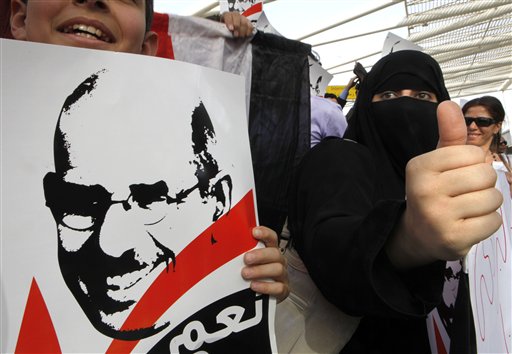
Mohamed ElBaradei is heading back to Egypt despite direct threats against his life. He said this to Newsweek:
When Egypt had parliamentary elections only two months ago, they were completely rigged. The party of President Hosni Mubarak left the opposition with only 3 percent of the seats. Imagine that. And the American government said that it was “dismayed.” Well, frankly, I was dismayed that all it could say is that it was dismayed. The word was hardly adequate to express the way the Egyptian people felt.
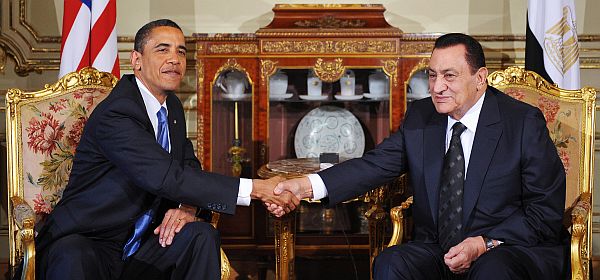
Then, as protests built in the streets of Egypt following the overthrow of Tunisia’s dictator, I heard Secretary of State Hillary Clinton’s assessment that the government in Egypt is “stable” and “looking for ways to respond to the legitimate needs and interests of the Egyptian people”. I was flabbergasted—and I was puzzled. What did she mean by stable, and at what price? Is it the stability of 29 years of “emergency” laws, a president with imperial power for 30 years, a parliament that is almost a mockery, a judiciary that is not independent? Is that what you call stability? I am sure not. And I am positive that it is not the standard you apply to other countries. What we see in Egypt is pseudo-stability, because real stability only comes with a democratically elected government.
If you would like to know why the United States does not have credibility in the Middle East, that is precisely the answer. People were absolutely disappointed in the way you reacted to Egypt’s last election. You reaffirmed their belief that you are applying a double standard for your friends, and siding with an authoritarian regime just because you think it represents your interests. We are staring at social disintegration, economic stagnation, political repression, and we do not hear anything from you, the Americans, or for that matter from the Europeans.
So when you say the Egyptian government is looking for ways to respond to the needs of the Egyptian people, I feel like saying, “Well, it’s too late!” This isn’t even good realpolitik. We have seen what happened in Tunisia, and before that in Iran. That should teach people there is no stability except when you have government freely chosen by its own people.
Al Ahram reports:
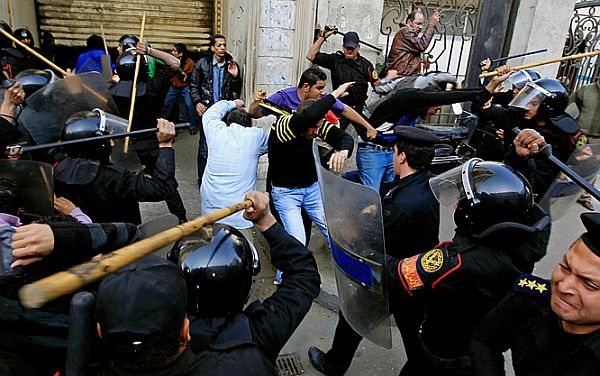
Downtown Cairo looked like a war zone Wednesday.
Police in both plain clothes and formal security uniforms were present by the thousands. Riot police were seen sleeping on, and manning, the 6 October and 15 May bridges – the main ones connecting main streets of the city — since last night. Hundreds of people gathered in several streets downtown chanting “People want the government down”, “Copts and Muslims don’t want this system”, and, “Bread, freedom, human integrity.” They were chased and beaten fiercely, many of them also dragged off by force – by thugs and state security agents.
Reporting on today’s demonstrations, Time noted:
Everywhere, the message was the same: “The people want the fall of the regime,” the protesters chanted as they marched over broken glass. On the Corniche, Cairo’s busy road along the Nile, protesters stopped traffic, setting a dumpster on fire and chanting “Down, Down Mubarak!” Moments later, they scattered after a charge by over a dozen plainclothes thugs, armed with sticks and knives, who chased them in between cars and onto a nearby bridge.
Throughout the evening, TIME’s Cairo reporter continued to hear reports of an impeding rally in the center of the city. And at around 11 p.m., a group of protesters attacked the Foreign Ministry, ransacking an outside office, before being pushed back.
The government released statements on Tuesday and Wednesday that sought to place much of the blame for Tuesday’s protest on Egypt’s largest opposition group, the banned Muslim Brotherhood. Activists who actually participated in the demonstrations say the allegation is bogus. “They’re trying to play the same old cards — by threatening the West and the United States that when this regime leaves power, the Muslim Brotherhood will take over. This is absolutely not true,” says Shadi Taha, a member of the liberal Tomorrow Party, whose leader Ayman Nour — a darling of the Bush administration — was on the street on Tuesday. “What we witnessed yesterday was that more than 90% of those people who took to the streets… it was probably their first time to demonstrate. We used to call them the silent majority — the majority that is not involved in politics, who have never been involved in politics, and who definitely are not involved in the Muslim Brotherhood.”