



Twitter roundup from the Egyptian port of Al-Arish where the Viva Palestina convoy has been attacked
The following tweets cover key moments from the last two hours in Al-Arish where Joti says: “All quiet for now. Six arrested, lots of head wounds as cops started the rock throwing. One serious injury stretchered out.” (It’s currently 6.35PM US Eastern Tuesday, 1.35AM Wednesday in Egypt and the tweets below appear in chronological order):
Riot cops have moved their barriers and look to be gearing up 4 a fight. Our boys preparing to defend the port. #vivapalestina – joti2gaza
Full-on battles between convoy boys and Egyptian riot cops. Tear gas, water cannons, rocks throwing. #vivapalestina – joti2gaza
For Gaza siege. We have bend over backwards to come to Elarish cause EGY said we’d be welcomed here, instead welcomed with violence – juanajaafar
Galloway here with TUR MPs to negotiate movement of convoy since 530pm local time. EGY asked for 59 of our vehicles to give to Israel. – juanajaafar
59 vehicles = 25% of our convoy which includes 2 big trucks from GBR and TUR. This contradicts written agreement EGY gave to TURs in Aqaba – juanajaafar
Galloway says Viva has video taken from meeting room to show special police starting violence. Police then threw stones at meeting room – juanajaafar
RT @Irish4Palestine: ppl were attacked by outsiders who came with stick and stones and entered compound, this was a set up #vivapalestin – peter2gaza
RT @viva_palestina: RT @juanajaafar: Arrested are from GRB, USA, Msia and Kuwaiti. (via @Stand4Liberty) – peter2gaza
All quiet for now. Six arrested, lots of head wounds as cops started the rock throwing. One serious injury stretchered out. #vivapalestina – joti2gaza
Viva Palestina are faced with 2,000 riot police in the port of Al-Arish!
To all friends of Palestine
Our situation is now at a crisis point! Riot has broken out in the port of Al- Arish.
This late afternoon we were negotiating with a senior official from Cairo who left negotiations some two hours ago and did not return. Our negotiations with the official was regarding taking our aid vehicles into Gaza.
He left two hours ago and did not come back. Egyptian authorities called over 2,000 riot police who then moved towards our camp at the port.
We have now blocked the entrance to the port and we are now faced with riot police and water cannons and are determined to defend our vehicles and aid.
The Egyptian authorities have by their stubbornness and hostility towards the convoy, brought us to a crisis point.
We are now calling upon all friends of palestine to mount protests in person where possible, but by any means available to Egyptian representatives, consulates and Embassy’s and demand that the convoy are allowed a safe passage into Gaza tomorrow!
Kevin Ovenden
Viva Palestina Convoy Leader
———————
Alice Howard
Viva Palestina UK – Administration Manager
Tel: 07944 512 469
Email: alice@vivapalestina.org
Website: http://www.vivapalestina.org/
Turkish MPs to enter Gaza with Viva Palestina convoy in Egypt
Five Turkish MPs will on Monday join an international aid convoy that has reached Egyptian port one-week later after the date that they initially hoped to reach Gaza Strip on the first anniversary of Israel’s 22-day offensive.
Viva Palestina Convoy is now at the Egyptian port of El-Arish with Turkish ship ULUSOY-6, which carried the convoy from the Syrian port of Lattakia to Egypt.
The aid volunteers who stay at Lattakia will fly in the day in 3 separate flights to Al-Arish to join the convoy. After everyone arrives at the Al- Arish port, the convoy will make an hour-drive to the Rafah border.
It is expected that the convoy will enter Gaza on Tuesday evening. It will be able to stay in Gaza for 24 hours only. During this time, all aid, drugs and medical tools will be delivered to the Gazan authorities. After 24 hours, all volunteers who travel with the convoy will go to Egypt and then fly back to their own countries. [continued…]
Egypt considers itself as the leader of the Arab world. It is the most populous Arab country, situated at the center of the Arab world. Fifty years ago the president of Egypt, Gamal Abd-al-Nasser, was the idol of all the Arabs, especially of the Palestinians. How can Egypt collaborate with the “Zionist enemy”, as Egyptians called Israel then, in bringing 1.5 million brother Arabs to their knees?
Until recently, the Egyptian government had been sticking to a solution that exemplifies the 6000-year old Egyptian political acumen. It participated in the blockade but closed its eyes to the hundreds of tunnels dug under the Egyptian-Gaza border, through which the daily supplies for the population were flowing (for exorbitant prices, and with high profits for Egyptian merchants), together with the stream of arms. People also passed through them – from Hamas activists to brides.
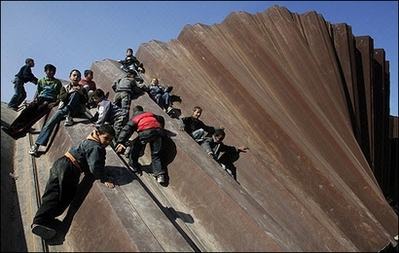
This is about to change. Egypt has started building an iron wall – literally – along the full length of the Gaza border, consisting of steel pillars thrust deep into the ground, in order to block all tunnels. That will finally choke the inhabitants.
When the most extreme Zionist, Vladimir Ze’ev Jabotinsky, wrote 80 years ago about erecting an “Iron Wall” against the Palestinians, he did not dream of Arabs doing just that. [continued…]
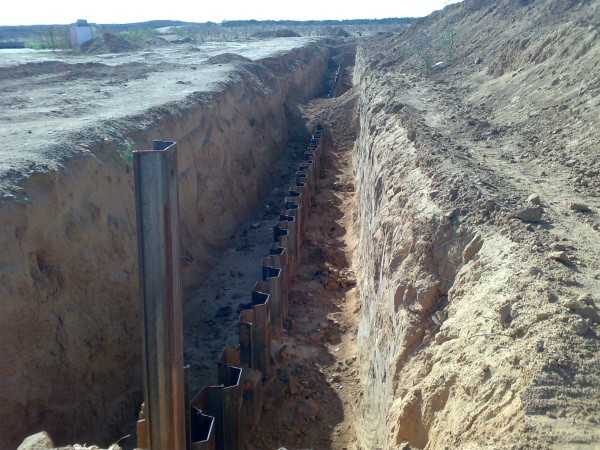
Hamas urges clerics to reverse Gaza wall edict
Hamas on Sunday urged leading Islamic clerics in Egypt to reverse a recent edict supporting the construction of a metal wall cutting off smuggling tunnels under the border with the Gaza Strip.
It emerged late last week that scholars at Cairo’s Al-Azhar University, Sunni Islam’s highest seat of learning, issued a fatwa in favor of the wall.
“It is one of Egypt’s legitimate rights to place a barrier that prevents the harm from the tunnels under Rafah, which are used to smuggle drugs and other [contraband] that threaten Egypt’s stability,” the newspaper Al-Masri Al-Yom quoted the scholars as saying, according to AFP.
“Those who oppose building this wall are violating the commands of Islamic law,” they added, after a meeting attended by Egypt’s top cleric Sheikh Muhammad Said Tantawi, who is a government appointee. [continued…]
Galloway Gaza convoy leaves Syria
A British-led aid convoy bound for the Gaza Strip is on its way to the Egyptian port of Al-Arish after departing Syria by boat, organizers said on Sunday.
The Viva Palestina convoy, led in part by firebrand British MP George Galloway, loaded 210 truckloads of food and medical supplies onto a ferry in the Syrian port of Latakia.
The group, which set out from London nearly a month ago and drove through Turkey and Syria, spent five days stranded in Jordan after Egypt denied it permission to travel to the Red Sea port of Nuweiba, insisting that aid convoys should transit through the port of Al-Arish, on the Mediterranean. [continued…]

‘Israel resembles a failed state’
One year has passed since the savage Israeli attack on the Gaza Strip, but for the people there time might as well have stood still.
Since Palestinians in Gaza buried their loved ones – more than 1,400 people, almost 400 of them children – there has been little healing and virtually no reconstruction.
According to international aid agencies, only 41 trucks of building supplies have been allowed into Gaza during the year.
Promises of billions made at a donors’ conference in Egypt last March attended by luminaries of the so-called “international community” and the Middle East peace process industry are unfulfilled, and the Israeli siege, supported by the US, the European Union, Arab states, and tacitly by the Palestinian Authority (PA) in Ramallah, continues. [continued…]
Editor’s Comment — Ali Abunimah, who has just left Cairo after attending the thwarted Gaza Freedom March, adds on his blog:
To talk about the siege of Gaza in the abstract is one thing, but to actually come to Egypt and find that Gaza is harder to visit than a prison is like a bucket of cold water. The Egyptian government may be efficient at few things, but it is highly efficient at maintaining the siege. Buses hired to take all the marchers to Gaza were prevented from showing up. Those who tried to get to Gaza under their own steam were turned back or detained at their hotel in Al Arish. It was very very frustrating. But whatever frustration we felt is one millionth of the frustration of the besieged Palestinian people in Gaza. So perhaps in some way it is better then that we did not get in, because Egypt gave us a small taste of what it serves every day to people in Gaza — and a small taste of what Egyptians face when they challenge their government’s policies.
T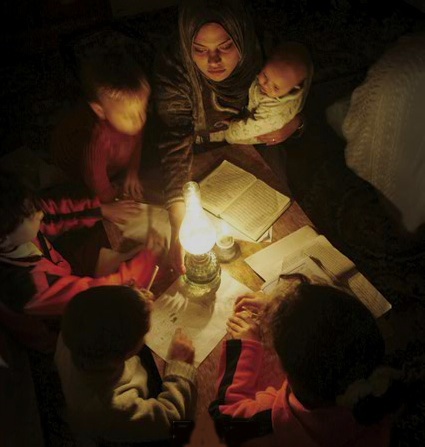 he question was like an electric shock to the six or so Palestine solidarity activists, including myself, as we were standing inside a classroom at a school in Gaza City.
“Why the Palestinians? Why are we the only ones suffering?” asked a Palestinian girl who was probably about nine or ten-years-old. And then the enormity of what the people of Gaza go through every day hit me.
Most of us were Americans and one was Canadian, and we were delivering some of the $17,000 in school supplies that Jessica Campbell and Julia Hurley, two members of the Gaza Freedom March student delegation, had brought and raised on their own. [continued…]
Israel’s 10 worst errors of the decade
…there is perhaps no better time than this to review Israel’s 10 Worst Mistakes of the Last 10 Years:
1. The Siege of Gaza – The stated goal of the siege was to undermine Hamas and to goad Gazans into rejecting Hamas rule. The effect of the siege has been to focus and intensify Palestinian anger against Israel, increase Gazans’ dependency on Hamas social welfare arms, enrich Hamas coffers through tunnel taxation and foreign donations, and sap Palestinian support for Fatah, which, through its back-channel encouragement for the siege, is seen as a betrayer and a boot-licker in the eyes of many Palestinians.
2. The Siege of Gaza – The blockade was ostensibly a means to stem the influx of weaponry into Gaza. In practice, with shipments the size of automobiles flowing through the tunnels, the Hamas arsenal has grown ever more sophisticated, now believed to include Iranian-manufactured rockets capable of striking Tel Aviv and Ben-Gurion Airport from the Strip.
3. The Siege of Gaza – In the eyes of the world community, the overwhelming collective punishment – and the relative silence of Israelis in response – has gutted Israeli claims to the moral high ground. It has undercut sympathy for Israelis living within Qassam range. It has kept open the moral wounds of the Gaza War, cramping rebuilding efforts, enshrining universal unemployment, and ensuring agonizing homelessness as the coastal winter gathers full force. Israeli officials have quietly take steps of astounding insensitivity, arbitrarily barring such goods as school supplies.
4. The Siege of Gaza – The siege has been presented in the past as a means of pressing Hamas to release Gilad Shalit. Not only does he remain captive, the terms of a prospective deal appear not to include lifting the siege. The siege has been presented in the past as a means of pressuring Gazans to end rocket fire. But rocket fire only increased after the siege was put in place. Finally, Cast Lead, the Gaza war a year ago, might have been prevented altogether, had Israel adhered more closely to the Egyptian-brokered Hamas-Israel truce agreement of June, 2008, and lifted the siege more completely in response to a drop in rocket fire.
5. The Siege of Gaza – The siege works to the detriment of U.S. support for Israel. In February, Secretary of State Hillary Clinton signaled anger at Israel over obstacles to humanitarian aid entering the strip. The message came soon after Senate Foreign Relations Committee Chairman John Kerry, visiting Gaza, learned that Israel had blocked shipments of pasta, ruling it off the list of permitted humanitarian aid items.
6. The Siege of Gaza – The fact that the siege has failed so completely in achieving its stated aims, reinforces the impression that its real purpose is punitive.
7. The Siege of Gaza – The siege places Israeli officials in jeopardy of being charged with violating the Fourth Geneva Convention and other international codes, as outlined in detail in the Goldstone Report. Referring to the siege, paragraph 1335 of the report states that: “From the facts available to it, the Mission is of the view that some of the actions of the Government of Israel might justify a competent court finding that crimes against humanity have been committed.”
8. The Siege of Gaza – With the siege under the direct aegis of Defense Minister Ehud Barak and his deputy, Matan Vilnai, the moral failings of the siege could prove the coup de grace to an already foundering Labor Party.
9. The Siege of Gaza – The siege threatens to destabilize the rule of Hosni Mubarak in Egypt, posing a potential threat to Israeli-Egyptian peace and Israeli security.
10. The Siege of Gaza – The siege corrupts the moral values of all Israelis, who, whether or not they are aware of what is being done to the people of Gaza, bear ultimate responsibility for all acts being carried out in their name. [continued…]

Activists reject Egypt’s Gaza offer
M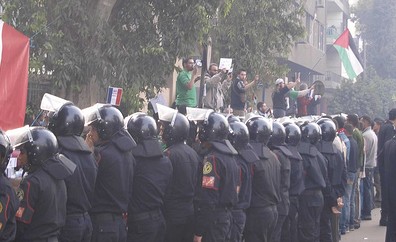 embers of an international group gathered in Cairo to protest against the siege of Gaza have rejected an Egyptian offer to allow 100 of them entry into the Palestinian territory.
Organisers of the Gaza Freedom March (GFM), which is comprised of 1,300 people from 42 different countries, declined the offer on Wednesday, saying “we refuse to whitewash the siege of Gaza”. [continued…]
Egypt’s role in the Gaza blockade
While Egypt is reported to be receiving technical assistance from the United States in constructing an underground steel barrier along Gaza’s southern border, Egypt’s foreign minister, Ahmed Aboul Gheit, told The National: “The Egyptian state and people paid a very high price and paid with their blood for more than 50 years in support of the Palestinians. No one should compare himself with what Egypt did and is still doing for the Palestinians.”
In Beirut, Hizbollah Secretary General Sayyed Hassan Nasrallah urged Egypt to stop building the barrier which could cut off the tunnels that currently provide a lifeline for the Palestinian territory which remains under an Israeli-imposed siege.
The Daily Star reported: “Nasrallah told a crowd of tens of thousands of Lebanese Shiite Muslims marking the Ashura religious ceremony that Egypt should be condemned if it does not halt the wall building. [continued…]

Hints of pluralism in Egyptian religious debates
Writing in his weekly newspaper column, Gamal al-Banna said recently that God had created humans as fallible and therefore destined to sin. So even a scantily clad belly dancer, or for that matter a nude dancer, should not automatically be condemned as immoral, but should be judged by weighing that person’s sins against her good deeds.
This view is provocative in Egypt’s conservative society, where many argue that such thinking goes against the hard and fast rules of divine law. Within two hours of the article’s posting last week on the Web site of Al Masry al Youm, readers had left more than 30 comments — none supporting his position.
“So a woman can dance at night and pray in the morning; this is duplicity and ignorance,” wrote a reader who identified himself as Hany. “Fear God and do not preach impiety.”
Still, Mr. Banna was pleased because at least his ideas were being circulated. Mr. Banna, who is 88 years old and is the brother of Hassan al-Banna, founder of the Muslim Brotherhood, has been preaching liberal Islamic views for decades.
But only now, he said, does he have the chance to be heard widely. It is not that a majority agrees with him; it is not that the tide is shifting to a more moderate interpretative view of religion; it is just that the rise of relatively independent media — like privately owned newspapers, satellite television channels and the Internet — has given him access to a broader audience. [continued…]
Netanyahu’s defiance of US resonates at home
For five months, Israeli Prime Minister Binyamin Netanyahu has been fending off U.S. pressure to halt the expansion of West Bank settlements. Now he is reaping dividends for his defiance.
Although Israeli leaders have historically been reluctant to publicly break with the United States for fear of paying a price in domestic support, polls show that Netanyahu’s strategy is working. And that means that after months of diplomacy, the quick breakthrough that President Obama had hoped would restart peace talks has instead turned into a familiar stalemate.
Arab states largely have rebuffed Obama’s request for an overture to Israel until the settlement issue is resolved — a stand that Egyptian President Hosni Mubarak emphasized in a meeting with Obama on Tuesday — and the Palestinians have said a settlement freeze is a precondition for resuming negotiations. Meanwhile, the Israeli public seems to have rallied around Netanyahu’s refusal to halt all settlement construction, a backlash that intensified when the Obama administration made clear that it wanted Israel to stop building Jewish homes in some parts of Jerusalem as well as in the occupied West Bank. [continued…]
Obama says Mideast peace process is in a ‘rut’
President Obama said Tuesday that the Middle East peace process was in a “rut,” and prodded Egyptian President Hosni Mubarak to help break an Arab-Israeli standoff that has frustrated the administration’s effort to restart talks.
“If all sides are willing to move off of the rut that we’re in currently, then I think there is an extraordinary opportunity to make real progress,” Obama said in an appearance with Mubarak at the White House. “But we’re not there yet.” [continued…]
Mubarak to tell U.S. Israel must make overture
In White House meetings beginning Monday, President Hosni Mubarak of Egypt is expected to tell the Obama administration that Arab nations want peace, but are unwilling to abide Mr. Obama’s call to make good-faith concessions to Israel until Israel takes tangible steps like freezing settlements, an Egyptian official said.
As part of its effort to resuscitate the peace process, the Obama administration has asked Arab countries to make small but symbolic gestures to normalize relations with Israel, like allowing planes to fly through their airspace or improving cultural ties. The administration has also asked Israel to freeze all growth in settlements.
So far, neither side has agreed to Mr. Obama’s proposed first steps, and so the president is expected to look to Mr. Mubarak for help in breaking the latest Middle East deadlock, regional analysts said. [continued…]
Too gung-ho? Israel military rabbis draw criticism
Most Israelis expect their military rabbis to confine themselves to such tasks as making sure the army provides kosher food and respects the Sabbath. But lately, some of them are asserting their own idea of Jewish virtue at the risk of stepping into the country’s culture wars.
Some critics worry that the rabbinate and its charismatic chief, Brig. Gen. Avichai Rontzki, are infusing a militant mix of Judaism and nationalism into a traditionally secular institution that embodies the Israeli consensus.
On the Palestinian side, Islamic hard-liners already see their war with Israel through an uncompromising religious lens, and the rabbinate’s critics warn that the Jewish state must not follow suit and risk pushing the conflict closer to a zero-sum holy war. [continued…]
Israel plans to accept the Egyptian-mediated cease-fire proposal with Hamas in the Gaza Strip, but does not intend to officially declare a commitment to it. Instead, Israel will treat the deal struck indirectly with Hamas as a series of steps beginning with a lull in hostilities, followed by gradual relaxation of the financial blockade of Gaza.
Ehud Barak, who will discuss the cease-fire with Egyptian President Hosni Mubarak in Sharm el-Sheikh Monday, is skeptical about the chances of achieving long-term quiet with Hamas, and his feelings are shared by Prime Minister Ehud Olmert and Foreign Minister Tzipi Livni.
However, Barak, who will be attending the World Economic Forum, is set to tell Mubarak and Egyptian intelligence chief Omar Suleiman that Israel is prepared to stop its military activities in Gaza if Hamas stops firing rockets at Israel. Israel will also try to get Egypt to step up efforts to stop weapons from being smuggled into Gaza. Barak is also expected to say that Israel will lift the blockade and open border crossings only if progress is made on talks aimed at releasing captive soldier Gilad Shalit.
Once quiet reigns, Israel hopes to gradually raise the number of trucks allowed to bring goods into the Strip (only about 60 trucks a day, on average, are now allowed in). If a deal is reached on returning Shalit, in exchange for Israel’s release of 450 prisoners, Israel would also agree to reopen the Rafah crossing, essentially lifting the blockade almost completely. [complete article]
Is Israel breaking its own taboo on talks with Hamas?
Participants at a recent inner cabinet meeting were listening to details of the Egyptian mediation initiative between Israel and Hamas on a cease-fire in the Gaza Strip recently, when a senior minister reportedly reminded those present that Israel does not negotiate, directly or indirectly, with Hamas. Shin Bet security service head Yuval Diskin interrupted, saying there was no other way to describe the talks.
A letter to Prime Minister Ehud Olmert, Defense Minister Ehud Barak and Foreign Minister Tzipi Livni, the details of which were revealed Friday, called for the indirect and secret talks with Hamas to be recognized. As for Israel’s greatest concerns – that Hamas will use a lull in hostilities to rearm and that Egypt’s promises to fight weapons smuggling bear no weight – the writers of the letter offered no solution.
Among the signatories’ names, that of MK Yossi Beilin (Meretz) is to be expected. More surprising are the names of the former Shin Bet chief Ephraim Halevi, who has actually been calling for talks with Hamas in recent months, along with former chief of staff Amnon Lipkin-Shahak and Brigadier General (res.) Shmuel Zakai, a former Gaza Division commander. This is an attempt to provide a military stamp of approval to a step Israel has officially sworn it would not take. What was taboo two years ago is no longer. [complete article]
Editor’s Comment — There’s one thing that George Bush, John McCain, and Barak Obama all currently claim: talking to Hamas is a bad idea. So what do they each have to say about the fact that Israel has abandoned this principle?
The Israelis are doing lots of posturing – claiming that talks have not been negotiations, saying that they won’t express their official commitment to a ceasefire with Hamas – but the reality is clear: the policy of attempting to defeat Hamas through a war of attrition has failed.
The presidential campaigns and the American press will of course all press along as though nothing has changed.
When the prime minister of Israel, Ehud Olmert, arrived at a Jerusalem ballroom in February to address the grandees of the Conference of Presidents of Major American Jewish Organizations (a redundancy, since there are no minor American Jewish organizations), he was pugnacious, as is customary, but he was also surprisingly defensive, and not because of his relentlessly compounding legal worries. He knew that scattered about the audience were Jewish leaders who considered him hopelessly spongy — and very nearly traitorous — on an issue they believed to be of cosmological importance: the sanctity of a “united” Jerusalem, under the sole sovereignty of Israel.
These Jewish leaders, who live in Chicago and New York and behind the gates of Boca Raton country clubs, loathe the idea that Mr. Olmert, or a prime minister yet elected, might one day cede the Arab neighborhoods of East Jerusalem to the latent state of Palestine. These are neighborhoods — places like Sur Baher, Beit Hanina and Abu Dis — that the Conference of Presidents could not find with a forked stick and Ari Ben Canaan as a guide. And yet many Jewish leaders believe that an Israeli compromise on the boundaries of greater Jerusalem — or on nearly any other point of disagreement — is an axiomatic invitation to catastrophe.
One leader, Joshua Katzen, of the Jewish Institute for National Security Affairs, told me, “I think that Israelis don’t have the big view of global jihad that American Jews do, because Israelis are caught up in their daily emergencies.” When I asked him how his Israeli friends responded to this, he answered: “They say, ‘When your son has to fight, you can have an opinion.’ But I tell them that it is precisely because your son has to fight that you have a harder time seeing the larger picture.”
When I spoke to Mr. Olmert a few days after his meeting with the Conference of Presidents, he made only brief mention of his Diaspora antagonists; he said that certain American Jews he would not name have been “investing a lot of money trying to overthrow the government of Israel.” But he was expansive, and persuasive, on the Zionist need for a Palestinian state. Without a Palestine — a viable, territorially contiguous Palestine — Arabs under Israeli control will, in the not-distant future, outnumber the country’s Jews. [complete article]
Editor’s Comment — We hear a lot about the existential threats that Israel faces, but an American plot to overthrow the government of Israel? And the accusation comes from the Israeli prime minister? Shouldn’t that be headline news?
Hamas doesn’t want a separate Gaza
Many Western observers, politicians and journalists considered the recent breach of the Rafah crossing between Gaza and Egypt a victory for the Hamas movement. Some viewed it as the beginning of the end of the siege imposed on the Palestinian people. The statement by Luisa Morgantini, the vice president of the European Parliament, was an example of this. The breach in the wall and the thousands of Palestinians crossing the border, she said, “are all true acts of resistance and an affirmation of the freedom of that people.”
The purpose of crossing the frontier was not to embarrass Egypt, challenge its sovereignty or threaten its security. It was a message to the forces of the Israeli occupation and the international community that the pressure to bring down the government of Premier Ismail Haniyya by starving the people of Gaza to death will not succeed and will not break the steadfastness and determination of the Palestinian people or end their legitimate resistance. [complete article]
Officials: Gaza op will bring int’l troops
Israel is considering a large-scale incursion into the Gaza Strip during which it would present an ultimatum to the international community for the deployment of a multinational force as the only condition under which it would withdraw, defense officials have told The Jerusalem Post.
[…]
“We are talking about the Second Lebanon War model,” a defense official said. “To go to war and tell the world that if they want a cease-fire and for us to leave then they will need to send a force to replace us.” [complete article]
During the years 2000-2006, Hamas obtained all the war medals it needed by steering what has become called the al-Aqsa Intifada. There was no higher reward for the leaders of Hamas than an esteemed reputation in the Islamic world, the ability to inflict pain on Israel, discredit Yasser Arafat, and achieve martyrdom; the ultimate goal of jihadis worldwide. By 2006, it was clear that something was still missing for Hamas. It was the opportunity to rule; the chance to dictate policy and be recognized not only by Arabs and Muslims but by the international community as well.
That, of course, in addition to their conviction that they could run a state, combat corruption and find jobs for the Palestinians. They sincerely believed – and still do – that they can deliver if given the chance. This is actually why they were voted into office in 2006. Palestinians did not vote for them because they promised to annihilate the state of Israel. They actually did not use that during their parliamentary race but rather, campaigned on a social agenda, banking on the bankruptcy of Fatah and the numerous shortcomings that surfaced after the death of Arafat in November 2004. It was a pragmatic victory rather than an ideological one. The Palestinians voted for Hamas because they promised better schools, more security, less bureaucracy and no corruption. Voters included seculars and Christians.
Giving them the full burden of government would have sidelined them from the resistance – the way it did to Fatah after 1993. They would have been too busy cleaning up house in the civil service, inspecting schools, and building roads, to lead a proper resistance. They made several important gestures towards Israel and the Americans, however, crying “Uncle” without actually saying it, because they wanted recognition as statesmen rather than guerilla warriors. Decision-makers in Washington, however, refused to listen, seeing Hamas as no different from al-Qaeda, because of its Islamic program. Instead of taking advantage of the situation, Israel brought Hamas back to the fold of the resistance (what they know how to do best). [complete article]
Egypt: Hamas, Fatah should control Gaza border together
Cairo wants Hamas and Fatah to jointly operate the border crossing between Gaza and Egypt, a spokesman for Egyptian President Hosni Mubarak said yesterday.
Meanwhile, the border was closed yesterday by mutual agreement of Egypt and Hamas, 12 days after the Islamic organization blew up the wall that sealed it.
Speaking after a meeting between Mubarak and European Union foreign policy chief Javier Solana, presidential spokesman Suleiman Awad said that Egypt would not allow the border to reopen. “Egypt is a respectable country,” he said. “You can’t break open its borders and throw stones at its soldiers.”
What Egypt would prefer, he said, is for the Rafah crossing to reopen under the same arrangements that were in place before Hamas took over Gaza last June – namely, under Palestinian control alongside EU monitors. The monitors left after the Hamas takeover, causing the crossing to be shut. Now, said Awad, “the ball is in the Europeans’ court.” [complete article]
Border crisis bolsters Islamists
Egypt’s main Islamist party and other opposition groups are strengthening their appeal by using images of desperate Palestinians streaming out of the Gaza Strip to provoke wider protests against President Hosni Mubarak’s 26-year-old government.
Demonstrations in Cairo and throughout the country by the Muslim Brotherhood and other political groups ostensibly have been staged to declare Egyptian solidarity with the residents of Gaza. But they are also aimed at weakening Mubarak, whom the groups accuse of oppression and criticize for economic shortcomings and close ties to Washington.
It is political theater punctuated with dangerous rhetoric. Mubarak’s vast intelligence and security forces are attempting to prevent pro-Palestinian protests from erupting into sustained nationwide anti-government rallies. But the Muslim Brotherhood and Kifaya, Arabic for “Enough,” an umbrella opposition group of leftists and nationalists, are determined to make just that happen. The Muslim Brotherhood has sponsored 80 demonstrations since Wednesday, when hundreds of thousands of Gazans began pouring into Egypt through a breached border wall. [complete article]
Editor’s Comment — However Israel, Egypt, the United States, and Mahmoud Abbas wrestle with the issue of “restoring security” along the Gaza border, the political symbolism is inescapable: Those who tear down walls will always be seen as the champions of freedom and those who struggle to raise those barriers back up will appear threatened by freedom.
First there was delight. Senior officials in Israel said that Egypt had taken on this trouble called Gaza. You could almost hear the chadenfreude in their voices. After not wanting to hear about Gaza or its refugees for a generation, Egypt received both, explosively. Now, at last, there will be a responsible country, and not Israel, to deal with the refugees.
Egypt will also have to safeguard the blasted gate, which looks like a modern sculpture, prevent the passage of explosives and terrorists and supervise the behavior of Hamas, because otherwise it will bear the consequences. The feeling is that Egypt has become a true enemy state at last, Syria-style. Just as Damascus is perceived as responsible for the actions of Hezbollah, so Cairo will be the custodian of Hamas. And what could be better for Israel than to have an address to turn to that is not an organization but a state, which at any given moment can have the screws applied to it in the form of sanctions that will affect not 1.5 million Palestinians but 75 million Egyptians?
Hey, Hamas really showed Egypt what’s what this time. But this approach ignores two facts. First, it was not Egypt that breached the barrier. Egypt did what any humane country would be expected to do in this situation, albeit quite belatedly. It allowed hundreds of thousands of crushed people to enter its territory to stock up on what they have been unable to buy in Gaza for months, nearly two years, in fact. Egypt’s government capitulated to public pressure, as every government is expected to do. President Hosni Mubarak understood that even his great loathing for Hamas could no longer justify his being dragged in the wake of an inhumane Israeli policy, the more so with masses of Egyptians demanding that he take action to save Palestinians, no matter how Israel defines them. [complete article]
Israeli ‘economic warfare’ to include electricity cuts in Gaza
Saying they were waging “economic warfare” against the Gaza Strip’s Hamas leaders, Israeli officials told the Supreme Court on Sunday that the military intends to start cutting electricity to the Palestinian territory and continue restricting fuel.
The statements by Israel’s state attorney, outlining Defense Ministry plans, came in response to a lawsuit filed by Israeli and Palestinian rights groups.
The organizations are asking the Supreme Court to make Israel end fuel restrictions that caused power blackouts in the Gaza Strip this month. The activists argue that the restrictions constitute collective punishment of Gaza’s 1.5 million people and violate international law. [complete article]
On Jan. 16, I interviewed Hamas leader Khaled Meshaal in his well-guarded office here in Damascus. He told me Hamas is interested in reaching a cease-fire with Israel, though he said Israel still rejects this idea completely. He said that Hamas – which has a long and close relationship with Egypt’s main political opposition movement, the Muslim Brotherhood – considers its support within the Arab countries an important asset. While we talked, Yemen’s president, Ali Abdullah Saleh, called. During their five-minute conversation, Mr. Meshaal asked President Saleh to work hard to help lift the siege on Gaza.
Meshaal said Hamas seeks a better relationship with the US. “We are not against the American people, but against this administration. We are not against American interests. Every state has the right to have its own interests – but not at the expense of other peoples.”
The State Department’s designation of Hamas as a foreign terrorist organization had caused big problems for the organization, he admitted. But “American policy is also affected badly,” he argued, “because it finds itself fighting the wrong wars.” [complete article]
See also, Abbas wins int’l backing for PA control at Egypt-Gaza border (Haaretz).
Hamas accepts invite to host Hamas-Fatah talks in Cairo
Hamas on Friday accepted Egyptian President Hosni Mubarak’s offer to host talks between rival Palestinian Fatah and Hamas leaders in Cairo.
Mubarak’s offer was made in an apparent effort to raise his country’s role as Mideast peace broker and ease the pressure following an influx of Palestinians into Egypt from the Hamas-controlled Gaza Strip. [complete article]
In Egypt, as elsewhere, all politics is ultimately local, and one serious problem for Mubarak is the link between the Brotherhood and Hamas, the Palestinian Islamist movement that won the 2006 elections and has been running Gaza since last summer’s coup, while keeping up (or failing to stop) daily salvoes of Qassam rockets being fired across the border into Israel.
Khaled Mishal, the influential Hamas leader in Damascus, has reportedly been on the phone to Mahdi Akef, the Brotherhood leader, to coordinate protests and maintain pressure. Both know this episode has been good for Hamas, bad for Mahmoud Abbas, the Palestinian president and Fatah leader who is committed to talks with Israel, as well as for Mubarak – and that it plays well with the Arab “street.”
Solidarity rallies with the Palestinians have been held from Mauritania in the far west of the Maghreb down to the Gulf. Al-Jazeera, the Arabic satellite TV channel, has been bombarding its viewers with the dramatic scenes from Gaza. [complete article]
There was some speculation today – for example, by the commentator Talal ‘Awkal in the Palestinian daily al-Ayyam – that Israel appeared to be hoping for a reversion to Gaza’s pre-67 status when it was controlled by Egypt, perhaps as a precursor to bringing the West Bank back into the Jordanian orbit. That followed the remarks by Israel’s deputy defence minister Matan Vilnai on Thursday that the opening of the Rafah border could pave the way for Israel permanently to hand over all responsibility for supplying Gaza to Egypt.
Neither is a serious option. The Palestinian national genie cannot be put back in the bottle, despite current divisions. And Israel remains the fully responsible occupying power in Gaza, controlling its land access, sea and air space and conducting regular military operations in the territory at will.
Those “incursions” are supposedly carried out to end rocket attacks from Gaza into southern Israel. If so, they are hopelessly ineffective. Benjamin Pogrund asked this week: what can Israel do to stop the rockets, which spread fear and demoralisation in towns like Sderot, even if – unlike Israeli attacks on Gaza – they rarely kill? The obvious answer is to end its illegal occupation of the Palestinian territories and negotiate a just settlement for the refugees, ethnically cleansed nearly 60 years ago, (who, with their families, make up a majority of the Gaza Strip’s population). [complete article]
Gazans with bulldozer defy Egypt’s efforts to close border
In a bold act of defiance, frustrated Palestinians trapped in the Gaza Strip on Friday confronted Egyptian security forces who were attempting to reseal the broken border, then brought in a bulldozer to open yet another breach.
As Egyptian forces in riot gear looked on, Palestinians rushed through the hole and abruptly halted Egypt’s attempts to close the border.
What was supposed to be the beginning of the end of a temporary escape valve for Gaza’s 1.5 million residents instead became a setback for Egyptian President Hosni Mubarak. [complete article]
See also, The Gaza ‘tea party’ (Sami Moubayed) and Hamas has gained from border breach, analysts say (Reuters).

Gaza border breach shows Israel that Hamas is in charge
A few Israel Defense Forces Engineering Corps officers surely shed a tear yesterday while viewing the television reports from Rafah: The barrier built by the IDF with blood and sweat along the Philadelphi Route, on the Gaza Strip border with Egypt, was coming down.
It was, apparently, the final remnant of Israel’s years of occupying the Strip. But Israel has better reasons to be worried by what happened yesterday. In destroying the wall separating the Palestinian and Egyptian sides of Rafah, Hamas chalked up a real coup. Not only did the organization demonstrate once again that it is a disciplined, determined entity, and an opponent that is exponentially more sophisticated than the Palestine Liberation Organization. It also took the sting out of the economic blockade plan devised by Israel’s military establishment, an idea whose effectiveness was doubtful from the beginning but whose potential for international damage was not.
Israel, Egypt and the Palestinian Authority are now forced to find a new joint border control arrangement, one that will probably depend on the good graces of Hamas. If the PA is indeed interested in taking responsibility for the border crossings, as Prime Minister Salam Fayyad has declared, it will have to negotiate with Hamas even though President Mahmoud Abbas is trying to avoid that at any cost. The other option – to leave the border untended – is even worse. [complete article]
See also, Sick Gazans rush Egypt’s chemists (AFP), Hole in the wall provides relief from misery of Israeli blockade (The Independent), and Churches decry Israel’s treatment of Gaza (Christian Post).
Editor’s Comment — In the cable TV/Israeli/neocon/Bush administration narrative, Hamas is a terrorist organization. So is al Qaeda. But here’s the difference — and this is one of the many reasons why the label “terrorist” explains so little and obscures so much. What Hamas did, al Qaeda would have found technically challenging and conceptually impossible.
Bush lauds Egypt leader, avoiding record on dissent
President Bush lavished praise on President Hosni Mubarak of Egypt on Wednesday, emphasizing the country’s role in regional security and the Israeli-Palestinian peace process while publicly avoiding mention of the government’s actions in jailing or exiling opposition leaders and its severe restrictions on opposition political activities.
Ending an eight-day trip through the Middle East in which he highlighted democratic change as the foundation for peace and security throughout the region, Mr. Bush strikingly avoided direct criticism of Mr. Mubarak, an autocratic leader in power since late 1981. In the past, Mr. Bush criticized Egypt for arresting political dissidents.
“I appreciate very much the long and proud tradition that you’ve had for a vibrant civil society,” said Mr. Bush, whose appearance with Mr. Mubarak was unannounced and, according to the White House, had been uncertain until the last minute.
Mr. Bush’s remarks reflected some of the contradictions evident in the issues he addressed on his trip.
He spoke passionately at times about the birth of liberty and justice in countries that restrict them and the role of women in societies that still largely sequester them.
And yet he avoided public disputes with monarchical leaders widely accused of limiting freedoms as he sought Arab support for the peace talks between the Israelis and Palestinians, the war in Iraq, diplomatic efforts to isolate Iran and easing the strain on the American economy caused by high oil prices. [complete article]