Category Archives: Iran

Uprisings in Tunisia and Egypt reveal potent challenge to Middle East seats of power

The New York Times reports:

As protesters in Tahrir Square faced off against pro-government forces, they drew a lesson from their counterparts in Tunisia: “Advice to the youth of Egypt: Put vinegar or onion under your scarf for tear gas.”

The exchange on Facebook was part of a remarkable two-year collaboration that has given birth to a new force in the Arab world — a pan-Arab youth movement dedicated to spreading democracy in a region without it. Young Egyptian and Tunisian activists brainstormed on the use of technology to evade surveillance, commiserated about torture and traded practical tips on how to stand up to rubber bullets and organize barricades.

They fused their secular expertise in social networks with a discipline culled from religious movements and combined the energy of soccer fans with the sophistication of surgeons. Breaking free from older veterans of the Arab political opposition, they relied on tactics of nonviolent resistance channeled from an American scholar through a Serbian youth brigade — but also on marketing tactics borrowed from Silicon Valley.

As their swelling protests shook the Egyptian state, they were locked in a virtual tug of war with a leader with a very different vision — Gamal Mubarak, the son of President Hosni Mubarak, a wealthy investment banker and ruling-party power broker. Considered the heir apparent to his father until the youth revolt eliminated any thought of dynastic succession, the younger Mubarak pushed his father to hold on to power even after his top generals and the prime minister were urging an exit, according to American officials who tracked Hosni Mubarak’s final days.

The defiant tone of the president’s speech on Thursday, the officials said, was largely his son’s work.

“He was probably more strident than his father was,” said one American official, who characterized Gamal’s role as “sugarcoating what was for Mubarak a disastrous situation.” But the speech backfired, prompting Egypt’s military to force the president out and assert control of what they promise will be a transition to civilian government.

Now the young leaders are looking beyond Egypt. “Tunis is the force that pushed Egypt, but what Egypt did will be the force that will push the world,” said Walid Rachid, one of the members of the April 6 Youth Movement, which helped organize the Jan. 25 protests that set off the uprising. He spoke at a meeting on Sunday night where the members discussed sharing their experiences with similar youth movements in Libya, Algeria, Morocco and Iran.


Facebooktwittermail

Egypt in 2011 is not Iran in 1979

Hamid Dabashi writes:

The pro-Isreali neocons in the United States and their Zionist counterparts in Israel compare the Egyptian and Iranian revolutions because they are frightened out of their wits by a massive revolutionary uprising in a major Arab country that may no longer allow the abuse of the democratic will of a people for the cozy continuation of a colonial settlement called “Israel”.

Echoing the Israeli Prime Minister Binyamin Netanyahu, the Iranian neocon contingencies like Abbas Milani of the Hoover Institute think tank in California fear that the Muslim Brotherhood will take over the Egyptian revolution and create an Islamic Republic—habitually turning a blind eye to the fact that a fanatical “Jewish Brotherhood” has already created a Jewish Republic for more than sixty years in the same neighborhood.

Soon after Binyamin Netanyahu and Abbas Milani, and from precisely the opposite ideological direction, Ali Khamenei, the leader of the Islamic Republic and the vast petrodollar propaganda machinery at his disposal, celebrated what is happening in Egypt as a reflection of Khomeini’s will and legacy and the commencement of an “Islamic awakening”. Not so fast, interjected an almost instant announcement from the Egyptian Muslim Brotherhood. This was not an Islamic Revolution, they explained, but an Egyptian revolution that belonged to all Egyptians—Muslims, Christians, people from other ideological persuasions.

In between the frightful Zionist propaganda and Islamist wishful thinking myriads of other opinions have been aired over the last two weeks in one way or another measuring the influence of the Islamic Revolution in Iran over the revolutionary uprising in Egypt.

This is a false and falsifying presumption first and foremost because what happened in Iran during the 1977-1979 revolutionary uprising was not an “Islamic Revolution” but a violently and viciously “Islamised revolution”.

A brutal and sustained course of repression—perpetrated under the successive smoke screens of the American Hostage Crisis of 1979-1981 and the Iran-Iraq War of 1980-1988, and the Salman Rushdi Affair of 1989-1999—is the crucial difference between an “Islamic” and “Islamised” revolution.

A cruel crescendo of university purges, cultural revolutions, mass executions of oppositional forces, and forced exile, took full advantage of domestic and regional crisisis over the last three decades to turn a multifaceted, modern, and cosmopolitan revolution into a banal and vicious theocracy.

The CIA-sponsored coup of 1953, the massive arming of Saddam Hossein to wage war against Iran, and the creation of the Taliban as a bulwark against the Soviet occupation of Afghanistan, all engineered by the United States, and the continued armed robbery of Palestine by Israel have been the regional contexts in which the Islamic Republic destroyed all its ideological and political alternatives and created a malicious theocracy, consistently and systematically abusing regional crisis to keep itself in power.

That historical fact ought to be remembered today so no false analogy or anxiety of influence is allowed to mar the joyous and magnificent uprising of Tunisians and Egyptians to assert and reclaim their dignity in a free and democratic homeland.

There is no reason whatsoever to believe that Tunisians or Egyptians will allow such a treacherous kidnapping of their dreams and aspirations by one fanatical ideological absolutism or another.

What we are witnessing in Tunisia and in Egypt today, as we in fact have been over the last two years in Iran, is a people’s democratic will to retrieve their cosmopolitan political culture, wresting it from colonial (Tunisia), imperial (Egypt), or tyrannical (Iran) distortion, deception, and corruption.

Facebooktwittermail

Iran bans unauthorized support for Egyptian revolution

BBC News reports:

Iranian opposition leader Mehdi Karroubi has been put under house arrest, his official website says.

Security officials at the premises say the measures will last until next week, it adds. No one is being allowed to enter the house except his wife.

Mr Karroubi and Mir-Hossein Mousavi, another opposition leader, had called for a rally on Monday to support the popular uprisings in Egypt and Tunisia.

The authorities refused permission, calling it a political move.

Although Iran’s establishment supports the Egyptian popular protests, a spokesman for Iran’s judiciary said on Wednesday that Iranians should show their solidarity by taking part in official rallies this Friday to commemorate the anniversary of Iran’s revolution.

Choosing another day to hold a rally means that the opposition leaders “wish to be in a separate front and will create divisions”, he told a news conference in Tehran.

Facebooktwittermail

Muslim Brotherhood rejects Khamenei’s attempt to hijack the revolution

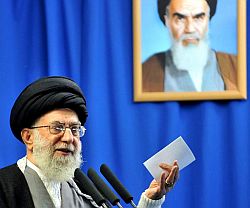
“The Iranian nation has become a model for the other nations through its resistance and insistence on Islam and Islamic establishment and due to the eye-catching progress it has made on this path throughout the last 32 years,” Ayatollah Khamenei said while addressing a military gathering in Tehran today.
But the Muslim Brotherhood is more interested in expressing its solidarity with its secular co-revolutionaries than its Iranian co-religionists. This isn’t an Islamic revolution, they say — stating the obvious. It’s an Egyptian revolution.

Ikhwanweb, the Muslim Brotherhood’s official English website editor in chief Khaled Hamza has stated that the current uprising in Egypt is a revolution of the Egyptian people and is by no means linked to any Islamic tendencies, despite allegations nor can it be described as Islamic.

Hamza stressed that the revolution is peaceful and calls solely for reform and a democratic civil state initiated by the youth through the social networking service Facebook and is far removed from any Islamist groups.

He criticized allegations and reiterations by some countries that the uprising was Islamic and denounced claims by the Iranian Supreme Leader Mr. Khamenai that the protests are a sign of an Islamic Awakening inspired by the 1979 Islamic Revolution in Iran.

Hamza maintained that the Egyptian protests are not an ‘Islamic’ uprising, but a mass protest against an unjust, autocratic regime which includes Egyptians from all walks of life and all religions and sects.

Anyone in any doubt about the difference between the Khamenei regime and the Muslim Brotherhood’s conservative and pragmatic political movment, should listen to the following from Dr Maha Azzam, Chatham House and Dr Shadi Hamid, Brookings Doha Center:

Listen!

If in the first days of the Egyptian people’s uprising, the Mubarak regime imagined it could ride out the storm, two weeks later we can see that the revolution is, on the contrary, growing in strength.

The Guardian‘s Jack Shenker describes the scene in Tahrir Square today:

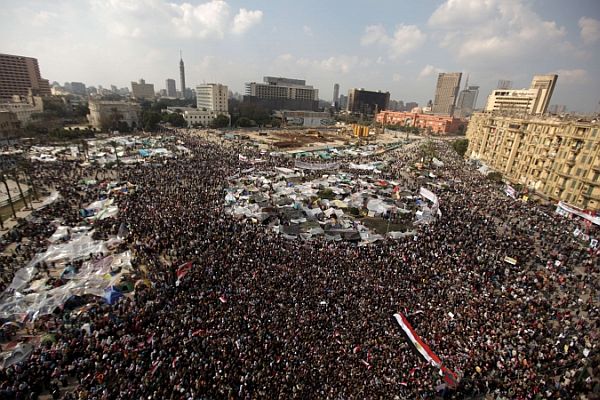
There is more energy and optimism in Tahrir today than almost anything I’ve seen before – an aimless wander through the packed crowds is a dizzying, exhilarating experience, revealing a hundreds of little micro-dramas playing out all over the square.

It’s so difficult to convey the atmosphere of this place through words or images; Tahrir may have dropped down the international media agenda somewhat in recent days, but honestly if you go down there and just stare around you – at the picnicking families, the raucous flag-wavers, the volunteer tea suppliers, the cheery human security cordons, the slumbering bodies curled up in the metal treads of the army’s tanks, the pro-change graffiti that adorns every placard, every tent, every wall space in vision – it’s impossible not to feel as moved as we all did in the very first days of this ongoing revolution.

As the streets appear safer and security more guaranteed, the numbers of those joining queues to enter Tahrir is growing, not falling – dozens told me today they were here for the first time. Politicking at the top may give the impression that the uprising has lost momentum, but clearly for many in Egypt it’s only just getting started.

An Al Jazeera report from Alexandria confirms the nationwide surge in demonstrations that has been driven by the impact of the Wael Ghonim interview broadcast on Egyptian television yesterday. The re-appearance of Ghonim — an activist leader and Google executive who was released from detention yesterday afternoon — “really had an impact on many Egyptians and forced a lot more to come out to the streets. This was the first time Egyptian television showed some of the most graphic images and stories that have happened over the last two weeks. So there’s definitely a surge in the number of pro-democracy, anti-government protests here in Alexandria,” said Jamal Elshayyal.

Facebooktwittermail

Self-fulfilling prophecy: Dennis Ross doesn’t think anything can get accomplished

Ali Gharib lays out the multiplicity of reasons why Dennis Ross — “a three-time-loser on Israeli-Palestinian peace-making” — lacks the competence for any role in the Middle East.

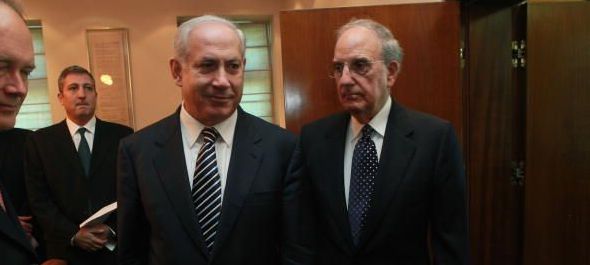
I was struck by an article by Nathan Guttman in the legendary Jewish Daily Forward about Dennis Ross and George Mitchell jockeying for the position of Obama Administration’s point-person in the Middle East peace process. The whole thing is a fascinating read, but this line really jumped out at me:

Others have also described Ross as more skeptical [than Mitchell] about the chances of peace, based on his decades-long experience with trying to bring together the parties.

I don’t want to get all new-agey, but if you think something is difficult or impossible to do, the chances of being able to do it are greatly diminished from the get-go.

So why does this Ross guy keep getting jobs that he doesn’t think are possible? I picked up Ross’ book off of my shelf here in D.C., and it amazed me how many times he says you cannot make any kind of deal with the Iranians. Then, Obama put him in charge of making a deal with the Iranians. Ross, we now learn, doubts that a peace deal can be reached in Israel-Palestine, and Obama gives him a job making peace in Israel-Palestine.

So what does this tell us about Obama? That he’s beholden to AIPAC; that he lacks courage, creativity and imagination. Above all, that lacking confidence in his own capacities of leadership he pays undue deference to the “qualification” that a subordinate possesses talent for no better reason than that he is an old hand — and that’s where Ross has “out performed” George Mitchell: more frequent flyer miles clocked up between the US and the Middle East.

Facebooktwittermail

Stuxnet attack on Bushehr: Russia warns of ‘Iranian Chernobyl’

Following Saturday’s New York Times report that the Stuxnet malware targeting Iran’s nuclear program was a joint US-Israeli operation, the Daily Telegraph reports that Russian nuclear scientists are concerned that the Bushehr nuclear plant could suffer catastrophic damage.

Fuel rods were inserted in the new reactor at the end of November and the plant is due to start producing electricity in the coming weeks. Ralph Langner, whose German team first identified Iran’s nuclear program as Stuxnet’s target, says the plant’s steam turbine is vulnerable to attack and in November wrote: “If you blow a 1000 Megawatt turbine, you will very likely be able to see the impact by satellite imagery.”

Con Coughlin writes:

Russian scientists working at the plant have become so concerned by Iran’s apparent disregard for nuclear safety issues that they have lobbied the Kremlin directly to postpone activation until at least the end of the year, so that a proper assessment can be made of the damage caused to its computer operations by Stuxnet.

The Iranian government is bitterly opposed to any further delay, which it would regard as another blow to national pride on a project that is more than a decade behind schedule. While Western intelligence officials believe Iran’s nuclear programme is aimed at producing nuclear weapons, Iran insists the project’s goals are peaceful.

The Russian scientists’ report to the Kremlin, a copy of which has been seen by The Daily Telegraph, concludes that, despite “performing simple, basic tests” on the Bushehr reactor, the Russian team “cannot guarantee safe activation of the reactor”.

It also accuses the Iranian management team, which is under intense political pressure to stick to the deadline, of “not exhibiting the professional and moral responsibility” that is normally required. They accuse the Iranians of having “disregard for human life” and warn that Russia could find itself blamed for “another Chernobyl” if it allows Bushehr to go ahead.

While it’s natural that the Russians would be concerned about being blamed, in such a scenario it’s a bit difficult to see how US interests would be served if vital shipping lanes and America’s Gulf allies were also put in jeopardy.

An American expert in nuclear intelligence told the New York Times “that Israel worked in collaboration with the United States in targeting Iran, but that Washington was eager for ‘plausible deniability'” — plausible deniability that the US no longer has.

Does this raise the possibility that the US might need to discreetly intervene to prevent an Israeli-made disaster?

Facebooktwittermail

What was Israel’s connection to the AQ Khan nuclear network?

The New York Times reports that the Stuxnet worm which was designed to attack Iran’s nuclear enrichment program was a joint US-Israeli operation. One of the crucial elements in developing the plan was being able to test the malware’s ability to disable P-1 centrifuges — the type that Iran employs in cascades of thousands of centrifuges in it Natanz enrichment facility. Israel has row upon row of this type of centrifuge at its clandestine nuclear weapons production facility in Dimona.

The question is: how did Israel come to possess so many P-1 centrifuges? Did Israel obtain the centrifuges from AQ Khan?

The CIA was tracking the AQ Khan network for decades before it eventually shut it down in 2003. Douglas Frantz, co-author of Fallout: The True Story of the CIA’s Secret War on Nuclear Trafficking, told NPR: “By the time they finally acted in 2003, an enormous amount of the world’s most dangerous technology had been sold to the world’s most dangerous regimes. And that, in our view, was a policy failure, a policy failure of enormous proportions, really.”

Perhaps the most secretive part of the Stuxnet story centers on how the theory of cyberdestruction was tested on enrichment machines to make sure the malicious software did its intended job.

The account starts in the Netherlands. In the 1970s, the Dutch designed a tall, thin machine for enriching uranium. As is well known, A. Q. Khan, a Pakistani metallurgist working for the Dutch, stole the design and in 1976 fled to Pakistan.

The resulting machine, known as the P-1, for Pakistan’s first-generation centrifuge, helped the country get the bomb. And when Dr. Khan later founded an atomic black market, he illegally sold P-1’s to Iran, Libya, and North Korea.

The P-1 is more than six feet tall. Inside, a rotor of aluminum spins uranium gas to blinding speeds, slowly concentrating the rare part of the uranium that can fuel reactors and bombs.

How and when Israel obtained this kind of first-generation centrifuge remains unclear, whether from Europe, or the Khan network, or by other means. But nuclear experts agree that Dimona came to hold row upon row of spinning centrifuges.

“They’ve long been an important part of the complex,” said Avner Cohen, author of “The Worst-Kept Secret” (2010), a book about the Israeli bomb program, and a senior fellow at the Monterey Institute of International Studies. He added that Israeli intelligence had asked retired senior Dimona personnel to help on the Iranian issue, and that some apparently came from the enrichment program.

Facebooktwittermail

Do we have Ahmadinejad all wrong?

Reza Aslan writes:

Is it possible that Iran’s blustering president Mahmoud Ahmadinejad, long thought to be a leading force behind some of Iran’s most hard-line and repressive policies, is actually a reformer whose attempts to liberalize, secularize, and even “Persianize” Iran have been repeatedly stymied by the country’s more conservative factions? That is the surprising impression one gets reading the latest WikiLeaks revelations, which portray Ahmadinejad as open to making concessions on Iran’s nuclear program and far more accommodating to Iranians’ demands for greater freedoms than anyone would have thought. Two episodes in particular deserve special scrutiny not only for what they reveal about Ahmadinejad but for the light they shed on the question of who really calls the shots in Iran.

In October 2009, Ahamdinejad’s chief nuclear negotiator, Saeed Jalili, worked out a compromise with world power representatives in Geneva on Iran’s controversial nuclear program. But the deal, in which Iran agreed to ship nearly its entire stockpile of low enriched uranium to Russia and France for processing, collapsed when it failed to garner enough support in Iran’s parliament, the Majles.

According to a U.S. diplomatic cable recently published by WikiLeaks, Ahmadinejad, despite all of his tough talk and heated speeches about Iran’s right to a nuclear program, fervently supported the Geneva arrangement, which would have left Iran without enough enriched uranium to make a nuclear weapon. But, inside the often opaque Tehran government, he was thwarted from pursuing the deal by politicians on both the right and the left who saw the agreement as a “defeat” for the country and who viewed Ahmadinejad as, in the words of Ali Larijani, the conservative Speaker of the Majles, “fooled by the Westerners.”

Facebooktwittermail

The day there is no Iranian bomb

Didi Remez provides a translation of an op-ed by Sever Plocker that appeared in the Hebrew edition of Yedioth Ahronoth:

One of the most historically important statements to have been made in the past ten years in the State of Israel made headlines in the Israeli media on Friday for a single day. It elicited a few reactions and a few brief analyses — and disappeared. The statement was ascribed to (and was not subsequently denied by) the outgoing Mossad director, Meir Dagan.

Dagan, a suspicious super-cautious individual who routinely prefers to err on the side of pessimism, was quoted as having said: “Iran will not have nuclear military capability at least until 2015.” The reason cited for this: technical difficulties and malfunctions, which have stymied Tehran’s efforts to get its military nuclear program off the ground. For the sake of accuracy, and the Mossad relies on accuracy, the above-cited “technical difficulties and malfunctions” have already caused that initiative a few years’ worth of setbacks.

For more than a decade, Israel has been living under the thickening cloud of the Iranian nuclear bomb. The military, economic and even the social agendas in Israel have been directly influenced by it. The election of Netanyahu as prime minister (and Barak’s joining the coalition) were explained by the need to place at the head of the state and the security establishment people who would be capable of leading the people and the army in this decisive year in dealing with Iran. From time to time, in light of the foolish things that the two of them have done, public opinion was asked to be forgiving of them because of the weight of the Iranian threat that lay on their shoulders.

That was the case up until Friday, January 7, 2011. On that day, the world order was changed. The Iranian nuclear threat died. It keeled over. Because, if the director of the State of Israel’s Mossad is prepared to risk saying that Iran won’t have even a single nuclear bomb “at least until 2015,” that means that Iran is not going to have a nuclear bomb. Period.

Facebooktwittermail

War with Iran postponed — at least until after the 2012 US presidential election

Reuters reports:

Israel believes Iran will not be able to produce a nuclear bomb before 2015 and a top Israeli official has counseled against pre-emptive military strikes, intelligence assessments published Friday showed.

Given in a briefing by Mossad director Meir Dagan upon his retirement Thursday, the assessments pointed to new Israeli confidence in U.S.-led sanctions and covert action designed to discourage or delay Tehran’s uranium enrichment program.

They were also in line with Israeli Prime Minister Benjamin Netanyahu’s circumspection — echoing misgivings voiced more publicly by the Obama administration — about resorting to force against Iran, which denies seeking nuclear arms and has vowed to retaliate against Israel and U.S. interests for any such attack.

“Iran will not achieve a nuclear bomb before 2015, if that,” Dagan said, according to a transcript obtained by Reuters.

Facebooktwittermail

What Iranians really think

Abbas Milani writes:

The failure of American and British governments to predict the fall of the shah in 1979 was one of the biggest intelligence failures of the twentieth century. In the aftermath of that monumental mess, the British government ordered a policy review to learn what went wrong. They identified three main errors: inattention to the brutality of the regime’s secret police (SAVAK), insufficient knowledge of the corruption of the ruling elite and a lack of focus on the intellectual life of Iran.

Today, thirty years later, the dominant discourse on American policy toward Tehran often suffers from exactly the same three maladies. As the nuclear impasse with Iran continues, the new Republican majority in the House of Representatives is likely to pressure the Obama administration for harsher measures against the clerical regime, so the debate about the stability of the Iranian elite and the power of the opposition, and about what would be the right U.S. policy, is only likely to increase.

In the weeks before the policy of ending subsidies on food and petroleum was implemented, several leading security officials of the regime threatened the people with harsh punishment should they react to the new economic landscape. Lest anyone missed the message, and lest anyone did not hear about the prison sentences against leaders of the opposition, the regime also organized a major show of force in Terhan—a “security exercise,” they said—intended to remind the people of what might happen if they dared demonstrate against the new harsh reality. In the days after the implementation of the policy, every night President Ahmadinejad is reported to have convened special sessions with his cabinet to address or contain any problem. The regime was clearly worried that any small incident might act as a trigger that would once again lead to mass demonstrations.

Facebooktwittermail

Iranian general murdered in Israel’s Ayalon prison?

Richard Silverstein writes:

New and astonishing developments in the case of Prisoner X, known to a source within Ehud Barak’s inner circle as Ali Reza Asgari, retired Iran Revolutionary Guard general and former deputy defense minister.

I exposed the name of Prisoner X here a few weeks ago. Today, brings news from Israel that Asgari is dead in his cell. According to the standard version, he committed suicide in his cell within the past week or so. Ynet reported the suicide story and noted that it was under gag order. Of course, this story was erased from the internet, but I’m posting a copy of the article which was taken down from the Ynet site.

What is so interesting about this story is that you have to combine two different articles (the second from Haaretz) to gain more insight into what really happened here. The Haaretz article, which was not removed under gag order because it was written in a sufficiently vague form that it could slip under the gag order, noted that there are investigations of those who die while in secret detention (the case with Asgari). One of the considerations in such an inquiry is whether a “government agency” may have caused the death:

Did such an agency have an interest in silencing the detainee? And if so, was a death declared a “suicide,” really murder? In the case of the death of a prisoner under special treatment [held by the security services], why it was not within the power of the Prison Service to prevent the suicide or some other form of violent death. [Emphasis added]

I should also confirm at this point that my original source for this story reaffirms specifically that it is Asgari, and not some other secret security prisoner who died. My source, I should add, only confirms the “official” government version that he committed suicide and not that he was murdered.

Assuming that the prisoner was indeed Asgari, I wouldn’t be quick to dismiss the claim that he committed suicide. Prolonged isolation, most likely accompanied by intermittent torture, with no prospect of release or a trial, would easily sap anyone’s will to live.

Meanwhile, a new report reveals the barbaric conditions in which Israel keeps prisoners in isolation — conditions one would expect to find used by a brutal authoritarian regime in a third world country.

A classified report by the Israel Bar Association obtained by Haaretz provides a glimpse into the harrowing conditions prisoners separated from the main jail population must endure.

According to the document, which is the first external review of the Prison Service, the isolation wings at the Ayalon and Shikma prisons are not fit for human habitation and “look more like a dungeon,” while most solitary cells in prisons across the country are “crammed, rancid with smells of sewer and mold, and infested with insects.”

“It’s difficult to ignore the feeling that isolation as practiced today serves a function of punishment rather than imprisonment,” wrote the authors of the report, Michael Atia – chairman of the prison service committee at the Israel Bar Association, and Moran Kabalo – chief of criminal law for the IBA.

Facebooktwittermail

Israel’s central role in ‘the new Cold War’

Even if Britain has yet to enact promised changes to the law in order to protect Israeli war criminals from facing the risk of arrest while visiting the UK, it would appear that some form of understanding is already in place so that Tamir Pardo, the new head of Mossad, will be able to visit in January.

An outline of some of the key issues on Pardo’s agenda when he meets Britain’s intelligence chiefs reveals the depth of Mossad’s operations across the Middle East. It also reveals that Israel sees itself having a pivotal role in what Pardo is branding “the new Cold War” between Russia and the West.

The Daily Telegraph reports:

[Pardo] is expected to brief officials on Mossad’s plans to provide Britain and Nato with increased intelligence over Iran’s nuclear weapons programme. Mossad has a network of undercover agents in the country.

He also intends to increase Mossad’s role in Yemen and to spearhead the hunt for al-Qaeda’s new chief of military operations, Saif al-Adel, who Mossad believe is based in Somalia.

At the same time he wants to expand Mossad’s watch over the SVR, Russia’s foreign intelligence service, which is an increasing presence in Syria and Turkey – and is using both countries as launch pads from which to enter Europe. In his first briefing to senior staff after he took up his new post, Mr Pardo said Mossad had a key role to play in helping the West win what he called “the new Cold War”.

With Mossad conducting operations in Iran, Yemen and Somalia, Israel sees itself as an indispensable partner with the United States in the enduring global conflict through which each nation now defines its identity and upon which each has become economically dependent. No two nations on the planet are more threatened by the possibility of peace.

Facebooktwittermail

The truth that the CIA is desperate to conceal

The New York Times reports:

A seven-year effort by the Central Intelligence Agency to hide its relationship with a Swiss family who once acted as moles inside the world’s most successful atomic black market hit a turning point on Thursday when a Swiss magistrate recommended charging the men with trafficking in technology and information for making nuclear arms.

The prospect of a prosecution, and a public trial, threatens to expose some of the C.I.A.’s deepest secrets if defense lawyers try to protect their clients by revealing how they operated on the agency’s behalf. It could also tarnish what the Bush administration once hailed as a resounding victory in breaking up the nuclear arms network by laying bare how much of it remained intact.

“It’s like a puzzle,” Andreas Müller, the Swiss magistrate, said at a news conference in Bern on Thursday. “If you put the puzzle together you get the whole picture.”

The three men — Friedrich Tinner and his two sons, Urs and Marco — helped run the atomic smuggling ring of A. Q. Khan, an architect of Pakistan’s nuclear bomb program, officials in several countries have said. In return for millions of dollars, according to former Bush administration officials, the Tinners secretly worked for the C.I.A. as well, not only providing information about the Khan network’s manufacturing and sales efforts, which stretched from Iran to Libya to North Korea, but also helping the agency introduce flaws into the equipment sent to some of those countries.

The Bush administration went to extraordinary lengths to protect the men from prosecution, even persuading Swiss authorities to destroy equipment and information found on their computers and in their homes and businesses — actions that may now imperil efforts to prosecute them.

While it has been clear since 2008 that the Tinners acted as American spies, the announcement by the Swiss magistrate on Thursday, recommending their prosecution for nuclear smuggling, is a turning point in the investigation. A trial would bring to the fore a case that Pakistan has insisted is closed. Prosecuting the case could also expose in court a tale of C.I.A. break-ins in Switzerland, and of a still unexplained decision by the agency not to seize electronic copies of a number of nuclear bomb designs found on the computers of the Tinner family.

The fact that the CIA and the US government have gone to such lengths to try and prevent the details about the CIA’s involvement in global nuclear proliferation being exposed, means that we can only speculate about what kind of damning information remains hidden.

Several scenarios seem possible:

  • that the CIA’s efforts to track the AQ Khan network reached a point where it might have appeared that it was aiding and abetting the network’s operation;
  • that bungled CIA efforts to sabotage the Iranian nuclear program resulted in Iran acquiring know-how or technology that it might not have otherwise been able to obtain;
  • and conceivably, that the CIA’s involvement in Iran’s nuclear program was so deep that it was exerting an influence over the strategic direction of the program.
Facebooktwittermail

The other side of the militarization of Iran’s regime

Elliot Hen-Tov and Nathan Gonzalez write:

This week, Iran implemented an overhaul of its national subsidy system, in effect cutting billions of dollars worth of subsidies for daily consumer use, especially fuel and electricity. Though cushioned by transfer payments to low-income households, it is akin to a major austerity move. While the economic impact is clear, many outsiders remain baffled how a regime ridden with internal factionalism (and widespread unpopularity) can manage such radical reforms. The past few weeks have seen rumors of a looming impeachment trial of President Mahmoud Ahmadinejad, followed by his humiliating dismissal of Foreign Minister Mottaki. These are hardly the signs of calm leadership steering through an economic crisis.

But narratives grabbed from the headlines can be misleading, and longer-term developments in Tehran point in a surprising direction. Today, the Islamic Republic is set to become more politically stable, and may even offer the chance for improved US-Iranian relations under what Secretary of State Hillary Clinton has called an emerging “military dictatorship.”

Although this development was well under way at from at least the mid-1990s, the 2009 post-election fiasco was the ultimate coming-out party of the security apparatus, notably the Revolutionary Guards. Observers have termed it a ‘praetorian takeover,’ borrowing the name from ancient Rome’s Praetorian Guard, the feared imperial bodyguard of the Caesar who used their proximity to power to eventually become kingmakers themselves.

Facebooktwittermail

Why a nuclear Iran could be good for the US

Chan Akya presents an interesting argument — even if no one in Washington would be so bold as to articulate such thoughts.

Most of the hijackers on September 11, 2001, were of Saudi origin and despite nominally falling under the leadership of Osama bin Laden it stands to reason that they were mainly disenchanted due to the stifling anti-democracy of Saudi Arabia and the inherent hypocrisy of Wahhabism in a country that spent most of its time kowtowing to the Americans.

Fearing the tactical nightmare of dealing with hundreds if not thousands of these disaffected youth, America and Europe chose to make the strategic blunder of supporting the crumbling monarchies as long as they attacked their own youth. This was a stupid bargain, to put it mildly.

A sustainable situation would be to engender wider regime change in the Middle East by booting out the creaking and corrupt monarchies, to be replaced progressively with Islamic leaders capable of taking a development-oriented approach to their countries. To ensure this new generation of Middle East leaders do not get overly tempted by the possibilities of attacking America or Israel, it would be necessary to have a “natural” check in the region – namely Iran.

Facebooktwittermail

Why Ahmadinejad fired FM Mottaki

insideIRAN.org reports on the sudden removal of Iran’s foreign minister on Monday.

Mohammad Reza Heidari, a former high-ranking Iranian diplomat in Norway, announced in December 2009 that he was quitting the foreign ministry and not returning to Tehran. He now lives in Oslo, where he spoke with Arash Aramesh of insideIRAN.org about Mottaki’s firing.

Q: Iran’s Minister of Foreign Affairs Manouchehr Mottaki was suddenly removed today. Did this surprise you and your friends in Iran’s diplomatic community?

A: In recent months, a number of events took place, which were interpreted by President Ahmadinejad as defeats for Mottaki. Mottaki was blamed for failing to prevent the passage of the UN resolution condemning Iran’s violation of human rights. He was blamed for failing to lead Iran to obtaining a seat in the UN Women’s Rights Panel. Then came the embarrassing story of sending illegal weapons to Nigeria. Mottaki traveled to Nigeria to minimize the damage but he failed there too. And the final blow came when UNESCO did not see Iran fit for holding a conference on philosophy. This was embarrassing to the Islamic Republic. The president tied these so-called defeats together so, if necessary, he would be able to convince the Supreme Leader that Mottaki had to go. Some of my friends and former colleagues in Tehran have told me that the Supreme Leader was not really involved in this and Ahmadinejad made this decision on his own.

He was suddenly removed. This is against diplomatic norms. It is very odd for the country’s top diplomat to be fired like this when the Foreign Minister is on an official visit delivering President Ahmadinejad’s message to the Senegalese government. This is very surprising.

Q: The Minister of Foreign Affairs has always been handpicked by the Supreme Leader. How could the president remove the Minister of Foreign Affairs without Ayatollah Khamenei’s knowledge or consent? Is this a show of power by President Ahmadinejad and sign that the Leader’s position has weakened?

A: There are rumors that Mr. Khamenei is very ill and some decision makers on the top have begun to exclude him from the decision-making process on some issues. It seems that Ahmadinejad’s supporters are stronger now. Mr. Mottaki had the backing of the Leader. Just months ago, the Leader wrote a letter asking Iranian officials to put aside their differences. The Leader specified that the country’s diplomatic affairs must be handled by the foreign minister.

Q: What is the main reason behind Mottaki’s removal?

A: Ahmadinejad wants to homogenize the government and make the nuclear issue the main pillar of his government. I have heard from my friends in the Ministry that Ahmadinejad has expressed his dissatisfaction with Mottaki. Ahmadinejad appointed Ali-Akbar Salehi, the current director of Iran’s Atomic Energy Agency, as acting minister. Salehi is trusted by the Leader as well.

This is also a signal to the world: the person in charge of Iranian diplomacy is the head of Iran’s nuclear program. This implies that the Iranian foreign policy is nothing but the nuclear issue; they are the same thing. The president wants to silence dissenting voices in the ministry. He wants to silence dissent in the Supreme National Security Council, headed by Saeed Jalili, Iran’s chief nuclear negotiator. Ahmadinejad wants a confrontational policy and does not like what moderates like Jalili and Mottaki have to say.

Supporters of Ahmadinejad do not want to talk about stopping enrichment. They want to be recognized as a nuclear power to satisfy their fantasy of being a power. Moderate conservatives are cautious and do not like this. The president has been constantly fighting with the parliament. He has had issues with his own conservative camp.

Facebooktwittermail

The expiration of the ‘peace process’: where now for the Middle East?

Alastair Crooke writes:

A ‘peace process’ that, from its inception, took Israel’s self-definition of its own security needs as the sole determinate of the walls within which any solution for Palestinians was to be conducted, has reached exhaustion. Based on such a reductive premise, its arrival at this deathly nadir, with no more than a prospect of disjointed alleviated occupation, possessing the most hollow trappings of statehood as its final security-led outcome, should evoke no surprise.

The non-solution to which such a premise would take us would defuse nothing: indeed, it might well prove to be the spark that could exacerbate or explode simmering regional animosities — even if these animosities were not ostensibly linked directly to the Palestinian issue.

Any thought that such a hollowed-out solution — alleviated occupation, posing as statehood — will defuse anti-American sentiment in the Muslim world is likely to prove to be resoundingly misplaced. On this, the critics from the political Right are correct: a flawed Israeli-Palestinian agreement, per se, will not drain-off anti-western regional sentiment; it will exacerbate it. It will feed it. But the corollary the Right pushes in its place, that defeating Iran somehow precisely is that elusive magic bullet the West so ardently desires (the key to soothing regional tensions and defusing hostility towards the West) represents an even greater pathology and disassociation from reality. It is one that is no less illusory for having the apparent endorsement of America’s Arab clients, whose talk is no more than a reflection back into the looking-glass of American diplomacy, as it stares at its own face.

What these American protégés really fear is the growing groundswell of scorn — scorn towards the western élites on whom these interlocutors wholly depend — but more precisely it is fear of the parallel disdain, directed towards these pro-American, self-enriching élites, themselves. Any show of western muscularity indirectly gives these anxious oligarchs, feeling their authority decay beneath them, a further lease on survival. Thus they speak their deeper fears into the American looking-glass in its own thinking. All these worrying, popular stirrings can only be Iranian: for they fear they carry the gene of revolution.

The peace process solution-phantasm has not only divided the Palestinians; but also shaped the political structure for the region for the last decades: polarizing the region — on the false premise — between those who were ‘opposed’ to peace and those who ‘supported’ peace. Many of those who were termed opposed to peace in reality were opposed more to Israel’s self-referencing security-led paradigm — than to a peaceful solution per se.

Contrary to general western expectations, there will be many in the region who welcome evidence of the clinical death of ‘the process’. They will see its passing away as a welcome and necessary catharsis that opens new possibilities; new politics. Already the polarized cold war architecture of the peace process has begun to dissolve: Turkey’s shift of orientation is one example of the shifts taking place — as the former regional division into two sculptural solids, spoilers versus supporters of peace, melts into a much more fluid and mobile regional mass. [Continue reading]

Facebooktwittermail