Unless Iran responds positively to President Obama’s offer of talks on its nuclear program by next month, it could face what Secretary of State Hillary Clinton calls “crippling sanctions.” That was the message from Administration officials touring the Middle East in recent weeks. And it’s backed by congressional moves to pass legislation aimed at choking off the gasoline imports on which Iran relies for almost a third of its consumption, by punishing third-country suppliers. It sounds impressive and, for an undiversified economy like Iran’s, potentially calamitous. But a number of Iran analysts are skeptical that new sanctions will break the stalemate.
President Mahmoud Ahmadinejad’s government has promised to present a new package of proposals on the nuclear issue to Western negotiators in the coming weeks. But that package is unlikely to reflect any shift in Tehran’s rejection of the U.S. demand that it forgo the right to enrich uranium as part of its nuclear-energy program. “If the U.S. position remains unchanged,” says Farideh Farhi, an Iran expert at the University of Hawaii, “Iran may well come to the table, but only in order to demonstrate to its own people that its regime has been recognized, not to seriously engage with U.S. proposals or give ground.” [continued…]
Last week Iran’s theocracy widened its crackdown from suppressing an opposition movement to putting on trial the very revolutionaries who launched the Islamic republic. This new purge may be more profound politically than the campaign against the followers of Mir Hossein Mousavi: The Iranian revolution is eating its children.
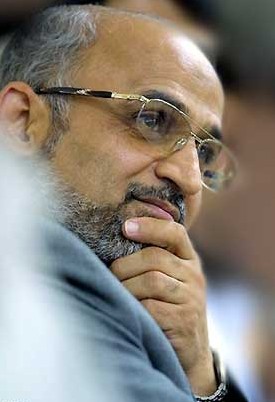
Mohsen Mirdamadi saw it all coming. He warned me about it five years ago. The only thing he didn’t foresee was his own role. Last week, he sat in a revolutionary court, dressed in gray prison pajamas, as one of its victims.
I’ve followed Mirdamadi since the 1979 U.S. Embassy takeover. In 1981, I stood below the plane that brought 52 American diplomats to freedom in Algeria and wondered about the type of people who seized, interrogated and brutalized hostages for 444 days. Mirdamadi was one of three ringleaders. Former hostage John Limbert remembers him as “particularly nasty.” I met him a decade ago.
Like many early revolutionaries, Mirdamadi had evolved over the intervening two decades from a scruffy student radical into a balding, pinstripe-suited realist. In 2000, he ran for parliament as a reformer. [continued…]
he alleged French spy stood at the lectern Saturday in Tehran and described her dastardly act of collusion.
Clotilde Reiss, a pale, soft-spoken 24-year-old who had been teaching French in the central Iranian city of Esfahan when she was arrested, confessed to sending a single e-mail to a colleague in the capital.
In it, she described the unrest unfolding in Esfahan after taking part in a couple of peaceful protests against the disputed reelection of President Mahmoud Ahmadinejad. [continued…]
A top judiciary official acknowledged Saturday that some detainees arrested after post-election protests had been tortured in Iranian prisons, the first such acknowledgment by a senior Iranian official.[…]
Speaking to reporters at a news conference, Qorbanali Dori-Najafabadi, the prosecutor general, said “mistakes” had led to a few “painful accidents which cannot be defended, and those who were involved should be punished.”
Such mistakes, he said, included “the Kahrizak incident,” a reference to the deaths of several detainees at Kahrizak detention center in southwestern Tehran. [continued…]
Among the more than 100 people on trial after Iran’s disputed presidential election are two dual citizens: Kian Tajbakhsh, 47, an American Iranian urban planner, and Maziar Bahari, 42, a Canadian Iranian filmmaker and Newsweek reporter.[…]
Their arrests follow a pattern during Ahmadinejad’s tenure of high-profile detentions of dual citizens. Since he took office in 2005, at least seven have been detained, including Woodrow Wilson Center scholar Haleh Esfandiari in 2007 and freelance journalist Roxana Saberi, who was convicted of espionage this year and later pardoned.
Tajbakhsh, who has lived in Iran since 1999 and has done some projects for its government, was held for four months in 2007, during which authorities accused him of trying to foment a “color” revolution. He stayed in Iran afterward and had plans to teach at Columbia University this fall.
Friends said he had purposely avoided the election-related turmoil, even abstaining from voting. “He felt confident there was no rationale for him to be imprisoned,” Sadjadpour said. Two days after the vote, Tajbakhsh wrote to him in an e-mail: “I’m keeping my head down. I have nothing journalistic to add to all the reports that are here.”
Bahari had been filing reports for Newsweek and for television stations in Britain; the Iranian government has accused him of sending reports to foreign news media in exchange for payment, said Nisid Hajari, Newsweek’s foreign editor.
“That’s exactly what he’s been doing for more than 10 years,” Hajari said, adding that the Iranian government had renewed Bahari’s press accreditation each year and had not complained about his work. “What they’ve accused him of doing is a job that they themselves had licensed and approved him to do.” [continued…]
The clock is ticking on Iran, or so we’re told. But whose clock, and what exactly is it timing? Obama administration officials say Iran has until September to respond to the US offer to negotiate over its nuclear programme or face what the secretary of state, Hillary Clinton, calls “crippling sanctions”. But what exactly is being demanded of Iran, and what is being offered? And what if those sanctions don’t change its stance?
Iran insists that its programme is entirely for peaceful energy production, and that it is not pursuing nuclear weapons. But – and this is perhaps the crucial point in the conversation – it very much insists that as a signatory of the Non Proliferation Treaty, it does, in fact, have the right to enrich uranium, and has no intention of surrendering that right. That, moreover, is not only the position of the hardline Ahmadinejad government, but also of its pragmatic and reformist rivals who continue to challenge the legitimacy of the president’s reelection.
The US and its allies believe Iran is using the cover of a civilian nuclear energy programme to put in place many of the key elements of a bomb, particularly the ability to enrich uranium. The Non Proliferation Treaty allows its signatories (including Iran) to enrich uranium as reactor fuel, under monitoring by the International Atomic Energy to ensure that it is not enriched to weapons grade. According to the US Director of National Intelligence, Dennis Blair, the US intelligence community believes Iran won’t have the technical capacity to produce weapons-grade material until 2013; that its leaders have not taken a political decision to create a bomb; and that they won’t do so as long as their programme remains under international scrutiny. [continued…]
Twitter, Facebook and Google’s newly introduced Persian-to-English translation software were part of a vast foreign conspiracy against Iran sketched out by a prosecutor at the second session of an extraordinary trial against alleged ringleaders of weeks of unrest unfolding in Iran.
Government critics and international observers have slammed the proceedings as grotesque “show trials” meant to silence the opposition to President Mahmoud Ahmadinejad, whose disputed reelection triggered weeks of popular protests partially quelled in a violent official crackdown. [continued…]
A hard-line group demanded Friday that Iran’s President Mahmoud Ahmadinejad obey the country’s supreme leader or risk losing the confidence of lawmakers from his own conservative political camp.
The Front Loyal to Imam and Leadership, a group of 14 conservative political parties and organizations led by prominent hard-liner Habibollah Asgaroladi, demanded that Ahmadinejad consult with his supporters before making appointments to his Cabinet, which he must submit for approval within 12 days.
“If, God forbid, you pursue an approach different from the one elucidated by the supreme leader [Ayatollah Ali Khamenei] because of your refusal to consult the honest friends of the revolution, or you lose public faith out of obstinacy, we fear that the regime would suffer irreparable damage,” said the statement, according to the semiofficial Iranian Students News Agency. [continued…]
A British embassy worker put on trial by the Iranian authorities was today reported to have admitted that information collected by the embassy on the unrest after the disputed presidential election was sent to Washington.
The Foreign Office expressed its “outrage” as Hossein Rassam, the embassy’s chief political analyst, appeared in court alongside Iranian moderates and a French citizen.
The official Iranian news agency IRNA quoted Rassam, who is charged with espionage, as saying that information was handed over to the Americans. “Because the American government lacks facilities to survey Iran events and because of the close relations between Washington and London, the British embassy in Tehran sent its collected vote unrest details to Washington,” the Reuters news agency reported Rassam as telling the court. [continued…]
Despite Iran’s progress since 2007 toward producing enriched uranium, the State Department’s intelligence analysts continue to think that Tehran will not be able to produce weapons-grade material before 2013, according to a newly disclosed congressional document.
The updated assessment, by the State Department’s Bureau of Intelligence and Research, emphasizes that the analysis is based on Iran’s technical capability and is not a judgment about “when Iran might make any political decision” to produce highly enriched uranium.
The intelligence community agrees that a political decision has not yet been made. According to the assessment, State Department analysts think such a decision is unlikely to be made “for at least as long as international scrutiny and pressure persist.” [continued…]
For most of the month of August, Congress will be on recess. Consider this the calm before the storm.
Most in Washington are aware that September will bring with it the biggest push for Iran sanctions in years. AIPAC has been lobbying for months on the Iran Refined Petroleum Sanctions Act (IRPSA), and on September 10 the Conference of Presidents of Major American Jewish Organizations will kick off a massive nationwide lobbying effort, which they compare to the “Save Darfur” movement. All of this will culminate at the end of the month when, conveniently enough, Mahmoud Ahmadinejad arrives in New York for the UN General Assembly.
Yes, right around the time Ahmadinejad is at the podium in the UN, Congress is expected to impose what it calls “crippling sanctions” on Iran’s economy. The plan is to blockade Iran’s foreign supplies of gasoline, hoping that an increase in the price per gallon at the pump will cause the Iranian people to rise up and demand a halt to Iran’s nuclear program.
But this plan has number of obvious flaws.
First, the Iranian people have already risen up against the government’s hardline leadership. What we have witnessed in Iran for the last two months is unprecedented. To think that marginally higher gas prices will mean anything to a population willing to risk their lives for freedom and democracy is at once naïve and hubristic. According to Juan Cole, imposing broad sanctions on Iran will likely only destroy Iranian civil society and bolster the state’s repressive apparatus–as it did in Iraq. [continued…]
Beyond the power struggle playing out on the streets of Tehran is a complex battle for control of Iran’s intelligence ministry — a pivotal institution in the regime’s repression of dissent.
President Mahmoud Ahmadinejad, who began a second term this week, fired Intelligence Minister Gholam-Hossein Mohseni-Ejei late last month after Mr. Ejei objected to the president’s efforts to name an in-law as first vice president.
The departure of Mr. Ejei, a hard-line cleric close to Iran’s Supreme Leader Ayatollah Ali Khamenei, two other Khamenei loyalists and nearly 20 other high-ranking officials appeared to weaken the leader’s hold over the ministry and strengthen the power of the Revolutionary Guards, Iran’s elite military force. [continued…]
A coup in Iran? By Reza Aslan, The Daily Beast, August 5, 2009
Today, the mess that is post-election Iran becomes Mahmoud Ahmadinejad’s problem, and bets are already being placed in Iran on just how long his second term as president will last.
Ahmadinejad’s most immediate challenge will be to name 21 cabinet ministers, the three most important of which are the minister of defense, the minister of the interior (who also oversees the elections), and the minister of foreign affairs. He can also nominate up to 10 vice presidents, one of which, the first vice president, will be charged with taking over the presidency should some horrible fate befall Ahmadinejad (God forbid). According to Iran’s constitution, the president has two weeks from the day of his inauguration to present his cabinet to the parliament for approval. This will not be an easy task. [continued…]
The Islamic Republic has on the whole been good at producing political theatre. Its establishment knows that politics can be a form of entertainment and that Iranians enjoy a good show. Unlike the shah, who always appeared uncomfortable with politics, the establishment of the Islamic Republic has tended to understand its utility. The sudden scandal, the rumour and, best of all, the “trial” have all helped to preoccupy the inquisitive and perhaps reassure the sceptics that politics remains alive, if not necessarily well, in the Islamic Republic of Iran. That said, managing political theatre has always been a delicate balancing act; too little and you risk losing control over the message, too much and you lose credibility. Many, particularly those of an authoritarian disposition, would like to dispense with the process altogether.
The paradox of the current administration in Iran, and in particular the character of Mahmoud Ahmadinejad, is that they want it both ways. They want the theatre but they also want total control, not only of the production, but of the audience reaction. In so doing they have singularly failed to manufacture consent and have been struggling since the election on 12 June to impose their narrative. Indeed, we should not lose sight of the fact that for all the contests on the streets and the divisions within the elites, this is at heart an ideological contest, where the message matters. This is why journalists have been expelled, academics imprisoned and activists put on trial. This is why the hardline establishment insists on normality and business as usual, and why the mere continuation of protests denies them that particular fiction. In fact, control has been especially elusive of late, not least because of the crisis of authority, but because the means of transmission have been so diverse: the internet has proved just as serious a battleground as the streets. But perhaps even more significant that these have been the mistakes perpetrated by the establishment itself in its urgency to get the message right. [continued…]
Barack Obama’s policy of engagement with Iran – the “unclenched fist” of his January inaugural address – has about 60 days left to run. If Tehran does not respond positively and credibly to his offer of dialogue on nuclear and regional issues by the end of September, all bets are off. At that point, US and European officials say, a new international coalition will set to work on possibly the toughest sanctions imposed on a single country since Iraq invaded Kuwait in 1990.
The threat of punitive sanctions, with or perhaps without UN security council blessing, is designed to concentrate minds in Tehran distracted by the divisive aftermath of June’s presidential election. But it also serves to discourage the Israelis – at least for now – from taking matters into their own hands by launching a unilateral military strike on Iran’s nuclear facilities. Israel’s leaders do not believe dialogue or sanctions will work. But they calculate cynically that they must give Obama’s diplomacy a chance to fail. [continued…]
The failure of the regime to quiet the streets and to close ranks behind Khamenei in his endorsement of a second Ahmadinejad term is without precedent in the Islamic Republic’s 30-year history. As leading U.S.-based Iran scholar Farideh Farhi told the Council on Foreign Relations, Khamenei and Ahmadinejad had assumed that “if they use a sufficient amount of violence, they can put an end to the popular anger that has been generated. [Instead], they continue to be surprised by the resistance that is being shown — not only by major players in Iranian politics, but the people of Iran as well. This dissatisfaction has been growing since the election.”
Where the battle lines within the regime initially appeared to be relatively clear-cut — Ahmadinejad, Khamenei and the Revolutionary Guards on one side, facing off against a coalition of conservative pragmatists and reformists on the other, with each side claiming some support from within the clergy — the picture has grown murkier over the eight weeks of crisis. A number of figures in the conservative clerical and political establishment have begun to question the authorities’ handling of the election’s aftermath, particularly the crackdown on dissent. And there are clear signs from within the conservative clergy that some feared Ahmadinejad and the security establishment were usurping some of the traditional prerogatives of the clerical ruling class. [continued…]
Paola Gourley, 40, does not want to know whether the baby she’s carrying will be a boy or a girl. At least, not yet. The father, Maziar Bahari, 42, is in prison in Iran, where he has been held without access to a lawyer or any chance to see his family since June 21. Paola, an Italian-English lawyer working in London, has no idea how much longer Maziar will be kept from her, and this is the first child for both of them. So when sonograms show the gender of their baby, she says she will put the results in an envelope and seal it, hoping that Maziar will be freed soon and they can look at the results together. But in the back of Paola’s mind, there is a growing fear that their baby will be born in November and Maziar will still be in prison.
“I try to keep positive, but that’s my biggest fear, that this is going to be a long-term thing,” she told me from London on Tuesday. “I just hope that the people holding Maziar realize just how unfair it is, and that they release him soon. I am petrified that they will use him as a scapegoat and keep him in jail, and that he won’t be with me when the baby is born. It makes me desperately sad.” [continued…]
Some of Iran’s most senior politicians yesterday publicly challenged supreme leader Ayatollah Ali Khamenei by boycotting the ceremony in which he endorsed Mahmoud Ahmadi-Nejad as president.
In an embarrassing snub, former presidents Akbar Hashemi-Rafsanjani, a conservative, and Mohammad Khatami, a reformist, refused to attend the meeting as part of their efforts to deprive the next government of legitimacy. [continued…]
Sam Tradeau, the New York representative for Reporters Without Borders, said that Newsweek initially tried to limit public comments about Mr. Bahari’s arrest, “believing this would be the most efficient way to secure his release, especially because the charges against him were completely baseless and ridiculous.”
But “the fact that Bahari was forced to give a false confession, and will now have to stand trial on extremely serious charges without being able to have his lawyer present, a right guaranteed to him by the Iranian Constitution, has put Newsweek in a much more urgent situation,” Mr. Tradeau said.
Newsweek now includes a prominent call to “Free Maziar Bahari” on its home page. The magazine has placed full-page advertisements in The New York Times, The Wall Street Journal and other publications calling for his release. It has also asked readers to sign an online petition. [continued…]
Iran has become “the world’s biggest prison for journalists,” the Paris-based advocacy group Reporters Without Borders reports. After opening the country to the foreign press during the presidential elections on June 12, the regime dramatically reversed course afterward, when hundreds of thousands of Iranians flooded the streets to protest the election’s outcome.
All foreign media were expelled, while the country’s own reporters were systematically rounded up and detained. Many have been taken to undisclosed locations, where they have had no communication with their families and no access to lawyers. Some have not been heard from in weeks, and some, like Amir-Hossein Mahdavi, editor in chief of Andisheh-ye Now, have suddenly popped up on state-run television to “confess” that the media’s allegations of election fraud were nothing more than a foreign plot to launch a velvet revolution in Iran. [continued…]
Secretary of State Hillary Rodham Clinton said Monday that she was “concerned” about three Americans detained in Iran and that the United States had not received any information from Iran about their fate since they crossed into the country from northern Iraq last week.
Clinton’s statement came after the head of the Iranian parliament’s foreign policy committee, Alaeddin Boroujerdi, confirmed the arrest of the Americans on Sunday, according to Iranian television. Iran’s Arabic-language network said in a news bulletin on Monday, quoting Iraqi police sources, that the Americans were “CIA agents.” The Iranian government, however, did not immediately endorse that claim. [continued…]
Mousavi’s supporters are trying to get the bazaar on his side. One of the marches in the weeks after Iran’s June election went from Imam Khomeini Square past Tehran’s main bazaar. According to a witness, thousands of bazaaris closed their shops so they could stand outside and watch hundreds of thousands of green-clad protesters silently walk by. In fact, the route had been designed to draw Iran’s merchants and workers into the growing opposition coalition to make it seem as if it had the support of Iran’s commercial sector.
While Ahmadinejad had his tax run-in with the bazaar, Mousavi does not have a positive record with many bazaaris either. Older bazaaris can still remember Mousavi the firebrand leftist, who as Prime Minister in the 1980s was associated with price controls and food cooperatives during the Iran-Iraq war. But younger managers and workers generally express support for Mousavi, even though, as one pointed out, “Mousavi never visited the bazaar before the election.” Bazaaris felt slighted by the snub, and since the bazaar’s merchants are still a main conduit to Iran’s smaller towns and rural areas, this was undoubtedly communicated outside the bazaar as well. [continued…]
Immediately after the Mashai appointment [as first deputy president] was made public, a chorus of conservative voices demanded its repeal, claiming that Mashai’s apparent sins were unforgivable. A few months ago, he had been accused of saying Islam does not have the ability to cope with twenty-first-century problems, and that Iranians have no natural enmity against the citizens of Israel. Ahmadinejad ignored demands for firing Mashai, defending him as one of the most pious men he has ever had the good fortune to meet. Aside from family ties, the two men share a passion for the messianic return of Shiism’s Twelfth Imam.
Khamenei soon sent Ahmadinejad a hand-written note declaring the Mashai appointment null and void. It was a Hokm-e Hokumati, the equivalent of a Papal Bull in Catholicism. Even then, Ahmadinejad chose to ignore the order for a week. The delay caused a minor rebellion in the cabinet, with several ministers, including the powerful ministers of intelligence, labor, and Islamic guidance, demanding that Ahmadinejad sack Mashai. Instead of heeding their advice, Ahmadinejad reportedly left the cabinet meeting in anger, sending Mashai back to chair the rest of the meeting. A few days later, he dismissed the dissenting ministers.
Of the group, the firing of Intelligence Minister Gholam Hossein Mohseni-Ejeyee is the most sensitive and important, since the ministry has become a surprising weak link in the regime’s apparatus of oppression. During Khatami’s presidency in the mid-90s, some of the ministry’s rogue elements, particularly those responsible for murder of opposition figures, were tried. Under Mohseni-Ejeyee, appointed by Ahmadinejad to the job in 2005, the ministry has been openly opposed to the broadcast of tortured “confessions” of those arrested during last month’s protests, all forced to admit that they had been pawns in a Western master-plan for a “velvet revolution” in Iran. Through leaked stories and occasional comments from “inside sources,” the intelligence ministry has been supporting the claims of the opposition–that the rebellion has been locally bred (rather than engineered by meddling foreigners), the result of perceived irregularities in the election. It is not surprising that after firing Mohseni-Ejeyee, Ahmadinejad went over the ministry of intelligence and said he was unhappy with their work. Even his effort to appoint one of Mohseni-Ejeyee’s deputies as acting minister backfired when the man refused to accept the job. Ultimately, Ahmadinejad has been forced to become the acting minister himself for the rest of his term. [continued…]
A day after Iranian authorities began a mass trial of more than 100 government opponents, state television broadcast a chilling segment in which two defendants — both prominent reform figures — said they had “changed” since being arrested, and disputed widespread claims that their publicized confessions had been coerced through torture.
The segment was broadcast shortly after a Tehran prosecutor, Saeed Mortazavi, who is running the trials, released a statement warning that anyone criticizing the trial as illegitimate, as many opposition figures have done, would also be prosecuted.
The two steps reflected an intensified effort to intimidate Iran’s opposition movement before President Mahmoud Ahmadinejad is inaugurated for a second term on Wednesday. [continued…]
A cell phone text message circulating in Tehran describes “some of the things banned in the Islamic republic: shouting ‘God is Great,’ attending Friday prayers, reading the Fatiha [the opening chapter of the Koran] and putting on a wake for the dead.”
The references are everyday practices in the life of a Muslim that the government has blocked supporters of opposition leader Mir Hossein Mousavi from doing since June 12.
Members of a paramilitary group called the Basij have shot in the direction of citizens chanting “God is great,” fired tear gas at Mousavi supporters attending Friday prayers and last week prevented Mr. Mousavi from reading the opening verse of the Koran over the grave of a protester — this in an overwhelmingly Muslim country whose government says it promotes and protects Islam.
But Iranians are continuing to chant “God is great” from their rooftops at night — as they did during the 1978-79 revolution — and to venture into the streets by the thousands to face off against baton-wielding motorcycle-mounted enforcers. [continued…]
With a mass trial of more than 100 putative dissidents under way, President Mahmoud Ahmadinejad was formally endorsed Monday as Iran’s leader for a second term. But several of his most prominent opponents, who have called his re-election fraudulent, stayed away from the event, news reports said.
The ceremony, conducted by the supreme leader, Ayatollah Ali Khamenei, came one day after state television broadcast a chilling segment of the trial in which two defendants — both prominent reform figures — said they had “changed” since being arrested and disputed widespread claims that their publicized confessions had been coerced through torture. [continued…]
Iran has perfected the technology to create and detonate a nuclear warhead and is merely awaiting the word from its Supreme Leader, Ayatollah Ali Khamenei, to produce its first bomb, Western intelligence sources have told The Times.
The sources said that Iran completed a research programme to create weaponised uranium in the summer of 2003 and that it could feasibly make a bomb within a year of an order from its Supreme Leader.
A US National Intelligence Estimate two years ago concluded that Iran had ended its nuclear arms research programme in 2003 because of the threat from the American invasion of Iraq. But intelligence sources have told The Times that Tehran had halted the research because it had achieved its aim — to find a way of detonating a warhead that could be launched on its long-range Shehab-3 missiles.
They said that, should Ayatollah Khamenei approve the building of a nuclear device, it would take six months to enrich enough uranium and another six months to assemble the warhead. [continued…]
Historically speaking, the Iranian government has enjoyed four sources of legitimacy: its ability to manage state affairs (and thus the people’s consent), its official religious authority, its commitment to Iran’s independence, and a stable base of social support. All of these have now been irretrievably undone.
The massive vote rigging on June 12 brought President Mahmoud Ahmadinejad’s ability to run the state’s affairs under intense public scrutiny, and the spontaneous uprising of the people in its wake openly removed the government’s political legitimacy.
Shortly after, in his speech at Friday prayer, Ayatollah Ali Khamenei, the supreme leader, declared war on the people, threatening a violent crackdown unless the results of the election were duly accepted. This removed the last vestiges of the regime’s religious legitimacy as well.
It had been waning for some time already, not only because it stands in opposition to Islam understood as a discourse of freedom, but even within the regime and among traditionalists. Ayatollah Ali Sistani (the greatest Shia clergyman in Iraq) was opposed to the principle of Velayat-e Faqih (the rule of the imamate), and Ayatollah Hossein Ali Montazeri (Khomeini’s would-be successor who later became his critic) had argued that the doctrine was simply a proof of shirk, or false God-making. [continued…]
The Obama Administration has begun to signal that if Iran hasn’t responded positively to its offer of negotiations over the nuclear question by mid September when the UN General Assembly convenes, Washington will move to implement what Secretary of State Hillary Clinton calls “crippling action” against Iran. They’re unlikely to get Chinese and Russian assent for further UN Security Council sanctions, but the US is moving towards using its commercial and financial muscle to force third-country corporations to cut ties with Iran that enable it to trade internationally. The prime goal of these US sanctions is choking off the gasoline imports on which the Iranian economy depends because of its own limited refining capacity. Companies in Europe, India and elsewhere that enable this trade will be targeted for sanctions unless they cut off gasoline supplies to Iran. At the same time, the US is signalling that it’s urging the Israelis to wait for diplomacy to play out before they launch military strikes, subtly flicking if not quite rattling a sabre.
Yet, there’s a consensus across the political spectrum that Iran is simply not in a position to engage in nuclear talks right now, given the turmoil within the regime. And Washington’s own opening demands are still stuck in the Bush era, insisting that Iran forego the right to enrich uranium – a position rejected by all the factions in Iran. It’s not hard to see, though, that if this autumn Iran suddenly finds itself facing gasoline sanctions and sabre rattling from Israel, behind demands that it surrender what it sees as its nuclear rights, many of those who are currently challenging Mr Ahmadinejad and Mr Khamenei will change their stance if they perceive the Islamic Republic under external threat. The “crippling action” Mrs Clinton now threatens may finally achieve what Mr Ahmadinejad and Mr Khamenei have thus far failed to do – persuade the key factions of the opposition to close ranks behind the regime. [continued…]
Iranian authorities accused several politicians, including former Vice President Mohammad Ali Abtahi, of planning the riots before the elections and sparking them by allegations of vote fraud.
” ‘Cheating’ was the code word for the riot in which people were mobilized to take to the streets,” the Fars news agency quoted Abtahi as saying.
“Of course, I was not in favor of Ahmadinejad’s presidency. I did not accept this election, and by that non-acceptance I prevented the growth of civil society and I betrayed Iranian culture and history,” Abtahi said, according to Fars.
The normally jovial cleric appeared gaunt and withdrawn as he sat in the courtroom. A photograph showed Abtahi reading the confession from a handwritten document. Reformist news websites quoted his wife as saying he had been drugged. His daughter told BBC Persian that his lawyer had been barred from the proceedings. [continued…]
Iran’s former President Mohammad Khatami vehemently condemned a series of confessions extracted from his political allies and broadcast on state television as part of what he described as a “show trial.”
In comments published today on his website, Khatami, onetime leader of the nation’s reformist movement, warned that the confessions aired during Saturday’s mass trial for those allegedly behind Iran’s weeks of unrest would backfire by further dividing the people from the establishment. [continued…]
President Mahmoud Ahmadinejad of Iran, under attack from a defiant protest movement that rejects his re-election as fraudulent and from a rising chorus of critics within his own hard-line camp, defended himself on Friday and denied reports that he had fallen out of favor with the country’s supreme leader.
Conservatives have accused Mr. Ahmadinejad of showing insufficient respect for the leader, Ayatollah Ali Khamenei, during a recent dispute over cabinet choices. Some have even hinted that the combative president, who is scheduled to be sworn in for a second term next week, may not last if he does not change his ways. [continued…]
Will the turmoil in Iran continue? Can Ayatollah Khamenei survive? Can the regime continue to call itself “Islamic”? Now that the supreme leader has shed his religious mantle and has trashed the constitution, the options are far narrower than you might think.
To gauge Iran’s future, it is essential to emphasize the obvious—the “Islamic” Republic of Iran was built on velayat-e-faqih, Ayatollah Khomeini’s concept of clerical oversight, which was intended to reverse Iran’s drift toward secularism under the shah.
Khomeini understood that for his imprint to be accepted, it would have to show respect for centuries of Iranian history and civilization and for the traditional Shiism practiced in Iran. This meant just rule, social and economic justice, the freedom to chose rulers, the obligation to fight oppression and the glorification of martyrdom among others—something that the shah had ignored to his own peril. Khomeini knew full well, from his own experience under the shah, that Iran, unlike other countries in the region, could not be governed by force for long. As such, Khomeini adopted a religious mantle and a new constitution to bolster his legitimacy. It looks like that same mantle has now become a noose around his successor’s neck. [continued…]
Last September, Gen. David H. Petraeus told reporters in Baghdad that the United States had been assured by the Iraqi government that the 3,400 Iranian dissidents in a camp in eastern Iraq would continue to be protected after the Americans turned over responsibility for the camp to Iraqi forces.
Last week’s bloody melee between Iraqi police officers and the residents of the camp has not only raised fresh doubts in Washington about the worth of these assurances, but has also exposed just how little leverage American officials now have in a country they largely controlled for almost six years.
It has also forced the Obama administration to confront some of the thorny issues that bedeviled its predecessor: how to prevent Iraq from falling deeper under Tehran’s influence, and how to fashion a tough Iran policy amid delicate negotiations to dismantle the country’s burgeoning nuclear program. [continued…]
Bombings at five Shiite Muslim mosques killed 29 worshippers Friday in a series of attacks that Iraqi army and police officers are interpreting as a sign that insurgents are determined to destabilize the country now that American forces have withdrawn from Iraqi cities and towns.
“You will see them attempting to start the sectarian violence again,” said a high-ranking Iraqi army officer who commands a unit in western Baghdad. He asked not to be named because he isn’t authorized to speak to the media.
Iraqi army and police officers told McClatchy that the pattern of attacks against the armed forces and civilians resembles the tactics that the extremist Sunni group al Qaida in Iraq used before 2006. The increase in car bombs, roadside bombs and death threats indicates that the Islamic extremist group is attempting to restore ground it lost during the “surge” of American forces in 2008, the officers said. [continued…]
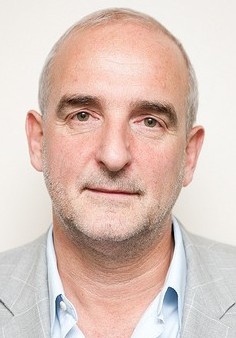
In Tehran, just before the election, I sat down with Nasser Hadian, who once taught at Columbia and is now at Tehran University. He’s an influential thinker on foreign affairs who got to know [Dennis] Ross while he was in the United States. Hadian told me that Iran has taken Obama’s outreach seriously. Hadian has been part of a group of foreign-policy experts, convened by Mahmoud Vaezi at the Center for Strategic Research in Tehran, who have been meeting every two weeks to review how to respond to the U.S. offer. Vaezi prepares reports that are submitted to Ali Akbar Hashemi Rafsanjani, the reformist former president who has been bitterly critical of the June 12 vote, and to Khamenei himself.
The discussions, I was told, have been detailed, including a review of who might lead any eventual bilateral negotiations from the Iranian side. One name that has been proposed is Ali Akbar Velayati, a former foreign minister who is a top adviser to Khamenei. In this light, the fact that Velayati praised Obama after the election for remaining quiet about it is interesting. Velayati also said, “America accepts a nuclear Iran, but Britain and France cannot stand a nuclear Iran.” This is a new language, however wide of the truth. The bizarre official lambasting of Britain — and demonizing of the BBC rather than the Voice of America — can be seen as the Iranian authorities trying to keep their U.S. options open.
“My argument in all the meetings has been: You have to go for full normalization and comprehensive engagement on all the issues,” Hadian told me. “Not a U.S. consulate in Tehran, or the nuclear issue in isolation; that won’t work. And because I know we cannot normalize unless Israeli concerns are addressed, I’ve argued that Ross would be an important assurance, someone able to convince the American Jewish lobby that any eventual agreement is workable.” That view, he suggested, had gained some traction in Tehran.
Hadian said Iran has looked at everyone in the policy mix — Burns, Ross, Talwar, Vali Nasr (an Iranian-American aide to Richard Holbrooke, the State Department envoy), Gary Samore (a nonproliferation expert at the N.S.C.), Tony Blinken (a national security adviser to Vice President Joe Biden) — and the general feeling was positive. “What Obama has already done for the United States in the Muslim world is unbelievable,” he said. “It is not easy for anyone here to attack him.”
But Hadian is a reformist who backed Moussavi. The Iran he talked about has not disappeared postelection — Velayati is as influential as ever — but it’s shaken. Khamenei, who just turned 70, knows he is vulnerable right now; it’s far from clear he’d be ready to negotiate from vulnerability. His suspicion of the United States is deep; anti-Americanism has worked for him over a 20-year rule. “Khamenei still believes the United States wants to go back to the patron-client relationship and the nuclear issue is being used for that,” Sadjadpour, of the Carnegie Endowment, told me. Even if he chooses to talk, would it not be in pursuit of a familiar Iranian tactic — stringing things out, as the centrifuges spin, until cracks appear among the Western allies, or China and Russia come to Tehran’s defense?
One thing is clear: Iran is no position to talk right now. It has no functioning national-security apparatus as its leaders scramble to shore up the regime. The republican pillar of the Islamic Republic has been destroyed to salvage a hard-line rightist order, but the price of this violent gamble in terms of lost support, internal division and external criticism has been immense. Iran has morphed in the global consciousness, to the point that U2 and Madonna have adopted the cause of Iranian democracy. With oil down and opposition up, Iran’s regional ascendancy is stalled or already in reverse. [continued…]
Make them wait By Trita Parsi, Foreign Policy, July 30, 2009
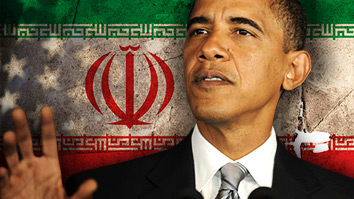
The Obama administration should avoid repeating the key mistake of the Bush administration, for which Iran was solely viewed through the prism of its nuclear program. Delaying nuclear talks a few months won’t make a dramatic difference to Iran’s nuclear program. It could, however, determine which Iran America and the region will be dealing with for the next few decades — one in which democratic elements strengthen over time, or one where the will of the people grows increasingly irrelevant to Iran’s decision-makers.
Moreover, even nuclear talks would have a negligible impact on the election dispute, Iran currently is not in a position to negotiate. Some in Washington believe that the paralysis in Tehran has weakened Iran and made it more prone to compromise. But rather than delivering more, Iran’s government currently couldn’t deliver anything at all. The infighting has simply incapacitated Iranian decision makers. [continued…]
Two important developments over the past few days suggest that a possible confrontation may be under way between Iran’s Supreme Leader, Ayatollah Sayyed Ali Khamenei, and the high command of Iran’s Revolutionary Guards Corps (IRGC).
One development was the order issued by Ayatollah Khamenei overruling Mahmoud Ahmadinejad’s appointment of Esfandiar Rahim Mashaei as his First Vice President (Iran’s president has eight vice presidents). The second was the firing of ultra hardliner Gholamhossein Mohseni Ejehei, the Minister of Intelligence.
A reliable source in Tehran told the author that both episodes were meant to be signals by the IRGC’s high command to Ayatollah Khamenei that they were in control, and that he should toe the line — their line. According to the source, Ayatollah’s Khamenei’s order to fire Mashaei was delivered to the Voice and Visage (VaV) of the Islamic Republic (Iran’s national radio and television network) on the day Mashaei was appointed by Ahmadinejad. The VaV was asked to announce the order on national television and radio, but Ezzatollah Zarghami, the director of VaV and a former officer in the IRGC, refused to do so. [continued…]
In his 1998 speech to the American people, Iran’s reformist president, Muhammad Khatami, said he prayed that “at the close of the 20th century, people would . . . begin a new century of humanity, understanding and durable peace, so that all humanity would enjoy the blessings of life.’’
Khatami’s address marked a stunning departure from the anti-Americanism that had fueled the Iranian revolution. A scholar of The Enlightenment, he praised Alexis de Tocqueville’s “Democracy in America,’’ which “reflects the virtuous and human side of this American civilization. In [Tocqueville’s] view, the significance of this civilization is in the fact that liberty found religion as a cradle for its growth, and religion found protection of liberty as its divine calling. Therefore, liberty and faith never clashed.’’
By insisting on the compatibility of religion and liberty in America, Khatami laid a philosophical foundation for bridging the political divide between Iran and the United States. He did not vilify the United States as the “Great Satan.’’ Instead he held the United States as a model for emulation – a democratic civilization whose success reflected the ingenious combination of the principles of religion and the virtues of liberty. [continued…]
The Iranian authorities sent a mixed message of clemency and firmness on Wednesday, saying that more detainees arrested in the post-election crackdown would soon be freed, but also that 20 protesters charged with serious crimes would be put on trial, starting this weekend.
There were also new arrests, including those of two prominent reformists, Saeed Shariati and Shayesteh Amiri, opposition Web sites reported. Separately, an “underground network providing foreign media outlets with photos and footage of the post-election unrest” has been identified and its members arrested, the state-run Press TV reported, citing security forces.
The report said that the network was made up of “pro-reform extremists” and that at least two members had confessed to providing images of the unrest to Western news media in an effort to “stage a regime change” in Iran. The Iranian leadership has blamed foreign media for riots and rallies after the disputed June 12 presidential election. [continued…]
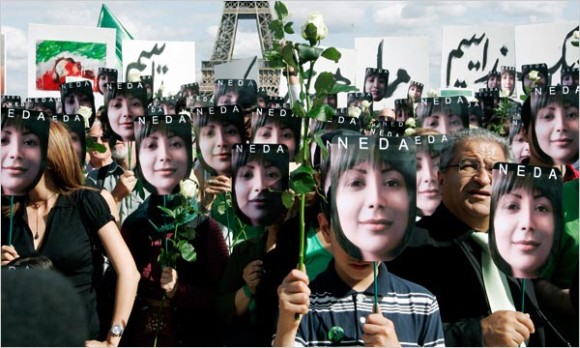
Thousands and possibly tens of thousands of mourners, many of them black-clad young women carrying roses, overwhelmed security forces today at Tehran’s largest cemetery to gather around the grave of Neda Agha-Soltan, the young woman whose videotaped shooting at a June 20 demonstration stunned the world.
Amateur video apparently taken at Behesht Zahra cemetery and quickly uploaded to the Internet shows a sea of mourners moving through the cemetery chanting slogans. “Death to the dictator,” chanted those in one long procession, kicking up a storm of dust as they walked. “Neda is not dead. This government is dead.” [continued…]
Political hard-liners warned President Mahmoud Ahmadinejad on Tuesday that he could be deposed like past Iranian leaders if he continued to defy the country’s supreme religious leader.
The implied threat was the latest evidence of the rift within Iran’s conservative camp and could serve to further sap the authority of a president already considered illegitimate by reformists.
The Islamic Society of Engineers, a political group close to parliamentary speaker Ali Larijani, warned in an open letter to Ahmadinejad that he could suffer the same fate as Prime Minister Mohammed Mossadegh, who was deposed in 1953 in a CIA-backed coup with the acquiescence of the clergy.
The letter also cites the experience of President Abolhassan Bani-Sadr, who was ousted in 1981 and fled the country after he fell out with the Islamic Republic’s founder, Ayatollah Ruhollah Khomeini. Both leaders had been elected by huge margins.
“It seems you want to be the sole speaker and do not want to hear other voices,” the group’s letter says, noting that recent actions by Ahmadinejad have frustrated his own supporters. “Therefore it is our duty to convey to you the voice of the people.” [continued…]
Nasser Hadian, a political scientist, told me [in early 2009]: “I say to my students, it’s hard to wait but you should be patient. The laws of the country cannot forever lag behind the reality, and Iran’s reality today is that women have been empowered and secularism has spread.” Nor, I thought, in an election year, could politics forever lag behind these facts.
The June 12 election offered a potential bridge between this youthful Iran in rapid evolution, curious about the world and increasingly connected to it online, and revolutionary institutions that had veered in a conservative direction under Ahmadinejad. Presidential votes have served as safety valves in the past. They have provided modest course corrections that have made the term “Republic” not altogether meaningless. Iran was distinguished in a despotic region by its unpredictable elections, as when the reformist Mohammad Khatami won in a landslide in 1997.
Khatami, who ended up changing more tone than substance, said he would stand again this year, before desisting in favor of Moussavi, a former prime minister of impeccable revolutionary credentials, a distant relative of Ayatollah Khamenei, a staunch nationalist, and seemingly the very embodiment of unthreatening change. Khamenei, as president, had worked with Moussavi in the war-ravaged 1980s. Their relationship was uneasy but survived eight years. Allergic to another Khatami presidency, the supreme leader appeared to have made his peace with Moussavi, even if his preference for Ahmadinejad was clear.
But Khamenei’s acquiescence was to the Moussavi of early May: drab, detached, and dutiful. By early June, he had become the energized anti- Ahmadinejad. Apathy among Iranians had yielded to the activism that would produce the 85 percent turnout. Moussavi had been propelled in part by his charismatic wife, Zahra Rahnavard, whom I saw just before the election at a big Tehran rally where, in floral hijab, she began with a resounding “Hello Freedom!” and proceeded to warn that “if there is rigging, Iran will have a revolution.” [continued…]
Some prisoners say they watched fellow detainees being beaten to death by guards in overcrowded, stinking holding pens. Others say they had their fingernails ripped off or were forced to lick filthy toilet bowls.
The accounts of prison abuse in Iran’s postelection crackdown — relayed by relatives and on opposition Web sites — have set off growing outrage among Iranians, including some prominent conservatives. More bruised corpses have been returned to families in recent days, and some hospital officials have told human rights workers that they have seen evidence that well over 100 protesters have died since the vote.
On Tuesday, the government released 140 prisoners in one of several conciliatory gestures aimed at deflecting further criticism. President Mahmoud Ahmadinejad issued a letter urging the head of the judiciary to show “Islamic mercy” to the detainees, and on Monday Iran’s supreme leader, Ayatollah Ali Khamenei, personally intervened and closed an especially notorious detention center.
But there are signs that widespread public anger persists, and that it is not confined to those who took to the streets crying fraud after Mr. Ahmadinejad’s landslide victory last month. Several conservatives have said the abuse suggests a troubling lack of accountability, and they have hinted at a link with Mr. Ahmadinejad’s recent willingness to defy even the venerated Ayatollah Khamenei. [continued…]
Iraqi troops and police carried out a bloody raid Tuesday on the camp of an Iranian opposition group that the United States has long sheltered, marking the Iraqi government’s boldest move since it declared its sovereignty a month ago and offering the latest sign that American influence is waning as Iranian clout rises.
The operation, which caught U.S. officials off guard, coincided with a visit by Defense Secretary Robert M. Gates, and analysts said it appeared designed to send a message of Iraqi independence.
The Mujaheddin-e Khalq, or MEK, has supplied information about Iran’s nuclear program to the United States, but the group has long been an irritant to the Islamic republic, which has repeatedly asked the government of neighboring Iraq to expel MEK members. The way Baghdad deals with the group is widely seen as a signal of whether Iraq is more heavily swayed by Iran or by the United States.
Leaders of the group said Iraqi troops fatally shot four residents Tuesday night and wounded scores. U.S. officials have long opposed a violent takeover of the camp northeast of Baghdad, and the Iraqi government’s willingness to carry out the raid while Gates was in the country startled some American officials. [continued…]
Associating with anyone from the West is dangerous. In these times, those abroad play a delicate but vital role. Their assistance in disseminating information from Iran is crucial but any form of intervention, be it military (the bombing of nuclear facilities) or economic (increased sanctions), is only incredibly destructive. Each threat of military aggression or proposed negotiation deadline makes “green” efforts more difficult. And increased economic sanction deteriorates our lives and safety. Some think the two recent airplane crashes may have been affected by our country’s lack of access to parts and planes.
This is our movement. We appreciate and continue to ask for global solidarity but this struggle is for Iranians. I believe that Nobel Peace Price laureate Shireen Ebadi’s statements echo the wider sentiments of the Iranian people. While speaking in Germany, she stated: “I am against economic sanctions and military interventions… Diplomatic ties must not be severed, instead the embassies could be downgraded to consulates. This would not harm the Iranian people, but it would illustrate the government’s isolation.” Keeping the table open with no conditions and encouraging dialogue with all factions in Iran is vital. However, it must be done extremely carefully so as not to provide any means of leverage for Ahmadinejad. [continued…]
The Iranian opposition leader Mir Hussein Moussavi spoke out more strongly than ever before on Monday against the arrests and killings of protesters, hours before Iran’s supreme leader ordered the closing of a “nonstandard” prison apparently in an effort to deflect rising criticism over the issue.
“How can it be that the leaders of our country do not cry out and shed tears about these tragedies?” Mr. Moussavi said, in comments to a teachers’ association that were posted on his Web site. “Can they not see it, feel it? These things are blackening our country, blackening all our hearts. If we remain silent, it will destroy us all and take us to hell.”
Mr. Moussavi’s angry tone appeared to reflect the steadily rising toll of those killed — some after being beaten in prison — in the crackdown that followed the disputed June 12 presidential election. A funeral was held in Tehran on Monday for Amir Javadi-Far, a student activist who died in prison after being arrested, and reports emerged of still more deaths. [continued…]
Phase 2 has begun. Six weeks after millions took to the streets to protest Iran’s presidential election, their uprising has morphed into a feistier, more imaginative and potentially enduring campaign.
The second phase plays out in a boycott of goods advertised on state-controlled television. Just try buying a certain brand of dairy product, an Iranian human-rights activist told me, and the person behind you in line is likely to whisper, “Don’t buy that. It’s from an advertiser.” It includes calls to switch on every electric appliance in the house just before the evening TV news to trip up Tehran’s grid. It features quickie “blitz” street demonstrations, lasting just long enough to chant “Death to the dictator!” several times but short enough to evade security forces. It involves identifying paramilitary Basij vigilantes linked to the crackdown and putting marks in green — the opposition color — or pictures of protest victims in front of their homes. It is scribbled antiregime slogans on money. And it is defiant drivers honking horns, flashing headlights and waving V signs at security forces. (See pictures of Iran’s presidential election and its turbulent aftermath.)
The tactics are unorganized, largely leaderless and only just beginning. They spread by e-mail, websites and word of mouth. But their variety and scope indicate that Iran’s uprising is not a passing phenomenon like the student protests of 1999, which were quickly quashed. This time, Iranians are rising above their fears. Although embryonic, today’s public resolve is reminiscent of civil disobedience in colonial India before independence or in the American Deep South in the 1960s. Mohandas Gandhi once mused that “even the most powerful cannot rule without the cooperation of the ruled.” That quotation is now popular on Iranian websites. [continued…]
Strains between the United States and Israel surfaced publicly in Jerusalem on Monday, as Defense Secretary Robert M. Gates tried to reassure Israelis that American overtures to Iran were not open-ended, and as Defense Minister Ehud Barak of Israel expressed impatience with the Americans for wanting to engage Iran at all.
“I don’t think that it makes any sense at this stage to talk a lot about it,” Mr. Barak said at a joint news conference with Mr. Gates at the King David Hotel in Jerusalem, referring to the American offer to talk to Iran about giving up its nuclear program. Nonetheless, he said Israel was in no position to tell the United States what to do.
But, alluding to a potential Israeli military strike against Iran if it gains nuclear weapons capability, he added: “We clearly believe that no options should be removed from the table. This is our policy, we mean it, we recommend to others to take the same position, but we cannot dictate to anyone.”
Later, Prime Minister Benjamin Netanyahu met with Mr. Gates, and his office released a statement saying that he had pressed Mr. Gates on the need to use “all means” to keep Iran from gaining a nuclear weapon. [continued…]
The United States may think of Russia as a strategic partner when it comes to Iran. In reality, the geostrategic tensions between Washington and Moscow are still powerful enough to warrant a common approach by Russia and its eastern neighbor Iran with respect to a deterrent strategy towards the intrusive Western superpower.
This week, a small but significant clue is on full display with joint Russia-Iran military exercises in the Caspian Sea involving some 30 vessels. This is partially disguised by a benign environmental cause.
The maneuver, dubbed “Regional Collaboration for a Secure and Clean Caspian”, combines security and maritime objectives in the Caspian Sea, the world’s largest lake and also a main energy hub that is now the scene of competing alternatives for energy transfer. It signals a new trend in Iran-Russia military cooperation that will most likely increase in the near and intermediate future in light of Iran’s observer status at the Shanghai Cooperation Organization. The continuing standoff over Iran’s nuclear program should affect this warming of relations. [continued…]
President Mahmoud Ahmadinejad of Iran dismissed his intelligence minister on Sunday and his culture minister resigned, the latest fallout of a bitter dispute among conservatives that has exposed Mr. Ahmadinejad’s vulnerability in the aftermath of last month’s disputed election.
The intelligence minister, Gholam-Hussein Mohseni-Ejei, is one of several who walked out of a cabinet meeting last week to protest Mr. Ahmadinejad’s promotion of a controversial deputy, Esfandiar Rahim Mashaei.
That dismissal seemed largely symbolic, with only a week left before Mr. Ahmadinejad is inaugurated for a second term and must submit a new cabinet to the Parliament. Analysts say he is trying to show political confidence after the June 12 election, which opposition supporters claim was rigged in his favor. But his conservative rivals appear to smell blood and have pressed him hard over the promotion of Mr. Mashaei.
Mr. Ahmadinejad could face trouble in the coming days, because dismissing ministers, beyond a certain point, triggers a parliamentary vote of confidence on the cabinet. The deputy speaker of Parliament said Sunday that any cabinet meetings before the end of the president’s term would be illegal, state media reported. [continued…]
ran’s influential former president Akbar Hashemi Rafsanjani on Sunday defied a call by a group of hardline clerics to back the country’s disputed presidential election result, a news agency reported.
On Friday, 50 members of the 86-seat Assembly of Experts, called on Rafsanjani in a statement to show more support for Supreme Leader Ayatollah Ali Khamenei, who endorsed the re-election of the hardline president, Mahmoud Ahmadinejad, soon after the June 12 vote, which moderates say was rigged.
Challenging the authority of Iran’s most powerful figure, Rafsanjani declared the Islamic republic in crisis in during his sermon on July 17 and demanded an end to arrests of moderates. [continued…]
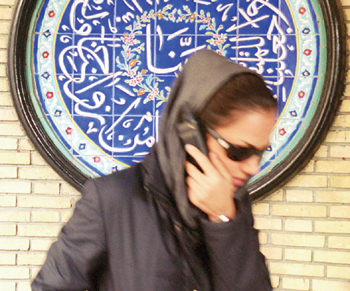
On June 15, five of my relatives — the oldest 65, the youngest 22 — spent four hours traveling across Tehran’s sprawling metropolis to reach a demonstration against the country’s election result. They first crammed into a creaky Iranian-made car, rode part of the way in a dilapidated bus and walked the final three miles. They strode quietly north along with an estimated 2 million others, hopeful that their show of peaceful force would convince the government to annul the election. The next day, the authorities began viciously attacking demonstrators. They dispatched plainclothes henchmen with pistols in their pockets to shoot randomly at civilians. Dissent, Iranians learned, could cost them their lives.
Immediately after the election, such protests evoked the grand marches of the 1979 Islamic revolution. But the scale of the dissent soon diminished. Clearly, the state’s vicious tactics were partly to blame. But Iranians were not simply terrorized into staying at home. Rather, there was no leader inspiring them to take to the streets — and put their lives at risk. The friends and relatives I have spoken to remain outraged over the fraudulent election. But they also remain perplexed by the opposition leaders. Many hailed from the regime’s old-guard elite, and it was unclear how much they would be willing to challenge the Islamic system.
No one had an answer to this central question: For whom, exactly, would ordinary Iranians be willing to put themselves in danger? What sort of leadership is required to make violence worth it? [continued…]
The leaders of Iran’s opposition movement sent an open letter of protest to the country’s highest religious authorities on Saturday, complaining that the state had used “illegal, immoral and irreligious methods” in the crackdown following last month’s disputed presidential election and calling for the release of hundreds of people arrested since.
The letter came a day after the funeral of a young protester with links to Iran’s political elite, whose father told a senior military commander that the youth had been beaten after his arrest, held incommunicado and allowed to die of an infection. The funeral drew senior figures, including conservative members of Parliament and a representative from the office of Iran’s supreme leader, Ayatollah Ali Khamenei.
The open letter was the latest sign of the opposition movement’s continuing defiance, despite stern warnings by leading clerics to drop the issue and an enormous police presence that has largely scuttled street protests for the past week. It followed a similar call eight days ago by former President Ali Akbar Hashemi Rafsanjani to release the detainees. [continued…]
This website or its third-party tools use cookies, which are necessary to its functioning. By closing this banner, you agree to the use of cookies.




 ast week Iran’s theocracy widened its crackdown from suppressing an opposition movement to putting on trial the very revolutionaries who launched the Islamic republic. This new purge may be more profound politically than the campaign against the followers of Mir Hossein Mousavi: The Iranian revolution is eating its children.
 istorically speaking, the Iranian government has enjoyed four sources of legitimacy: its ability to manage state affairs (and thus the people’s consent), its official religious authority, its commitment to Iran’s independence, and a stable base of social support. All of these have now been irretrievably undone.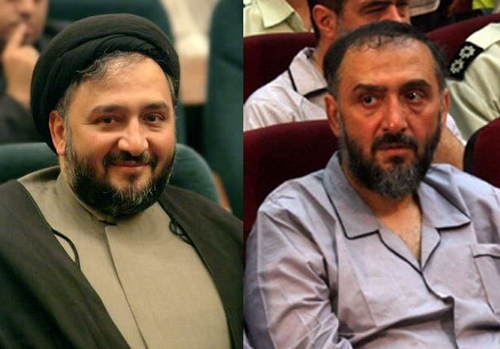

 n Tehran, just before the election, I sat down with Nasser Hadian, who once taught at Columbia and is now at Tehran University. He’s an influential thinker on foreign affairs who got to know [Dennis] Ross while he was in the United States. Hadian told me that Iran has taken Obama’s outreach seriously. Hadian has been part of a group of foreign-policy experts, convened by Mahmoud Vaezi at the Center for Strategic Research in Tehran, who have been meeting every two weeks to review how to respond to the U.S. offer. Vaezi prepares reports that are submitted to Ali Akbar Hashemi Rafsanjani, the reformist former president who has been bitterly critical of the June 12 vote, and to Khamenei himself.
 he Obama administration should avoid repeating the key mistake of the Bush administration, for which Iran was solely viewed through the prism of its nuclear program. Delaying nuclear talks a few months won’t make a dramatic difference to Iran’s nuclear program. It could, however, determine which Iran America and the region will be dealing with for the next few decades — one in which democratic elements strengthen over time, or one where the will of the people grows increasingly irrelevant to Iran’s decision-makers.
 olitical hard-liners warned President Mahmoud Ahmadinejad on Tuesday that he could be deposed like past Iranian leaders if he continued to defy the country’s supreme religious leader.
 n June 15, five of my relatives — the oldest 65, the youngest 22 — spent four hours traveling across Tehran’s sprawling metropolis to reach a demonstration against the country’s election result. They first crammed into a creaky Iranian-made car, rode part of the way in a dilapidated bus and walked the final three miles. They strode quietly north along with an estimated 2 million others, hopeful that their show of peaceful force would convince the government to annul the election. The next day, the authorities began viciously attacking demonstrators. They dispatched plainclothes henchmen with pistols in their pockets to shoot randomly at civilians. Dissent, Iranians learned, could cost them their lives.