Martin Chulov reports on Qassem Suleimani, the head of Iran’s elite al-Quds Force, who is widely regarded as the most powerful man in Iraq.
In Baghdad, no other name invokes the same sort of reaction among the nation’s power base – discomfort, uncertainty and fear.
“He is the most powerful man in Iraq without question,” Iraq’s former national security minister, Mowaffak al-Rubaie, said recently. “Nothing gets done without him.”
Until now, however, few Iraqis have dared to talk openly about the enigmatic Iranian general, what role he plays in Iraq and how he shapes key agendas like no one else.
“They are too busy dealing with the aftermath,” said a senior US official. “He dictates terms then makes things happen and the Iraqis are left managing a situation that they had no input into.”
Suleimani’s journey to supremacy in Iraq is rooted in the Islamic revolution of 1979, which ousted the Shah and recast Iran as a fundamentalist Shia Islamic state. He rose steadily through the ranks of the Iranian military until 2002 when, months before the US invasion of Iraq, he was appointed to command the most elite unit of the Iranian military – the al-Quds force of the Revolutionary Guards Corp.
The al-Quds force has no equal in Iran. Its stated primary task is to protect the revolution. However, its mandate has also been interpreted as exporting the revolution’s goals to other parts of the Islamic world.
Shia communities throughout the region have proved fertile grounds for revolutionary messages and have formed deep and abiding partnerships with the al-Quds force. So too have several Sunni groups opposed to Israel – first among them Hamas in Gaza.
But Iraq has been Suleimani’s key arena. The last eight years have witnessed a proxy war between Suleimani’s Quds force and the US military, the full effects of which are still being played out, as the US prepares for a full departure from Iraq and Iraq’s leaders ponder over whether to ask them to stay.
By January 2012, the State Department will do something it’s never done before: command a mercenary army the size of a heavy combat brigade. That’s the plan to provide security for its diplomats in Iraq once the U.S. military withdraws. And no one outside State knows anything more, as the department has gone to war with its independent government watchdog to keep its plan a secret.
Stuart Bowen, the Special Inspector General for Iraq Reconstruction (SIGIR), is essentially in the dark about one of the most complex and dangerous endeavors the State Department has ever undertaken, one with huge implications for the future of the United States in Iraq. “Our audit of the program is making no progress,” Bowen tells Danger Room.
For months, Bowen’s team has tried to get basic information out of the State Department about how it will command its assembled army of about 5,500 private security contractors. How many State contracting officials will oversee how many hired guns? What are the rules of engagement for the guards? What’s the system for reporting a security danger, and for directing the guards’ response?
And for months, the State Department’s management chief, former Ambassador Patrick Kennedy, has given Bowen a clear response: That’s not your jurisdiction. You just deal with reconstruction, not security. Never mind that Bowen has audited over $1.2 billion worth of security contracts over seven years.
Iraqi government forces arrived at the headquarters of the Journalistic Freedoms Observatory (JFO) at about 2 a.m. on Feb. 23, half a block from Baghdad’s Firdos Square, where eight years earlier news cameras had captured the iconic toppling of Saddam Hussein’s statue. The soldiers jumped out of their Humvees and began trying to break down the front door. Inside, the building’s night watchman had been sleeping in his ground-floor apartment. He woke to the banging and opened the door, where he was met by a score of armed men, some wearing black clothing and ski masks, some in military fatigues stripped of any identifying insignia.
“Where is the JFO?” the officers demanded.
They didn’t identify themselves. They didn’t have to. As the government would later confirm, these forces answered to the Baghdad Operations Command, which coordinates all security forces in the capital and reports directly to Prime Minister Nouri al-Maliki’s office. Since 2007, Maliki has bypassed several layers of civilian and military leadership, establishing a direct line of control over key security forces, including Iraq’s 54th and 56th brigades, as well as an elite counterterrorism force trained and supported by the U.S. Special Operations Command. In concert with the “surge,” this strategy helped Iraq’s government regain control of the streets from a virulent insurgency. “We’re working literally day and night with the Baghdad Operation[s] Command,” said Maj. Gen. Joseph Fil, commander of U.S. troops in Baghdad, on Feb. 16, 2007, at the dawn of a joint U.S.-Iraqi operation that would soon bring remarkable security gains to the capital. Some four years later, the Baghdad Operations Command continues to act against entities deemed dangerous to the state.
The night watchman pointed the officers up a narrow stairway toward the JFO’s second-story offices. They ran upstairs and bashed their way in. More soldiers entered the building. They blindfolded the night watchman and bound his arms and legs.
The JFO’s headquarters consists of a reception area, a few small offices, and a conference room. Like most local NGOs, it operates on a shoestring budget, in affiliation with a few larger international organizations like Reporters Without Borders and the Society of Professional Journalists. Its mission is to protect the freedom of the press. On a practical level, this means the JFO is the central hub to which journalists in Iraq report censorship and abuse. Their records were stored in file cabinets and computers, all of which the security forces ransacked. They confiscated seven laptop and desktop computers, external hard disks, paper archives, five handicams, and one boxy gray television camera, an antique souvenir that had last been used in the 1950s. The raid lasted three hours. When it was over, the watchman was unbound and left to comfort his frightened wife and child.
Fellow journalists in Baghdad were amazed — though not surprised — to hear of such a brazen government attack on the press. A mutual friend arranged for me to meet Ziyad al-Ajili, director of the JFO. I drove across town to his office, which staffers had quickly returned to a state of tidiness. A broken door frame and the absence of desktop computers were the only traces of the break-in.
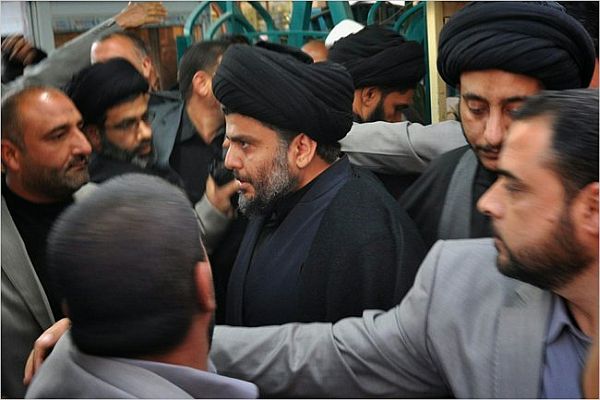
Iraqi cleric and militia leader Moqtada al-Sadr has threatened to take up arms against US troops unless they leave the country by the end of the year.
In a rare interview, he told the BBC he believed US forces would not stick to an agreement to withdraw from Iraq.
The US still has about 46,000 troops in Iraq, due to have withdrawn by January 2012.
On Thursday, tens of thousands of the cleric’s supporters rallied in Baghdad, calling for the Americans to leave.
The Pentagon has been pressing the Iraqi government to decide quickly whether it will ask some to stay on beyond the deadline.
In Sadr City, Moqtada al-Sadr’s Baghdad stronghold, his supporters marched in military formation, their boots trampling on the flags of the US, UK and Israel.
More than half of all Egyptians would like to see the 1979 peace treaty with Israel annulled, according to results of a poll conducted by the U.S.-based Pew Research Center released Monday.
The poll highlights the deep unpopularity of the three-decade-old treaty, which is central to U.S. policy in the region and was scrupulously adhered to by former President Hosni Mubarak, until his Feb. 11 ouster.
The poll also revealed that most Egyptians are optimistic about where the country is headed following the 18-day popular uprising that brought down the president, and they look forward to greater democracy in their country.
The fall of Egypt’s autocratic leader and the rise of a more democratic system, however, could threaten relations with neighboring Israel.
According to the poll results, only 36 percent of Egyptians are in favor of maintaining the treaty, compared with 54 percent who would like to see it scrapped. (Associated Press)
Stretched close to the limit by combat in Afghanistan and determined not to get into a ground war in Libya, the Pentagon is stepping up the pressure to maintain a huge US troop presence in today’s largely peaceful Iraq. What might seem at first sight strange and unnecessary is in fact fully in line with the ambitions of those who planned the invasion eight years ago. Whether neocons or “realists”, they always wanted to have a long-term political and military footprint in the northern sector of the Middle East, strategically placed between Syria and Iran.
As with so many elements of the geopolitical strategy he inherited from George Bush, Barack Obama has gone along with it. So it should be no surprise that Admiral Mike Mullen, chairman of the joint chief of staffs, was in Baghdad on Friday urging the government to amend the agreement under which all US forces have to leave Iraq by the end of this year. Robert Gates, the US defence secretary, was in the Iraqi capital on a similar mission a few weeks earlier.
Both Sunni and Shia protesters were on the streets last week to denounce the US plans, united by a common sense of nationalism that has not been seen since the first year of the US occupation, before sectarian divisions were artificially inflamed. In Mosul around 5,000 people, including provincial council members and tribal leaders, rallied against any extension of the US presence, while supporters of the Shia cleric Moqtada al-Sadr marched in Baghdad. (Jonathan Steele)
Protesters in Saudi Arabia: “Down with the Khalifas, Down with America, Down with Israel, Down with Wahhabism!”
More Syrians are missing, hinting at a wider crackdown
Dozens of residents have disappeared in Syria since Friday, many of them from the restive city of Homs and towns on the outskirts of the capital, Damascus, human rights activists said Sunday, amid signs that the Syrian government may widen its crackdown on a five-week uprising that has already killed hundreds.
The disappearances were yet another indication that the government’s decision to lift emergency rule, in place since 1963, might prove more rhetoric than reform. Though the government has proclaimed the law’s repeal on Thursday as a sweeping step, the past few days have proven some of the bloodiest and most repressive since the uprising began.
On Friday, at least 109 people were killed, as security forces fired on protesters in 14 towns and cities. At least 12 more were killed Saturday, when mourners sought to bury the dead from the day before. Another person was reported killed Sunday in Jabla, where security forces fired on residents after the visit of the governor. “We don’t trust this regime anymore,” one protester there said. “We’re sick of it.”
Human Rights Watch called on the United Nations to set up an international inquiry into the deaths and urged the United States and Europe to impose sanctions on officials responsible for the shootings and the detentions of hundreds of protesters. (New York Times)
Iran has been targeted by a new computer virus in a “cyber war” waged by its enemies, according to a senior military official of the Islamic republic.
Gholam Reza Jalali, commander of civil defence, told the semi-official Mehr news agency on Monday that the new virus, called Stars, was being investigated by experts.
“Certain characteristics about the Stars virus have been identified, including that it is compatible with the [targeted] system,” he said.
He said that Iranian experts were still investigating the full scope of the malware’s abilities. (Al Jazeera)
As US Secretary of Defense Robert Gates visited Baghdad yesterday, the New York Times reported:
Mr. Gates and American military commanders have made no secret of their view that some of the 47,000 American troops in Iraq should remain after 2011 as a stability force, particularly as tensions have flared between Arabs and Kurds in the north. But Mr. Gates said that the Iraqi government must first request that the American troops stay. That has not happened yet, much to the growing impatience of American commanders who say they need to know now in order to plan into 2012.
“We are willing to have a presence beyond that time,” Mr. Gates told the soldiers at Camp Liberty. “But we’ve got a lot of commitments around the world.” He added that “if folks are going to want us to have a presence, we’re going to need to get on with it pretty quickly in terms of our planning and our ability to figure out where we get the forces.”
He also said that although the Iraqis had shown interest in keeping some American troops in the country, “The politics are such, we’ll just have to wait and see.”
Mr. Gates was obliquely referring to the politics surrounding Mr. Maliki, who is hemmed in by a bloc of politicians loyal to the anti-American cleric Moktada al-Sadr. Mr. Sadr, whose support Mr. Maliki relied on to secure a second term as prime minister, is opposed to any delay in the American withdrawal. Any extension of the American troop presence would require the politically risky decision by Mr. Maliki to ask for it.
The top American commander in Iraq, Gen. Lloyd J. Austin III, made clear on Thursday that Iraq was not ready to defend itself, particularly from the skies. He said the Iraqis also needed help with intelligence gathering, logistics and the use of different weapons systems in coherent warfare. He said that there was a debate in the Iraqi government about whether the United States should stay or not, and that the wind of that debate was not blowing in one direction, “It’s blowing in every direction.”
Despite the uncertainties, Mr. Gates told the troops at Camp Liberty that “Iraq has been an extraordinary success story for the United States military.” In briefly reflective comments, he recalled for them the first of some dozen trips to Iraq as defense secretary, in December 2006, when violence was raging and he held a news conference at a nearby base while a firefight went on in the background.
Today, Mr. Gates said, countries in turmoil across the Middle East “would be happy if they could get to where Iraq is today — it isn’t perfect, but it’s new and it is a democracy and people do have rights.”
In conclusion, he recalled that when he took over as defense secretary, people said he would be evaluated by how Iraq turned out. “And I’ll let people judge for themselves,” he said.
Meanwhile, Al Jazeera‘s Jane Arraf tweets that demonstrators gathered in Baghdad’s Tahrir Square today, burning American flags and protesting against the continuation of the US occupation. The protesters also say even the US embassy — the biggest embassy in the world — is part of the occupation.
The fantasy that the Arabs are passive and unsuited to democracy has evaporated in weeks. Arabs have overthrown hated authoritarian regimes in Tunisia and Egypt. In Libya, they have fought a sclerotic regime in power for 42 years that has refused to listen to their demands, facing extraordinary violence, hundreds of deaths, untold injuries, mass exodus and generalised chaos. In Algeria, Morocco, Bahrain, Yemen, Jordan, Iraqi Kurdistan, the West Bank and Oman, Arabs have taken to the streets in vast numbers. This defiance has spread even to non-Arab Iran.
And where promises of reform have been made but were then found wanting, people have simply returned to the streets. In Egypt, protesters have demanded faster and further-reaching reform. In Tunisia, renewed demonstrations on 25-27 February led to five deaths but won a change of prime minister (Mohamed Ghannouchi stepped down in favour of Beji Caid-Essebsi). In Iraq, renewed protests led to a promise to sack unsatisfactory ministers. In Algeria, the 19-year emergency law was repealed amid continuing protests. The demands are growing throughout the region, and will not be silenced.
The revolutions in Tunisia and Egypt, the uprising in Libya, and all the other popular movements that have shaken the region are not just about how people want to live and develop, but about regional politics. For the first time since the 1970s, geopolitics cannot be analysed without taking into account, at least in part, the aspirations of people who have retaken control of their destinies.
An outspoken Shiite prayer leader who demonstrators say was arrested last Friday was a focal point of the “day of rage” protest, said Ibrahim Al-Mugaiteeb, president of the Human Rights First Society.
Sheikh Tawfeeq Al-Amer was arrested Friday after a sermon stating that Saudi Arabia should become a constitutional monarchy, Al-Mugaiteeb said. (CNN)
Bahrain: Dangerous statistics and facts about the national security apparatus
The Bahrain Center for Human Rights (BCHR) expresses again its deep concern regarding the mounting dangerous role of the National Security Apparatus (NSA) at the expense of liberties and human rights in Bahrain. A list which the BCHR has obtained reveals that amongst the more than 1000 employees working for the NSA, 64% of them are non-citizens, mostly of Asian nationalities. The king’s relatives occupy the highest posts in the NSA; Sheikh Khalifa bin Abdulla Al-Khalifa heads it, in addition to three others from the King’s family.
The aforementioned list also reveals that the NSA is formed on sectarian basis. The percentage of Shiite citizens employed at the NSA does not exceed 4%, and they work as informants and in the low level jobs. While the Shiites, who form two thirds of the Bahraini citizens, are the main target for the NSA. This appears when verifying the sectarian identity of the villages and areas that the Security Special Forces are besieging on an almost daily basis, the organizations that are being targeted, the protest events that are being suppressed, the hundreds of people being arrested and trialed on security charges, and the activists targeted with smearing media campaigns.
Several hurt as Sunnis, Shi’ites clash in Bahrain
Several people were hurt in fighting between Sunni and majority Shi’ite Muslims in a town in central Bahrain on Friday, the first sectarian violence since protests erupted in the Sunni-ruled kingdom two weeks ago.
The overnight clashes were triggered by a family dispute or a car accident, or both, according to different accounts, although the government said the cause of the dispute was “simple.”
“There were about a hundred people involved,” one resident said as police helicopters circled overhead and ambulances rushed from the scene.
Youths with sticks and batons fled the area, residents said. (Reuters)
Protesters converge on Iraq capital
Thousands of people have converged on Baghdad’s Tahrir, or Liberation, Square for an anti-government demonstration, despite a vehicle ban that forced many to walk for hours to the heart of the Iraqi capital.
Al Jazeera’s Jane Arraf reported from Baghdad that the situation was heading towards a stand-off, as security forces demanded the protesters leave, blocking their route across a bridge leading to the Green Zone, where the government has its base.
Concrete blocks were set up by authorities on all of Baghdad’s bridges ahead of the protests.
“What we’re seeing here is a bit of a test, of how the government will respond when these people clearly want their demands to be heard,” Arraf said.
The protests in Iraq are growing in size, partly because of the instability of the coalition government formed by Nouri al-Maliki, the country’s prime minister, Arraf said.
Iraqis are increasingly unwilling to accept the nature of the democracy that has emerged in years after Saddam’s regime was overthrown.
“This is a new democracy, it’s an unusual democracy, and it’s not exactly what people bargained for,” she said.
“On top of that, people are looking around protests in Egypt and Tunisia … It has shown them, particularly these young people that if they come out and demand their rights, perhaps something will happen.”
The Baghdad demonstration was one of many taking place across the country on Friday, including in the port of Basra and the city of Najaf. (Al Jazeera)
Blowback: Weapons of Mideast oppression, ‘Made in U.S.A.’
The Times’ Feb. 22 article, “Britain, Italy condemned for Libya ties,” provides helpful insight into the uproar caused by British and Italian military aid to Libya. However, readers would be well served by further information on how, with our government’s support, U.S. companies have provided military and crowd-control equipment that has propped up authoritarian governments throughout the Middle East.
Rather than seeing the U.S. as spreading freedom, Arabs who have taken to the streets have experienced “Made in U.S.A.” tear gas used by repressive governments to kill and maim unarmed protesters and crush popular movements for justice.
For unarmed Arab protesters in Egypt, Bahrain, Yemen, Tunisia and the Israeli-occupied West Bank, Pennsylvania may seem to be the tear-gas capital of the world judging by the labels on the canisters fired at them. Combined Systems Inc. (CSI) is headquartered in Jamestown, Pa., and NonLethal Technologies Inc.’s home is in Homer City, Pa. The apparently defunct Federal Laboratories was based in Saltsburg, Pa. (Los Angeles Times)
As the Mideast protests and government crackdowns continue, one country to watch closely is Iraq, with whom the U.S. has a long-term partnership and where clashes between protesters and government forces recently turned violent. Even as Iraqi security forces detained and abused hundreds of intellectuals and journalists, the U.S. government—in keeping with a pattern of silence on Iraq’s abuses—has withheld criticism of its strategic ally. (Salon noticed this too.)
Asked generally about the violence against Iraqi demonstrators on Friday, White House Press Secretary Jay Carney said only “the approach we’ve taken with regard to Iraq is the same that we’ve taken with regard to the region,” which he said was to call on governments to respond to the protests peacefully. Neither the White House nor the State Department seem to have mentioned the matter since. Yesterday’s State Department briefing discussed Libya, Egypt, Iran, Oman, Saudi Arabia, South Korea, China, Pakistan, Argentina, South Africa and Haiti—Iraq was never discussed.
The only way to get to Baghdad’s Tahrir Square — yes, it has one too — on Feb. 25 was to walk. It was a treat to stride down roads usually solid with traffic, but the silent city also felt ominous. Prime Minister Nouri al-Maliki had warned that the long-planned “Day of Rage” protests would be infiltrated by al Qaeda and remnants of Saddam Hussein’s Baathist regime, and imposed a ban on all vehicles within city limits to reduce the risk of car bombs. Religious leaders warned people to stay away, while security officials made doom-laden predictions of violence. Most people were too scared to venture outside.
The hush throughout Baghdad made the clamor in Tahrir Square seem all the louder. Thousands of demonstrators had walked for miles to gather there, not even bothering to go to Friday prayers first. They were mostly men — some university graduates, others day laborers, but all with the same grievances. We have no electricity and no water, scant job opportunities, and our politicians are liars and thieves, they said. They flung themselves against the blast walls blocking the entrance to the Green Zone, a symbol of the distant and unaccountable elite that they were raging against.
The protesters’ banners were homemade and simple in their demands. “The government in the Green Zone is afraid of the people,” said one. “Yes to democracy and public services,” another proclaimed.
Settar al-Sammarai, a soldier with six children who had been retired on a pension of $200 a month when Saddam Hussein’s army was disbanded, said, “I would like my voice to be heard by the government — I would like to be heard condemning the robbery of public funds.”
The Baghdad protests highlight the same frustrations that led Tunisians and Egyptians to topple their autocrats. A generation of Iraqis has grown up with even less control over their lives than youth elsewhere in the Arab world. They went from brutality and scarcity under Saddam Hussein to a U.S.-led liberation they never asked for. Foreign troops patrolled their streets, searched their houses at night, yelled at them in a language they didn’t understand, and, as the WikiLeaked war logs show, killed without good reason. The ensuing chaos placed them at the mercy of Iraq’s fearsome militias. And now, they’re living under a prime minister who is undermining some of the crucial checks and balances that are meant to make the Iraqi government accountable to its people.
23 killed in Iraq’s ‘Day of Rage’ protests
Tens of thousands of Iraqis surged into the streets Friday in at least a dozen demonstrations across the country, storming provincial buildings, forcing local officials to resign, freeing prisoners and otherwise demanding more from a government they only recently had a chance to elect.
At least 23 protesters were killed as Iraqis braved security forces to vent shared frustrations at the nearest government official. Sunnis, Shiites, Kurds and Christians, they shouted for simple dignities made more urgent by war – adequate electricity, clean water, a decent hospital, a fair shot at a job.
“I have demands!” Salma Mikahil, 48, cried out in Baghdad’s Tahrir Square, as military helicopters and snipers looked down on thousands of people bearing handmade signs and olive branches signifying peace. “I want to see if Maliki can accept that I live on this,” Mikahil said, waving a 1,000-dinar note, worth less than a dollar, toward Prime Minister Nouri al-Maliki’s offices. “I want to see if his conscience accepts it.”
The protests – billed as Iraq’s “Day of Rage” – represented a new sort of conflict for a population that has been menaced by sectarian militias and suicide bombers. Now, many wondered whether they would have to add to the list of enemies their own government, whose security forces beat and shot at protesters and journalists Friday and left hundreds injured.
Six people were killed in Fallujah and six others in Mosul, with the other deaths reported in five separate incidents around the country, according to officials and witnesses. The reports attributed most casualties to security forces who opened fire.
The demonstrators who sparked the crackdown were calling for reform, not revolution, although there were mini-examples of the latter – hyper-local versions of the recent revolts in Egypt, Tunisia and Libya. Crowds forced the resignation of the governor of the southern province of Basra and the entire city council of Fallujah and chased away the governor of Mosul, the brother of the speaker of parliament, who was also there and fled, too. (Washington Post)
Tribal leader’s resignation is blow to Yemeni president
A leading tribal figure in Yemen announced his resignation from the ruling party on Saturday, signaling a major blow to the embattled leadership of President Ali Abdullah Saleh as demonstrations calling for his resignation continue across the country.
“The Yemeni people would not keep silent on the blood of martyrs shed in Aden and will avenge it,” Sheikh Hussein Al Ahmar said in a speech before a large gathering of tribesmen in northern Amran province, referring to deaths of antigovernment protesters in the southern city of Aden, according to local press reports. He also called for the overthrow the Saleh regime, and the gathering broke out in antigovernment chants.
Mr. Ahmar is a prominent leader in Yemen’s most influential tribal confederation, the Hashids; his brother, Sadiq Al Ahmar, is the chief Hashid leader. Mr. Saleh, the president, is also a member of the Hashid confederation and has been meeting with tribal leaders to garner their support over the past two weeks.
Four days earlier, Mohammad Abdel Illah al-Qadi, a key leader of the Sanhan tribe, a Hashid affiliate that is also the president’s home tribe, resigned because of violence used against protesters. Mr. Qadi, whose father is a powerful military leader, was one of 10 parliament members who resigned the ruling party. (New York Times)
Shi’ite dissident returns to Bahrain from exile
A hardline Shi’ite dissident flew home to Bahrain from exile on Saturday to join an opposition movement demanding that the island kingdom’s Sunni ruling family accept a more democratic system.
“We want a real constitution,” Hassan Mushaimaa told reporters at the airport. “They’ve promised us (one) before and then did whatever they wanted to.”
“I’m here to see what are the demands of the people at the square and sit with them and talk to them,” he said, referring to anti-government protesters camped in Manama’s Pearl Square.
Thousands of anti-government protesters marched from Pearl Square to a former office of Prime Minister Sheikh Khalifa bin Salman al-Khalifa on Saturday in a new tactic to press demands for the removal of a man who has held his post for 40 years.
Sheikh Khalifa, the king’s uncle, is a symbol of the ruling family’s political power and wealth.
The march was the protesters’ first foray into a government and commercial district of Manama. They halted at a compound that also houses the Foreign Ministry. Many waved Bahraini flags and chanted: “The people want the fall of the regime.” (Reuters)
Saudi youths call for rally in Jeddah
A group of Saudi youth has called for a rally in the southwestern coastal city of Jeddah to show solidarity with the pro-democracy uprisings and revolutions across the Arab world.
A group calling itself Jeddah Youth for Change has distributed printed statements, calling on the people to join a demonstration near al-Beia Square in Jeddah on Friday.
“We will not give up our right to peacefully demonstrate,” the flier says.
“We will express our solidarity with the Libyan people who are living the hardship of their revolt against the oppressive and unjust system of Muammar Gaddafi,” it added.
Also in the eastern Qatif region, people are planning to hold a rally on Friday in support of the Libyan revolution and the uprising in Bahrain.
Thousands of people have said they are prepared to attend the protests after Saudi youth named March 11th the Day of Rage on the social networking website, Facebook. (Press TV)
Hundreds of thousands protest across Mideast
Hundreds of thousands of protesters turned out in cities across the Middle East on Friday to protest the unaccountability of their leaders and express solidarity with the uprising in Libya that Col. Muammar el-Qaddafi is trying to suppress with force.
The worst violence of the day appeared to be in Libya, where security forces shot at protesters as they left Friday prayers to try to launch the first major anti-government demonstration in the capital. Demonstrations in recent days have been in other cities, and several of those have fallen to armed rebels determined to oust Colonel Qaddafi.
Protests in Iraq also took a violent turn, with security forces firing on crowds in Baghdad, Mosul, Ramadi and in Salahuddin Province, killing at least ten people. Unlike in other Middle Eastern countries, the protesters in Iraq are not seeking to topple their leaders, but are demanding better government services after years of war and deprivation.
Religious leaders and the prime minister had pleaded with people not to take to the streets, with Moktada al-Sadr saying the new government needed a chance to improve services and Prime Minister Nuri Kamal al-Maliki warning that insurgents could target the gatherings. But on Friday, the deaths came at the hands of government forces.
Demonstrations elsewhere — in Bahrain, Yemen, Jordan, Egypt and Tunisia — were almost exclusively peaceful. (New York Times)
Tahrir protesters call on old guard to go
Thousands of workers strike in Saudi Arabia
Saudi Arabia is now being rocked by strikes as the mood of resistance spreads across the region. A socialist in Saudi Arabia reports on how struggles in the Middle East are even spreading to the most vicious dictatorship, which is sponsored by the US
‘I went to my workplace on Thursday of last week, and I found out that there were over 3,000 workers demanding their rights before they called a general strike in the construction site in Saudi Binladin Group. The workers were very angry. Their workplace is one of the largest construction projects in the country, which is worth SR.100 billion.
However, they live in a terrible conditions. One of the workers told me, “I live in a room four metres by three metres with eight people, and for every ten people there is only one toilet.” Another Egyptian worker told me about the working conditions and the restriction of religious freedom: “They are Zionists, they don’t even allow me to pray on time!” (Socialist Worker)
Egyptian workers strike for minimum wage and independent unions
But Hamad Bin Isa al-Khalifa has. He happens to be the king of Bahrain, where thousands of people have been peacefully protesting against his unelected royal regime since 14 February. His Majesty’s response? On 16 February, shortly before dawn, he ordered his security forces to storm Pearl Square in the heart of Bahrain’s capital, Manama, where the protesters – emulating those who had gathered in Cairo’s Liberation Square – were camping out. The police fired rubber bullets and tear gas at the king’s sleeping subjects, killing at least four, including a two-year-old girl, and injuring hundreds of others. The next day, they switched to live ammunition.
Nonetheless, the king of Bahrain has received his gilded invitation from Buckingham Palace, embossed with the Queen’s EIIR royal cypher. The Bahraini monarch is not the only Middle East tyrant to have made the cut. Invitations are reported to have gone out to King Abdullah of Saudi Arabia and King Abdullah of Jordan. Then again, given the pace of events in Tunisia and Egypt and the ongoing unrest in Libya, it is a matter of debate as to whether the two Abdullahs or Hamad will still be in power come 29 April. (Mehdi Hasan)
No real freedom without dismantling the secret political police
President Zine el Abbidin of Tunisia and President Mubarak of Egypt may have been ousted, but the terror and control of the secret political police continues unchecked and invisible to the eyes of the international community. Unless the domestic intelligence agencies: the state security investigations apparatus (SSI) in Egypt and its counterpart in Tunisia are immediately dismantled, not only will repression continue, but an underground witch-hunt against citizens who continue to press for genuine democracy will follow. There are signs that this is already happening in Tunisia where politically active citizens have once again felt the secret police force breathing down their necks.
Sihem Bensedrine, a prominent activist who was harassed under Ben Ali’s rule over attempts to set up an independent Internet newspaper and a satellite television channel, said that recently she has been again subject to surveillance by the secret police. Prior to the Jasmine revolution in Tunisia, the president’s party established a very complex and pervasive regime for monitoring ordinary citizens through the secret [political] police. According to Nadia Marzouki, a citizen had to avoid entanglements with the authorities, otherwise officials may “interfere with her enrolment at a university, her exams, her wedding or her desire to open a restaurant or shop, buy property, give birth in a hospital, obtain a passport or even buy a cellular phone: After 23 years of internalizing fear, Tunisians became their own censors.”
In post-Mubarak Egypt, the fear barrier over mentioning the SSI is now almost fully breached, but activists affirm that the officers are still in full force. The state security investigations apparatus has, since its establishment under British colonial rule, systematically served to protect the ruling regime by collecting intelligence information and using soft and brutal power against real, virtual or potential sources of dissidence. Since former Minister of Interior Habib al Adly came to power in 1997, he has worked to transform the apparatus into a parallel governance structure that uses repression, coercion and control mechanisms to remind citizens that the big SSI brother is always watching. When Mubarak announced the resignation of the government on the night of the January 28, Habib al Adly was removed from power. Technically, the SSI is supposed to be answerable to the Minister of Interior and it was assumed that the SSI would become redundant once Habib el Adly resigned. Yet what happened next suggested otherwise. Wael Saeed Abbas Ghoneim, one of the youth bloggers, was kidnapped by the State Security Investigations apparatus on January 27 and detained blindfolded for 12 days while everyone was oblivious to his whereabouts. It was assumed that he would be released shortly after January 28; but this was not the case. (Mariz Tadros)
In a press statement to Safa news agency on Saturday, Dr. Zahhar ruled out that the Egyptian revolution could immediately impact the situation in the besieged Gaza Strip due to the ruling military council’s preoccupation with its numerous and complex internal affairs.
Gaza police order male hairdressers to quit working
Hatem Ghoul was on his way to work at his hairdressing salon in Gaza City earlier this week when he got word that his employees had been paid a visit by the police.
They had left a message for Ghoul: could he drop by the police station; there was something they wanted to discuss. And, it turned out, not just him. The other four male hairdressers in the city had similar requests.
Ghoul had been expecting this for almost a year, since reports that Hamas was cracking down on men cutting and styling women’s hair. But Ghoul and his male colleagues in Gaza City continued to work, and no one stopped them.
This week he was left in no doubt. One by one, he told me, the men were called into a room where an unrelated detainee was chained to a wall by his wrists, and told to sign a pledge to give up their profession or face arrest and a 20,000 shekel (£3,400) fine. (The Guardian)
Iraqi police allowed dozens of assailants to beat and stab peaceful protesters in Baghdad on February 21, 2011, Human Rights Watch said today. Security forces have an obligation to protect the right to assemble peacefully and to use only the minimum necessary force to protect lives if violence erupts, Human Rights Watch said.
In the early hours of February 21 dozens of men, some wielding knives and clubs, attacked about 50 protesters who had set up two tents in Baghdad’s Tahrir Square. The assailants stabbed and beat at least 20 of the protesters who were intending to camp in the square until February 25, when groups have called for national protests similar to the “Day of Anger” in Egypt. The attack came directly after the police had withdrawn from the square, and witnesses suggested the assailants were in discussion with the police before they attacked.
“Promises by Prime Minister Nuri al-Maliki to allow protests are meaningless when we see vicious attacks like the one on February 21,” said Joe Stork, deputy Middle East director at Human Rights Watch. “Iraqi authorities should hold police who allowed this attack to happen accountable.”
Mubarak given up, wants to die in Sharm says Saudi official
Egypt’s ousted president has given up and wants to die in the Red Sea resort of Sharm el-Sheikh where he has been living since a popular uprising ended his rule, a Saudi official said on Wednesday.
Hosni Mubarak, 82, has suffered from health problems in recent years and travelled to Germany for gall bladder surgery in March last year. Reports of a further decline have increased since he stepped down on Friday after three decades in power.
An official in Saudi Arabia said the kingdom had offered to host Mubarak but he was determined to see out his days in Egypt. Official confirmation could not immediately be obtained from the Saudi government. (Reuters)
Ex-judge to head Egypt reform panel
Egypt’s new army rulers have appointed Tareq al-Bishry, a retired judge, to head a committee set up to suggest constitutional changes.
Al-Bishry was a strong supporter of an independent judiciary during Hosni Mubarak’s rule and is respected in legal circles for his independent views.
“I have been chosen by the Higher Military Council to head the committee for constitutional amendments,” al-Bishry said on Tuesday.
The Higher Military Council had earlier vowed to rewrite the constitution within 10 days and put it to a referendum within two months. (Al Jazeera)
Central Auditing Organization employees staged a sit-in Wednesday demanding that the organization be given total independence from the government. Employees also called for amending regulations, promotions and a bonus increase, among other demands.
Meanwhile, about 2000 Manpower Ministry employees protested against corruption within a group of investors who were appointed by Minister Aisha Abdel Hadi. Protesters called for bonus pay and a monthly travel allowance of LE 200. (Al-Masry Al-Youm)
After 25 Bahman’s success, the challenges for Iran’s Green Movement
The Iranian regime’s response to the street protests of Monday was predictable. Rather than realising that a sizeable proportion of its people were maintaining serious and justifiable grievances about the ruling elite, institutions of the Islamic Republic have put up a preposterous show of defiance. A large group of Parliamentary deputies openly agitated for violence and asked for Mir Hossein Mousavi and Mehdi Karroubi to be killed.
The classic line of UK-US-Israel-“terrorist” MKO (Mujahedin-e-Khalq) involvement patterns were put out in full force. The Secretary of the Expediency Council and 2009 Presidential candidate Mohsen Rezaei, a man routinely praised by pundits as a voice of balance and reason on the current Iranian political battleground, called both Mousavi and Karroubi “servants of the Americans” and laid out an ultimatum for the two former Presidential candidates: disown the protests by Tuesday night or face the “fully justifiable” response of the “people”.
The two Green leaders did nothing of that sort. In communiques published on their official website (over which there are some doubts of legitimacy, given that Mousavi has supposedly been cut off from contact since Sunday), both Mousavi and Karroubi praised the behaviour of the people on Monday and stated their determination to persist with their struggle.
Both messages fell short, however, of taking stock of the mood on the streets of Tehran and other cities on 25 Bahman. As relayed by the considerable YouTube footage, the bulk of the slogans shouted by the protestors were directed straight at the Supreme Leader, Ayatollah Ali Khamenei, who is now considered the main “culprit” of the current predicament. But no mention of Khamenei is made by either Mousavi or Karroubi, despite the ringing chant on YouTube associating the Supreme Leader’s fate with that of former Egyptian President Mubarak and Tunisian leader Ben Ali. Both Mousavi and Karroubi have also decided to maintain the controversial theme of “loyalty to the Late Imam’s [Ayatollah Khomeini] Values”. Mousavi’s alleged communique even said that such loyalty is the sole desire of the protestors, a comment which completely discounts the frequent and clear calls for the termination of the velayat-e faqih doctrine — introduced and brought forward by Khomeini — as principal element in the leadership of the Islamic Republic. (Enduring America)
U.S. follows two paths on unrest in Iran and Bahrain
The Obama administration has responded quite differently to two embattled governments that have beaten protesters and blocked the Internet in recent days to fend off the kind of popular revolt that brought down Egypt’s government.
With Iran — a country under sanctions pursuing a nuclear program that has put it at odds with the West — the administration has all but encouraged protesters to take to the streets. With Bahrain, a strategically important ally across the Persian Gulf from Iran, it has urged its king to address the grievances of his people.
Those two approaches were on vivid display at a news conference on Tuesday.
President Obama accused Iran’s leaders of hypocrisy for first encouraging the protests in Egypt, which they described as a continuation of Iran’s own revolution, and then cracking down on Iranians who used the pretext to come out on the streets. He then urged protesters to muster “the courage to be able to express their yearning for greater freedoms and a more representative government.”
But speaking to other restive countries, including Bahrain, Mr. Obama directed his advice to governments, not protesters, illustrating just how tricky diplomacy in the region has become. He said his administration, in talking to Arab allies, was sending the message that “you have a young, vibrant generation within the Middle East that is looking for greater opportunity; and that if you are governing these countries, you’ve got to get out ahead of change. You can’t be behind the curve.”
Mr. Obama’s words on Iran, on the other hand, were among the strongest he has ever voiced in encouraging a street revolt, something his administration initially shied away from doing in June 2009, after a disputed presidential election provoked an uprising that was crushed by the government. Later, the administration embraced the protests, but by then the “Green Movement” in Iran had been crushed. (New York Times)
From Tunis to Cairo to Riyadh?
In any authoritarian regime, instability seems unthinkable up to the moment of upheaval, and that is true now for Saudi Arabia. But even as American influence recedes across the Middle East, the U.S. soon may face the staggering consequences of instability here, in its most important remaining Arab ally. While a radical regime in Egypt would threaten Israel directly but not America, a radical anti-Western regime in Saudi Arabia—which produces one of every four barrels of oil world-wide—clearly would endanger America as leader of the world economy. (Wall Street Journal — subscription required)
Teen killed as Iraq guards fire into demo
A teenager was killed Wednesday when private guards shot at protesters who set fire to several Iraqi government offices, in the country’s most violent demonstrations since uprisings in Egypt and Tunisia.
The protests, which also left 27 people wounded, took place in the southern city of Kut, capital of Wasit province, with more than 2,000 demonstrators calling for the provincial governor to resign over poor basic services.
The demonstration began at 9:00 am (0600 GMT) and saw protesters set fire to three buildings — the offices of Wasit provincial council, the governorate’s main administrative building and the governor’s official residence.
Policemen and soldiers fired their weapons into the air in a bid to dissuade protesters, while private security guards employed by Wasit council opened fire directly into the crowd, for which a senior policeman pledged punishment.
Majid Mohammed Hassan from Kut hospital’s administrative unit put the toll at one dead and 27 wounded. He said the fatality had been a 16-year-old boy who suffered a bullet to the chest. (AFP)
Libya: Protests ‘rock city of Benghazi’
Hundreds of people have clashed with police and pro-government supporters in the Libyan city of Benghazi, reports say.
Eyewitnesses told the BBC the overnight unrest followed the arrest of an outspoken critic of the government.
The lawyer was later said to have been released but the protests continued. (BBC)
What the hell is happening in Yemen?
Tuesday, Feb. 15: Al-Jazeera again reports 3,000 anti-government protesters. I think they’re mainly pulling this from the AFP (I can’t find their article from Tuesday) at this point. That is definitely untrue. About 500 pro and 500 anti-government demonstrators were at the old campus of Sana’a University. Police were keeping them apart as a few of them threw rocks at each other. They filed out around 1 PM, which is lunch/qat time. The giant police force in the central of the city AJE mentions, again, is the group of Saleh supporters that are camping out in Tahrir, enjoying the complimentary vittles.
Wednesday, Feb. 16: A few colleagues went to both old and new campuses of Sana’a University today and all of them said there were nothing but pro-government demos. Somehow, we end up with this gem form the AP. They claim that THOUSANDS of policemen blocked THOUSANDS of student protesters from Sana’a University from joining THOUSANDS of OTHER student protesters somewhere else in Sana’a. That’s rich…and impossible. This AP article firmly establishes the Yemeni alternate universe, somewhere in a galaxy far, far away. Maybe in that Yemen the Russian Club has reasonably priced drinks? No, impossible.
Keep in mind that this is only in Sana’a. I can confidently say that demonstrations in Taiz and Aden are quite large and the government is probably trying to contain them more violently. What is actually going on in Taiz is a mystery, I don’t know of any journalists at all working in that city. From the pictures I’ve seen and the things I’ve read earlier in the week, I can confidently say that if a revolution is going to take place in Yemen (its still probably won’t) its going to start in Taiz. By all (credible) accounts, the protests in Sana’a are winding down. There are plans for more protests next week. Look to those demonstrations to see if the grassroots movement is really going to take hold in Sana’a. (Jeb Boone)
Yemen, UK discuss security cooperation
Yemen and Britain discussed here on Wednesday aspects of security cooperation and means of boosting them, especially areas of training and combating terrorism and enhancing the coastguard abilities.
This came during a meeting brought together Interior Minister Mutahar al-Masri and British ambassador to Yemen Jonathan Wilks, who touched on arrangements for holding the meeting of Friends of Yemen and the possibility of supporting security aspects .
The British ambassador hailed the performance of the Yemeni security services , especially in the counter-terrorism unity and the coastguard authority. (Saba Net)
Jordan revokes restrictions on public gatherings
Protest marches in Jordan will no longer need government permission, Jordan’s interior minister said Tuesday, bowing to growing pressure to allow wider freedoms.
In street protests in the past five weeks, Muslim opposition groups, their leftist allies and independent rights activists demanded that the government remove restrictions on free speech and assembly.
Jordan’s King Abdullah II responded by promising changes to pertinent laws, including a controversial election law which critics say allows the king’s loyalists to dominate the legislature, the only elected national decision-making body.
Srour said Tuesday that protesters would still have to inform authorities of any gathering two days in advance to “ensure public safety” and that they would have to observe public order. However, he stressed that the government would no longer interfere in such matters. (AP)
Reporting on Muqtada al Sadr’s return to Iraq, the Los Angeles Times said:
If his old speeches had been warlike, urging rebellion against the Americans, his tone Saturday was measured and controlled, acknowledging the harshness of Iraq’s war in the streets and the suffering of all Iraqis.
“Whatever struggle happened between brothers, let us forget about it and turn the page forever and live united,” he said from a newly erected podium outside the villa that once was the home of his father, the grand ayatollah who sacrificed his life defying Saddam Hussein’s dictatorial regime.
Sadr once more sounded the call of war against U.S. forces, and was answered back with a hearty, “Down, down, America!” But if before he encouraged violence, many would say recklessly, now he weighed his every word, emphasizing the need for discipline.
“Resistance, yes, resistance, but not everyone will carry weapons,” he told the crowd. “Only those qualified will carry weapons.”
Weeks after his political bloc served as a kingmaker in the negotiations that kept onetime foe Nouri Maliki in the prime minister’s office, at times Saturday, Sadr sounded like a bread-and-butter politician.
“If it serves the people, providing security, safety and services, then we are with this government, not opposed to it,” Sadr counseled his followers.
If one believes in such a thing as an arc of destiny, the one clear line that has spanned the last seven years in Iraq almost without wavering has been the ascent of Muqtada al-Sadr — the man who for so many years was referred to derisively by Western journalists as a “firebrand cleric.” Even now, while the New York Times adopts the more neutral “populist cleric”, Sadr is defined by what he opposes (he is “the United States’ most enduring foe”) and he is put on a par with the prime minister (“the rare Iraqi figure who can compete in stature with Prime Minister Nuri Kamal al-Maliki”). But unlike Sadr, Maliki holds his power through political office and the backing that office receives from the United States. No sooner that Maliki becomes a former prime minister than almost as soon he will likely become a forgotten prime minister. Sadr’s power base is far less ephemeral.
Anyone remember what Jay Garner, the first U.S. viceroy in Baghdad in 2003, answered when asked how long American troops would be in Iraq? “Look back on the Philippines around the turn of the 20th century,” he told an interviewer. “They were a coaling station for the navy, and that allowed us to keep a great presence in the Pacific. That’s what Iraq is for the next few decades: our coaling station that gives us great presence in the Middle East.” Instead, as radical anti-American cleric Muqtada al-Sadr made a triumphant return this week from self-imposed exile in Iran to assume a central role in the newly elected government, it is looking increasingly likely that the U.S. military presence in Iraq will be terminated by the end of this year.
The end of 2011 is, of course, when all U.S. troops are required to leave Iraq under the Status of Forces Agreement negotiated with the Iraqi government by the Bush Administration in December 2008. To stay beyond that, they’d have to be asked by the Iraqi government. But the assumption ever since the agreement, often publicly stated, has been that as that the deadline would be renegotiated. Indeed, in the year that followed the agreement, the U.S. spent $496 million on base construction in Iraq — bringing the total spent on putting down military roots in Iraq since 2005 to $2.1 billion. Four “superbases” have been constructed as hubs of the U.S. military presence there.
But the recently completed formation of a new Iraqi government underscores the fact that Iraqi sovereignty is real and U.S. influence there is limited.
A Turkey as resurgent as at any time since its Ottoman glory is projecting influence through a turbulent Iraq, from the boomtowns of the north to the oil fields near southernmost Basra, in a show of power that illustrates its growing heft across an Arab world long suspicious of it.
Its ascent here, in an arena contested by the United States and Iran, may prove its greatest success so far, as it emerges from the shadow of its alliance with the West to chart an often assertive and independent foreign policy.
Turkey’s influence is greater in northern Iraq and broader, though not deeper, than Iran’s in the rest of the country. While the United States invaded and occupied Iraq, losing more than 4,400 troops there, Turkey now exerts what may prove a more lasting legacy — so-called soft power, the assertion of influence through culture, education and business.
“This is the trick — we are very much welcome here,” said Ali Riza Ozcoskun, who heads Turkey’s consulate in Basra, one of four diplomatic posts it has in Iraq.
Turkey’s newfound influence here has played out along an axis that runs roughly from Zakho in the north to Basra, by way of the capital, Baghdad. For a country that once deemed the Kurdish region in northern Iraq an existential threat, Turkey has embarked on the beginning of what might be called a beautiful friendship.
In the Iraqi capital, where politics are not for the faint-hearted, it promoted a secular coalition that it helped build, drawing the ire of Iraq’s prime minister, Nuri Kamal al-Maliki, along the way. For Iraq’s abundant oil and gas, it has positioned itself as the country’s gateway to Europe, while helping to satisfy its own growing energy needs.
Just as the Justice and Development Party of Prime Minister Recep Tayyip Erdogan has reoriented politics in Turkey, it is doing so in Iraq, with repercussions for the rest of the region.
This website or its third-party tools use cookies, which are necessary to its functioning. By closing this banner, you agree to the use of cookies.

In Baghdad, no other name invokes the same sort of reaction among the nation’s power base – discomfort, uncertainty and fear.