Category Archives: Iraq

US silent on plight of Iraq’s Christians

Reza Aslan writes:

Iraq’s 2,000-year-old Christian community is on the brink of extinction, its members targeted by al Qaeda attacks and fleeing abroad. But Hillary Clinton, the one person who could force the Iraq government to act, is keeping her mouth shut.

A full-scale genocide is under way in Iraq: a well-planned, well-financed, deliberate plot to cleanse the country of its Christian citizens. And thus far, neither the Iraqi government nor the United States is doing anything to stop it.

On Wednesday, al Qaeda militants launch a synchronized bombing attack on 11 Christian communities throughout Iraq, killing six and wounding more than 30. That attack followed on the heels of the ghastly assault last month on Christian worshippers attending a service at Our Lady of Salvation church in Baghdad, in which 58 people were brutally murdered and another 60 wounded.

After that attack, Iraqi Prime Minister Nouri al-Maliki issued a statement condemning the violence: “Those with deviant thoughts from al Qaeda and their allies belonging to the followers of the ousted regime targeted our Christian brothers in a terrorist crime that aims at undermining security and stability, inciting strife and chaos and sending Iraqis away from their home.”

Yet beyond these empty words, the Iraqi government has done absolutely nothing to protect the besieged Christian community from further attack, despite a promise from al Qaeda in Iraq that “all Christian centers, organizations and institutions, leaders and followers, are legitimate targets for Mujahedeen wherever they can reach them.” Indeed, just a couple of days after Maliki’s speech, three more bombs aimed at Christians went off in western Baghdad.


Facebooktwittermail

US effort to limit Sadr bloc’s influence in new Iraqi government

Christian Science Monitor reports:

The US is warning that it could cut substantial funding to Iraq’s Health, Education, and Transport ministries if the anti-American Sadr bloc is given those cabinet posts in a new government being formed by Prime Minister Nouri al-Maliki.

The comments by a senior US embassy official were the clearest public statements yet of US determination to try to limit the influence of the Sadr movement if it continues to rebuff American overtures. The hardline Shiite bloc won the single biggest number of seats in the Iraqi parliament in March 7 elections but refuses to meet with American officials.

“We accept and understand there are going to be Sadrist ministers, but some of the ministries that have been mentioned in the press as potentially going to the Sadrists happen to be ministries that we look at very closely,” said the embassy official in an interview with the Monitor on Saturday. “We hope that if Sadrists are able to head those ministries, they will be able to take a more pragmatic approach than they have in the past, because it would be a terrible shame for the Iraqi government and the Iraqi people if we were no longer able to run the very substantial education programs we’re running in Iraq.”

The official, speaking on condition of anonymity, cited the education, health, and transport ministries as those which could become impossible to support if the Sadrists continued to oppose dealing with the US. He declined to specify which Iraqi ministries the US would have no problem in seeing the Sadr bloc running.

Facebooktwittermail

Biggest threat to Iraq comes from closest US ally — Saudi Arabia

The Guardian reports:

Iraqi government officials see Saudi Arabia, not Iran, as the biggest threat to the integrity and cohesion of their fledgling democratic state, leaked US state department cables reveal.

The Iraqi concerns, analysed in a dispatch sent from the US embassy in Baghdad by then ambassador Christopher Hill in September 2009, represent a fundamental divergence from the American and British view of Iran as arch-predator in Iraq.

“Iraq views relations with Saudi Arabia as among its most challenging given Riyadh’s money, deeply ingrained anti-Shia attitudes and [Saudi] suspicions that a Shia-led Iraq will inevitably further Iranian regional influence,” Hill writes.

“Iraqi contacts assess that the Saudi goal (and that of most other Sunni Arab states, to varying degrees) is to enhance Sunni influence, dilute Shia dominance and promote the formation of a weak and fractured Iraqi government.”

Hill’s unexpected assessment flies in the face of the conventional wisdom that Iranian activities, overt and covert, are the biggest obstacle to Iraq’s development.

Facebooktwittermail

Wikileaks on Israel, Iraq and the Iranian specter

Juan Cole writes:

A 2007 cable from then US ambassador to Israel to Secretary of State Condi Rice shows a) that the Israeli leadership did not want the US to withdraw from Iraq and b) that Israeli politicians think that even if Iran never used a nuclear weapon, just for it to have one would doom Israel.

Since the US is in fact withdrawing from Iraq, and will be mostly out by next year this time, we may conclude that the Israeli leadership is very nervous about Tel Aviv – Baghdad relations. That the new government being formed by Prime Minister-designate Nuri al-Maliki depends deeply on the support of Muqtada al-Sadr and his Sadrist movement, the most anti-Israel political force in Shiite Iraq, must petrify Prime Minister Netanyahu and his security cabinet. The likelihood of the Sadrists further coordinating with Lebanon’s Hizbullah party-militia is high. So the fall of Saddam did not in fact take away the Iraq file from consideration in Israel’s future.

As for Iran, US intelligence still cannot find evidence of a nuclear weapons program, and the UN inspectors again certified spring, 2010, that no nuclear material has been diverted from the Natanz facility to non-civilian purposes.

But the cable shed light on the thinking of high Israeli officials about why Israel cannot, as many US analysts have suggested, just live with an Iranian bomb if one is achieved. They believe that such a development would create a psychological nervousness in the Israeli public that would likely doom it as a Jewish state.

Facebooktwittermail

Beirut in Baghdad: Is the ‘Lebanonization’ of Iraq complete?

At Foreign Policy, Lara Setrakian writes:

Four years after a flurry of predictions about the “Lebanonization” of Iraq, they may be coming true. “Lebanonization” was a derogatory term, a hint at imminent civil war, political deadlock, Iran’s hand in local militias and on many domestic levers. The columns and commentary on Iraq’s “Lebanonization” issued a collective “uh oh,” warning the state would fall apart like Lebanon did from 1975-1991.

What moved the term through officialdom was a perception that Iran and Syria were playing Iraq the way they played Lebanon in 1980s: perpetuating a status quo of chaos, then profiting from the melee. The Sadrists were like Hezbollah-in-waiting, tied to Tehran and using force to stymie Iraq’s government, if they couldn’t control it outright.

“What prompted me to use the term was the external dynamic … and it has still has some validity,” said Ambassador Ryan Crocker, who has served as the top U.S. diplomat in both Iraq and Lebanon. He concedes that at present, in Iraq as in Lebanon, Iran has a virtual veto – influence enough to block any major decision that crosses its interests.

“Iran can’t call the shots in Iraq. They can’t make things happen, but they can screw things up. And they play a long game … they’re waiting for us to be gone to make life harder for Iraqis.”

Today the “Lebanonization” of Iraq is a different story, in which the parallels are mostly political. In Iraq’s March election and its tussled aftermath — there’s still no government in place and likely won’t be one until after Ramadan — analysts see a repeat of Lebanon’s 2009 parliamentary poll. In both cases a “pro-U.S.” leader edges out the Iran-backed alliance, but it’s a watered-down win. The country triangulates the interests of its three main blocs (Iraq: Shiite, Sunni, Kurd; Lebanon: Sunni, Shiite, Christian) through a long negotiation (this week talks in Baghdad broke down). Then a government theoretically comes together, balancing power among its political actors, whose voters cluster around their ethnic or religious base.

“The comparison holds. Today, Iraq has a Lebanon-style government: tribes with guns and a state that’s not able to provide what a state should provide, like basic security,” said Paul Salem from the Carnegie Endowment’s Beirut office. In the vacuum, violent groups from al Qaeda in Iraq to Salafist movements in Northern Lebanon undo law and order.

Facebooktwittermail

The man who won the war in Iraq

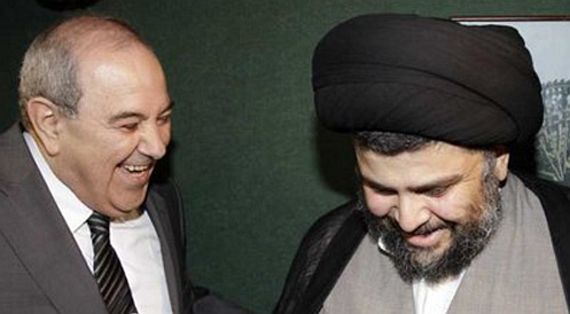
After Moqtada al-Sadr’s recent meeting with Ayad Allawi — a top contender for the prime minister post in Iraq — Babak Dehghanpisheh considers Sadr’s current position as a kingmaker in Iraqi politics and his larger ambitions.

Sadr can, rightfully, claim that his movement is one of the few on the Iraqi political scene that’s homegrown. Compare this to the Sadrists’ top rivals in the Islamic Supreme Council of Iraq (ISCI). For years, they’ve tried to fight the image that they were brought in on American tanks and are beholden to both Washington and Tehran, even changing their name because the Supreme Council for the Islamic Revolution in Iraq sounded too Iranian. They tried appropriating the image of Iraq’s most senior cleric, Ayatollah Ali Sistani, to woo more supporters (there are still posters up around Baghdad showing the late ISCI leaders Ayatollah Mohammad Baqer Hakim and Abdul Aziz Hakim beside Sistani). Nothing worked. ISCI got wiped out at the polls in March and also had a pretty dismal showing during provincial elections last year.

The Sadrists, by contrast, aren’t going anywhere — which puts Washington, among others, in a bind. Sadr’s supporters are more than just a political party. The cleric is clearly following the Hezbollah model, creating a populist political movement backed by a battle-hardened militia. The language Sadr uses when discussing the U.S. presence in Iraq — resistance, occupation, martyrdom — could easily have been taken from a speech by Hezbollah’s leader, Hassan Nasrallah. All this has discouraged U.S. officials from holding talks with Sadr — something they’ve never done since 2003. It’s not exactly like Sadr has gone out of his way to open up a dialogue, either. In fact, Sadr and many of his top aides have made it clear that the Mahdi Army won’t disarm as long as there are American troops on Iraqi soil.
[…]
Sadr’s ambitions don’t cover Iraq’s domestic agenda alone. His high-profile trips to Jordan, Turkey, Lebanon, Saudi Arabia and elsewhere indicate that he wants to be seen as a prominent regional player. He would like to promote his Mahdi Army as a member of the so-called “axis of resistance” made up by Hezbollah and Hamas, both of which have made their names by confronting the United States and Israel.

Facebooktwittermail

The shifting sands of state power in the Middle East

In The Washington Quarterly, Alastair Crooke writes:

In his commendably candid interview with Time in January 2010, President Barack Obama noted that managing politics in the Israeli–Palestinian conflict “is just really hard.” The president, however, might well have been speaking about the Middle East as a whole. It is not just the Israeli-Palestinian track that has been difficult, so too have the Iranian and Syrian tracks, where engagement has not taken traction. Iran, Iraq, Israel, Lebanon, Syria—nothing has been exactly easy for US policymakers this past year. To be fair to the president, he has taken office at a time when the whole region is journeying into a new era. In a sense, the president is facing the consequences of three key events that took place in the region more than 20 years ago.

That the dynamics for change arising from this triumvirate of events should have culminated at the outset of Obama’s term is unfortunate. But the reality is that the strategic balance within the Middle East was already tipping. Change on several planes—at conventional state politics, economics, and within Islam—were already underway. The consequence of this is that the United States’ old allies in the ‘‘southern tier’’—namely Egypt and Saudi Arabia—are likely to wield less influence in the future. The ‘‘northern tier’’—which includes Turkey along with Iran, Qatar, Syria, and possibly Iraq and Lebanon—represents the nascent “axis of influence” for the coming regional era, barring war.

The prospective bitter struggle—already begun—over the future of the region, and over the shaping of Islam closely interconnected to the balance of power, will not see a region that becomes any “easier” for the United States to deal with. The question is whether or not the United States can accommodate some of the unfolding changes. As it remains obsessed with dissections of Israeli politics and bilateral relations, can it even recognize the broader regional changes? Will it adjust to them, or will the United States seek to inoculate itself by clinging to nation-state structures from the 1920s?

Download the complete article in PDF format here.

Facebooktwittermail

Iraq prime minister lashes out at rival

The Los Angeles Times reports:

Iraq’s prime minister dismissed his rival’s call for international help to resolve the country’s postelection political crisis as the dispute threatens to inflame rifts and undermine American plans for withdrawal.

In a televised speech Friday, Prime Minister Nouri Maliki, whose political bloc finished a close second behind former premier Iyad Allawi’s slate in the March 7 elections, alleged that “regional, international” players were attempting a coup d’etat against his government.

“We have accomplished very much in Iraq,” he said from the southern shrine city of Karbala, the symbolic heartland of Iraq’s Shiite Muslims, who were long oppressed under the Sunni-dominated Baath Party government of Saddam Hussein.

“We will not allow any foreign interference in our internal affairs that will breach our sovereignty,” Maliki said.

Meanwhile, earlier this week, the New York Times reported:

The torture of Iraqi detainees at a secret prison in Baghdad was far more systematic and brutal than initially reported, Human Rights Watch reported on Tuesday.

The existence of the prison, which housed mostly Sunni Arab prisoners, has created a political furor in Iraq, prompted government denials and fanned sectarian tensions.

“Abu Ghraib was a picnic” compared with the secret prison, said Sheik Abdullah Humedi Ajeel al-Yawar, one of the most influential Sunni Arab tribal leaders in the northern province of Nineveh, where the detainees were rounded up by Iraqi soldiers based on suspicions that they had links to the insurgency and brought to Baghdad with little due process. Abu Ghraib is the prison at which American guards tortured Iraqi prisoners, severely damaging Iraqis’ trust in the United States.

Human Rights Watch gained access on Monday to about 300 male detainees transferred from the once secret prison at the Old Muthanna military airfield to the Rusafa prison in Baghdad and documented its findings, which it described as “credible and consistent,” in a draft report provided to The New York Times on Tuesday by the rights group.

The group said it had interviewed 42 detainees who displayed fresh scars and wounds. Many said they were raped, sodomized with broomsticks and pistol barrels, or forced to engage in sexual acts with one another and their jailers.

Facebooktwittermail

Post-election massacre in Iraq

The Washington Post reports:

Gunmen pretending to be Iraqi security forces and U.S. soldiers killed at least 24 people here, shooting some and slitting others’ throats as they moved from house to house, officials and residents said Saturday.

The victims of the hour-long incident included women and children, but most were members of the Awakening, Sunni paramilitary forces also known as the Sons of Iraq that battled insurgents at the behest of the U.S. military.

The targeted killings were perhaps the most brutal since the horrific spiral of sectarian assassinations in 2006 and 2007 pulled Iraq into a state of civil war. With American forces no longer patrolling Iraqi cities, the killings also reinforced a sense of abandonment among Arab Sunnis, whose tribes defied insurgents to join forces with the United States despite their distrust of the Shiite-led government.

Meanwhile, AFP reports:

Iraq’s Sadrists concluded an unofficial two-day ballot on Saturday over who should be the country’s leader, after the bloc’s strong showing in last month’s election gave it kingmaker status.

The “referendum”, which has no legal authority, comes as sitting Prime Minister Nuri al-Maliki and ex-premier Iyad Allawi battle to form a government, with neither holding enough seats to claim a parliamentary majority.
“The referendum has concluded and the participation rate was very high,” said Saleh al-Obeidi, the Najaf-based spokesman for the movement.

“The counting process has already started in the provinces, and in the next few days we will release the results.”

Both Maliki and Allawi were on the unofficial ballot, which also included the former’s predecessor Ibrahim al-Jaafari.

Vice President Adel Abdel Mahdi and Jaafar al-Sadr, the son of an ayatollah who founded Maliki’s Islamic Dawa Party and was murdered by Saddam’s regime in 1980, are also candidates, while ballot sheets also included space for voters to write the name of their chosen nominee.

Although the plebiscite was nominally open to all Iraqis, the vast majority of voters are likely to have been Sadrist backers.

Facebooktwittermail

Sadrists hold key to Iraq’s political future

As if to mock America’s role in the future of Iraq, the single point of continuity since the fall of Saddam has been the rising power of Moqtada al Sadr. Even after his movement seemed to have been bludgeoned into submission and he took refuge in Iran, this period of dormancy during which the rough-mannered Shiite leader has focused on elevating his spiritual authority also appears to have served to help him consolidate his political power.

The Guardian reports:

The first in what could be the most crucial series of discussions to form Iraq’s new government took place early last week outside the country’s borders in the Iranian Shia shrine city of Qom.

Sitting cross-legged on the floor was a familiar firebrand in a black turban, Moqtada al-Sadr. Across from him was a delegation from the office of Iraq’s prime minister, Nouri al-Maliki. They had come to seek a detente – and more importantly to find a way, any way, that the exiled cleric, who maintains an overlord’s hold over more than two million Shia Iraqis, would support Maliki being returned to office.

It was a triumphant moment for Sadr, who had been hounded out of town in 2007 by Maliki and the US army and marginalised as a spent force by American officials and most of the prime minister’s inner sanctum. Now, here he was being courted by his persecutors. In the two weeks since the 7 March general election, with the ballots steadily falling Ayad Allawi’s way and power slipping from the grasp of the supremelyconfident incumbent leader, Sadr had been transformed from a pariah into a potential kingmaker.

Juan Cole adds:

Al-Hayat reports in Arabic on the emergence of the Sadr Movement as the largest Shiite party within the Shiite fundamentalist coalition, the Iraqi National Alliance. The Free Independent (al-Ahrar) party that represented the Sadrists won 38 seats out of the 70 that the INA garnered, making the Islamic Supreme Council of Iraq, the Islamic Virtue Party and other Shiite religious components of the list much smaller and less weighty in the coalition’s deliberations.

No sooner, the article says, than the election tallies began coming in did the government of Prime Minister Nuri al-Maliki begin gradually releasing Sadrist prisoners who had been in Iraqi penitentiaries for years. Al-Hayat’s sources say that in Babil Province, orders were received from the government to release members of the Sadr Movement, in an attempt to mollify that group.

Sadrist leader Liqa’ Al-Yasin said that the Sadrists have now become the spinal column of the Iraqi National Alliance. He said that the movement had demonstrated that it had a large public base, and asserted that that base is cultured, aware, and abiding by the principles both of Islamic Law and the Nation. Al-Yasin said that the Sadrists would work for the liberation of Iraq and the realization of national sovereignty. [Translation: they want US troops out of their country tout de suite.] He adds that other goals are to gain the release of prisoners and to take some of the burdens off the shoulders of ordinary citizens. Sadrist leaders said that “the next phase will concentrate on political action to end the Occupation altogether.

Facebooktwittermail

After losing election, Maliki fights to stay in power

The New York Times reports that even if Maliki lost the Iraqi election he shows no interest in stepping down:

Prime Minister Nuri Kamal al-Maliki’s party lost the Iraqi election, but a day after the results were announced it became clear that he would fight to hold on to his post — and had taken steps to do so even before the outcome became public.

On Thursday, a day before the results were announced, he quietly persuaded the Iraqi supreme court to issue a ruling that potentially allows him to choose the new government instead of awarding that right to the winner of the election, the former interim prime minister Ayad Allawi.

On another front, officials in charge of purging the government of former members of Saddam Hussein’s Baath Party said Saturday that they still expected to disqualify more than 50 political candidates, many of them members of Mr. Allawi’s Iraqiya Party. That could strip Mr. Allawi of his plurality, 91 parliamentary seats compared with 89 for Mr. Maliki’s State of Law party.

And if all that does not work, the prime minister still is clamoring for a recount, and he said he planned to file a legal appeal even though the United Nations, the elections commission and international observers have declared the election valid. Ultimately, the same Supreme Federal Court, which is nominally independent but has proved friendly to Mr. Maliki in the past, will decide the recount issue.

McClatchy adds:

At least four Sunni Muslim candidates who appear to have won parliamentary seats on the winning ticket of secular leader Ayad Allawi have become targets of investigation by security forces reporting to the narrowly defeated Iraqi Prime Minister Nouri al Maliki, according to interviews Saturday with relatives, Iraqi security forces and the U.S. military.

All four candidates ran in Diyala province, a restive mainly Sunni area north of Baghdad. One candidate who won more than 28,000 votes is being held incommunicado in a Baghdad jail, two other winners are on the run and the whereabouts of the fourth, a woman, are unknown.

Maliki alluded to the cases in his televised refusal Friday to accept a loss in the March 7 parliamentary elections, saying of unnamed rival candidates: “What would happen if some of them are in prison now on terror accusations and they participated in the elections and might win?”

Maliki’s critics say the Shiite prime minister is using state security forces and the courts to remove political rivals – especially prominent Sunnis – in a last-ditch effort to disqualify candidates from Allawi’s Iraqiya coalition, which holds only a two-seat lead ahead of Maliki’s State of Law bloc.

Facebooktwittermail

Iraq’s election result declared

The New York Times reports:

When the votes were all finally counted, Iraq’s election left almost everything unresolved, from who would finally rule the country to whether American combat troops would be able to leave on schedule by August.

The former interim prime minister, Iyad Allawi, a secular Shiite once derided as an American puppet, galvanized the votes of Sunnis who sat out Iraq’s first national elections and clawed his way back from political obscurity. But his wafer-thin edge of 91 to 89 over his nearest rival, the incumbent prime minister, Nuri Kamal al-Maliki, falls far short of the majority of 163 of the 325 seats in parliament that he needs to form a government.

A jubilant Mr. Allawi said he would work with any group that was willing to join him in forming a government. “We will not exclude anyone,” he said. “Our coalition is open to all.”

But even with the best of intentions, assembling that coalition will take at least until July, possibly even longer, Iraqi political experts said, and Mr. Allawi will have to overcome deep-seated enmity from the other two biggest vote-getting blocs: the Kurds, with 43 seats; and the Iraqi National Alliance, a Shiite party that gained 70 seats and is led in part by the anti-American cleric, Moqtada al-Sadr, who emerged as a possible king maker.

In that case, Mr. Maliki would remain as a caretaker prime minister, and Iraq would enter a protracted period of uncertainty that could prove particularly dangerous as American troops draw down. President Barack Obama has promised that all combat troops will withdraw from Iraq by August, leaving 50,000 trainers and support troops until the end of 2011.

Facebooktwittermail

In early tally, tight Iraq race deepens splits

The New York Times reports:

Iraq’s major coalitions were locked in a surprisingly close race on Thursday, in initial results from elections that deepened divisions across a fractured landscape. Candidates were quick to charge fraud, heightening concerns whether Iraq’s fledgling institutions were strong enough to support a peaceful transfer of power.

The day was the most tumultuous since Sunday’s vote for Parliament, with Prime Minister Nuri Kamal al-Maliki’s office saying he underwent surgery, officials with his chief rival complaining that their ballots were dumped in the garbage, and a leading Shiite coalition claiming that it had challenged the popular mandate that Mr. Maliki needed to return to power.

The turmoil deepened both anticipation and uncertainty over an election to choose a government that will rule Iraq as the United States begins its military withdrawal in earnest next month. “It is a very close race,” said a Western official, who viewed the early results but spoke on condition of anonymity since Iraqi officials were designated to release them. “Whatever the end results, we know it will be a fierce struggle to form a government.”

The initial returns, according to officials who have seen tallies from across the country, suggested a very tight race among Mr. Maliki’s coalition; Ayad Allawi, a secular Shiite and the leader of the Iraqiya coalition; and a Shiite coalition known as the Iraqi National Alliance. The Kurds, though divided, appeared poised to finish strongly as well, they said, leaving Iraq’s political map far more ambiguous than just weeks ago.

Facebooktwittermail

Strong showing for Moqtada al-Sadr

Reuters reports:

Supporters of a fiery anti-U.S. cleric may have staged a comeback in Iraq’s parliamentary election in Baghdad’s Sadr City slum, once a bastion of Shi’ite militants and now a bellwether of Shi’ite political sentiment.

Moqtada al-Sadr, who galvanized Iraqi Shi’ites against the U.S. military after the 2003 invasion but has faded from the political scene since he began religious studies in Iran several years ago, broke a long silence ahead of Sunday’s national vote.

He urged followers to vote in the election, an important step for Iraq as it struggles to solidify its democracy and security ahead of a planned U.S. withdrawal by end 2011.

Early indicators show the strategy may have paid off in Sadr City, home to more than 2 million people, for the Iraqi National Alliance (INA), the large Shi’ite coalition Sadr has joined

Facebooktwittermail

‘We have an American occupation and an Iranian administration’

Anthony Shadid reports from Falluja on the Iraqi elections:

In this town, nicknamed the City of Mosques, the scratchy loudspeakers of muezzins that once preached resistance to the American occupation implored Sunni Arabs to defy bombs and vote Sunday. They did, in a landmark election that demonstrated how far Iraq has come and perhaps how far it has to go.

The droves of Sunni Arab residents casting ballots in towns like Falluja, the name itself an indelible symbol of America’s entanglement here, promised to redraw Iraq’s political landscape. The turnout delivered Sunnis their most articulated voice yet on the national stage, seven years after the American-led invasion ended their dominance.

Yet the very act of their empowerment on Sunday may make that landscape even more combustible. Voters here faced an unprecedented diversity of choices, even within coalitions, that could fragment their representation. Their demands, from securing the presidency for a Sunni to diluting Iran’s influence, could make the already formidable task of forming a coalition government even more difficult.

At polling stations near cratered buildings, past blast walls that still bore the pockmarks of bullets, the sentiments of voters who largely boycotted Iraq’s national elections in 2005 illustrated that divide. Even as many cast ballots for the slate of Ayad Allawi, a secular Shiite and former prime minister, they condemned religious Shiite parties. With the invective once reserved for Americans, voters now attacked Iran, seen here as the patron of Iraq’s Shiite-led government.

“There’s no more war, it’s true, but we’re still not free,” Riyadh Khalaf, 47, a laborer, said as he stood near a polling station in the neighborhood of Andalus, where distant bombings reverberated through the morning. “We have an American occupation and an Iranian administration.”

Facebooktwittermail

Iraqi elections

The New York Times reported:

A concerted wave of attacks struck Baghdad and other cities across the country on Sunday as Iraqis voted to elect a new parliament and possibly a new prime minister. Explosions reverberated across the capital moments before the polls opened and continued through the morning haze for the first hours of voting.

At least 38 people were killed and dozens more wounded in Baghdad alone by the time polls officially closed there, the Interior Ministry reported.

Insurgents in Iraq had vowed to disrupt the election, and the attacks appeared timed to frighten voters away from polling sites. If that were the intent, it did not succeed entirely.

By late morning the attacks — dozens of mortars, rockets and bombs — had tapered off, and Iraqis lined up to vote, many of them expressing anger and determination.

“Everyone went,” Maliq Bedawi, 45, who works at Baghdad International Airport, said as he waved his purple-stained finger. He stood outside the rubble of an apartment building that was struck and destroyed by what the police said was a Katyusha rocket. “They were defiant about what happened. Even people who didn’t want to vote before, they went after this rocket.”

Iraqis, he went on, “are not afraid of bombs anymore.”

The Washington Post reported:

As Obama administration officials tried in recent weeks to anticipate what could go wrong in Sunday’s elections in Iraq, they realized with some relief that they are largely powerless to control what happens.

In twice-daily meetings leading up to the vote and in a final preelection videoconference Thursday with the U.S. ambassador and military commander on the ground, officials contemplated the possibilities. Violence, intimidation or fraud might limit turnout or mar the legitimacy of the vote. Post-election political jockeying could delay the formation of a government for months and leave a dangerous power vacuum. Iran could create mischief, or worse.

But beneath the last-minute activity in Washington, officials have recognized that the electoral contest and its aftermath are in the hands of the Iraqis. Nearly seven years after U.S.-led troops took over Iraq, the administration appears content with its changing role there.

Committed to halving the contingent of nearly 100,000 U.S. troops in Iraq by summer’s end as he escalates a red-hot war in Afghanistan, President Obama has set a high bar for intervening — or even acknowledging serious concern about the future.

Facebooktwittermail

Why Iran’s top spy isn’t meddling in Iraq — for now

Among the many intriguing pieces of information about Qassem Suleimani, the head of Iran’s Quds Force, in this profile by Christopher Dickey, is this: Suleimani along with many other senior figures in the Quds Force actually supported Mir Hossein Mousavi in last summer’s presidential election.

The text message was cryptic and sent through an intermediary, but its spookiness has become legendary among the Americans tasked with trying to stabilize Iraq. The moment was May 2008, and once again all hell was breaking loose. Shiite militias had gone to battle against each other. The fighting threatened to spread to Baghdad. Gen. David Petraeus and Ambassador Ryan Crocker were scrambling to find somebody to broker a truce. Then the text message was passed to the American commander. “General Petraeus,” it began, “you should know that I, Qassem Suleimani, control the policy for Iran with respect to Iraq, Lebanon, Gaza, and Afghanistan.” Within days it was Suleimani who brokered the truce.

What surprised Petraeus and Crocker was not the Iranian’s role. They knew that already. It was the blunt confidence with which Suleimani stated it. As the head of the infamous Quds Force, he commands all the Iranian Revolutionary Guard Corps (IRGC) operations outside Iran’s borders—whether covert, overt, or outright terrorist. In the fractious politicking almost certain to follow Iraq’s parliamentary elections on Sunday, this 53-year-old Iranian general could pull the strings that make or break the new government in Baghdad.

Long before America’s troops occupied Iraq, Suleimani’s forces occupied the shadows. In the buildup to the U.S.-led invasion, he was the go-to guy for much of the Iraqi Kurdish and Shiite opposition to Saddam Hussein. Suleimani’s networks of agents, collaborators, military advisers, client militias, and secret informers give him a degree of power that is difficult to gauge, but it often seems proconsular: “I, Qassem Suleimani,” his text read, like an emperor’s decree. And his real message in 2008 was that he could turn up the heat, or turn it down, at will.

Facebooktwittermail