Category Archives: Israel

Why Iran will push back on the West’s nuclear offer

Why Iran will push back on the West’s nuclear offer

As the world has waited for Iran’s response to the latest nuclear deal offered by the West, conventional wisdom has held that Tehran has been playing for time, testing the limits of international political resolve, and hamstrung by internal political divisions. There’s a measure of truth to all three claims, as official sources in Tehran have begun to indicate that Iran will accept the framework of the deal, but demand important changes. But the root of the problem may be that while the agreement is envisaged as a first step, the two sides don’t share a common destination.

The draft agreement discussed at talks in Vienna last week would have Iran ship 2,645 pounds of its low-enriched uranium (some three quarters of the stockpile enriched at its Natanz facility) to Russia by the end of this year. There it would be enriched to a higher grade and converted into fuel plates in France, after which it would be shipped back to Iran to power the Tehran medical research reactor. Western governments, which fear that Iran has already stockpiled enough enriched uranium to be reprocessed it into a single bomb, like that the deal would remove most of Tehran’s stockpile, and return it in a state difficult for Iran to weaponize. Though there are no signs that Iran is currently working on a turning its uranium into an actual bomb, the West wants the material moved out of Iran in a single shipment, and by the end of this year. That way, they say, it will take Tehran another year to replenish its stockpile to current levels, setting back the supposed “ticking clock” of a potential Iranian bomb, and allowing more time to negotiate an end to Iran’s enrichment program.

Iran, needless to say, sees things very differently. It has no intention of relinquishing its uranium-enrichment program, which it insists is for the peaceful purposes of a civilian energy program and is its right as a signatory to the Non-Proliferation Treaty (NPT). And what it likes most about the Vienna deal is that it can be read as tacit acceptance of Iranian enrichment; the stockpile at the heart of the deal, after all, was enriched in violation of U.N. Security Council resolutions. But Iran doesn’t trust the intentions of some of its interlocutors, particularly France, which has adopted the most hawkish position among the Western powers against any Iranian enrichment. In other words, the very thing that Western powers like about the proposal — that it separates Iran from its uranium stockpile — is precisely what the Iranians fear as a prelude to moves to end all of its enrichment. [continued…]

Iran hints at uranium plan changes

A high-ranking Iranian official said Tuesday that even if the country agreed to a United Nations-sponsored plan to ship its enriched uranium abroad for further processing, it would not ship it all at once, Iranian news media reported.

That position, if maintained, could undermine the entire plan. The French government, a party to the deal, has made it clear that the uranium must be shipped all at once before the end of the year.

Iran has said it will formally respond on Friday to the proposal, which is intended to delay the country’s ability to produce a nuclear weapon for about a year and buy time for a broader diplomatic solution to the nuclear standoff. [continued…]

Weapons of mass distraction

If Iranian negotiators haven’t read Avner Cohen’s book Israel and the Bomb, they should. They’d find out that Oct. 30 is the 41st anniversary of the beginning of the series of negotiations that culminated in American recognition of Israel’s “nuclear ambiguity.” They might learn some useful lessons.

As the worldwide media weighs and critiques Iran’s dilatory response (or lack of satisfactory response) to western pressures over its nuclear program, Israeli diplomats and pundits are reiterating that, no matter what Iran says, it is nonetheless trying to exploit the pretext of a peaceful nuclear program to develop a nuclear weapons program.

After all, Israelis know how the game is played. They wrote the rules.

On Oct. 30, 1968, US Assistant Defense Secretary Paul Warnke began a series of negotiations with then-Israeli Ambassador Yitzchak Rabin, who would become Israel’s fifth Prime Minister in 1974. [Awarded the 1994 Nobel Peace Prize for shaking hands with Yassir Arafat, Rabin was assassinated by a right wing Jewish fanatic at a Jerusalem peace rally a year later.] Although Warnke had not been provided with the CIA’s assessment of Israel’s nuclear weapons program, he nevertheless suspected that Israel had the capability of producing a nuclear bomb and quite possibly had already done so. He proposed a Memorandum of Understanding (MOU) that linked Israel’s signature on the NPT not only to the sale of the Phantom jets Israel wanted from the U.S. but to the transformation of the U.S. into Israel’s main arms supplier, a role that had, until the 1967 “Six Day” war, been filled by France.

As reconstructed and recounted by Avner Cohen in his 1998 book (pp. 307-318), based on once-classified documents, Warnke met with Rabin on Nov. 12, and attempted to clarify the assertion, “Israel will not be the first to introduce nuclear weapons into the area.” Rabin replied that it meant, “We would not be the first to introduce nuclear weapons.” [continued…]

Iranian-American dual loyalty?

The campaign against J Street has contained a fairly amount of anti-Arab and anti-Muslim bigotry, epitomized by former AIPAC staffer Lenny Ben-David’s attack on any J Street donors unfortunate enough to have Arab names. Now comes a new and equally unseemly line of attack, centering on an Iran panel at the recent J Street conference that featured National Iranian American Council (NIAC) president Trita Parsi. Parsi, Michael Goldfarb of the Weekly Standard claims, is “the Iranian regime’s man in Washington.” Jeffrey Goldberg of the Atlantic similarly accuses Parsi of “doing a lot of leg-work for the Iranian regime.”

To begin with, it’s worth noting the inaccuracy of the charge. NIAC was harshly critical of the Iranian government’s crackdown on protesters following the disputed elections in June, issuing a June 20 statement “strongly condemn[ing] the government of Iran’s escalating violence against demonstrators” and calling for new elections. A later statement urged the Obama administration not to neglect human rights issues in the course of its diplomacy with Iran. Anyone who followed the post-election crisis closely — no matter where they came from on the ideological spectrum — soon came to rely on NIAC’s blog as an indispensabe source of news and analysis about the protests. And Parsi (who has in the past written for IPS) became the most prominent proponent of engagement to change his stance in the wake of the elections, calling for a “tactical pause” in U.S. diplomacy while the political situation within Iran developed. [continued…]

Pragmatists in Tehran

Direct U.S.-Iranian negotiations in Geneva and Vienna this month over Iran’s nuclear program demonstrate something very positive about the prospects for U.S. diplomacy with Iran: When given the chance to engage directly with the United States, Iran will take that chance and pursue negotiations in an active and constructive way.

This does not mean that Iran will automatically give the United States what it wants. But it does mean that Iran will approach negotiations with the United States in a rational manner grounded in Iranian national security interests. This should not come as a surprise: It is how Iran has approached previous episodes of engagement with the United States — including two years of extremely constructive official talks between the U.S. and Iran over Afghanistan and al Qaeda, following the 9/11 attacks (talks in which I directly participated).

Now that Tehran has asked for an extension of the deadline for its response to a proposal to ship most of Iran’s low enriched uranium out of the country for fabrication into fuel rods, it is important to remember Tehran’s history of pragmatic cooperation and avoid distorting events or overreacting. [continued…]

House panel approves bill to punish Iran

A House committee, seeking to pressure Iran to abandon its nuclear ambitions, approved a bill Wednesday aimed at punishing Tehran by cutting off its access to gasoline and other refined petroleum products.

The measure, which would give the president powers to take action against foreign companies that sell refined petroleum to Iran, is popular on Capitol Hill, and three-quarters of House members have cosponsored the legislation.

But the measure could undermine Obama administration efforts to negotiate with Iran over its nuclear development program. If talks fail and further sanctions become necessary, administration officials prefer to enact measures supported by many countries, rather than just one. [continued…]


Facebooktwittermail

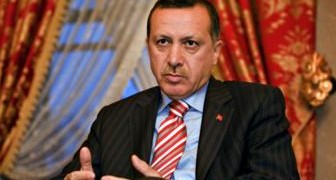
‘Iran is our friend,’ says Turkish PM Recep Tayyip Erdogan

‘Iran is our friend,’ says Turkish PM Recep Tayyip Erdogan

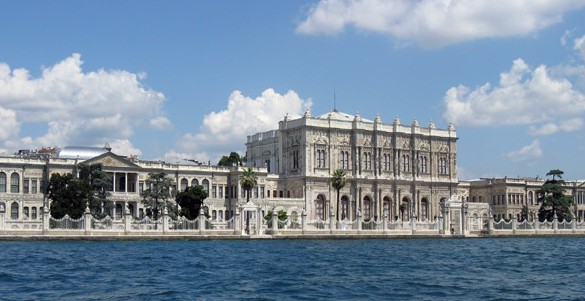
With its stunning vistas and former Ottoman palaces, the banks of the Bosphorus – the strategic waterway that cuts Istanbul in half and divides Europe from Asia – may be the perfect place to distinguish friend from foe and establish where your country’s interests lie.

And sitting in his grandiose headquarters beside the strait, long the symbol of Turkey’s supposed role as bridge between east and west, Recep Tayyip Erdogan had little doubt about who was a friend and who wasn’t.

Mahmoud Ahmadinejad, Iran’s radical president whose fiery rhetoric has made him a bête noire of the west? “There is no doubt he is our friend,” said Erdogan, Turkey’s prime minister for the last six years. “As a friend so far we have very good relations and have had no difficulty at all.”

What about Nicolas Sarkozy, president of France, who has led European opposition to Turkey’s bid to join the EU and, coincidentally, adopted a belligerent tone towards Iran’s nuclear programme? Not a friend?

“Among leaders in Europe there are those who have prejudices against Turkey, like France and Germany. Previously under Mr Chirac, we had excellent relations [with France] and he was very positive towards Turkey. But during the time of Mr Sarkozy, this is not the case. It is an unfair attitude. The European Union is violating its own rules.

“Being in the European Union we would be building bridges between the 1.5bn people of Muslim world to the non-Muslim world. They have to see this. If they ignore it, it brings weakness to the EU.” [continued…]

Editor’s Comment — When President Obama addressed the Turkish parliament on April 6, he said: “Turkey’s greatness lies in your ability to be at the center of things. This is not where East and West divide – this is where they come together.”

Turkey has since been making great strides with its “zero problems with neighbors” policy as Foreign Minister Ahmet Davutuoğlu engages erstwhile adversaries emphasising “a common history, a common fate and a common future.”

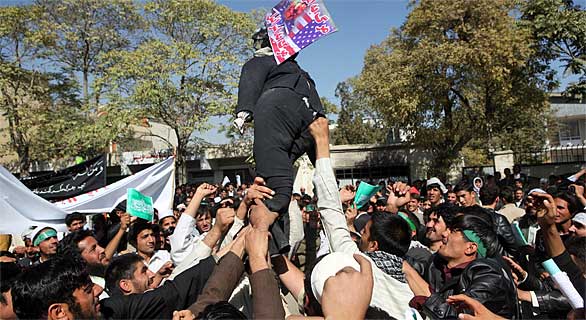
Meanwhile, at the hub of America’s active and violent engagement with the Muslim world, in Kabul, American flags and effigies of Obama are being burned in protest.

The White House should be asking: how come the Turks are having so much more success in practicing what we preach?

In the aftermath of the war on Gaza, Turkey has been uncompromising and principled in its criticisms of Israel. When asked whether he fears that this might risk harming Turkish-US relations, Erdogan dismisses the suggestion, saying: “I don’t think there is any possibility of that. America’s policy in this region is not dictated by Israel.”

Is that wishful thinking, or is it a polite and indirect way of telling Obama that it’s time to stiffen his backbone?

Facebooktwittermail

Where have all Israel’s friends gone?

“Where have all the friendships gone…”

Among all the members of our political, military and media establishments who are now suggesting an “inquiry”, there is no one – literally not one – who means by that a real investigation. The aim is to deceive the Goyim and get them to shut up.

Actually, Israeli law lays down clear guidelines for such investigations. The government decides to set up a commission of investigation. The president of the Supreme Court then appoints the members of the commission. The commission can compel witnesses to testify. Anybody who may be damaged by its conclusions must be warned and given the opportunity to defend themself. Its conclusions are binding.

This law has an interesting history. Sometime in the 50s, David Ben-Gurion demanded the appointment of a “judicial committee of inquiry” to decide who gave the orders for the 1954 “security mishap”, also known as the Lavon Affair. (A false flag operation where an espionage network composed of local Jews was activated to bomb American and British offices in Egypt, in order to cause friction between Egypt and the Western powers. The perpetrators were caught.)

Ben-Gurion’s request was denied, under the pretext that there was no law for such a procedure. Furious, Ben-Gurion resigned from the government and left his party. In one of the stormy party sessions, the Minister of Justice, Yaakov Shimshon Shapira, called Ben-Gurion a “fascist”. But Shapira, an old Russian Jew, regretted his outburst later. He drafted a special law for the appointment of Commissions of Investigation in the future. After lengthy deliberations in the Knesset (in which I took an active part) the law was adopted and has since been applied, notably in the case of the Sabra and Shatila massacre. [continued…]

Jordan’s ties with Israel turn cold

Jordan and Israel mark 15 years of peace today, but ties between both countries are cooler than ever.

Since the right-wing Israeli government of Benjamin Netenyahu took office in May, Jordan has been left further disappointed with its neighbour.

“Our relation is getting colder,” King Abdullah told Israel’s daily Haaretz newspaper this month. “Let’s remember that the peace treaty was signed as part of a process to achieve comprehensive peace. And the full potential of not just Jordanian-Israeli relations, but the whole region, will not be realised unless comprehensive peace is achieved.” [continued…]

Facebooktwittermail

As occupier, Israel must face up to Goldstone report

As occupier, Israel must face up to Goldstone report

Goldstone was born in June 1967. I am not referring to the judge from South Africa, but to his report, or more precisely, the notion that Israel needs a synonym for the soul-searching it must carry out after 42 years of occupation. In the 575 pages of the report that is loaded with details, names, numbers, a list of weapons, interrogation methods and articles of international law, three paragraphs hide among the conclusions on pages 521 and 522, numbered 1674 to 1676. Here lies the explanation for the tragic results of Operation Cast Lead.

In those paragraphs Goldstone uses the term “continuum” to establish that the operation cannot be understood on its own without assessing it as part of a chain of events, which also includes the complete closure of the Gaza Strip for three years, the policy of razing homes, the arrests, the interrogations and torture, not only in the Gaza Strip but also in the West Bank and East Jerusalem. In short, Operation Cast Lead is not an “incident.” It is a link in a chain as old as the occupation itself.

The equation Israel is demanding – between those wounded in the Gaza operation and those wounded in Sderot, between the Qassams and the F-16s, between the mortars and the tank that killed three of Dr. Ezzeldeen Abu al-Aish’s daughters, between Hamas and Israel – betrays a poor understanding of the report’s essence. Goldstone puts the symptom under the microscope and derives the illness. The result is a textbook whose title should have been “A manual for the occupier in the fifth decade.” [continued…]

Whatever Bibi wants, Bibi gets

Barack Obama is a rookie. At least, this is what the Israeli prime minister seems to think. So far, Benjamin Netanyahu has been able to maximize his gains at the expense of the U.S. president and the Palestinians while solidifying his own position in the process.

Consider last month’s trilateral meeting on the sidelines of the U.N. General Assembly. After months of tough and very public statements by top U.S. officials, Netanyahu was able to get the leader of the free world to concede on a settlement freeze and gave nothing in return. For Israeli hawks and their allies in the United States, this was a victory. But it did not come without costs, even leaving aside the effect on Palestinian Authority President Mahmoud Abbas’s domestic popularity. Heads of state around the world paid attention, and surely some of them thought of Obama: This man is a pushover. [continued…]

Jordan to Israel: Temple Mount violence derails peace efforts

Jordan warned Israel Police and religious Jewish radicals on Sunday that further provocation in the compound that houses the al- Aqsa Mosque in Jerusalem would “fuel violence in the region and jeopardize peace efforts”.

Clashes between Israeli police and youths armed with rocks broke out Sunday at the Noble Sanctuary/Temple Mount compound where the mosque is located. The confrontation was apparently sparked by calls by radical Jewish clerics to their followers to go up to the compound, and by calls by radical Muslim clerics for their followers to defend the site. [continued…]

Israel confirms settlers ramping up West Bank construction

The defense establishment confirmed that in recent weeks West Bank settlers have been making a noticeable effort to expedite construction, in an attempt to maximize the “facts on the ground” before the United States and Israel reach an agreement on a settlement freeze.

A senior security source said this week that the defense establishment’s view on the situation was reflected in reports published in Haaretz last Friday, which stated that extensive construction is currently being carried out in at least 11 settlements. [continued…]

Facebooktwittermail

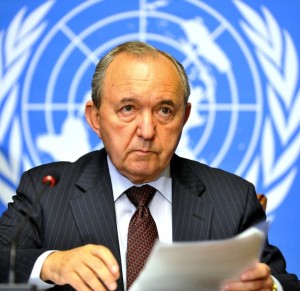
Justice Richard Goldstone interviewed by Bill Moyers

Justice Richard Goldstone – Part One

RICHARD GOLDSTONE: As I say, I accept the right of Israel, absolutely, to defend itself. But let me give you an example. Assuming the United States fighting Taliban, started bombing the whole food infrastructure of the people in the area where Taliban are- plowing up fields, bombing food factories, I don’t believe that this would be accepted as legitimate by the people of the United States.

BILL MOYERS: Do we need to change the rules of war in fighting terrorism?

RICHARD GOLDSTONE: Not at all, and you know, it struck me when I heard that Prime Minister Netanyahu suggested that the law of war needs to be changed. It seems to me to contain an implicit acceptance that they broke the law that now is, and that’s why it needs to be changed. [continued…]

Justice Richard Goldstone – Part Two

Facebooktwittermail

‘Turkey-Israel ties could head for breakup’

‘Turkey-Israel ties could head for breakup’

The crisis in Israeli-Turkish relationship could deteriorate to the point of a breakup, former US ambassador to Israel Martin Indyk said on Wednesday.

In an interview with The Jerusalem Post, Indyk, currently the Brookings Institute’s vice president for foreign policy, said that the “three brakes” that had prevented Turkey under the Islamic-rooted AK party from drifting toward the Arab world and away from Israel were the Turkish military, its business class, and the “peace process.”

Each of these brakes has been loosened over the last two years – the military has been pushed back into the barracks and no longer has influence over government policy as it once did; the business class is feeling considerable heat from the government and is in no position to stand up and say that ties with Israel are economically important; and the peace process – both with Syria and the Palestinians – is nonexistent, he said.

“I think that it is serious because it is like a car with an accelerator and no brake,” said Indyk, who participated this week in President Shimon Peres’s Israeli Presidential Conference in Jerusalem, arriving directly from meetings in Istanbul.

“I think it is a serious deterioration in the relationship, and it could lead to a breakup. It’s not like it hasn’t happened before. Israel lost a relationship with the whole of Africa, and had to rebuild it. It could happen,” he said. [continued…]

Turkey confirms Iran gas deal

Turkey plans to carry out its $3.5 billion natural gas development plans in Iran, Turkish Energy Minister Taner Yildiz said on Wednesday.

“The issue would be discussed during Prime Minister Tayyip Recep Erdogan’s upcoming trip to Tehran,” Reuters reported.

The Turkish and Iranian governments agreed in July 2007 that Turkish Petroleum Corporation (TPAO) would produce 20.4 billion cubic meters (bcm) of natural gas annually from three development phases of Iran’s South Pars gas field, but the deal has been delayed. [continued…]

Facebooktwittermail

Goldstone challenges US over Gaza report

Goldstone challenges US over Gaza report

Judge Richard Goldstone told Al Jazeera on Thursday that he is still waiting for the U.S. to back up its claim that his report on the war in Gaza has a number of flaws.

“The Obama administration joined our recommendation calling for full and good-faith investigations, both in Israel and in Gaza, but said that the report was flawed,” Goldstone told Al Jazeera.

The UN commission chairman said that if Washington points out the flaws, he would be ready to respond. “I have yet to hear from the Obama administration what the flaws in the report that they have identified are. I would be happy to respond to them, if and when I know what they are,” he said.

Israel’s attacks will lead to its isolation

Israel has been dealing one blow after another to the rest of the world. While China has still not recovered from Foreign Minister Avigdor Lieberman’s absence from the reception at its Tel Aviv embassy – a serious punishment for China’s support for the Goldstone report – France is licking its wounds after Prime Minister Benjamin Netanyahu “vetoed” a visit by the French foreign minister to Gaza. And Israel has dealt another blow: Its ambassador in Washington, Michael Oren, will boycott the conference next week of the new Israel lobby J Street.

China, France and J Street will somehow get by despite these boycotts, Turkey will also recover from the great vacationers’ revolt, and we can expect that even the Swedes and Norwegians will recover from Israel’s loud reprimands. But a country that attacks and boycotts everyone who does not exactly agree with its official positions will become isolated, forsaken and detestable: North Korea of today or Albania of yesterday. It’s actually quite strange for Israel to use this weapon, as it is about to turn into the victim of boycotts itself.

Israel strikes and strikes again. It strikes its enemies, and now it strikes out at its friends who dare not fall exactly in line with its official policies. The J Street case is a particularly serious example. This Jewish organization rose in America along with Barack Obama. Its members want a fair and peace-seeking Israel.

That’s their sin, and their punishment is a boycott. [continued…]

‘U.S. to stand by Israel in the fight against Goldstone report’

President Peres on Wednesday harshly condemned the Goldstone report and told the U.S. envoy to the United Nations, Susan Rice that, “It is outrageous that a respected institution like the United Nations provides a platform to spread lies and stories about Israel.”

The Goldstone report accuses Israel Defense Forces and Palestinian militants of war crimes and possible crimes against humanity during their Dec. 27-Jan. 18 conflict in the Gaza Strip.

The report also calls on the UN Security Council to refer the matter to the International Criminal Court at The Hague, which could prosecute Israeli officials for war crimes.

“The United Nations provides a stage for Ahmmadinejad, who threatens to annihilate Israel, and lets him stand judge,” continued Peres. “This is nothing short of ridiculous.”

Rice promised that the United States will continue to stand by Israel as a loyal friend in the fight against the Goldstone report. [continued…]

U.S., EU pile on pressure for Israel to create own panel on Gaza op

The United States and a number of important EU countries are pressing Israel to establish an independent commission of inquiry into the findings of the Goldstone report on last winter’s Gaza offensive.

British Prime Minister Gordon Brown and French President Nicholas Sarkozy, for example, have written a letter on the subject to Prime Minister Benjamin Netanyahu, and messages have been sent through diplomatic channels, in phone calls and in Netanyahu’s meetings with senior American and European officials, said a senior official in Jerusalem.

Netanyahu has yet to take a stance in debates in the cabinet and security cabinet on the issue, let alone decide on the matter. No decision is expected in the next few days, according to a source in the Prime Minister’s Bureau.

The main supporters of establishing a commission are Deputy Prime Minister Dan Meridor and Attorney General Menachem Mazuz, while the main opponents are Defense Minister Ehud Barak and Deputy Prime Minister Eli Yishai. [continued…]

Hamas: investigate attacks on Israeli civilians

Hamas authorities in the Gaza Strip should promptly implement the recommendations of the Goldstone report on Gaza by conducting credible investigations into serious laws-of-war violations by Palestinian forces, Human Rights Watch said in a letter sent October 20, 2009, to Prime Minister Ismail Haniya.

The United Nations Fact-Finding Mission on the Gaza Conflict, led by Justice Richard Goldstone, called on Hamas and Israel to investigate within six months alleged violations of the laws of war by their respective forces. The report said that Palestinian rocket attacks against Israeli population centers should be investigated as war crimes. The UN Human Rights Council voted on October 16 to endorse the recommendations of the Gaza report. [continued…]

Why we report on ‘open’ societies

Responding to Robert Bernstein’s NYT op-ed

Human Rights Watch was saddened to read in The New York Times on October 20, 2009 that its founding chair, Robert L. Bernstein, feels he must “join the critics” of our work on Israel. We fundamentally disagree with Mr. Bernstein’s views.

Human Rights Watch does not believe that the human rights records of “closed” societies are the only ones deserving scrutiny. If that were the case, we would not work on US abuses in Guantanamo Bay, police abuse in Brazil, the “untouchables” in India, or migrants in South Africa. “Open” societies and democracies commit human rights abuses, too, and Human Rights Watch has an important role to play in documenting those abuses and pressing for their end.

Human Rights Watch does not devote more time and energy to Israel than to other countries in the region, or in the world. We’ve produced more than 1,700 reports, letters, news releases, and other commentaries on the Middle East and North Africa since January 2000, and the vast majority of these were about countries other than Israel. Furthermore, our Middle East division is only one of 16 research programs at Human Rights Watch. The work on Israel is a tiny fraction of Human Rights Watch’s work as a whole.

It is not the case that Human Rights Watch had “no access to the battlefield” after the Israeli operation in Gaza in January 2009. Although the Israeli government denied us access, our researchers entered Gaza via the border with Egypt and conducted extensive interviews with victims, eyewitnesses, United Nations officials, local authorities, and others. As in war zones around the world, we also visited attack sites, analyzed ballistics evidence, photographed wounds, and examined autopsy and other medical reports.

Mr. Bernstein brought his concerns about our work on Israel to a full meeting of the Human Rights Watch Board of Directors in April. The board unanimously rejected his view that Human Rights Watch should report only on closed societies, and expressed its full support for the organization’s work.

Human Rights Watch stands fully behind the work we have done on Israel and around the world. [continued…]

Facebooktwittermail

Israel wants law of war changed after damning UN Gaza report

Israel wants law of war changed after damning UN Gaza report

Israel’s Prime Minister Benjamin Netanyahu instructed his government on Tuesday to draw up proposals to amend the international laws of war after a damning UN report on its war in Gaza.

The security cabinet did not, however, discuss calls made by ministers for an internal investigation into the 22-day offensive at the turn of the year that killed some 1,400 Palestinians and 13 Israelis, an official told AFP.

“The prime minister instructed the relevant government bodies to examine a worldwide campaign to amend the international laws of war to adapt them to the spread of global terrorism,” his office said in a statement.

Israel was dealt a heavy diplomatic blow with the adoption by the UN Human Rights Council of the report that accused both Israel and the Hamas rulers of the Gaza Strip of war crimes.

Israel’s closest allies, the United States, Britain and France urged it to investigate war crime allegations raised by the fact-finding missions headed by Richard Goldstone, a former international war crimes prosecutor.

Defence Minister Ehud Barak backed Netanyahu’s call for a diplomatic campaign, saying that Israel should propose changes in the international laws of war “in order to facilitate the war on terrorism,” an official quoted him as saying. [continued…]

Facebooktwittermail

Iran ramps up pressure on Pakistan over Guards bombing

Iran ramps up pressure on Pakistan over Guards bombing

Iran turned up the heat on Pakistan on Tuesday, saying the group accused of carrying out a suicide bombing that killed top commanders of the elite Revolutionary Guards is based on its territory.

Islamabad strongly denied the allegations, saying the attack was an attempt to “spoil ties” with Iran.

Foreign Minister Manouchehr Mottaki said members of the group accused of mounting Sunday’s attack in southeastern Sistan-Baluchestan province regularly criss-cross the frontier with Pakistan. [continued…]

Iran’s nuclear talks also hit

According to a Tehran University political science author who wishes to remain anonymous, the Pishin attackers had multiple objectives. “First, they wanted to prevent a crucial unity meeting between Shi’ites and Sunnis in Sistan-Balochistan. Second, they wanted to exacerbate tension between the central government and the Balochi minority. Third, they wanted to cause new tensions between Iran and Pakistan, whose government is backed by the US and Saudi Arabia. Fourth, they timed their attacks with the critical nuclear meeting in Vienna to thwart any agreement on Iran’s proposal for nuclear fuel for the reactor in Tehran.”

There is a widespread belief in Tehran that the Pishin attack, especially as it claimed the lives of five IRGC commanders, could not possibly have taken place without the knowledge, and perhaps complicity, of Western and/or Israeli intelligence.

This sentiment is apparently shared by Russia, in light of the quick response by Russian President Dmitry Medvedev, who sent his condolences together with a firm message that Russia was prepared to cooperate with Iran against terrorism. This was in sharp contrast to the silence of US President Barack Obama.

“Iran is now baited into security tensions with nuclear-armed Pakistan and that simply strengthens the hands of the hardliners in Iran who believe that Iran needs a nuclear shield,” the same Tehran professor told the author. [continued…]

Jundallah versus the mullahtariat

Approximately 2,000 strong, Jundallah claims to represent the Sunni Balochi struggle against the centralizing power of Tehran. Nonsense: pan-Balochi aspirations actually are better represented by other Balochi nationalist groups, such as the Balochistan Liberation Army (BLA) in Pakistan. Jundallah for its part does not threaten Islamabad; it is an ultra-sectarian, anti-Shi’ite outfit immersed in the intolerant Deobandi interpretation of Islam.

Jundallah has its headquarters in Karachi and bases in both Balochistans. It does have a firm connection to the South Waziristan tribal areas; it has been connected to the hardcore Sunni and viscerally anti-Shi’ite Lashkar-e-Jhangvi; and is definitely tactically connected to al-Qaeda, “talking” if not to the historic leadership ensconced, in theory, in South Waziristan, at least to the “new generation” al-Qaeda.

It was Jundallah that, last December, perpetrated the first suicide bombing ever in Iran, after spending a few years basically practicing sabotage, kidnapping officials and killing border guards. In May, only three weeks before the Iranian presidential election, Jundallah raised the stakes with an attack on the top mosque in Zahedan, the largest city in the southern part of Sistan-Balochistan.

Islamabad – as always when it comes to anything regarding Balochistan – is perplexed. It never knew how to deal with Balochi separatist movements in the first place – apart from iron-clad repression. But as far as Jundallah is concerned, Islamabad did try, it handed over Rigi’s brother, Abdul Hamid, to Tehran, branding Jundallah as a “terrorist organization”, and always protesting its innocence of the outfit’s designs. [continued…]

Facebooktwittermail

Israeli cabinet to appoint team to fight Goldstone report

Israeli cabinet to appoint team to fight Goldstone report

Defense Minister Ehud Barak on Tuesday prevented a debate by the Security Cabinet on the possible establishment of an inquiry committee on Operation Cast Lead in Gaza.

Barak said he believed such a committee would do more damage to Israel in the international arena, and commended the IDF once again for its conduct in the operation.

However the Cabinet did decide to establish a team to fight the Goldstone report, which claims Israel committed war crimes during Cast Lead, including its international and legal manifestations.

The team will be under the Foreign Ministry’s jurisdiction, and will involve officials from other ministries if need be. Its main goal is to prepare for a possible debate on the report by the UN Security Council in December. [continued…]

Goldstone to U.S. rabbis: Lieberman doesn’t want Mideast peace talks

The author of a damning report on Israel’s winter offensive against Hamas in Gaza, Richard Goldstone, has said that Foreign Minster Avigdor Lieberman does not want there to be an Israeli-Palestinian peace process.

Goldstone, a South African Jurist, made the claim in a conference call on Sunday with 150 U.S. rabbis from left-leaning organizations. He was speaking in reference to an Israeli assertion that the report would harm peace talks.

“That just is a shallow, I believe, false allegation,” he said. “What peace process are they talking about? There isn’t one. The Israeli foreign minister doesn’t want one at all.” [continued…]

Facebooktwittermail

Israel ranks 93rd in Press Freedom Index 2009

Israel ranks 93rd in Press Freedom Index 2009

Operation Cast Lead, Israel’s military offensive against the Gaza Strip, had an impact on the press. As regards its internal situation, Israel sank 47 places in the index to 93rd position. This nose-dive means it has lost its place at the head of the Middle Eastern countries, falling behind Kuwait (60th), United Arab Emirates (86th) and Lebanon (61st).

Israel has begun to use the same methods internally as it does outside its own territory. Reporters Without Borders registered five arrests of journalists, some of them completely illegal, and three cases of imprisonment. The military censorship applied to all the media is also posing a threat to journalists.

As regards its extraterritorial actions, Israel was ranked 150th. The toll of the war was very heavy. Around 20 journalists in the Gaza Strip were injured by the Israeli military forces and three were killed while covering the offensive. [continued…]

Facebooktwittermail

Eavesdropping sparks fresh border tension between Lebanon and Israel

Eavesdropping sparks fresh border tension

Hizbollah’s discovery of at least three eavesdropping devices planted in southern Lebanon by the Israeli military last weekend has inflamed an already tense border situation as the Lebanese armed forces fired anti-aircraft weapons at unmanned Israeli drones sent to survey the situation.

The situation began in the border village of Houla, a Hizbollah stronghold, on Sunday night, when, according to a statement by Hizbollah’s military wing, the Islamic Resistance discovered devices planted underground by Israel to spy on the group’s internal communications. One of those devices exploded on Sunday night.

“The Islamic Resistance has discovered a spying device installed by the Israeli enemy on a cable between the villages of Mays and Jebel after the 2006 war,” the Lebanese militant faction said in a statement. [continued…]

Facebooktwittermail

Jordan king warns over US Mideast policy

Jordan king warns over US Mideast policy

Jordan’s king said in comments published Monday that the U.S. administration seems to be focusing more of its attention on Iran and less on resolving the Israeli-Palestinian conflict, saying time was running out to make peace.

In an interview with Italian daily La Repubblica, King Abdullah II said the region’s hopes for peace were huge at the start of the Obama administration, but now sees the “goal getting farther away.”

“I’ve heard people in Washington talking about Iran, again Iran, always Iran,” Abdullah was quoted as saying. “But I insist on, and keep insisting on the Palestinian question: the Israeli-Palestinian conflict is the most serious threat to the stability of the region and the Mediterranean.” [continued…]

Editor’s Comment — Having just won the Nobel Peace Prize for advancing global diplomacy, President Obama should reflect some more on how engagement really works. The United States will talk to its adversaries, Obama boldly declared before getting elected. So far so good.

But engagement is sure to lead to a dead end unless it functions effectively as a two-way street. Washington has shown its readiness to talk, but is it ready to listen? Engagement can be as boneheaded as non-engagement if it doesn’t involve listening.

Abdullah, Erdogan and others are telling the US that this administration’s approach to the Middle East is failing. Is the administration listening?

Stop Palestinian suffering for Mideast peace, says Erdoğan

Peace cannot be established in the Middle East when the suffering of the Palestinians continues and the Gaza Strip remains a wreck, Turkish Prime Minister Recep Tayyip Erdoğan said Monday.

Speaking at the Istanbul Forum organized by Stratim, Seta and the German Marshall Fund, Erdoğan said the Palestinian question is at the center of all problems in the Middle East. The prime minister recalled that Turkey vocalized its disapproval of the previous year’s bombing of the Gaza Strip, adding: “We criticized steps that were serving no purpose, but which increased suffering and sabotaged the peace process. We will continue to criticize it today, too. We will criticize anything similar taking place in other areas.” [continued…]

Turkish president: ‘Brave criticism’ of Israel to continue

Turkey will continue to criticize its ally Israel with “courage” if it engages in “mistakes”, Turkish President Abdullah Gül said Sunday, continuing the verbal sparring between the two countries over the situation in Gaza.

Turkey is one of the “rare” countries to have good relations with both Arab countries and Israel, Gul said during an interview with public teleivision TRT.

“But this does not mean that Turkey will not raise its voice against errors if they are made. We should not think that Turkey will keep silent,” he said. [continued…]

How do Turkey and Israel measure each other’s love?

…in Israel’s eyes, Turkey is seen as two states – one in the form of the military, twin sister of Israel, the other political, leaning toward Islam and making friends with Syria and Iran. Thus, insolent Israel decided in a typical manner not to take Turkey’s politicians seriously and to adopt the Turkish army. Israel was also certain all these years that Turkey, backward and poor, needed its sole friend in the Middle East because it was not accepted in the region due to its Ottoman history and close ties with Israel and the United States, and therefore could not do without Israel.

So in Israel, people have been quick to conclude that “something went wrong” in Turkey. Suddenly the government rules the army instead of the army, Israel’s loyal friend, telling the government what to do. Israelis did not think for a minute that the Turkish army might also have had enough.

Turkey has changed; inwardly, for the most part. In a long and difficult process it has become a more democratic country. The army is still dominant, but less public in its role in the civilian domain. Turkey has overcome most of its economic problems and has been transformed into a regional economic power. It is a real strategic asset for the United States, increasing its importance after the Iraq war. It has also developed a different regional strategy.

Whoever reads what Foreign Minister Ahmet Davutoglu says recognizes that Turkey aspires to become an influential player not only in the Middle East but also in the Caucasus and Asia. It is involved in the fighting in Afghanistan, is forming an economic alliance with Iraq, plans to invest billions of dollars in Egypt, and its annual trade with Iran stands at $9 billion, with Syria at $1.5 billion.

And here is the paradox. This is the only Muslim country that is not harshly criticized, whether by Iran or any Arab state, for having such close ties with Israel. As such, it could have served as an excellent mediator between Israel and the Arab countries had Israel not considered it an obvious satellite state. [continued…]

Facebooktwittermail

Goldstone: My mission – and motivation

Goldstone: My mission – and motivation

Israel and its courts have always recognized that they are bound by norms of international law that it has formally ratified or that have become binding as customary international law upon all nations. The fact that the United Nations and too many members of the international community have unfairly singled out Israel for condemnation and failed to investigate horrible human rights violations in other countries cannot make Israel immune from the very standards it has accepted as binding upon it.

Israel has a strong history of investigating allegations made against its own officials reaching to the highest levels of government: the inquiries into the Yom Kippur War, Sabra and Shatila, Bus 300 and the Second Lebanon War.

Israel has an internationally renowned and respected judiciary that should be envy of many other countries in the region. It has the means and ability to investigate itself. Has it the will? [continued…]

Editor’s Comment — The Netanyahu government’s stonewalling of the Goldstone inquiry does not appear to have purely been an act of self-protection; it also seems to reflect a national spirit of impunity rooted in the conviction: “We had no choice.”

Having turned this declaration into a battle cry, violence was cleansed of doubt as Israel embarked on its own jihad. “We went into Gaza and God went into Gaza with us,” was how one Israeli Special Forces soldier put it.

When the enemy’s homes have been flattened, their bodies incinerated, their land defiled and their water poisoned and all of this is being done under God’s watchful eye and under His protection, the killers return to their homes expecting glorification, not to become the targets of an international inquiry.

Facebooktwittermail

At NYU, devilish Shlomo Sand predicts the Jewish past and pastes the Zionists

At NYU, devilish Shlomo Sand predicts the Jewish past and pastes the Zionists

When Sand said that Israel was not a democracy, and a Zionist called out, “It is a flawed democracy,” Sand bellowed. No: a democracy is founded on the idea that the people are the sovereign, that the people own the state. That is the first principle of a republic going back to Rousseau. Liberalism and civil rights are not the core [of Israel]. Yes, Israel is a liberal society. It tolerates Shlomo Sand’s heresy, for instance, and puts him on TV. But it is a liberal ethnocracy.

Down the row from me were two Arabs. I recognized the man from other events I have been to. I noticed how fulfilled they were by the talk, how quietly approving, and it was in this connection that we saw Sand’s passion: on behalf of the Palestinians. This part of the lecture brought tears to my eyes, it was so forceful and unapologetic. The idea that Joe Lieberman has a right to move to Israel tomorrow and a Palestinian whose ancestors have lived there for centuries cannot is an outrage, Sand said. But for 50 years the Palestinian Israelis were afraid to speak out.

“They were afraid because of the Nakba. They were afraid because of the military regime. Today this is a generation of young Palestinian Israelis that stop to be afraid. They become more anti-Israel in their politics the more they become Israelis.” [continued…]

The Invention of the Jewish People is now available from Amazon.

Facebooktwittermail

Gaza costs Israel another friend: there aren’t many left

Gaza costs Israel another friend: there aren’t many left

For years Israel has acted as if the unconditional support of the US would be enough to shield it for ever from the consequences of its behaviour – which is why last week was an unusually traumatic one for them.

No suicide bombers detonated themselves and no rockets or mortar shells fell, but the double whammy of a Turkish snub and a UN Human Rights Council vote shook Israelis even more than any aimless shelling would have done. Those two events signal profound changes that leave Israel paying a growing political price for the attack last winter that killed some 1,400 Palestinians and reduced Gaza to rubble.

It was the brutal pummelling of Gaza that prompted Turkey’s democratically elected government to break the silence among the region’s moderates and stand up for the Palestinians. At the time, the prime minister, Recep Erdogan, condemned the Israeli actions as war crimes, in language deemed intemperate and inappropriate by western leaders.

Curiously, Erdogan’s “intemperate” language was endorsed by the findings of a UN Human Rights Council investigation headed by the Jewish South African judge Richard Goldstone, known as a friend of Israel – findings that were adopted by the Council on Friday despite the efforts of the US and France to shield Israel from being formally accused of war crimes in an international body. [continued…]

Facebooktwittermail

Israel: A fugitive state

Israel: A fugitive state

Do the innocent refuse to be questioned?

The Netanyahu government’s campaign to obstruct both the Goldstone inquiry and the report that it produced has been waged in the name of protecting Israel’s right of self-defense.

But Israel’s defenses are actually far weaker than the Goldstone critics care to admit: Israel is so vulnerable that it cannot withstand critical scrutiny or self-examination.

Gone are the days when an Israeli defense minister could be found by Israelis to “bear personal responsibility” for the massacre of hundreds of Palestinian civilians, as the Kahan Commission found Ariel Sharon after investigating his role in the Sabra and Shatila Massacre.

Now, Israel cannot even take the risk of conducting an independent investigation into alleged war crimes, let alone deal with the unpredictable outcome of such an investigation.

Instead, the defense of Israel now requires that all those who remain loyal to its interests and concerned about its preservation, maintain solidarity in a single mission: do everything possible to silence the Jewish state’s critics.

The underlying assumption seems to be that Israel will remain eternally an object of enmity; that the best it can hope for is that its enemies remain weak.

This is not merely the condition of a national identity; it percolates through to the outlook of individuals — an outlook that is inevitably misanthropic. It is to assume an existential orientation which regards the bulk of humanity as a harbor of ill-will.

For Israelis and many of their supporters, this situation ought to provoke a profound inquiry into the nature of antisemitism.

From where in the world does this ancient bigotry now draw most of its life?

In a pandemic of anti-Israel hostility?

Or might it find its most vital form of traction much closer to home, inside those very minds that perceive the rest of the world as other?

Are the Goldstone critics trying to defend Israel, or are they trying to sustain the image of an embattled state too fragile to survive the corrosive impact of investigation?

Mahmoud Ahmadinejad’s thesis is that Israel, like the Soviet Union, is destined to self-destruction. Michael Oren, Israel’s ambassador to the United States, seems susceptible to a similar fear.

Earlier this year, Oren wrote:

The breakdown of public morality, in my view, poses the greatest single existential threat to Israel. It is this threat that undermines Israel’s ability to cope with other threats; that saps the willingness of Israelis to fight, to govern themselves, and even to continue living within a sovereign Jewish state. It emboldens Israel’s enemies and sullies Israel’s international reputation. The fact that Israel is a world leader in drug and human trafficking, in money laundering, and in illicit weapons sales is not only unconscionable for a Jewish state, it also substantively reduces that state’s ability to survive.

Oren’s view has apparently subsequently shifted and he now seems to regard the results of the UN investigation as posing a greater threat to Israel than any other: “The Goldstone Report goes further than Ahmadinejad and the Holocaust deniers by stripping the Jews not only of the ability and the need but of the right to defend themselves.”

The ambassador might pause to consider this: A breakdown in public morality and an unwillingness to investigate alleged war crimes may in fact be intimately connected.

Facebooktwittermail

US: Security Council might not debate Goldstone Report

US: Security Council might not debate Goldstone Report

The endorsement of the Goldstone Report by the UN Human Rights Council (UNHRC) does not necessarily mean that it will be reviewed by the Security Council, US State Department spokesman Ian Kelly said Friday.

Earlier, the UNHRC voted to refer the report to the Security Council, possibly setting up international prosecution of Israelis and Palestinians accused of war crimes.

The report accused both Israel and the Palestinian terror group Hamas of committing war crimes in Gaza in their December-January conflict.

Kelly told reporters in Washington that the resolution had “an unbalanced focus and we’re concerned that it will exacerbate polarization and divisiveness.” [continued…]

Israel vents fury at ally Turkey over ‘barbaric’ TV drama

Israel’s increasingly troubled relations with its main ally in the Muslim world took a turn yesterday when it formally protested to Turkey over the “incitement” generated by a television series featuring fictional scenes of barbaric acts by Israeli soldiers.

The airing of the series, on Turkish
state television, coincides with tensions triggered by a decision last week by Ankara to exclude Israel – which it has severely criticised over last winter’s war in Gaza – from a planned Nato air exercise.

The acting Turkish ambassador, Ceylan Ozen, was summoned yesterday to the Israeli foreign ministry in protest at the drama series Ayrilik which shows soldiers brutalising Palestinians. In one abbreviated sequence shown on YouTube, a soldier is seen gratuitously shooting a girl at close range, killing her. In another, Palestinians are apparently about to be executed by a firing squad. [continued…]

An ordinary Israel

Is Israel just a nation among nations?

On one level, it is indeed an ordinary place. People curse the traffic, follow their stocks, Blackberry, go to the beach and pay their mortgages. Stroll around in the prosperous North Tel Aviv suburbs and you find yourself California dreaming.

On another, it’s not. More than 60 years after the creation of the modern state, Israel has no established borders, no constitution, no peace. Born from exceptional horror, the Holocaust, it has found normality elusive. [continued…]

Despite promises to Obama, construction continues in dozens of W. Bank settlements

Human rights activists monitoring the West Bank report that despite commitments Israel made to President Barack Obama’s administration last month, widespread building activity commenced three weeks ago in at least 12 settlements.

The work consists of ground preparation, pouring concrete and drilling construction foundations.

This work is not part of the projects that Israel and the United States had reached an understanding on. Prime Minister Benjamin Netanyahu and Defense Minister Ehud Barak had agreed with the administration to complete some 2,500 housing units that were already in various stages of construction at the time. The dozen sites do not appear on the list of 492 new housing units that the defense ministry issued after Barak approved their construction. Work on these units began after the list was released. [continued…]

ZOA praises Obama administration on Goldstone

The Zionist Organization of America is praising the Obama administration for “taking a principled stance” against the Goldstone Report.

The ZOA points to the remarks made at the UN Human Rights Council by U.S. Assistant Secretary of State for Democracy, Human Rights and Labor Michael Posner, in which he said that “we believe that the document is deeply flawed and disagree sharply with its methodology and many of its recommendations, including their extraordinarily broad scope.” [continued…]

Facebooktwittermail