Category Archives: Israel

Israel is becoming a diplomatically crippled nation

Disengaging from Israel

The historic reconciliation agreement signed Saturday between Turkey and Armenia constitutes further testament to the positive changes undergone by Turkey in recent year. A government with an Islamic orientation was able to impressively promote two highly sensitive issues for Turkish public opinion: Recognizing the cultural rights of the Kurdish minority and normalizing ties with Armenia.

The strong sense of Turkish nationalism previously prevented any compromise with the Kurds, for fear this will open the door for boosting their national demands and in turn for a renewed territorial disintegration by Turkey.

Tayyip Erdogan’s administration realized that it is precisely openness towards the Kurdish minority that will prompt a greater sense of belonging among them and weaken their aspiration to join other Kurdish areas, mostly in Iraq.

Erdogan faced a similar choice vis-à-vis Armenia: Perpetuating the frozen status-quo in the ties with Turkey’s neighbor would have boosted the global Armenian campaign for recognition of the massacre committed by the Turks as an organized and methodical genocide. Turkey would have been faced with all the possible implications of such recognition, especially if it would have also been backed by the US Congress.

Erdogan decided to preempt this blow, and while taking advantage of the weak Armenian economy (which suffered gravely as result of the closure of its borders with Turkey and Azerbaijan) managed to secure (with Swiss mediation) a reconciliation agreement that is difficult for both for the Turks and for the Armenians – yet postpones to an unknown future date the question of addressing the Armenian holocaust and entrusts future research on its scope in the hands of historians. [continued…]

Editor’s Comment — The writer notes “the fact that precisely at a time when Turkey reaches out to its past enemies, the Turkish administration is adopting an increasingly hostile policy vis-à-vis its former great ally – Israel” and he cites this as a justification for Turkey’s entry into the European Union being blocked.

It’s interesting that an Israeli should be advising the EU who it should or should not be willing to consider as a future member. Of course Israelis who are concerned about keeping Turkey out of the EU merely need to do their bit in helping foment anti-Muslim bigotry across Europe to ensure that the Turks won’t get a fair hearing.

While Eldad Beck clearly admires Erdogan’s diplomatic successes, he falls back on an old cliche in assuming that the Turkish leader is merely taking advantage of popular hostility towards Israel in order to advance his political goals. The assumption, as always, is that such hostility would either not exist or be of minor proportions were it not being fomented. Israel remains the perpetual victim of a bad press.

The real lesson that Israelis should be drawing from observing Turkey is to note how stark the difference is between a diplomatically and democratically empowered nation as it pursues a policy of regional engagement, versus the inevitable isolation that Israel now faces as a diplomatically crippled nation.

It turns out that having just one friend isn’t enough.

Israel’s growing isolation

… we have to recognize the fact that should the trend of isolation continue, we shall have to pay a heavy price – first and foremost on the economic front.

More than ever before, Israel’s growth and employment situation hinge on exporting goods to the global market. In case of isolation, we will find it difficult to engage in international trade, attract foreign investments, and acquire the credit we need.

The isolation will also undermine us strategically, as it would encourage Hezbollah, Hamas, Syria and Iran to provoke us. This is based on the assumption that the Israeli government will shy away from ordering the IDF to operate against them in full force, for fear of another Goldstone Report and possibly even UN Security Council sanctions.

Moreover, the isolation also serves to increase Israel’s depends on the American Administration to a dangerous degree; this dependence is too heavy as it is. [continued…]


(Part One and Part Two)

Facebooktwittermail

Allies push Israel for Gaza probe

Allies push Israel for Gaza probe

Israel has come under pressure from its allies to investigate UN allegations of possible war crimes by its army during its Gaza offensive last winter.

Britain’s UN envoy urged Israel to hold “full, credible and impartial” investigations, echoing similar calls from his US and French counterparts. [continued…]

U.N. rights body considers condemning Israel on Gaza

Israeli and Palestinian leaders should launch investigations of alleged war crimes in Gaza to help rebuild trust and support peace, the U.N. High Commissioner for Human Rights said on Thursday.

At the opening of a U.N. Human Rights Council meeting on the issue, Navi Pillay said that all sides of the Middle East conflict were continuing to violate international law and voiced concern that transgressors are being left unpunished.

“A culture of impunity continues to prevail in the occupied territories and in Israel,” she told the 47-member body, calling for “impartial, independent, prompt and effective investigations into reported violations of human rights and humanitarian law.” [continued…]

In Gaza, actress Mia Farrow voices ‘outrage’ over blockade

Mia Farrow said Thursday she was outraged by conditions for children in the Gaza Strip after a blockade that has stretched for more than two years and a large-scale Israeli offensive against Hamas last winter.

The 64-year-old American actress also criticized Gaza militants’ rocket attacks on southern Israel, saying stopping them could lead to more international aid for the impoverished coastal strip. [continued…]

Facebooktwittermail

Why Palestinians have lost faith in Obama

Why Palestinians have lost faith in Obama

For a man who is sometimes seen as the Palestinian politician that the Israelis and the Americans like best, Prime Minister Salaam Fayyad was in a strikingly robust mood during a two-hour press conference in Ramallah yesterday. While too polite to criticise the Obama administration, he nevertheless had a clear message in the wake of the failure by the US to persuade the Israeli government of Benjamin Netanyahu to grant a freeze on Jewish settlement construction in the West Bank as a precursor to serious negotiations.

He suggested that the Palestinian leadership no longer had much interest in a “process for the sake of a process” and he questioned what Mr Netanyahu’s “equivocal” endorsement of a Palestinian state really meant.

Mr Fayyad had been much struck by a report from the Jerusalem Centre for Public Affairs, arguing that the 60 per cent of the West Bank controlled by Israel and designated as Area C under the Oslo accords, including the Jordan Valley, should not be handed over in any peace deal. If the Israeli establishment was envisaging a “Mickey Mouse state” along these lines, he said, then “it looks like it would not come close to what we have in mind.” [continued…]

Yishai: Deporting foreign children preserves Israel’s Jewish identity

Interior Minister and Shas Party chairman Eli Yishai plans “to muster all of Shas’ political power on the issue of the foreign workers,” he told Haaretz on Tuesday.

During a conversation with Prime Minister Benjamin Netanyahu on Monday, Yishai warned that if the cabinet rejects his demand that children of foreign workers not be given residency or citizenship in Israel, he will abdicate responsibility for the Immigration Authority, which is currently in his ministry’s purview, to the Prime Minister’s Office, and foment a coalition crisis to boot. [continued…]

Facebooktwittermail

Experts say Iran may be ready for a nuclear deal

Experts say Iran may be ready for a nuclear deal

In contentious, high-stakes negotiations, deals are possible when both sides have a chance to declare victory, and that point may have been reached.

“If the Iranian endgame is to keep enrichment, and if the United States’ endgame is to make sure there are no nuclear weapons in Iran, then it can be a win-win,” said Trita Parsi, author of a book on Iran and president of the National Iranian American Council, an independent advocacy group in Washington. “Those who have been criticizing the administration for compromising or giving Iran a concession, they are wrong. It is not a concession to adjust to an unchanging reality.”

For Iran, this is not exactly about compromising — which it has shown little appetite for — as much as cooperating. For the West, it is not about winning concessions but about developing verifiable assurances that Iran is not producing weapons.

“I think the Iranians are simply in no mood to accept any serious limits on the expansion of their program,” said Flynt Leverett, director of the Iran Project at the New America Foundation. “From their point of view, they already suspended enrichment for almost two years, from 2003 to 2005, and from their perspective, they got nothing for that and they’re not going to do that again.”

But Mr. Leverett said Iran sees “that by expanding, they’ve gotten the attention of the international community and they have cards to play.”

And that may have been Iran’s primary goal from the start.

There are many analysts inside and outside Iran who say that Tehran’s objective has been to master — or at least appear to master — the process of preparing nuclear fuel, fashioning a warhead and providing the means to deliver that warhead, but not actually to build a weapon. [continued…]

‘Israel may attack Iran after December’

Israel is making preparations to carry out military attacks in Iran after December, a French magazine reported overnight Wednesday.

According to the report in Le Canard Enchainé quoted by Israel Radio, Jerusalem has already ordered high-quality combat rations from a French food manufacturer for soldiers serving in elite units and has also asked reservists of these units staying abroad to return to Israel.

The magazine further reported that in a recent visit to France, IDF Chief of General Staff Lt.-Gen. Gabi Ashkenazi told his French counterpart Jean-Louis Georgelin that Israel was not planning to bomb Iran, but might send elite troops to conduct activities on the ground there. [continued…]

Editor’s Comment — So, the bombing plans have now been shelved. Instead, Israel is going to send in commandos?

I kind of doubt it. The first problem is getting them in. I suppose the Kurds might oblige. But is Israel willing to risk seeing any of its soldiers taken prisoner and put on trial or used as human shields?

Facebooktwittermail

Turkey becoming the strongest democratic force in the Middle East

Israeli-Turkish diplomatic crisis worsens

Ten months after Turkey first protested Israel’s military operation in and around Palestinian Gaza Strip, crisis between Ankara and the Israelis appears to be going from bad to worse.

It became clear on Sunday that Turkey had banned Israel from participating in a NATO-led, international air-force drill over its territory, which led to the entire exercise being postponed.

A day later, Turkish Prime Minister Recep Tayyip Erdogan launched a blistering verbal attack on Israel and its actions in Gaza last winter.

“While in some countries children are provided with comfort, peace, the most advanced education and health opportunities, other children are faced with poverty, destitution, helplessness, war, conflict, weapons of mass destruction and phosphorus bombs,” he told the Turkish Religious Council, cited by media reports in Turkey and Israel. [continued…]

Turkey confident to intensify military ties with Syria

After boosting their political relationship under the high-level strategic cooperation mechanism, Turkey and Syria are now taking steps to intensify defensive ties as well, a development that comes after Ankara’s decision to delay an international military exercise that would have included Israel.

In Gaziantep, Syrian Defense Minister Ali Habib announced Ankara and Damascus agreed to expand the scope of military drills that were conducted last spring. “Syria and Turkey held maneuvers in the spring and will hold more exercises to develop our actions on the border,” Habib said, according to local press but not confirmed by Turkish officials.

Turkey’s Defense Minister Vecdi Gönül said contact groups would be established between Turkey and Syria later this month to improve defense ties. He did not elaborate further but it has been learned that the contact groups will work on the fight against terrorism, military exercises and logistics. [continued…]

Syria border, once associated with terror, now a path to integration

he Öncüpınar border gate on the Turkish side of the Turkish-Syrian border on Tuesday served as the venue for a symbolic gesture reflecting remarkable progress in bilateral relations between the two countries with the signing of a historic deal by the foreign ministers of the two countries, which came to the brink of war more than a decade ago.

Foreign Minister Ahmet Davutoğlu and his Syrian counterpart, Walid al-Moallem, officially signed an agreement on Tuesday in Gaziantep to end visa requirements between the two countries, a goal announced in mid-September by the two ministers during a visit to İstanbul by Syrian President Bashar al-Assad. While announcing the end to visa requirements, Davutoğlu and al-Moallem made an accord last month to end visa requirements and signed a bilateral cooperation agreement under which top ministers from the two countries will meet each year.

The accord, titled the “High-Level Strategic Cooperation Council Agreement,” is similar to a strategic mechanism recently established between Turkey and Iraq. [continued…]

EARLIER IN DAVOS: Barbarianism unmasked

The conceit of every autocratic leader is that power fits comfortably upon his shoulders. Even if he has not been chosen directly by his people, his right to rule reflects a natural order.

The World Economic Forum at Davos, with all its trappings of civility and reflective sophistication, embodies the same conceit. This is the forum of world governance that repeatedly unwittingly exposes the chasm dividing the world from its leaders.

Yesterday’s session, “Gaza: the case for Middle East peace,” was a pivotal moment in political discourse between the West and the rest of the world. The self-righteous hubris of an enraged Israeli president collided with the outrage of those who refused to ignore his bloodied hands.

To fully understand what happened, watch the one-hour eight-minute discussion. (For readers who want to fast forward to the part where Shimon Peres starts venting his rage, drag the play marker across to 45 minutes 50 seconds.)

“Why did they fire at us? What did they want? We didn’t occupy. There was never a day of starvation in Gaza. By the way, Israel is the supplier of water daily to Gaza. Israel is the supplier of fuel to Gaza.”

Right now, the press has much less interest in exposing Peres’ lies than it has in the headline-grabbing moment — the point at which Turkish prime minister Recep Tayyip Erdogan left the stage in reaction to the insulting behavior of the Washington Post‘s David Ignatius. [continued…]

Facebooktwittermail

Jordanian frustration with U.S., Israel mounting

Jordanian frustration with U.S., Israel mounting

While I was in Jordan, King Abdullah gave a lengthy interview to Haaretz about the Israeli-Palestinian situation in which he warned that “We’re sliding back into the darkness.” My conversations with more than two dozen Jordanian officials, political activists, journalists and analysts suggest that on this, at least, the King reflects a widespread Jordanian consensus. Jordanians are growing increasingly frustrated with the Obama team’s approach, alarmed at Netanyahu’s unpunished intransigence, and downright frantic about the trend in Jerusalem. If we don’t start seeing progress soon, with stronger American leadership, then the “tinderbox” could explode.

It wasn’t always like this. When I was last in Jordan about six months ago, I found a great deal of optimism over the appointment of George Mitchell and the high profile Obama gave to the Israeli-Palestinian problem. But now those hopes seem to have largely evaporated. The launch of Israeli-Palestinian talks which they had expected by June continue to drift in limbo, while Obama’s failure to deliver on the settlement freeze has — just as so many predicted — eroded his credibility. How could the Americans have allowed Netanyahu to not only defy U.S. demands on settlements but to not even pay any significant price? Again and again, from all sectors of Jordanian political society, I heard the same refrain: Obama’s heart is in the right place and we want him to succeed, but he’s just not getting it done. [continued…]

‘Israel abuses detention without trial’

Twenty-eight Palestinians have been held in administrative detention for two to four years, and one has been held for four-and-a-half years, according to a report due to be released early Wednesday morning by two human rights organizations, B’Tselem and Hamoked.

The report, entitled “Without Trial,” found that more than 1,000 Palestinians had been held simultaneously in administrative detention during the second intifada.

At the end of September of this year, Israel was holding 335 administrative detainees, including three women and a minor. Thirty-seven percent of the detainees had been in jail for one to two years. [continued…]

Palestinian support wanes for American-trained forces

Commanders of the U.S.-trained Palestinian security forces who have been locking up criminals and battling Hamas militants here for nearly two years have maintained morale in the ranks with a single promise: They will one day be the anchor of security for an independent Palestinian state.

The lack of progress toward that goal is starting to sap Palestinian public support for the forces and erode morale among troops, even as they win praise and fresh funding from Washington for their accomplishments. [continued…]

After the bombing, drug addiction strikes Gaza

Mental health professionals say there has been a rise in the drug’s usage in Gaza since the war. The Hamas authorities have tried to crack down on it, but the drug’s severe withdrawal symptoms means it is a seriously hard habit to break. Hasan Shaban Zeyada, a senior psychologist at the Gaza Community Mental Health Programme (GCMHP) is convinced that many of the psychological problems underlying the addiction are “the consequence of living in this situation: the siege, internal division and the war”.

Abu Ahmed used to have a good job as a driver. But like an estimated 100,000 other Gazans he lost it when Israel imposed its blockade after Hamas seized control of the strip from Fatah in June 2007. “Before the war the situation was so hard. There was no work, plus I had to take care of 11 people, including my wife. All people could do was sit around in the street and drink tea or coffee.” [continued…]

Facebooktwittermail

U.S. to Egypt: Fatah-Hamas deal undermines Israel-PA talks

U.S. to Egypt: Fatah-Hamas deal undermines Israel-PA talks

The United States sent a message to Egypt stating it does not support the proposed reconciliation agreement between Fatah and Hamas as it would undermine negotiations with Israel, Haaretz has learned.

George Mitchell, the U.S. envoy to the Middle East, met on Saturday night in Cairo with the chief of Egyptian intelligence, Gen. Omar Suleiman, and told him the United States would not support an agreement not aligned with the principles of the Quartet.

According to the agreement, which was supposed to have been signed by Thursday, Abbas was to issue a presidential decree no later than October 25, scheduling both parliamentary and presidential elections for June 28. Eighty percent of the delegates to the Palestinian parliament were to be elected by party basis, and 20 percent by constituency.

A special committee with delegates from all factions was supposed to have assumed control of the Gaza Strip, reporting to Abbas. The Strip was also to see a new security force, staffed with members of all Palestinian factions.

Sources told Haaretz that Mitchell made clear to the Egyptians on Saturday the United States expects any Palestinian government to follow the conditions of the Quartet, which include recognition of the State of Israel, acknowledging earlier agreements and renouncing terrorism.

Mitchell also said certain aspects of current agreement were poorly timed as they would undermine relaunching negotiations between Israel and the Palestinians. [continued…]

Palestinian memo says hopes in Obama ‘evaporated’

An internal document circulated among members of Palestinian President Mahmoud Abbas’ political party says all hopes placed in the Obama administration “have evaporated” because of alleged White House backtracking on key issues to the Palestinians.

The Fatah Party memorandum, obtained Tuesday by The Associated Press, accuses the United States of backing off from its demands that Israel freeze settlement construction and failing to set a clear agenda for new Mideast peace talks.

It wasn’t immediately clear whether the Oct. 12 document reflected Abbas’ views or was intended to be leaked as Fatah’s attempt to pressure President Barack Obama to bear down harder on Israel.

The document said the Palestinians have lost hope in Obama and accused the American leader of caving in to pressure from pro-Israel lobbyists in Washington.

“All hopes placed in the new U.S. administration and President Obama have evaporated,” said the document issued by Fatah’s Office of Mobilization and Organization. The department is headed Fatah’s No. 2, Mohammed Ghneim. [continued…]

Turkey’s attitude toward Israel is changing

Turkey did not hide its deep opposition to Israel’s policies in the territories in general and to Operation Lead Cast in particular. Erdogan’s outburst against President Shimon Peres last January at the Davos gathering did not stem from Islamist or pro-Iranian objectives.

Erdogan’s support for a UN deliberation of the Goldstone Report and his declaration that “those responsible for war crimes must be identified and held accountable,” is not based on any wish to please Iran or Syria. Turkey has a steady and clear policy on this issue and it is not a proxy for any country.

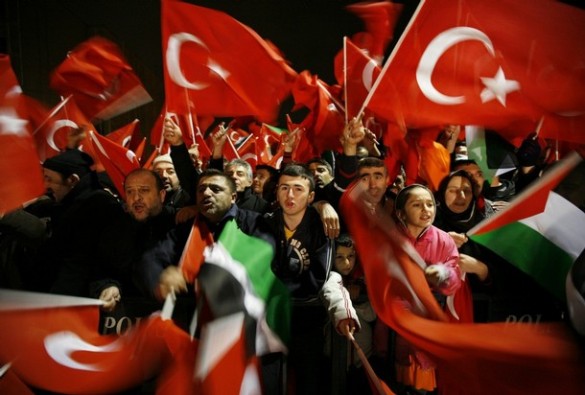
Public opinion exists in Turkey too and it is influential, and when the prime minister sees thousands of Turks protesting against Israel’s policy in Jerusalem, he cannot remain indifferent. At the same time, Turkey continues and will continue to have normal ties with Israel because such a relationship is part of Turkey’s strategy, but today it finds itself in a different international status, of the sort that allows it to also take swipes at Israel. [continued…]

Facebooktwittermail

Obama has betrayed mission to forge Mideast peace

Obama has betrayed mission to forge Mideast peace

What has the new Nobel laureate done so far in our region? Mitchell Shmitchell, a bitter and lost struggle over settlement expansion, a bizarre struggle against the Goldstone report, a disgraceful silence about the Gaza siege, and the ultimate proof that there’s nothing new under the Middle Eastern sun. It’s not Obama who “can,” it’s Israel. Israel can twist the arms of any president. You don’t want to freeze the settlements? Okay, never mind. You don’t want to take responsibility for the crimes in Gaza? Okay, never mind. You don’t want to end the occupation? Okay, never mind. This is not the conduct of a Nobel laureate and president.

A consolation prize: Perhaps the Nobel will serve as a catalyst, a kind of alarm clock ringing to wake the laureate in the final minute. Unlike in Afghanistan and Iraq, in this region he will not need to shed American blood to secure peace. It’s enough to show political determination, apply pressure and use Israel’s isolation and dependency for the cause of peace. Israel needs a friend to save it from itself.

Obama now needs to choose whether to join the laureates-in-vain – from Henry Kissinger to Yitzhak Rabin, Shimon Peres and Yasser Arafat – or join the great ones, like Martin Luther King, Jr., Nelson Mandela, Mikhail Gorbachev, Aung San Suu Kyi and Mother Teresa. It’s true, no one has ever won the prize twice (except the International Committee of the Red Cross), but no one has won it on a down payment, either. If Obama brings peace to the Middle East, perhaps Oslo will change its ways once more and grant him the Nobel again – once as a down payment, once by right. Congratulations, Mr. President, now it’s time to settle your debt. [continued…]

Obama, man of peace? No, just a Nobel prize of a mistake

Isn’t there anyone in the White House to remind Mr Obama that the Israelis have never obliged a US president who asked for an end to the building of colonies for Jews – and Jews only – on Arab land? Bill Clinton demanded this – it was written into the Oslo accords – and the Israelis ignored him. George W Bush demanded an end to the fighting in Jenin nine years ago. The Israelis ignored him. Mr Obama demands a total end to all settlement construction. “They just don’t get it, do they?” an Israeli minister – apparently Prime Minister Benjamin Netanyahu – was reported to have said when the US Secretary of State, Hillary Clinton, reiterated her president’s words. That’s what Avigdor Lieberman, Israel’s crackpot foreign minister – he’s not as much a crackpot as Mahmoud Ahmadinejad, but he’s getting close – said again on Thursday. “Whoever says it’s possible to reach in the coming years a comprehensive agreement,” he announced before meeting Mr Obama’s benighted and elderly envoy George Mitchell, “… simply doesn’t understand the reality.”

Across Arabia, needless to say, the Arab potentates continue to shake with fear in their golden minarets. That great Lebanese journalist Samir Kassir – murdered in 2005, quite possibly by Mr Obama’s new-found Syrian chums – put it well in one of his last essays. “Undeterred by Egypt since Sadat’s peace,” he wrote, “convinced of America’s unfailing support, guaranteed moral impunity by Europe’s bad conscience, and backed by a nuclear arsenal that was acquired with the help of Western powers, and that keeps growing without exciting any comment from the international community, Israel can literally do anything it wants, or is prompted to do by its leaders’ fantasies of domination.” [continued…]

Facebooktwittermail

Our exclusive right to self-defense

Our exclusive right to self-defense

Virtually all of Israel is now speaking in one voice against the Goldstone report, against any attempt to blame us over the war in Gaza. We’ve honed our message to a sharp point and, inspired by Prime Minister Binyamin Netanyahu’s performance at the UN, we’re delivering it with just the right tone of outrage:

How dare anyone deny us the right to self-defense! How dare anyone deny us the right to fight back against terrorism!

Very nice. Puts everyone else on the defensive. The right to self-defense is up there with motherhood and apple pie – who’s going to come out against it, especially for us, for Israel, for the Jews, for the people of the Holocaust?

The right to self-defense – perfect.

But I’d like to ask: Do the Palestinians also have the right to self-defense?

We probably wouldn’t admit it out loud, but in our heads we would say – again, in one voice – “No!”

This is the Israeli notion of a fair deal: We’re entitled to do whatever the hell we want to the Palestinians because, by definition, whatever we do to them is self-defense. They, however, are not entitled to lift a finger against us because, by definition, whatever they do to us is terrorism. [continued…]

Facebooktwittermail

Give peace a chance, says Mitchell. Fat chance, says Lieberman.

No chance of peace for years, says Israel’s Foreign Minister

There is no chance of an early solution to the Israeli-Palestinian conflict and people must “learn to live with it”, the Israeli Foreign Minister warned yesterday.

“Anyone who says that within the next few years an agreement can be reached ending the conflict… simply doesn’t understand the situation and spreads delusions, ultimately leading to disappointments and an all-out confrontation here,” Avigdor Lieberman said in a radio interview.

He added: “I am going to say very clearly: there are conflicts that have not been completely solved and people have learnt to live with it, like Cyprus.”

Mr Lieberman, the head of the far-right Yisrael Beitenu party, suggested that a long-term, interim deal with the Palestinians could ensure prosperity, security and stability, but tougher questions should be left until later.

“We have to be realistic,” he said. “We will not be able to reach agreement on core and emotional subjects like Jerusalem and the right of return of Palestinian refugees.” [continued…]

Palestinians change course on UN report

The Palestinian leadership has quickly backtracked in its approach to a U.N. report accusing Israel of possible war crimes in Gaza, in what its top diplomat acknowledged Thursday is erupting into a “clear crisis” for its people. [continued…]

UN Security Council to discuss Gaza report next week

A divided U.N. Security Council will meet next week at the request of Arab countries to discuss a U.N. report on war crimes committed by both Palestinian militants and Israel’s army during last December’s conflict in the Gaza Strip.

The Security Council’s monthly meeting on the Middle East was scheduled for October 20, but after a request from council member Libya that some western diplomat’s characterized as a bit of a “surprise”, the 15-member body agreed in closed consultations Wednesday to move up its session to October 14. [continued…]

After Goldstone, Hamas faces fateful choice

Naming collaboration — even treason — for what it is has always been a painful taboo among Palestinians, as for all occupied peoples. It took the French decades after World War II to begin to speak openly about the extent of collaboration that took place with the Nazi-backed Vichy government. Abbas and his militias — who for a long time have been armed and trained by Israel, the United States and so-called “moderate” Arab states to wage war against the Palestinian resistance — have relied on this taboo to carry out their activities with increasing brazenness and brutality. But the taboo no longer affords protection, as calls for Abbas’ removal and even trial issued from Palestinian organizations all over the world.

Hamas too seems to have been taken by surprise at the strength of reaction. Hamas leaders were critical of Abbas’ withdrawal of the Goldstone resolution, but initially this was notably muted. Early on, Khaled Meshal, the movement’s overall leader, insisted that despite the Goldstone fiasco, Hamas would proceed with Egyptian-mediated reconciliation talks with Fatah and smaller factions scheduled for later in the month, stating that reaching a power-sharing deal remained a “national interest.”

As the tremors continued, however, Hamas leaders escalated their rhetoric — seemingly following, not leading, public opinion. Mahmoud Zahar, a prominent Hamas leader in the Gaza Strip, labeled Abbas a “traitor” and urged that he be stripped of his Palestinian nationality. Prime Minister Ismail Haniyeh, speaking before a hastily convened session of the Palestinian Legislative Council, said Abbas was personally responsible for the “crime” committed in Geneva, and a senior officer from the Hamas-controlled Gaza police force held a press conference to announce that Abbas and his associates would be subject to arrest if they set foot in Gaza. [continued…]

Netanyahu, the tunnels opener

Last week, an incident that could have set the entire Middle East on fire was prevented. Netanyahu’s secret plan to visit a disputed tunnel in the East Jerusalem Palestinian neighborhood of Silwan, at the site known as Ir David (the City of David), was canceled, probably with some international intervention. Am I exaggerating the danger? No. Judging from past experience, provocations in Jerusalem never end well, and with the tensions in Jerusalem clearly rising in recent weeks, the potential for an explosion is very real. [continued…]

Israel considers recalling its ambassador to Sweden

Israel is considering recalling its ambassador to Stockholm in light of Swedish Foreign Minister Carl Bildt’s remarks in support of a UN report claiming war crimes were committed by both sides during the Israel-Hamas Gaza conflict.

Bildt told reporters in Stockholm Thursday that South African jurist Richard Goldstone, who headed the investigation into the war, is a person with “high credibility” and “high integrity” and that his report carries weight.

Deputy Foreign Minister Danny Ayalon called to re-examine Israel’s relations with Sweden. [continued…]

Facebooktwittermail

Iran: Can the U.S. take ‘yes, but’ for an answer?

Iran: Can the U.S. take ‘yes, but’ for an answer?

The U.S. and its allies had sought to prevent Iran from achieving a “breakout” capacity — i.e., assembling sufficient civilian nuclear infrastructure to allow it to move relatively quickly to build a bomb should it choose to break out of the NPT, in the manner that a country like Japan is capable of doing. That goal required Iran to give up exercising its right to enrich uranium. There’s no sign of Iran moving in that direction, but if it shows new flexibility in negotiating further safeguards against weaponization of its nuclear output, that will create a new dilemma for the Obama Administration: whether or not the U.S. and its allies, particularly Israel, can live with an outcome that leaves Iran with “threshold” capacity, even under greater safeguards.

While under attack in a Senate subcommittee from Republicans who are skeptical over the Geneva talks, Deputy Secretary of State Jim Steinberg suggested on Tuesday, according to CNN, that “one reason for the Obama Administration’s engagement toward Iran was to secure international support for sanctions if Iran continued to defy international demands.” The argument works if Iran stonewalls; but if it offers counterproposals deemed reasonable by China, Russia and some Europeans, winning support for further sanctions would become even harder. And that’s a game the Iranians may be ready to play, by refusing to give up uranium enrichment but at the same time showing new openness to measures aimed at strengthening international confidence in the peaceful intent of its nuclear program. Tehran is far more likely to tailor its positions to what will be acceptable to Russia, China and some of the Europeans than it is to heed the demands put forward by the U.S. and its key allies. [continued…]

CIA knew about Iran’s secret nuclear plant long before disclosure

In an interesting reversal of roles from the Bush era, the Europeans were pushing for the plant to be outed at once, while the U.S. was more cautious. “The Americans seem to have become more patient as their dossier on Iran has gotten fuller, while the Europeans are getting more anxious about taking care of this matter as they’ve learned more,” says Jacquard.

From then on, the challenge was to keep the information secret. Panetta said he ordered the presentation to be readied “in the event that that information leaked out or that [the Obama Administration] wanted to present it to the International Atomic Energy Agency.” British, French and Israeli intelligence agencies were involved in creating the presentation, he added.

U.S. officials believe that it was only when Iran found out that its cover had been blown that it chose to own up to the plant’s existence — although how it might have learned of Washington’s discovery remains unclear. On the eve of the U.N. General Assembly last month, the Iranians sent the IAEA a terse note, acknowledging the presence of the Qum facility. The next day, Panetta dispatched a team to the IAEA’s headquarters in Vienna to make the presentation. [continued…]

Is the U.S. preparing to bomb Iran?

The notification says simply, “The Department has an Urgent Operational Need (UON) for the capability to strike hard and deeply buried targets in high threat environments. The MOP is the weapon of choice to meet the requirements of the UON.” It further states that the request is endorsed by Pacific Command (which has responsibility over North Korea) and Central Command (which has responsibility over Iran).

The request was quietly approved. On Friday, McDonnell Douglas was awarded a $51.9 million contract to provide “Massive Penetrator Ordnance Integration” on B-2 aircraft.

This is not the kind of weapon that would be particularly useful in Iraq or Afghanistan, but it is ideally suited to hit deeply buried nuclear facilities such as Natanz or Qom in Iran. [continued…]

Iran blames U.S. in disappearance of scientist

Iran’s foreign minister on Wednesday accused the United States of being involved in the disappearance of an Iranian scientist with alleged links to Iran’s nuclear program.

The charge comes less than a week after Iran reached tentative accords with the United States and other major powers on addressing questions about its nuclear ambitions, including letting international inspectors visit its newly disclosed uranium-enrichment site near Qom. The charge also comes as the United States has raised questions about Americans being held in Iran.

The scientist, Shahram Amiri, vanished during a pilgrimage to Saudi Arabia four months ago; Iran previously called on Saudi Arabia to help locate him. He is a researcher at Malek Ashtar University, which is connected to Iran’s Revolutionary Guard Corps and was listed by the European Union last year as an entity linked to Iran’s nuclear activities or weapon delivery systems. [continued…]

Iran plans to cut subsidised gasoline quota

Iran plans to nearly halve the amount of gasoline that motorists can buy at a heavily subsidised price, state television reported on Thursday, in what could be a politically controversial proposal.

It quoted Oil Minister Massoud Mirkazemi as saying that under the plan, to be considered by parliament next week, the quota of subsidised gasoline would be reduced to 55 litres per month from 100 litres now.

The proposal comes as the United States and its European allies explore ways of targeting fuel imports into Iran if it continues to press on with its nuclear programme. [continued…]

Facebooktwittermail

Obama’s Middle East mess

Obama’s Middle East mess

As Abbas falls, have no doubt that he got pushed by an inept administration that similarly gets weak-kneed whenever it feels pressure from either the Israel lobby or the Israeli government.

Yesterday, State Department spokesman, Ian Kelly, was asked: “What role specifically did the United States play in pressuring the Palestinian Authority to make that decision [to shelve the Goldstone report]?

Kelly, squirming like an eel, responded:

Well, I don’t know if I would accept your characterization of pressuring. I think that we recognized that we had serious concerns with the recommendations and some of the allegations. We felt very strongly that while these investigations should be investigated and addressed, that we thought on the one hand that Israel had the kind of institutions that could address these allegations. And of course, we urged Israel to address these very serious allegations.

But I think we had a broader concern that we didn’t want the report to distract us from our ultimate goal, which was to address the root causes of the tragic events of last January, and that’s the lack of a regional and lasting peace between the two parties – between the Israelis and the Palestinians. So we were concerned that we stay focused on that ultimate goal.

And we are not saying that the allegations in the report – we’re not saying that they should be ignored. We simply do not want the report itself to become any kind of impediment to this ultimate goal. We appreciate the seriousness with which the Palestinians approach this very, very difficult issue, and we respect this decision to defer discussion of the report to a later date for the reasons that I just stated – that we want to make sure that we stay focused on the ultimate goal here.

(Goldstone discussion begins at 6 minutes 55 seconds.)

What kind of tortured logic is this? On the one hand war crimes committed in Gaza are somehow extraneous to an understanding of the root causes of the conflict, yet the root cause of the conflict is conflict itself?

The administration needs to make up its mind: Either this conflict is all about violence, in which case Israeli violence can’t be ruled out of the equation. Or, the violence is merely symptomatic of underlying political injustices and a natural outcome of addressing those injustices will be a long sought peace. Take your pick.

Of course, the true sentiment that few American officials are crass enough to utter, yet apparently everyone believes, is that when Israelis kill hundreds of Palestinians they really don’t intend to kill any (“we shoot and we cry”), yet when Palestinians kill a dozen Israelis they merely fall short of accomplishing their genocidal intentions.

* * *

After taking stabs at solving the Middle East conflict, engaging Iran, bringing about global nuclear disarmament, healing the rift between Muslims and the West, shoring up the global financial system, tackling climate change and reforming America’s health care system, there are strong indications that Obama came into office intoxicated by his image as a world savior.

Even so, his cool created the impression that he might actually be impervious to the influence of adulation, but even though some of us thought he had risen above the massive projections that were being imposed on him, the evidence is that to some extent he got sucked into the myth that had been created around him.

To see Obama now as either a tragic figure or as the victim of circumstances essentially absolves him of responsibility for his own actions.

I don’t think it’s premature to be conducting an autopsy on Obama’s Middle East initiative and the first question to ask is this: Did he manage to cross the most minimal threshold for a defensible approach? That is, can he claim at least to have done no harm?

Unfortunately, the harm appears grossly evident and it hinges on his choice to raise expectations across the region and then allow those expectations to founder. Expectations dashed are much more destructive than expectations never formed. (George Bush never disappointed anyone because no one took his promises seriously. In office and life he mastered the art of setting a low bar.)

So, could Obama have entered the situation differently and put himself in a better position to at least live up to the Hippocratic oath (which, incidentally, all politicians should be forced to take)?

He could have acknowledged that he had on his plate more than any human president could address (“sorry folks, I’m not the Messiah”) and he could in his first days in office have said something like this:

“The Middle East conflict is a wound to which no easy remedy can be applied. I do not come into office claiming to have any greater powers than all of my predecessors who struggled with limited success to deal with this issue.

“I do know this, however: setting aside the many intractable political issues, there is right now a humanitarian crisis in Gaza. We haven’t had time to assess the scope of this crisis but having appointed George Mitchell as my Middle East peace envoy, I’ve asked him to put the crisis in Gaza at the top of his agenda. In the next few days he will be visiting the area to assess which needs must most urgently addressed.”

At that point, the Israel Lobby’s wheels would have started spinning frantically. But how do you conduct a campaign focused on preventing Mitchell going to Gaza and addressing a humanitarian crisis?

No doubt, phones in the White House and the State Department would have been ringing off the hook as Abe Foxman and other Jewish community leaders and Israeli officials objected, saying that such a move would not be “helpful”. But seriously, how do you conduct a public campaign whose direct aim is to prevent help reaching tens of thousands of people whose homes had been flattened?

What happened in reality? Obama and Mitchell made the choice of staying out of Gaza. Neither of them had a gun pointed at his head.

Obama had the opportunity to craft a policy that grew modestly and organically from the facts on the ground. A combination of fear, arrogance and perhaps lack of political imagination, led him to pass up that opportunity.

Facebooktwittermail

Does Iran have data to build a nuclear bomb? No, says US

Does Iran have data to build a nuclear bomb? No, says US.

A senior US security official Sunday disagreed with the assessment that Iran now knows how to make a nuclear bomb.

According to the Sunday New York Times, a secret International Atomic Energy Agency (IAEA) report says that Iran has “sufficient information to be able to design and produce a workable” atom bomb.

US National Security Adviser James Jones, however, disputed the IAEA’s findings. Asked on CNN’s “State of the Union” if Iran has the data to make a nuclear bomb, he said: “No, we stand by the reports that we’ve put out.” [continued…]

Lawmakers vow swift action over Iran’s alleged nuclear inroads

US lawmakers on Sunday vowed quick action against Iran following a report that weapons experts believe Tehran has the know-how to build an atomic bomb — even as a senior US official downplayed the news article.

A chorus of congressional voices, both Republican and Democratic, urged tough action against Tehran following a New York Times report that the International Atomic Energy Agency (IAEA) has determined Iran now has “sufficient information” to build a nuclear weapon.

US lawmakers said the revelation warranted an immediate and severe response. [continued…]

Ahmadinejad has no Jewish roots

In June 2005, Mahmoud Ahmadinejad’s meteoric rise from mayor of Tehran to president of one of the most influential countries in the Middle East took everyone by surprise. One of the main reasons for the astonishment was that so little was known about him.

One recently published claim about his background comes from an article in the Daily Telegraph. Entitled “Mahmoud Ahmadinejad revealed to have Jewish past”, it claims that his family converted to Islam after his birth. The claim is based on a number of arguments, a key one being that his previous surname was Sabourjian which “derives from weaver of the sabour, the name for the Jewish tallit shawl in Persia”.

Professor David Yeroshalmi, author of The Jews of Iran in the 19th century and an expert on Iranian Jewish communities, disputes the validity of this argument. “There is no such meaning for the word ‘sabour’ in any of the Persian Jewish dialects, nor does it mean Jewish prayer shawl in Persian. Also, the name Sabourjian is not a well-known Jewish name,” he stated in a recent interview. In fact, Iranian Jews use the Hebrew word “tzitzit” to describe the Jewish prayer shawl. Yeroshalmi, a scholar at Tel Aviv University’s Center for Iranian Studies, also went on to dispute the article’s findings that the “-jian” ending to the name specifically showed the family had been practising Jews. “This ending is in no way sufficient to judge whether someone has a Jewish background. Many Muslim surnames have the same ending,” he stated. [continued…]

Facebooktwittermail

Hamas, not Abbas, is the Palestinians’ real leader

Hamas, not Abbas, is the Palestinians’ real leader

In a single phone call to his man in Geneva, Mahmoud Abbas has demonstrated his disregard for popular action, and his lack of faith in its accumulative power and the place of mass movements in processes of change.

For nine months, thousands of people – Palestinians, their supporters abroad and Israeli anti-occupation activists – toiled to ensure that the legacy of Israel’s military offensive against Gaza would not be consigned to the garbage bin of occupying nations obsessed with their feelings of superiority.

Thanks to the Goldstone report, even in Israel voices began to stammer about the need for an independent inquiry into the assault. But shortly after Abbas was visited by the American consul-general on Thursday, the leader of the Palestine Liberation Organization got on the phone to instruct his representative on the United Nations Human Rights Council to ask his colleagues to postpone the vote on the adoption of the report’s conclusions.

Heavy American pressure and the resumption of peace negotiations were the reasons for Abbas’ move, it was said. Palestinian spokespeople spun various versions over the weekend in an attempt to make the move kosher, explaining that it was not a cancelation but a six-month postponement that Abbas was seeking.

Will the American and European representatives in Geneva support the adoption of the report in six months’ time? Will Israel heed international law in the coming months, stop building in the settlements and announce immediate negotiations on their dismantlement and the establishment of a Palestinian state in the occupied territories? Is this what adoption of the report would have endangered? Of course not. [continued…]

Editor’s Comment — The White House, having initially promised American Jewish community leaders that the Goldstone report could be assured a quiet death (it would reach a “natural conclusion” in the UN Human Rights Council and move no further), then opted for a different choice: half-life might cause fewer political ruptures than sudden death. All that was required was the Mahmoud Abbas be obliging enough to do the administration’s dirty work and get the report shelved. Obama could then maintain his serenity and keep the peace process moving forward.

What kind of imbecile thought that was a plan that would work?

* * *

Yesterday, the jailed Tanzim leader and Fatah Central Committee member Marwan Barghouti said: “whoever thinks it’s possible to make peace with the current Israeli government is being delusional.”

He also suggested that the circumstances which led to the Al-Aqsa Intifada still prevail and called on Palestinians to conduct a “peaceful resistance” campaign.

That’s something Obama and Mitchell might pause to consider.

Hamas accuses Abbas of treason for ‘justifying’ Gaza war

Hamas leaders on Monday warned that President Mahmoud Abbas’ decision to delay action on a United Nations report criticizing Israel’s offensive in the Gaza Strip was in essence a “justification” of the war and encouragement of occupation.

The report, by Justice Richard Goldstone, criticized both Israel and the Palestinians for the war in January 2008. Last week the Palestinian delegation to the UN Human Rights Council dropped its support for an immediate vote on the report.

Speaking to Gaza lawmakers, Hamas Prime Minister Ismail Haniyeh accused Abbas of having “justified” the war by agreeing to defer a UN vote that would have condemned Israel’s failure to cooperate with the war crimes investigation led by South African judge Richard Goldstone. [continued…]

Palestinians, U.S. Jews spar over ‘Judaizing’ Jerusalem

The Western-backed Palestinian Authority on Monday urged the world to “force [Israel] to put off its attempts to take over Jerusalem and Judaize it,” prompting Orthodox Jews in the United States to vow never to give up their historical right to the ancient city.

The Palestinian cabinet, issuing a strong statement after a meeting in the West Bank town of Ramallah, condemned what it called a plan by Jews to “perform religious rituals” in the Temple Mount compound which contains the al-Aqsa mosque, Islam’s third holiest site.

It also pledged “to confront Israel,” as Israeli security forces clashed with Arab protesters for a second day in the Jerusalem area. In response, the leading body of Orthodox Jews in America condemned the Palestinian Authority and the violence exhibited by Palestinian protesters. [continued…]

In Jerusalem, clashes over Temple Mount, Al Aqsa Mosque

Israeli police shut down access to key Muslim holy sites in Jerusalem’s Old City on Sunday, spurring Palestinian protesters to throw rocks and bottles in protest – marking the second consecutive Sunday of disturbances near the city’s overlapping points of prayer for Jews and Muslims.

Clashes broke out in reaction to Israel’s closure of the entrances to the Dome of the Rock and the Al Aqsa Mosque, Islam’s third-holiest site. About 150 Palestinians who gathered for a prayer service near the city’s Lion’s Gate on Sunday morning hurled rocks and bottles at Israeli police, who fired tear gas in attempt to disperse the crowd. Palestinian officials said nine people were treated for light injuries, primarily tear gas inhalation. Israel said two of its policeman were sent to hospitals after being injured by rocks and bottles.

An Israeli police spokesman said that the decision to close the site was made following calls in various Palestinian media on Saturday night to march on the Haram el-Sharif (The Noble Sanctuary), as it is called in Arabic – referred to by Israelis as the Temple Mount. Several Islamic groups claim that an Israeli archeological dig below the site is endangering Al Aqsa and that it will soon collapse, a claim Israel denies. [continued…]

Facebooktwittermail

Israel minister feared UK arrest

Israel minister feared UK arrest

Israeli minister and former military chief Moshe Yaalon cancelled a UK visit because of fears of arrest for alleged war crimes, his office says.

Pro-Palestinian groups in Britain want Mr Yaalon to face trial over the 2002 killing of a Gaza militant, in which 14 others also died.

Mr Yaalon took legal advice and wanted “to avoid playing into the hands of anti-Israel propaganda”, an aide said. [continued…]

Facebooktwittermail

Israel names Russians helping Iran build nuclear bomb

Israel names Russians helping Iran build nuclear bomb

The West says the plant [near Qom] is tailor-made for a secret weapons programme and proves Iran’s claim that its nuclear programme is intended only for peaceful purposes is a lie. The plant is designed to hold 3,000 centrifuges — enough to produce the material needed for one bomb a year.

Iran’s conduct over the next few weeks will determine whether the West continues its new dialogue or is compelled to increase pressure with tougher United Nations and other sanctions.

Ephraim Sneh, a former Israeli deputy defence minister, warned that time was running out for action to stop the programme. “If no crippling sanctions are introduced by Christmas, Israel will strike,” he said. “If we are left alone, we will act alone.” [continued…]

Editor’s CommentThe Sunday Times has amazing intelligence sources!

Not a single IAEA inspector has set foot in the Fordo facility or seen its plans and yet we know that it is “tailor-made for a secret weapons programme”.

Right! I suppose you can argue the fact that it’s a deeply concealed structure makes it “tailor-made” for such a purpose, but that would seem to be a case of inferring that something is certain because it is unknown.

That might be so in the mind of a Sunday Times reporter, but I for one, have yet to observe such a quasi-mystical correspondence between the known and the unknown.

As for yet another Israeli threat — I’m sorry, but the more often they are made, the more implausible they become, at least to me.

The military option: Could they do it?

The U.S. military is developing technologies, including a new generation of “bunker-busting” bombs, that could destroy facilities like the one near Qom.

But there are doubts about the effectiveness of those weapons, prompting current and former U.S. officials to say that a military effort aimed at crippling Iran’s nuclear program would require dozens of missile strikes and possibly even the insertion of U.S. troops.

“If you’re going to have an effective campaign to go in and throw [Iran’s nuclear program] back years, you’re talking about a massive, massive effort,” said a former senior U.S. intelligence official who was involved in examining such scenarios.

“This is not an Iraqi reactor or a Syrian reactor,” the official said, referring to Israel’s strikes in 1981 and 2007, respectively, on above-ground nuclear facilities in those countries. “This is a different game.”

The official and others spoke on condition of anonymity when discussing millitary planning.

President Obama said shortly after taking office that he was prepared to use “all elements of American power to prevent Iran from developing a nuclear weapon.” Last week, he reiterated that he would not “rule out any options when it comes to U.S. security interests.”

The increasingly difficult nature of upholding that pledge through military strikes, however, became clearer last week when U.S. officials described the newest Iranian site, believed to be a uranium enrichment which plant which could furnish fissile material for a bomb. [continued…]

Facebooktwittermail

Palestinians cry ‘blackmail’ over Israel phone service threat

Palestinians cry ‘blackmail’ over Israel phone service threat

Israel is threatening to kill off a crucial West Bank economic project unless the Palestinian Authority withdraws a request to the International Criminal Court to investigate alleged Israeli crimes during last winter’s Gaza war.

Shalom Kital, an aide to defence minister Ehud Barak, said today that Israel will not release a share of the radio spectrum that has long been sought by the Palestinian Authority to enable the launch of a second mobile telecommunications company unless the PA drops its efforts to put Israeli soldiers and officers in the dock over the Israeli operation.

“It’s a condition. We are saying to the Palestinians that ‘if you want a normal life and are trying to embark on a new way, you must stop your incitement,” Mr. Kital said. “We are helping the Palestinian economy but one thing we ask them is to stop with these embarrassing charges.”

As long as the Wataniya Mobile company is unable to begin its operations, communications costs are likely to remain inordinately high for Palestinian businesses and individuals. But thwarting the company benefits four unauthorized Israeli operators who make sizeable profits in the Palestinian market using infrastructure they have set up in the illegal Israeli settlements across the West Bank. [continued…]

Facebooktwittermail

Obama agrees to keep Israel’s nukes secret

Obama agrees to keep Israel’s nukes secret

President Obama has reaffirmed a 4-decade-old secret understanding that has allowed Israel to keep a nuclear arsenal without opening it to international inspections, three officials familiar with the understanding said.

The officials, who spoke on the condition that they not be named because they were discussing private conversations, said Mr. Obama pledged to maintain the agreement when he first hosted Israeli Prime Minister Benjamin Netanyahu at the White House in May.

Under the understanding, the U.S. has not pressured Israel to disclose its nuclear weapons or to sign the nuclear Non-Proliferation Treaty (NPT), which could require Israel to give up its estimated several hundred nuclear bombs. [continued…]

Facebooktwittermail