Category Archives: Israel

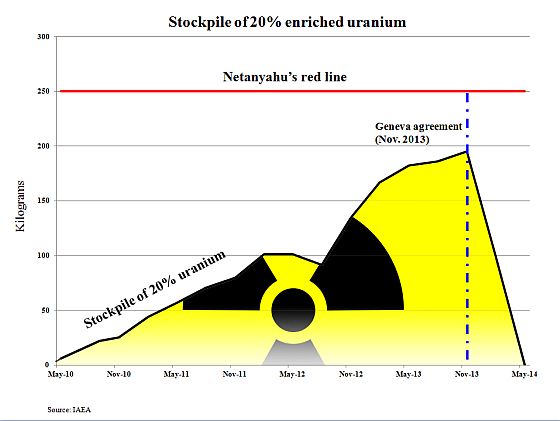
Iran nuclear deal respects Netanyahu’s red line

red-line

Graham Allison writes: Amidst the weeping and gnashing of teeth from the Prime Minister’s office after the interim agreement on Iran reached in Geneva, it is appropriate to pause to ask how President Obama’s interim agreement actually measures up on Israeli Prime Minister Netanyahu’s chosen yardstick.

Who can forget Netanyahu’s UN presentation last year where he made his best case to the world about the threat Iran’s nuclear program poses to international security. To vivify this danger, Bibi unveiled a graphic sketch of a bomb on which he demonstrably drew a red line.

As he explained in his UN speech then: “In the case of Iran’s nuclear plans to build a bomb, this bomb has to be filled with enough enriched uranium. And Iran has to go through three stages. The first stage: they have to enrich enough of low enriched uranium. The second stage: they have to enrich enough medium enriched uranium. And the third stage and final stage: They have to enrich enough high enriched uranium for the first bomb.”

Having set the stage, he then asked, “Where’s Iran?” As he answered: “Iran’s completed the first stage. It took them many years, but they completed it and they’re 70% of the way there. Now they are well into the second stage.” He then vowed that Iran would never be allowed to cross his red line to the third stage. “The red line must be drawn on Iran’s nuclear enrichment program,” he argued, “because these enrichment facilities are the only nuclear installations that we can definitely see and credibly target. I believe that faced with a clear red line, Iran will back down.” [Continue reading…]

Facebooktwittermail

Israel’s plan to forcibly resettle Negev Bedouins prompts global protests

The Guardian reports: Several thousand people worldwide have taken part in protests at the Israeli government’s plans to forcibly remove Bedouin Arabs from their villages in the Negev desert.

In Israeli towns and cities mounted police used teargas, stun grenades and water cannon against demonstrators, in what the Association of Civil Rights in Israel described as a “disproportionate” response to stone-throwing. More than 40 people were arrested at protests across the country, and 15 police officers were injured.

In what was billed as an international “day of rage”, demonstrations were also held in London, Berlin, Rome, Istanbul, Cairo and in the United States.

Binyamin Netanyahu, the Israeli prime minister, criticised the protests. “We will not tolerate such disturbances,” he said in a statement. “Attempts by a loud and violent minority to deny a better future to a large and broad population are grave. We will continue to advance the law for a better future for all residents of the Negev,” he said. [Continue reading…]

Facebooktwittermail

Bedouin rise up against Israel eviction plan

Al Jazeera reports: Those passing by Al Araqib may call it a shanty town, but to Sheikh Siah Altori it is a home he says he is prepared to die for. After a reported 62 separate demolitions by state authorities, the remains of the Bedouin community, off the road from Rahat to Be’er Sheva, consists of several portable buildings, and a clutch of shacks and animal pens clinging to a hillside in the north of Israel’s Negev Desert.

Portions of the village’s lands have been designated to be planted with a state-sponsored forest. Al Araqib is one of the Bedouin communities known as an “unrecognised village”, which receive no state services such as electricity, water or sanitation. As many as 200,000 Bedouin live in the Negev, an area comprising 60 percent of Israel’s territory. Under a government proposal known as the Prawer-Begin Plan, $340m has been allocated for land and monetary compensation to move up to 40,000 of the Bedouin into state-sponsored townships.

On Saturday, thousands of demonstrators gathered in more than 30 cilties – in Israel and the occupied Palestinian territories as well as in other countries – to protest the Prawer-Begin Plan.

At Hura, a town in the northern Negev, more than 500 protesters gathered peacefully until youth began throwing stones and police used water cannon, horses and stun grenades to disperse the demonstration. Clashes continued throughout the night as the highway from Be’er Sheva to the Dead Sea was blocked with burning barricades and scores of young people throwing stones and Molotov cocktails.

Earlier, Bedouin were joined by busloads of supporters to voice opposition to the Begin-Prawer Plan. While the Israeli government maintains that the policy will ensure its Bedouin population receive access to basic services and economic opportunities, critics see the plan as an attempt to displace and threaten an indigenous way of life. [Continue reading…]

Facebooktwittermail

Britain’s ill-informed friends of Israel are refusing to face facts on Iran nuclear deal

Peter Oborne writes: It was one of those coincidences that a novelist might hesitate to invent. One of William Hague’s first tasks after signing a historic nuclear agreement with Iran was to address the grandest and most important gathering of Britain’s pro-Israel lobby.

Having flown back into London from Geneva on the Sunday, the Foreign Secretary then turned up the next day at the Park Plaza hotel at Westminster for the annual lunch of Conservative Friends of Israel (CFI). More than 100 Tory MPs, as well as hundreds more CFI supporters, were present to hear Daniel Taub, the Israeli ambassador, chide Mr Hague over Iran. One reporter present wrote that Mr Hague was “humiliated”, adding that when he rose to speak he was greeted with “light applause” and “heard in obvious silence”.

Some close to Mr Hague insist, by contrast, that it was a cheerful event. Nevertheless, the atmosphere was by no means as warm and easy as it was last year, when David Cameron was the guest of honour. At some tables, I am told, there was palpable resentment. Each guest had been given a briefing pack that included a caustic summary of the deal that Mr Hague had signed the previous day. A longer version of this document was then dispatched to Conservative MPs, ahead of the Foreign Secretary’s afternoon statement to the House of Commons on Iran.

I have obtained this briefing, which parroted the overblown rhetoric with which Benjamin Netanyahu, the Israeli prime minister, responded to the deal in Geneva. The CFI warned Tory MPs that “the world’s most dangerous regime has taken a significant step towards obtaining the world’s most dangerous weapon” – echoing Mr Netanyahu almost verbatim.

This was not merely propaganda. It was ignorant and poorly informed. [Continue reading…]

Facebooktwittermail

Human tragedy unfolds as Gaza runs on empty

The Telegraph reports: The horrific scars disfigure Mona Abu Mraleel’s otherwise strikingly beautiful face. Swathes of bandages cover the injuries the 17-year-old sustained to her arms and legs in a blaze from which she narrowly escaped with her life.

Still racked by pain from burns to 40 per cent of her body, she goes to hospital on a daily basis to have her dressings changed. Specialist doctors are preparing to carry out a delicate skin graft operation in the coming days.

Yet the hospital on which her recovery depends is woefully ill-fitted to the task – riddled by equipment failures, power cuts and shortages in a mounting crisis that doctors fear is leading to a “health catastrophe”.

Mona lives in Gaza, the impoverished Palestinian coastal enclave where chronic fuel shortages have led to electricity cuts of up to 18 hours a day and reduced ordinary life and public services to a standstill.

She is just one of many Gazans suffering in a rapidly worsening economic climate that this week prompted the British Foreign Office minister, Hugh Robertson, to demand urgent action to restore an adequate fuel supply to the territory. [Continue reading…]

Facebooktwittermail

Five reasons Israel won’t attack Iran

Zachary Keck writes: Although not a member of the P5+1 itself, Israel has always loomed large over the negotiations concerning Iran’s nuclear program. For example, in explaining French opposition to a possible nuclear deal earlier this month, French Foreign Minister Laurent Fabius stated: “The security concerns of Israel and all the countries of the region have to be taken into account.”

Part of Fabius’ concern derives from the long-held fear that Israel will launch a preventive strike against Iran to prevent it from obtaining nuclear weapons. For some, this possibility remains all too real despite the important interim agreement the P5+1 and Iran reached this weekend. For example, when asked on ABC’s This Week whether Israel would attack Iran while the interim deal is in place, William Kristol responded: “I don’t think the prime minister will think he is constrained by the U.S. deciding to have a six-month deal. […] six months, one year, I mean, if they’re going to break out, they’re going to break out.”

Israeli prime minister Benjamin Netanyahu has done little to dispel this notion. Besides blasting the deal as a “historic mistake,” Netanyahu said Israel “is not obliged to the agreement” and warned “the regime in Iran is dedicated to destroying Israel and Israel has the right and obligation to defend itself with its own forces against every threat.”

Many dismiss this talk as bluster, however. Over at Bloomberg View, for instance, Jeffrey Goldberg argues that the nuclear deal has “boxed-in Israeli Prime Minister Benjamin Netanyahu so comprehensively that it’s unimaginable Israel will strike Iran in the foreseeable future.” Eurasia Group’s Cliff Kupchan similarly argued: “The chance of Israeli strikes during the period of the interim agreement drops to virtually zero.”

Although the interim deal does further reduce Israel’s propensity to attack, the truth is that the likelihood of an Israeli strike on Iran’s nuclear facilities has always been greatly exaggerated. There are at least five reasons why Israel isn’t likely to attack Iran. [Continue reading…]

Facebooktwittermail

Britain warns Israel: Don’t undermine Iran nuclear deal

Reuters reports: Israel should avoid taking any action that would undermine the interim nuclear agreement reached between Iran and world powers at the weekend, Britain’s Foreign Secretary William Hague said on Monday.

Urging world leaders to give the interim deal a chance, Hague said it was important to try to understand those who opposed the agreement. But he urged Israel and others to confine their criticism to rhetoric.

“We would discourage anybody in the world, including Israel, from taking any steps that would undermine this agreement and we will make that very clear to all concerned,” Hague told parliament.

Facebooktwittermail

After rapid release of hot air, Israeli leaders may soon run out of cliches

spent-force

The New York Times reports: Israeli leaders denounced the agreement reached Sunday in Geneva, saying they were not bound by it and reiterating the principle that Israel would be ready to defend itself without assistance against any threat.

After weeks of intense lobbying against any deal between the world powers and Iran that does not ensure the dismantling of Iran’s nuclear program, Prime Minister Benjamin Netanyahu of Israel called the agreement “a historic mistake,” saying in remarks that were broadcast from the start of his weekly cabinet meeting, “Today the world has become a much more dangerous place because the most dangerous regime in the world has taken a significant step toward attaining the most dangerous weapon in the world.”

Mr. Netanyahu excoriated the world’s leading powers for agreeing to Iranian uranium enrichment for the first time and for relenting on sanctions “in exchange for cosmetic Iranian concessions that can be canceled in weeks.”

“Israel is not bound by this agreement,” he said. “As prime minister of Israel, I would like to make it clear: Israel will not allow Iran to develop a military nuclear capability.”

The foreign minister of Israel, Avidgor Lieberman, told Israel Radio that “Israel will have to make a reassessment” and that “all the options are on the table.”

“We are talking about the greatest diplomatic achievement for the Iranians,” he said. “We have to take our decision in a cleareyed, independent manner, and we have to be serious enough to be responsible for our fate. Responsibility for the fate of the Jewish people and for the state of Israel lies with the Israeli government alone.” [Continue reading…]

Yada, yada, yada. What options on which table?

Jeffrey Goldberg is in no doubt that Israel no longer has any military options:

[Obama] boxed-in Israeli Prime Minister Benjamin Netanyahu so comprehensively that it’s unimaginable Israel will strike Iran in the foreseeable future. Netanyahu had his best chance to attack in 2010 and 2011, and he missed it. He came close but was swayed by Obama’s demand that he keep his planes parked. It would be a foolhardy act — one that could turn Israel into a true pariah state, and bring about the collapse of sanctions and possible war in the Middle East — if Israel were to attack Iran now, in the middle of negotiations.

Facebooktwittermail

Secret U.S.-Iran talks set stage for nuke deal

The Associated Press reports: The United States and Iran secretly engaged in a series of high-level, face-to-face talks over the past year, in a high-stakes diplomatic gamble by the Obama administration that paved the way for the historic deal sealed early Sunday in Geneva aimed at slowing Tehran’s nuclear program, The Associated Press has learned.

The discussions were kept hidden even from America’s closest friends, including its negotiating partners and Israel, until two months ago, and that may explain how the nuclear accord appeared to come together so quickly after years of stalemate and fierce hostility between Iran and the West.

But the secrecy of the talks may also explain some of the tensions between the U.S. and France, which earlier this month balked at a proposed deal, and with Israel, which is furious about the agreement and has angrily denounced the diplomatic outreach to Tehran. [Continue reading…]

Haaretz reports: Israel found out about the existence of secret talks between the United States and Iran months before they were officially informed of the negotiations by the U.S. government, a senior Israeli official told Haaretz. The Israeli government learned of the secret negotiations sometime near the beginning of the summer through intelligence it managed to obtain.

Managed to obtain how? Through surveillance on U.S. diplomatic communications? Or, more likely, through leaks from an Israel-friendly Washington insider.

Facebooktwittermail

A nuclear deal to which no one can reasonably object

Fred Kaplan writes: The Iranian nuclear deal struck Saturday night is a triumph. It contains nothing that any American, Israeli, or Arab skeptic could reasonably protest. Had George W. Bush negotiated this deal, Republicans would be hailing his diplomatic prowess, and rightly so.

A few weeks ago, a “senior administration official” outlined the agreement that President Obama hoped to achieve in Geneva. Some reporters who heard the briefing (including me) thought that the terms were way too one-sided, that the Iranians would never accept them. Here’s the thing: The deal just signed by Iran and the P5+1 nations (the United States, Britain, France, Russia, and China plus Germany) is precisely the hoped-for deal laid out at that briefing.

It is an interim agreement, not a treaty (which means, among other things, that it doesn’t require Senate ratification). It is meant as a first step toward a comprehensive treaty to be negotiated in the next six months. More than that, it expires in six months. In other words, if Iran and the other powers can’t agree on a follow-on accord in six months, nobody is stuck with a deal that was never meant to be permanent. There is no opportunity for traps and trickery.

Meanwhile, Iran has to do the following things: halt the enrichment of all uranium above 5 percent and freeze the stockpile of uranium enriched to 3.5 percent; neutralize its stockpile of uranium that’s been enriched to 20 percent (either by diluting it to 5 percent purity or converting it to a form that cannot be used to make a weapon); stop producing, installing, or modernizing centrifuges; stop constructing more enrichment facilities; halt all activities at the Arak nuclear reactor (which has the potential to produce nuclear weapons made of plutonium); permit much wider and more intrusive measures of verification by the International Atomic Energy Agency, including daily inspections of all facilities.

Without going into a lot of technical detail (which can be read here), the point is this: The agreement makes it impossible for the Iranians to make any further progress toward making a nuclear weapon in the next six months—and, if the talks break down after that, and the Iranians decide at that point to start building a nuclear arsenal, it will take them much longer to do so. [Continue reading…]

Facebooktwittermail

A path towards peace with Iran — Netanyahu’s worst nightmare

Haaretz reports: Prime Minister Benjamin Netanyahu said Sunday that the interim agreement reached hours prior between Iran and six world powers in Geneva over the prior’s nuclear program endangered Israel, calling the deal a “historic mistake.”

“What was achieved last night in Geneva is not a historic agreement; it is a historic mistake,” he said. “Today the world has become a much more dangerous place because the most dangerous regime in the world has taken a significant step toward attaining the most dangerous weapon in the world.”

“This agreement and what it means endanger many countries including, of course, Israel,” he said. “Israel is not bound by this agreement. The Iranian regime is committed to the destruction of Israel and Israel has the right and the obligation to defend itself, by itself, against any threat. As Prime Minister of Israel, I would like to make it clear: Israel will not allow Iran to develop a military nuclear capability.”

In his last-minute shuttle diplomacy, Benjamin Netanyahu made his entreaties to all the world powers begging them not to make a “bad deal” with Iran. He was politely received and then duly ignored.

Well, ignored might be an overstatement since for the last decade Israel has been instrumental in pushing Iran to the top of the international agenda when, absent that pressure, the world could have been attending to much more urgent and truly global issues.

At a time when the diplomatic momentum was clearly not moving in Netanyahu’s favor, one might ask: why did he not back down from his maximalist demand on zero enrichment and find a way of offering qualified support for this emerging nuclear accord? Why hold on to a set of conditions that Iran would find impossible to accept?

The reason is that Netanyahu’s goal has never been for the nuclear issue to be resolved. It’s political value resides wholly in this remaining an unresolved issue and in Israel’s ability to cast Iran as a perpetual threat. For Netanyahu, any deal is a bad deal because absent an Iranian threat, Israel will find itself under increasing pressure to address the Palestinian issue.

If, as now seems genuinely possible, a permanent nuclear accord is reached with Iran, this will diminish the risk of a major regional war. The risk of a local war — most likely with Lebanon — will, however, increase for as long as Israel is governed by warmongers who prefer to drum up external threats rather than attempt to get their own house in order.

Facebooktwittermail

Geneva deal seals Netanyahu’s legacy: An ineffectual leader

Amir Oren writes: Netanyahu is a serial failure. Mitt Romney was not elected president. Congress did not stand behind Israel and against Obama. The agreement with Iran will be carried out, over Netanyahu’s objections, because that is what the superpowers want. John Kerry, encouraged by the diplomatic success that began with Syria’s chemical disarmament, will not let go regarding the Israeli-Palestinian talks. The Likud leadership anticipates a diplomatic and political crisis next spring, with a divided party that will try to tie Netanyahu’s hands. If he wants to run again, as his ministers believe he does, he will have to become even more extreme and speed toward Obama on a collision course.

This morning, in Switzerland, Netanyahu had his toy gun taken away. In Basel, Herzl founded the state of the Jews, and in Geneva, Obama ended Netanyahu’s era. He can no longer claim truly that he wants to govern the Israelis. The prime minister of Israel cannot be merely some diplomatic version of PR expert Rani Rahav who rails — as Rahav does about Shelly Yacimovich — that the deal with Iran is “bad, bad, bad.”

Netanyahu continuing as prime minister is a waste of time, energy, money and attention. In a new reality, Israel needs new leadership.

Facebooktwittermail

With Iran deal sealed, don’t expect Israel to send out the air force

In Haaretz, Amos Harel writes: The Israeli government has lost this battle, as it believed it would once Hassan Rohani was elected Iranian president in June. It didn’t convince the superpowers to stand firm and make the Iranians crawl toward a more demanding agreement.

Despite the criticism expected to follow, it seems Israel will have to swallow hard and accept the deal, as problematic as it is. Later on it will focus on the sanctions front. Prime Minister Benjamin Netanyahu may resume putting pressure on his friends in the U.S. Congress to try to block the administration and tighten the sanctions that are still in Congress’ purview.

Meanwhile, Israeli intelligence will try to reveal Iranian deception that would let Netanyahu keep telling the world “I told you so.” Israel has already warned that Iran could go the way of North Korea and reach the bomb despite the global diplomatic effort. But an Israeli military option isn’t in play, at least not at this stage. As long as there is such sweeping international support for the interim agreement, bombing Iran’s nuclear facilities would be political suicide.

Meanwhile, Reuters reports: Israeli stock prices rose to another record high on Sunday, ignoring local politicians’ comments that a deal to curb Iran’s nuclear programme was a mistake.

Facebooktwittermail

As Syrian chemical attack loomed, missteps doomed civilians

The Wall Street Journal reports: As Syrian troops battled rebel forces in the Damascus suburbs Aug. 18, U.S. eavesdropping equipment began picking up ominous signals.

A special Syrian unit that handles chemical weapons was ordered closer to the front lines, officials briefed on the intelligence say, and started mixing poisons. For two days, warning signs mounted until coded messages went out for the elite team to bring in the “big ones” and put on gas masks.

U.S. intelligence agencies didn’t translate the intercepts into English right away, so White House officials didn’t know what the Syrian regime was planning until the assault began. Just before 2:30 a.m. on Aug. 21, the first salvo of poison-filled rockets streaked through the clear night sky and crashed into rebel strongholds.

Sarin gas, which kills almost instantly by attacking the nervous system, spread across sleeping farms. Pushed down by falling temperatures, the poison settled in low-lying areas and penetrated homes.

Men, women and children began coughing and gagging, with little more than wet handkerchiefs and T-shirts to hold over their mouths. Neighborhood doctors quickly ran out of antitoxins, and, in a desperate effort to wash away the poison, flooded clinic floors and dragged unconscious victims through the water. More than 1,400 people died, according to U.S. estimates, making it the worst chemical-weapons strike in a quarter century.

A final report is due soon from the United Nations. The Wall Street Journal has pieced together a reconstruction of that fateful day from battlefield reports and dozens of interviews with eyewitnesses, rebels, medics, activists and Western intelligence officials. It reveals both the horror of the attack and the months of miscalculations by the Syrian regime, opposition groups and U.S. government that left them all unprepared for what happened.

U.S. and Israeli communications intercepts reveal chaos inside the Syrian regime that night. When the reports of mass casualties filtered back from the field, according to the officials briefed on the intelligence, panicked Syrian commanders shot messages to the front line: Stop using the chemicals!

Calls came in to the presidential palace from Syrian allies Russia and Iran, as well as from Hezbollah, the Lebanese militant group whose fighters were inadvertently caught up in the gassing, according to previously undisclosed intelligence gathered by U.S., European and Middle Eastern spy agencies. The callers told the Syrians that the attack was a blunder that could have profound international repercussions, U.S. officials say.

The Obama administration had been closely monitoring Syria’s chemical-weapons stockpile since the conflict began in 2011, and had watched the regime carry out about a dozen small-scale chemical attacks before the big one, U.S. officials say. Even if they had translated the intercepts before the Aug. 21 strike, these officials say, they likely wouldn’t have acted because there were no indications it would be out of the ordinary.

Top policy makers had little appetite for getting more deeply involved in the conflict, and questions loomed large about the legality of providing support to the rebels and the best strategy for managing the chemical-weapons threat, these officials say. Rebel leaders and their allies in the U.S. government say the White House failed to act on requests for gas masks, antidote injectors and other protective gear until it was too late.

All told, the events of Aug. 21 changed the Middle East and U.S. policy in ways likely to reverberate for years. It prompted the U.S. to consider and then pull back from military action. The eventual deal to avert a strike, in which Syria agreed to destroy its chemical-weapons stockpiles, elevated Russia, for now, to a leadership position in the region.

President Bashar al-Assad has tightened his hold on power. His regime has denied using chemical weapons, blaming the attacks on the rebels. In exchange for giving up his chemical arsenal, he avoided an American military intervention and likely will get even more support from Russia and Iran. Mr. Assad has pressed ahead with his offensive using conventional arms. U.S. intercepts show a Russian official later boasting to a Syrian counterpart about how easy it had been to get the U.S. to back off strike plans, officials briefed on the intelligence say.

Syrian opposition leaders made their first formal appeal to the U.S. for protection from chemical weapons back in June 2012. At a meeting in Washington, opposition representatives handed administration officials a request for various nonlethal supplies, including 2,500 gas masks, say people who attended.

Samantha Power, then the White House’s top human-rights official and now U.S. ambassador to the United Nations, was receptive, these people say. But other White House advisers, they say, questioned whether the masks would make much of a difference. Some worried that if Islamic extremists in the opposition got their hands on them they might try to seize poison gas from the regime. Administrative lawyers worried about potentially running afoul of domestic and international law.

“It was never ‘no.'” says one opposition representative about what would become a series of requests. “But it would never happen.”

A senior administration official says, “Decisions that were made on assistance to the opposition were made in consultation with them as to what their priorities were.”

That July, American and Israeli spy agencies for the first time intercepted fragmentary intelligence about regime forces using chemical weapons on a small scale. The evidence wasn’t conclusive—there were no physical traces—but some top military officials say they found it persuasive and wanted to make it clear right away to Syria the U.S. wouldn’t tolerate even small attacks.

Then-White House Deputy National Security Adviser Denis McDonough and other officials told their agency counterparts that the top-secret information shouldn’t be made public, but congressional committees were briefed, according to officials. Mr. McDonough also decided to restrict the distribution of such “raw” intelligence inside the government because of its sensitivity, these people say. White House officials didn’t want to set off a chain reaction that would restrict their ability to decide how active a role to play, senior U.S. officials say.

The following month, on Aug. 20, President Barack Obama said the regime would cross the U.S.’s “red line” if it started moving or using “a whole bunch of chemical weapons.”

Last December, the U.S. intercepted an unusually complete communication in which Syrian officials spoke about a potentially larger-scale chemical attack involving aircraft. The White House sent private messages to the Russian government, which in turn asked Iran to lean on the Syrians to scrap the plan, according to current and former U.S. officials involved in the matter. Iran did just that, the officials say. A spokesperson for Iran’s U.N. mission said Iran had made it clear it opposed the use of chemical weapons. [Continue reading…]

Facebooktwittermail

Son of Israeli ex-president takes helm of Labor Party, urging peace

The New York Times reports: Isaac Herzog, the son of a former president, took the helm of Israel’s Labor Party and thus Parliament’s opposition on Friday, vowing to restore the party’s historic focus on promoting peace with the Palestinians and to mount a vigorous challenge to Prime Minister Benjamin Netanyahu’s right-leaning government.

“Only bold steps toward peace with the Palestinians will enable us to break through on all fronts,” Mr. Herzog said at a news conference in Tel Aviv. “I am not sure — I have grave doubts — whether Prime Minister Netanyahu understands this and if he’s working toward it.”

Promising to “restore the political banner to center stage” for “the sake of a just state,” he said he would “outflank those in power until we return to lead the country.”

A lawyer universally known as Buji and a father of three, Mr. Herzog, 53, hails from a beloved Israeli dynasty: His father, Chaim Herzog, a military man and diplomat, served as Israel’s sixth president, from 1983 to 1993, and his grandfather Yitzhak HaLevi Herzog was the first Ashkenazi chief rabbi of the modern state.

Mr. Herzog, who has served in Parliament since 2003 and held several ministerial posts, replaced Shelly Yacimovich, a former journalist who emphasized domestic socioeconomic concerns during her two years leading Labor, and was virtually invisible on the international stage. [Continue reading…]

Facebooktwittermail

White House: Israel’s all-or-nothing proposal on Iran would lead to war

JTA reports: Israel’s proposal that Iran totally dismantle its nuclear capacity in exchange for sanctions relief would likely lead to war, a top White House official said.

The official, in a conference call on Wednesday with think tanks and advocacy groups sympathetic to the Obama administration’s Iran strategy, outlined the proposal that the major powers will put forward at a third round of negotiations in Geneva beginning Thursday.

JTA obtained a recording of the call on condition that it not name the participants or fully quote them.

A think tank participant on the call said Israel’s posture — demanding a total halt to enrichment and the dismantling of all of Iran’s centrifuges — was a path to war. [Continue reading…]

Facebooktwittermail

Israeli military signals positive view of nuclear deal with Iran

Christian Science Monitor reports: Even as Prime Minister Benjamin Netanyahu continues his diplomatic offensive against what he calls a “dangerous” compromise on Iran’s nuclear program, Israel’s military intelligence seems open to a deal, even one that relaxes the Western sanctions on Iran that Mr. Netanyahu has vocally supported.

According to an unclassified assessment shared by a senior Israeli officer, military intelligence is focused on the implications of a potential compromise between Iran and the P5+1 (the US, Britain, France, Russia, China, and Germany).

A deal would boost President Hassan Rouhani, whose surprise victory in June appeared to herald a political shift in Iran – although he is up against hardliners who oppose a deal.

In the background briefing with foreign journalists, which covered a wide range of Middle East hotspots, the intelligence officer said Iran was one of several countries that could buck the general turmoil across the region.

“We see a bit of a possibility, although it’s quite problematic, of more … stability,” said the officer, who spoke on the basis of anonymity. But that is dependent on the success of negotiations “over the nuclear project, but more than that, over the relief of the sanctions on the Iranian economy,” he said. [Continue reading…]

Facebooktwittermail

Israel’s growing gang violence leads to calls for anti-terror tactics

The Guardian reports: Simon was standing in his shop in sight of Ashkelon’s football stadium when he heard the bomb go off.

At first, said Simon – who declined to give his surname – he thought it was a Palestinian missile from Gaza, a short distance along the coast. “I shut the shop and smoked a cigarette to calm myself,” he said. After a few minutes, puzzled he had not heard the air-raid siren, he stuck his head out of his door to see the flaming shell of a car. Its passenger, and the target of the blast, was a member of prominent Israeli crime organisation the Domrani family.

The car bomb on Ort Street, close to a school, was not a solitary incident. In the space of a fortnight spanning the final week of October and the beginning of this month, two car bombs detonated in the southern port city, both targeting Domrani family members.

Ashkelon is not the only Israeli town to be rocked by mob violence this year. On 7 November, a device attached to the car of a prominent state prosecutor, well-known for pursuing Israel’s crime families, detonated in Tel Aviv.

This rise in incidents has inspired a fierce debate that reached a climax last week with a call from Israel’s hawkish public security minister, Yitzhak Aharonovitch, for the use of anti-terror tactics usually reserved for Palestinian militants – including administrative detention – against Jewish Israeli crime families. As he made his call, several high-profile arrests took place and a number of businesses associated with mobsters were bulldozed in Ashkelon.

If one man embodies the country’s reviled organised crime network, it is 38-year-old Shalom Domrani, reputed head of the family that bears his name. It is his war with a former associate that has thrown Israel’s gangsters into an unwelcome spotlight. Domrani was arrested on 9 November with six of his associates. The circumstances of his detention underscore another cause for mounting concern over the activities of organised criminals: the fear that crime families are making money by infiltrating local government. [Continue reading…]

Facebooktwittermail