Category Archives: Israel

Who benefits from the attacks in Israel?

Today’s attacks in southern Israel in which gunmen killed eight people were clearly carefully planned. It seems reasonable to assume that as much attention was given to the attacks’ timing.

Reuters reported:

The Magen David Adom ambulance service said seven people were killed along the road, just meters from the border with Egypt. The military put the number of wounded at around 25.

Israeli special forces were called in and engaged the gunmen as police and the military closed roads around Eilat, a popular Red Sea resort. The military said between two and four gunmen were killed. Israeli media reports said up to seven were killed.

The Israeli government was swift to assign responsibility for the attacks as spokesman Mark Regev said Israel “has specific and precise information that these terrorists who targeted Israelis today came out of the Gaza Strip.”

Time reports:

Israeli security officials had been tracking the militants from the Gaza Strip, where plans were laid for the attack, into the lawless Sinai desert that since the fall of Hosni Mubarak has offered a more and more accessible back door to Israel. But somehow, the militants found a way to strike first, killing seven Israelis on a lonely desert highway.

“It wasn’t supposed to end this way,” a senior Israeli intelligence officer tells TIME. “And now we have to find out why it didn’t end the way it should have.”

Retaliatory airstrikes in Gaza today were aimed at members of the Popular Resistance Committees. Reports on Twitter describe ongoing Israeli missile strikes on multiple locations across Gaza.

One of the other immediate results of the attacks was that J14 protests scheduled to take place across Israel were cancelled. That decision was then reversed and Saturday night’s main rally in Tel Aviv will take the the form of a quiet memorial march with torches and candles.

Will this be the moment at which Israelis once again close ranks as they find solidarity through opposition to a common enemy? In other words, is the J14 movement about to fizzle out?

If every act of terrorism can be regarded as a form of bloody political theater, it’s hard to imagine that the organizers of this performance would have been oblivious about who happened to be in the audience at this time. A group of Republican members of Congress is visiting Israel this week, with another batch scheduled to arrive this weekend, Politico notes.

No doubt many of the visiting Americans will have exceptionally harsh words for one of their colleagues upon their return to Washington. Sen. Patrick Leahy’s effort to apply sanctions against Israeli special forces units accused of human rights violations, now looks particularly badly timed.

Just as Benjamin Netanyahu felt that the 9/11 attacks were good for Israel, it’s hard not to believe that he must feel that today’s attacks are good for his government.

And just in case anyone in Turkey still holds out any hope that Israel might apologize for murdering nine of its citizens just over a year ago, today’s events will merely make this week’s refusal even more emphatic.

Meanwhile, Hamas is cooperating with the Egyptian government in an effort to shut down an al Qaeda affiliate based in Gaza.

Al-Masry Al-Youm reports:

Hamas has responded to Egypt’s request to crack down on the Army of Islam and prevent its forces from infiltrating through the tunnels into Egypt.

A security source said clashes took place on Wednesday between Hamas and the Army of Islam in Gaza in a bid to capture their leader Mumtaz Daghmash, who is accused of carrying out bombings and terrorist attacks in Egypt.

Hamas met on Wednesday with officials of the Egyptian intelligence service to agree on border control measures with a view to preventing attacks by elements of the Army of Islam and the Jaljalat organization, which is affiliated with Al-Qaeda.

The Egyptian military and police sent a large number of special forces troops into North Sinai a week ago in an effort to crack down on armed criminal gangs and insurgents in the peninsula. The initiative, named Operation Eagle, saw Egyptian army tanks and troops deployed to the streets of Sinai towns for the first time since the 1970s.

Bloomberg adds:

Egyptian security forces in the northern Sinai Peninsula arrested 20 people, including Palestinians, suspected of involvement in attacks on police stations and a natural gas pipeline to Israel, the state-run Middle East News Agency said.

Some of the suspects belong to “jihadi cells,” and others are accused of criminal activities, MENA reported today, citing Saleh el-Masri, the Northern Sinai security chief, as saying. Those arrested include Egyptians from other provinces who have been recruited and sent to Sinai, it reported.

Violence in Sinai since the ouster of former President Hosni Mubarak prompted security forces to conduct an operation to capture “criminals and extremists” in the peninsula, the state-run Al Ahram newspaper said on Aug. 16. Egyptian gas supplies to Israel were disrupted after four attacks on the pipeline network from Feb. 5 to July 12.

El-Masri said forces discovered a workshop that manufactures explosive devices, explosive belts and landmines, MENA reported. He stressed the importance of the cooperation of tribal leaders in the area with the army and other forces to restore security in Sinai, it said.


Facebooktwittermail

Al Jazeera journalist held in Israeli prison

Al Jazeera reports:

Samer Allawi, Al Jazeera Arabic’s Kabul bureau chief, has been brought before an Israeli military court, almost a week after he was arrested by Israeli officials when he tried to cross the border between Jordan and the occupied West Bank.

Israeli authorities extended his detention by seven days and charged him with being a member of Hamas on Tuesday.

Allawi was arrested on August 10 at the end of a three-week holiday in his home town of Sabastia near Nablus.

The Israeli authorities originally informed Allawi’s family that he would be held for four days for questioning, saying that it was a “security-related arrest”.

Last Thursday, the authorities told Al Jazeera that Allawi’s detention would be extended.

Facebooktwittermail

Glenn Beck calls Israel social protesters ‘communists’

Haaretz reports:

Beck is currently in Israel for a mass rally to “Restore Courage” in Jerusalem.

The conservative pundit, who left Fox News in June of this year, scoffed at the protesters’ list of demands, comparing many of their calls for increased social benefits to those of the former Soviet Union.

When he heard that the protest leaders were calling for higher taxation for the Israeli upper-classes, Beck laughed derisively, saying “ah, hate the rich.”

Beck then went on to suggest that the housing crisis could be solved by simply building up empty land in the West Bank. The right-wing commentator emphasized that the area, biblically referred to as “Judea and Samaria”, is “Judea – like Jews”.

The commentator said that Judea and Samaria is the contested territory’s real name, not the West Bank.

Beck continued to poke holes in the “extreme left” protesters’ demands calling for decreased privatization of health care, free education and an increase in minimum wage.

Beck also insinuated a possible collaboration between socialists and Islamists, pointing out historical instances in which the two movements went hand in hand.

Facebooktwittermail

Report reveals harsh condition in Israeli jails

Haaretz reports:

Inmates were cuffed hand and foot as a punishment, sometimes for months on end, while prisoners considered suicidal remained in restraints for long periods without access to proper medical care, according to a recent report on conditions in Israeli prisons in 2009 and 2010.

The report, issued by the Justice Ministry’s Public Defender’s Office, reveals widespread overcrowding, poor hygienic conditions and excessive punitive measures in most facilities.

In the Sharon Prison, for example, the agency found a policy of restraining suicidal inmates to their beds in order to punish them rather than in order to protect them.

One prisoner was found to have been kept in bed with arm and leg restraints for several hours, during which time he was unable to eat, smoke, cover himself with a blanket or go to the toilet. The restraints were so tight they left red marks on the prisoner’s wrists.

In Tsalmon Prison representatives of the Public Defender’s Office observed a prisoner kept in bed with arm and leg restraints in a stench-filled cell with cockroaches crawling on the walls. The prisoner, who is being treated with psychiatric drugs, told PDO officials he had been held for a number of months in this way. He said that in order to use the toilet he had to shout for a guard stationed some distance away, at the entrance to the wing.

PDO officials observed an inmate at Hadarim Detention Center who had been cuffed to his bed 24 hours a day for five and a half months, and afterward remained in restraints at night, for 13 hours a day, for an additional period of about six months.

Facebooktwittermail

Israel’s J14 ‘social justice’ movement — just about money?

Since it began, Israel’s J14 ‘social justice’ movement, has made what was ostensibly a tactical choice to be apolitical and sidestep the divisive issue of the occupation.

Following a chorus of appeals to take a stand on this pivotal issue, the movement has implicitly done just that.

Max Blumenthal reports:

On August 14, a month after the demonstrations began, the movement finally tackled the situation across the Green Line. But instead of connecting the concept of social justice to the rights of everyone living under Israeli control, July 14 officially endorsed (website is in Hebrew) a tent protest for “social justice” in the illegal West Bank mega-settlement of Ariel.

Presumably J14’s Ariel protesters welcome the latest news about their illegal settlement:

Defense Minister Ehud Barak has approved the building of 277 apartments the West Bank settlement of Ariel, defying U.S. criticism of continued settlement construction.

Barak authorized the construction in Ariel, the core of the settlement bloc deepest inside the West Bank. One hundred of the apartments will house Israelis evacuated in 2005 from a Gaza Strip settlement.

Jerome Slater notes:

Many of Israel’s bravest and most admirable opponents of the occupation—people like [Jeff] Halper, Bernie Avishai, Gideon Levy, Yitzhak Laor, and others—are enthusiastic about the protest movement. Others, like Akiva Eldar, Amira Hass, and Uri Avnery, while of course strongly supporting the social justice goals, are uneasy about the decision to exclude the occupation or skeptical about the likely outcome. For example, Hass writes: “In the coming months, as the movement grows, it will split. Some will continue to think and demand ‘justice’ within the borders of one nation, always at the expense of the other nation that lives in this land. Others, however, will understand that this will never be a country of justice and welfare if it is not a state of all its citizens.”

In light of divisions within the Israeli left and the persuasive arguments on both sides of the debate, an outsider is in no position to reach a confident assessment about the issue. Yet, I can’t help feeling uncomfortable about the current strategy of the protest leaders. First, there is an important difference between the social justice protests and the last mass protests in Israel, which were over Israel’s complicity in the 1982 Sabra and Shatilla massacres in Lebanon. The latter was unambiguously driven by moral considerations; the former, while certainly containing a moral component, is also driven simply by economic self-interest, especially since it has become a populist movement linking the Israeli right with the left. For that reason, there is little reason to be hopeful that the movement signals a moral transformation of Israeli society.

As far as Ami Kaufman is concerned, J14 is really about one thing: money.

Although the protesters are demanding “social justice,” what they’re really asking for is “more money!” – as painful as that may sound. What they’re really shouting is, “Hey! How about a little less capitalism, and a tad more socialism!” Let’s not forget what triggered these demos: Daphne Leef couldn’t afford her rent and set up a Facebook page. It doesn’t get more financial than that.

This revolution is all about money. Sure, there are also elements of “justice” in it (better education for all, health services for all, better taxation, the end of rampant privatization and more) – but the engine of this movement is the realization of people that the system is screwing them. The system gives too much to the rich, and less to them.

Haggai Matar, the Israeli refusenik and activist who until now was ready to pronounce the fight against the occupation a failure, is not ready to write off J14.

It is still too early to predict exactly where the “J14” social protest movement is heading. But for the first time in decades, perhaps, we are witnessing the impossible becoming possible. What appeared to be a mere fantasy half a year ago, while we were watching the people of Egypt take their dreams into the streets, has become a vivid reality.

For example, on the very first day after the Rothschild camp was erected, I met a young Tel Aviv friend with no background in political activism, who decided to protest his high rent. In a discussion about the struggle, he was very adamant about the need to avoid any issue that was not directly related to the housing problem. A week later, I ran into him again, lecturing passionately to friends about why this must be a struggle to change the entire economic system, not just the rent. I learnt that between our two meetings he participated in several workshops about the economy, which took place in the tent camp, and watched films critical of privatization. This has radicalized him in a way that was never before possible in the militaristic security-driven discourse that ruled Israeli political culture since before 1948.

The very next day we witnessed the first mass demonstration in the streets of Tel Aviv and it was here that I first felt that the “people” in the slogan “the people demand social justice” might for the first time actually refer to all Israel’s people or citizens, not just Jews. This simple republican notion, with its radical potential of including Jews and Palestinians in the same mainstream movement against neo-liberal capitalism, would soon prove its worth. The following week’s rally, probably the biggest demonstration in Israeli history, already featured a Palestinian speaker, an Israeli citizen, on stage (Dimi wrote about this here).

Just seven short days after that, more than ten Palestinian tent camps were set up within Israel’s borders. Palestinian citizens have joined the “encampments assembly” – the national leadership of the struggle. Their demands for recognition of “unrecognized” villages and for construction permits on their own lands are being integrated into the official struggle agenda. Last Saturday night’s protest, which focused on the periphery rather than Tel Aviv, saw Palestinian citizens as major partners, if not outright initiators. This was true not only in bi-national Jaffa and Haifa, but also in Be’er Sheva and Afula, where populations are almost entirely Jewish. On the central stages of all these demonstrations, speakers repeated the notion of Jewish-Arab partnership. Raja Za’atry, member of the Higher Arab Monitoring Committee in Israel, welcomed demonstrators to the “Red Haifa”, and said that “hunger and humiliation, just like capital, have no homeland or language… This struggle belongs to everyone!”

Facebooktwittermail

J14 tent protests: What about the occupation?

Joseph Dana writes:

Largely shielded from the European and American financial crises, the Israeli economy has been growing at an astonishing rate over the past five years: 4.7 per cent in 2010 alone. But the wealth isn’t evenly distributed: most Israelis living inside the 1967 borders struggle to make ends meet because of the high cost of living and relatively high taxes, which are largely spent on security and the occupation of the West Bank and Gaza.

Last month, a group of Tel Aviv residents in their twenties set up camp in the centre of Rothschild Boulevard to protest against housing costs in the city. They didn’t have a serious plan for political change, but the protest tapped into nationwide discontent. Within a few days, hundreds more people had joined them. The momentum spread quickly through the country, with camps appearing everywhere from Eilat on the Red Sea to Kiryat Shmona on the Lebanese border.

On Saturday, 250,000 Israelis marched in Tel Aviv and 10,000 marched to the prime minister’s residence in Jerusalem, demanding ‘social justice’. Netanyahu, the main target of the demonstrators’ placards, was quick to paint the protests as a misdirected reincarnation of the ‘radical left’. But this stale tactic didn’t stop an overwhelming majority of Israelis supporting the protests. According to recent opinion polls, 87 per cent see the demands for economic reform as legitimate.

The protester’s working definition of ‘social justice’, however, is unclear and full of contradictions. Most glaringly, they have yet to address the question of the Occupied Territories. From the start, organisers maintained that their protests were a rare instance of ‘apolitical’ social organising. The Palestinian issue was understood to be too divisive to be included under the umbrella of Israel’s social justice revolution, and there’s no doubt that, had protesters connected their struggle for social justice to the occupation, many fewer Israelis would have joined the protests.

Facebooktwittermail

Does J14 herald a new political era in Israel?

In a discussion, 972 Magazine poses the question: Does social unrest and emerging tent city protest movement signify the dawn of a new political era in Israel?

Avrum Burg, author and former Knesset Speaker, responds:

“It’s not political,” protesters are shouting but they want politics to change their lives. In a few months they won’t be here and it’s the old politics that will remain to clean up the mess on the streets. All that will be left of the protest will be memories and the lists of things accomplished. With time, the following truths will be recognized: that the defamed “Tel Aviv state” is the only one that can move mountains and hills here.

It will also be recognized that it is easier for people to whine over the price of cheese than to change the economic system and the values which drive it. By saying “no politics” one avoids the most fatal of our diseases – the war we have subjected ourselves to in the West Bank, also due to short term economical interests.

Over there – on the hills of Judea and Samaria – the government does build, and subsidize, and give benefits – for Jews. Those who wish to disconnect the tent protests from this war also disconnect their struggle from the real opportunity to change the internal process which has brought us here.

And to the protesters: don’t shy away from politics. Take part in it, take it over. Offer a complete social alternative and not just a struggle over another Shekel in the price of cheese. Don’t run away from the occupation – end it before it swallows us all.

Facebooktwittermail

Israeli tent protests ignore link between neoliberalism, occupation

Max Ajl writes:

What have thus far been mostly absent [during Israel’s J14 protests] are calls to end the occupation, a silence that speaks eloquently to the composition of Israeli society, in which a call to end the occupation or dismantle the racist juridical structure is perceived as an attack on the state religion: militarist nationalism. Such a call would be “political,” as opposed to the current protests, which are merely “social” in nature.

It is yet early, but two things seem clear. One, this movement will not break the Israeli structure of power. Two, this is an early fracture – a foretaste of later ruptures – within Zionism.

It would be wonderful to be wrong about the first point. One could not predict the fall of the Iranian shah from the Peacock Throne in 1977 before months-long street melees sent him into flight. The rise of Hugo Chavez was not prefigured in the caracazo, the countrywide riots against Venezuelan neoliberal austerity measures, of 1989. Revolutions are inherently unpredictable, as people move out of the gentle ebbs and flows, the quotidian cycles, of their lives, and move to messianic time. At such moments, belief in their own power, a kind of “collective effervescence,” can create opportunities that no one would have predicted or believed possible just weeks before, and radical change becomes a kind of a mirage that one suddenly wills into being real. Such sparks of human creativity and the instinct for freedom kindle flames within structures designed to douse them.

Still, the fractures within those structures are real. The average apartment is unaffordable for 90 percent of the population, what academic and housing researcher Danny Ben Shahar calls a “social time-bomb,” in part the result of housing inflation as a jet-setting Jewish transnational elite flits into Tel Aviv and Jerusalem for the summer, stays at their “ghost apartment,” then returns to Paris and Los Angeles. Inflation is not restricted to the housing market. As Histadrut Labor Federation Chairman Ofer Eini said, “If once I was able to go to the supermarket and make a NIS 700 purchase, today I pay double. And that is not linked to the CPI. If the CPI rises 3 percent, the supermarket prices rise 30 percent. The one benefiting from these rising prices is the government.”

The question of the “government” benefiting from rising prices is dubious. Inflation might be partially pushed by the government, but historically, Israeli inflation has led to a redistribution of economic clout from the bottom and middle of Israeli society to its upper echelons. The upper class, welded solidly into transnational capital circuits, is the real beneficiary, behind the veneer of the state and the politicians it pushes into office. And it frequently does not bother with the veneer: amidst a cartelized economy, prices are pushed higher and higher by the corporations that set prices, while wages do not come close to keeping pace with price increases.

Facebooktwittermail

Capitol Hill’s representatives for Israel

Josh Ruebner writes:

Nearly 20 percent of the constituents of Rep. Jesse Jackson, Jr. (D-IL) live under the poverty line, and nearly 15 percent are unemployed. Jackson’s congressional district, covering parts of the south side of Chicago and its southern suburbs, has been hit harder than many others by the crises plaguing the economy. Many of his constituents are looking at even more cutbacks in social services, higher prices for food and fuel, and ever scarcer jobs.

During this August congressional recess, Rep. Jackson, Jr. should be at home, meeting with constituents and proposing to them how he will help them cope with their difficult circumstances. Instead, the politician is proudly gallivanting around Israel, in one of three separate congressional delegations heading there this month on all-expense-paid junkets organized by the American Israel Education Foundation (AIEF), a so-called charitable affiliate of the American Israel Public Affairs Committee (AIPAC), the most influential of the myriad pro-Israel lobbying outfits.

In total, 81 representatives, nearly one-fifth of the entire House, will participate in these jaunts, which, according to The Washington Post, include “a round-trip flight in business class for lawmakers and their spouses (that alone is worth about $8,000), fine hotels and meals, side trips, and transportation and guides.

Of course, these congressional delegations are not all fun and games. Members of Congress will be expected to sing for their lavish dinners by honoring President Bush’s 2007 pledge to provide the Israeli military with $30 billion of tax-payer-funded weapons between 2009 and 2018. So far, proposed increases in military aid to Israel have been spared from the budgetary chopping block by President Obama and a compliant Congress that treats Israeli militarism as more sacrosanct than medical care for seniors. This despite the fact that Israel misuses the funds, in violation of the Arms Export Control Act, to commit human rights abuses against Palestinians living under its illegal 44-year military occupation of the West Bank, East Jerusalem, and Gaza Strip.

Facebooktwittermail

Not the Israeli summer… yet

Mark LeVine writes:

Somewhere in the afternoon of this past Saturday, while hundreds of thousands of Israelis celebrated their renewed civic spirit and sense of national solidarity through their participation in the rapidly escalating protests against high housing prices and social inequality, a car approached the Shavei Shomron checkpoint north of Nablus. Inside were Rami Hwayel and several other cast members of a new production of “Waiting for Godot”. The play, which is being directed by famed Israeli auteur Udi Aloni is in rehearsals in Ramallah, but the cast was heading home to Jenin, to their home base at the Jenin Freedom Theatre.

When they reached the checkpoint, soldiers demanded to see their ID cards, after which, without warning, they pulled Hwayel out of the car, blindfolded him and threw him in an army vehicle to be taken away. As of Sunday no one had been told why he was detained. The military has slapped a gag order on all reporting about his detention inside Israel, and he can be held without charge or even access to a lawyer for up to a month. He is the third member of the Freedom Theatre to be detained in the last few weeks, all without official explanation or due process. According to an Israeli attorney who’s met with them, at least one of the captives has been “treated inhumanely”.

These two events – one “history-making”, the other all too mundane – point to the long journey Israelis will have to traverse before their increasingly massive protests against sky high housing prices and other social injustices becomes the revolution many already believe it to be.

Facebooktwittermail

Israel’s Arab citizens must join the social struggle

Oudeh Basharat writes:

In days gone by there were long lines of cars at the gas stations on the eve of a rise in prices. The late comedian Dudu Topaz ridiculed the Israeli citizen who “puts one over” on the state by stocking up before the price increase, opportunistic individualism was at its zenith, and people used elbows energetically to obtain yet one more cheap liter of fuel.

Moreover, up until half an hour before the Rothschild intifada erupted, the economics reporters were still feeding us stories about the paradise in which we live, about the wonders of the Israeli economy that survived the worldwide crash. The ordinary citizen asked himself: If the economy is so far up, why are we so far down?

Now, it emerges, the economic press has been like a cunning high-school principal who allows five of 40 students to take the matriculation exams, and then boasts of 100 percent success. For the tycoons everything is glitzy whereas nobody ever goes to see the backyard. And all along representatives of the government and the “court” reporters explained that Israel is the only democracy in the Middle East, and the masses who couldn’t make it until the end of the month were urged to stand tall and show their pride in this hollow patriotism.

After a while, however, the masses discovered that in the only democracy there is no voice except that of swinish capitalism, and an opposition functioning as the coalition’s watchdog. The dizzying economic “success” was the second episode in the series; in the first, Finance Minister Benjamin Netanyahu – during his term in Prime Minister Ariel Sharon’s government – wiped out the welfare state, and the press told us that the Israeli economy had been saved. About this kind of paradox, people say: “The operation was a success, but the patient died.”

This month it has emerged that this dead man is alive and kicking – and hurting. “I wonder from where you came to know the struggle?” poet Abdel Rahman Abnoudi asked the young people at Tahrir Square in Cairo, the “mother” of all squares. There as here, after years of despondency, they had eulogized the young generation. They had convinced them it wasn’t worth struggling because there was no other way: either corrupt dictatorship or fanatical religious zealousness. In this country, they convinced the young people that there was nothing to be done: The choice was either Prime Minister Benjamin Netanyahu and Foreign Minister Avigodor Lieberman with the tycoons – or opposition leader Tzipi Livni with Lieberman and the tycoons.

The young people of Rothschild, like the young people of Tahrir, have proved that revolutions bubble like subterranean currents, and even when they are not visible they continue to flow. This outburst will grow even stronger and will start to raise fundamental questions about the connections between the huge investment in the settlements and the worsening plight of other citizens. This outburst will yet lead the Rothschild revolutionaries, who are fighting against the tycoons’ exploitation, to conclude that they cannot fight their exploiters and at the same time be the exploiters of the another people’s young population.

The Arab population, schooled in suffering and struggles, is watching what is happening on Rothschild with tremendous sympathy. The fight against exploitation has captured its heart – whether in Tel Aviv or in Aleppo. After the bitter experience that has been this population’s lot, the state is perceived as destructive, not constructive.

The Arab citizens and their leadership must now join the general struggle and insist that the government treat them as equal citizens. This integration will be a worthy opening shot in a process that will lead to deeper understanding of the civil essence of their struggle.

And let us return to Abnoudi, who warned the Tahrir revolutionaries about “the wolves.” This advice is also sound for the Rothschild revolutionaries. After all, in the tall buildings where the lights are burning nonstop, people are not necessarily working on rectifying injustice. Perhaps someone there is thinking about how to make the September tsunami happen sooner.

Facebooktwittermail

Israel’s democracy for Jews

The Israeli historian, Alexander Yakobson, writes in Haaretz:

Many people believe that Israeli democracy relies on a shaky public and ideological foundation, liable to collapse at any moment. It’s true that this is a society created, for the most part, by people from non-democratic countries and shaped during a bitter national conflict; the worldview of many of its people include things that do not easily accord with liberal democracy – if they do at all.

The secret to the strength of Israeli democracy may actually lie in another feature of this society that cannot easily be reconciled with a well-run democracy: the quasi-tribal sense of Jewish solidarity, the general sense that we are a kind of extended family. The vast majority of Jews from all backgrounds who came here have had no desire to kill or imprison other Jews because of politics, for reasons that are better defined as tribal rather than democratic. But in a society where this is the prevailing feeling, it is impossible to maintain any type of dictatorship. A society like this can be governed only democratically, and even then with difficulty.

So where in this democracy built on Jewish solidarity does this leave the 20% of Israel’s population who are not Jewish? Jews have no great desire to kill non-Jews, Yakobson says reassuringly. So if Israel’s democracy is ethnically based, the consolation for the democratically-deprived minority is that they are not dead.

To what extent Yakobson’s perspective has been represented on the streets of Tel Aviv this weekend remains unclear.

The veteran anti-occupation activist and conscientious objector, Haggai Matar, writes in Hebrew (translation from Dimi Reider):

Odeh Bisharat, the first Arab to address the mass rallies, greeted the enormous audience before him and reminded them that the struggle for social justice has always been the struggle of the Arab community, which has suffered from inequality, discrimination, state-level racism and house demolitions in Ramle, Lod, Jaffa and Al-Araqib. Not only was this met with ovation from a huge crowd of well over a hundred thousand people, but the masses actually chanted: “Jews and Arabs refuse to be enemies.” And later, in a short clip of interviews from protest camps across the country, Jews and Arabs spoke, and a number of them, including even one religious Jew, repeatedly said that “it’s time for this state to be a state for all its citizens.” A state for all its citizens. As a broad, popular demand. Who would have believed it.

Yet how could anyone in a state that already calls itself a democracy say it’s time for this state to be a state for all its citizens?

Stated in plain English that means: it’s time for Israel to become a democracy.

Facebooktwittermail

Israel’s J14 protest movement may challenge something even deeper than the occupation

Dimi Reider writes:

The social justice demonstrations have been accused of ignoring the key issue of the occupation. But their tremendous groundswell of solidarity and cooperation is slowly gnawing at something even more significant than that – the principle of separation, of which the occupation is just one exercise.

One of the most impressive aspects of the J14 movement is how quickly it is snowballing, drawing more and more groups and communities into a torrent of discontent. Pouring out into the streets is everything that Israelis, of all national identities, creeds and most classes complained about for years: The climbing rents, the rising prices on fuel, the parenting costs, the free-fall in the quality of public education, the overworked, unsustainable healthcare system, the complete and utter detachment of most politicians, on most levels, from most of the nation.

All this has been obfuscated for decades by the conflict, by a perpetual state of emergency; one of the benefits from leaving the occupation outside the protests, for now, was to neutralise the entire discourse of militarist fear-mongering. Contrary to what Dahlia and Joseph wrote last week, the government so far utterly failed to convince the people military needs must come before social justice; Iran has largely vanished from the news pages, and attempts to scare Israelis with references to a possible escalation with Lebanon or the Palestinian are relegated to third, fourth and fifth places in the headlines, with the texts often written in a sarcastic tone rarely employed in Israeli media on “serious” military matters.

Over the past week, though, the Palestinians themselves have begun gaining presence in the protests; not as an external threat or exclusively as monolithic victims of a monolithic Israel, but as a part and parcel of the protest movement, with their demands to rectify injustices unique to the Palestinians organically integrating with demands made by the protests on behalf of all Israelis.

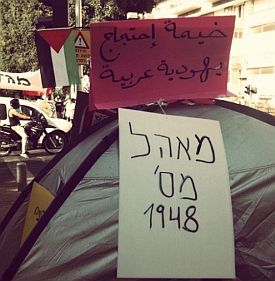
First, a tent titled “1948″ was pitched on Rothschild boulevard, housing Palestinian and Jewish activists determined to discuss Palestinian collective rights and Palestinian grievances as a legitimate part of the protests. They activists tell me the arguments are exhaustive, wild and sometimes downright strange; but unlike the ultra-right activists who tried pitching a tent calling for a Jewish Tel Aviv and hoisting homophobic signs, the 1948 tenters were not pushed out, and are fast becoming part of the fabric of this “apolitical” protest.

A few days after the 1948 tent was pitched, the council of the protests – democratically elected delegates from 40 protest camps across the country – published their list of demands, including, startlingly, two of the key social justice issues unique to the Palestinians within Israel: Sweeping recognition of unrecognised Bedouin villages in the Negev; and expanding the municipal borders of Palestinian towns and villages to allow for natural development.

The demands chimed in perfectly with the initial drive of the protest – lack of affordable housing. Neither issue has ever been included in the list of demands of a national, non-sectarian movement capable of bringing 300,000 people out into the streets.

And, finally, on Wednesday, residents of the Jewish poverty-stricken neighbourhood of Hatikva, many of them dyed-in-the-wool Likud activists, signed a covenant of cooperation with the Palestinian and Jewish Jaffa protesters, many of them activists with Jewish-Palestinian Hadash and nationalist-Palestinian Balad. They agreed they had more in common with each other than with the middle class national leadership of the protest, and that while not wishing to break apart from the J14 movement, they thought their unique demands would be better heard if they act together. At the rally, they marched together, arguing bitterly at times but sticking to each other, eventually even chanting mixed Hebrew and Arabic renditions of slogans from Tahrir.

Facebooktwittermail

How Israel trains its children to hate and kill Palestinians

The Guardian reports:

Nurit Peled-Elhanan, an Israeli academic, mother and political radical, summons up an image of rows of Jewish schoolchildren, bent over their books, learning about their neighbours, the Palestinians. But, she says, they are never referred to as Palestinians unless the context is terrorism.

They are called Arabs. “The Arab with a camel, in an Ali Baba dress. They describe them as vile and deviant and criminal, people who don’t pay taxes, people who live off the state, people who don’t want to develop,” she says. “The only representation is as refugees, primitive farmers and terrorists. You never see a Palestinian child or doctor or teacher or engineer or modern farmer.”

Peled-Elhanan, a professor of language and education at the Hebrew University of Jerusalem, has studied the content of Israeli school books for the past five years, and her account, Palestine in Israeli School Books: Ideology and Propaganda in Education, is to be published in the UK this month. She describes what she found as racism– but, more than that, a racism that prepares young Israelis for their compulsory military service.

“People don’t really know what their children are reading in textbooks,” she said. “One question that bothers many people is how do you explain the cruel behaviour of Israeli soldiers towards Palestinians, an indifference to human suffering, the inflicting of suffering. People ask how can these nice Jewish boys and girls become monsters once they put on a uniform. I think the major reason for that is education. So I wanted to see how school books represent Palestinians.”

In “hundreds and hundreds” of books, she claims she did not find one photograph that depicted an Arab as a “normal person”. The most important finding in the books she studied – all authorised by the ministry of education – concerned the historical narrative of events in 1948, the year in which Israel fought a war to establish itself as an independent state, and hundreds of thousands of Palestinians fled the ensuing conflict.

The killing of Palestinians is depicted as something that was necessary for the survival of the nascent Jewish state, she claims. “It’s not that the massacres are denied, they are represented in Israeli school books as something that in the long run was good for the Jewish state. For example, Deir Yassin [a pre-1948 Palestinian village close to Jerusalem] was a terrible slaughter by Israeli soldiers. In school books they tell you that this massacre initiated the massive flight of Arabs from Israel and enabled the establishment of a Jewish state with a Jewish majority. So it was for the best. Maybe it was unfortunate, but in the long run the consequences for us were good.”

Children, she says, grow up to serve in the army and internalise the message that Palestinians are “people whose life is dispensable with impunity. And not only that, but people whose number has to be diminished.”

Facebooktwittermail

Egypt comes to Israel

Noam Sheizaf reports:

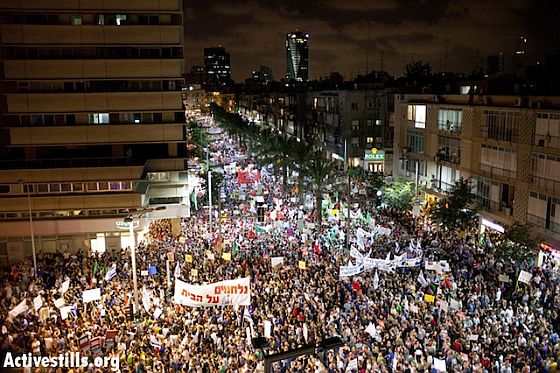
Around 300 thousands Israelis took the streets on Saturday night, calling for social justice and the introduction of a welfare state. Estimates are that this has been the largest demonstration in the country’s history.

The biggest of several rallies took place in Tel Aviv, where over 200,000 marched to the government building on Kaplan Street (Rabin Square, the usual site of such protests, is being renovated and was closed to the public). 30,000 marched in Jerusalem to PM Netanyahu’s house. Smaller rallies were held in Modi’in, Haifa, Nes Tziona and other towns. In Kiryat Shmone, protesters blocked the highway leading north.

Despite attempts by the organizers to convey a non-partisan message, many of the demonstrators directed their calls at Prime Minister Binyamin Netanyahu, and some held signs calling for his resignation. Former activist and Hadash MK called to the protesters: “With you, we will win over this pathetic government.” As was the case in previous rallies, the most popular call was “the people demand social justice,” followed by “Here comes the welfare state.”

Gideon Levy writes:

Tel Aviv was bursting at the seams last night. It was not the mother of all protests – it was the grandmother of all protests. The city looked yesterday like one of the stormiest cities on earth. Streams of people were flowing in every direction, some on foot, some in cars. Buses and trains spewed out the crowds, and not everyone even managed to get to the area of the protest. An amazingly large sign, in Hebrew and Arabic – the latter is about to cease being an official language in this country – read “Egypt is here.”

Indeed, the pictures last night looked like the nights of Tahrir Square. Now the comparison to the Cairo revolution is not exaggerated or wishful thinking. Now it really does resemble it, not including the violence, of course.

And really, when size talks, as it did last night, violence is not needed. A regime that remains impassive to such gigantic rallies would be completely insensitive, and in any case is destined to fall.

Prime Minister Benjamin Netanyahu can go on joking with his ministers; his fate is sealed. The cynics can continue tsk-tsking and talking about the “confused” and “spoiled” protest, and yet, a protest it is, the likes of which has never been seen here.

Facebooktwittermail

‘Israel is inadvertently becoming a part of the Middle East’

Amira Hass reports:

Palestinian social leaders believe the social protests that have erupted throughout Israel are largely influenced by the Arab Spring, contending Israelis must realize they too are suffering due to the occupation and money spent on settlements in the West Bank.

Israelis are imitating the Arab world, and West Bank Palestinians believe this to be a good thing. According to the Ma’an news agency, 14,032 (nearly 75%) of the 18,722 readers who responded to their online survey, believe that what is happening in Israel’s streets is influenced by and imitating the “Arab Spring”.

“Israel is inadvertantly becoming a part of the Middle East,” said sociologist Honaida Ghanim, who researches Israeli society, adding that “this is the power of bottom-up activity, when the country’s ideologists aren’t consulted.”

Ghanim wasn’t surprised when the protests began. As an Israeli citizen, born in Marja and General Director of “MADAR” the Palestinian Forum for Israeli Studies, the sociologist is well acquainted with Israeli polarization. However, she is certain that the recent events in Egypt and Tunisia had a large impact on the Israeli protest movement.

Sufian Abu Zaida is a member of Fatah and former prisoner, who currently teaches about Israeli society in the Birzeit University and the Al-Quds Open University. He was born in Jabaliya, a refugee camp in the Gaza Strip, to a family of refugees from the town Burayr (today Bror Hayil).

The Palestinian teacher promises to remind his students next year that “this might be the first thing Israelis learnt from Arabs. They have always presented themselves as the only positive ray of light in a pitch black Middle East. Suddenly there is something to learn from these retards.”

Ghanim cited additional sociological factors as part of the impetus for change in Israel, saying “on the one hand, there is neo-liberalism and globalization that have resulted in an unacceptable gap between the wealth of the state and individuals and the harshness of life for the masses. On the other hand, these are similar tools – online social networks, with Facebook heading the list, which had a far-reaching effect on the media.”

Despite this, there isn’t much interest among the Palestinians in the protest occupying Israel for over three weeks. “We are a people in perpetual struggle with the government, three weeks of protest are not long enough to seriously catch our attention,” said Nariman al-Tamimi, from Nabi Salih, and Afaf Ghatasha, a feminist activist and member of the Palestinian People’s Party.

However, they are both impressed – as are other Palestinians –that the Israeli movement is geared toward improving the already high level standard of living in Israel in comparison to that of most Palestinians. Israelis are making “demands that are luxuries,” according to Ghatasha.

Facebooktwittermail

Tent 1948

Abir Kopty writes:

If you are Palestinian, it will be difficult to find anything to identify with in Tel Aviv’s tents’ city, until you reach Tent 1948. My first tour there was a few days ago, when I decided to join Tent 1948. Tent 1948’s main message is that social justice should be for all. It brings together Jewish and Palestinian citizens who believe in shared sovereignty in the state of all its citizens.

For me, as Palestinian, I don’t feel part of the July 14 movement, and I’m not there because I feel part, almost every corner of this encampment reminds me that this place does not want me. My first tour there was pretty depressing, I found lots of Israeli flags, a man giving a lecture to youth about his memories from ’48 war’ from a Zionist perspective, another group marching with signs calling for the release of Gilad Shalit, another singing Zionist songs. This is certainly not a place that the 20% of the population would feel belong to. The second day I found Ronen Shuval, from Im Tirtzu, the extreme right wing organization giving a talk full of incitement and hatred to the left and human rights organizations. Settlers already set a tent and were dancing with joy.

The existence of Tent 1948 in the encampment constitutes a challenge to people taking part in the July 14 movement. In the first few days, the tent was attacked by group of rightwing activists, who beat activists in the tent and broke down the Palestinian flag of the tent. Some of the leaders of the July 14 movement have said clearly that raising core issues related to Palestinian community in Israel or the occupation will make the struggle “lose momentum”. They often said the struggle is social, not political, as if there was a difference. They are afraid of losing supporters if they make Palestinian issues bold.

The truth is that this is the truth.

The truth is, this is exactly what might help Netanyahu, if he presses the button of fear, recreates the ‘enemy’ and reproduce the ‘security threat’, he might be able to silence this movement. The problem is not with Netanyahu, he is not the first Israeli leader to rely on this. The main problem is that Israelis are not ready yet to see beyond the walls surrounding them.

Facebooktwittermail