The Guardian reports: Western air forces must be willing to confront Russian military jets over the skies of Syria to enforce a no-fly zone and protect the citizens of eastern Aleppo from a bombardment akin to the attack on Guernica during the Spanish civil war, UK MPs will be told by a former cabinet minister in an emergency three-hour Commons debate on Tuesday.
The intervention by Andrew Mitchell, the former international development secretary, and the granting of the debate itself, will force the UK’s Foreign Office to set out how it intends to respond after Russia’s veto of a UN resolution calling for a ceasefire in eastern Aleppo. The west has been criticised for lacking any leverage over Russia in Syria.
Britain has criticised Russia but set out no clear plan on how to respond to the growing threat posed by Moscow not just in the Middle East, but across eastern Europe. Mitchell argues the whole post-cold war international diplomatic architecture is being torn down by Russian actions. [Continue reading…]
Category Archives: Lands
Warming relations between Russia and Turkey as Putin and Erdogan revive pipeline deal
The New York Times reports: Amid increasingly tense relations with the United States over Syria, President Vladimir V. Putin of Russia took advantage of a routine meeting in Istanbul on Monday to advance the Kremlin’s reconciliation with Turkey, including an agreement to revive a suspended natural-gas pipeline project.
The new pipeline, known as the Turkish Stream, would run under the Black Sea to Turkey and then the Greek border, allowing Russian gas to reach Western markets without using Russia’s existing export pipelines through Eastern Europe.
The pipeline would make it much easier for Russia to cut off gas supplies to neighboring countries like Ukraine without disrupting sales to countries farther west like Italy or Austria. Russia has been trying for years to establish such an export route.
Mr. Putin’s appearance at an international energy conference was his first visit to Turkey since a crisis in relations between the countries after Turkey’s downing of a Russian fighter jet along the border with Syria in November 2015, in which a Russian pilot was killed. President Recep Tayyip Erdogan of Turkey, nominally an ally of the United States in Syria, patched things up with a letter of apology and a trip to St. Petersburg in August.
The two have sought to use their warming relationship both at home and abroad to indicate that they are not politically isolated and remain central players in any Syria solution. They sat next to each other in the front row of the World Energy Congress in Istanbul, laughing together, and later met for bilateral talks. [Continue reading…]
Why Yemen conflict has become another Syria
Simon Tisdall writes: The brazen attempt by Houthi rebels to sink a US warship patrolling off Yemen marks a potentially significant escalation of a conflict that has been alternately fuelled and ignored by the western powers. The attack by the Houthis, whose main backer is Iran, coincides with an unprecedented ballistic missile strike 325 miles inside Saudi territory and suggests a spreading, region-wide conflagration could be nearer at hand than previously thought.
Insurrection and revolt have been endemic in Yemen since the early part of this century. But the conflict intensified in March last year when Saudi Arabia, Iran’s main rival, launched a large-scale intervention, backed by a coalition of Arab states.
Since then an estimated 10,000 Yemenis have died and many more have been injured, displaced or have faced famine conditions. The US and Britain back the Saudi coalition and have provided limited practical support such as intelligence-sharing and training, but have eschewed direct involvement in Yemen. The exception is the CIA’s repeated drone strikes, including those against alleged Islamic State and al-Qaida in the Arabian Peninsula terrorists.
As in Syria, the Obama administration has favoured a hands-off approach, preferring to act through proxies rather than engage directly. This diffidence stems from Barack Obama’s fear of the US being sucked into more Middle East wars. It is also the byproduct of his controversial attempt to mend fences with Iran through last year’s landmark nuclear deal. [Continue reading…]
UN chief condemns airstrike on Yemeni funeral and dismisses Saudi denials
The New York Times reports: The United Nations secretary general, Ban Ki-moon, on Monday condemned a weekend airstrike on a funeral ceremony in the Yemeni capital, Sana, as well as the Saudi-led bombing campaign believed to be responsible for it.
Mr. Ban said he supported demands for an international inquiry into whether the attack, which killed at least 140 people, was a war crime.
“Despite mounting crimes by all parties to the conflict, we have yet to see the results of any credible investigations,” he said. “This latest horrific incident demands a full inquiry.”
Brushing aside Saudi Arabia’s initial denials of responsibility, he said reports from the site of the attack indicated that it was carried out by the Saudi-led coalition.
According to witness accounts cited by United Nations human rights investigators, two airstrikes struck the Al Kubra community hall in Sana, seven to eight minutes apart. It was packed with families attending the funeral of a leader of the Houthi rebel movement, which is battling the Saudi-backed government of President Abdu Rabbu Mansour Hadi for control of the country. Many prominent military and political leaders associated with the Houthis were in the hall and were killed in the assault, the United Nations said. [Continue reading…]
The Intercept reports: Fragments of what appear to be U.S.-made bombs have been found at the scene of one of the most horrific civilian massacres of Saudi Arabia’s 18-month air campaign in Yemen.
Aircraft from the Saudi-led coalition on Saturday bombed a community hall in Sana’a, Yemen’s capital city, where thousands of people had gathered for a funeral for Sheikh Ali al-Rawishan, the father of the rebel-appointed interior minister. The aircraft struck the hall four times, killing more than 140 people and wounding 525. One local health official described the aftermath as “a lake of blood.”
Multiple bomb fragments at the scene appear to confirm the use of American-produced MK-82 guided bombs. One fragment, posted in a picture on the Facebook page of a prominent Yemeni lawyer, says “FOR USE ON MK-82 FIN, GUIDED BOMB.” [Continue reading…]
‘Hard Brexit’ could cost 66 billion pounds a year
Reuters reports: The United Kingdom could lose up to 66 billion pounds a year under a “hard Brexit”, The Times reported citing leaked government papers.
GDP could fall by as much 9.5 percent if Britain leaves the European Union compared with if it stays within the union, The Times reported.
The 66-billion-pound figure was in a draft cabinet committee paper which was seen by The Times. [Continue reading…]
Everything Donald Trump says about Syria is crazy, wrong, or both

Michael Weiss writes: Well, now I prefer the guy who didn’t know what Aleppo is.
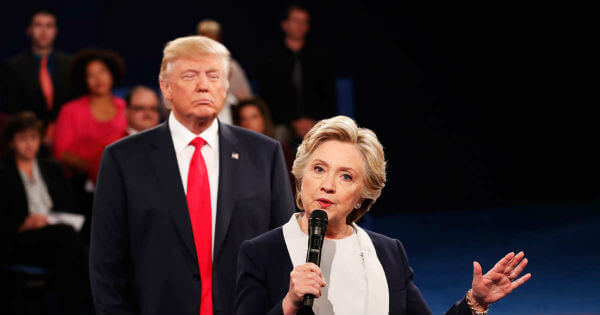
In the second presidential debate, during which Hillary Clinton looked as if she could profit from her own no-fly zone against her menacingly hovering opponent, Donald Trump made a series of assertions about the five-year-old humanitarian catastrophe in Syria that no one with access to Google, much less classified intelligence, ever ought to make. That he managed to do this while both deferring to a theocratic—excuse me, Islamic terrorist—regime he claims to reprehend and also humiliating his own running-mate in the process was a masterstroke of Trumpist illogic and megalomania.
By way of reaffirming his faith in a better working relationship with the Kremlin (whose hacking of the Democratic National Committee he again doubted), Trump stated that “Assad is killing ISIS. Russia is killing ISIS. And Iran is killing ISIS.” He sees this as proof of absent American leadership, and is quite comfortable being on their side in a civilizational struggle, even though he hates the fact that Iran is richer and only able to war against the Sunni extremists thanks to Obama’s nuclear deal.
In point of fact, none of the parties Trump rattled off has demonstrated much of a keenness or willingness to fight ISIS in Syria, as a bevy of U.S. officials and independent monitors have repeatedly pointed out. [Continue reading…]
Russia to build permanent Syrian naval base, eyes other outposts
Reuters reports: Russia will create a permanent naval base in Syria to expand its military footprint in its closest Middle East ally, a government official said on Monday, a week after Moscow said it was considering reopening Soviet-era bases in Vietnam and Cuba.
The move, announced by Russian Deputy Defence Minister Nikolai Pankov, is further evidence Russia is building up its capabilities in Syria despite a partial drawdown in March and another sign it is digging in for the long haul to help prop up President Bashar al-Assad.
“By doing this Russia is not only increasing its military potential in Syria but in the entire Middle East,” Senator Igor Morozov, a member of the upper house of parliament’s International Affairs Committee, told the RIA news agency. [Continue reading…]
Russian parliament authorizes air force to remain in Syria forever
RT reports: The lower house of the Russian parliament (the State Duma) has ratified an agreement allowing the country’s Air Force to stay in Syria on an unlimited basis. Combatting terrorism is cited as one of the key goals.
The ballot took place on Friday with all 446 legislators voting in favor of the agreement, which will be applied “for an unlimited period and is timely applied from the date of its signing.” [Continue reading…]
U.S. ‘could be implicated in war crimes’ in Yemen
Reuters reports: The Obama administration went ahead with a $1.3 billion arms sale to Saudi Arabia last year despite warnings from some officials that the United States could be implicated in war crimes for supporting a Saudi-led air campaign in Yemen that has killed thousands of civilians, according to government documents and the accounts of current and former officials.
State Department officials also were privately skeptical of the Saudi military’s ability to target Houthi militants without killing civilians and destroying “critical infrastructure” needed for Yemen to recover, according to the emails and other records obtained by Reuters and interviews with nearly a dozen officials with knowledge of those discussions.
U.S. government lawyers ultimately did not reach a conclusion on whether U.S. support for the campaign would make the United States a “co-belligerent” in the war under international law, four current and former officials said. That finding would have obligated Washington to investigate allegations of war crimes in Yemen and would have raised a legal risk that U.S. military personnel could be subject to prosecution, at least in theory.
For instance, one of the emails made a specific reference to a 2013 ruling from the war crimes trial of former Liberian president Charles Taylor that significantly widened the international legal definition of aiding and abetting such crimes.
The ruling found that “practical assistance, encouragement or moral support” is sufficient to determine liability for war crimes. Prosecutors do not have to prove a defendant participated in a specific crime, the U.N.-backed court found.
Ironically, the U.S. government already had submitted the Taylor ruling to a military commission at Guantanamo Bay, Cuba, to bolster its case that Khalid Sheikh Mohammed and other al Qaeda detainees were complicit in the Sept 11, 2001 attacks. [Continue reading…]
Iraq’s post-ISIS outlook darkens as factions turn on themselves
Financial Times reports: The turmoil began with a Shia-led parliamentary sit-in against Iraq’s Shia-dominated government. Next, a top Sunni minister was dismissed with the help of Sunni rivals. A few weeks later, the leading Kurdish minister was sacked — thanks partly to lawmakers in his own political bloc.
Sign up By signing up you confirm that you have read and agree to the terms and conditions, cookie policy and privacy policy.
Since the 2003 US invasion fostered splits along Iraq’s three main ethno-sectarian faultlines, Iraqis have grown accustomed to the country’s raucous factionalism. But now, those blocs are not only fighting each other, they are fighting among themselves, creating new schisms that risk fragmenting the political, social and tribal forces that keep Iraq patched together.It is happening as Baghdad battles to recapture territory from Isis, with the military preparing an offensive on the northern city of Mosul, and to overcome an economic crisis triggered by falling oil revenues.
“One of the greatest challenges this country is going to face after Isis is the Shia-Shia, Sunni-Sunni and Kurdish-Kurdish conflicts that are going to happen,” says Hanan al-Fatlawi, a Shia lawmaker and opponent of Haider al-Abadi, the prime minister. “This next struggle is coming soon.” [Continue reading…]
Amid Syrian chaos, Iran’s game plan emerges: A path to the Mediterranean
Martin Chulov reports: Not far from Mosul, a large military force is finalising plans for an advance that has been more than three decades in the making. The troops are Shia militiamen who have fought against the Islamic State, but they have not been given a direct role in the coming attack to free Iraq’s second city from its clutches.
Instead, while the Iraqi army attacks Mosul from the south, the militias will take up a blocking position to the west, stopping Isis forces from fleeing towards their last redoubt of Raqqa in Syria. Their absence is aimed at reassuring the Sunni Muslims of Mosul that the imminent recapture of the city is not a sectarian push against them. However, among Iraq’s Shia-dominated army the militia’s decision to remain aloof from the battle of Mosul is being seen as a rebuff.
Yet among the militias’ backers in Iran there is little concern. Since their inception, the Shia irregulars have made their name on the battlefields of Iraq, but they have always been central to Tehran’s ambitions elsewhere. By not helping to retake Mosul, the militias are free to drive one of its most coveted projects – securing an arc of influence across Iraq and Syria that would end at the Mediterranean Sea.
The strip of land to the west of Mosul in which the militias will operate is essential to that goal. After 12 years of conflict in Iraq and an even more savage conflict in Syria, Iran is now closer than ever to securing a land corridor that will anchor it in the region – and potentially transform the Islamic Republic’s presence on Arab lands. “They have been working extremely hard on this,” said a European official who has monitored Iran’s role in both wars for the past five years. “This is a matter of pride for them on one hand and pragmatism on the other. They will be able to move people and supplies between the Mediterranean and Tehran whenever they want, and they will do so along safe routes that are secured by their people, or their proxies.”
Interviews during the past four months with regional officials, influential Iraqis and residents of northern Syria have established that the land corridor has slowly taken shape since 2014. It is a complex route that weaves across Arab Iraq, through the Kurdish north, into Kurdish north-eastern Syria and through the battlefields north of Aleppo, where Iran and its allies are prevailing on the ground. It has been assembled under the noses of friend and foe, the latter of which has begun to sound the alarm in recent weeks. Turkey has been especially opposed, fearful of what such a development means for Iran’s relationship with the PKK (the Kurdistan Workers’ party), the restive Kurds in its midst, on whom much of the plan hinges. [Continue reading…]
Russia vetoes UN demand for end to bombing of Syria’s Aleppo
Reuters reports: Russia vetoed a French-drafted U.N. Security Council resolution on Saturday that would have demanded an end to air strikes and military flights over Syria’s city of Aleppo, while a rival Russian draft text failed to get a minimum nine votes in favor.
Moscow’s text was effectively the French draft with Russian amendments. It removed the demand for an end to air strikes on Aleppo and put the focus back on a failed Sept. 9 U.S./Russia ceasefire deal, which was annexed to the draft.
British U.N. Ambassador Matthew Rycroft told Russian U.N. Ambassador Vitaly Churkin: “Thanks to your actions today, Syrians will continue to lose their lives in Aleppo and beyond to Russian and Syrian bombing. Please stop now.”
Syrian President Bashar al-Assad’s forces, backed by Russian war planes and Iranian support, have been battling to capture eastern Aleppo, the rebel-held half of Syria’s largest city, where more than 250,000 civilians are trapped.
“Russia has become one of the chief purveyors of terror in Aleppo, using tactics more commonly associated with thugs than governments,” U.S. Deputy Ambassador to the United Nations David Pressman told the council. [Continue reading…]
Seven reasons the new Russian hack announcement is a big deal
Julia Ioffe writes: It’s been buried under news of Donald Trump bragging about his ability to grab women by their genitals, but Friday afternoon’s news dump included a stunning declaration by the Department of Homeland Security: the first direct accusation from the Obama administration that Russia is trying to interfere with our elections.
“The U.S. Intelligence Community is confident that the Russian Government directed the recent compromises of e-mails from US persons and institutions, including from US political organizations,” the statement said, concluding that “these thefts and disclosures are intended to interfere with the US election process.” After the Democratic National Committee hack and the scattered hacks of voting machines, and months of talk in the press and on Capitol Hill, the Obama administration has openly called out the Kremlin for meddling in the election.
This was immediately followed by a new dump of documents from WikiLeaks, this time of Clinton campaign chair John Podesta’s emails, and news that the Russian ambassador to the United Nations lodged a formal complaint with the organization when another official criticized Trump. And all of this comes against the backdrop of Trump’s constant and effusive praise for Vladimir Putin, as well as a steady stream of revelations about his campaign’s shady ties to Russia.
As head-spinning as it might be and as distracted as we might be by #TrumpTapes, this is arguably the more important story. What’s really going on? The hacking war is a genuinely new development in the long and often fraught U.S. relationship with Russia, and carries profound implications. Here’s what’s behind Friday’s statement — and why it matters so much. [Continue reading…]
U.S. set to open a climactic battle against ISIS in Mosul
The New York Times reports: As Iraqi and American troops prepare to try to retake the city of Mosul from the Islamic State, the Obama administration is describing the battle as the last major hurdle before declaring victory against the extremist Sunni militancy — in Iraq, at least.
But some former officials and humanitarian aid groups are worried that President Obama will run into the same problem that haunted his predecessor, George W. Bush: beginning a ground campaign without a comprehensive plan for what happens afterward.
“There’s an effort to proclaim mission accomplished, and obviously, getting back Mosul would be a momentous and symbolic defeat for ISIS,” said Vali Nasr, a former State Department official in the Obama administration, using another name for the Islamic State. But, he said, victory in Mosul without a detailed arrangement for how the city and the surrounding province will be governed “does nothing to prevent extremists from resurfacing again.”
Still, Obama administration officials are loath to further delay the operation, which they first envisioned two years ago, in order to sort out in advance the post-conflict political arrangements in and around Mosul, Iraq’s second-largest city. The administration is taking the calculated risk that the future of a region populated by a welter of ethnic and religious groups can be worked out peacefully as the battle unfolds or even after the militants are defeated, with American officials serving as brokers when needed but not imposing a plan. [Continue reading…]
Is Russia pulling Turkey away from the West?
Mustafa Akyol writes: A binational meeting was held in Moscow Oct. 2, bringing together Ahmet Tunc — an adviser of Melih Gokcek, the mayor of Ankara and a strong supporter of President Recep Tayyip Erdogan — and Aleksandr Dugin, a “special representative” of President Vladimir Putin. In the meeting, Dugin made the sensational claim that he himself helped save Turkey from the military coup by informing Turkish authorities about some “unusual activity” in the military July 14, a day before the coup attempt. He also claimed that the coup plot took place “because Erdogan had begun to turn toward Russia.”
Dugin also urged his Turkish guests to reconsider the orientation of their country. “You know, they are not welcoming Turks to Europe,” he said, in reference to Turkey’s unpromising bid to join the European Union. “Yet while Europe’s doors are closed to you, Russian ones are open.”
If Dugin were an ordinary Russian political scientist, these words would not mean much. But he is widely acknowledged as a major ideologue of the Putin regime. Western media outlets have dubbed him “Putin’s brain” and the “prophet of the new Russian Empire.” He is known for promoting “Eurasianism,” which seems to be “a scheme for uniting all the global enemies of liberalism under Russian leadership.” [Continue reading…]
Polish workers, Indian students and Italian politicians voice fears over Brexit effect on British culture
The Observer reports: Two young Polish women on the train from Gatwick into London are chattering away, bags at their feet. Off the flight from Kraków after five days at home with family, they followed the news, and the speeches, from Britain all week. “You have to – so as to get an idea of how long before we will be driven out of England. I’m sure it will happen,” said Angela, who is the manager of a gastropub near Oxford.
“It’s sad this is the way things are going because I was pleased to have a woman prime minister, but my boss said to me it will be bad. He’s angry because he wants to choose staff for how good they are, not their nationality. He says it will be hard to replace me, which is nice to hear,” she said.
Angela and her friend, Martina, are among the 600,000 people who will not have been in the UK for five years – giving, under present rules, permanent residency rights – by the time the UK leaves the EU in 2019. Now she and her friend are alarmed by the tone of the rhetoric that emerged from last week’s Tory conference. They are among thousands across Europe and beyond who fear that life for people hoping to settle in Britain may be about to become more difficult.
Of the 2.1 million EU nationals employed in the UK, Poles are the biggest group. Of EU nationals in the UK, Poles number 916,000, Irish 332,000, Romanians 233,000 and Portuguese 219,000, according to latest figures from the Office of National Statistics.
“My cousin is a priest here, he would rather be in Poland, close to his old mother, but he came where there is a shortage [of priests] and to be where he is needed. Britain does need workers,” Angela said. “In Poland people are worried, shocked. They say Britain is now dangerous and tell stories in the newspaper of race attacks and murders. People are scared if their children are living here,” she added. [Continue reading…]
Nearly half the adults in Britain and elsewhere in Europe hold extremist views
BuzzFeed reports: Almost half of the adults in 12 European countries now hold anti-immigrant, nationalist views, according to major new research that reveals the spread of fringe political views into the mainstream.
BuzzFeed News has been given exclusive access to new data from YouGov, which polled more than 12,000 people across the continent to measure the extent of what it termed “authoritarian populist” opinions – a combination of anti-immigration sentiments, strong foreign policy views, and opposition to human rights laws, EU institutions, and European integration policies.
The YouGov findings are the first to capture the political attitudes that are both fuelling, and being fuelled by, upheaval across Europe and beyond – from the continent’s refugee crisis and the Brexit vote in Britain, to the burkini ban in France, to the rise of Donald Trump and the radical “alternative right” in the US.
In Britain, the poll found authoritarian populist attitudes were shared by 48% of adults, despite less than 20% of the population identifying itself as right-wing. Three months on from the EU referendum, prime minister Theresa May has responded this week by appealing directly to disaffected working-class voters with a promise to crackdown on immigration and reassert British sovereignty. [Continue reading…]
The United States and Russia are prepping for doomsday
Jeffrey Lewis writes: The other day, a little present arrived in the mail. It was book, or rather a pair of doorstops. Titled Doomed to Cooperate, the massive two-volume set is about 1,000 pages of essays, interviews, and vignettes from more than 100 participants in the remarkable period of cooperation between the nuclear weapons complexes of the United States and Russia in the immediate post-Cold War period. Siegfried Hecker, who edited the volumes, titled them after the remark of a Soviet scientist, who said of the shared danger that nuclear weapons pose, “Therefore, you know, we were doomed to work together, to cooperate.” Not everyone got the message, certainly not Vladimir Putin. Set against relations between Washington and Moscow today, the incredible stories in Hecker’s two volumes seem to be from another era entirely. On Monday, Putin issued a decree suspending a plutonium disposition agreement with the United States due to its “unfriendly actions.” (An unofficial translation is available from the Center for Energy and Security Studies in Moscow, as is a draft law submitted by the Kremlin.) Putin’s decree ends one of the last remaining forms of cooperation from that remarkable era.
“Plutonium disposition” is a fancy sort of phrase, the kind of term of art that, when I drop it at a cocktail party, sends people off to refill their drinks. But plutonium is the stuff of which bombs are made. After the Cold War, the United States and Russia agreed to dispose of tons of plutonium to make sure it could never be put back into bombs. So believe you me, when the Russians decide that maybe they should just hang on to that material for a while longer, it’s not so boring.
And we’re talking about a lot of plutonium here. If you recall the dark days of the Cold War, or maybe just read about them in a book, the United States and Soviet Union each had tens of thousands of nuclear weapons. That’s sort of insane if you think about what just one nuclear bomb did to Hiroshima and another to Nagasaki. But the United States and the Soviet Union each built stockpiles in excess of 30,000 nuclear weapons at their peak, massive arsenals of nuclear weapons that vast exceeded any conceivable purpose. And at the beating heart of the vast majority of those bombs were tiny little pits of plutonium.
Washington and Moscow have made great strides in reducing their vast nuclear arsenals, although we still have more than enough nuclear weapons to kill each other and then make the rubble bounce. The United States, for example, has reduced its stockpile from a peak of 31,255 nuclear weapons in 1967 to 4,571 in 2015. Let’s just say Russia’s stockpile is comparable, though perhaps not quite as modest.
Of course, retiring a nuclear weapon requires it to be dismantled. In the United States, a backlog of thousands of weapons awaits dismantlement. That queue stretches to 2022, and few experts think the United States will meet that target. And even once a weapon is dismantled, that still leaves the plutonium. As long as the plutonium exists, it can be turned back into a nuclear bomb.
The United States and Russia have lots and lots of plutonium left over from the Cold War. Neither country makes new plutonium anymore, or at least no weapons-grade plutonium, but don’t worry — there’s still more than enough to keep you up at night. The International Panel on Fissile Materials, at Princeton University, estimates the stockpiles of weapons-grade plutonium at 88 metric tons for the United States and 128 metric tons for Russia. To give you a sense of how much plutonium that is, it is an unclassified fact that a nuclear weapon can be made with as little as 4 kilograms of plutonium. It’s a slightly touchier subject that this is the average in the U.S. stockpile — one can make do with less. But let’s do the math: Even at 4 kilograms per nuclear weapon, 88 metric tons represents enough material for 22,000 nuclear weapons. [Continue reading…]