Kenan Malik writes: Debates about immigration are… rarely about numbers as such. They are much more about who the migrants are, and about underlying anxieties of nation, community, identity and values. ‘We should not forget’, claimed Hungarian prime minister Viktor Orbán, as Hungary put up new border fences, and introduced draconian new anti-immigration laws, ‘that the people who are coming here grew up in a different religion and represent a completely different culture. Most are not Christian, but Muslim.’ ‘Is it not worrying’, he asked, ‘that Europe’s Christian culture is already barely able to maintain its own set of Christian values?’
Many thinkers, Christian and non-Christian, religious and non-religious, echo this fear of Muslim immigration undermining the cultural and moral foundation of Western civilization. The late Oriana Fallaci, the Italian writer who perhaps more than most promoted the notion of Eurabia – the belief that Europe is being Islamicised – described herself as a ‘Christian atheist’, insisting that only Christianity provided Europe with a cultural and intellectual bulwark against Islam. The British historian Niall Ferguson calls himself ‘an incurable atheist’ and yet is alarmed by the decline of Christianity which undermines ‘any religious resistance’ to radical Islam. Melanie Phillips, a non-believing Jew, argues in her book The World Turned Upside Down that ‘Christianity is under direct and unremitting cultural assault from those who want to destroy the bedrock values of Western civilization.’
To look upon migration in this fashion is, I want to suggest, a misunderstanding of both Europe’s past and Europe’s present. To understand why, I want first to explore two fundamental questions, the answers to which must frame any discussion on inclusion and morality. What we mean by a diverse society? And why should we value it, or indeed, fear it?
When we think about diversity today in Europe, the picture we see is that of societies that in the past were homogenous, but have now become plural because of immigration. But in what way were European societies homogenous in the past? And in what ways are they diverse today?
Certainly, if you had asked a Frenchman or an Englishman or a Spaniard in the nineteenth or the fifteenth or the twelfth centuries, they would certainly not have described their societies as homogenous. And were they to be transported to contemporary Europe, it is likely that they would see it as far less diverse than we do.
Our view of the Europe of the past is distorted by historical amnesia; and our view of the Europe of the present is distorted by a highly restricted notion of diversity. When we talk of European societies as historically homogenous, what we mean is that they used to be ethnically, or perhaps culturally, homogenous. But the world is diverse in many ways. Societies are cut through by differences, not only of ethnicity, but also of class, gender, faith, politics, and much else. [Continue reading…]
Category Archives: Lands
‘UK approach’ to Brexit will allow Scotland to determine when Article 50 gets invoked
The possibility of the UK’s withdrawal from the EU leading to the demise of the UK, is reminiscent of the case in which the doctor comes out of the operating theater and says, “the surgery was successful but unfortunately the patient died.”
The EU referendum question — “Should the United Kingdom remain a member of the European Union or leave the European Union?” — had a false simplicity because it didn’t address the issue of the UK’s ability to remain intact outside the EU.
For this reason, Britain’s new prime minister, Theresa May, is adopting a “UK approach” to Brexit which takes the UK’s continued existence as a requirement in the unfolding political process.
The Telegraph reports: Theresa May has indicated that Brexit could be delayed as she said she will not trigger the formal process for leaving the EU until there is an agreed “UK approach” backed by Scotland.
The Prime Minister on Friday travelled to Scotland to meet Nicola Sturgeon, the First Minister, and discuss plans for Britain’s Brexit negotiation.
In a sign that the new Prime Minister is committed to keeping the Union intact, she said she will not trigger Article 50 – the formal process for withdrawing from the EU – until all the devolved nations in the country agree.
Her comments could prompt anger from EU leaders, who want Mrs May to trigger Article 50 as soon as possible.
Speaking in Edinburgh, Mrs May said: “I have already said that I won’t be triggering Article 50 until I think that we have a U.K. approach and objectives for negotiations. I think it is important that we establish that before we trigger Article 50.”
Ms Sturgeon has promised to explore every option to keep Scotland in the EU, and has repeatedly warned that if that is not possible as part of the UK, it is “highly likely” to lead to a second independence vote. [Continue reading…]
In the 2014 referendum on Scottish independence, the strongest argument that was made against independence was that it would only be by remaining part of the UK that Scotland could ensure its continuing membership of the EU. Both in 2014 and now, the Scottish people have shown that whatever Scotland’s relationship with the rest of the UK might end up being, Scotland’s overriding priority is to remain in the EU.
Police and academics search Nice attacker’s history for a motive
Jason Burke writes: Lahouaiej-Bouhlel certainly matches the classic profile of French violent Islamic extremist in many ways – though he is a relatively recent arrival rather than born in the country of immigrant parents, as is more usually the case. He was a young, male petty criminal. He was also not devout, all witnesses so far agree. He did not fast during Ramadan, ate pork, drank, and was never seen at any local mosque.
This lack of piety among militants may seem confusing. It is, however, the rule rather than the exception. It was true of the dozen or so French and Belgian young men involved in bombings and shootings earlier this year, and of Mohammed Merah, who committed the first major attack in France in 2012. Other examples beyond France include that of Omar Mateen, who killed 49 in a Florida nightclub last month.
This apparent paradox has prompted a keen debate among experts. The argument has major policy implications. In France, it has been bitter. Olivier Roy, a well-known French scholar currently at the University of Europe in Florence, suggests those drawn into violent activism are already “in nihilist, generational revolt”. This is why so many are criminals, or marginal. Extremist Islam gives them a cause and frames anger and alienation in the way extremist leftwing ideologies did for some in the 1960s and 1970s. The new militants are thus not victims of “brainwashing” by cynical and fanatical recruiters. This is the Islamisation of radicalism, Roy says, not the radicalisation of Islam.
Many disagree. Some say Roy naively ignores the impact of intolerant and reactionary doctrines on Muslim communities in the west. Others suggest he underestimates the historical impact of western colonialism as well as that of more recent western policies in the Middle East. [Continue reading…]
Nice attacker was radicalised within months and sent £84,000 to his Tunisian family days before attack
The Telegraph reports: he terrorist behind the Bastille Day atrocity was radicalised within months and sent his Tunisian family £84,000 just days before the massacre, it was claimed on Saturday.
Mohamed Lahouaiej Bouhlel’s brother in Tunisia described receiving the fortune in cash as police swooped to arrest five suspected associates across the city of Nice
The French interior minister, Bernard Cazeneuve, said the attacker “appears to have become radicalised very quickly” as one neighbour of his estranged wife added: “Mohamed only started visiting a mosque in April.”
Investigators examining Bouhlel’s phone records found evidence that he was in contact with known Islamic radicals.
However, an intelligence source cautioned: “That could just be a coincidence, given the neighbourhood where he lived. Everyone knows everyone there. He seems to have known people who knew Omar Diaby (a known local Islamist believed to be linked with the Al Nusra group close to Al Qaeda).”
Relatives have reportedly claimed Bouhlel, in the days before the attack, persuaded friends to smuggle the bundles of cash back to his family in their hometown of Msaken, Tunisia.
His brother Jaber also said he had not seen his brother for several years and the money had come as a complete surprise. [Continue reading…]
The Guardian reports: The Tunisian delivery driver who killed 84 people on Thursday when he drove a truck at high-speed into a crowd watching Bastille Day fireworks in Nice sent a text message just before the attack about his supply of weapons.
Mohamed Lahouaiej-Bouhlel, 31, wrote of his “satisfaction at having obtained a 7.65mm pistol” and discussed “the supply of other weapons,” a police source confirmed to AFP. Two replica assault rifles and a dummy grenade were also found in the truck.
It also emerged that Lahouaiej-Bouhlel took pictures of himself at the wheel of the truck before the fatal attack, and shared them by text message. Over 200 investigators are working on identifying the recipients of the messages. [Continue reading…]
How ISIS is getting beaten at home — and taking terror abroad
Mark Perry writes: Just 24 hours after a Tunisian-born French citizen killed more than 80 people in Nice, President Obama is coming under fire from critics for “fiddling around” against the Islamic State, as former CIA Director James Woolsey said on Thursday night on MSNBC. While it isn’t yet clear whether the Nice attack was ISIS-ordered or inspired, Woolsey questioned Obama’s commitment to destroying the jihadist group, saying “we haven’t taken the gloves off.”
In fact, according to several senior serving and retired military officers, Woolsey has it wrong. “ISIS is reeling and their fighters are fleeing the battlefield,” a senior officer of the U.S. Central Command (Centcom), told me last week. “We don’t have a victory yet, but we’re winning and it’s not even close. The campaign is absolutely relentless, very violent. We’re killing a lot of their people. That’s a fact, and it’s undeniable.” In recent weeks Iraqi forces have taken back the city of Fallujah and regained control of key positions near the city of Mosul.
Unfortunately, this same officer says, the success of the anti-ISIS, U.S.-led air campaign is having some unintended, but predictable, consequences. One of them is the increasing vulnerability of European countries, particularly those (like France) that are participants in the air campaign. [Continue reading…]
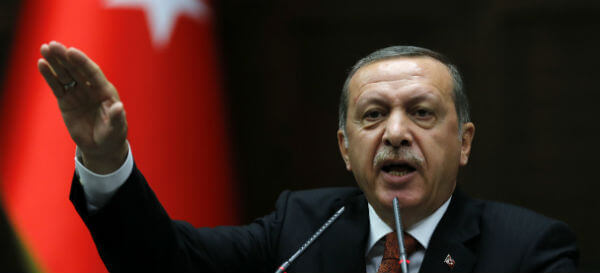
Erdogan sees attempted coup as ‘gift from God’

I don’t have much patience for conspiracy theories, but the one incontrovertible fact about all coups is that, by definition, coups involve conspiracies.
A conspiracy of some kind has been unfolding in Turkey over the last 24 hours. What is unclear is who was involved, what exactly they had planned, and what was the basis of their expectations.
President Tayyip Erdogan now says: “This uprising is a gift from God to us because this will be a reason to cleanse our army.”
Indeed. Turkey’s president comes out of this event the big winner. He can present himself as a man of the people strong enough to withstand any domestic challengers.
The Telegraph reports:
When he arrived in Istanbul in the early hours of the morning, Mr Erdogan, grave and ashen-faced, warned that his foes would “pay a heavy price” for their “treason and rebellion”.
The deputy leader of his AK party demanded the return of the death penalty so that putschists could be “executed”. Meanwhile, the deputy prime minister promised to rid the government of all enemies. “Even if they went into the tiniest veins of the state, they will be purged,” he declared.
Whatever steps he now takes to consolidate and expand his power, he can do so in the name of defending peace and stability — Erdogan, the guardian of democracy, dedicated to preventing Turkey ever again coming under military rule.
As soon as news broke about the coup attempt, the first question everyone had was about the president’s whereabouts. In any coup, typically one of the first steps is to kill or capture the head of state. In this case, Erdogan was away on vacation in the resort town of Marmaris, but he claims to have eluded several assassination attempts last night.
When Erdogan made his first television appearance via Facetime, it would be hard to say he looked presidential, but then again, he didn’t have a gun pointed at his head.
Erdogan making statement on Facetime. TV broadcasts live. pic.twitter.com/UYoe5Loob9
— Gilgo (@agirecudi) July 15, 2016
Meanwhile, shutting down some bridges and sending some tanks into the streets is an effective way of creating news footage for television and social media, but it would have taken a much larger show of force to convince the residents of any of Turkey’s major cities that the military had really taken control. There’s a big difference between ordering a curfew and having the ability to impose one.
If the plan devised for carrying out this coup seems to have been poorly conceived and poorly executed, the plan for handling the outcome seems stunningly detailed and is being implemented faster than the coup itself.
2,839 soldiers, including high-ranking officers, have been arrested and 2,745 judges have also been dismissed today.
The investigative procedures in Turkey are either extraordinarily efficient, or, more likely, a lot of decisions about how to deal with this coup were made well before the coup itself took place.
The purge of Ergodan’s enemies hasn’t just begun, but it will now move forward with a dramatic advance in pace.
For Turkey’s sake, Erdoğan should resist desire for revenge
Simon Tisdall writes: Recep Tayyip Erdoğan is a man of choleric disposition. The Turkish president has a track record of ruthlessness in dealing with opponents and critics and, thus, his response to Friday’s attempted coup by sections of the Turkish military can be expected to be fierce and brutal..
Erdogan’s combative outlook is the result, at least in part, of his experiences as a poor child growing up in a working-class Istanbul neighbourhood, and of the tough treatment handed out to him when, as mayor of the city and a rising opposition star prior to 2003, he was hounded, persecuted and sentenced to jail along with many of his supporters.
But his tough-guy stance is also the result of his determination to have his own way; his paternalistic conviction that he knows what’s best for Turkey.
Since becoming prime minister and now president, Erdoğan has frequently claimed to be the target and victim of murky conspiracies designed to depose him and destroy his neo-Islamist ruling party, the Justice and Development party (AKP). Usually, in his mind, these supposed plots are directed by hidden enemies based abroad. His particular bête noir is Fethullah Gülen, a former ally now exiled in the US. [Continue reading…]
Who was Mohamed Lahouaiej Bouhlel, the French-Tunisian suspect behind the Nice attack?
Why does France keep getting attacked?
Jason Burke writes: So once again, there will be the tricolour flag projected on buildings around the world, a hashtag expressing solidarity with France, and declarations of sympathy.
There will also be the question: why is France suffering a wave of extremist violence that is more intense – certainly more lethal – than any other seen in the west since the 9/11 attacks almost 15 years ago?
Though it is still unclear if the driver of the truck in Nice was linked to any broader network or organisation – prosecutors on Friday said only that his actions were in line with an Isis call to action – his attack is a grim reminder of the bloodshed on Paris just months ago.
One reason that France is a particular target is down to a specific decision by Islamic State to target it. In September 2014, shortly after the beginning of airstrikes by a US-led coalition which includes France, the chief spokesman for Isis, Mohammad al-Adnani, singled out the “spiteful French” among a list of enemies in a speech calling for the group’s sympathisers to launch attacks across the west.
Undoubtedly, the role France has historically assumed as standard bearer of western secular liberalism has also put the nation in the spotlight. Islamic extremists may see the US as a source of moral decadence and economic exploitation, but France is seen as an atheist power which is both defending western ideals such as human rights, free speech and democracy and, in the eyes of jihadis, trying to impose them on the Islamic world.
We know from interrogations of Isis returnees that the group started planning strikes in France even before it seized the Iraqi city of Mosul and declared a caliphate in 2014. [Continue reading…]
Syria’s deadly spillover
James Denselow writes: Recent deadly events in the Middle East have taken attention away from the central Syrian conflict.
Suicide bombers have struck three Saudi cities, multiple suicide attacks have hit a Christian village in North-Eastern Lebanon, Turkey is still reeling from the attack on its international airport in Istanbul, Jordan has declared its Syria border a closed military zone while Iraqis are still getting over the huge attack that killed 292 people in Baghdad.
While the conflict inside Syria is fluid, multi-layered and deadly, it has been relatively, and somewhat surprisingly, contained over the past five years. This can no longer be said to be the case and a new European Council on Foreign Relations report has warned of a “regional contagion” as the delicate balance of power in Syria’s neighbours and the wider Middle East beings to wobble. [Continue reading…]
Climate change department shut down by Theresa May in ‘plain stupid’ and ‘deeply worrying’ move
The Independent reports: The decision to abolish the Department for Energy and Climate Change has been variously condemned as “plain stupid”, “deeply worrying” and “terrible” by politicians, campaigners and experts.
One of Theresa May’s first acts as Prime Minister was to move responsibility for climate change to a new Department for Business, Energy & Industrial Strategy.
Only on Monday, Government advisers had warned of the need to take urgent action to prepare the UK for floods, droughts, heatwaves and food shortages caused by climate change.
The news came after the appointment of Andrea Leadsom – who revealed her first question to officials when she became Energy Minister last year was “Is climate change real? – was appointed as the new Environment Secretary.
And, after former Energy and Climate Change Secretary Amber Rudd announced in November that Britain was going to “close coal” by 2025, Ms Leadsom later asked the coal industry to help define what this actually meant.
Former Labour leader Ed Miliband tweeted: “DECC abolition just plain stupid. Climate not even mentioned in new deptartment title. Matters because departments shape priorities, shape outcomes.” [Continue reading…]
Plans to bring Contempt of Parliament charges against Tony Blair for lying about war in Iraq
‘Trapped by all the sides’ in Yemen’s largely ignored war
The Washington Post reports: The streets are eerily silent in this front-line enclave near Taiz’s Freedom Square, where thousands of protesters rose up against Yemen’s government five years ago.
The presidential palace nearby survived the demonstrations but not the war that followed. It is now a concrete carcass, pummeled by airstrikes. Shops are shuttered and homes are empty. The only people who remain cannot afford to go anywhere else.
By day, snipers strike down residents. At night, the gunfire and artillery shelling start.
“We’re trapped by all the sides,” said Ghulam Sayed, a former bus driver.
For weeks, Yemen’s warring factions have held peace talks to end their 16-month civil war, bringing a sense of calm to much of the country. But in the southwestern city of Taiz the conflict rages on, defying a U.N.-backed cease-fire. Civilians are indiscriminately killed or wounded daily. Thousands languish in ragged displacement camps. Humanitarian groups are blocked from adequately helping victims.
On one side of the war is an alliance of Shiite Houthi rebels and loyalists of former president Ali Abdullah Saleh. They have seized the capital, Sanaa, and control the northern half of the country.
On the other side is the government, backed by the United States, Saudi Arabia and other regional powers. It controls only portions of the south, including the port of Aden. The rest is lawless or ruled by radical Islamists. [Continue reading…]
9/11 report’s classified ’28 pages’ about potential Saudi Arabia ties released
The Guardian reports: The Obama administration has released the long-classified 28 pages of the official congressional report on the 11 September 2001 terrorist attacks, which concerned the alleged ties of the Saudi Arabian government to the 9/11 hijackers.
Publishing the long-awaited pages 13 years after they were first classified, the White House insisted they show no link between Saudi Arabia and the hijackers who carried out the terrorist attacks. The pages put into the public domain the remaining unseen section of the 2002 report, from the joint congressional inquiry into intelligence community activities before and after the 9/11 attacks.
“This information does not change the assessment of the US government that there’s no evidence that the Saudi government or senior Saudi individuals funded al-Qaida,” said Josh Earnest, the White House press secretary. “The number one takeaway from this should be that this administration is committed to transparency even when it comes to sensitive information related to national security.” [Continue reading…]
Egypt’s Brotherhood, Sisi both put out feelers for reconciliation
Abdelrahman Youssef writes: The word “reconciliation” has been dominating the Egyptian political scene for almost two weeks. Talk has revolved around the future of the relationship between the regime and the Muslim Brotherhood, which is facing the worst crackdown since its establishment.
Political discussions in Egypt are not what brought about this prevalent idea; rather, it emerged due to a number of coalesced factors, notably the statement of Legal and Parliamentary Affairs Minister Magdy al-Agaty, who said in an interview, “We can reconcile with a member of the Brotherhood as long as his hands are not stained with blood. [Brotherhood members] are Egyptians in the first place. Why don’t we make peace with them and integrate them into the fabric of the Egyptian people if they did not commit any crime?”
However, it was not long before this controversial issue came to the surface again when Mohamed Fayek, head of the National Council for Human Rights, said July 3, “There will be a presidential pardon soon for all the detained young people who were not involved in armed activities.” [Continue reading…]
Bernard-Henri Lévy: ‘Europe without the British spirit cannot be Europe’
Richard Williams interviews the French philosopher, Bernard-Henri Lévy: The outcome of the Brexit vote, not surprisingly, upset him. “For me, all my life, England has been really an example, a model. In dark times, this country has so often had the good reflex. I never saw in my lifetime, and I don’t find in my memory, a circumstance in which this country has gone through such a disaster with open eyes and such a popular fervour, left and right united in the same dishonour, nobody wanting to take the responsibility of going out. This is incredible. What’s sad is that England has added a little chapter to the history of the shameful comedy of bad politics.”
The referendum, he says, should never have been called. “A referendum is really the last option. It should not be a regular form of government. There is a great mistake in taking the option of referendum for personal reasons, for domestic reasons, in order to improve a career and so on. And when the destiny of a country is at stake, the destiny of a continent, it’s such a risk to play that with a tiny majority.
“You ask the people for a reply to a question. But democracy is not only a reply to a question. Democracy is first to shape the question, number two to reply, and number three to adapt to the reply with some laws and decrees and so on. Democracy means all three: to raise, to reply and to apply. A referendum is only number two, without the raising of the question and the application. So, even in the most traditional terms of political philosophy, you cannot say that a referendum is the embodiment of democracy. Not: ‘Are you for Europe or not for Europe?’ A question in democratic terms is something more sophisticated. Which can be the product of the will of the people, but not like this” – he snaps his fingers – “on one Thursday.”
And will the consequence of the British withdrawal be to solidify Europe, or to atomise it? “I don’t know. First of all, it is atomising the United Kingdom. Mr Cameron, Mr Boris Johnson and Mr Farage made a big achievement – they took the risk of destroying a great 60-year-old institution, and the many-centuries-old political whole that is the United Kingdom. This is the situation. And Europe without the UK, without the British spirit, cannot be Europe. It will be a huge loss of being, a loss of substance.” [Continue reading…]
Boris Johnson and diplomacy are not synonymous
Patrick Wintour writes: Boris Johnson’s surprise appointment as foreign secretary is as much about the dismemberment of the foreign office as the sudden resurrection of the Conservative party’s favourite loveable rogue. It is also the first confirmation that Theresa May is going to be prepared to take risks in government.
For diplomacy and Boris Johnson are not, after all, exactly synonymous. Any cursory reading of his regular Daily Telegraph columns reveals praise of Vladimir Putin, calls to accommodate Syrian president, Bashar al-Assad, and indiscretions about the president of the United States. The Germans have previously singled out Johnson for causing Brexit with “a diet of lies”.
So even though Johnson had played a dominant role in the leave campaign, few thought May would regard it as politically necessary to bring him back into the fold. He may remain hugely popular in the Tory constituencies and large parts of the country but he was always assumed to be too big a risk and someone who might outshine the comparatively dour prime minister.
Margaret Thatcher for instance tended to favour the duller end of the foreign secretaryship, choosing figures such as Geoffrey Howe, Francis Pym or Douglas Hurd.
But the foreign secretaryship may not turn out to be one of the great offices of state in a May government. Much of the heavy lifting on Brexit is going to be taken up by a new Brexit department, and to be conducted by David Davis, a former shadow home secretary and Europe minister in the Major government. Davis had no role in the Cameron government and was untrusted by the Cameron team, but now faces one of the toughest jobs in government. It will be his task to disentangle the UK from the European Union, including when to trigger article 50. Johnson – who has in the past likened the EU to ill-fitting underwear – will be kept away. [Continue reading…]
Polly Toynbee writes: The Boris shock appointment looks strangely out of kilter with May’s “safe pair of hands”. It may please her to see appalled faces in the Foreign Office, but this feels like an isolationist insult to the world. His first global tour will need to be on his knees.
How will the “special relationship” fare when he meets Hillary Clinton, whom he calls “a sadistic nurse”? Or the touchy, but geopolitically pivotal, President Recep Tayyip Erdoğan, about whom he has only just written an obscene limerick rhyming Ankara with wankerer. Funny? Not so much in a foreign secretary.
Racist pro-colonial “jokes” will precede him wherever he goes – “piccaninnies” and “natives” with “watermelon” smiles – a whole back catalogue of deliberate offence.
Those who feel ashamed already at how the world sees our xenophobic referendum will have a lot more to blush about as Boris brags and blusters his self-obsessed way through diplomatic etiquette. The Middle East? He praises Syria’s Bashar al-Assad. Europe? He compared the EU to Hitler. This man, unconnected to notions of truth, is in charge of MI6. What kind of negotiator will he be on anything sensitive (and everything is)?
Maybe May hopes he’ll crash and burn, but he can do great damage wherever he goes. The joke will be on us, for letting him treat the rest of the world as his playground. [Continue reading…]
What’s the best Brexit Theresa May could get for Britain?
Patrick Wintour writes: Theresa May’s mantra “Brexit means Brexit” is designed to reassure. Suspicious leavers are being told by their new prime minister that there will be no reversal, slippery evasions or procrastination on her watch.
In the referendum campaign she may have been a reluctant remainer, but the message – with Brexiters taking the three top foreign policy jobs in cabinet – is that she will now abide by the people’s instructions. In the best Thatcherite tradition there will be no turning back.
Yet “Brexit means Brexit” means next to nothing since there are so many ways for the UK to leave the European Union, and so many different kinds of new relationship with the EU on offer, each with their own balance of advantage and disadvantage. Indeed few made a more careful attempt to weigh those risks than May herself in a lengthy speech on 25 April.
May is a stickler for detail and doubtless will be alarmed by the absence of a coherent plan for Brexit in Whitehall. If preparation is a prerequisite for successful Brexit, the omens are poor. The official leave campaign, focused on victory and avoiding internal division, drew up only the flimsiest plan for what Brexit would look like, pointing vaguely at the exit door, but with little idea of what lay the other side. Foreign Office diplomats were instructed to draw up no contingency plans whatsoever, supposedly for fear they might leak. [Continue reading…]