Category Archives: Lands

The largely unheard story of democracy developing in Syria

Syria1

Middle East Monitor reports: Until now the Syrian story has been a fabrication of assumptions and sensationalism spun by the media. Burning Country is an attempt to counter this, a chance for real Syrians to tell their own stories. As co-author Robin Yassin-Kassab puts it: “We felt that people had been coming at it from narratives of big stories that zoomed out so far they couldn’t hear the people on the ground that had made the revolution and were suffering the counter-revolution. We wanted to amplify those voices.”

Yassin-Kassab and fellow co-author Leila Al-Shami have weaved together the testimonies of revolutionaries, activists, refugees, fighters, democracy activists, pro-regime Alawites and Islamists with their own analysis to create an account of Syria that takes us back further than Ottoman rule and up to October 2015. Published by Pluto Press this year, the book describes how Al-Assad was once respected for adopting an anti-Zionist, anti-Western and pro-Arab rhetoric and today garners western sympathy for his so-called opposition to US-led imperialism, a position the authors describe as “populist opportunism”.

“I think his rhetoric was very anti-imperialist and that was in line with popular sentiment in the Arab street and I think for that reason he was popular for his foreign policy stance both inside Syria and more broadly around the Arab world,” says Al-Shami. “But that didn’t match up in practice and when you see the actions of the Baathist regime whether they’re under Bashar or his predecessor, his father, they certainly didn’t match that rhetoric. You had the massacres of Palestinians in Tel Zaatar camp in Lebanon, you had the intervention against the Black September movement in Jordan and then under Bashar you had collusion with imperialism because you had people that were basically deported, tortured by proxy, to the Assad regime under the US rendition programme as part of its ‘War on Terror’.”

Though the nationalist rhetoric did work among some sections of the population, Yassin-Kassab explains, most people living in Syria were unhappy under the regime. But prior to 2011 economic stability was more important than foreign policy and Hafez Al-Assad had achieved this stability by building roads and installing electricity in long neglected areas of the countryside and subsidising fuel and food. When Bashar succeeded his father, he retracted many of these benefits. “I think these things were important and when these things were pulled out everybody said, ‘look this nationalist rhetoric which we’ve gone along with is rubbish isn’t it?’ When they got hungry, which is what happened when Bashar Al-Assad came and did these neo-liberal reforms which were really crony-capitalist reforms and removed a lot of the safety nets that had allowed people to keep quiet. I think that’s more important, I don’t think they stayed in power because of the nationalist rhetoric.” [Continue reading…]


Facebooktwittermail

Refugees and social media in a surveillance state

The New York Times reports: The Department of Homeland Security, at the urging of Congress, is building tools to more aggressively examine the social media accounts of all visa applicants and those seeking asylum or refugee status in the United States for possible ties to terrorist organizations.

Posts on Twitter, Facebook and other social media can reveal a wealth of information that can be used to identify potential terrorists, but experts say the department faces an array of technical, logistical and language barriers in trying to analyze the millions of records generated every day.

After the December mass shooting in San Bernardino, Calif., “we saw that our efforts are not as robust as they need to be,” Francis X. Taylor, under secretary for intelligence and analysis, the top counterterrorism official at the Department of Homeland Security, said at a congressional hearing.

Travel industry officials and immigration rights advocates say the new policy carries the peril of making someone who posts legitimate criticism of American foreign policy or who has friends or followers who express sympathy toward terrorists subject to unwarranted scrutiny.

Their concerns underline the mounting challenge for law enforcement agencies that are trying to keep pace with the speed and scope of technology as terrorists turn to social media as an essential tool.

“We haven’t seen the policy, but it is a concern considering the already lengthy and opaque process that refugees have to go through,” said Melanie Nezer of HIAS, a group that helps resettle refugees in the United States. “It could keep out people who are not a threat.” Several trade organizations in the travel industry said they had similar concerns.

The attackers in San Bernardino, Tashfeen Malik and her husband, Syed Rizwan Farook, had exchanged private online messages discussing their commitment to jihad and martyrdom, law enforcement officials said. But they did not post any public messages about their plans on Facebook or other social media platforms, officials said. [Continue reading…]

Facebooktwittermail

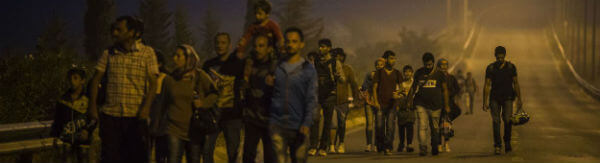
Refugee arrivals in Greece exceed 100,000 in less than two months

The Guardian reports: More than 100,000 refugees and migrants have arrived in Europe so far this year, at triple the rate of arrivals over the first half of 2015.

At least 102,500 have arrived on the Greek islands of Samos, Kos and Lesbos, according to the International Organisation for Migration (IOM). Another 7,500 have reached Italy, and in the first six weeks of the year 411 people are known to have died attempting to make the journey.

In 2015 the threshold of 100,000 arrivals was not reached until the end of June. As spring approaches and the weather improves, the rate of arrivals this year is expected to climb further.

The IOM said 20% of the arrivals were from Afghanistan and nearly half were Syrians. On Monday the US and Russia agreed to organise a partial truce involving the Assad regime and most of the Syrian armed opposition, but not Islamic State or the Nusra Front. There are widespread doubts about how effective the ceasefire will be and how long it will last. [Continue reading…]

Facebooktwittermail

Egyptian military court convicts toddler of murder

The New York Times reports: As alibis go, this one would seem to be airtight: Your honor, my client was only a year old at the time of the crime.

But it did not stop an Egyptian military court from convicting the accused, a boy now 3 ½, of killing three people, carrying guns and firebombs, blocking a road with burning tires, and trying to damage government buildings — and sentencing him to life in prison.

The verdict came last week in a mass trial of 107 people suspected of being members of the outlawed Muslim Brotherhood, and the charges stemmed from the protests, street clashes and police crackdowns in Egypt after the military overthrow of the elected Islamist president, Mohamed Morsi, in 2013. Hundreds of people were killed and thousands were jailed.

After an uproar over the conviction of the boy — Ahmed Mansour Qorani Sharara, who was never arrested — the military said that it was a case of mistaken identity, and that the authorities had actually meant to try a 16-year-old student with the same name. The teenager is on the run, the military added in a post on its official Facebook page.

But that, too, may be a mistake: Before the military statement, a police spokesman, Abu Bakr Abdel-Karim, said in a television interview that the wanted culprit was the toddler’s uncle, a 51-year-old man who has a similar name. [Continue reading…]

Facebooktwittermail

Report details ‘inhuman’ treatment in Israeli jail

Al Jazeera reports: Blows to the head and sleeping in insect-infested beds are among numerous examples of “degrading” and “inhuman” treatment of Palestinian detainees by Israeli interrogators, according to a new report from Israeli human rights groups.

The 54-page report from HaMoked and B’Tselem, released on Wednesday, alleges that the treatment of detainees is at times “tantamount to torture”. It documents physical abuse by Israeli interrogators both in the field and at the Shikma detention facility in the southern Israeli city of Ashkelon.

“[One Palestinian] was beaten until he passed out. Another detainee related that police officers photographed themselves next to him as he lay handcuffed on the ground after being beaten for about half an hour,” the report stated, noting that abusive conditions had been “used systematically against Palestinians interrogated at Shikma”.

The findings are based on the testimonies of 116 Palestinians interviewed between August 2013 and March 2014, along with dozens of affidavits and medical records. [Continue reading…]

Facebooktwittermail

Netanyahu demands Israeli apartheid posters be removed from London Underground

The Guardian reports: The Israeli prime minister, Binyamin Netanyahu, has asked the UK government to remove hundreds of flyposters on London Underground trains put up by pro-Palestinian activists which claim that his country’s policies amount to apartheid.

The posters, designed to look like genuine adverts, were pasted on tube trains by London Palestine Action as part of this year’s Israeli Apartheid Week. Political leaders in Jerusalem and Jewish organisations in the UK condemned the posters.

Netanyahu asked Israel’s foreign ministry director, Dore Gold, to raise the matter with British government officials while on a trip to London. “I asked him to demand from the British government that the posters be removed,” he told parliamentary colleagues, according to reports in the Israeli media. [Continue reading…]

Facebooktwittermail

Syria and Barack Obama’s surplus powerlessness

Fred Hof writes: In his excellent Black Flags: The Rise of ISIS, Joby Warrick quotes White House wordsmith Benjamin Rhodes as saying, “I think, candidly, that a lot of people have used this debate to position themselves for posterity as being for doing something in Syria when in fact it wouldn’t have made much difference.” Leave aside that the use of the word “candidly” is an indicator that the thought articulated is anything but candid. Leave aside the broad brush nature of the accusation. What is important is not the view of a staffer, but that of his boss. If President Obama thinks that his critics are poseurs and their ideas are all useless, what does it imply about his willingness to correct a disastrous course during the time left to him in the presidency?

Mr. Kerry too is perfectly free to claim that nary a “realistic alternative” has been offered by critics. This critic takes special exception to the claim. What is important, however, is whether or not the President of the United States recognizes that a significant policy shift is required. What is critical is whether or not he is energizing his national security apparatus to produce alternatives for his consideration. If he is satisfied with the present course, if he is at peace with the political implications for allies of Syria emptying itself, and if he is satisfied that mass murder in Syria can go unanswered on the grounds that it is not genocide, then it will likely be up to his successor to stop digging and eventually climb out of the hole. [Continue reading…]

The phrase, surplus powerlessness, comes from Michael Lerner, who in his 1991 book of the same name, defined it this way:

the set of feelings and beliefs that make people think of themselves as even more powerless than the actual power situation requires, and then leads them to act in ways that actually confirm them in their powerlessness.

Lerner describes the shift from idealism to cynicism that has shaped the thinking of so many of our generation — including a president who once in office, traded hope for realism:

The cynical chic that dominates social and political discourse in the 1990s — and which finds its highest expression in the elitist put-downs of all forms of idealism that weekly emanate from The New Republic, national columnists, and television news commentators and analysts — is a defensive compensation for the pain that many people experienced when they found that their unrealistic hopes for total transformation could not immediately be gratified. The tendency of the mass media to foster a desire for immediate gratification of all our desires made many people expect that the minute they could formulate the notion of a very different kind of world, the moment they could see its importance and desirability, they should be able to achieve it without too much struggle. A year or two, perhaps. But if nothing happened that quickly, then perhaps nothing would ever happen, and the very possibility of things changing must be an illusion. How quickly the demand for instant gratification turns revolutionaries into cynics. Suddenly the Saddam Husseins and Mu’ammar Qaddafis, the virulent nationalists of Eastern Europe, the totalitarian oppressors in China, the multinational firms that seem to have little compassion for the communities they uproot or destroy or the ecology they pollute in pursuit of their profits — all seem to be inevitable, as though built into the structure of necessity. All we can do as individuals, we begin to believe, is to become “realistic,” which is to say, to act in the same selfish and self-centered way as everyone else, expecting that anyone who can will hurt us if we don’t get the advantage first.

The power of an American president can be overstated and yet the description — most powerful man on Earth — remains true, even at this time of dwindling American power.

The president might view Syria as though he is no different from the millions of other onlookers who feel powerless to influence events and yet his posture has always involved the exercise of choice.

Some might argue that Obama now serves as a much needed role model in a rare, unappreciated virtue: American humility.

I suspect, however, that the lesson more commonly drawn from his example will be that presidents can’t actually accomplish much. Having fueled hope, he ended up breeding apathy.

Whether that turns out to be the case will likely become evident as the Bernie Sanders campaign advances.

Some of the early signs are not too promising as strong youth support fails to be matched in voter turnout.

Facebooktwittermail

How Denmark turned ugly

refugees1

Hugh Eakin writes: In country after country across Europe, the Syrian refugee crisis has put intense pressure on the political establishment. In Poland, voters have brought to power a right-wing party whose leader, Jarosław Kaczyński, warns that migrants are bringing “dangerous diseases” and “various types of parasites” to Europe. In France’s regional elections in December, some Socialist candidates withdrew at the last minute to support the conservatives and prevent the far-right National Front from winning. Even Germany, which took in more than a million asylum-seekers in 2015, has been forced to pull back in the face of a growing revolt from Chancellor Angela Merkel’s own party and the recent New Year’s attacks on women in Cologne, allegedly by groups of men of North African origin.

And then there is Denmark. A small, wealthy Scandinavian democracy of 5.6 million people, it is according to most measures one of the most open and egalitarian countries in the world. It has the highest income equality and one of the lowest poverty rates of any Western nation. Known for its nearly carbon-neutral cities, its free health care and university education for all, its bus drivers who are paid like accountants, its robust defense of gay rights and social freedoms, and its vigorous culture of social and political debate, the country has long been envied as a social-democratic success, a place where the state has an improbably durable record of doing good. Danish leaders also have a history of protecting religious minorities: the country was unique in Nazi-occupied Europe in prosecuting anti-Semitism and rescuing almost its entire Jewish population.

When it comes to refugees, however, Denmark has long led the continent in its shift to the right—and in its growing domestic consensus that large-scale Muslim immigration is incompatible with European social democracy. To the visitor, the country’s resistance to immigrants from Africa and the Middle East can seem implacable. In last June’s Danish national election—months before the Syrian refugee crisis hit Europe—the debate centered around whether the incumbent, center-left Social Democrats or their challengers, the center-right Liberal Party, were tougher on asylum-seekers. The main victor was the Danish People’s Party, a populist, openly anti-immigration party, which drew 21 percent of the vote, its best performance ever. Its founder, Pia Kjærsgaard, for years known for suggesting that Muslims “are at a lower stage of civilization,” is now speaker of the Danish parliament. With the backing of the Danish People’s Party, the center-right Liberals formed a minority government that has taken one of the hardest lines on refugees of any European nation. [Continue reading…]

Facebooktwittermail

A requiem for the European dream

Olivier Guez writes: Even though radical Islam, mass migrations, Russian revanchism and military interventions are challenges that no European state can meet alone, political sentiments across the Continent are all in the wrong direction. Frightened Europeans retreat into their sovereign little states, propelled by the popular right and xenophobia. In Hungary and Poland, those forces have taken power. By 2017, they may well do so in France, and Britons may have quit Europe altogether. That would leave no nation in a position to take the reins from France or Germany in leading Europe’s imperfect union.

So what comes next? Can we reasonably believe Europe will snap out of it? Will there be a Franco-German turnaround in shamed memory of the slaughter at Verdun 100 years ago? I don’t think so.

It is a matter of leadership. In the 1990s, François Mitterrand and Helmut Kohl, like Adenauer and De Gaulle before them, could work together, in part because they had experienced the ultimate alternative — the horrors of war. But those giants have long left the stage. There exists today neither any guiding program nor true solidarity, and historical memories have grown very short. Ms. Merkel and Mr. Hollande are more than ever focused on their own national conundrums: for France, how to control terrorism; for Germany, how to treat refugees.

What Europe’s heads of state have not done, and simply must begin to do, is prepare their citizens for the one great requirement for progress toward more unity — an enormous leap of faith and optimism, even while in the grip of fear. Instead, they betray their peoples’ fondest dreams by pecking at one another. And even my generation, who were 15 to 20 years old when the Berlin Wall fell, fails to stand up to them and demand that they save the dream we were promised — a Europe finally at permanent peace and working in unison after all the divisions and horrors of the 20th century. [Continue reading…]

Facebooktwittermail

Inside Obama administration differing views on support for Syrian Kurds

Josh Rogin and Eli Lake write: Syrian Kurds are now attacking U.S.-supported rebels, but U.S. officials disagree about whether the Kurds have switched sides — and about whether the U.S. should continue increasing its arms support for them, as opposed to focusing support on Sunni Arab rebels.

Kurdish fighters have taken advantage of the Russian-backed Syrian regime offensives in the north of the country, seizing territory from U.S.-backed rebels who are on the defensive. But factions within the Obama administration disagree about whether the Kurds are simply being opportunistic, or have coordinated their attacks with Russia, Iran and the Syrian regime.

Some administration officials told us that U.S. intelligence has documented meetings between the Kurds’ armed group and officials in the Iranian Revolutionary Guards Quds Force, which has fought alongside the Assad regime against the opposition since 2011. This faction also says the Kurdish group, the YPG, is closely working with the PKK, a Kurdish terrorist organization at war with Turkey. [Continue reading…]

Facebooktwittermail

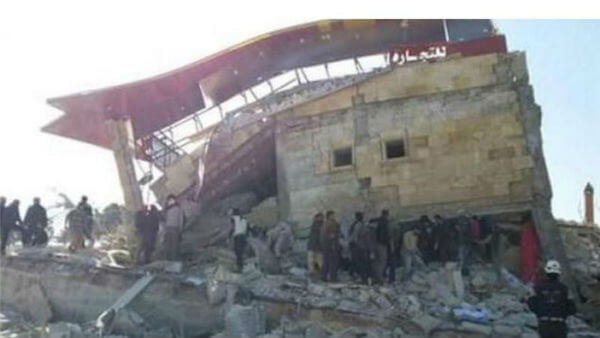
UN finds ‘deliberate’ destruction of hospitals in Syria

msf-hospital

The New York Times reports: First, the government soldiers made sure no food could get into rebel-held towns. Then, government planes bombed what health centers remained in those towns, making sure that those who got sick from hunger had no medical care to save them.

That is the harrowing picture painted by the latest report of the United Nations Commission of Inquiry on the war in Syria. The report, released Monday, chronicles a series of attacks on health care centers by government forces and the Islamic State, and it says the “deliberate destruction of health care infrastructure” was responsible for driving up deaths and permanent disabilities.

To follow the commission’s work in Syria — it has written 11 reports since August 2011 — is to witness how blatantly the laws of war have been broken, with no prospects of accountability.

The commission flatly asserts in the latest report that “war crimes are rampant” by government forces and their armed rivals, and for the first time it sharply points to the very countries that are bargaining over a peace deal for fueling the violence. [Continue reading…]

Facebooktwittermail

Syrian rebels see flaws in U.S.-Russian truce plan

Reuters reports: The United States and Russia announced plans for a “cessation of hostilities” in Syria that would take effect on Saturday but exclude groups such as Islamic State and al Qaeda’s Nusra Front, a loophole Syrian rebels immediately highlighted as a problem.

Monday’s agreement, described by a U.N. spokesman as “a first step towards a more durable ceasefire,” is the fruit of intensive diplomacy between Washington and Moscow, which back opposing sides in the 5-year-old civil war that has killed more than 250,000 people.

Presidents Barack Obama and Vladimir Putin discussed the accord by phone, and the Kremlin leader said it could “radically transform the crisis situation in Syria.” The White House said it could help advance talks on bringing about political change in Syria.

To succeed, the deal will require both countries to persuade their allies on the ground to comply. Fighting and air strikes continued on Monday, according to a British-based monitoring group.

The plan allows the Syrian army and allied forces, as well as Syrian opposition fighters, to respond with “proportionate use of force” in self-defense. It leaves a significant loophole by allowing further attacks, including air strikes, against Islamic State, Nusra and other militant groups.

Bashar al-Zoubi, head of the political office of the Yarmouk Army, part of the rebel Free Syrian Army, said that would provide cover for Syrian President Bashar al-Assad and his Russian allies to keep attacking opposition-held territory where rebel and militant factions are tightly packed.

“Russia and the regime will target the areas of the revolutionaries on the pretext of the Nusra Front’s presence, and you know how mixed those areas are, and if this happens, the truce will collapse,” he said. [Continue reading…]

Facebooktwittermail

U.S. scrambles to contain growing ISIS threat in Libya

The New York Times reports: The Islamic State’s branch in Libya is deepening its reach across a wide area of Africa, attracting new recruits from countries like Senegal that had been largely immune to the jihadist propaganda — and forcing the African authorities and their Western allies to increase efforts to combat the fast-moving threat.

The American airstrikes in northwestern Libya on Friday, which demolished an Islamic State training camp and were aimed at a top Tunisian operative, underscore the problem, Western officials said. The more than three dozen suspected Islamic State fighters killed in the bombing were recruited from Tunisia and other African countries, officials said, and were believed to be rehearsing an attack against Western targets.

Even as American intelligence agencies say the number of Islamic State fighters in Iraq and Syria has dropped to about 25,000 from a high of about 31,500, partly because of the United States-led air campaign there, the group’s ranks in Libya have roughly doubled in the same period, to about 6,500 fighters. More than a dozen American and allied officials spoke of their growing concern about the militant organization’s expanding reach from Libya and across Africa on rules of anonymity because the discussions involved intelligence and military planning. [Continue reading…]

Facebooktwittermail

Russia wants closer look from above the U.S.

The New York Times reports: Russia asked on Monday to fly surveillance planes equipped with high-powered digital cameras over the United States, fueling a long-simmering debate among Pentagon and intelligence officials over Russia’s intentions to use such flights to spy on American power plants, communications networks and other critical infrastructure.

Russia has for years conducted unarmed observation flights over the United States — as the United States does over Russia — as part of the Open Skies Treaty that was signed in 1992 by both nations and 32 other countries at the end of the Cold War, and entered into force a decade later. Although the treaty and the flights, unfamiliar to most Americans, amount to officially sanctioned spying, their goal has been to foster transparency about military activity and to reduce the risk of war and miscalculation, especially in Europe.

Now some senior American intelligence and military officials say the new digital technology combined with shifting Russian flight plans would violate the spirit of the treaty. Some Republicans also expressed alarm. [Continue reading…]

Facebooktwittermail

Alfred McCoy: Washington’s twenty-first-century opium wars

In October 2001, the U.S. launched its invasion of Afghanistan largely through proxy Afghan fighters with the help of Special Operations forces, American air power, and CIA dollars.  The results were swift and stunning. The Taliban was whipped, a new government headed by Hamid Karzai soon installed in Kabul, and the country declared “liberated.”

More than 14 years later, how’d it go? What’s “liberated” Afghanistan like and, if you were making a list, what would be the accomplishments of Washington all these years later?  Hmm… at this very moment, according to the latest reports, the Taliban control more territory than at any moment since December 2001.  Meanwhile, the Afghan security forces that the U.S. built up and funded to the tune of more than $65 billion are experiencing “unsustainable” casualties, their ranks evidently filled with “ghost” soldiers and policemen — up to 40% in some places — whose salaries, often paid by the U.S., are being pocketed by their commanders and other officials.  In 2015, according to the U.N., Afghan civilian casualties were, for the seventh year in a row, at record levels.  Add to all this the fact that American soldiers, their “combat mission” officially concluded in 2014, are now being sent by the hundreds back into the fray (along with the U.S. Air Force) to support hard-pressed Afghan troops in a situation which seems to be fast “deteriorating.”

Oh, and economically speaking, how did the “reconstruction” of the country work out, given that Washington pumped more money (in real dollars) into Afghanistan in these years than it did into the rebuilding of Western Europe after World War II?  Leaving aside the pit of official corruption into which many of those dollars disappeared, the country is today hemorrhaging desperate young people who can’t find jobs or make a living and now constitute what may be the second largest contingent of refugees heading for Europe.

As for that list of Washington’s accomplishments, it might be accurate to say that only one thing was “liberated” in Afghanistan over the last 14-plus years and that was, as TomDispatch regular Alfred McCoy points out today, the opium poppy.  It might also be said that, with the opium trade now fully embedded in both the operations of the Afghan government and of the Taliban, Washington’s single and singular accomplishment in all its years there has been to oversee the country’s transformation into the planet’s number one narco-state.  McCoy, who began his career in the Vietnam War era by writing The Politics of Heroin, a now-classic book on the CIA and the heroin trade (that the Agency tried to suppress) and who has written on the subject of drugs and Afghanistan before for this site, now offers a truly monumental look at opium and the U.S. from the moment this country’s first Afghan War began in 1979 to late last night. Tom Engelhardt

How a pink flower defeated the world’s sole superpower
America’s opium war in Afghanistan
By Alfred W. McCoy

After fighting the longest war in its history, the United States stands at the brink of defeat in Afghanistan. How can this be possible? How could the world’s sole superpower have battled continuously for 15 years, deploying 100,000 of its finest troops, sacrificing the lives of 2,200 of those soldiers, spending more than a trillion dollars on its military operations, lavishing a record hundred billion more on “nation-building” and “reconstruction,” helping raise, fund, equip, and train an army of 350,000 Afghan allies, and still not be able to pacify one of the world’s most impoverished nations? So dismal is the prospect for stability in Afghanistan in 2016 that the Obama White House has recently cancelled a planned further withdrawal of its forces and will leave an estimated 10,000 troops in the country indefinitely.

Were you to cut through the Gordian knot of complexity that is the Afghan War, you would find that in the American failure there lies the greatest policy paradox of the century: Washington’s massive military juggernaut has been stopped dead in its steel tracks by a pink flower, the opium poppy.

Continue reading

Facebooktwittermail

Azaz: The border town that is ground zero in Syria’s civil war

Martin Chulov reports: For nearly five years of war, the Syrian border town of Azaz had been little more than a staging point. Opposition fighters used it to receive supplies from the main crossing three miles north, and casualties of the brutal conflict were sent the other way to hospitals inside Turkey.

Nothing changed when Islamic State made Azaz one of its main hubs for six months from mid-2013. The supplies kept coming and the wounded continued to leave, even as the struggle for the north slowly changed hue from homegrown insurrection to a conflict fuelled by many international agendas. The gateway remained just that – until a fortnight ago, when the Kurds of northern Syria moved towards it.

Since then, Azaz has been transformed into ground zero of the war for the north of Syria. Its fate has implications far beyond, with Turkey, especially, now more heavily invested – and exposed – to the region’s shifting dynamics than at any point since its leaders swung behind the Syrian opposition in the summer of 2011.

What becomes of Syria could well be determined in the border areas around Azaz, where a Game of Thrones-like cast of players is vying for supremacy over lands that stretch south to the ancient city of Aleppo, and north beyond the Turkish frontier, over which Ankara now has less control than at any point since the modern state of Turkey was formed. [Continue reading…]

Facebooktwittermail

‘Provisional’ Syria ceasefire plan called into question as bombs kill 120

The Guardian reports: A “provisional agreement” on a ceasefire in Syria has been reached between the US and Russia, the US secretary of state, John Kerry, said on Sunday, but serious doubts remain on whether it will come into force as the country reeled from a series of deadly car bombs in Syria’s two biggest cities that left more than 120 dead.

In Homs, twin car bombs killed at least 57 people and wounded 100 on Sunday, and explosions hit parts of the capital, Damascus, killing a further 62 and wounding 180, according to the UK-based Syrian Observatory for Human Rights. The attacks on both cities were claimed by Islamic State.

Kerry said he had reached an agreement following phone talks with his Russian counterpart, Sergei Lavrov, amid signs that Russia is putting some pressure on the Syrian president, Bashar al-Assad, to comply. There are serious doubts over the strength of the deal, which would need the agreement of Vladimir Putin and Barack Obama, who are expected to speak by phone later this week.

A previous UN-brokered ceasefire, agreed between the interested parties in Munich a fortnight ago, failed to come into force on Friday as expected, with Russia continuing its bombing campaign and the Syrian army moving to encircle Syria’s second city of Homs. [Continue reading…]

Facebooktwittermail

Concerns in Saudi Arabia over signs of more military involvement in Syria

The Washington Post reports: Saudi Arabia is flexing its muscles as pro-government forces in Syria’s civil war make sweeping advances, but concerns have mounted about its expanding military involvement in the conflict.

Syrian President Bashar al-Assad’s military, backed by Iranian-led militiamen and Russian airstrikes, has pressed a major offensive in the northern city of Aleppo, even as talks to broker a ceasefire have made some progress.. The move threatens rebel groups that have received cash and weapons from Saudi Arabia, a Sunni powerhouse and U.S. ally that opposes Assad because of his alliance with Shiite rival Iran.

Saudi officials have responded by dispatching warplanes to Turkey, another opponent of the Syrian leader. They have said they could commit ground forces to Syria that would technically fight the Islamic State militant group but could also seemingly challenge pro-Assad forces.

Saudi leaders also have announced large-scale military exercises involving 20 mostly Arab and African nations.

“Bashar al-Assad will leave – have no doubt about it,” Saudi Foreign Minister Adel al-Jubeir recently told CNN. “He will either leave by a political process or he will be removed by force.” [Continue reading…]

Facebooktwittermail