The Guardian: Mystery surrounds the fate of a senior Syrian security chief who is rumoured to have fallen foul of President Bashar al-Assad, against a background of recent rebel gains, growing Iranian influence and reports of intrigue and disarray in Damascus.
Lt Gen Ali Mamlouk, the head of the country’s national security council, was reported on Monday to be under house arrest in the Syrian capital following a rash of speculation about his whereabouts at a time of deepening crisis for the regime.
According to the Daily Telegraph, the 69-year-old was arrested on suspicion of planning a coup and talking to the opposition because he has qualms about Iran, Assad’s most loyal ally. Tehran is playing an increasingly pivotal role in Syria.
Category Archives: Lands
Iraq counts on magic wands to stop ISIS
The Daily Beast: Last summer, in the days after the group now known as ISIS began its assault across Iraq, many feared that Baghdad could soon fall. Car bombs regularly killed dozens inside the capital. Police and soldiers manned checkpoints across the city. They were Baghdad’s defense and symbols of the state’s power in the face of onslaught. To protect the capital, these cops and soldiers were armed with magic wands. They still are now, nearly a year later.
Across Iraq, members of the security forces carry these magic wands—Rube Goldberg gadgets supposedly designed to detect explosives. The walkie talkie-sized instruments, as ubiquitous in Baghdad as radios are on cops in the United States, are useless pieces of plastic and a required piece of equipment. They were purchased by the Iraqi government for millions of dollars and are still in use to this day, waved around cars like divining rods, two years after a British con man was sentenced to prison for selling them.
Iraqi police officer Salim Abdul Zahra, 33, wielded one of the wands while manning a checkpoint in Baghdad last December. “Want the truth?” Zahra asked after some preliminary explanation about how the detector was supposed to be used. “It is worthless and fake,” he said. “The proof is all the explosions that still happen here.”
But though the wand didn’t work, he said he had to wave it around. Ultimately, if he didn’t use the wand, which he and his fellow officers knew was worthless, he would stick out. “What I can do?” he asked. “I follow the orders and use it.”
In sign of Palestinians’ mood, Hamas wins vote at a West Bank university
The New York Times reports: Lina Halsa certainly made a splash at the student rally for the Islamist Hamas movement here at Birzeit University last month. Wearing a sleeveless top, tight jeans, and with her hair in a ponytail, Ms. Halsa’s attire was revealing even by the standards of this liberal, secular campus. But it was downright scandalous according to Hamas norms.
Yet, Ms. Halsa was the very image of Hamas success on the campus, where the Islamist party beat out the more moderate Fatah faction in student elections. A photograph of her waving the faction’s signature green banner rocketed around social media, followed by a video in which she explained that she voted Hamas in part because her clothing “shows how much they are able to embrace other people.”
A headline in the Pan-Arab daily Al Hayat trumpeted: “A Blonde Turns Birzeit Green.”
The April 22 election was about far more than clothing, of course. Student elections are seen as an important benchmark of the Palestinian political mood, particularly since there has been no national balloting since Hamas won the legislative contests in 2006, and president of the Palestinian Authority, Mahmoud Abbas, is starting the 11th year of what was to be a five-year term. The nod to Hamas was broadly interpreted as another indication of just how unpopular President Abbas and his government have become. [Continue reading…]
Ann Jones: Citizen’s revolt in Afghanistan
Soon after 9/11, Ann Jones went to Afghanistan to help in whatever way she could, “embedding” with civilians who had been battered by the rigors of that war-torn land. Out of that experience, especially dealing with the crises of women, she wrote a powerful and moving book, Kabul in Winter. In 2010, she borrowed a flak jacket, put on her combat boots, and settled into a U.S. military outpost in eastern Afghanistan near the Pakistani border to see what life was like for American soldiers. (“Being outside the wire had filled me with sorrow as I watched earnest, heavily armed and armored boys try to win over white-bearded Afghans — men of extraordinary dignity — who have seen all this before and know the outcome.”)
The following year, she returned again to Afghanistan, this time focused not on the “collateral damage” to Afghans from our endless war there, but on the true costs of such a war to Americans. In a country that has never stopped talking about its “wounded warriors,” she alone, and not some young, hot-shot reporter from a major media outlet, followed American war wounded off the grim battlefields of that never-ending war all the way home. She started at the trauma hospital at Bagram Air Base, then travelled with often desperately wounded Americans via C-17 to Landstuhl Regional Medical Center in Germany, and afterward on to Walter Reed Army Medical Center. Finally, she visited traumatized and wounded veterans back in their homes. The book she wrote from this, They Were Soldiers: How the Wounded Return From America’s Wars — The Untold Story, is a one-of-a-kind odyssey on the up-close-and-personal costs of our global war on terror. (“As I followed the sad trail of damaged veterans to write my new book, I came to see how much they and their families have suffered, like Afghans, from the delusions of this nation’s leaders — many running counter to international law — and of other influential Americans, in and out of the military, more powerful and less accountable than themselves.”)
On her latest trip to Afghanistan, she re-embedded with those who have born the brunt of and bear the deepest scars from the American war there: civilians, especially women, in a society that, after 35 years of Cold War combat, brutal civil war, and Washington’s war on terror, all involving religious and political extremism that should chill the soul, couldn’t be under more pressure. The U.S. has, of course, sunk many billions of dollars into the promised “reconstruction” of the country, a process of failed nation-building that turned out to also be deeply corrupt. Many more billions went into the kind of military-building that, across the Greater Middle East, has proven just as unsuccessful.
With U.S. (and NATO) forces being reduced there, the American-built Afghan security forces are already suffering unsustainable casualties and may one day go the way of the American-built Iraqi Army in 2014. With the war in Afghanistan going badly, the much-vaunted American “withdrawal” from the country has recently turned into a kind of dance in place, while a constitutionally challenged government in Kabul struggles seven months after coming into office to take control. More than 13 years after the U.S. “liberated” Afghanistan, that country’s main claim to fame may be that it’s become the narco capital of the globe.
Back in the streets of the Afghan capital, Jones now reports that its civilians, facing the nightmarish murder of a young woman, may be taking things heroically into their own hands. She describes the stirrings of what might someday be thought of as an “Afghan Spring.” Of course, given the disastrous pushback against the various Arab Springs, that in itself is a daunting thought. Still, hope has been in short supply in twenty-first-century Afghanistan, so consider this a potentially remarkable development. Tom Engelhardt
“Farkhunda is our sister”
A “martyr,” a murder, and the making of a new Afghanistan?
By Ann JonesI went to Kabul, Afghanistan, in March to see old friends. By chance, I arrived the day after a woman had been beaten to death and burned by a mob of young men. The world would soon come to know her name: Farkhunda. The name means “auspicious” or “jubilant.” She was killed in the very heart of the Afghan capital, at a popular shrine, the burial place of an unnamed ghazi, a warrior martyred for Islam. Years ago, I worked only a few doors away. I knew the neighborhood well as a crossroads for travelers and traders, a market street beside the Kabul River, busy with peddlers, beggars, drug addicts, thieves, and pigeons. It was always a dodgy neighborhood. Now, it had become a crime scene.
In April, at the end of the traditional 40-day period of mourning for the dead woman, that crime scene became the stage for a reenactment of the murder by a group of citizens calling themselves the Committee for Justice for Farkhunda, which was pressing the government to arrest and punish the killers. Shortly after the performance, the office of the attorney general announced formal chargesagainst 49 men: 30 suspected participants in the woman’s murder and 19 police officers accused of failing to try to stop it. On May 2nd, a trial began at the Primary Court, carried live on Afghan television. Farkhunda is now dead and buried, but her story has had staying power. It seems to mark the rise of something not seen in Afghanistan for a very long time: the power of people to renounce violence and peacefully reclaim themselves. This makes it worth recalling just how events unfolded and what messages they might hold for Americans, in particular, who have been fighting so fruitlessly in Afghanistan for 13-plus years.
Big drop in share of Americans calling themselves Christian
The New York Times reports: The Christian share of adults in the United States has declined sharply since 2007, affecting nearly all major Christian traditions and denominations, and crossing age, race and region, according to an extensive survey by the Pew Research Center.
Seventy-one percent of American adults were Christian in 2014, the lowest estimate from any sizable survey to date, and a decline of 5 million adults and 8 percentage points since a similar Pew survey in 2007.
The Christian share of the population has been declining for decades, but the pace rivals or even exceeds that of the country’s most significant demographic trends, like the growing Hispanic population. It is not confined to the coasts, the cities, the young or the other liberal and more secular groups where one might expect it, either.
“The decline is taking place in every region of the country, including the Bible Belt,” said Alan Cooperman, the director of religion research at the Pew Research Center and the lead editor of the report. [Continue reading…]
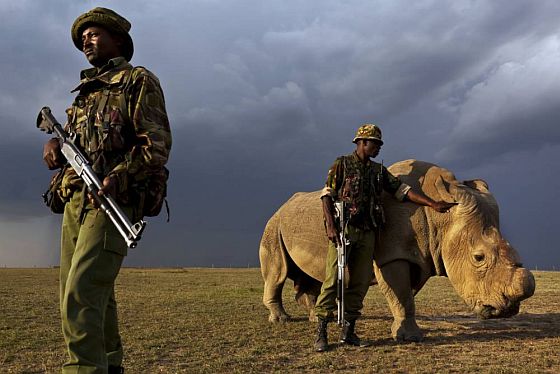
A picture of loneliness: You are looking at the last male northern white rhino

Jonathan Jones writes: What is it like to look at the very last of something? To contemplate the passing of a unique wonder that will soon vanish from the face of the earth? You are seeing it. Sudan is the last male northern white rhino on the planet. If he does not mate successfully soon with one of two female northern white rhinos at Ol Pejeta conservancy, there will be no more of their kind, male or female, born anywhere. And it seems a slim chance, as Sudan is getting old at 42 and breeding efforts have so far failed. Apart from these three animals there are only two other northern white rhinos in the world, both in zoos, both female.
It seems an image of human tenderness that Sudan is lovingly guarded by armed men who stand vigilantly and caringly with him. But of course it is an image of brutality. Even at this last desperate stage in the fate of the northern white rhino, poachers would kill Sudan if they could and hack off his horn to sell it on the Asian medicine market.
Sudan doesn’t know how precious he is. His eye is a sad black dot in his massive wrinkled face as he wanders the reserve with his guards. His head is a marvellous thing. It is a majestic rectangle of strong bone and leathery flesh, a head that expresses pure strength. How terrible that such a mighty head can in reality be so vulnerable. It is lowered melancholically beneath the sinister sky, as if weighed down by fate. This is the noble head of an old warrior, his armour battered, his appetite for struggle fading. [Continue reading…]
Pakistanis knew where bin Laden was, say U.S. sources
NBC News reports: Two intelligence sources tell NBC News that the year before the U.S. raid that killed Osama bin Laden, a “walk in” asset from Pakistani intelligence told the CIA where the most wanted man in the world was hiding – and these two sources plus a third say that the Pakistani government knew where bin Laden was hiding all along.
The U.S. government has always characterized the heroic raid by Seal Team Six that killed bin Laden as a unilateral U.S. operation, and has maintained that the CIA found him by tracking couriers to his walled complex in Abbottabad, Pakistan.
The new revelations do not necessarily cast doubt on the overall narrative that the White House began circulating within hours of the May 2011 operation. The official story about how bin Laden was found was constructed in a way that protected the identity and existence of the asset, who also knew who inside the Pakistani government was aware of the Pakistani intelligence agency’s operation to hide bin Laden, according to a special operations officer with prior knowledge of the bin Laden mission. The official story focused on a long hunt for bin Laden’s presumed courier, Ahmed al-Kuwaiti.
While NBC News has long been pursuing leads about a “walk in” and about what Pakistani intelligence knew, both assertions were made public in a London Review of Books article by investigative reporter Seymour Hersh. Hersh’s story, published over the weekend, raises numerous questions about the White House account of the SEAL operation. It has been strongly disputed both on and off the record by the Obama administration and current and former national security officials. [Continue reading…]
Blogger accuses Seymour Hersh of ‘plagiarism’ for bin Laden raid story
Politico: In the day following the publication of Seymour Hersh’s scandalous alternative account of the 2011 raid that killed Osama bin Laden, the prize-winning investigative journalist has been pilloried as a fabulist, a fool, and even a fibber.
But one national security expert has a new insult to throw into the mix: plagiarist.
R.J. Hillhouse, a national security blogger and former college professor, wrote on her blog, “The Spy Who Billed Me” that she had accused the Obama administration of fabricating accounts of its raid that killed Osama bin Laden back in August 2011. Hersh’s story, published in the London Review of Books on Sunday, is “either plagiarism or unoriginal,” wrote Hillhouse.
The blog post Hillhouse is referring to dates back to August 7, 2011, only a few months after Osama bin Laden’s death. In it Hillhouse wrote, like Hersh, that the informant who led the CIA to bin Laden was a walk-in seeking financial compensation, that Pakistani officials were keeping bin Laden under house arrest with Saudi financial support, and that Pakistani officials had cooperated with the clandestine U.S. operation that killed him. [Continue reading…]
The many problems with Seymour Hersh’s latest conspiracy theory
Max Fisher writes: On Sunday, the legendary investigative journalist Seymour Hersh finally released a story that he has been rumored to have been working on for years: the truth about the killing of Osama bin Laden. According to Hersh’s 10,000-word story in the London Review of Books, the official history of bin Laden’s death — in which the US tracked him to a compound in Abbottabad, Pakistan; killed him in a secret raid that infuriated Pakistan; and then buried him at sea — is a lie.
Hersh’s story is amazing to read, alleging a vast American-Pakistani conspiracy to stage the raid and even to fake high-level diplomatic incidents as a sort of cover. But his allegations are largely supported only by two sources, neither of whom has direct knowledge of what happened, both of whom are retired, and one of whom is anonymous. The story is riven with internal contradictions and inconsistencies.
The story simply does not hold up to scrutiny — and, sadly, is in line with Hersh’s recent turn away from the investigative reporting that made him famous into unsubstantiated conspiracy theories.
A decade ago, Hersh was one of the most respected investigative journalists on the planet, having broken major stories from the 1969 My Lai massacre to the 2004 Abu Ghraib scandal. But more recently, his reports have become less and less credible. He’s claimed that much of the US special forces is controlled by secret members of Opus Dei, that the US military flew Iranian terrorists to Nevada for training, and that the 2014 chemical weapons attack in Syria was a “false flag” staged by the government of Turkey. Those reports have had little proof and, rather than being borne out by subsequent investigations, have been either unsubstantiated or outright debunked. A close reading of Hersh’s bin Laden story suggests it is likely to suffer the same fate. [Continue reading…]
Has ISIS lost its head?
The Daily Beast reports: Abu Bakr al-Baghdadi, the Islamic State’s leader, has been moved from Iraq to the Syrian city of Raqqa, the terror army’s de facto capital, amid tight security two months after sustaining serious shrapnel wounds leaving his spine damaged and his left leg immobile, say jihadist defectors.
He is said to be mentally alert and able to issue orders, but his physical injuries are now prompting the so-called Islamic State’s governing Shura Council to make a final decision on a temporary stand-in leader who can move back and forth between front-lines in Syria and Iraq and is able to handle day-to-day leadership in the self-declared caliphate.
That leader will be, in effect, under al-Baghdadi, a super deputy to the caliph — in Arabic, na’ib al-malik, or viceroy. According to Islamic State defectors debriefed by opposition activists in neighboring Turkey, the election will pit two Iraqis and a Syrian against each other — all well-known figures within the terror army’s top leadership.
These sources say nine doctors to treat the infirm al-Baghdadi were also taken to Raqqa, including a senior physician from Mosul’s general hospital, but the entire al-Baghdadi caravan of attending medics, aides and body guards was split into separate convoys to avoid attracting attention from U.S. satellite surveillance and inviting a coalition airstrike or drone attack. At least one doctor didn’t know who his patient was when he arrived in Raqqa and was ordered brusquely to stop asking questions about the man’s identity. [Continue reading…]
Assad fires an intel chief
The Daily Beast reports: The sacking of yet another Syrian intelligence chief has raised suspicions that President Bashar al-Assad’s inner circle is fraying under the pressure of recent battlefield losses to the rebels. Disputes over the out-sized role Iran is playing to prop up the beleaguered Damascus regime are thought to be central to these internal disputes.
Ali Mamlouk, the head of the country’s National Security Bureau, and considered a trusted security adviser to the Assad family since the 1970s, has been accused of plotting a coup and placed under house arrest, according to a report today in Britain’s Daily Telegraph. In the past few weeks two other spy chiefs have been removed or killed.
In April, Rustum Ghazaleh, head of the Political Security Directorate, died in hospital after he was beaten up on the orders of General Rafiq Shehadeh, his counterpart in military intelligence, who was in turn sacked. The two argued ]over the increasing power of Iranian advisers in Damascus. [Continue reading…]
Saudi forces and Houthis trade heavy fire along border
Al Jazeera reports: Yemen’s Houthi fighters and Saudi Arabian forces have traded heavy artillery and rocket fire in border areas, residents say, a day before a proposed ceasefire.
The Houthis said they fired Katyusha rockets and mortars on the Saudi cities of Jizan and Najran on Monday, after the Saudis hit Saada and Hajjah provinces with more than 150 rockets, the Reuters news agency reported.
Saudi Arabia’s civil defence department said that one Saudi person was killed in the shelling in Najran, which it said targeted a school and residence adjacent to a military post. [Continue reading…]
Yemen: Coalition blocking desperately needed fuel
Human Rights Watch: The Saudi Arabia-led coalition’s blockade of Yemen is keeping out fuel needed for the Yemeni population’s survival in violation of the laws of war. Yemen is in urgent need of fuel to power generators for hospitals overwhelmed with wounded from the fighting and to pump water to civilian residences.
The 10-country coalition, which has United States logistics and intelligence support, should urgently implement measures for the rapid processing of oil tankers to allow the safe, secure, and speedy distribution of fuel supplies to the civilian population. The Houthis and other armed groups controlling port areas should permit the safe transfer of fuel to hospitals and other civilian entities. Fuel should be allowed to go through whether or not a proposed ceasefire takes effect.
“The rising civilian casualties from the fighting could become dwarfed by the harm caused to civilians by the coalition blockade on fuel, if it continues,” said Joe Stork, deputy Middle East and North Africa director. “It is unclear how much longer Yemen’s remaining hospitals have before the lights go out.” [Continue reading…]
Hamas cracks down on Salafists in Gaza Strip
Asmaa al-Ghoul writes: The confrontation between the Salafist jihadist movement and Hamas-led security services in the Gaza Strip has returned to the surface following a two-year truce between the two sides.
Strong tensions returned after security services arrested Salafist Sheikh Adnan Mayt, a prominent Salafist jihadist activist, April 6. This was followed by the arrest of other Salafists and raids of their homes, an April 29 statement by Ansar al-Dawla al-Islamiya (Arabic for “supporters of the Islamic State”) said.
The arrests increased following the two roadside bomb blasts that detonated in the Gaza Strip on April 18, which the Interior Ministry described as “primitive.” One of the blasts exploded near the outer wall of the UNRWA headquarters, and the other went off near the UNRWA general prosecutor’s office. A third explosion took place a day earlier near the Abu Mazen roundabout in western Gaza. [Continue reading…]
Election may set U.K. on path to a split, isolation
The Washington Post reports: After unexpected political charisma and cunning propelled him to another term as Britain’s prime minister, David Cameron will now need every ounce of those skills to avoid going down in history with an altogether different title: founding father of Little England.
A result that maintained the status quo at 10 Downing Street masked the dramatic transformations roiling Britain, ones that threaten to leave this country more isolated than at any time in its modern history.
Thursday’s election may become just the first in a trilogy of rapid-fire votes that set this island adrift from Europe, divide it in half along ancient lines of national identity and ultimately leave behind a rump state of ever-diminishing value to its American allies.
“Yesterday was V-E Day, when the United Kingdom was celebrating its finest hour. Seventy years later, it could be contemplating the beginning of its end in its current form,” said David Torrance, a British political analyst and author. “The next five years will be a twin debate about two unions — the European Union and the United Kingdom.”
The questions of whether Britain stays whole and whether it remains in Europe are deeply entangled, with the outcome of one expected to heavily influence the other. [Continue reading…]
Democracy doesn’t stop at the election – and Britain’s is broken
By Colin Crouch, University of Warwick
It’s only after an election is over that real politics begins. The polls themselves are designed to preserve almost perfect equality among citizens in the electoral process.
But that’s just the formal side of democracy. Election campaigns have become almost liturgical, heavily choreographed events. And what takes place during the rest of the five years is the informal side – a much rougher affair, with no gestures towards equality at all.
The contrast between the two parts of politics has been stretched to breaking point as campaigns become ever more artificial, while inequalities of wealth and income grow more extreme and play an ever greater political role.
That rising inequality is creating economic and social problems is now widely understood, but there’s been far less discussion of the threats it poses to democracy. The issue really comes into focus when we recognise these differences between the formal and informal sides of democracy, and the very different ways in which they treat inequality.
In the electoral process, we quite rightly insist on important principles of perfect equality. We stick to one citizen, one vote and punish those who try to cheat, hold the parties’ broadcast presentations to strict fairness rules, ban party materials from polling stations, and closely limit individual candidates’ spending.
But democracy isn’t just about voting. It’s about campaigning, discussing, lobbying and imposing pressure – things that go on all the time, not just during elections. This is the informal part of the political system, and if it did not exist we could hardly say we lived in a democracy.
The problem is that these parts of our democracy offer no guarantee at all of equality among citizens.
Logging threatens one of Europe’s last virgin forests
Der Spiegel reports: It’s not easy to fight for your cause with pepper spray in your mouth and eyes, but Gabriel Paun tried it anyway in front of the gate of a huge sawmill in the Romanian town of Sebes. On that day last winter, Paun had followed a truck loaded with lumber after the vehicle left the Retezat National Park, located in the heart of the Carpathian Mountains — one of Europe’s most beautiful forested regions — and in the heart of a threatened world.
Paun was wearing a brown vest over a camouflage hoodie. He had a buzzed, military style haircut. Paun, an activist with the Romanian organization Agent Green, followed the truck to the sawmill. He had a suspicion and all he had to do was make one phone call to confirm it.
In Romania there is a hotline to check the origins of lumber transports. The system can use the license plate number to track each truckload of wood. Paun dialed the number and an employee at the Environment Ministry’s wood tracking section picked up the phone. Her answer left no doubt: She said the lumber was “illegal.” Paun followed the truck to the entrance of the sawmill, which belongs to Austria’s Schweighofer Group, and informed security guards working for the company. But instead of taking the wood out of circulation, they put Paun out of commission: first with blows, then with pepper spray, causing Paun to fall to the ground. Everything was captured on shaky video images and uploaded to YouTube.
The film snippet is a hit in Romania, where it has become a symbol for the Romanians’ concern for their forests — and for their powerlessness to stop it from disappearing. At stake here is one of the last virgin forests in Europe. These are regions roamed by brown bears, wolves and lynxes, and many of these areas have remained untouched for centuries. [Continue reading…]
Seymour Hersh: Osama bin Laden was held hostage by Pakistan’s intelligence services from 2006 until he was killed
Seymour Hersh writes: It’s been four years since a group of US Navy Seals assassinated Osama bin Laden in a night raid on a high-walled compound in Abbottabad, Pakistan. The killing was the high point of Obama’s first term, and a major factor in his re-election. The White House still maintains that the mission was an all-American affair, and that the senior generals of Pakistan’s army and Inter-Services Intelligence agency (ISI) were not told of the raid in advance. This is false, as are many other elements of the Obama administration’s account. The White House’s story might have been written by Lewis Carroll: would bin Laden, target of a massive international manhunt, really decide that a resort town forty miles from Islamabad would be the safest place to live and command al-Qaida’s operations? He was hiding in the open. So America said.
The most blatant lie was that Pakistan’s two most senior military leaders – General Ashfaq Parvez Kayani, chief of the army staff, and General Ahmed Shuja Pasha, director general of the ISI – were never informed of the US mission. This remains the White House position despite an array of reports that have raised questions, including one by Carlotta Gall in the New York Times Magazine of 19 March 2014. Gall, who spent 12 years as the Times correspondent in Afghanistan, wrote that she’d been told by a ‘Pakistani official’ that Pasha had known before the raid that bin Laden was in Abbottabad. The story was denied by US and Pakistani officials, and went no further. In his book Pakistan: Before and after Osama (2012), Imtiaz Gul, executive director of the Centre for Research and Security Studies, a think tank in Islamabad, wrote that he’d spoken to four undercover intelligence officers who – reflecting a widely held local view – asserted that the Pakistani military must have had knowledge of the operation. The issue was raised again in February, when a retired general, Asad Durrani, who was head of the ISI in the early 1990s, told an al-Jazeera interviewer that it was ‘quite possible’ that the senior officers of the ISI did not know where bin Laden had been hiding, ‘but it was more probable that they did [know]. And the idea was that, at the right time, his location would be revealed. And the right time would have been when you can get the necessary quid pro quo – if you have someone like Osama bin Laden, you are not going to simply hand him over to the United States.’
This spring I contacted Durrani and told him in detail what I had learned about the bin Laden assault from American sources: that bin Laden had been a prisoner of the ISI at the Abbottabad compound since 2006; that Kayani and Pasha knew of the raid in advance and had made sure that the two helicopters delivering the Seals to Abbottabad could cross Pakistani airspace without triggering any alarms; that the CIA did not learn of bin Laden’s whereabouts by tracking his couriers, as the White House has claimed since May 2011, but from a former senior Pakistani intelligence officer who betrayed the secret in return for much of the $25 million reward offered by the US, and that, while Obama did order the raid and the Seal team did carry it out, many other aspects of the administration’s account were false. [Continue reading…]