Category Archives: Lands

Don’t put Syria aside, Brahimi says amid Ukraine crisis

n13-iconBloomberg reports: More than 350,000 people will have died in Syria’s civil war by next year if peace talks don’t restart, United Nations mediator Lakhdar Brahimi said in an effort to keep an international spotlight on the conflict.

“I told the Security Council that Syria cannot be placed on a back burner,” Brahimi told the UN General Assembly yesterday, according to a transcript. “A crisis of this magnitude needs the full attention of this organization.”

With the Security Council set to take up a resolution today on Russia’s move into Ukraine, Brahimi sought to underscore the continuing human and economic costs of Syria’s civil war, which entered its fourth year this week with more than 130,000 people killed. He said more than 300 Syrians flee their homes every hour. [Continue reading…]

Facebooktwittermail

Navy Seals take over oil tanker seized by Libyan rebels

n13-iconThe Guardian reports: American Navy Seals have seized a North Korea-flagged tanker which had been loaded with crude oil at a rebel-held port in eastern Libya, the Pentagon said on Monday.

The operation to take control of the Morning Glory came a week after Libya failed to prevent the tanker from leaving the rebel-controlled eastern port of Es Sider loaded with an estimated $20m cargo, in a crisis that has brought the country to the brink of civil war.

“The Morning Glory is carrying a cargo of oil owned by the Libyan government’s National Oil Company,” said Pentagon spokesman John Kirby. “The ship and its cargo were illicitly obtained from the Libyan port of Es Sider.”

There were no casualties in the operation, which took place in international waters off the coast of Cyprus late on Sunday night. The raid was authorised by the US president, Barack Obama, after receiving a request for assistance from Tripoli. The Seals boarded the 21,000-tonne tanker using helicopters and fast boats from a warship, the USS Roosevelt.

The Pentagon said a US navy crew was now piloting the tanker towards an unnamed Libyan port where it will be handed to government control. [Continue reading…]

Facebooktwittermail

State TV says Russia could turn U.S. to ‘radioactive ash’

n13-iconAFP reports: A leading anchor on Russian state television on Sunday described Russia as the only country capable of turning the United States into “radioactive ash”, in an incendiary comment at the height of tensions over the Crimea referendum.

“Russia is the only country in the world realistically capable of turning the United States into radioactive ash,” anchor Dmitry Kiselyov said on his weekly news show on state-controlled Rossiya 1 television.

Kiselyov made the comment to support his argument that the United States and President Barack Obama were living in fear of Russia led by President Vladimir Putin amid the Ukraine crisis.

His programme was broadcast as the first exit polls were being published showing an overwhelming majority of Crimeans voting to leave Ukraine and join Russia.

He stood in his studio in front of a gigantic image of a mushroom cloud produced after a nuclear attack, with the words “into radioactive ash”.

“Americans themselves consider Putin to be a stronger leader than Obama,” he added, pointing to opinion polls which then popped up on the screen.

“Why is Obama phoning Putin all the time and talking to him for hours on end?” he asked.

Kiselyov has earned a reputation as one of Russia’s most provocative television news hosts, in particularly with his often blatantly homophobic remarks.

But he is also hugely influential with his weekly news show broadcast at Sunday evening prime time.

Putin last year appointed Kiselyov head of the new Russia Today news agency that is to replace the soon to be liquidated RIA Novosti news agency with the aim of better promoting Russia’s official position. [Continue reading…]

Facebooktwittermail

Foes of America in Russia crave rupture in ties

a13-iconThe New York Times reports: As Russia and the United States drift toward a rupture over Crimea, the Stalinist writer Aleksandr A. Prokhanov feels that his moment has finally arrived.

“I am afraid that I am interested in a cold war with the West,” said Mr. Prokhanov, 76, in a lull between interviews on state-controlled television and radio. “I was very patient. I waited for 20 years. I did everything I could so that this war would begin. I worked day and night.”

Mr. Prokhanov is an attack dog whose career has risen, fallen and risen again with the fortunes of hard-liners in the Kremlin. And it is a measure of the conservative pivot that has taken place in Moscow in Vladimir V. Putin’s third presidential term that Mr. Prokhanov and a cadre of like-minded thinkers — a kind of “who’s who of conspiratorial anti-Americanism,” as one scholar put it — have found themselves thrust into the mainstream.

For centuries, Russian history has been driven by a struggle between ideas, as reformers and revanchists wrestled over the country’s future. Mr. Putin keeps a distance from the ideological entrepreneurs clustered around the Kremlin, leaving his influences a matter of speculation.

But it became clear last week, as the United States threatened to cut off Russian corporations from the Western financial system, that influential members of the president’s inner circle view isolation from the West as a good thing for Russia, the strain of thought advanced by Mr. Prokhanov and his fellow travelers. Some in Mr. Putin’s camp see the confrontation as an opportunity to make the diplomatic turn toward China that they have long advocated, said Sergei A. Karaganov, a dean of the faculty of international relations at the Higher School of Economics in Moscow.

“This whole episode is going to change the rules of the game,” Mr. Karaganov said of Crimea, which is holding a referendum on secession on Sunday. “Confrontation with the West is welcomed by all too many here, to cleanse the elite, to organize the nation.” [Continue reading…]

Facebooktwittermail

What was done to the Jews for generations, the Jews are now doing to themselves

o13-iconGideon Levy writes: This kind of talk could only take place in darkness; in beer cellars, at violent fringe demonstrations or at the headquarters of outlawed organizations. Only the extreme, fascist, neo-Nazi, anti-Semitic and xenophobic right would dare to breathe a word of it. Only skinheads and their masters would dare to speak of national purity and of defining their country based on ethnicity, religion, race, nationality or heredity.

No one would dare to say France for the French, America is all-American, Germany is a German state or Italy is a Catholic one. Anyone who did so wouldn’t be considered credible. These countries are democracies of all their citizens; their character is determined by the components of the entire population. Living in each are minorities, their numbers growing in this era of globalization and migration. No one speaks of a nation-state, of a state of one religion, of one racial group.

But this kind of talk is fashionable in Israel. It’s legitimate and even Zionist: a Jewish state. Only in Israel are individual rights and the character of the state determined by origin, like having a Jewish great-grandmother. The hell with members of minority groups – most of whom were born here.

This kind of talk has also become a basic condition for the negotiations with the Palestinians. It’s just a cheap excuse, of course – one more obstacle on the road to reaching a peace agreement, heaven forfend. But the disease’s malignant symptoms are deeply encoded in Israel’s DNA.

Israel is returning to the ghetto, building its own neo-ghetto with its own two hands. Welcome to the Israel Ghetto; it built the walls and fences that surround it long ago, and the mental and cultural walls are on the way. What was done to the Jews for generations, the Jews are now doing to themselves: judging people by their ancestors and withdrawing into a ghetto-state whose nature will be determined by its degree of purity. [Continue reading…]

Facebooktwittermail

How America’s billionaires are taking over science

f13-iconWilliam J Broad writes: American science, long a source of national power and pride, is increasingly becoming a private enterprise.

In Washington, budget cuts have left the nation’s research complex reeling. Labs are closing. Scientists are being laid off. Projects are being put on the shelf, especially in the risky, freewheeling realm of basic research. Yet from Silicon Valley to Wall Street, science philanthropy is hot, as many of the richest Americans seek to reinvent themselves as patrons of social progress through science research.

The result is a new calculus of influence and priorities that the scientific community views with a mix of gratitude and trepidation.

“For better or worse,” said Steven A. Edwards, a policy analyst at the American Association for the Advancement of Science, “the practice of science in the 21st century is becoming shaped less by national priorities or by peer-review groups and more by the particular preferences of individuals with huge amounts of money.”

They have mounted a private war on disease, with new protocols that break down walls between academia and industry to turn basic discoveries into effective treatments. They have rekindled traditions of scientific exploration by financing hunts for dinosaur bones and giant sea creatures. They are even beginning to challenge Washington in the costly game of big science, with innovative ships, undersea craft and giant telescopes — as well as the first private mission to deep space.

The new philanthropists represent the breadth of American business, people like Michael R. Bloomberg, the former New York mayor (and founder of the media company that bears his name), James Simons (hedge funds) and David H. Koch (oil and chemicals), among hundreds of wealthy donors. Especially prominent, though, are some of the boldest-face names of the tech world, among them Bill Gates (Microsoft), Eric E. Schmidt (Google) and Lawrence J. Ellison (Oracle).

This is philanthropy in the age of the new economy — financed with its outsize riches, practiced according to its individualistic, entrepreneurial creed. The donors are impatient with the deliberate, and often politicized, pace of public science, they say, and willing to take risks that government cannot or simply will not consider.

Yet that personal setting of priorities is precisely what troubles some in the science establishment. Many of the patrons, they say, are ignoring basic research — the kind that investigates the riddles of nature and has produced centuries of breakthroughs, even whole industries — for a jumble of popular, feel-good fields like environmental studies and space exploration.

As the power of philanthropic science has grown, so has the pitch, and the edge, of the debate. Nature, a family of leading science journals, has published a number of wary editorials, one warning that while “we applaud and fully support the injection of more private money into science,” the financing could also “skew research” toward fields more trendy than central.

“Physics isn’t sexy,” William H. Press, a White House science adviser, said in an interview. “But everybody looks at the sky.”

Fundamentally at stake, the critics say, is the social contract that cultivates science for the common good. They worry that the philanthropic billions tend to enrich elite universities at the expense of poor ones, while undermining political support for federally sponsored research and its efforts to foster a greater diversity of opportunity — geographic, economic, racial — among the nation’s scientific investigators.

Historically, disease research has been particularly prone to unequal attention along racial and economic lines. A look at major initiatives suggests that the philanthropists’ war on disease risks widening that gap, as a number of the campaigns, driven by personal adversity, target illnesses that predominantly afflict white people — like cystic fibrosis, melanoma and ovarian cancer. [Continue reading…]

Facebooktwittermail

Putin wins in Russia only by escalating his war rhetoric

o13-iconMasha Gessen writes: Vladimir Putin has won. In Russia, support for his war in Ukraine is overwhelming. And his approval rating has finally recovered after falling drastically in December 2011, when the Russian protest movement erupted.

Putin claimed reelection to his third term as president in March 2012, as mass demonstrations were taking place in cities and towns across Russia. Official tallies said he won with 63 percent of the vote, but independent exit polls suggested he captured about 50 percent — hardly a show of overwhelming support for a virtually unopposed candidate (none of the four opponents he handpicked for the ballot had campaigned).

After the election, Putin began cracking down on opponents while mobilizing his shrinking constituency against an imaginary enemy: strong, dangerous, Western and, apparently, homosexual. Laws were passed restricting public assembly and the activities of nongovernmental organizations; about three dozen people of various political and social stripes were jailed for protesting.

The crackdown proved effective: When the risks of demonstrating became extremely high and the benefits apparently nonexistent, the number of protests and protesters dwindled; the loose leadership structure of the 2011-12 protest movement dissolved in a haze of mutual recriminations.

As for the mobilization effort, the results were mixed: Putin’s approval rating, as measured by the Levada Center, Russia’s only independent polling organization, bounced back soon after his reelection but sank again and then plateaued. The high approvals that he enjoyed in his first decade at the helm, around 70 percent, were a distant memory. [Continue reading…]

For many of those observers who view Putin as having been pushed into a corner by Western governments who recklessly and foolishly hijacked Ukrainian politics, the Russian president is a cool realist acting in Russia’s national interests, doing what any responsible leader would do.

One of the multiple problems with this interpretation of what is currently unfolding is that it discounts the effects of the psychological imperatives to which Putin is now strapped.

A full-scale invasion of Ukraine might seem irrational now that Crimea is already fully under Russian control — 93% of voters are reported to have supported Crimea becoming part of Russia. But Putin’s next choices may be shaped much less by his assessment of Russia’s geopolitical interests than they are by the image of a strong leader around which he has drummed up so much popular support. He has been stacking up more and more reasons to continue his military advance, leaving less and less room to climb down without appearing to have lost his courage.

Facebooktwittermail

Ukraine’s fallen statues of Lenin are not just a rejection of Russia

o13-iconSrećko Horvat writes: A spectre is haunting Europe – the spectre of Lenin.

Back in 2011 Ukraine was preparing to host Euro 2012. The government decided to release a promotional video titled Switch On Ukraine. Among the sites shown in the video was Liberty Square in the north-eastern city of Kharkiv. But something was missing. When the sun rose over the square, instead of an 8.5 metre-high statue of Lenin there was only an empty plinth. Someone had digitally erased the politically problematic icon.

In 2013 another statue of Lenin, this time in Kiev’s central plaza – once known as October Revolution Square and now known as Euromaidan – was smashed by angry protesters using sledgehammers. Many have correctly identified this as the key point in Ukraine’s political crisis. According to one estimate, of the nearly 1,500 Lenin memorials across Ukraine, protesters have destroyed around 100 of them, from Poltava to Chernihiv, from Zhytomyr to Khmelnytskyi.

This is nothing new of course. During the very beginning of the violent dissolution of Yugoslavia, I remember vividly how communist and anti-fascist monuments were torn down by nationalists who believed that democracy had finally arrived. Some urinated on them, others blew them up. In the period from 1990 to 2000 at least 3,000 monuments were torn down in Croatia alone.

Is the monument mayhem in Ukraine any different? It is: last week, residents of Kharkiv – the same town where the symbolic erasure of Lenin started in 2011 – installed barricades around the statue of Lenin after fending off an attack by Euromaidan revolutionaries. Even if the protesters weren’t defending the image of Lenin so much as exhibiting their attachment to Putin this is a remarkable state of affairs.

To return to the former Yugoslavia for the moment: according to the last statistics from the World Bank, the unemployment rate among young people in Bosnia and Herzegovina is 57.9%. This ex-Yugoslav state is not yet part of the European Union, but is already approaching Greece’s 60% rate. The newest member of the EU, neighbouring Croatia, is third in the union when it comes to youth unemployment, at 52%.

So this is what we got by getting rid of communism and entering the EU. [Continue reading…]

Facebooktwittermail

Syria and the Arab affliction of family rule

o13-iconRami G Khouri writes: Perplexity and despair seem to be the two sentiments that most often define people’s attitudes to the mayhem in Syria.

The fighting by an expanding range of Syrians, backed by a regional and global web of supporters, has reached barbaric proportions in some cases, with civilians largely paying the price.

Refugee and displaced persons flows continue to grow and now account for some 6 million people. While efforts to find a diplomatic breakthrough continue and most interventions by outside forces are focused on providing humanitarian aid to the millions of Syrians in need, a wider web of Arab, Middle Eastern and global actors pump in money and guns to keep the Syrian war going.

Nobody knows what to do and more and more voices are calling for external military intervention to protect civilians or even to topple Bashar Assad’s regime. The impact of the war on neighboring countries is reaching unsustainable levels, especially Jordan and Lebanon. To their credit, the neighbors have kept their borders open to fleeing Syrians, even though these host countries are finding it more and more difficult to absorb any more refugees due to the pressure on their own social infrastructure, such as housing, water, education, and medical care. The host countries have received financial assistance either directly or through the United Nations and other international organizations, but it is well below what is needed.

Perhaps one reason why Arab host countries such as Lebanon, Jordan and Iraq keep their borders open is that these countries have all experienced the pain of conflicts that sent many of their own citizens fleeing for shelter in neighboring lands. So we should keep in mind that what is happening in Syria, terrible as it is, should not be seen as an aberration in modern Arab history, but rather represents perhaps the culminating chaos of that history. Syria once referred to itself as “the throbbing heart of Arabism.” That might be an appropriate description in retrospect, because the country’s destruction and implosion today very much mirror those deviant tendencies that have defined the configuration and behavior of so many Arab countries.

Some time in the 1970s, the majority of Arab states left behind their nationalist development aspirations and instead settled into a pattern of conduct that has culminated in the ghastly situation in Syria. The single most debilitating reality of modern Arab history has been the tendency of Arab countries to be ruled by single families that rely on vast security networks to maintain their rule. Single family rule is bad enough; military-security-police states are equally bad. Put them together and you get the core weakness of the modern Arab state system that has seen country after country suffer the scourge of internal war, mass suffering and significant refugee flows. [Continue reading…]

Facebooktwittermail

On third anniversary of Syrian rebellion, Assad is steadily winning the war

a13-iconThe Washington Post reports: Three years into the revolt against his rule, Syrian President Bashar al-Assad is in a stronger position than ever before to quell the rebellion against his rule by Syrians who rose up to challenge his hold on power, first with peaceful protests and later with arms.

Aided by the steadfast support of his allies and the deepening disarray of his foes, Assad is pressing ahead with plans to be reelected to a third seven-year term this summer while sustaining intense military pressure intended to crush his opponents.

The strategy is not new, but in recent months it has started to yield tangible progress in the form of slow but steady gains on several key fronts on the battlefield that call into question long-held perceptions of a stalemate.

Most notably, the government has pushed the rebels back or squeezed them into isolated pockets in large swathes of the territory surrounding Damascus, diminishing prospects that the opposition will soon be in a position to seriously threaten the capital or topple the regime.

For those who joined the effort to unseat Assad three years ago, flush with the fervor of the Arab Spring protests sweeping the region, the realization that the rebellion is faltering is “deeply depressing,” said Abu Emad, a student activist who has watched as the government has steadily crushed the armed rebellion in his hometown of Homs, once regarded as the epicenter of the revolt. [Continue reading…]

Facebooktwittermail

Will Russia risk an all-out invasion of Ukraine?

a13-iconAndrew S Bowen writes: In September 2013, Russia unnerved the Baltic States and several NATO countries by holding military exercises on the borders of Lithuania, Latvia, Estonia, Poland, and in the Kaliningrad enclave that involved an estimated 70,000 troops. Earlier, in April, the Russian Air Force had practiced mock bombing runs near Swedish air space. The unease caused by these events — along with many others, including the resumption of a Russian Naval task force in the Mediterranean and international flights of strategic bombers — was considerable, prompting many analysts to remark on the Russian military’s resurgent confidence and capability. It was confidence and capability born of a massive modernizatsiia program designed to remedy the inadequacies exposed by the 2008 war with Georgia, and to create a modern, professional military capable of protecting Russia’s status as a great power.

Today, Russia is flexing that newfound military might in Crimea and on its eastern border with Ukraine, where it is massing troops and carrying out a series of military exercises. As the clock ticks down toward a referendum on secession for the Black Sea peninsula, fear is mounting about a full-scale invasion of the Ukrainian heartland — this time, involving Russian troops with insignias on their uniforms. But as analysts speculate about Moscow’s intentions, the question that led most observers to discount the possibility of a Russian takeover of Crimea remains unanswered: To what end?

The most likely answer is that the Crimean invasion — and the current military exercises along the Ukrainian border — is intended to signal to the new government in Kiev that Russia’s interests are not to be ignored. In that case, they would represent a continuation of Russia’s efforts to negate any incipient relationship between Ukraine and the EU that would threaten Moscow’s influence in the region. As my colleague and FP columnist Michael Weiss notes, “That’s why the Kremlin has created a shadow EU known as the Customs Union, which includes Russia, Belarus and Kazakhstan, and whose sole mission seems to be keeping ex-satellites from being lured into Brussels’ orbit.” [Continue reading…]

Facebooktwittermail

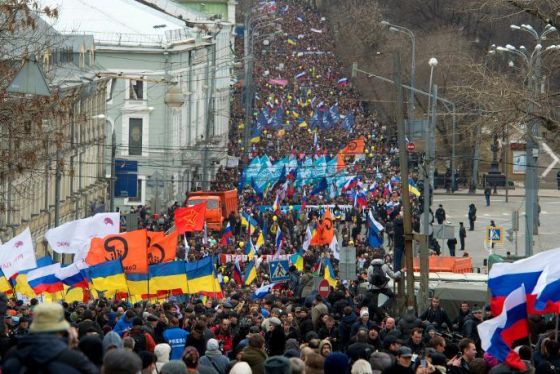
50,000 rally in Moscow against Putin’s intervention in Ukraine

moscow-antiwar

AFP reports: Around 50,000 people rallied in central Moscow Saturday in protest at Russia’s intervention in Ukraine, a day before the Crimean peninsula votes on switching to Kremlin rule.

Waving both Ukrainian and Russian flags and shouting slogans heard during the anti-government protests in Kiev, the demonstrators urged Russian President Vladimir Putin to pull troops back from a Cold War-style confrontation.

Marchers carried placards reading “Putin, get out of Ukraine” and others comparing Russia’s move on Crimea with the Nazi annexation of the Sudetenland as Europe rushed headlong into World War II.

Many of the protesters adopted the chants and slogans of Ukraine’s popular uprising that ousted President Viktor Yanukovych last month.

University professor Yelena Orlova, 47, whose sign read “Ukraine is a sovereign state”, said she did not expect the rally would change her government’s position, but believed it was her duty to speak out.

“I don’t agree with the policy of Putin,” she told AFP. “I am against the annexation of Crimea. I think Russia should respect the borders of Ukraine.” [Continue reading…]

Facebooktwittermail

Which march would you join?

A reader here just left a comment complaining about my “frothing support for the heathens who took Kiev by force,” and said, “I wish the people of Crimea the best and hope the vote tomorrow goes for separation from the u.s. / e.u.”

I can only imagine what kind of Manichean worldview lurks behind the reference to “heathens,” but the general sentiment here seems to one that is not uncommon among stalwart critics of American power. It seems to work like this:

If a prominent political leader antagonizes the U.S. and its European allies (I refer of course to the well-known demons de jour: Fidel Castro, Slobodan Milošević, Hugo Chávez, Mahmoud Ahmadinejad, Muammar Gaddafi, Bashar al-Assad, Vladimir Putin) and that individual is then vilified in the media, the mere fact that this person is being targeted in this way is taken as a sign that he must be doing something right. He symbolizes the rejection of Western hegemony and is conferred honorary membership to a select group of über-rebels who have the courage take a dramatic stand defying Western imperialism.

I am not immune to experiencing this sentiment, since power needs to be poked in the eye occasionally, yet that doesn’t mean that we should ignore the failings of those who are doing the poking.

But that’s what all too often happens when criticism of the US/the West becomes an obsession: it makes authoritarian rule become excusable.

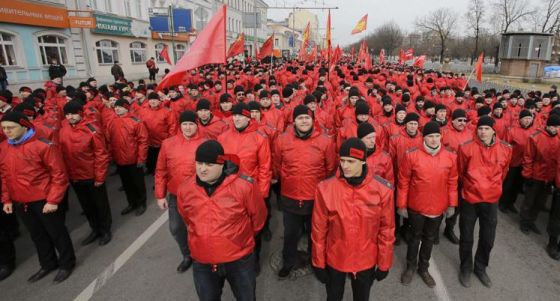
To anyone who thinks that tomorrow the people of Crimea are about to release themselves from the stifling grip of European influence in exchange for a warm embrace from Russia, I simply ask: who do you imagine you would have felt more comfortable marching alongside in Moscow today?

The disciplined young men in the “Brotherhood and Civil Resistance March,” or with activists like Ilya Yashin who have the guts to say: “We are patriots and Putin is Russia’s enemy”?

Brotherhood-and-Civil-Resistance

Reuters: “The pro-Russian patriotic procession was held to express support to Russian speakers living in Crimea and Ukraine and protest against the policies conducted by new Ukrainian authorities, according to organisers.”

Facebooktwittermail

Russia preparing for full-scale invasion of Ukraine

n13-iconThe Interpreter: Russia now has a massive force of tanks, troops, artillery, aircraft, and naval forces in position to potentially invade mainland Ukraine from Crimea in the south, but also from positions east and north of Ukraine. However, today reports are pouring in from across Russia of even more firepower on the move:

Facebooktwittermail

Should Ukraine have given up its nuclear arsenal?

e13-iconThe Guardian reports: Ukraine’s prime minister Arseniy Yatsenyuk has accused Russia of demonstrating unacceptable “military aggression” which has “no reason and no grounds”.

Moscow has deployed 10,000 troops along its border with Ukraine, deepening the crisis in Crimea ahead of a last desperate effort by the US secretary of state, John Kerry, to broker a deal with his Russian counterpart, Sergei Lavrov, in London on Friday.

Yatsenyuk told the UN security council on Thursday he is convinced Russians do not want war. He urged Russia’s leaders to heed the people’s wishes and return to dialogue with Ukraine. “If we start real talks with Russia, I believe we can be real partners,” Yatsenyuk said.

He said Ukraine gave up the world’s third-largest nuclear arsenal in 1994 in exchange for guarantees of its independence and territorial integrity. After Russia’s recent actions, Yatsenyuk said, “it would be difficult to convince anyone on the globe not to have nuclear weapons”. [Continue reading…]

In an op-ed for the New York Times yesterday, John Mearsheimer wrote: The West has few options for inflicting pain on Russia, while Moscow has many cards to play against Ukraine and the West. It could invade eastern Ukraine or annex Crimea, because Ukraine regrettably relinquished the nuclear arsenal it inherited when the Soviet Union broke up and thus has no counter to Russia’s conventional superiority.

No doubt, if Israel’s leaders are ever pushed into a position where they need to defend retaining their own nuclear arsenal, they will surely be tempted to cite Professor Mearsheimer’s position — that giving up such weapons can turn out to be regrettable.

Let’s suppose, however, that Ukraine was still bristling with nuclear weapons — at its peak its arsenal was larger than those of Britain, France, and China combined — are we to imagine that its interim government would now be making veiled threats to incinerate Moscow? Are we to suppose that Russian forces would have stayed out of Crimea? After all, how many wars have Israel’s nuclear weapons prevented?

It seems just as likely that in the current situation, Putin would be arguing that Russia had no choice but take over the whole of Ukraine — not under the pretext of protecting ethnic Russians but in the name of defending global security, his argument being that in an unstable Ukraine, “loose nukes” pose a threat to everyone.

What seems regrettable is not that Ukraine gave up its nuclear weapons but that the security guarantees it was given for doing so appear to have been worthless.

Facebooktwittermail

Russia blocks access to major independent news sites

Electronic Frontier Foundation reports: Russia’s government has escalated its use of its Internet censorship law to target news sites, bloggers, and politicians under the slimmest excuse of preventing unauthorized protests and enforcing house arrest regulations. Today, the country’s ISPs have received orders to block a list of major news sites and system administrators have been instructed to take the servers providing the content offline.

The banned sites include the online newspaper Grani, Garry Kasparov’s opposition information site kasparov.ru, the livejournal of popular anti-corruption crusader Alexei Navalny, and even the web pages of Ekho Moskvy, a radio station which is majority owned by the state-run Gazprom, and whose independent editor was ousted last month and replaced with a more government-friendly director.

The list of newly prohibited sites was published earlier today by Russia’s Prosecutor General, which announced that the news sites had been “entered into the single register of banned information” after “calls for participation in unauthorized rallies.” Navalny’s livejournal was apparently added to the register in response to the conditions of his current house arrest, which include a personal prohibition on accessing the Internet. [Continue reading…]

Facebooktwittermail