Calder Walton writes: Recently declassified intelligence records reveal that at the end of the war the main priority for MI5 [Britain’s domestic counterintelligence and security agency] was the threat of terrorism emanating from the Middle East, specifically from the two main Zionist terrorist groups operating in the Mandate of Palestine, which had been placed under British control in 1921. They were called the Irgun Zevai Leumi (“National Military Organization,” or the Irgun for short) and the Lehi (an acronym in Hebrew for “Freedom Fighters of Israel”), which the British also termed the “Stern Gang,” after its founding leader, Avraham Stern. The Irgun and the Stern Gang believed that British policies in Palestine in the post-war years — blocking the creation of an independent Jewish state — legitimized the use of violence against British targets. MI5’s involvement with counterterrorism, which preoccupies it down to the present day, arose in the immediate post-war years when it dealt with the Irgun and Stern Gang.
MI5’s involvement in dealing with Zionist terrorism offers a striking new interpretation of the history of the early Cold War. For the entire duration of the Cold War, the overwhelming priority for the intelligence services of Britain and other Western powers would lie with counterespionage, but as we can now see, in the crucial transition period from World War to Cold War, MI5 was instead primarily concerned with counterterrorism.
As World War II came to a close, MI5 received a stream of intelligence reports warning that the Irgun and the Stern Gang were not just planning violence in the Mandate of Palestine, but were also plotting to launch attacks inside Britain. In April 1945 an urgent cable from MI5’s outfit in the Middle East, SIME, warned that Victory in Europe (VE-Day) would be a D-Day for Jewish terrorists in the Middle East. Then, in the spring and summer of 1946, coinciding with a sharp escalation of anti-British violence in Palestine, MI5 received apparently reliable reports from SIME that the Irgun and the Stern Gang were planning to send five terrorist “cells” to London, “to work on IRA lines.” To use their own words, the terrorists intended to “beat the dog in his own kennel.” The SIME reports were derived from the interrogation of captured Irgun and Stern Gang fighters, from local police agents in Palestine, and from liaisons with official Zionist political groups like the Jewish Agency. They stated that among the targets for assassination were Britain’s foreign secretary, Ernest Bevin, who was regarded as the main obstacle to the establishment of a Jewish state in the Middle East, and the prime minister himself. MI5’s new director-general, Sir Percy Sillitoe, was so alarmed that in August 1946 he personally briefed the prime minister on the situation, warning him that an assassination campaign in Britain had to be considered a real possibility, and that his own name was known to be on a Stern Gang hit list.
The Irgun and the Stern Gang’s wartime track record ensured that MI5 took these warnings seriously. In November 1944 the Stern Gang had assassinated the British minister for the Middle East, Lord Moyne, while he was returning to his rented villa after a luncheon engagement in Cairo. Moyne’s murder was followed by an escalation of violence in Palestine, with incidents against the British and Irgun and Stern Gang fighters being followed by bloody reprisals. In mid-June 1946, after the Irgun launched a wave of attacks, bombing five trains and 10 of the 11 bridges connecting Palestine to neighboring states, London’s restraint finally broke. British forces conducted mass arrests across Palestine (codenamed Operation Agatha), culminating on June 29 — a day known as “Black Sabbath” because it was a Saturday — with the detention of more than 2,700 Zionist leaders and minor officials, as well as officers of the official Jewish defense force (Haganah) and its crack commandos (Palmach). None of the important Irgun or Stern Gang leaders was caught in the dragnet, and its result was merely to goad them into even more violent counteractions. On July 22, the Irgun dealt a devastating blow, codenamed Operation Chick, to the heart of British rule in Palestine when it bombed the King David Hotel in Jerusalem, which housed the offices of British officialdom in the Mandate, as well as serving as the headquarters of the British Army in Palestine.
The bombing was planned by the leader of the Irgun, Menachem Begin, later to be the sixth prime minister of Israel and the joint winner of a Nobel Peace Prize. On the morning of July 22, six young Irgun members entered the hotel disguised as Arabs, carrying milk churns packed with 500 pounds of explosives. At 12:37 p.m. the bombs exploded, ripping the facade from the southwest corner of the building. This caused the collapse of several floors in the hotel, resulting in the deaths of 91 people. In terms of fatalities, the King David Hotel bombing was one of the worst terrorist atrocities inflicted on the British in the twentieth century. It was also a direct attack on British intelligence and counterterrorist efforts in Palestine: both MI5 and SIS — the Secret Intelligence Service, also known as MI6 — had stations in the hotel. [Continue reading…]
Category Archives: Lands
Syria’s pragmatic Islamic Front
Hania Mourtada writes: When he was a fighter with the Free Syrian Army (FSA), waging war against President Bashar al-Assad’s forces in the northern economic hub of Aleppo, Abu Muhannad’s confidence verged on presumptuousness. He spent 2012 and part of 2013 fighting alongside his comrades in the Martyrs’ Swords battalion and, upon their return from the front lines, the young fighters would gather to reflect on their most recent victory as they smoked arguileh and drank cups of bitter tea.
The Free Syrian Army, the loose-knit, Western-backed rebel umbrella group, eventually succumbed to irrelevance due to poor funding and lack of cohesiveness. Abu Muhannad’s small battalion disbanded and he found himself stranded, without the safety afforded by membership into a group. Still, he chose to remain in his home country, hoping to find himself a place among the new rebel realignments.
Then, a few weeks ago, he sat down for tea with a young French fighter.
The Frenchman was a member of the Islamic State of Iraq and al-Sham (ISIS), an al Qaeda affiliate in Syria. Their conversation devolved into a heated argument — the French jihadist felt that Abu Muhannad, a devout Muslim, was too focused on fighting for the liberation of Syria rather than waging a global jihad. He chided Abu Muhannad for calling the country Syria instead of bilad al-sham, an expression favored by global jihadists that refers to the entire Levant, which they believe should be the focal point of a new Islamic state.
“It was a fight over terminology,” said Abu Muhannad, who was reached via Skype in the Turkish city of Antakya where he has been staying with a friend. “He accused me of being secretly secular because I was being patriotic instead of referring to the country as an Islamic emirate. I told him he wasn’t here to teach me about my own religion.”
The French fighter walked away in the middle of the argument. The following day, Abu Muhannad’s friends informed him that ISIS was planning to assassinate him. Abu Muhannad claimed the al Qaeda-linked group had tried to kill him once before, and that he had narrowly escaped. Shortly after Abu Muhannad fled to Turkey, ISIS captured his younger brother, a citizen journalist, who remains imprisoned to this day. Abu Muhannad suspects the group is holding his brother indefinitely to lure him back to Syria.
This is not the first time that an FSA fighter finds himself driven out of the country by ISIS. The extremist group has repeatedly clashed with not only FSA rebels, but also with like-minded Islamist brigades, often over petty disputes. An undercurrent of tension pervades the relationship between ISIS, which ultimately seeks to establish and Islamic emirate in Syria, and the constellation of moderate Sunni fighters who simply want to oust Bashar al-Assad from power.
The experience of being exiled from his own country by foreign Jihadists has left Abu Muhannad as livid at ISIS as he is at the Syrian regime.
“They have these disgusting, smelly beards. They won’t even comb their hair. If I knew the revolution would bring them here, I swear I would never have participated in it,” he said. “Did I rebel against the regime to end up in hiding? And who am I running away from? Chechens? European fanatics? Who are those people? They have overstayed their welcome.”
With the Supreme Military Council, the Turkey-based military opposition body, failing to secure significant funding for the Free Syrian Army, the mainstream rebel group has been growing weaker by the day.
Abu Muhannad, like many disillusioned fighters, is now placing his bet on the new Islamic Front. The new alliance was announced in November, and has become the largest rebel force in Syria by merging together seven influential Islamist groups, including the Salafist Ahrar al-Sham brigade; the Army of Islam, which is prominent in the Damascus suburbs; and the Aleppo-based Al-Tawheed brigade. Abu Muhannad says its leaders have been household names since the beginning of the uprising, and its fighters were brothers-in-arms when the FSA was still a fledgling enterprise. The group notably excludes al Qaeda’s two affiliates in Syria, and may be an attempt by one of the rebels’ primary patrons, Saudi Arabia, to check the influence of ISIS.
It’s not only Abu Muhannad who sees the Islamic Front as a potential antidote to the expanding influence of extremists within Syrian rebel ranks. The group is made up of Salafist fighters who ascribe to a puritanical interpretation of the Quran — but it nevertheless remains a local movement that is amenable to Syrians, and which is seemingly willing to adjust its ways to preserve its popular base. Earlier this month, U.S. diplomats attempted to arrange a meeting with leaders of the new alliance, where they hoped to convince them to support peace talks with the Assad regime and warn them against any collaboration with al Qaeda-affiliated groups. The Islamic Front flatly refused to meet with the U.S. envoys, without providing a reason why. [Continue reading…]
Soil pollution is poisoning China’s food supply

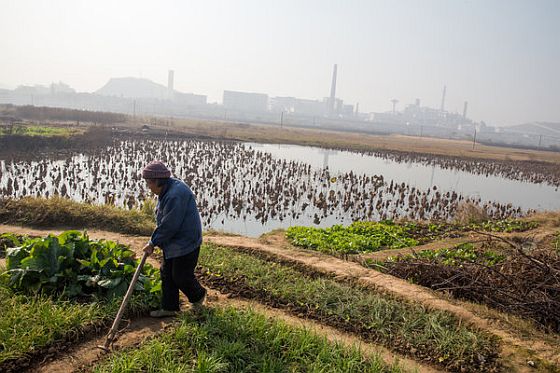
The New York Times reports: The farm-to-table process in China starts in villages like this one in the agricultural heartland. Food from the fields of Ge Songqing and her neighbors ends up in their kitchens or in the local market, and from there goes to other provinces. The foods are Chinese staples: rice, cabbage, carrots, turnips and sweet potatoes.
But the fields are ringed by factories and irrigated with water tainted by industrial waste. Levels of toxic heavy metals in the wastewater here are among the highest in China, and residents fear the soil is similarly contaminated. Though they have no scientific proof, they suspect that a spate of cancer deaths is linked to the pollution, and worry about lead levels in the children’s blood.
“Of course I’m afraid,” said Ms. Ge, in her 60s, pointing to the smokestacks looming over her fields and the stagnant, algae-filled irrigation canals surrounding a home she shares with a granddaughter and her husband, a former soldier. “But we don’t do physical checkups. If we find out we have cancer, it’s only a burden on the children.”
With awareness of China’s severe environmental degradation rising, there has been a surge of anxiety in the last year among ordinary Chinese and some officials over soil pollution in the country’s agricultural centers and the potential effects on the food chain. In recent years, the government has conducted widespread testing of soil across China, but it has not released the results, adding to the fear and making it more difficult for most Chinese to judge what they eat and pinpoint the offending factories.
An alarming glimpse of official findings came on Monday, when a vice minister of land and resources, Wang Shiyuan, said at a news conference in Beijing that eight million acres of China’s farmland, equal to the size of Maryland, had become so polluted that planting crops on it “should not be allowed.”
A signal moment came in May, when officials in Guangdong Province, in the far south, said they had discovered excessive levels of cadmium in 155 batches of rice collected from markets, restaurants and storehouses. Of those, 89 were from Hunan Province, where Ms. Ge farms.
The report set off a nationwide scare. In June, China Daily, an official English-language newspaper, published an editorial saying that “soil contaminated with heavy metals is eroding the foundation of the country’s food safety and becoming a looming public health hazard.”
One-sixth of China’s arable land — nearly 50 million acres — suffers from soil pollution, according to a book published this year by the Ministry of Environmental Protection. The book, “Soil Pollution and Physical Health,” said that more than 13 million tons of crops harvested each year were contaminated with heavy metals, and that 22 million acres of farmland were affected by pesticides.
But the government has refused to divulge details of the pollution, leaving farmers and consumers in the dark about the levels of contaminants in the food chain. The soil survey, completed in 2010, has been locked away as a “state secret.” [Continue reading…]
Alberta tar sands operations encircled by expanding area of mercury pollution
ThinkProgress: Just one week after Al Jazeera discovered that regulatory responsibility for Alberta, Canada’s controversial tar sands would be handed over to a fossil-fuel funded corporation, federal scientists have found that the area’s viscous petroleum deposits are surrounded by a nearly 7,500-square-mile ring of mercury.
Canadian government scientists have found that levels of mercury — a potent neurotoxin which has been found to cause severe birth defects and brain damage — around the region’s vast tar sand operations are up to 16 times higher than regular levels for the region. The findings, presented by Environment Canada researcher Jane Kirk at an international toxicology conference, showed that the 7,500 miles contaminated are “currently impacted by airborne Hg (mercury) emissions originating from oilsands developments.”
The Canadian government touts Alberta’s oil sands as the third-largest proven crude oil reserve in the world, next to Saudi Arabia and Venezuela. The region’s heavy crude oil is mixed with clay, bitumen, and a good deal of sand — hence the name “oil sands.” This makes for a unique and energy-intensive extraction process that some scientists say produces three times the greenhouse gas emissions of conventionally produced oil. Environment Canada has said it expects production emissions from tar sands to hit 104 million tonnes of CO2 by 2020 under current expansion plans. [Continue reading…]
Israeli military intelligence sees genuine political change in Iran
Summarizing the assessment of Israeli military intelligence, Haaretz reports: Syria is continuing to fall apart, with forces that oppose the regime now in control of nearly half the country, in the north and the east. But the Assad regime continues to cling to the cities that are important to its survival and maintains a fairly wide corridor that includes the Alawite cities in the northwest of the country, as well as Aleppo, Homs, Damascus and the southern city of Daraa. Last March, Assad seemed to be on the verge of collapse, but was able to recover thanks to massive aid from Russia, Iran and Hezbollah. Since the victory organized for Assad in June by Hezbollah forces in the town of Qusair, on the Lebanese border, the fighting has become static, with no thrust of momentum or victory by either side. Presently, the opposition looks too weak and divided to topple the regime in the near future.
All the signs are that the upheaval in the Arab world will continue into 2014. The worsening economic situation – which the violence has only aggravated – will likely push more young people into the arms of the jihadist organizations, which will increasingly also clash with Israel on the margins of their main activity.
As for Iran, intelligence discerns a genuine struggle over the future image of the country between the spiritual leader Ali Khamenei and his conservative allies, and a more moderate group headed by the new president, Hassan Rohani. Expert analysis does not view Rohani’s election as a deception by Khamenei intended solely to mislead the West, but rather as an authentic leader who is creating an independent power center. The internal struggle between the blocs in Iran has yet to be resolved, but Rohani enjoys broad public support, despite the clout of the Revolutionary Guards and the senior army officers who are loyal to the spiritual leader.
Haaretz reported in September that on the eve of Netanyahu’s departure for the United Nations General Assembly in New York, the head of MI, Maj. Gen. Aviv Kochavi, provided him with an assessment holding that a deep strategic change was being played out in Iran, expressed in Rohani’s election victory in June.
Kochavi appears to be sticking to this opinion. Earlier this month, he presided over a ceremony at which prizes for creative thinking were awarded to intelligence officers. According to a report on Israel Radio, a group of officers from the research division who “identified the change in Iran” received a special certificate of appreciation from Kochavi. Officially, senior Israeli figures such as Netanyahu, Ya’alon and Foreign Minister Avigdor Lieberman are scoffing at the change in Tehran and saying that Rohani’s “charm offensive” is simply a mask assumed by the regime solely in order to get relief from the international sanctions. It turns out that MI, without for a moment detracting from the dangers of Iran’s nuclear project and its support for terrorism, thinks otherwise.
Syria — a land now defined by loss
Lina Sergie Attar writes: “Where am I going to die?” That was the first question my grandmother asked me last August in New York City after fleeing her home in Aleppo. I didn’t know how to respond. Over the last 16 months, this uncertain question burdened her as she crossed from state to state, from one of her four children’s homes to another.
My grandmother, Maliha Zuhdi Serjieh, was born in Istanbul in 1923, raised in Beirut, married in Aleppo, and died last week in Michigan. Almost all of her 90 years were spent across a once-porous Levant, but her last year and a half was spent in exile just like thousands of fellow Syrians now scattered across the globe.
In Syria, the political is always personal. For the past two weeks, regime planes have launched hundreds of barrel bombs over Aleppo, destroying buildings and taking hundreds of innocent lives. In Syria, collective pain often intersects with personal loss — like when you mourn a city and a grandmother at the same time.
My grandmother died on Tuesday, Dec. 17, thousands of miles away from her home. Our ultimate dreams of return to Syria were slashed with her death. There will forever be an absence in the apartment in the Sabil neighborhood where my father was born and an absence in the cemetery where my grandfather is buried. There will forever be an inconsolable loss in our family that marks us as Syrians. For there is no family without loss in this terrible war.
The last time I saw my grandmother, only two weeks before she died, she asked me, “Is it true there is a revolution in Syria?” Family members had been trying to shield her from the bloody reality for many months but I just responded calmly, “Yes, Nana.” Then she asked, “So people are killing each other?” Again, I answered, “Yes, Nana.” She stared at me with her pale blue eyes for a few long moments and said, “History is all the same. And the people are always the ones who suffer.” [Continue reading…]
Why Sarin isn’t the biggest concern for Syrian children
Dr. Zaher Sahloul writes: Though Syrian children are being killed by snipers and shells and increasingly succumb to malnutrition, polio, waterborne diseases and bitter cold, our policymakers are acting as if chemical weapons were the main cause of mayhem and death to Syrian children.
It may come as a surprise to those of us following the Syrian crisis that a recent report by Oxford Research Group, entitled “Stolen Futures: The Hidden Toll of Child Casualties in Syria,” documented the killing of 11,420 Syrian children from the start of the conflict until August 2013, not by chemical agents, but by old-style and new conventional weapons. The report’s findings include:
• 71 percent of children were killed by explosive weapons.
• 26.5 percent of children died from bullets.
• 764 children as young as one year old were summarily executed.
• 389 were killed by sniper fire.
According to the U.S. estimates, 426 children were gassed to death by Sarin on Aug. 21 in the Ghouta chemical attack, which means that only 3.5 percent of Syrian children were killed by chemical weapons, while the vast majority (96.5 percent) were killed by conventional methods. [Continue reading…]
Less than one third of Americans believe in evolution
(Note: Because of the misleading way in which Pew presents its own findings, multiple reports run with a headline similar to this one in USA Today: “One-third of Americans reject human evolution.” That would appear to imply that two-thirds of Americans accept the theory of evolution that provides the foundation for evolutionary biology. However, the rejectionists that the survey identifies are those who believe in the literal truth of Genesis, Adam and Eve etc.. Those who subscribe to Intelligent Design or other non-scientific Creationist evolutionary narratives are viewed by Pew as believing in human evolution.)
I am not a militant atheist. I have little patience for the anti-religion campaigning engaged in by Richard Dawkins, Sam Harris, and their ilk. The idea of trying to rid the world of religion makes no more sense than trying to abolish sport.
Human beings are not governed by reason and people who become enslaved by rationality, inevitably become emotionally malformed. The human capacity to express and experience love is a capacity without which we would cease to be human. As Pascal said: “The heart has its reasons which reason knows not.”
We live in a world constructed by thought and shared ideas and our ability to make sense of life springs in large part from the fact that we continuously filter our experience through stories — stories through which we tell ourselves who we are, where we live, and why we live.
Because of this, I don’t think that science should or can be thrust down anyone’s throat…
And yet to learn that less than a third of Americans believe in evolution is deeply depressing — even if not surprising.
Those who want to put a strong political spin on the results of a new Pew Research Center poll on views about evolution are emphasizing the fact that the greatest concentration of skepticism on evolution is among Republicans while pointing to the figure of 67% of Democrats believing in evolution.
The pollsters, however, fudged the basic question by implying that it’s possible to believe in evolution without accepting its scientific basis.
Pew’s primary interest was in differentiating between those Americans who take Genesis literally and those who don’t. Those Americans who believe “a supreme being guided the evolution of living things for the purpose of creating humans and other life in the form it exists today” are counted as believing in evolution, even though they don’t believe in natural selection.
The fact that Pew chose to slice the question in this way is itself illustrative of the weak influence science has in American culture. “Evolution” is being treated as an object of belief coming in many varieties, rather than as hard, incontrovertibly proven scientific fact.
No one would conduct a poll asking Americans whether they believe the Earth revolves around the Sun and yet when it comes to the subject of evolution, the deference to religious belief is so engrained that evolution is treated as a completely subjective term — evolution, whatever that means to you.
Why does this matter?
The world cannot tackle climate change if America turns its back on science. And yet as a culture, America currently stands somewhere between the sixteenth and the twentieth century. Copernicus was successful but the jury’s still out on Darwin.
If two-thirds of the population is skeptical about evolution, what chance is there of persuading them that climate change is caused by human activity?
It hardly seems coincidental that almost exactly the same number of Americans who believe in human-caused climate change also believe in evolution through natural selection. (I would hazard a guess that it’s not just the same number, but also the same Americans.)
Iran, Turkey’s new ally?
Vali R. Nasr writes: In sharp contrast to Israel and the Persian Gulf monarchies, which have been alarmed by the interim deal on Iran’s nuclear program, Turkey sees benefit in serving as a bridge between Iran and the West and in providing the gateway to the world that Tehran needs as it emerges from isolation.
The Iranian turn has come at an opportune time for Turkish foreign policy in other ways, too. Iran has influence with Iraq’s Shiite-led government and Syria’s Alawite elite. In Iraq, where a crucial oil deal hangs in the balance, Turkey needs Iranian cooperation. It also needs Iran’s help on Syria.
Turkey initially tied its policy to America’s demand that President Bashar al-Assad quit. It was disappointed when the Obama administration signed on to a Russian-brokered deal with Mr. Assad on chemical weapons. With violence menacing across the border, Turkey wants to see an end to Syria’s civil war. The new moderate government in Tehran is Turkey’s best hope for leveraging a settlement.
Economic ties between Turkey and Iran have been strengthening, with trade now estimated to be worth $20 billion. The real number may be still higher, since the recent corruption charges allege that Turkish officials and the state-owned Halkbank have been helping Iranian businesses dodge international sanctions. In any case, Iranian exports still reach Turkey, and the proceeds fund the purchase of gold and silver that flow back to Iran. In turn, Turkey’s economy depends on Iran’s oil and gas, its investments dollars and large export market.
If Iran does conclude a long-term nuclear deal with the West, it still cannot expect a warm welcome from the Sunni Arab world. With the region divided by a widening sectarian rift, the Persian Gulf monarchies will become only more fretful about Iran’s regional ambitions. That makes Turkey potentially a key strategic partner for Iran, especially if its economy starts to grow as sanctions are relaxed. [Continue reading…]
Saudis pledge $3 billion to support Lebanon’s army
The Wall Street Journal reports: Saudi Arabia pledged $3 billion to bolster Lebanon’s armed forces, in a challenge to the Iranian-allied Hezbollah militia’s decadeslong status as Lebanon’s main power broker and security force.
Lebanese President Michel Sleiman revealed the Saudi gift on Lebanese national television Sunday, calling it the largest aid package ever to the country’s defense bodies. The Saudi pledge compares with Lebanon’s 2012 defense budget, which the Stockholm International Peace Research Institute put at $1.7 billion.
Lebanon would use the Saudi grant to buy “newer and more modern weapons,” from France, said Mr. Sleiman, an independent who has become increasingly critical of Hezbollah. It followed what he called “decades of unsuccessful efforts” to build a credible Lebanese national defense force.
As a direct challenge to Hezbollah, the Saudi gift—and the Lebanese president’s acceptance—has potential to change the balance of power in Lebanon and the region. It also threatens to raise sectarian and political tensions further in a region already made volatile by the three-year, heavily sectarian civil war next door in Syria.
The Saudi move was announced hours after thousands of Lebanese turned out for the funerals of former cabinet minister Mohamad Chatah and some of the other victims killed Friday in a bombing in downtown Beirut. The bomb was believed to have targeted Mr. Chatah, an outspoken critic of Hezbollah’s dominance of Lebanese affairs and security. No group has claimed responsibility. [Continue reading…]
The ghosts of Benghazi
David Kirkpatrick reports: Months of investigation by The New York Times, centered on extensive interviews with Libyans in Benghazi who had direct knowledge of the attack there [on September 11, 2012] and its context, turned up no evidence that Al Qaeda or other international terrorist groups had any role in the assault. The attack was led, instead, by fighters who had benefited directly from NATO’s extensive air power and logistics support during the uprising against Colonel Qaddafi. And contrary to claims by some members of Congress, it was fueled in large part by anger at an American-made video denigrating Islam.
A fuller accounting of the attacks suggests lessons for the United States that go well beyond Libya. It shows the risks of expecting American aid in a time of desperation to buy durable loyalty, and the difficulty of discerning friends from allies of convenience in a culture shaped by decades of anti-Western sentiment. Both are challenges now hanging over the American involvement in Syria’s civil conflict.
The attack also suggests that, as the threats from local militants around the region have multiplied, an intensive focus on combating Al Qaeda may distract from safeguarding American interests.
In this case, a central figure in the attack was an eccentric, malcontent militia leader, Ahmed Abu Khattala, according to numerous Libyans present at the time. American officials briefed on the American criminal investigation into the killings call him a prime suspect. Mr. Abu Khattala declared openly and often that he placed the United States not far behind Colonel Qaddafi on his list of infidel enemies. But he had no known affiliations with terrorist groups, and he had escaped scrutiny from the 20-person C.I.A. station in Benghazi that was set up to monitor the local situation.
Mr. Abu Khattala, who denies participating in the attack, was firmly embedded in the network of Benghazi militias before and afterward. Many other Islamist leaders consider him an erratic extremist. But he was never more than a step removed from the most influential commanders who dominated Benghazi and who befriended the Americans. They were his neighbors, his fellow inmates and his comrades on the front lines in the fight against Colonel Qaddafi.
To this day, some militia leaders offer alibis for Mr. Abu Khattala. All resist quiet American pressure to turn him over to face prosecution. Last spring, one of Libya’s most influential militia leaders sought to make him a kind of local judge.
Fifteen months after Mr. Stevens’s death, the question of responsibility remains a searing issue in Washington, framed by two contradictory story lines.
One has it that the video [Innocence of Muslims], which was posted on YouTube, inspired spontaneous street protests that got out of hand. This version, based on early intelligence reports, was initially offered publicly by Susan E. Rice, who is now Mr. Obama’s national security adviser.
The other, favored by Republicans, holds that Mr. Stevens died in a carefully planned assault by Al Qaeda to mark the anniversary of its strike on the United States 11 years before. Republicans have accused the Obama administration of covering up evidence of Al Qaeda’s role to avoid undermining the president’s claim that the group has been decimated, in part because of the raid that killed Osama bin Laden.
The investigation by The Times shows that the reality in Benghazi was different, and murkier, than either of those story lines suggests. Benghazi was not infiltrated by Al Qaeda, but nonetheless contained grave local threats to American interests. The attack does not appear to have been meticulously planned, but neither was it spontaneous or without warning signs. [Continue reading…]
Irrespective of whatever actually happened in Benghazi, the ability of most Americans of all political stripes to view such an event without a distorted perspective is severely constrained by the degree to which terrorism has become a pillar of the American worldview.
The neoconservatives were resoundingly successful in promoting the idea of a global terrorist network — not one which has a formal, verifiable structure; but one that exists more like a mycelium of evil.
Its tentacles are subterranean, vast, and yet ethereal. It is everywhere and nowhere, elusive and yet all-powerful; at some moments about to expire and yet paradoxically always an inextinguishable force.
We are meant to fear it just as resolutely as we cling to any object of faith. Indeed, to fail to view terrorism with sufficient gravity is to fail to uphold ones responsibilities as a patriotic American.
Even though it’s more than a decade since 9/11, terrorism remains America’s cultural straightjacket — that’s why even now in popular culture we have yet to see the war on terrorism being satirized.
At the height of the Cold War, when thousands of young Americans were getting killed in Vietnam in the name of standing up against Communism, it was somehow possible for Mel Brooks to create Get Smart and poke fun at spies and the paranoiac neuroses of the era.
The world has since pulled back from the threat of Mutually Assured Destruction and yet by some spectacular defiance of logic or any sense of proportion, terrorism has been conjured as an even greater threat.
At this time, 83% of Americans believe that protecting this nation from terrorist attacks should be the U.S. government’s top foreign policy priority whereas only 37% would prioritize dealing with global climate change.
That, to my mind, is a definition of collective insanity.
Don’t let Israel declare war for America
Sheldon Richman writes: The American people should know that pending right now in Congress is a bipartisan bill that would virtually commit the United States to go to war against Iran if Israel attacks the Islamic Republic. “The bill outsources any decision about resort to military action to the government of Israel,” Columbia University Iran expert Gary Sick wrote to Sen. Chuck Schumer (D-NY) in protest, one of the bill’s principal sponsors.
The mind boggles at the thought that Congress would let a foreign government decide when America goes to war, so here is the language (PDF):
If the government of Israel is compelled to take military action in legitimate self-defense against Iran’s nuclear weapon program, the United States Government should stand with Israel and provide, in accordance with the law of the United States and the constitutional responsibility of Congress to authorize the use of military force, diplomatic, military and economic support to the Government of Israel in its defense of its territory, people and existence.
This section is legally nonbinding, but given the clout of the bill’s chief supporter outside of Congress — the American-Israel Public Affairs Committee (AIPAC [PDF]), leader of the pro-Israel lobby — that is a mere formality. [Continue reading…]
Why won’t the West call out Saudi Arabia for persecution of democratic activists?
Andy Fitzgerald writes: At the memorial for Nelson Mandela, President Barack Obama eulogized the fallen leader:
Like Gandhi, he would lead a resistance movement – a movement that at its start held little prospect of success. Like [Martin Luther] King, he would give potent voice to the claims of the oppressed.
Listening in the crowd sat Prince Muqrin bin Abdulaziz al-Saud, the Kingdom of Saudi Arabia’s second deputy prime minister. Apparently the words were lost on the government His Royal Highness was representing (though it’s questionable he even relayed the message), because within the next week, a Saudi judge sentenced democratic activist Omar al-Saeed to 4 years in prison and 300 lashes. His crime: calling for a constitutional monarchy (a government that would likely outlaw such cruel and unusual punishment).
Saeed is a member of the Saudi Civil and Political Rights Association (Acpra), an organization documenting human rights abuses and calling for democratic reform. He is its fourth member to be sentenced to prison this year. In March, co-founders Mohammad Fahad al-Qahtani (who I have met in the past, and previously wrote about) and Abdullah al-Hamid were sentenced to prison terms of 10 and 5 years on charges such as “breaking allegiance with the ruler” and running an unlicensed political organization – despite repeated attempts to obtain a license.
Not surprisingly, there has been no strong public statement from the Obama administration regarding Saeed’s sentencing. [Continue reading…]
Syria: How ISIS serves the interests of the Assad regime
Sarah Birke describes the growth in power of the Islamic State of Iraq and Greater Syria, ISIS, which many Syrians now regard as a foreign occupier.
A year ago, the main groups fighting on the rebel side were disorganized and badly behaved, but most of them still identified—at least in their core aims of toppling Assad and building a nation state open to all Syrians—with the street movement that started in 2011. And while Salafist-Islamist rebel groups began taking a larger part in the conflict in 2012, most of them were Syrian and viewed as part of the communities in which they established themselves.
In contrast, ISIS is a group with an international profile and an extremist view of Islamic rule. And it has shown its readiness to take on any Syrians it doesn’t like, whether opposition or regime supporters. In September ISIS ousted the moderately Islamist Ahfad al-Rasoul from Raqqa by using suicide bombings (Jabhat al-Nusra, another al-Qaeda offshoot, had clashed with the group, but had not gone this far). It pushed out Northern Storm, a local rebel band, from the town of Azaz, a staging post between Aleppo and the Turkish border. And it’s also been fighting the armed wing of Syria’s Kurdish party, the PYD, in the northeast. All of which has left little doubt about its strength, or the damage it has caused to the rebellion itself.
The mainstream opposition is in a tricky position. On December 19, its exiled leadership council, the Syrian National Coalition, issued a blunt statement accusing ISIS of “abducting people for not abiding by their self-imposed regulations” and declaring that “the Coalition does not consider ISIS a part of the opposition. Its actions serve the regime’s interests.” But the Coalition has wavered on other groups with extreme views, since disavowing them highlights the lack of fighters allied with it on the ground. For example, it denounced the US’s designation of Jabhat al-Nusra as a terrorist group in 2012 and today has an unclear relationship with other Islamist groups.
ISIS originated as an Iraq-based al-Qaeda affiliate, al-Qaeda in Iraq. The organization is led by Abu Bakr al-Baghdadi, an ambitious Iraqi extremist who has overseen relentless attacks in Iraq, causing civilian casualties, and who was designated a Global Terrorist by the US State Department in October 2011, with a $10 million bounty on his head. As the war in Syria progressed, al-Baghdadi saw an opportunity for al-Qaeda, and in January 2012, sent some footmen to found Jabhat al-Nusra with the aim of creating a new transnational state ruled by sharia law and a belief in using violence to get there.
Over the following year Nusra steadily gained strength, and in April 2013 al-Baghdadi decided it was time to merge Nusra with al-Qaeda in Iraq, expanding the geographical spread of the organization, which doesn’t recognize national borders but seeks to unite the entire umma, or Muslim community of believers, under one rule. He declared the two branches would be known as the Islamic State of Iraq and al-Sham. Al-Sham refers to Greater Syria, the whole expanse of the Levant that holds a special place in jihadist thought for being the heart of the region and close to Jerusalem. But Jabhat al-Nusra’s leader Mohammed al-Jolani, who is Syrian, refused the merger, possibly because it had not been sanctioned by al-Qaeda’s chief, Ayman Zawahiri, who later ruled that the two groups should remain separate (a ruling ignored by the ambitious Baghdadi, leading some to consider ISIS outside al-Qaeda).
In fact, while ISIS and Nusra share many aims, and both are well funded and trained, there are significant differences between the two groups. Jabhat al-Nusra stresses the fight against Assad, while ISIS tends to be more focused on establishing its own rule on conquered territory. Nusra has pursued a strategy of slowly building support for an Islamic state, while ISIS is far more ruthless, carrying out sectarian attacks and imposing sharia law immediately. And while Nusra, despite its large contingent of foreign fighters, is seen as a home-grown problem, Syrians at the border frequently described Da’ash as foreign “occupiers” in their country.
In its active online media presence ISIS, like some other groups, portrays itself as a social movement with an armed wing rather than a mere rebel group. “They are there for a political reason: to lay the groundwork for a caliphate,” Charles Lister, an analyst of Syria’s rebels, told me. In recent weeks ISIS’s attacks in Iraq have increased, making it the bloodiest period since 2008. Much of its activity has focused on the western provinces adjacent to eastern Syria, a stronghold for the group.
ISIS’s vision is phenomenally popular with hardline jihadists and their supporters—more so than Jabhat al-Nusra’s—which helps explain why the conflict has managed to attract so many foreign fighters. Fundraising campaigns on Twitter by such figures as the Kuwaiti Sheikh Hajjaj al-Ajmi indicate that significant money is coming to ISIS from private donors in the Gulf. And on every trip I have made to the Turkish towns along the border with Syria in the last two years, I have come across foreign fighters heading to fight. Many of them in recent months are coming to join ISIS.
Some analysts have argued that ISIS has learned from its experience in Iraq where Sunni tribes, communities, and fellow insurgents turned against al-Qaeda, leading to the Awakenings, when tribes, funded by the US, began fighting the group. In areas of Syria where it has gained control, ISIS has begun increasing outreach to the local communities. It has just launched a newspaper in northern Syria. Videos the have posted on Twitter show tug-of-war events or festivals in village squares after Friday prayers, often packed with enthusiastic-seeming young men. In Raqqa, the group has been handing out stickers for buses telling women how to dress. Children have been a special focus. Purple gift bags have gone to girls in some rebel-held areas near Damascus, an area where the group is gradually expanding. It has ensured a food supply in towns it controls, often pushing out any other providers so as to make the population dependent on it alone.
But ISIS’s real power comes from the fear it seeks and manages to inspire. The group has shown zero tolerance for political dissent. Many Syrians I met along the border mentioned with horror ISIS’s execution of two young boys in Aleppo due to alleged heresy. The kidnappings of local activists and journalists has deterred dissent while also whipping up anti-ISIS sentiment. The group has blown up Shiite shrines, but has also shown few qualms about Sunni civilians getting killed in the process. Beheadings have become common. Father Paolo dall’Oglio, an Italian Jesuit priest who has lived in Syria for thirty years, and who campaigns for inter-religious tolerance, is missing, abducted by ISIS during a visit to the city of Raqqa in late July. As with dozens of others who remain in captivity, ISIS has not demanded ransom or announced his execution; rather it appears to be holding hostages as an insurance against attacks.
This has caused many Syrians to despise ISIS. Since June, there have been anti-ISIS protests in Raqqa—something which requires courage given ISIS’s ruthlessness. More recently, even Islamist activists such as Hadi al-Abdullah, a prominent Syrian from Homs, have criticized the group, describing them as “Dawlet al-Baghdadi,” or Baghdadi’s state, echoing “Suria al-Assad”, Assad’s Syria, the way regime supporters refer to the country. And yet ISIS continues to recruit Syrian fighters. Some say that Syrians joined because the group offers better money and protection than other rebel outfits. In an interview posted to YouTube, Saddam al-Jamal, a former leader of Ahfad al-Rasoul, explains that he defected to ISIS, because moderate fighters are subject to too much foreign interference and are pressured to fight Islamists as well as the regime.
His view is symptomatic of how hostile many Syrians have become to outside powers, which, according to many opposition supporters, have done more harm than good by supporting the opposition just enough to continue the war, but not enough to ensure a decisive victory.
Syria’s civil war tests whether borders drawn less than a century ago will last
The Washington Post reports: That half of his farm lies in Syria and half in Lebanon is a source of mystery and inconvenience for Mohammed al-Jamal, whose family owned the property long before Europeans turned up and drew the lines that created the borders of the modern Middle East.
Jamal has mostly ignored the invisible frontier that runs a few yards from his house — and so did the Syrian civil war when it erupted nearby. Relatives were kidnapped, neighbors volunteered to fight and shells came crashing in, killing some of his cows, injuring three workers and underlining just how meaningless the border is.
“I blame Sykes-Picot for all of it,” said Jamal, referring to the secret 1916 accord between Britain and France to divide up the remnants of the collapsing Ottoman Empire. The result was the creation of nation-states where none had existed before, cutting across family and community ties and laying the foundations for much of the instability that plagues the region to this day.
Less than a century after they were drawn, the durability of those borders — and the nations they formed — is being tested as never before. The war in Syria is spilling into Iraq, Lebanon, Turkey, Jordan and Israel, sucking in places that for centuries belonged to a single entity and people whose history, faith and livelihoods transcend the nations in which they were born.
Sunnis from across the region are pouring into Syria to fight alongside the rebels, many in pursuit of extremist ideals aimed at restoring Sunni dominion. Shiites from the same countries are flocking to defend President Bashar al-Assad’s Shiite-affiliated regime, compounding the sectarian dimension of a war that no longer is just about Syria.
Civilians are fleeing in the opposite direction, 2.3 million of them to date, transforming communities lying outside Syria in ways that may be irreversible.
“From Iran to Lebanon, there are no borders anymore,” said Walid Jumblatt, the leader of Lebanon’s minority Druze community. “Officially, they are still there, but will they be a few years from now? If there is more dislocation, the whole of the Middle East will crumble.”
Nobody seriously expects existing borders to be formally redrawn as a result of the ongoing upheaval. But as world powers prepare to gather in Switzerland next month for talks aimed at ending the Syrian conflict, this is a moment every bit as profound as the one that followed World War I when the region’s nations were born, said Fawaz Gerges of the London School of Economics. [Continue reading…]
Brotherhood confronts Egypt ‘anti-terror’ law
Al Jazeera reports: After much pulling and tugging between Egypt’s military-backed government and the Muslim Brotherhood, the state has adopted a highly controversial “anti-terrorism” law that effectively freezes any legal activity from the country’s largest opposition group.
The law, which criminalises any kind of participation linked to the Muslim Brotherhood, intensifies Egypt’s political polarisation. The legislation comes ahead of a nationwide referendum on the country’s constitution set for January 5.
The bill was passed after a bomb blast killed 16 people on December 24 in the Nile Delta city of Al Mansoura. Although the law does not include Ansar Bayt al-Makdis, the an al-Qaeda-linked group who claimed responsibility for the attack, legislation does target the Muslim Brotherhood who condemned the assault and whose supporters have been staging daily peaceful protests since the army-led overthrow of President Mohamed Morsi on July 3.
Despite previous government pledges not to shun any faction from the political scene, the law bolts the lock on the return of a party that has won every vote since the 2011 uprising that toppled Hosni Mubarak.
Human Rights Watch has said the law banning the Brotherhood is “politically driven”.
Anti-coup protesters, mostly sympathisers of the Muslim Brotherhood, remain determined to stay on the streets, even if it means risking arrest. [Continue reading…]
Lebanon: The meaning of the Shatah assassination
Rami G. Khouri writes: Lebanon was jolted into a fresh political crisis on Friday after a car bomb in central Beirut assassinated Mohammad Shatah, a prominent political ally and adviser to former Prime Ministers Saad Hariri and Fouad Siniora. Such attacks have been a sad part of Lebanese political culture since the 1970s. The target, timing and location of the attack perhaps shed light on the perpetrators and purpose of the criminal deed, which killed at least four others and wounded over 70 people.
The attack should probably be analyzed at three levels simultaneously: the domestic confrontation between the March 14 and March 8 coalitions; the armed conflict to bring down or save the Syrian regime; and the wider ideological conflict across the Middle East that is driven to a large extent by Iran and Saudi Arabia. Killing Shatah at this time and in the heart of March 14’s political terrain in West Beirut echoes elements of all three conflicts.
Lebanon has been gripped by political stagnation in its formal governance institutions for much of the past year, as the Parliament, Cabinet and National Dialogue have all been moribund due to a deep ideological divide between the Hariri-led March 14 forces that are close to Saudi Arabia and the Hezbollah-led March 8 camp that is close to Syria and Iran. Both rhetoric and violent actions have escalated between these two groups and their allies in Lebanon in the past year. They are also engaged in combat inside Syria, where Hezbollah and Iran support Bashar Assad’s regime and Lebanese Sunni Salafists are fighting to bring down the Damascus regime. [Continue reading…]
Anti-Assad Lebanese ex-minister killed in Beirut bomb
#Hezbollah is pressing hard to be granted similar powers in security & foreign policy matters that Syria exercised in Lebanon for 15 yrs.
— Mohamad B Chatah (@mohamad_chatah) December 27, 2013
Reuters reports: Former Lebanese minister Mohamad Chatah, who opposed Syrian President Bashar al-Assad, was killed in a massive bomb blast which one of his political allies blamed on Lebanon’s Shi’ite Hezbollah militia.
Friday’s attack also killed five other people and threw Lebanon, which has been drawn into neighboring Syria’s conflict, into further turmoil after a series of sectarian bombings aimed at Shi’ites and Sunnis over the past year.
Former prime minister Saad al-Hariri accused Hezbollah of involvement in the killing of Chatah, his 62-year-old political adviser, saying it was “a new message of terrorism”.
“As far as we are concerned the suspects … are those who are fleeing international justice and refusing to represent themselves before the international tribunal,” Hariri said.
Chatah’s killing occurred three weeks before the long-delayed opening of a trial of five Hezbollah suspects indicted for the 2005 bombing which killed former prime minister Rafik al-Hariri, Saad’s father, and 21 other people.
The trial is due to open in The Hague in January. The suspects are all fugitives and Hezbollah, which denies any role in the Hariri assassination, has refused to cooperate with the court, which it says is politically motivated. Preliminary U.N. investigations implicated Syrian officials.
Chatah, a Sunni Muslim, was a vocal critic of Hezbollah.
In his most recent blog post, Chatah wrote: Fact number 1: A united and peaceful Syria ruled by Assad is simply not possible anymore.It has been like that for some time.The status quo ante cannot be restored. Iran and Hezbollah realize this more than anyone else.
Fact number 2: The Assad regime is incapable of adapting to a powersharing arrangement as contemplated by the Geneva principles. The regime is brittle and fragile as it is brutal and ruthless. It can break but cannot bend. Assad knows it and Iran knows it.
Fact number 3: A free and democratic Syria would be a strategic disaster for Tehran. If given a choice, the Syrian people would be certain to sever their country’s geopolitical alliance with the Islamic Republic and stop providing a geographic corridor to Iran’s military arm in Lebanon..
Fact number 4: Iran’s second best alternative to the irretrievable status quo ante is simply a protracted war. This is now Iran’s victory strategy. A bloody and chaotic Syrian theater will still be usable by Iran and Hezbollah more flexibly and efficiently than their western enemies. Remember the civil war in Lebanon?
Fact number 5: A protracted war in Syria will help terrorism flourish even more. Both the kind manipulated used by the regime to blackmail the west and the “authentic” strain that festers and spreads in open wounds, like opportunistic parasites.
Conclusion: If Iran’s militant ideology and hegemonic ambitions and radical “Islamic” terrorism are the two strategic threats that need to be overcome, then the policy towards Syria should aim at bringing to a quick end both the devastating war and Assad’s rule. Humanitarian considerations aside, any policy that is based on the premise that a protracted conflict in Syria is costless is misguided and dangerous. It is exactly what Iran wants and it will help the scourge of terrorism to thrive.