Category Archives: Palestinian Territories

Viva Palestina convoy arriving in Turkey

Viva Palestina convoy arriving in Turkey

The Gaza I know

For most Americans, the Gaza Strip is, at best, unknown territory. At worst, it is a hostile land whose “terrorist infrastructure” must be dismantled, no matter what the cost to its million and a half residents.

The Gaza I have been visiting for the past twenty-one years bears little relation to the dehumanizing imagery to which it has been reduced by the mainstream media. The Gaza I know is home to friends and strangers who are as welcoming and humane as they are resilient and determined to achieve their freedom. They have maintained their humanity despite enduring a brutal forty-two-year-old Israeli occupation that has cost them the destruction of their homes, land, economy and future and the loss of more than 4,000 lives since the dawn of the twenty-first century.

For the past two and a half years, this spit of sand–just twenty-five miles long and a few miles wide–has been virtually a closed prison. Since June 2007 Israel’s blockade has prevented the entry of all but a handful of basic items, and the exit of patients who urgently need medical treatment and students with scholarships to study abroad. Then, a year ago, came the “shock and awe” of Israel’s “Operation Cast Lead,” intended as a knockout blow not just to the crude rockets fired from Gaza but to its life-sustaining infrastructure and the will of its people to resist. [continued…]

One Palestinian family’s story illustrates the absurdity, and intention, of Israeli policy

I am a Palestinian refugee, from the village of Fallujah which lies between Gaza, Hebron and Asqalan. I’ve never been allowed to visit Fallujah; my grandparents were exiled from there in 1949 (a year after the founding of Israel) and took refuge in the Gaza Strip. My father and I were both born in the Khan Younis refugee camp-he a few years before Gaza was occupied by Israel, and I in 1988, a month after the outbreak of the first intifada. My dad married a woman from the West Bank-they had met and fallen in love while they were both studying at Birzeit University, and when I was two years old we emigrated to the UK where he received his Phd.

Fourteen years later, in 2004, we all returned to Palestine to live in Ramallah. Now British citizens, my parents were determined that my three siblings and I would forge a stronger connection to our homeland than we ever could living abroad. At first, the transition was made easier by the fact that our foreign passports gave us the freedom of movement that was denied to other Palestinians in the West Bank and Gaza. For me, this reality was shattered when in late 2005 I attempted to cross the River Jordan from the West Bank to visit my aunt in Amman. The Israeli border agents told me that I could not pass, because I had an Israeli issued Gaza ID. Under Israeli military rules, this meant that I could not ‘legally’ be present in the West Bank because the Israeli occupation had mandated that Palestinians from Gaza could not enter the West Bank, and Palestinians from the West Bank could not enter Gaza. This policy had been in force since the early 1990’s, but was applied with increasing severity after the outbreak of the second intifada.

I lived the next four years under constant fear of arrest by the Israeli military, because that would have resulted in almost certain deportation to Gaza, and isolation from my family. For those four years, I never left the confines of Ramallah, so as to avoid the Israeli checkpoints on every one of the town’s entrances-but even this couldn’t give me a sense of security because I had to commute daily to Birzeit University, on a route frequently patrolled by Israeli forces from the nearby settlement of Bet El. [continued…]

Steps to create an Israel-Palestine

In recent years the idea of a one-state solution has been anathema to Israelis and their supporters worldwide. This has been fueled by the fear of the “demographic threat” posed by the high Palestinian birthrate. Indeed, many Israeli supporters of a two-state solution came to that position out of fear of this demographic threat rather than sympathy with Palestinian national aspirations.

At the root of their fear was the belief that despite Israel’s best efforts to push Palestinians from land and property and to import Jewish settlers in their stead, the Arab population would keep climbing. And that, when the Arabs reached the 51% mark, the state of Israel would collapse, its Jewish character would disappear and its population would dwindle into obscurity.

Yet that scenario is not necessarily the inevitable result of either demography or democracy. Religious and ethnic minorities have successfully thrived in many countries and managed to retain their distinctive culture and identity, and succeeded in being effective and sometimes even dominant influences in those countries. Those who believe in coexistence must begin to seriously think of the legal and constitutional mechanisms needed to safeguard the rights of a Jewish minority in Israel-Palestine. [continued…]

Facebooktwittermail

Viva Palestina convoy heading to Gaza – day 7

Vans, plans and solidarity

It’s day 7 and we’ve completed the first leg of our journey to Gaza.

We’ve made it through France, Belgium, Luxembourg, Germany, Austria and Italy, successfully loaded all vehicles onto the overnight ferry at Ancona and off again at Igoumenitsa, crossed the Alps and the northern Greek mountains and are now approaching Thessaloniki, where a warm welcome, the town’s mayor and a sports stadium await us.

And this time, we get to sleep INSIDE the stadium (as opposed to camping in the car park, as we have til now), with toilets, showers, a hot meal and suchlike convivial comforts.

Things we have learned so far

1. No plan survives first contact with the convoy. Expect the worst. Triple all time estimates.

2. A convoy is only as fast as its slowest vehicle. Up a big hill. In the rain.

3. CB radio turns grown men into little boys.

4. Camping is probably more fun in the summer. [continued…]

Facebooktwittermail

The US cash behind extremist settlers

The US cash behind extremist settlers

Last month, a Brooklyn-based non-profit organisation called the Hebron Fund, which supports Jewish settlers in the Israeli-occupied city of Hebron, held a fundraiser at the New York Mets’ stadium, Citi Field.

The fundraiser went forward despite calls for its cancellation from grassroots human rights organisations from the US, Palestine and Israel. The fact that the Hebron Fund likely raised hundreds of thousands of dollars for extremist Israeli settlers at a major US venue with little public scrutiny is a troubling sign for those who hope that the US can play a constructive role in achieving a just peace in the Middle East.

Perhaps more worryingly, according to Washington Post columnist David Ignatius: “A search of IRS records identified 28 US charitable groups that made a total of $33.4m in tax-exempt contributions to settlements and related organisations between 2004 and 2007.” Some of the larger organisations, including Friends of the Ateret Cohanim and Friends of Ir David, both leading the Jewish settler takeover of Palestinian East Jerusalem, are based in New York City.

Israeli settlements violate the Geneva convention’s prohibition against an occupying power transferring its population into occupied territory, and Israeli settlement expansion directly contradicts the US call for a settlement freeze. [continued…]

How does the U.S. help fund pro-settler IDF troops?

The Task Force to Save the Nation and the Land, the organization that offered every soldier refusing to evacuate a settlement, and the Kfir Brigade soldiers who publicly demonstrated their opposition to evacuation, NIS 1,000 for every day they spend in military prison, is a registered non-profit organization and has a license to operate.

The group receives donations from a U.S. based group that are tax exempt. No comment was available from the organization.

The Global Task Force to Save the Nation and the Land, established in 2003 and rising to fame during the disengagement from the Gaza Strip, melds positions of the extreme right wing and the messianic Hassidic Chabad sect. The group is headed by Rabbi Shalom Dov Wolpe, a Chabad Hassid of the messianic stream, who lives in Kiryat Gat. In recent years the group began offering monetary rewards to soldiers and civilians. Among the rewards it has given was NIS 20,000 to each soldier who lifted a sign of “The Shimshon Battalion does not evict from Homesh” at the Western Wall a month ago, and gave NIS 1,800 to the soldier Tzach Kortz, who shot a terrorist in Kiryat Arba last week. [continued…]

Peace Now and J Street should join the battle against tax breaks for the West Bank colonists

In a sign that the discourse is changing and taboo subjects are coming inside, The Atlantic considers the case for ending the special relationship of US and Israel, and picks up an important piece in the Guardian by Andrew Kadi and Aaron Levitt about the U.S. tax subsidies extended to the Hebron colonists. Kadi and Levitt focus on the Hebron Fund’s fundraiser at the Mets ballpark last month:
“Until the public, advocacy groups, media and the US government scrutinise and rein in settlement non-profits like the Hebron Fund, policy statements about peace in the Middle East will do nothing to stop the daily violence and dispossession suffered by Palestinians.”

My question: Where are Jeremy Ben-Ami of J Street and Michael Walzer of Americans for Peace Now? This is actually an issue we can all do business on. Ben-Ami says that he is trying to end the colonization of the West Bank. Well, focusing on the Hebron Fund and its tax break is one real and significant way to apply pressure. Earlier this year my old professor, Walzer, wrote bravely that the United States must put heavy pressure on Israel to defeat the settler movement (and save the 2-state solution)! Walzer is on the board of Americans for Peace Now. So are Dan Fleshler and Richard Dreyfuss. [continued…]

Israeli minister says settlers’ resistance ‘natural’

As Jewish settlers step up their resistance to a temporary and partial settlement construction freeze ordered last month by the Israeli government, Avigdor Lieberman, Israel’s foreign minister, yesterday said the opposition was “legitimate” and “natural”.

While Mr Lieberman, himself a settler, did not condone the kind of action that has seen settlers try to block access roads to Jerusalem or prevent government officials from reaching settlements to implement the construction freeze order, his comments indicate that the order has struck a nerve with settlers and consequently the reaction will have a political fallout.

Over the past few days, settlers stepped up their action against the order, evident in incidents of vandalism on Palestinians’ properties, their efforts to disrupt the lives of Israelis and target government officials with protests outside their homes. The well-orchestrated campaign seems to have taken the Israeli government by surprise. [continued…]

Who will save Gaza’s children?

Among all the complex and long-term solutions being sought in Copenhagen for averting environmental catastrophe across the world, there is one place where the catastrophe has already happened, but could be immediately ameliorated with one simple political act.

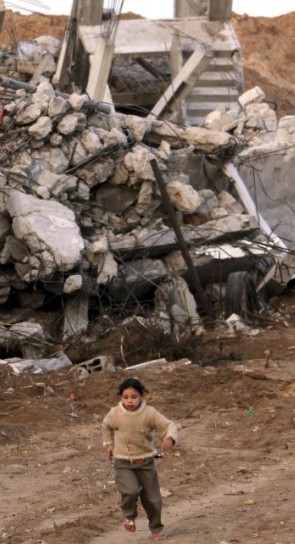
In Gaza there is now no uncontaminated water; of the 40,000 or so newborn babies, at least half are at immediate risk of nitrate poisoning – incidence of “blue baby syndrome”, methaemoglobinaemia, is exceptionally high; an unprecedented number of people have been exposed to nitrate poisoning over 10 years; in some places the nitrate content in water is 300 times World Health Organisation standards; the agricultural economy is dying from the contamination and salinated water; the underground aquifer is stressed to the point of collapse; and sewage and waste water flows into public spaces and the aquifer.

The blockade of Gaza has gone on for nearly four years, and the vital water and sanitation infrastructure went past creaking to virtual collapse during the three-week assault on the territory almost a year ago. [continued…]

Facebooktwittermail

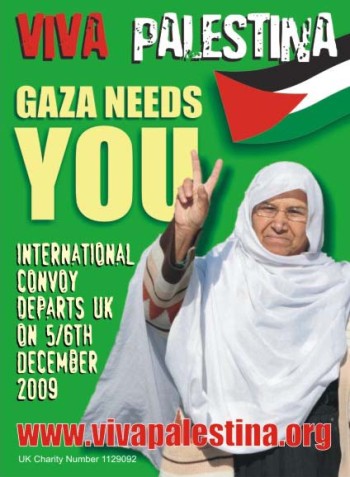
The third Viva Palestina Gaza convoy leaves London

“What Viva Palestina have achieved on their previous convoys has been incredible. Not only did they break the siege on Gaza, but they brought much needed aid, and solidarity on a massive international scale. The efforts of everyone from right across the world who took part in the previous convoy’s by giving up their time to drive to the stricken region of Gaza should be fully commended.

“To everyone taking part in the 3rd Viva Convoy, I wish you all the very best of luck, and your efforts for the people in Gaza just warms my heart. You bring hope, solidarity, peace, and love from right across the world. I am with you all the way in spirit.” — Noam Chomsky

Facebooktwittermail

West Bank settlers carry on building as new freeze is proposed

West Bank settlers carry on building as new freeze is proposed

At the small Jewish community of Revava in the northern West Bank, it was difficult to see yesterday what difference Israel’s freeze on settlement building would make. Construction continued on 20 housing units and the locals were apparently unperturbed by politicking between Jerusalem and Washington.

Under the proposal announced by Binyamin Netanyahu on Wednesday, no new residential permits will be issued and no new residential construction can start for ten months in the West Bank, excluding east Jerusalem. This was not stopping an American-Israeli homeowner and his family, who were working on the shell of their new house — one of 3,000 that have already been started and which will, therefore, continue.

The settlers of Revava admitted that existing curbs on building were beginning to bite. “It is a big problem,” said David, an armed private security guard. “There’s a great demand for housing here. There are lots of people applying for housing. My family lived in a three-room apartment but the family grew and now it is too small.”

The settlers, who call the West Bank area Judea and Samaria, said that they would do their best to continue building, despite the Government’s plans. “This is the heartland of our national claim, and the essence of Zionism is the return to the heartland where we once lived,” said David Ha-Ivry, a spokesman for the Jewish community in the northern West Bank. “There are things that can be done [by the Government] to make it difficult for us to proceed, but we find solutions. It’s part of the game. We’re doing pretty well.” [continued…]

Editor’s Comment — Anywhere else in the world, what the Israeli government calls a “freeze” would be called a development plan.

Even if this ten-month pause is actually enforced (and that, as the article above suggests, seems unlikely), to stop housing construction while continuing infrastructure and services expansion is transparently a plan to further entrench the policy of colonization.

Haaretz reports: “Defense Minister Ehud Barak on Thursday ordered the IDF to issue a temporary freeze order, but at the same time allowed the construction of 28 new public buildings in settlements.”

Perhaps the Israeli government should adopt a new expression for their practice of animated suspension: a fluid freeze.

Can Obama stand up to Israel?

President Obama urgently needs to distance Washington from the provocative – and illegal – actions the Israeli government has been undertaking in Jerusalem.

He needs to do this to save the two-state solution that he supports between Israelis and Palestinians. He needs to do it, too, because it will help protect US troops around the world. Jerusalem is a core concern for many of the world’s 1.5 billion Muslims, and with US forces now facing tense situations in several majority-Muslim countries, Washington has a stronger need than ever to keep the goodwill of the peoples of those lands. [continued…]

Facebooktwittermail

From Gaza to Obama: An open letter

From Gaza to Obama: An open letter

Mr President,

The whole world celebrated your election as the first African-American president of the US. I did not. Neither did the inhabitants of the concentration camp where I live. Your sympathetic visit to Sderot—an Israeli town which was the Palestinian village of Najd until 1948 when its people were ethnically cleansed—three years after your first visit to a Kibbutz in northern Israel in support of its residents, and after your pledge to be committed to the security of the State of Israel and its “right” to retain unified Jerusalem as the capital city of the Jewish people—to give but few examples—were all clear indications of where your heart lies.

Another reason for the writing of this letter is shock at the indifference and arrogance with which Secretary of State Hillary Clinton dismissed Palestinian concerns about Israel’s illegal Jewish-only settlements in the West Bank. Only a few weeks ago you made the admirable statement that all Jewish settlement must halt, and you made it clear that this included expansion of existing settlements as well as the construction of new settlements. However, when Netanyahu let it be known that he had no intention of stopping settlements, you missed an historic opportunity to draw a line: no more billions and no more weapons for Israel unless and until this condition is met. Now Clinton has the Herculean task of pretending that your position on Jewish settlements has not changed, although it is clear you have chosen not to use the very real power at your disposal to bring Israeli policy into line. [continued…] (h/t Rob Browne)

Barack Obama rewards big donors with plum jobs overseas

He may have promised to change Washington, but President Barack Obama is continuing one of its most renowned patronage traditions: bestowing prized ambassadorships on big donors.

Of the nearly 80 ambassadorship nominations or confirmations since Obama’s Inauguration, 56 percent were given to political appointees and 44 percent have gone to career diplomats, according to records kept by the American Foreign Service Association.

The latest nomination came this week, when Beatrice Wilkinson Welters was nominated to serve as ambassador to the island nation of Trinidad and Tobago in the Caribbean.

Welters, a longtime advocate for underprivileged children, and her husband, Anthony, an executive with UnitedHealth Group, generated between $200,000 and $500,000 in donations to Obama’s presidential campaign and an additional $100,000 for his Inauguration, according to the Center for Responsive Politics, a nonpartisan group that tracks political giving. [continued…]

The gaffes of Hillary Clinton

Though none of these comments had a tangible impact on U.S. foreign policy, the same can’t be said about two episodes in which Clinton veered away from the White House’s message on the Middle East peace process. The first came in May, when Clinton revealed at a press conference that Obama’s call for an Israeli settlement freeze included any “natural growth” within existing settlements. The circumstances remain murky, but two sources with detailed knowledge of the U.S.-Israeli relationship say that the Obama team was not yet prepared to make public this departure from Bush-era policy. Rather than leave his secretary of state twisting in the wind, says one of the sources, Obama wound up repeating her formulation a few days later, touching off months of tension with the Israelis. [continued…]

Facebooktwittermail

Imagine living in the West Bank…

Imagine living in the West Bank…

For most Israelis, the occupied West Bank — now mostly concealed behind a barrier far more imposing than the Berlin Wall — could be a million miles away. Even so, thousands really do know what it’s like. They have firsthand experience of the conditions imposed on ordinary Palestinians — they know because during their military service they had a direct role in imposing those conditions.

For the rest of us, beyond hearing testimony, seeing photographs and film, it is really only through an act of imagination that we can transport ourselves there and attempt to understand what it means to be living under military occupation.

The following film was created as a tool to help those of us who take freedom of movement for granted, to have a sense of what it means when that freedom is taken away.

Facebooktwittermail

From Bradford to Gaza

The brothers from Bradford are ready for Gaza

On March 9, I wrote: “In Sharm el-Sheikh a week ago, world leaders delivered empty promises. Today, Viva Palestina delivered the goods!”

The first Viva Palestina convoy had just completed its arduous drive through Europe and across North Africa, traveling 5,000 miles to deliver humanitarian aid to the people of Gaza.

Before world leaders had convened in Egypt to make what were indeed empty promises — virtually none of the $4.5 billion of aid pledged in early March has subsequently reached any of its intended recipients — a bunch of ordinary working folk had gathered donations from their local communities, bought ambulances, a firetruck, other vehicles, medical equipment and urgently needed supplies and were well on their way to reaching Gaza.

At the time it looked like a terrific display of human spirit, even if it amounted to only a small fraction of the relief just one government could provide. Nine months later, after a second convoy reached Gaza in July and as a third “mega convoy” gears up for departure on December 5 [PDF], Viva Palestina has not only been an inspiring mobilization of people power — it has been of real practical effect at at time that the Blairs, Mitchells, Clintons, Milibands and Obamas of this world have shown themselves to be pathetic examples of all-words-and-no-actions.

Among the participants in the new convoy are a contingent from Bradford for whom I have a special affection.

With their keffiyehs, beards and traditional Pakistani dress, to many Americans some of these guys will look like jihadists from Waziristan, but to me they’re fellow Yorkshiremen.

As they are getting ready to go, they’ve put together a short video — after the intro titles, fast-forward to minute three (unless you have a particular interest in what ambulances look like) to hear the Bradford brothers speak for themselves:

For information on making donations to Viva Palestina go here.

To make donations to Viva Palestina USA go here.

To make donations to the Bradford convoy contact Sid 0797-066-6656 or Shaf 0796-693-0587 (when dialing from outside the UK, dial your international access code then +44, then drop the “0”, eg from the US 011 +44 797-066-6656). Sid is the tire-fitter who appears in the video above wearing an olive-green keffiyeh. See the Bradford Group’s flyer [PDF]. The Bradford group has already raised $335,000 (200,000 pounds) in donations from the local community.

For information on Viva Palestina USA go here.

Al Jazeera English recently aired a short documentary on the conditions facing the residents of the Gaza Strip. Munzer al-Dayyeh is a 40-year-old mechanic living in Gaza. And while the effects of war and ongoing siege may be good for his business, he can’t manage to secure medical treatment for his disabled children. An insight into an ordinary Gazan man struggling to make a living and to find a solution for his family in the difficulties of the Gaza Strip.

Locked in: Life in Gaza – Part 1

Locked in: Life in Gaza – Part 2

Facebooktwittermail

Israeli rabbi approves murder of non-Jews

Israeli rabbi approves murder of non-Jews

A book published this week by a radical Jewish rabbi from the Israeli-occupied West Bank and endorsed by prominent religious right-wing figures suggests killing any non-Jew, including children and babies, who pose a threat to Israel.

The book’s publication, just days after the arrest of Jewish settler Jack Teitel, who is charged with a string of killings, including two Palestinians, reflects a growing antipathy towards Palestinians among Jews living in the occupied territory.

Michael Warschawski, the founder of the Jerusalem-based Alternative Information Centre, said the book went public with a concept that was already being promoted in a quieter way by dozens of settler rabbis in internal community newspapers and speeches. [continued…]

Facebooktwittermail

West Bank rabbi: Jews can kill Gentiles who threaten Israel

West Bank rabbi: Jews can kill Gentiles who threaten Israel

Just weeks after the arrest of alleged Jewish terrorist, Yaakov Teitel, a West Bank rabbi on Monday released a book giving Jews permission to kill Gentiles who threaten Israel.

Rabbi Yitzhak Shapiro, who heads the Od Yosef Chai Yeshiva in the Yitzhar settlement, wrote in his book “The King’s Torah” that even babies and children can be killed if they pose a threat to the nation.

Shapiro based the majority of his teachings on passages quoted from the Bible, to which he adds his opinions and beliefs. “It is permissable to kill the Righteous among Nations even if they are not responsible for the threatening situation,” he wrote, adding: “If we kill a Gentile who has sinned or has violated one of the seven commandments – because we care about the commandments – there is nothing wrong with the murder.” [continued…]

Israel spy agency tried to recruit alleged killer

A Jewish settler who was arrested for allegedly having murdered two Palestinians was approached by Israel’s internal security agency to be an informer after the attacks, the agency said Friday.

Jack Teitel, a 37-year-old immigrant from the United States, was arrested in October on suspicions of murdering the men in 1997 while visiting Israel as a tourist, the police announced on Sunday. He is also suspected of being behind a string of bomb attacks since 2006.

When Teitel returned to Israel in 2000, three years after the murders, he was questioned by the Shin Bet internal security service and the police over the killings, but no charges were filed. [continued…]

In the garden of bigotry and extremism

Another right-wing Orthodox Jewish killer has come out of the woodwork, which means, again, that the right-wing Orthodox Jewish camp’s stock is going up while that of its opposite number, the secular left, is going down.

This is the way it works now: An “ideological” settler goes on a bombing, shooting and stabbing spree against Palestinians, gays, a left-wing professor, a Christian missionary, maybe a couple of policemen and who knows who else. Immediately, the Orthodox Jewish right professes shock and starts praising itself to the skies, condemning the media and the country’s half-dozen or so leftists for incitement, while intimidating everybody else into nodding their heads.

The people in Shvut Rahel, home of confessed murderer Ya’acov Teitel, suspected accomplice Yosef Shpinoza, former Kach activist Avraham Richland and the late Asher Weisgan (who killed four Palestinian laborers in 2005) are absolutely stunned.

How could it happen – here, of all places? Ya’acov was such a nice, unassuming, quiet guy. He was always helping people. Of course we condemn the murders, what a question! And all these “attempts by the Left to take advantage of the situation for incitement against all of the settlers are ugly and pathetic.” [continued…]

Facebooktwittermail

Israel moves to rein in right-wing extremists

Israel moves to rein in right-wing extremists

A US native from this isolated settlement was arrested by Israeli security services nearly a month ago amid allegations that he killed two Palestinians more than a decade ago and attempted to murder two others more recently. The local media are calling it the latest case of Jewish terrorism.

The accusations against Yaakov Teitel, the son of a US Navy dentist, is fanning concern in Israel that nationalist vigilantes in Israel still have the ability to carry out attacks aimed at sabotaging peace negotiations and expected land concessions.

The case is even more loaded because security services publicized it Sunday – just days before the Nov. 4 anniversary of the 1995 assassination of Yitzhak Rabin by Jewish extremist Yigal Amir, which derailed the peace process for years. [continued…]

Teitel affair attests to lack of deterrence vis-à-vis violent radicals

When a murderer like Yaakov Teitel walks around freely for 12 years, carries out attacks, trains, creates an explosives lab, and builds up a weapons depot with no interruption, this means there is no deterrence.

In other words, the Shin Bet security service and police are not there. And when there is no deterrence, there is high likelihood that the next “patriotic” murderer is already walking amongst us.

And what does the next murderer think to himself, the person who dreams – like Yaakov Teitel – of being the nation’s savior and guardian of our race? How simple it is, he must be telling himself. You can murder, plant explosives, and create provocations freely and nobody will snitch on you or capture you.

After all, Yaakov Teitel did not hide in a large city like Tel Aviv. He lived in a very small community, Shvut Rachel. It’s impossible that he raised no suspicions for such a long time. But the fact is, nobody informed authorities. Even when he was held up for questioning, he was released for lack of evidence.

So what does the next murderer conclude about the Shin Bet’s ability to cover and penetrate such small communities? There is nobody to fear. Law enforcement authorities don’t reach these places. [continued…]

Facebooktwittermail

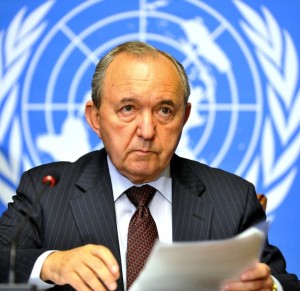
Goldstone vs US House of Representatives

Goldstone vs US House of Representatives

“We were disturbed by the lethality and toxicity of weapons used in Gaza, some of which have been in Western arsenals since the Cold War, such as white phosphorous, which incinerated 14 people, including several children in one attack; flechettes, small darts that are designed to tumble upon entering human flesh in order to cause maximum damage, strictly in breach of the Geneva Convention; and highly carcinogenic tungsten shrapnel and dime munitions, which contain tungsten in powder form. There is also a whole cocktail of other problematic munitions suspected to have been used.

“There are a number of other post-conflict issues in Gaza that need to be addressed. The land is dying. There are toxic deposits from all the munitions that have been dropped. There are serious issues with water—its depletion and its contamination. There is a high instance of nitrates in the soil that is especially dangerous to children. If these issues are not addressed, Gaza may not even be habitable by World Health Organization norms.” — Colonel Desmond Travers, one of the four members of the United Nations Fact Finding Mission on the Gaza Conflict, interviewed by Ken Silverstein.

______

When the House of Representatives is about to pass a non-binding resolution condemning the Goldstone report [PDF] on Israel’s war crimes in Gaza and Josh Block (spokesman for the American Israel Public Affairs Committee) says: “AIPAC, in concert with every mainstream pro-Israel organization in the United States, supports this important resolution,” it’s fair to conclude that AIPAC doesn’t simply support the resolution; it almost certainly had a major role in drafting the resolution.

Rabid opposition to the Goldstone report reached a hyperbolic peak this week when the Simon Wiesenthal Center referred to this serious legal finding as “the ‘Magna Carta’ of international terrorists”.

Why the hysteria?

The UN General Assembly is set to debate the report on Wednesday and in so doing will further enhance the legitimacy of what has already become a highly influential document.

As Israel has framed the issue, the legitimization of Goldstone is part of a campaign to delegitimize the Jewish state. But on the contrary, in recognition of the effectiveness of Israel’s own legal system, the Goldstone report has called on Israel “to launch appropriate investigations that are independent and in conformity with international standards, into the serious violations of International humanitarian and International Human Rights Law reported by the Mission and any other serious allegations that might come to its attention.”

The Washington Post, reporting on the move in the House, said:

The resolution, co-sponsored by the two senior members of the House Foreign Affairs Committee, Rep. Howard L. Berman (D-Calif.) and Ileana Ros-Lehtinen (R-Fla.), charges that the report by South African jurist Richard Goldstone for the U.N. Human Rights Council is “irredeemably biased and unworthy of further consideration or legitimacy,” in part because it was based on “a flawed and biased mandate,” and that the militant group Hamas was able to “significantly shape the findings of the investigation.”

Goldstone categorically rejects that assertion: “The allegation that Hamas was able to shape the findings of my report or that it pre-screened the witnesses is devoid of truth. I challenge anyone to produce evidence in support of it.”

The Post also said:

Goldstone, in a letter to Berman and Ros-Lehtinen, has complained of numerous inaccuracies in the resolution about his report. But Lynne Weil, a spokeswoman for Berman, said that the chairman believes Goldstone’s letter contains “a number of points that are inaccurate” and that he will “issue a complete response” to Goldstone before the House vote.

What follows is Justice Goldstone’s letter where clause by clause he exposes the flaws in the House resolution:

The Honorable Howard Berman
Chairman, House Committee on Foreign Affairs

The Honorable Ileana Ros-Lehtinen
Ranking Member, House Committee on Foreign Affairs

October 29, 2009

Dear Chairman Berman and Ranking Member Ros-Lehtinen,

It has come to my attention that a resolution has been introduced in the Unites States House of
Representatives regarding the United Nations Fact Finding Mission on the Gaza Conflict, which I
led earlier this year.

I fully respect the right of the US Congress to examine and judge my mission and the resulting
report, as well as to make its recommendations to the US Executive branch of government.
However, I have strong reservations about the text of the resolution in question – text that
includes serious factual inaccuracies and instances where information and statements are taken
grossly out of context.

I undertook this fact-finding mission in good faith, just as I undertook my responsibilities vis à
vis the South African Standing Commission of Inquiry Regarding Public Violence and
Intimidation, the International War Crimes Tribunal on the former Yugoslavia, the International
Criminal Tribunal for Rwanda, the International Panel of the Commission of Enquiry into the
Activities of Nazism in Argentina, the Independent International Commission on Kosovo, and the
Volker Committee investigation into the UN’s Iraq oil-for-food program in 2004/5.

I hope that you, in similar good faith, will take the time to consider my comments about the
resolution and, as a result of that consideration, make the necessary corrections.

Whereas clause #1: “Whereas, on January 12, 2009, the United Nations Human Rights Council passed Resolution A/HRC/S-9/L.1, which authorized a `fact-finding mission’ regarding Israel’s conduct of Operation Cast Lead against violent militants in the Gaza Strip between December 27, 2008, and January 18, 2009;”

This whereas clause ignores the fact that I and others refused this original mandate, precisely
because it only called for an investigation into violations committed by Israel. The mandate given
to and accepted by me and under which we worked and reported reads as follows:

“. . .to investigate all violations of international human rights law and international humanitarian
law that might have been committed at any time in the context of the military operations that
were conducted in Gaza during the period from 27 December 2008 and 18 January 2009, whether
before, during or after”.

Whereas clause #2: “Whereas the resolution pre-judged the outcome of its investigation, by one-sidedly mandating the `fact-finding mission’ to `investigate all violations of international human rights law and International Humanitarian Law by . . . Israel, against the Palestinian people . . . particularly in the occupied Gaza Strip, due to the current aggression’”

This whereas clause ignores the fact that the expanded mandate that I demanded and received
clearly included rocket and mortar attacks on Israel and as the report makes clear was so
interpreted and implemented. It was the report carried out under this broadened mandate – not the
original, rejected mandate – that was adopted by the Human Rights Council and that included the
serious findings made against Hamas and other militant Palestinian groups.

Whereas clause #3: “Whereas the mandate of the `fact-finding mission’ makes no mention of the relentless rocket and mortar attacks, which numbered in the thousands and spanned a period of eight years, by Hamas and other violent militant groups in Gaza against civilian targets in Israel, that necessitated Israel’s defensive measures;”

This whereas clause is factually incorrect. As noted above, the expanded mandate clearly
included the rocket and mortar attacks. Moreover, Chapter XXIV of the Report considers in
detail the relentless rocket attacks from Gaza on Israel and the terror they caused to the people
living within their range. The resulting finding made in the report is that these attacks constituted
serious war crimes and possibly crimes against humanity.

Whereas clause #4: “Whereas the `fact-finding mission’ included a member who, before joining the mission, had already declared Israel guilty of committing atrocities in Operation Cast Lead by signing a public letter on January 11, 2009, published in the Sunday Times, that called Israel’s actions `war crimes’;”

This whereas clause is misleading. It overlooks, or neglects to mention, that the member concerned, Professor Christine Chinkin of the London School of Economics, in the same letter, together with other leading international lawyers, also condemned as war crimes the Hamas rockets fired into Israel.

Whereas clause #5: “Whereas the mission’s flawed and biased mandate gave serious concern to many United Nations Human Rights Council Member States which refused to support it,
including Bosnia and Herzegovina, Cameroon, Canada, France, Germany, Italy, Japan, the Netherlands, the Republic of Korea, Slovakia, Slovenia, Switzerland, Ukraine, and the United Kingdom of Great Britain and Northern Ireland;”

This whereas clause is factually incorrect. The mandate that was given to the Mission was certainly not opposed by all or even a majority of the States to which reference is made. I am happy to provide further details if necessary.

Whereas clause #6: “Whereas the mission’s flawed and biased mandate troubled many distinguished individuals who refused invitations to head the mission;”

This whereas clause is factually incorrect. The initial mandate that was rejected by others who
were invited to head the mission was the same one that I rejected. The mandate I accepted was
expanded by the President of the Human Rights Council as a result of conditions I made.

Whereas clause #8: “Whereas the report repeatedly made sweeping and unsubstantiated determinations that the Israeli military had deliberately attacked civilians during Operation Cast Lead;”

This whereas clause is factually incorrect. The findings included in the report are neither “sweeping” nor “unsubstantiated” and in effect reflect 188 individual interviews, review of more than 300 reports, 30 videos and 1200 photographs. Additionally, the body of the report contains a plethora of references to the information upon which the Commission relied for our findings.

Whereas clause #9: “Whereas the authors of the report, in the body of the report itself, admit that `we did not deal with the issues . . . regarding the problems of conducting military operations in civilian areas and second-guessing decisions made by soldiers and their commanding officers `in the fog of war.’;”

This whereas clause is misleading. The words quoted relate to the decision we made that it would have been unfair to investigate and make finding on situations where decisions had been made by Israeli soldiers “in the fog of battle”. This was a decision made in favor of, and not against, the interests of Israel.

Whereas clause #10: “Whereas in the October 16th edition of the Jewish Daily Forward, Richard Goldstone, the head of the `United Nations Fact Finding Mission on the Gaza Conflict’, is quoted as saying, with respect to the mission’s evidence-collection methods, `If this was a court of law, there would have been nothing proven.’”

The remark as quoted is both inaccurate and taken completely out of context. What I had explained to The Forward was that the Report itself would not constitute evidence admissible in court of law. It is my view, as jurist, that investigators would have to investigate which allegations they considered relevant. That, too, was why we recommended domestic investigations into the allegations.

Whereas clause #11: “Whereas the report, in effect, denied the State of Israel the right to self- defense, and never noted the fact that Israel had the right to defend its citizens from the repeated violent attacks committed against civilian targets in southern Israel by Hamas and other Foreign Terrorist Organizations operating from Gaza;”

It is factually incorrect to state that the Report denied Israel the right of self-defense. The report examined how that right was implemented by the standards of international law. What is commonly called ius ad bellum, the right to use military force was not considered to fall within our mandate. Israel’s right to use military force was not questioned.

Whereas clause #12: “Whereas the report largely ignored the culpability of the Government of Iran and the Government of Syria, both of whom sponsor Hamas and other Foreign Terrorist Organizations;”

This whereas clause is misleading. Nowhere that I know of has it ever been suggested that the Mission should have investigated the provenance of the rockets. Such an investigation was never on the agenda, and in any event, we would not have had the facilities or capability of investigating these allegations. If the Government of Israel has requested us to investigate that issue I have no doubt that we have done our best to do so.

Whereas clause #14: “Whereas, notwithstanding a great body of evidence that Hamas and other violent Islamist groups committed war crimes by using civilians and civilian institutions, such as mosques, schools, and hospitals, as shields, the report repeatedly downplayed or cast doubt upon that claim;”

This is a sweeping and unfair characterization of the Report. I hope that the Report will be read by those tasked with considering the resolution. I note that the House resolution fails to mention that notwithstanding my repeated personal pleas to the Government of Israel, Israel refused all cooperation with the Mission. Among other things, I requested the views of Israel with regard to the implementation of the mandate and details of any issues that the Government of Israel might wish us to investigate.

This refusal meant that Israel did not offer any information or evidence it may have collected regarding actions by Hamas or other Palestinian groups in Gaza. Any omission of such information and evidence in the report is regrettable, but is the result of Israel’s decision not to cooperate with the Fact-Finding mission, not a decision by the mission to downplay or cast doubt on such information and evidence.

Whereas clause #15: “Whereas in one notable instance, the report stated that it did not consider the admission of a Hamas official that Hamas often `created a human shield of women, children, the elderly and the mujahideen, against [the Israeli military]’ specifically to `constitute evidence that Hamas forced Palestinian civilians to shield military objectives against attack.’;”

This whereas clause is misleading, since the quotation is taken out of context. The quotation is
part of a section of the report dealing with the very narrow allegation that Hamas compelled
civilians, against their will, to act as human shields. The statement by the Hamas official is
repugnant and demonstrates an apparent disregard for the safety of civilians, but it is not evidence
that Hamas forced civilians to remain in their homes in order to act as human shields. Indeed,
while the Government of Israel has alleged publicly that Hamas used Palestinian civilians as
human shields, it has not identified any cases where it claims that civilians were doing so under
threat of force by Hamas or any other party.

Whereas clause #16: “Whereas Hamas was able to significantly shape the findings of the investigation mission’s report by selecting and prescreening some of the witnesses and intimidating others, as the report acknowledges when it notes that `those interviewed in Gaza appeared reluctant to speak about the presence of or conduct of hostilities by the Palestinian armed groups . . . from a fear of reprisals’;”

The allegation that Hamas was able to shape the findings of my report or that it pre-screened the
witnesses is devoid of truth. I challenge anyone to produce evidence in support of it.

Sincerely,

Justice Richard J. Goldstone

Facebooktwittermail

Israel accused of rationing water to Palestinians

Israel accused of rationing water to Palestinians

Amnesty International on Tuesday accused Israel of denying Palestinians adequate access to water while allowing Jewish settlers in the occupied West Bank almost unlimited supplies.

Israel, the human rights group said, restricts availability of water in the Palestinian territories “by maintaining total control over the shared resources and pursuing discriminatory policies.”

“Israel allows the Palestinians access to only a fraction of the shared water resources, which lie mostly in the occupied West Bank while the unlawful Israeli settlements there receive virtually unlimited supplies,” Amnesty researcher Donatella Rovera said in a report.

Israel consumes four times more water than Palestinians, who use an average of 70 litres (16 gallons) a day per person, according to the report entitled: “Troubled waters – Palestinians denied fair access to water.” [continued…]

Facebooktwittermail

Which way for Hamas?

Which way for Hamas?

Whereas in 2008 Hamas brashly punched a hole through Egypt’s border defenses, unleashing an embarrassing stampede of Palestinians into Egyptian shops, Interior Minister [Fathi] Hamad says Hamas now “coordinates fully” with Gaza’s sole Arab neighbor. Hamas even poses as a guardian of Egypt’s national security, not least by killing al-Qaeda’s self-proclaimed preachers and other adherents in Gaza. “Our task now is governance, to consolidate stability rather than continue resistance,” says Hamad.

Yet a day after speaking these soothing words, the interior minister offered a very different political horizon. Between towering bodyguards from Hamas’s armed wing, the Qassam Brigades, he delivered an apocalyptic address to a summoned assembly of clan elders. It was angels that chased Israel’s army from Gaza in last winter’s war, he thundered, adding with a numerological flourish that whereas Israel beat twenty-two Arab nations, Gaza’s Islamic resistance had routed the enemy in just twenty-two days. The Jewish state, he concluded, would disappear in 2022.

Such reverses in rhetoric reveal a movement struggling to reconcile two competing audiences: the “international community,” which calls for Hamas to be more moderate, and a core constituency that grows suspicious at any sign it might be selling out. Much as Communist regimes tacked “Democratic” to their names to disguise totalitarianism, Hamas officials use the word “resistance” to hide the waning of their armed struggle. The culture minister, when he attends theatrical productions, speaks of Resistance Culture. The minister of economy hails recent openings of cafés and restaurants as triumphs of the Resistance Economy. “As long as we don’t raise our hands in surrender and continue to struggle, that’s resistance,” he said.

Hamas has failed to achieve the prime requisite for a more normal life: ending the siege. [continued…]

Facebooktwittermail

Jordan king warns over US Mideast policy

Jordan king warns over US Mideast policy

Jordan’s king said in comments published Monday that the U.S. administration seems to be focusing more of its attention on Iran and less on resolving the Israeli-Palestinian conflict, saying time was running out to make peace.

In an interview with Italian daily La Repubblica, King Abdullah II said the region’s hopes for peace were huge at the start of the Obama administration, but now sees the “goal getting farther away.”

“I’ve heard people in Washington talking about Iran, again Iran, always Iran,” Abdullah was quoted as saying. “But I insist on, and keep insisting on the Palestinian question: the Israeli-Palestinian conflict is the most serious threat to the stability of the region and the Mediterranean.” [continued…]

Editor’s Comment — Having just won the Nobel Peace Prize for advancing global diplomacy, President Obama should reflect some more on how engagement really works. The United States will talk to its adversaries, Obama boldly declared before getting elected. So far so good.

But engagement is sure to lead to a dead end unless it functions effectively as a two-way street. Washington has shown its readiness to talk, but is it ready to listen? Engagement can be as boneheaded as non-engagement if it doesn’t involve listening.

Abdullah, Erdogan and others are telling the US that this administration’s approach to the Middle East is failing. Is the administration listening?

Stop Palestinian suffering for Mideast peace, says Erdoğan

Peace cannot be established in the Middle East when the suffering of the Palestinians continues and the Gaza Strip remains a wreck, Turkish Prime Minister Recep Tayyip Erdoğan said Monday.

Speaking at the Istanbul Forum organized by Stratim, Seta and the German Marshall Fund, Erdoğan said the Palestinian question is at the center of all problems in the Middle East. The prime minister recalled that Turkey vocalized its disapproval of the previous year’s bombing of the Gaza Strip, adding: “We criticized steps that were serving no purpose, but which increased suffering and sabotaged the peace process. We will continue to criticize it today, too. We will criticize anything similar taking place in other areas.” [continued…]

Turkish president: ‘Brave criticism’ of Israel to continue

Turkey will continue to criticize its ally Israel with “courage” if it engages in “mistakes”, Turkish President Abdullah Gül said Sunday, continuing the verbal sparring between the two countries over the situation in Gaza.

Turkey is one of the “rare” countries to have good relations with both Arab countries and Israel, Gul said during an interview with public teleivision TRT.

“But this does not mean that Turkey will not raise its voice against errors if they are made. We should not think that Turkey will keep silent,” he said. [continued…]

How do Turkey and Israel measure each other’s love?

…in Israel’s eyes, Turkey is seen as two states – one in the form of the military, twin sister of Israel, the other political, leaning toward Islam and making friends with Syria and Iran. Thus, insolent Israel decided in a typical manner not to take Turkey’s politicians seriously and to adopt the Turkish army. Israel was also certain all these years that Turkey, backward and poor, needed its sole friend in the Middle East because it was not accepted in the region due to its Ottoman history and close ties with Israel and the United States, and therefore could not do without Israel.

So in Israel, people have been quick to conclude that “something went wrong” in Turkey. Suddenly the government rules the army instead of the army, Israel’s loyal friend, telling the government what to do. Israelis did not think for a minute that the Turkish army might also have had enough.

Turkey has changed; inwardly, for the most part. In a long and difficult process it has become a more democratic country. The army is still dominant, but less public in its role in the civilian domain. Turkey has overcome most of its economic problems and has been transformed into a regional economic power. It is a real strategic asset for the United States, increasing its importance after the Iraq war. It has also developed a different regional strategy.

Whoever reads what Foreign Minister Ahmet Davutoglu says recognizes that Turkey aspires to become an influential player not only in the Middle East but also in the Caucasus and Asia. It is involved in the fighting in Afghanistan, is forming an economic alliance with Iraq, plans to invest billions of dollars in Egypt, and its annual trade with Iran stands at $9 billion, with Syria at $1.5 billion.

And here is the paradox. This is the only Muslim country that is not harshly criticized, whether by Iran or any Arab state, for having such close ties with Israel. As such, it could have served as an excellent mediator between Israel and the Arab countries had Israel not considered it an obvious satellite state. [continued…]

Facebooktwittermail

At NYU, devilish Shlomo Sand predicts the Jewish past and pastes the Zionists

At NYU, devilish Shlomo Sand predicts the Jewish past and pastes the Zionists

When Sand said that Israel was not a democracy, and a Zionist called out, “It is a flawed democracy,” Sand bellowed. No: a democracy is founded on the idea that the people are the sovereign, that the people own the state. That is the first principle of a republic going back to Rousseau. Liberalism and civil rights are not the core [of Israel]. Yes, Israel is a liberal society. It tolerates Shlomo Sand’s heresy, for instance, and puts him on TV. But it is a liberal ethnocracy.

Down the row from me were two Arabs. I recognized the man from other events I have been to. I noticed how fulfilled they were by the talk, how quietly approving, and it was in this connection that we saw Sand’s passion: on behalf of the Palestinians. This part of the lecture brought tears to my eyes, it was so forceful and unapologetic. The idea that Joe Lieberman has a right to move to Israel tomorrow and a Palestinian whose ancestors have lived there for centuries cannot is an outrage, Sand said. But for 50 years the Palestinian Israelis were afraid to speak out.

“They were afraid because of the Nakba. They were afraid because of the military regime. Today this is a generation of young Palestinian Israelis that stop to be afraid. They become more anti-Israel in their politics the more they become Israelis.” [continued…]

The Invention of the Jewish People is now available from Amazon.

Facebooktwittermail

Israel: A fugitive state

Israel: A fugitive state

Do the innocent refuse to be questioned?

The Netanyahu government’s campaign to obstruct both the Goldstone inquiry and the report that it produced has been waged in the name of protecting Israel’s right of self-defense.

But Israel’s defenses are actually far weaker than the Goldstone critics care to admit: Israel is so vulnerable that it cannot withstand critical scrutiny or self-examination.

Gone are the days when an Israeli defense minister could be found by Israelis to “bear personal responsibility” for the massacre of hundreds of Palestinian civilians, as the Kahan Commission found Ariel Sharon after investigating his role in the Sabra and Shatila Massacre.

Now, Israel cannot even take the risk of conducting an independent investigation into alleged war crimes, let alone deal with the unpredictable outcome of such an investigation.

Instead, the defense of Israel now requires that all those who remain loyal to its interests and concerned about its preservation, maintain solidarity in a single mission: do everything possible to silence the Jewish state’s critics.

The underlying assumption seems to be that Israel will remain eternally an object of enmity; that the best it can hope for is that its enemies remain weak.

This is not merely the condition of a national identity; it percolates through to the outlook of individuals — an outlook that is inevitably misanthropic. It is to assume an existential orientation which regards the bulk of humanity as a harbor of ill-will.

For Israelis and many of their supporters, this situation ought to provoke a profound inquiry into the nature of antisemitism.

From where in the world does this ancient bigotry now draw most of its life?

In a pandemic of anti-Israel hostility?

Or might it find its most vital form of traction much closer to home, inside those very minds that perceive the rest of the world as other?

Are the Goldstone critics trying to defend Israel, or are they trying to sustain the image of an embattled state too fragile to survive the corrosive impact of investigation?

Mahmoud Ahmadinejad’s thesis is that Israel, like the Soviet Union, is destined to self-destruction. Michael Oren, Israel’s ambassador to the United States, seems susceptible to a similar fear.

Earlier this year, Oren wrote:

The breakdown of public morality, in my view, poses the greatest single existential threat to Israel. It is this threat that undermines Israel’s ability to cope with other threats; that saps the willingness of Israelis to fight, to govern themselves, and even to continue living within a sovereign Jewish state. It emboldens Israel’s enemies and sullies Israel’s international reputation. The fact that Israel is a world leader in drug and human trafficking, in money laundering, and in illicit weapons sales is not only unconscionable for a Jewish state, it also substantively reduces that state’s ability to survive.

Oren’s view has apparently subsequently shifted and he now seems to regard the results of the UN investigation as posing a greater threat to Israel than any other: “The Goldstone Report goes further than Ahmadinejad and the Holocaust deniers by stripping the Jews not only of the ability and the need but of the right to defend themselves.”

The ambassador might pause to consider this: A breakdown in public morality and an unwillingness to investigate alleged war crimes may in fact be intimately connected.

Facebooktwittermail