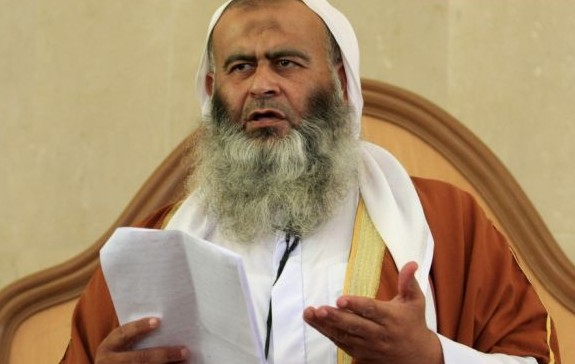
Israel has come under pressure from its allies to investigate UN allegations of possible war crimes by its army during its Gaza offensive last winter.
Britain’s UN envoy urged Israel to hold “full, credible and impartial” investigations, echoing similar calls from his US and French counterparts. [continued…]
Israeli and Palestinian leaders should launch investigations of alleged war crimes in Gaza to help rebuild trust and support peace, the U.N. High Commissioner for Human Rights said on Thursday.
At the opening of a U.N. Human Rights Council meeting on the issue, Navi Pillay said that all sides of the Middle East conflict were continuing to violate international law and voiced concern that transgressors are being left unpunished.
“A culture of impunity continues to prevail in the occupied territories and in Israel,” she told the 47-member body, calling for “impartial, independent, prompt and effective investigations into reported violations of human rights and humanitarian law.” [continued…]
Mia Farrow said Thursday she was outraged by conditions for children in the Gaza Strip after a blockade that has stretched for more than two years and a large-scale Israeli offensive against Hamas last winter.
The 64-year-old American actress also criticized Gaza militants’ rocket attacks on southern Israel, saying stopping them could lead to more international aid for the impoverished coastal strip. [continued…]
While I was in Jordan, King Abdullah gave a lengthy interview to Haaretz about the Israeli-Palestinian situation in which he warned that “We’re sliding back into the darkness.” My conversations with more than two dozen Jordanian officials, political activists, journalists and analysts suggest that on this, at least, the King reflects a widespread Jordanian consensus. Jordanians are growing increasingly frustrated with the Obama team’s approach, alarmed at Netanyahu’s unpunished intransigence, and downright frantic about the trend in Jerusalem. If we don’t start seeing progress soon, with stronger American leadership, then the “tinderbox” could explode.
It wasn’t always like this. When I was last in Jordan about six months ago, I found a great deal of optimism over the appointment of George Mitchell and the high profile Obama gave to the Israeli-Palestinian problem. But now those hopes seem to have largely evaporated. The launch of Israeli-Palestinian talks which they had expected by June continue to drift in limbo, while Obama’s failure to deliver on the settlement freeze has — just as so many predicted — eroded his credibility. How could the Americans have allowed Netanyahu to not only defy U.S. demands on settlements but to not even pay any significant price? Again and again, from all sectors of Jordanian political society, I heard the same refrain: Obama’s heart is in the right place and we want him to succeed, but he’s just not getting it done. [continued…]
Twenty-eight Palestinians have been held in administrative detention for two to four years, and one has been held for four-and-a-half years, according to a report due to be released early Wednesday morning by two human rights organizations, B’Tselem and Hamoked.
The report, entitled “Without Trial,” found that more than 1,000 Palestinians had been held simultaneously in administrative detention during the second intifada.
At the end of September of this year, Israel was holding 335 administrative detainees, including three women and a minor. Thirty-seven percent of the detainees had been in jail for one to two years. [continued…]
Commanders of the U.S.-trained Palestinian security forces who have been locking up criminals and battling Hamas militants here for nearly two years have maintained morale in the ranks with a single promise: They will one day be the anchor of security for an independent Palestinian state.
The lack of progress toward that goal is starting to sap Palestinian public support for the forces and erode morale among troops, even as they win praise and fresh funding from Washington for their accomplishments. [continued…]
Mental health professionals say there has been a rise in the drug’s usage in Gaza since the war. The Hamas authorities have tried to crack down on it, but the drug’s severe withdrawal symptoms means it is a seriously hard habit to break. Hasan Shaban Zeyada, a senior psychologist at the Gaza Community Mental Health Programme (GCMHP) is convinced that many of the psychological problems underlying the addiction are “the consequence of living in this situation: the siege, internal division and the war”.
Abu Ahmed used to have a good job as a driver. But like an estimated 100,000 other Gazans he lost it when Israel imposed its blockade after Hamas seized control of the strip from Fatah in June 2007. “Before the war the situation was so hard. There was no work, plus I had to take care of 11 people, including my wife. All people could do was sit around in the street and drink tea or coffee.” [continued…]
The United States sent a message to Egypt stating it does not support the proposed reconciliation agreement between Fatah and Hamas as it would undermine negotiations with Israel, Haaretz has learned.
George Mitchell, the U.S. envoy to the Middle East, met on Saturday night in Cairo with the chief of Egyptian intelligence, Gen. Omar Suleiman, and told him the United States would not support an agreement not aligned with the principles of the Quartet.
According to the agreement, which was supposed to have been signed by Thursday, Abbas was to issue a presidential decree no later than October 25, scheduling both parliamentary and presidential elections for June 28. Eighty percent of the delegates to the Palestinian parliament were to be elected by party basis, and 20 percent by constituency.
A special committee with delegates from all factions was supposed to have assumed control of the Gaza Strip, reporting to Abbas. The Strip was also to see a new security force, staffed with members of all Palestinian factions.
Sources told Haaretz that Mitchell made clear to the Egyptians on Saturday the United States expects any Palestinian government to follow the conditions of the Quartet, which include recognition of the State of Israel, acknowledging earlier agreements and renouncing terrorism.
Mitchell also said certain aspects of current agreement were poorly timed as they would undermine relaunching negotiations between Israel and the Palestinians. [continued…]
An internal document circulated among members of Palestinian President Mahmoud Abbas’ political party says all hopes placed in the Obama administration “have evaporated” because of alleged White House backtracking on key issues to the Palestinians.
The Fatah Party memorandum, obtained Tuesday by The Associated Press, accuses the United States of backing off from its demands that Israel freeze settlement construction and failing to set a clear agenda for new Mideast peace talks.
It wasn’t immediately clear whether the Oct. 12 document reflected Abbas’ views or was intended to be leaked as Fatah’s attempt to pressure President Barack Obama to bear down harder on Israel.
The document said the Palestinians have lost hope in Obama and accused the American leader of caving in to pressure from pro-Israel lobbyists in Washington.
“All hopes placed in the new U.S. administration and President Obama have evaporated,” said the document issued by Fatah’s Office of Mobilization and Organization. The department is headed Fatah’s No. 2, Mohammed Ghneim. [continued…]
Turkey did not hide its deep opposition to Israel’s policies in the territories in general and to Operation Lead Cast in particular. Erdogan’s outburst against President Shimon Peres last January at the Davos gathering did not stem from Islamist or pro-Iranian objectives.
Erdogan’s support for a UN deliberation of the Goldstone Report and his declaration that “those responsible for war crimes must be identified and held accountable,” is not based on any wish to please Iran or Syria. Turkey has a steady and clear policy on this issue and it is not a proxy for any country.
Public opinion exists in Turkey too and it is influential, and when the prime minister sees thousands of Turks protesting against Israel’s policy in Jerusalem, he cannot remain indifferent. At the same time, Turkey continues and will continue to have normal ties with Israel because such a relationship is part of Turkey’s strategy, but today it finds itself in a different international status, of the sort that allows it to also take swipes at Israel. [continued…]
Virtually all of Israel is now speaking in one voice against the Goldstone report, against any attempt to blame us over the war in Gaza. We’ve honed our message to a sharp point and, inspired by Prime Minister Binyamin Netanyahu’s performance at the UN, we’re delivering it with just the right tone of outrage:
How dare anyone deny us the right to self-defense! How dare anyone deny us the right to fight back against terrorism!
Very nice. Puts everyone else on the defensive. The right to self-defense is up there with motherhood and apple pie – who’s going to come out against it, especially for us, for Israel, for the Jews, for the people of the Holocaust?
The right to self-defense – perfect.
But I’d like to ask: Do the Palestinians also have the right to self-defense?
We probably wouldn’t admit it out loud, but in our heads we would say – again, in one voice – “No!”
This is the Israeli notion of a fair deal: We’re entitled to do whatever the hell we want to the Palestinians because, by definition, whatever we do to them is self-defense. They, however, are not entitled to lift a finger against us because, by definition, whatever they do to us is terrorism. [continued…]
There is no chance of an early solution to the Israeli-Palestinian conflict and people must “learn to live with it”, the Israeli Foreign Minister warned yesterday.
“Anyone who says that within the next few years an agreement can be reached ending the conflict… simply doesn’t understand the situation and spreads delusions, ultimately leading to disappointments and an all-out confrontation here,” Avigdor Lieberman said in a radio interview.
He added: “I am going to say very clearly: there are conflicts that have not been completely solved and people have learnt to live with it, like Cyprus.”
Mr Lieberman, the head of the far-right Yisrael Beitenu party, suggested that a long-term, interim deal with the Palestinians could ensure prosperity, security and stability, but tougher questions should be left until later.
“We have to be realistic,” he said. “We will not be able to reach agreement on core and emotional subjects like Jerusalem and the right of return of Palestinian refugees.” [continued…]
The Palestinian leadership has quickly backtracked in its approach to a U.N. report accusing Israel of possible war crimes in Gaza, in what its top diplomat acknowledged Thursday is erupting into a “clear crisis” for its people. [continued…]
A divided U.N. Security Council will meet next week at the request of Arab countries to discuss a U.N. report on war crimes committed by both Palestinian militants and Israel’s army during last December’s conflict in the Gaza Strip.
The Security Council’s monthly meeting on the Middle East was scheduled for October 20, but after a request from council member Libya that some western diplomat’s characterized as a bit of a “surprise”, the 15-member body agreed in closed consultations Wednesday to move up its session to October 14. [continued…]
Naming collaboration — even treason — for what it is has always been a painful taboo among Palestinians, as for all occupied peoples. It took the French decades after World War II to begin to speak openly about the extent of collaboration that took place with the Nazi-backed Vichy government. Abbas and his militias — who for a long time have been armed and trained by Israel, the United States and so-called “moderate” Arab states to wage war against the Palestinian resistance — have relied on this taboo to carry out their activities with increasing brazenness and brutality. But the taboo no longer affords protection, as calls for Abbas’ removal and even trial issued from Palestinian organizations all over the world.
Hamas too seems to have been taken by surprise at the strength of reaction. Hamas leaders were critical of Abbas’ withdrawal of the Goldstone resolution, but initially this was notably muted. Early on, Khaled Meshal, the movement’s overall leader, insisted that despite the Goldstone fiasco, Hamas would proceed with Egyptian-mediated reconciliation talks with Fatah and smaller factions scheduled for later in the month, stating that reaching a power-sharing deal remained a “national interest.”
As the tremors continued, however, Hamas leaders escalated their rhetoric — seemingly following, not leading, public opinion. Mahmoud Zahar, a prominent Hamas leader in the Gaza Strip, labeled Abbas a “traitor” and urged that he be stripped of his Palestinian nationality. Prime Minister Ismail Haniyeh, speaking before a hastily convened session of the Palestinian Legislative Council, said Abbas was personally responsible for the “crime” committed in Geneva, and a senior officer from the Hamas-controlled Gaza police force held a press conference to announce that Abbas and his associates would be subject to arrest if they set foot in Gaza. [continued…]
Last week, an incident that could have set the entire Middle East on fire was prevented. Netanyahu’s secret plan to visit a disputed tunnel in the East Jerusalem Palestinian neighborhood of Silwan, at the site known as Ir David (the City of David), was canceled, probably with some international intervention. Am I exaggerating the danger? No. Judging from past experience, provocations in Jerusalem never end well, and with the tensions in Jerusalem clearly rising in recent weeks, the potential for an explosion is very real. [continued…]
Israel is considering recalling its ambassador to Stockholm in light of Swedish Foreign Minister Carl Bildt’s remarks in support of a UN report claiming war crimes were committed by both sides during the Israel-Hamas Gaza conflict.
Bildt told reporters in Stockholm Thursday that South African jurist Richard Goldstone, who headed the investigation into the war, is a person with “high credibility” and “high integrity” and that his report carries weight.
Deputy Foreign Minister Danny Ayalon called to re-examine Israel’s relations with Sweden. [continued…]
As Abbas falls, have no doubt that he got pushed by an inept administration that similarly gets weak-kneed whenever it feels pressure from either the Israel lobby or the Israeli government.
Yesterday, State Department spokesman, Ian Kelly, was asked: “What role specifically did the United States play in pressuring the Palestinian Authority to make that decision [to shelve the Goldstone report]?
Kelly, squirming like an eel, responded:
Well, I don’t know if I would accept your characterization of pressuring. I think that we recognized that we had serious concerns with the recommendations and some of the allegations. We felt very strongly that while these investigations should be investigated and addressed, that we thought on the one hand that Israel had the kind of institutions that could address these allegations. And of course, we urged Israel to address these very serious allegations.
But I think we had a broader concern that we didn’t want the report to distract us from our ultimate goal, which was to address the root causes of the tragic events of last January, and that’s the lack of a regional and lasting peace between the two parties – between the Israelis and the Palestinians. So we were concerned that we stay focused on that ultimate goal.
And we are not saying that the allegations in the report – we’re not saying that they should be ignored. We simply do not want the report itself to become any kind of impediment to this ultimate goal. We appreciate the seriousness with which the Palestinians approach this very, very difficult issue, and we respect this decision to defer discussion of the report to a later date for the reasons that I just stated – that we want to make sure that we stay focused on the ultimate goal here.
(Goldstone discussion begins at 6 minutes 55 seconds.)
What kind of tortured logic is this? On the one hand war crimes committed in Gaza are somehow extraneous to an understanding of the root causes of the conflict, yet the root cause of the conflict is conflict itself?
The administration needs to make up its mind: Either this conflict is all about violence, in which case Israeli violence can’t be ruled out of the equation. Or, the violence is merely symptomatic of underlying political injustices and a natural outcome of addressing those injustices will be a long sought peace. Take your pick.
Of course, the true sentiment that few American officials are crass enough to utter, yet apparently everyone believes, is that when Israelis kill hundreds of Palestinians they really don’t intend to kill any (“we shoot and we cry”), yet when Palestinians kill a dozen Israelis they merely fall short of accomplishing their genocidal intentions.
* * *
After taking stabs at solving the Middle East conflict, engaging Iran, bringing about global nuclear disarmament, healing the rift between Muslims and the West, shoring up the global financial system, tackling climate change and reforming America’s health care system, there are strong indications that Obama came into office intoxicated by his image as a world savior.
Even so, his cool created the impression that he might actually be impervious to the influence of adulation, but even though some of us thought he had risen above the massive projections that were being imposed on him, the evidence is that to some extent he got sucked into the myth that had been created around him.
To see Obama now as either a tragic figure or as the victim of circumstances essentially absolves him of responsibility for his own actions.
I don’t think it’s premature to be conducting an autopsy on Obama’s Middle East initiative and the first question to ask is this: Did he manage to cross the most minimal threshold for a defensible approach? That is, can he claim at least to have done no harm?
Unfortunately, the harm appears grossly evident and it hinges on his choice to raise expectations across the region and then allow those expectations to founder. Expectations dashed are much more destructive than expectations never formed. (George Bush never disappointed anyone because no one took his promises seriously. In office and life he mastered the art of setting a low bar.)
So, could Obama have entered the situation differently and put himself in a better position to at least live up to the Hippocratic oath (which, incidentally, all politicians should be forced to take)?
He could have acknowledged that he had on his plate more than any human president could address (“sorry folks, I’m not the Messiah”) and he could in his first days in office have said something like this:
“The Middle East conflict is a wound to which no easy remedy can be applied. I do not come into office claiming to have any greater powers than all of my predecessors who struggled with limited success to deal with this issue.
“I do know this, however: setting aside the many intractable political issues, there is right now a humanitarian crisis in Gaza. We haven’t had time to assess the scope of this crisis but having appointed George Mitchell as my Middle East peace envoy, I’ve asked him to put the crisis in Gaza at the top of his agenda. In the next few days he will be visiting the area to assess which needs must most urgently addressed.”
At that point, the Israel Lobby’s wheels would have started spinning frantically. But how do you conduct a campaign focused on preventing Mitchell going to Gaza and addressing a humanitarian crisis?
No doubt, phones in the White House and the State Department would have been ringing off the hook as Abe Foxman and other Jewish community leaders and Israeli officials objected, saying that such a move would not be “helpful”. But seriously, how do you conduct a public campaign whose direct aim is to prevent help reaching tens of thousands of people whose homes had been flattened?
What happened in reality? Obama and Mitchell made the choice of staying out of Gaza. Neither of them had a gun pointed at his head.
Obama had the opportunity to craft a policy that grew modestly and organically from the facts on the ground. A combination of fear, arrogance and perhaps lack of political imagination, led him to pass up that opportunity.
Israel is threatening to kill off a crucial West Bank economic project unless the Palestinian Authority withdraws a request to the International Criminal Court to investigate alleged Israeli crimes during last winter’s Gaza war.
Shalom Kital, an aide to defence minister Ehud Barak, said today that Israel will not release a share of the radio spectrum that has long been sought by the Palestinian Authority to enable the launch of a second mobile telecommunications company unless the PA drops its efforts to put Israeli soldiers and officers in the dock over the Israeli operation.
“It’s a condition. We are saying to the Palestinians that ‘if you want a normal life and are trying to embark on a new way, you must stop your incitement,” Mr. Kital said. “We are helping the Palestinian economy but one thing we ask them is to stop with these embarrassing charges.”
As long as the Wataniya Mobile company is unable to begin its operations, communications costs are likely to remain inordinately high for Palestinian businesses and individuals. But thwarting the company benefits four unauthorized Israeli operators who make sizeable profits in the Palestinian market using infrastructure they have set up in the illegal Israeli settlements across the West Bank. [continued…]
A UN report published Tuesday says poverty in the Gaza Strip has deteriorated to levels unseen since 1967.
The UN trade and development agency says 90% of Gaza’s residents are currently beneath the poverty line and rates the damages caused by the IDF’s Operation Cast Lead at $4 billion, a sum it claims is three times larger than the Strip’s annual market performance.
The agency claims the operation halted all trade in the Gaza Strip, creating a defecit of around $88 million. This, in addition to material damages and loss of finances due to the siege and trade limitations later imposed on the Strip, make up the final sum.
The agency’s report claims the Strip has not been in such dire straits since 1967, and that the government has become the residents’ main force of employment. [continued…]
It has been six months since the international community pledged nearly US$5 billion (Dh18bn) in aid to the Palestinian people, chiefly for the reconstruction of the Gaza Strip after Israel’s devastating offensive there this year.
None of this aid has reached Gaza and no reconstruction has started.
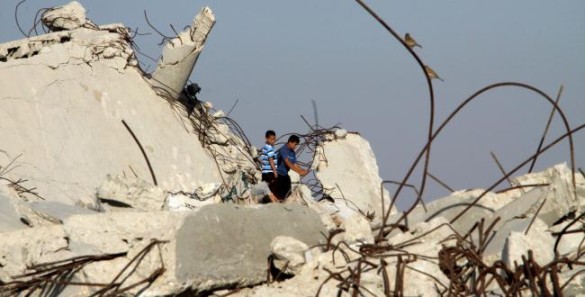
Although Israel is slowly easing its restrictions on the flow of basic humanitarian goods to Gaza, including food and medicine, construction materials remain prohibited from entering, institutions and homes still lie in rubble, and critically needed projects to repair and upgrade Gaza’s power plant and tottering sewage network lie dormant. [continued…]
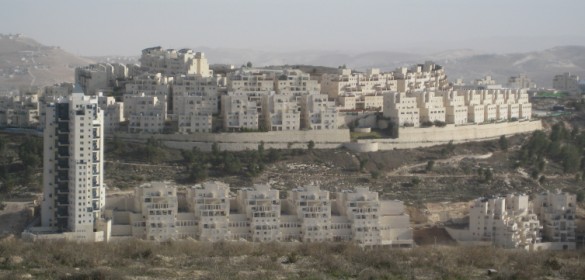
Prime Minister Benjamin Netanyahu will approve hundreds of new housing units in West Bank settlements before slowing settlement construction, two of his aides said Friday, in an apparent snub of Washington’s public demand for a total settlement freeze.
The aides also said Netanyahu would be willing to consider a temporary freeze in settlement construction, but their definition of a freeze would include building the new units and finishing some 2,500 others currently under construction.
The settlement suspension also would not include east Jerusalem, which the Palestinians hope to make their future capital.
The U.S. has a set a high public bar for a freeze, saying repeatedly that all settlement activity on lands the Palestinians claim for a future state must stop, without exception. However, Israel appeared to gain some wiggle room in recent weeks as the sides discussed the details of a would-be settlement freeze. [continued…]
Editor’s Comment — When did Netanyahu make his definitive assessment of Obama?
Was it when the presidential candidate was putting on his most obsequious performance in front of AIPAC, spouting drivel about an indivisible Jerusalem?
Whenever it happened, it is clear that Netanyahu took a clear measure of the strength of his adversary and concluded that whatever the power of his office, this particular president was pliable as willow.
We regret the reports of Israel’s plans to approve additional settlement construction. Continued settlement activity is inconsistent with Israel’s commitment under the Roadmap.
As the President has said before, the United States does not accept the legitimacy of continued settlement expansion and we urge that it stop.
When this president urges this prime minister to stop, I’m reminded of Bush urging Sharon to pull his troops out of Jenin “without delay” in 2002 – a meek demand that was predictably ignored – and of Olmert telling Bush how Rice should vote at the UN – a presumptuous call that was not rebuffed.
Crude as this way of expressing it might be, again and again we witness a suposedly powerful American president acting like he’s the Israeli prime minister’s bitch.
Have I given up on Obama? Not yet, but I see little evidence that he has the capacity to be bold. The skeptic at this blog is teetering on the brink of becoming a cynic.
The Central Bureau of Statistics said there were 672 new housing starts in Jewish settlements in the West Bank in the first half of 2009, down from 1,015 in the same period last year.
The data which does not include annexed east Jerusalem.
But while the 33 percent dip appears significant, it returns construction levels to about the same pace as 2007 when 713 new housing projects were begun. [continued…]
Prime Minister Benjamin Netanyahu’s planned approval of the construction of hundreds of new housing units in West Bank settlements is “unacceptable,” Palestinian President Mahmoud Abbas said Friday in Paris.
“What the Israeli government said [about the planned construction] is not useful,” Abbas said after a meeting with French President Nicolas Sarkozy. “It is unacceptable for us. We want a freeze on all settlement construction.”
Abbas also told journalists that a possible summit meeting with Netanyahu and U.S. President Barack Obama in New York, on the margins of a UN General Assembly meeting, depended on “steps that are taken beforehand regarding a settlement construction freeze.” Continue reading →
Late last month, Salam Fayyad, the appointed Palestinian Authority (PA) prime minister in Ramallah, made a surprise announcement: he declared his intention to establish a Palestinian state in the West Bank and Gaza Strip before the end of 2011 regardless of the outcome of negotiations with Israel.
Fayyad told the London Times that he would work to build “facts on the ground, consistent with having our state emerge as a fact that cannot be denied.” His plan was further elaborated in a lengthy document grandly titled “Program of the Thirteenth Government of the Palestinian National Authority.”
The plan contains all sorts of ambitious ideas: an international airport in the Jordan Valley, new rail links to neighboring states, generous tax incentives to attract foreign investment, and of course strengthening the “security forces.” It also speaks boldly of liberating the Palestinian economy from its dependence on Israel, and reducing dependence on foreign aid.
This may sound attractive to some, but Fayyad has neither the political clout nor the financial means to propose such far-reaching plans without a green light from Washington or Tel Aviv. [continued…]
The accelerating pace of Jewish settlement expansion in East Jerusalem this year may spur violence between Israelis and Palestinians in the city and cripple new efforts by the Obama administration to kick-start peace talks, an Israeli anti-settlement group warned yesterday.
The “massive” construction being planned by Jewish settlers within Palestinian neighbourhoods in East Jerusalem is likely to prompt clashes, said Yudith Oppenheimer, the executive director of Ir Amim, a Jerusalem-based advocacy group.
“There is a combination of factors, including settlers invading Palestinian neighbourhoods, already annoying with their presence and control of houses and land and their mass construction plans when, next door, Palestinian neighbours cannot even build a balcony because they do not get a permit. This creates the conditions for violence,” she said. [continued…]
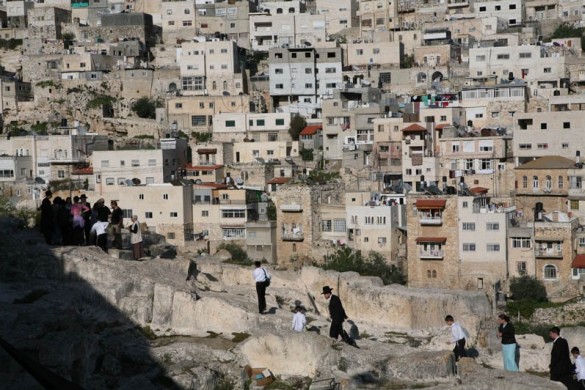
It’s searing hot, but there’s some pleasantness about the stone-flagged path rising from the centre of Silwan, Jerusalem. Maybe it’s the breeze, or the stone houses oozing coolness into the air, or maybe it’s the wide-open mountain landscape. There are three of us – Ilan, the director, Michael, the cameraman and me, the interviewee. We’re making a film on the blatant institutional discrimination against the residents of this Palestinian east-Jerusalem neighbourhood; authorities favour the Jewish settlers who are not hiding their desire to Judaise the neighbourhood, to void it of its Palestinian character.
Even before we position the camera, a group of orthodox Jewish girls, aged about eight to 10, come walking up the path in their ankle-long skirts, pretty, chattering, carefree. One of them slows down beside us, and pleasantly asks us if we want to film her. What would you like to tell us, we ask. I want to say that Jerusalem belongs to us Jews, she says as she walks on, only it’s a pity there are Arabs here. The messiah will only come when there isn’t a single Arab left here. She walks on, and her girlfriends giggle and rejoin her.
Two minutes later a young, well-built young man comes up, carrying a weapon and a radio, without any uniform or tag upon his clothes. Even before he opens his mouth I’m already guessing he’s a security guard, an employee of the private security contractor operated by settlers but sponsored by the housing ministry at an annual budget of NIS 40m (£4.6m). This security company has long since become a private militia policing the entire neighbourhood and intimidating the Palestinian residents without any legal basis whatsoever. A committee set up by a housing minister determined that this arrangement was to cease, and the security of both Palestinian and Jewish residents must be handed over to the Israeli national police. The government endorsed the committee’s conclusions in 2006, but recanted six months later, under settler pressure. The private security contractor went on operating. [continued…]
Jerusalem began as a small village in a place known as the City of David where the Palestinian village of Silwan sits today. Buried under the village lands, 5000 years of history bind the stories of ancient nations and rulers with the present life of the local residents. Dozens of excavated archaeological strata tell the complex multi-cultural saga of Jerusalem.
We, a group of archaeologists and residents of Silwan, invite you to hear the story of ancient Jerusalem and of life in the village today. Our tour sheds light on the role of archaeology in the Israeli-Palestinian conflict and in the discourse of the future of Jerusalem. We will offer a different perspective: archaeology without an ownership, one that bridges between periods, cultures and nations; archaeology which involves the local residents and examines the past as a shared asset regardless of religion or nationality.
We believe that archaeology in Silwan/”City of David” has the power to change the dynamics of the conflict and promote tolerance and respect for other cultures, past and present, for a better future for both the local residents and the whole region. [continued…]
When Canadian businessman Sam Ismail brought his wife and five children to visit his brother’s family in Ramallah last week, he planned to stay for 10 days and tour both Israel and the Palestinian territories. They had flown into Amman, crossed over to the West Bank. Knowing that Palestinian Authority license plates are banned in Israel, Ismail reserved a car at an Israeli rental company. But, when he got to Israeli border control, he was shocked to discover that his Canadian passport was stamped “Palestinian Authority Only.” “Last time they came, they visited Acre, Haifa, Jerusalem — the whole country,” Ismail’s brother Nedal, who lives in the West Bank, told TIME. “This time they packed up after 96 hours and spent the extra week in Jordan instead.”
Ismail had fallen afoul of an Israeli border policy, quietly begun in June, that bars foreigners who say they are visiting the Palestinian Authority from entering Israel. Israel says the visa helps to exclude visitors who threaten security. According to Israeli Interior Ministry spokeswoman Sabine Haddad, the procedure is based on an unpublished 2006 decision by the Israeli interior and defense ministers that “any foreign national who wants to enter the Palestinian Authority must have a permit issued by the army, and entry is permitted only into PA territory.” [continued…]
Uri Davis is used to denunciations. A “traitor”, “scum”, “mentally unstable”: those are just some of the condemnations that have been posted in the Israeli blogosphere in recent days. As the first person of Jewish origin to be elected to the Revolutionary Council of the Palestinian Fatah movement, an organisation once dominated by Yasser Arafat, Davis has tapped a deep reserve of Israeli resentment. Some have even called for him to be deported.
He has been here before, not least as the man who first proposed the critique of Israel as an “apartheid state” in the late 1980s. Davis’s involvement in the first UN World Conference Against Racism in Durban in 2001 was condemned by the Anti-Defamation League. During a career of protest he has been described – inevitably – as a “self-hating Jew”. He calls himself an “anti-Zionist”. And his personal history is a fascinating testimony to the troubled history of the postwar Israeli left and forgotten trajectories in the story of Israel itself.
The man elected to the Revolutionary Council in 31st place from a field of 600 has been as much shaped by the tidal forces of recent Jewish history – not least his own family’s sufferings in the Holocaust – as any fellow citizen of Israel. But he disputes a largely manufactured account of that experience that he believes has been used deliberately “to camouflage” its “apartheid programme”. Now he enjoys an extraordinary mandate to explain his own views. And he hopes, too, that just as the small number of white members of the ANC widened its legitimacy during the apartheid era in South Africa, other Jews can be attracted to participate in Fatah, transforming it into a broader-based movement that stands for equal rights for both Arabs and Jews in a federated state. [continued…]
Eyebrows were raised around the world Aug. 14 when Hamas security forces in Rafah swiftly, and brutally, destroyed an al-Qaeda-inspired group that had proclaimed the southern Gaza town an “Islamic emirate.” After all, Hamas is listed by the U.S. and the European Union as a terrorist organization, and many in the West don’t expect an avowedly Islamist political organization to forcefully suppress jihadist groups.
Yet, that’s exactly what happened when pro-al-Qaeda cleric Abdel Latif Moussa gathered about 100 of his heavily armed supporters in a mosque to denounce Hamas rule and declared himself the “Islamic prince” of the new “emirate.” Hamas security men moved in to disarm the group, and 24 people, including Moussa and about 20 of his followers, were killed in the ensuing firefight. Their group, Jund Ansar Allah, claimed inspiration from al-Qaeda, and condemned Hamas both for maintaining a cease-fire with Israel and for its failure to impose Islamic Shari’a law after taking full control of Gaza in 2007. It had mounted small-scale attacks on rivals inside Gaza, and two months ago failed in a bizarre cavalry charge by mounted fighters against Israeli border guards. Following the Rafah showdown, the fringe group has vowed to wage war on Hamas, turning Gaza’s rulers into an unlikely ally against Osama bin Laden.
The horsemen of Jund Ansar Allah on training exercises in preparation for their quixotic attack on an Israeli border post in June:
Still, there was little surprise about the Rafah confrontation for longtime observers of Palestinian politics. Hamas, in fact, has always been at odds with al-Qaeda. Despite its Islamist ideology, Hamas is first and foremost a nationalist movement, taking its cue from Palestinian public opinion and framing its goals and strategies on the basis of national objectives, rather than the “global” jihadist ideology of al-Qaeda. For example, Hamas has periodically debated the question of whether to attack American targets in its midst, and each time has reiterated the insistence of the movement’s founders that it confine its resistance activities to Israeli targets.
“What distinguishes Hamas — as well as organizations like Hizballah and Egypt’s Muslim Brotherhood — from groups like al-Qaeda is that they recognize, whether out of principle or practical necessity, that the will of the people they claim to represent is paramount,” says Mouin Rabbani, an Amman-based analyst with the Center for Palestine Studies. “In deciding their actions, they’re ultimately more responsive to their environment than to their principles.” [continued…]
A Hamas representative said on Thursday the Palestinian Islamist group was still positive about reconciliation with its rival Fatah, days ahead of an expected new round of Egyptian-brokered talks.
“We are going to continue the dialogue with a positive mentality, but we must settle the question of (Hamas) political prisoners in the West Bank,” Hamas official Osama Abu Khaled told AFP. [continued…]
Palestinians are as eager as anyone to see positive economic development for their tormented country. But they know full well that real economic progress awaits their release from Israeli military occupation (West Bank, East Jerusalem) and siege (Gaza Strip).
Consider the recent media promotion of the Netanyahu government’s view that the occupied West Bank is witnessing rapid economic growth. Thomas Friedman picked up on that theme in his New York Times column, as did Michael Oren, Israel’s ambassador to the United States, in this newspaper. The selective economic data they provide ignore the reality: Occupied Palestinian territory is not a sovereign country where traditional economic measures apply.
I was the manager who oversaw the establishment of the first modern mall in the West Bank—the Plaza Shopping Center in El Bireh. I can attest that the success of a West Bank mall rests on a thin layer of elite consumer privilege poised precariously over a chasm of widespread disempowerment. Until West Bank Palestinians gain free and open access to the world economy, beyond the markets of the occupying power, major enterprises in Palestinian towns will suffer. [continued…]
When peace-loving Israeli liberals present their conflict with Palestinians in neutral, symmetrical terms – admitting that there are extremists on both sides who reject peace – one should ask a simple question: what goes on in the Middle East when nothing is happening there at the direct politico-military level (ie, when there are no tensions, attacks or negotiations)? What goes on is the slow work of taking the land from the Palestinians on the West Bank: the gradual strangling of the Palestinian economy, the parcelling up of their land, the building of new settlements, the pressure on Palestinian farmers to make them abandon their land (which goes from crop-burning and religious desecration to targeted killings) – all this supported by a Kafkaesque network of legal regulations.
Saree Makdisi, in Palestine Inside Out: An Everyday Occupation, describes how, although the Israeli occupation of the West Bank is ultimately enforced by the armed forces, it is an “occupation by bureaucracy”: it works primarily through application forms, title deeds, residency papers and other permits. It is this micro-management of the daily life that does the job of securing slow but steady Israeli expansion: one has to ask for a permit in order to leave with one’s family, to farm one’s own land, to dig a well, or to go to work, to school, or to hospital. One by one, Palestinians born in Jerusalem are thus stripped of the right to live there, prevented from earning a living, denied housing permits, etc.
Palestinians often use the problematic cliché of the Gaza strip as “the greatest concentration camp in the world”. However, in the past year, this designation has come dangerously close to truth. This is the fundamental reality that makes all abstract “prayers for peace” obscene and hypocritical. The state of Israel is clearly engaged in a slow, invisible process, ignored by the media; one day, the world will awake and discover that there is no more Palestinian West Bank, that the land is Palestinian-frei, and that we must accept the fact. The map of the Palestinian West Bank already looks like a fragmented archipelago. [continued…]
No people mourn better than the Jewish people. For seven days after death, the family sits shiva, a vigil at home for loved ones to comfort one another and reflect on the life lost. During the following year and then beyond, the stages of mourning develop to allow next of kin to continue their lives while still remembering who is gone from them.
The process is successful for Jews, but it is failing the Jewish state. Six decades since the gravest of their tragedies, Jews have collectively yet to find a sustainable way of moving on without forgetting the Holocaust. The inability to do so poses dire consequences for Israel and the possibility for peace.
For Israel, the Holocaust didn’t end in 1945, but reconstituted itself in the country’s political and social cultures. It’s no accident that Yad Vashem, Israel’s Holocaust museum, is physically connected to Har Hertzl, Israel’s national cemetery. The symbolism hits you over the head: Israel was born out of the Holocaust, and the price to protect the Jewish people from another one is steep. There is truth in that, but also danger. Binding too tightly the slaughter of Jewish civilians by Nazis and the deaths of Israeli soldiers by Arabs turns every threat to Israel into another Holocaust. [continued…]
Mahmoud Abbas, the 74-year-old leader of the Palestinian Fatah movement, registered a significant achievement in holding the movement’s Sixth General Conference, which has been wrapping up its business in Bethlehem in the Israeli-occupied West Bank this week.
But veteran Palestinian analysts say Abbas’s biggest internal political challenges still lie ahead. Many of these challenges, they note, stem directly from the compromises he made to be able to convene the conference at all – and to ensure that it presented the trappings of success in the form of a political platform and leadership elections.
One of the biggest compromises was linked to the decision to hold the conference inside the Israeli-occupied West Bank. That meant there were numerous long time Fatah activists from the demographically weighty Palestinian diaspora – and from Gaza – who were barred from attending by Israel. [continued…]
Two years after its takeover of the Gaza strip, Hamas has faced down its greatest challenger: A militant, Al Qaeda-inspired organization that says Hamas is not Islamic enough.
Last Friday, Hamas forces and the Jund Ansar Allah (Soldier of God) movement fought a day-long gun and artillery battle that killed about 30 in the southern Gaza town of Rafah after the group’s spiritual leader, Sheikh Abdel Latif Moussa, declared an Islamic emirate in Gaza and denounced Hamas. Mr. Moussa was killed in the fighting, centered on the mosque where he and his followers had gathered.
It was the first time an Al Qaeda-inspired group had directly challenged Hamas’ rule in the Gaza Strip but it may not be the last. Fueled by the failure of Hamas to address the area’s growing poverty and isolation, and Hamas’ relative recent restraint in its confrontation with Israel, analysts say such organizations are growing in the territory. [continued…]
Jund Ansar Allah is one of several tiny radical Islamist groups that have popped up in the Gaza Strip in the past few years.
These groups have openly challenged the Hamas government on the grounds that it has not imposed Islamic law (Shari’a).
The radical groups want to see a regime similar to the one in Sudan and other Islamic countries, where thieves have their arms amputated and those found guilty of adultery are stoned to death.
Some have claimed that these groups are either linked to or inspired by al-Qaida, but so far there is no evidence to back up their claim.
Hamas officials, however, say that many of the leaders and members of these groups were in fact affiliated with the former Fatah-controlled security forces or with militias belonging to Fatah in the Gaza Strip.
A senior Hamas official told The Jerusalem Post over the weekend that Jund Ansar Allah received its weapons from former Fatah policemen and security officials in the southern Gaza Strip.
The official said he did not rule out the possibility that Fatah leaders in the West Bank were trying to use radical Islamic groups to undermine the Hamas government. [continued…]
Al-Qaeda loyalists in Gaza declared war on Hamas Saturday after violent shootouts left 24 people dead, including Jund Ansar Allah leader Abdel-Latif Moussa.
In a message posted by al-Qaeda’s websites the Islamic Swords of Justice, a group affiliated with the Salafi movement, vowed to avenge the deaths. “We tell our people who witnessed this crime that this is not over, and war is on its way,” the message said. [continued…]
Operating initially in Rafah and Khan Younis, Jund Ansar Allah spread rapidly throughout Gaza and, until Friday’s raid, claimed to have 500 members, including a number of foreign fighters.
It is said to have a military base in a former Israeli settlement, from which it carried out a number of minor attacks on Israeli forces during the first half of the year, according to its website.
On 8 June, however, the group came to public attention with a spectacular, if unsuccessful, raid on the Karni border crossing.
At least three of its fighters were shot dead by Israeli troops after 10 rode into battle on horses laden with large quantities of explosives. [continued…]
In an echo of restrictions already firmly in place in Gaza, Israel has begun barring movement between Israel and the West Bank for anyone holding a foreign passport, including humanitarian aid workers and thousands of Palestinian residents.
The new policy is designed to force foreign citizens to choose between visiting Israel, including East Jerusalem, which Israel has annexed illegally, and the West Bank. In most cases, travel between the two areas will no longer be possible.
The new regulation is in breach of Israel’s commitments under the Oslo accords to western governments that their citizens would be given continued access to the occupied territories. [continued…]
A plumber by trade, Ezra Nawi is a Jewish member of a small band of Israeli peace activists who put themselves on the line week in and week out by traveling to the stony hills outside Hebron to help Palestinians defend their land against right-wing Jewish settlers. And he has the lumps to show for it. Four years back, some settlers at Susya had tried to drive a Palestinian family off their land by tossing a dead dog into their well in order to poison the family’s water. The following day, Palestinians hauled the dog out of the well and were trying to draw water under the protection of Nawi and some other volunteers from an Jewish-Arab peace group known as Ta’ayush. Masked settlers appeared, smashed one activist with the butt of a gun and broke a long wooden stick over Nawi’s head.
Nawi reacted as he always has — by holding his ground — without resorting to violence. In his many confrontations over the years with Israeli police, soldiers and settlers, Nawi has never struck back, say his colleagues at Ta’ayush. “Non-violence is Ezra’s natural affinity,” says David Shulman, a Ta-ayush member and professor of Sanskrit who has on multiples occasions witnessed Nawi’s encounters with settlers and police. “He is amazingly gentle and empathetic. He’s not capable of violence.” [continued…]
Hamas: Head of Al-Qaida affiliate killed in Gaza By Avi Issacharoff, Haaretz, August 15, 2009 Hamas security said Saturday that the leader of an Al-Qaida-inspired group in the Gaza Strip has been killed during a fierce gun battle that began on Friday.
Abdel-Latif Moussa, the leader of Jund Ansar Allah, was killed when fighting resumed with Hamas forces after dawn Saturday, Ihab Ghussein, a Hamas Interior Ministry spokesman, told The Associated Press.
He said Moussa detonated an explosives vest he was wearing during the fighting.
“The so-called Moussa has committed suicide…killing a mediator who had been sent to him to persuade him and his followers to hand themselves over to the government,” Ghussein said. Continue reading →
This website or its third-party tools use cookies, which are necessary to its functioning. By closing this banner, you agree to the use of cookies.







 plumber by trade, Ezra Nawi is a Jewish member of a small band of Israeli peace activists who put themselves on the line week in and week out by traveling to the stony hills outside Hebron to help Palestinians defend their land against right-wing Jewish settlers. And he has the lumps to show for it. Four years back, some settlers at Susya had tried to drive a Palestinian family off their land by tossing a dead dog into their well in order to poison the family’s water. The following day, Palestinians hauled the dog out of the well and were trying to draw water under the protection of Nawi and some other volunteers from an Jewish-Arab peace group known as Ta’ayush. Masked settlers appeared, smashed one activist with the butt of a gun and broke a long wooden stick over Nawi’s head.