Gizmodo reports: Even technology experts can be insecure on the internet, as last week’s “Google Docs” phishing attack demonstrated. An array of Gmail users, including BuzzFeed tech reporter Joe Bernstein, readily handed over access to their email to a bogus app. Politicians should be especially wary of suspicious emails given recent events, yet a security test run by the Special Projects Desk found that a selection of key Trump Administration members and associates would click on a link from a fake address.
The Trump camp has talked a lot about cybersecurity—or “the cyber”—particularly to criticize Hillary Clinton for the risks posed by her private email server and to savor the damage done by hacks against the Democratic National Committee and Clinton campaign chairman John Podesta. Its own record, however, is less than sterling—in January, notably, after Trump named Rudolph Giuliani as a cybersecurity advisor, experts promptly discovered that the Giuliani Security corporate website was riddled with known vulnerabilities.
So, three weeks ago, Gizmodo Media Group’s Special Projects Desk launched a security preparedness test directed at Giuliani and 14 other people associated with the Trump Administration. We sent them an email that mimicked an invitation to view a spreadsheet in Google Docs. The emails came from the address security.test@gizmodomedia.com, but the sender name each one displayed was that of someone who might plausibly email the recipient, such as a colleague, friend, or family member.
The link in the document would take them to what looked like a Google sign-in page, asking them to submit their Google credentials. The url of the page included the word “test.” The page was not set up to actually record or retain the text of their passwords, just to register who had attempted to submit login information.
Some of the Trump Administration people completely ignored our email, the right move. But it appears that more than half the recipients clicked the link: Eight different unique devices visited the site, one of them multiple times. There’s no way to tell for sure if the recipients themselves did all the clicking (as opposed to, say, an IT specialist they’d forwarded it to), but seven of the connections occurred within 10 minutes of the emails being sent.
At least the recipients didn’t go farther. Our testing setup—which included disclaimers for careful readers at each step—did not induce anyone to go all the way and try to hand over their credentials.
Two of the people we reached—informal presidential advisor Newt Gingrich and FBI director James Comey—replied to the emails they’d gotten, apparently taking the sender’s identity at face value. Comey, apparently believing that he was writing to his friend, Lawfareblog.com editor-in-chief Ben Wittes, wrote: “Don’t want to open without care. What is it?” And Gingrich, apparently under the impression he was responding to an email from his wife, Callista, wrote: “What is this?”
In both cases, we didn’t respond. In an actual phishing attack, the replies could have given the sender a chance to more aggressively put their targets at ease and lure them in. [Continue reading…]
Category Archives: Russia
Trump’s silence on French hacks troubles cyber experts
Politico reports: The Trump administration is so far ignoring pleas from both on and off Capitol Hill to denounce the suspected Russian-backed digital assault that appeared aimed to tilt Sunday’s French presidential election toward nationalist candidate Marine Le Pen.
The White House’s failure to mention the attack on one of America’s oldest allies has worried Democrats, cyber policy specialists and former White House officials, who say the omission reveals a troubling inability to call out Russia over its digital aggression.
“This is an issue that should provoke grave concern in both parties,” Senate Minority Leader Chuck Schumer said on the floor Monday afternoon. “It should compel us, Democrats and Republicans, to take proactive actions against this new threat.”
In the hack — which some researchers have linked to Russian intelligence — tens of thousands of internal documents and emails appeared online late Friday after being pilfered from the political party of centrist candidate Emmanuel Macron. The dump came less than two days before Macron’s resounding victory on Sunday.
The White House’s lack of comment on the incident comes just over a week after President Donald Trump publicly renewed his own skepticism about Russia’s role in the hacking of Democratic Party emails during the U.S. presidential race, despite the U.S. intelligence community’s forceful conclusion that senior Kremlin officials personally orchestrated the campaign with the aim of undermining Hillary Clinton.
“The silence is just a sign of how unprepared we are to deal with these things,” said James Lewis, a cyber expert at the Center for Strategic and International Studies. [Continue reading…]
Trump’s silence is most likely even more indicative of this: that the Faustian bargain he made with Putin was that his presidency could be the beneficiary of Russian hacking with the understanding that sooner or later it could also become a target.
It is highly implausible that the Trump campaign and Trump presidency have not been the targets of damaging hacking attacks due to their mastery of information security. Much more likely, Russia holds a trove of damning information on Trump that at any time of its choosing it could release in order to destroy a president who turned out to have proved himself unworthy of protection.
Trump’s silence is a sign of his obedience.
Evidence suggests Russia behind hack of French president-elect
Ars Technica reports: Late on May 5 as the two final candidates for the French presidency were about to enter a press blackout in advance of the May 7 election, nine gigabytes of data allegedly from the campaign of Emmanuel Macron were posted on the Internet in torrents and archives. The files, which were initially distributed via links posted on 4Chan and then by WikiLeaks, had forensic metadata suggesting that Russians were behind the breach—and that a Russian government contract employee may have falsified some of the dumped documents.
Even WikiLeaks, which initially publicized the breach and defended its integrity on the organization’s Twitter account, has since acknowledged that some of the metadata pointed directly to a Russian company with ties to the government:
#MacronLeaks: name of employee for Russian govt security contractor Evrika appears 9 times in metadata for "xls_cendric.rar" leak archive pic.twitter.com/jyhlmldlbL
— WikiLeaks (@wikileaks) May 6, 2017
Evrika (“Eureka”) ZAO is a large information technology company in St. Petersburg that does some work for the Russian government, and the group includes the Federal Security Service of the Russian Federation (FSB) among its acknowledged customers (as noted in this job listing). The company is a systems integrator, and it builds its own computer equipment and provides “integrated information security systems.” The metadata in some Microsoft Office files shows the last person to have edited the files to be “Roshka Georgiy Petrovich,” a current or former Evrika ZAO employee. [Continue reading…]
Yates fuels questions about Trump’s 18-day delay in firing Flynn
Bloomberg reports: Eighteen days.
That’s how much time passed from acting Attorney General Sally Yates’s warning to the White House that National Security Adviser Michael Flynn lied to Vice President Mike Pence about contacts with Russian officials to the administration’s decision to fire him.
The White House will be under increasing pressure to explain what it did during that period after Yates’ Senate testimony on Monday, her highest-profile appearance since President Donald Trump fired her Jan. 30 for refusing to enforce his initial travel ban. Her revelations come as FBI and multiple congressional committees intensify their scrutiny of Russia’s meddling in last year’s election and any possible connections to Trump aides or associates.
Yates, an Obama administration holdover, said she reached out to White House Counsel Donald McGahn in late January after noting discrepancies between classified intelligence reports on Flynn’s behavior and Pence’s descriptions of what the national security adviser told him.
In two White House meetings on Jan. 26 and Jan. 27, Yates said she told McGahn that the classified information suggested that Flynn was potentially subject to blackmail because the Russians would know he had misled Pence.
“We felt it was critical we get this information to the White House,” Yates told a Senate Judiciary subcommittee in a hearing alongside former Director of National Intelligence James Clapper. “We believed that General Flynn was compromised with respect to the Russians. To state the obvious, you don’t want your national security adviser compromised with the Russians.” [Continue reading…]
Macron and the revival of Europe
Roger Cohen writes: It’s not just that Emmanuel Macron won and will become, at the age of 39, France’s youngest president. It’s not merely that he defeated, in Marine Le Pen, the forces of xenophobic nationalism exploited by President Donald Trump. It’s that he won with a bold stand for the much-maligned European Union, and so reaffirmed the European idea and Europe’s place in a world that needs its strength and values.
This, after Britain’s dismal decision last year to leave the European Union, and in the face of Trump’s woeful anti-European ignorance, was critical. Macron underlined his message by coming out to address his supporters in Paris accompanied by the European anthem, Beethoven’s “Ode to Joy,” rather than the Marseillaise — a powerful gesture of openness.
A Le Pen-led lurch into a Europe of nationalism and racism has been averted. President Vladimir Putin of Russian backed Le Pen for a reason: He wants to break down European unity and sever the European bond with the United States. Instead, the center held and, with it, civilization.
A federalizing Europe is the foundation of European postwar stability and prosperity. It offers the best chance for young Europeans to fulfill their promise. It is Europeans’ “common destiny,” as Macron put it in his acceptance speech, standing before the French and European Union flags. To think otherwise is to forget history. No wonder Chancellor Angela Merkel of Germany, through her spokesman, immediately proclaimed a victory “for a strong and united Europe.” [Continue reading…]
How democracy gets hijacked
Carole Cadwalladr writes: In June 2013, a young American postgraduate called Sophie was passing through London when she called up the boss of a firm where she’d previously interned. The company, SCL Elections, went on to be bought by Robert Mercer, a secretive hedge fund billionaire, renamed Cambridge Analytica, and achieved a certain notoriety as the data analytics firm that played a role in both Trump and Brexit campaigns. But all of this was still to come. London in 2013 was still basking in the afterglow of the Olympics. Britain had not yet Brexited. The world had not yet turned.
“That was before we became this dark, dystopian data company that gave the world Trump,” a former Cambridge Analytica employee who I’ll call Paul tells me. “It was back when we were still just a psychological warfare firm.”
Was that really what you called it, I ask him. Psychological warfare? “Totally. That’s what it is. Psyops. Psychological operations – the same methods the military use to effect mass sentiment change. It’s what they mean by winning ‘hearts and minds’. We were just doing it to win elections in the kind of developing countries that don’t have many rules.”
Why would anyone want to intern with a psychological warfare firm, I ask him. And he looks at me like I am mad. “It was like working for MI6. Only it’s MI6 for hire. It was very posh, very English, run by an old Etonian and you got to do some really cool things. Fly all over the world. You were working with the president of Kenya or Ghana or wherever. It’s not like election campaigns in the west. You got to do all sorts of crazy shit.”
On that day in June 2013, Sophie met up with SCL’s chief executive, Alexander Nix, and gave him the germ of an idea. “She said, ‘You really need to get into data.’ She really drummed it home to Alexander. And she suggested he meet this firm that belonged to someone she knew about through her father.”
Who’s her father?
“Eric Schmidt.”
Eric Schmidt – the chairman of Google?
“Yes. And she suggested Alexander should meet this company called Palantir.”
I had been speaking to former employees of Cambridge Analytica for months and heard dozens of hair-raising stories, but it was still a gobsmacking moment. To anyone concerned about surveillance, Palantir is practically now a trigger word. The data-mining firm has contracts with governments all over the world – including GCHQ and the NSA. It’s owned by Peter Thiel, the billionaire co-founder of eBay and PayPal, who became Silicon Valley’s first vocal supporter of Trump. [Continue reading…]
Did Macron outsmart campaign hackers?
Christopher Dickey writes: It was the dog that didn’t bark in the night, and its bite may be less impressive still. As a tale of hacking and political subversion unfolded in France on Friday and Saturday, it looked like a re-run of the American experience. But there are some critical differences.
In the last hours before midnight on Friday, just before a campaigning blackout imposed by French electoral law in anticipation of the crucial vote on Sunday, somebody dumped nine gigabytes of emails and documents supposedly purloined from the campaign of leading presidential candidate Emmanuel Macron.
It looked like, and almost certainly was, a last-minute bid to tip the scales in favor of the centrist Macron’s opponent, the nativist, populist Marine Le Pen, who has received more-than-tacit endorsements from Russian President Vladimir Putin, who received her at the Kremlin, and U.S. President Donald Trump, who has declared his appreciation of her as the “strongest” candidate.
Macron, by contrast, is favored by those who want a strong European Union, a strong NATO, and a France looking to the future rather than clinging to the fearful and fictional nostalgia promulgated by Le Pen.
As the news broke, suspicion focused on the same “Fancy Bear” Russian hackers who fiddled with the American presidential campaign last year. As The Daily Beast reported 10 days earlier, they have been working hard for the election of anti-immigrant, anti-Muslim, anti-European Union, anti-euro, anti-NATO, anti-American, Pro-Trump Le Pen.
Literally at the 11th hour, before the blackout would silence it, the Macron campaign issued a statement saying it had been hacked and many of the documents that were dumped on the American 4Chan site and re-posted by Wikileaks were fakes.
The mainstream French media carried the Macron campaign statement, but virtually nothing else. In addition to the normal proscription of campaign “propaganda” on election eve, the government issued a statement saying specifically that anyone disseminating the materials in this dump in France could be liable to prosecution, and calling on the media to shoulder their “responsibility” by steering clear of them. [Continue reading…]
A last-minute attempt to sabotage the French presidential election
The Washington Post reports: The French campaign watchdog on Saturday began investigating the “massive and coordinated piracy action” that presidential candidate Emmanuel Macron reported just minutes before the official end of campaigning in the most heated election for the presidency that France has seen in decades.
Late on Friday, the Macron campaign said in a statement that it had been the victim of a major hacking operation that saw thousands of emails and other internal communications dumped into the public domain.
At the end of a high-stakes race, the news quickly stoked fears of a targeted operation meant to destabilize the electoral process, especially after reports of Russian hacking in the U.S. presidential election.
Macron, an independent centrist, is facing off against the far-right populist and National Front leader Marine Le Pen, who for years has benefitted from considerable Russian financial support and from favorable coverage in state-run Russian media. Voters are set to decide Sunday which candidate becomes France’s next president.
“Intervening in the last hour of the official campaign, this operation is obviously a democratic destabilization, as has already been seen in the United States during the last presidential campaign,” the Macron campaign said.
It was not immediately clear who was being blamed for the hacking, which the campaign said had led to the leaking of documents via social media networks. [Continue reading…]
Reuters reports: Ben Nimmo, a UK-based security researcher with the Digital Forensic Research Lab of the Atlantic Council think tank, said initial analysis indicated that a group of U.S. far-right online activists were behind early efforts to spread the documents via social media. They were later picked up and promoted by core social media supporters of Le Pen in France, Nimmo said.
The leaks emerged on 4chan, a discussion forum popular with far right activists in the United States. An anonymous poster provided links to the documents on Pastebin, saying, “This was passed on to me today so now I am giving it to you, the people.”
The hashtag #MacronLeaks was then spread by Jack Posobiec, a pro-Trump activist whose Twitter profile identifies him as Washington D.C. bureau chief of the far-right activist site Rebel TV, according to Nimmo and other analysts tracking the election. Contacted by Reuters, Posobiec said he had simply reposted what he saw on 4chan.
“You have a hashtag drive that started with the alt-right in the United States that has been picked up by some of Le Pen’s most dedicated and aggressive followers online,” Nimmo told Reuters.
Vitali Kremez, director of research with New York-based cyber intelligence firm Flashpoint, told Reuters his review indicates that APT 28, a group tied to the GRU, the Russian military intelligence directorate, was behind the leak. He cited similarities with U.S. election hacks that have been previously attributed to that group.
APT28 last month registered decoy internet addresses to mimic the name of En Marche, which it likely used send tainted emails to hack into the campaign’s computers, Kremez said. Those domains include onedrive-en-marche.fr and mail-en-marche.fr.
“If indeed driven by Moscow, this leak appears to be a significant escalation over the previous Russian operations aimed at the U.S. presidential election, expanding the approach and scope of effort from simple espionage efforts towards more direct attempts to sway the outcome,” Kremez said. [Continue reading…]
The New York Times reports: In April, a report by the cybersecurity firm Trend Micro said there was evidence that the campaign was targeted in March by what appeared to be the same Russian operatives who were responsible for hacks of Democratic campaign officials before last year’s American presidential election. [Continue reading…]
Zeynep Tufekci writes: Hacking and releasing all internal documents and private communication of one campaign is a form of political sabotage, and it may be more potent than you expect. There won’t be time to prove or debunk anything but the confusion will spread. This isn’t whistleblowing meant to shed light on the operations of power. The goal is to frustrate, not persuade, and to create doubt, confusion and paralysis.
In the United States, many reporters had great difficulty resisting the lure of the uncurated dump from the Clinton campaign. I watched on Twitter as they spent a lot of time digging up emails about themselves and colleagues, and chuckling and snarking over it. There were just six weeks left before a consequential election in the United States, but they couldn’t take their eyes of all this candy, Most of the stuff was mundane. There were a few items of public interest — vastly outweighed by juicy, juicy gossip. A lot of this gossip made its way to major newspapers, even their front pages. Important issues got buried. We got very few stories before the election, for example, about the unprecedented conflicts-of-interest that would be posed by a presidency of a businessman with vast holdings all over the world, and a name that he licenses to commercial buildings.
It’s true that there is barely more than a day left until your election, but such fixation with the gossipy side of politics can cripple reporters’ attention after the election too. Editors will be tempted to assign many reporters to dig through the whole dump, and reporters may find themselves mentioned.
There are a lot of things you probably should be reporting on after the election, and the day will still be 24 hours. Editors and reporters should not just follow the candy that has been deliberately dumped in front of them. It’s hard to resist such temptation, but in an age when censorship operates by distracting us from what’s important, it is crucial to consider what’s essential and what is deliberate ploys at distraction. Consider carefully the opportunity cost of assigning large numbers of reporters to search through the dump. In this day of shrinking newspaper budgets, what else are you not covering? What does it mean to rifle through one side’s internal communication, while completely silent on the other, unhacked counterpart?
My advice for traditional media simple, but hard to follow: when reporting, have a laser sharp eye on news truly in the public interest: gross misconduct; major corruption; criminal actions. Before reporting on information from a hack, ask yourself this: would you go to great lengths to find a way to hack or leak this information if it wasn’t just conveniently dumped in front of you? If not, it’s probably not newsworthy enough to report on.
And while reporting, don’t forget the bigger story: this was an act of political sabotage, asymmetric releasing of all internal assets of only one campaign. The political sabotage itself is news, and it should be covered as news—and not just after the fact. [Continue reading…]
U.S. far-right activists promote hacking attack against Macron
The New York Times reports: After months of trying to move the political needle in favor of Marine Le Pen in the French presidential election, American far-right activists on Saturday threw their weight behind a hacking attack against her rival, Emmanuel Macron, hoping to cast doubt on an election that is pivotal to France and the wider world.
The efforts were the culmination of a monthslong campaign against Mr. Macron after his candidacy began to gain steam earlier this year, with digital activists in the United States and elsewhere regularly sharing tactics, tips and tricks across the English- and French-speaking parts of the internet.
It is unclear whether the leaked documents, which some experts say may be connected to hackers linked to Russia, will affect the outcome of the election on Sunday between Ms. Le Pen, the far-right candidate from the National Front and Mr. Macron, an independent centrist. But the role of American far-right groups in promoting the breach online highlights their growing resolve to spread extremist messages beyond the United States.
“It’s the anti-globalists trying to go global,” said Ben Nimmo, a senior fellow of the digital forensics research lab at the Atlantic Council, a think tank, who has studied the far right’s recent efforts against Mr. Macron and others in France. “There’s a feeling of trying to export the revolution.” [Continue reading…]
Flynn was warned by Trump transition officials about contacts with Russian ambassador
The Washington Post reports: Former national security adviser Michael Flynn was warned by senior members of President Trump’s transition team about the risks of his contacts with the Russian ambassador weeks before the December call that led to Flynn’s forced resignation, current and former U.S. officials said.
Flynn was told during a late November meeting that Russian Ambassador Sergey Kislyak’s conversations were almost certainly being monitored by U.S. intelligence agencies, officials said, a caution that came a month before Flynn was recorded discussing U.S. sanctions against Russia with Kislyak, suggesting that the Trump administration would reevaluate the issue.
Officials were so concerned that Flynn did not fully understand the motives of the Russian ambassador that the head of Trump’s national security council transition team asked Obama administration officials for a classified CIA profile of Kislyak, officials said. The document was delivered within days, officials said, but it is not clear that Flynn ever read it.
The previously undisclosed sequence reveals the extent to which even some Trump insiders were troubled by the still-forming administration’s entanglements with Russia and its enthusiasm for a friendly relationship with the Kremlin. [Continue reading…]
Syria government ‘producing chemical weapons at research facilities’
BBC News reports: Syria’s government is continuing to make chemical weapons in violation of a 2013 deal to eliminate them, a Western intelligence agency has told the BBC.
A document says chemical and biological munitions are produced at three main sites near Damascus and Hama.
It alleges that both Iran and Russia, the government’s allies, are aware.Western powers say a Syrian warplane dropped bombs containing the nerve agent Sarin on an opposition-held town a month ago, killing almost 90 people.
The United States launched a missile strike on a Syrian airbase in response to the incident at Khan Sheikhoun, which President Bashar al-Assad says was faked.
The intelligence document obtained by the BBC says Syria’s chemical weapons are manufactured at three sites – Masyaf, in Hama province, and at Dummar and Barzeh, both just outside Damascus. All three are branches of the Scientific Studies and Research Centre (SSRC), a government agency, it adds. [Continue reading…]
Russia reaches deal for Syria safe zones, but some rebels scoff
The New York Times reports: Russia, Iran and Turkey signed a memorandum on Thursday to create four “de-escalation zones” in Syria, to reduce bloodshed in a war now in its seventh year, but many questions remained about the plan.
Presented at talks in Astana, Kazakhstan, the memorandum was the most ambitious of recent proposals, but it was not signed by the Syrian rebels or government. Rebel representatives said it left too many loopholes for the Syrian military to continue what the rebels called indiscriminate bombings of civilian areas.
The memorandum calls for a pause in fighting, including government airstrikes, and for unhindered aid deliveries in and around the four main zones still held by rebels unaffiliated with the Islamic State. It also calls for all parties to fight jihadists like the Islamic State and the Qaeda-linked group once known as the Nusra Front.
The top United Nations envoy dealing with Syria, Staffan de Mistura, called the memorandum an “important, promising, positive step in the right direction.”
But some rebels, in rejecting the deal, said they would not accept Iran as a guarantor and reiterated their demands for the ouster of Iran-backed militias like Hezbollah, an end to arbitrary detentions, and other concessions the government is unlikely to grant. [Continue reading…]
Putin has a new secret weapon in Syria: Chechens
Neil Hauer writes: The Russian intervention in Syria has been, by most accounts, a success. And Russian President Vladimir Putin is going to do everything he can to keep it that way.
Beginning with an air campaign on behalf of Syrian President Bashar al-Assad in September 2015, Russian forces have not only stopped regime losses but also helped Damascus retake Aleppo city in December 2016. Now with the opposition stronghold under government control and Assad’s hold on power no longer in question, Moscow has said it plans to reduce its presence in the country. But while some Russian forces did initially depart in early January, Moscow is actually expanding its role in Syria. Russian officials announced major expansions to Russian military bases in the country while the number of private contractors fighting on the Kremlin’s behalf also swelled.
Most interestingly, however, Putin deployed an unprecedented Russian weapon to Syria: several units of Chechen and Ingush commandos hailing from Russia’s restive North Caucasus region.
Until recently, regular Russian forces in Syria were largely limited to being a support crew for aircraft conducting strikes across the country. Apart from a few notable exceptions — artillery and special forces deployments in Hama province and military advisors alongside Syrian troops in Latakia — Moscow’s ground game in Syria has been minimal. But the ongoing deployment of the Chechen and Ingush brigades marks a strategic shift for the Kremlin: Russia now has its own elite ground personnel, drawn from its Sunni Muslim population, placed across Syria. This growing presence allows the Kremlin to have a greater role in shaping events on the ground as it digs in for the long term. Such forces could prove vital in curtailing any action taken by the Assad regime that would undermine Moscow’s wider interests in the Middle East while offering a highly effective method for the Kremlin to project power at a reduced political cost.
The exact role and size of the Kremlin’s new brigades are still uncertain. Initial open-source reports on the ground placed the number of Chechens deployed in December at around 500, while some estimates suggested a total of 300-400. The number of Ingush is reportedly slightly smaller, at roughly 300. Despite their designation as “military police,” the units are reportedly drawn from elite Spetnaz formations within the Chechen armed forces and are being employed in a role far beyond the simple rear-area guard duty that’s typical of such units: manning checkpoints, distributing aid, guarding bases, and even coordinating the defense of pro-government strongholds with regime forces.
“I think this represents Moscow’s grudging recognition that it’s stuck in a quagmire,” says Mark Galeotti, a senior researcher at the Institute of International Relations in Prague. In their hybrid civil-military role, capable of a wide range of operations, these brigades have become a go-to deployment for the Kremlin as it seeks to assert itself in various theaters abroad. Chechen fighters have appeared alongside pro-separatist Russian “volunteers” in eastern Ukraine, and several battalions of Chechen servicemen also entered Georgia during its brief war with Russia in August 2008, occupying the town of Gori. At least some of the Chechen troops deployed in Syria have combat experience in eastern Ukraine, with the Russian newspaper Novaya Gazeta reporting that one of the Chechen commanders is Apti Bolotkhanov, who spent substantial time fighting alongside pro-Russian forces in the Donbass.
But beyond their skill on the battlefield, the brigades are valuable to Moscow for other reasons. Russian society and leadership have proved extremely sensitive to casualties in Syria; the Kremlin has gone to extreme lengths to hide its losses. Casualties are often only publicly confirmed after observers find the tombstones of deceased soldiers in their hometown cemeteries. Moscow’s official figures only account for 30 dead in Syria — with the true figure likely much higher. Using nonethnic Russian special personnel might protect the Kremlin from a public backlash sparked by rising battlefield casualties. Losses incurred by the new, North Caucasian contingent are unlikely to trigger such a response. Russian society carries a deep-seated resentment toward natives of the region, in particular Chechens, after two wars in the 1990s and multiple terrorist attacks since.
Gregory Shvedov, the editor of the Caucasian Knot website and an expert on the North Caucasus, says popular disdain toward the region is a major factor for the deployment of these personnel. “Cynically speaking [it would be much easier for Putin] if the Chechens or other [troops] from the Caucasus would be killed in Syria … than those from other regions of Russia,” Shvedov notes. [Continue reading…]
To freeze Syria war, Russia proposes setting up ‘de-escalation zones’
The New York Times reports: Russia is circulating a draft proposal to Syrian rebel groups and diplomats that envisions pausing the war in Syria through the creation of safe “de-escalation zones,” with outside troops possibly acting as buffers between the antagonists.
The draft proposal, shared with The New York Times on Wednesday by participants at Syria talks held in Astana, Kazakhstan, is one of the most detailed suggestions to emerge in recent months in the rocky negotiations to halt the war, now in its seventh year.
The proposal would apply to Syrian government and rebel forces in the four main areas of the country where insurgents unaffiliated with the Islamic State still hold significant territory.
But it faces a number of challenges, most notably acceptance by the Syrian government and the insurgent groups attending the talks.
The insurgent groups suspended participation in the talks on Wednesday to protest what they described as heavy bombing by the Syrian government’s Russian-backed forces the day before that killed dozens, including civilians.
The Russian proposal does not specify measures to prevent government warplanes from carrying out such bombings. Rebels said they remained suspicious of Russian guarantees, regardless, because Russia has been unable or unwilling to curb government attacks on civilians.
President Vladimir V. Putin of Russia said on Wednesday that the proposal had the backing not only of Russia but also of Iran, another ally of President Bashar al-Assad of Syria, and Turkey, which backs some anti-Assad groups.
“We as guarantors — Turkey, Iran, Russia — will do everything for this to work,” Mr. Putin said in remarks carried on Russian television, speaking in Sochi, Russia, after meeting with President Recep Tayyip Erdogan of Turkey.
The proposal was made as the United States, another supporter of some anti-Assad groups, appeared to be re-engaging in the negotiations after a prolonged absence.
Stuart E. Jones, the acting assistant secretary of state, was in Astana, the most senior American official to participate in Syria talks since President Trump took office. [Continue reading…]
Russia, feeling slighted by Trump, seeks a reset
The New York Times reports: Given the spotlight focused on Russia during the American presidential campaign and Donald J. Trump’s warm words as candidate for President Vladimir V. Putin, the Kremlin anticipated a starring role as foreign policy partner No. 1 under the Trump administration.
Instead, while President Trump has been feting every Theresa, Justin and Abdel Fattah at the White House or at his Mar-a-Lago estate in Florida, including a high-profile dinner with President Xi Jinping of China, Mr. Putin has had to content himself with three measly telephone calls since the inauguration.
“They feel slighted,” Vladimir Frolov, a prominent foreign policy analyst and columnist, said of the Russian leadership. [Continue reading…]
Kremlin critic Aleksei Navalny says attack left him mostly blind in an eye
The New York Times reports: Aleksei A. Navalny, the Russian opposition leader, said on Tuesday that a doctor told him he had lost 80 percent of the sight in one eye after suffering a chemical burn when an assailant threw a green liquid in his face last week.
The eye’s vision may improve, but the outlook is unclear, Mr. Navalny wrote on his website, citing his doctor.
Initially, the attack had appeared less serious; dousing opposition figures with green dye is a common occurrence and often attributed to pro-Kremlin activists. Typically, a type of topical medical disinfectant has been used. It is difficult to wash out but harmless.
Mr. Navalny, who has declared his intention to run in Russia’s presidential election next year, had already been splashed in the face with green dye once this spring, without any adverse affects.
But after the attack on Thursday, in which a man threw the green liquid in the opposition leader’s face and then ran away, Mr. Navalny was taken to a hospital to treat burning in his right eye.
In a post on his website on Tuesday, Mr. Navalny said his ophthalmologist had told him that he had a “chemical burn on the right eye” caused by something other than the green-colored disinfectant. “There was clearly a mix of disinfectant and another, caustic chemical,” Mr. Navalny wrote. [Continue reading…]
As U.S. and China find common ground on North Korea, is Russia the wild card?

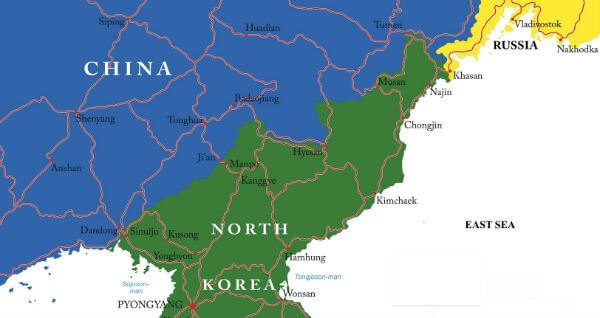
Reuters reports: When North Korean leader Kim Jong Un sent Lunar New Year greetings this year, the first card went to Russian President Vladimir Putin, ahead of leaders from China and other allies of the isolated country, according to its official news agency.
Some academics who study North Korea argue Kim could be looking for Russia to ease any pain if China, which accounts for about 90 percent of North Korea’s trade, steps up sanctions against the isolated country as part of moves to deter its nuclear and missile programmes.
U.S. President Donald Trump lavished praise on Chinese President Xi Jinping last week for Beijing’s assistance in trying to rein in Pyongyang. A day later, U.S. Secretary of State Rex Tillerson pressed the United Nations Security Council to impose more sanctions to further isolate Pyongyang.
There is no sign of any sustainable increase in trade between Russia and North Korea, but business and transport links between the two are getting busier.
A new ferry service starting next week will move up to 200 passengers and 1,000 tonnes of cargo six times a month between North Korea and the Russian port of Vladivostok. [Continue reading…]
Russian election hacking ‘wildly successful’ in creating discord, says former U.S. lawmaker
Reuters reports: Russia succeeded in its goals of sowing discord in U.S. politics by meddling in the 2016 presidential election, which will likely inspire similar future efforts, two top former U.S. voices on intelligence said on Tuesday.
Former Director of National Intelligence James Clapper and former House Intelligence Committee Chairman Mike Rogers agreed at a panel at Harvard University that Russia likely believed it had achieved its goals and could attempt to repeat its performance in elections in other countries.
“Their purpose was to sew discontent and mistrust in our elections they wanted us to be at each others’ throat when it was over,” Rogers said at the panel at Harvard’s Kennedy School of Government. “It’s influencing, I would say, legislative process today. That’s wildly successful.” [Continue reading…]