Financial Times reports: Nato’s top commander accused Russia and the Syrian regime on Tuesday of “weaponising” immigration by using bombs aimed at civilians to deliberately cause large flows of refugees and challenge European political resolve.
General Philip Breedlove, Nato’s supreme allied commander, said that the types of bombs being used in Syria — especially the Assad regime’s barrel bombs — were designed to force civilians from their homes.
Asked at a Senate hearing whether Russia was aggravating the Syrian refugee crisis in order to divide countries in the EU, he replied: “I can’t find any other reason for them [air strikes against civilians] other than to cause refugees to be on the move and make them someone else’s problem.” He added: “I use the term weaponisation of immigration.” [Continue reading…]
Category Archives: Syria
Most of the refugees stuck in Greece are now women and children
The Washington Post reports: In a cold drizzle, Aziza Hussein, a 30-year-old Syrian widow traveling with her four children, stood amid a surge of migrants trapped at the northern Greek border. Her way forward blocked by armed Macedonian troops, police dogs and a razor-wire fence, she stood in the middle of the chaotic scrum of refugees, clutching her 5-year-old son.
“What are we going to do?” she said, shielding her eyes with a trembling hand as she cried.
In recent days, European nations have moved more aggressively than ever to shut down the route used by more than a million migrants fleeing war and poverty in the Middle East and beyond. Yet even as they do, the region is confronting a new kind of migrant flow — waves of women and children.
Last year, most of the asylum seekers fleeing to Europe were men, many of them young and single. But in the past several weeks, the balance has shifted, with women and their children, as well as unaccompanied minors, now accounting for roughly 57 percent of asylum seekers. [Continue reading…]
From astronaut to refugee: How the Syrian spaceman fell to Earth
The Guardian reports: The Neil Armstrong of the Arab world has an office in a ramshackle building in Istanbul’s Fatih or “Little Syria”. Muhammed Faris is a refugee, just like the people milling outside, facing up to the hardest challenge in his life; one that has already seen the roles of fighter pilot, spaceman, military advisor to the Assad regime; protester, rebel and defector.
In Syria, Faris is a national hero, with a school, airport and roads named after him. Medals on the wall of his office honour his achievements as an astronaut (or, strictly speaking, a cosmonaut). Here, hundreds of miles from his birthplace, Aleppo, he campaigns for democratic change in Syria, “through words, not weapons”.
In 1985, he was one of four young Syrian men vying to join the Interkosmos training programme, for allies of the Soviet Union, at Star City just outside Moscow. There had been one Arab in space before, Sultan Bin Salman Al Saud, a member of the Saudi royal family, but never a professional Arab spaceman. Despite the thawing of the cold war, US relations with Iran and its ally Syria were deteriorating. Syrian ties to the Soviet Union were strong: Russia supported Bashar’s father, Hafez Assad, in his rise to power in a coup in 1970. In return, the Soviets were allowed to open a naval base in Tartus, which remains in Russian hands today. [Continue reading…]
Syrian government forces open new battle with rebels in northwest
Reuters reports: Syrian government forces launched an attack on Wednesday to capture a rebel-held hill in north-western Syria, a rebel official and the Syrian Observatory for Human Rights reported, an expansion of operations that have continued in that area despite a deal to cease fighting.
Rebels said the assault on Kabani hill in the province of Latakia was supported by Russian air strikes.
Both the government and rebels have accused each other of violating the truce, which came into effect on Saturday. The agreement does not include Islamic State or the Nusra Front, an al Qaeda-linked group that has a wide presence in northwestern Syria. [Continue reading…]
Regime warns residents of besieged Damascus suburbs
NOW reports: The Syrian regime has dropped leaflets over rebel-held suburbs of Damascus bearing a warning of further destruction, despite the beginning of a fragile cessation of hostilities over the weekend.
The foreboding leaflets delivered Tuesday morning and over the past few days by military helicopters flying above the besieged eastern Ghouta suburbs of Syria’s capital called on residents to give up arms in return for an amnesty.
“It is far better for you to choose the path of safety and peace than the path of war and destruction,” one of the leaflets warned. [Continue reading…]
Turkey’s lack of confidence in Arab countries
Semih Idiz writes: Speaking a few days after Saudi Arabia’s Foreign Minister Adel al-Jubeir put to rest speculation that Turkey and his country were preparing for a ground operation in Syria, [Turkey’s Prime Minister Ahmet] Davutoglu made several remarks that are bound to go down badly in Moscow and Tehran, suggesting that Ankara is betting on a defeat of the Syrian regime and its principal allies Russia and Iran, much like the defeat of the Soviet Union in Afghanistan. He also said Turkey would not actively intervene in Syria because it was not confident of support from Arab countries, citing the condemnation by the Arab League of the deployment of Turkish troops in Bashiqa near Mosul on Dec. 3.
Davutoglu’s remarks revealed that the Arab League’s reaction to the Bashiqa deployment, the complaint lodged at the UN Security Council by the Iraqi government and the lack of support from Arab countries for this deployment still rankle in Ankara.
Jubeir told Agence France-Presse on Feb. 18 that any special forces sent by Saudi Arabia to Syria would only fight the Islamic State, underlining that they would not get involved in unilateral operations against the Syrian regime unless an international coalition was established for this purpose. Jubeir’s remark deflated growing expectations in some quarters of the Islamist and pro-government Turkish media that Turkey and Saudi Arabia, with their own “coalition of the willing,” were preparing to intervene in Syria. [Continue reading…]
Mapped: Russian airstrikes in Syria post-cease-fire
The Washington Post reports: Russian airstrikes continued in Syria despite a shaky truce between factions fighting on the ground, according to a report published Monday. Though said to be hitting terrorist factions, some strikes have reportedly struck U.S.-backed opposition groups.
The report, written by the Institute for the Study of War, compiles data based on open-source data including “local Syrian activist networks, Syrian state-run media, and statements by Russian and Western officials.”
According to the report, there was a lull in strikes Saturday — the day the cessation of hostilities was supposed to go into affect — but they began again in earnest Sunday. In the hours leading up to the pause, reports on the ground indicated that there were more than 100 airstrikes in northern Aleppo as Russian and Syrian government forces attempted to consolidate last-minute gains. [Continue reading…]
Syrian opposition says government wrecking truce deal
Reuters reports: A senior official from Syria’s main opposition group said on Monday that a fragile international attempt to halt nearly five years of fighting was in danger of collapse because of attacks by government forces.
The cessation of hostilities drawn up by Washington and Moscow faced “complete nullification” because Syrian government attacks were violating the agreement, the official of the Saudi-backed opposition High Negotiations Committee (HNC) said.
France said there were reports of attacks on opposition forces in breach of the deal, which came into force on Saturday, and countries backing the Syrian peace process met to try to clarify the situation. [Continue reading…]
Russia says federal model is possible for Syria in future
Reuters reports: Syria could become a federal state if that model works in the country, Russian Deputy Foreign Minister Sergei Ryabkov told a news briefing on Monday.
A fragile cessation of hostilities, drawn up jointly by the United States and Russia, has led to a dramatic reduction of violence in Syria over the weekend, though rebels are accusing the government of numerous violations including air strikes.
The United Nations’ Syria mediator, Staffan de Mistura, has said he intends to reconvene peace talks between the Syrian government and opposition on March 7, provided the halt in fighting largely holds and allows for greater delivery of humanitarian relief.
“If as a result of talks, consultations and discussions on Syria’s future state order … they come to an opinion that namely this (federal) model will work to serve the task of preserving Syria as a united, secular, independent and sovereign nation, then who will object to this?” Ryabkov said. [Continue reading…]
In the fight against ISIS, the effectiveness of the YPG gets overstated
Hassan Hassan writes: A week after ISIL was reportedly expelled from its last stronghold in Hasaka, it launched an assault in Tal Abyad in northern Raqqa in the early hours of Saturday.
The militant group clashed with Kurdish militias affiliated to the People’s Protection Units (YPG), who drove ISIL from this border city in June last year. The attack on Saturday was ISIL’s second infiltration of the city since its defeat there.
During the clashes, ISIL fighters reportedly stormed the house of a tribal sheikh from Deir Ezzor living in Tal Abyad and beheaded him. Khaled Dahham Al Bashir – from the Baggara tribal confederation, one of the largest in Syria – was said to have been working with the YPG as part of the tribal component in the Syrian Democratic Forces, and was therefore an obvious target for ISIL. The ISIL assault on several different locations seemed carefully planned with specific targets.
Of particular significance was the fact that the YPG had to immediately call in US air strikes to repel the attack. The episode reveals a fault line in the way that the United States, the main backer of the YPG, fights ISIL in Syria.
The YPG’s victories against ISIL – in Kobani, Tal Abyad and southern Hasaka – were made possible largely because of intensive US firepower. According to military sources, the YPG lacks the capacity to defeat ISIL without close US air support. One source said that American air strikes account for “more than 90 per cent” of the ISIL defeats in those battles.
This is important if one contrasts the YPG with other forces in northern Syria that have defeated ISIL or repulsed its assaults for more than two years without any air support. Those forces would typically be fighting on two fronts at the same time. Rebel forces in Idlib, for instance, have kept the province free from ISIL despite repeated attempts to infiltrate it since 2014 – including at the peak of ISIL’s strength and morale after it defeated the Iraqi army in Mosul. [Continue reading…]
Hezbollah is learning Russian
Alexander Corbeil writes: Hezbollah has suffered several setbacks since it began its involvement in the Syrian war — over 1,300 of its fighters have been killed and thousands injured, it has had to cut back on social services it provides to its constituency and had to resort to recruiting teenagers for the fight in Syria. However, the Syrian civil war, especially the recent Russian involvement is also helping enhance the group’s fighting capabilities which is likely to have significant political and security implications in Lebanon and beyond.
Hezbollah has proven to be a forward-thinking and malleable fighting force. In 2012, when the group began to engage more robustly in Syria, it quickly learned that its defensive tactics were not applicable to the fight. Instead of a modern Israeli army, Hezbollah faced an insurgency. These rebel groups applied similar tactics to Hezbollah’s against regime soldiers and further benefited from local knowledge of the terrain in areas crucial to Bashar al-Assad’s survival. For instance, during the capture of Qusayr in 2013 Hezbollah reportedly lost around one-tenth of its fighters, with estimates ranging from 70 to 120 dead and 200 wounded, up to two dozen of whom were killed in a rebel ambush on the first day of that offensive; what Hezbollah leaders thought would be a quick victory instead turned into a drawn-out fight. Fast-forwarding to 2016, Hezbollah has refined its offensive capabilities and—under the cover of a new powerful ally, Russia—continued to help the Syrian regime take back crucial territory with lower casualty rates. [Continue reading…]
The mysterious fate of the dissident Italian priest snatched by ISIS
Michael Weiss writes: The last time Hind Aboud Kabawat saw her mentor Father Paolo Dall’Oglio alive, she felt her heart “squeeze in pain.”
The Italian priest who had for 30 years made his home and clerical reputation in Syria was depositing her at Ataturk International Airport, in Istanbul, when he forgot the spiritual form their physical leave-taking always took: prayer. Father Paolo would place his crucifix on Kabawat’s head and chin, and then they would ask the divine to guide them in their daily struggles. Perhaps he was in haste to get her onto her return flight to her hometown of Toronto, but the rite this time slipped his mind. So Kabawat, an Orthodox Christian, reminded the gray-bearded Jesuit and hero of the Syrian people of the valedictory benediction. Father Paolo lovingly obliged. That was three years ago.
The priest was snatched by ISIS not long thereafter while walking through the streets of the caliphate’s capital of Raqqa. He had smuggled himself back into Syria after being kicked out by Bashar al-Assad, Kabawat says, to try and negotiate the release of captive journalists, and was convinced he could reason with the jihadists.
Kabawat is a natural-born worrier, and Father Paolo used to call her “Martha,” after the sister described in the Gospel of Luke as “cumbered about many things” whom Jesus visits at her home. Unlike her attentive sibling Mary, Martha neglects the savior’s counsel. But now the roles were somewhat reversed, and the emissary of Christ was the one who wouldn’t listen.
One needn’t have been especially preoccupied or put-upon to fear an audience with ISIS. “This was 2013—we didn’t really know who they were. But still I told him, ‘Don’t do it face to face.’ He said, ‘No, no, no. If, after three days, you don’t hear from me, then something bad will have happened.’”
Something bad did.
The echo here with the resurrection may have been intentional, though it’s hard to associate Father Paolo with the megalomania of one comparing himself to his avowed role model. On this score, Kabawat is definitive: “He was always telling me, ‘Hind, we can’t be sitting and lecturing others. We need to go to the people. Because this is freedom and democracy, from the people to the people. This is exactly what Jesus wants and what Jesus did. He did not sit in his home.’” [Continue reading…]
Berlin’s museum tours in Arabic forge a bridge to refugees

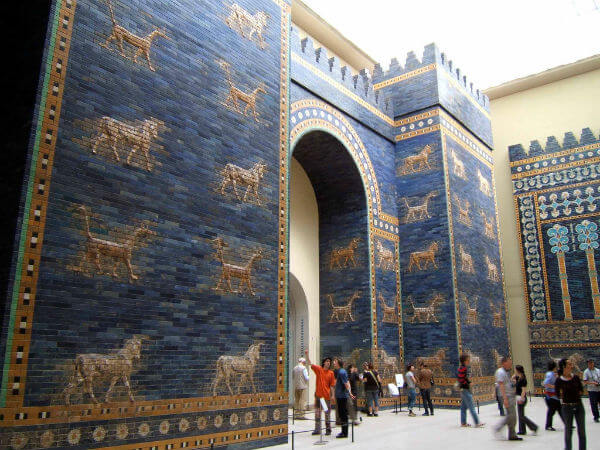
The New York Times reports: The Pergamon Museum is home to the famous Ishtar Gate, a monument of blue and white tile decorated with golden lions and daisies that was once the entrance to ancient Babylon. When Kamal Alramadhani, a 25-year-old Iraqi economics student, saw it for the first time this month, “I got goose bumps,” he said, pointing to his arm.
“It’s from Iraq,” he added quietly, through an Arabic translator. “My country.” A native of Mosul, Mr. Alramadhani studied economics at the University of Baghdad and came to Germany in October, part of a wave of asylum seekers that is stirring opposition here but also leading the government to look for ways to help the migrants adjust.
That afternoon, Mr. Alramadhani and about 30 others — some of them teenagers who had walked much of the way from Syria — were visiting the museum for the first time, on a free Arabic-language tour. It is part of a new and growing state-financed program to introduce the refugees to Germany’s cultural heritage — even, of course, when some of that heritage comes from the Middle East.
The visits can be fraught. “Sometimes people say: ‘The Germans have all our heritage! They stole it!’” said Zoya Masoud, 27, who led the Arabic-language tour that afternoon at the Museum of Islamic Art, which is part of the Pergamon Museum and filled with treasures from empires past. Often, the visitors say the art is probably better off in Berlin because so much in Syria has been destroyed by the war and the Islamic State, Ms. Masoud said.
Other times, the tours bring up raw memories for visitors who have arrived in the last three months. At a painted marble wall niche from a house in Damascus that dates to the 15th and 16th century and was inhabited by Samaritans, a Christian minority, “some people want to cry,” Ms. Masoud said. “When they see the colors and the shapes, they get chills.”
Ms. Masoud is not a refugee — she grew up in Damascus, a child of Syrian and Lebanese parents, and moved to Europe to study in 2010, before Syria fell into civil war. She is one of 19 guides — 18 from Syria and one from Iraq — who are part of a program, called Multaka, or “meeting point” in Arabic, which began in December and is aimed at training refugees to become museum guides. [Continue reading…]
If you hate your own government then the crimes of dictators who it vilifies become easy to excuse
Idrees Ahmad writes: On Sunday, when one of Hollywood’s most politically active and humane figures weighed in to condemn the media for “misleading the public on Syria”, one could only welcome the intervention.
Except, Mark Ruffalo, the Oscar-nominated star of Spotlight, was not indicting the media for failing the people of Syria; he was condemning it for being insufficiently sympathetic to the regime and Russia. He was recommending to his 2.23 million Twitter followers an article by Boston Globe columnist Stephen Kinzer in which he alleges that the “American press is reporting the opposite of what is actually happening”; that it unfairly describes everything Russia and Iran do as “negative and destabilizing”; and it fails to report that in the Assad regime and Russia’s assault on Aleppo, its inhabitants are “finally see[ing] glimmers of hope”. Kinzer’s basis for these claims? A comment “on social media” and the opinion of a “Beirut-based analyst” (in reality a pro-Hizbullah activist who is a contributor to the Russian news outlet RT and the Iranian supreme leader’s personal news site).
To compensate for its fact deficit, Kinzer liberally sprinkles his article with straw men. He claims that journalists are misleading the public by describing Jabhat al-Nusra, as “moderates,” not as “the local al-Qaeda franchise”. As a matter of fact, no one refers to Nusra as “moderates”, and a Nexis search of major newspapers reveals virtually no article that doesn’t refer to it without mentioning its al-Qaeda affiliation.
This article was a sequel to another, published three days after Russia started a series of attacks on MSF-run hospitals, which was boldly titled: “On Syria: Thank you, Russia!” In it Kinzer prescribed that “Russia’s policy should be ours: prevent the fall of Bashar al-Assad’s government, craft a new regime that would include Assad or his supporters, and then work for a cease-fire.” However, to accede to the opposition’s demand for a cease-fire, he insisted, would be to “guarantee continued war”. In a subsequent TV interview, Kinzer lauded the foreign policy wisdom of Donald Trump. (Similar sentiments have also been expressed by his Irish counterpart, Patrick Cockburn of The Independent).
Ruffalo wasn’t the only one promoting this nonsense. Beyond the agoraphobic netherworld of internet conspiracists, it was also warmly received by bestselling authors, Daily Show producers, liberal academics, Pulitzer Prize-winners, and think-tankers.
Why do bien pensant liberals like Ruffalo fall for such dross? Ideological blinkers? Or has dissent become all about aesthetics? It seems at any given moment maintaining an adversarial posture is more important than substantive engagement with an issue. Why bother with details when one can derive them from general principles? And if the reality of an issue contradicts one’s preconceived notions, then reality itself must be brought into question. Shooting the messenger is always a reliable option. But dressed up as criticism of “the mainstream media”, “the establishment”, or “Washington”, even a full-throated defence of fascism acquires the sheen of fearless truth-telling.
There are few things more commonplace than an Oedipal disdain for one’s own government. In this solipsistic worldview, one has no need to understand the dynamics of a foreign crisis; they can be deduced remotely. If you hate your own government then, by virtue of being in its bad books, a Putin or an Assad becomes an ally. [Continue reading…]

Air strikes hit six towns in Syria’s Aleppo day after truce, monitor
Reuters reports: War planes attacked six towns in Syria’s northern Aleppo province early on Sunday, the Syrian Observatory for Human Rights said, a day after a cessation of hostilities agreement took effect.
Syrian insurgents said the air strikes were carried out by Russian war planes in support of Syria’s government, but the Observatory which monitors the conflict said the identity of the jets was not clear.
“We do not know which planes carried out the strikes and also we are not sure if this is considered a breach to the truce because it is not clear if these towns are included in the truce,” the Observatory’s director Rami Abdulrahman said.
Syria’s state media did not mention the strikes. Russia’s defense ministry declined to comment. [Continue reading…]
Russians resume air strikes nr Bab al Hawa in continuation of offensive begun Thursday — an area where Nusra not a player — multisources
— Roy Gutman (@Roy_Gutman) February 28, 2016
Huffington Post asked Joshua Landis: Could this limited ceasefire be a first step towards a future peace deal?
I doubt it. Russia and Syria are committed to reconquering all of Syria. So far Putin doesn’t seem to show any signs of losing interest in Syria or getting stuck in a quagmire.
I think this momentary pause is first and foremost to demonstrate that America is doing something. There’s tremendous pressure on the United States. This is both for humanitarian reasons — as Russia bombs hospitals and a tide of humanity pushes up against the Turkish border — and because [President Barack] Obama needs to do something to smooth the feathers of our traditional allies, like Turkey and Saudi Arabia, who are apoplectic and accuse the U.S. of abandoning them.
I think Obama told the Russians: Give us a ceasefire, even if it’s a limited one for short duration, because I’ve got to take something home. And this is what the Russians have come up with. But obviously Assad is very interested in pressing his advantage right now — he has the rebels on the run. The Syrian regime’s objective is to shut off the rebels’ supply chain to the Turkish border, and the more truces they sign, the longer they have to linger and wait. [Continue reading…]
Track ceasefire violations at Syria Ceasefire Monitor.
The Arab world and the West: A shared destiny
Jean-Pierre Filiu discusses his book, Les Arabes, leur destin et le nôtre, which aims to shed light on struggles in the Arab World today by exploring the entwined histories of the Arab World and the West, starting with Bonaparte’s expedition to Egypt in 1798, through military expeditions and brutal colonial regimes, broken promises and diplomatic maneuvers, support for dictatorial regimes, and the discovery of oil riches. He also discusses the “Arab Enlightenment” of the 19th Century and the history of democratic struggles and social revolts in the Arab world, often repressed.
Filiu is also the author of From Deep State to Islamic State: The Arab Counter-Revolution and its Jihadi Legacy, “an invaluable contribution to understanding the murky world of the Arab security regimes.”
How the White House disregarded mounting evidence of an imminent Russian intervention in Syria
Reuters reports: Last July, Syrian President Bashar al-Assad seemed to be losing his battle against rebel forces. Speaking to supporters in Damascus, he acknowledged his army’s heavy losses.
Western officials said the Syrian leader’s days were numbered and predicted he would soon be forced to the negotiating table.
It did not turn out that way. Secret preparations were already underway for a major deployment of Russian and Iranian forces in support of Assad.
The military intervention, taking many in the West by surprise, would roll back rebel gains. It would also accelerate two shifts in U.S. diplomacy: Washington would welcome Iran to the negotiating table over Syria, and it would no longer insist that Assad step down immediately.
“That involved swallowing some pride, to be honest, in acknowledging that this process would go nowhere unless you got Russia and Iran at the table,” a U.S. official said.
At the heart of the diplomacy shift – which essentially brought Washington closer to Moscow’s position – was a slow-footed realization of the Russian military build-up in Syria and, ultimately, a refusal to intervene militarily.
Russia, Iran and Syria struck their agreement to deploy military forces in June, several weeks before Assad’s July 26 speech, according to a senior official in the Middle East who was familiar with the details.
And Russian sources say large amounts of equipment, and hundreds of troops, were being dispatched over a series of weeks, making it hard to hide the pending operation.
Yet a senior U.S. administration official said it took until mid-September for Western powers to fully recognise Russia’s intentions. One of the final pieces of the puzzle was when Moscow deployed aircraft flown only by the Russian military, eliminating the possibility they were intended for Assad, the official said. [Continue reading…]
Clear evidence that hospitals and medical workers are deliberate bombing targets in Syria

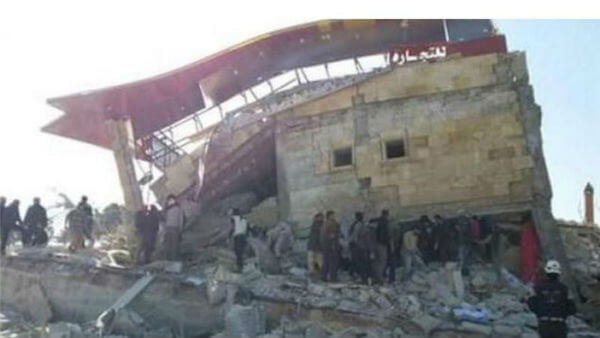
The New York Times reports: The hospital in the northern Syrian town of Maarat al-Noaman was not just grazed, or damaged, by the airstrikes last week. It was destroyed, taking a direct hit that pancaked its three stories into one, entombing and killing 25 people, including nine staff members.
It was struck at around 9:02 a.m., just as day-shift workers and patients were arriving; then again at around 9:05. As rescuers swarmed around, another explosion struck at 9:45, and another at 9:48. That same morning, two airstrikes hit the National Hospital on the other side of town, which was treating nurses injured in the attack on the first facility.
This detailed account, provided by the director of the hospital, which was supported by Doctors Without Borders, is one example of why many Syrian medical workers in insurgent-held areas and human rights groups believe medical facilities are not just being hit by stray bombs or indiscriminate attacks, but have long been deliberately targeted by the Syrian government and its Russian allies. It is a measure of the deep mistrust that gravely challenges prospects for a truce set to begin Saturday.
“I had the feeling they were trying to kill me,” said the director, Dr. Mazen al-Saoud, 55, in a telephone interview from Maarat al-Noaman, his hometown. “Wherever I went, there was bombing.”
According to Doctors Without Borders, there were 94 attacks last year alone on 67 hospitals and clinics the group supports in insurgent-held areas from northern to southern Syria, destroying 12 facilities and killing 23 staff members. In 2016, there have already been 17 attacks on health facilities, including six assisted by the group. [Continue reading…]