The New York Times reports: In many parts of the country, including South Carolina, the Syrian crisis has elicited calls for compassion and offers of help: On Sept. 13, hundreds of people gathered in University City, a suburb of St. Louis, to ask the federal government to accept “as many Syrian refugees as possible” in the area, according to the St. Louis chapter of the Council on American-Islamic Relations.
This week, the mayors of 18 American cities, including Bill de Blasio of New York and Eric Garcetti of Los Angeles, sent a letter to President Obama urging him “to increase still further the number of Syrian refugees the United States will accept for resettlement.” The mayors asserted that the United States had a “robust screening and background check” system in place for refugees, who, they said, “have helped build our economies, enliven our arts and culture, and enrich our neighborhoods.”
But even before the Syrian crisis dominated headlines worldwide, resettlement agencies had noted a rise in anti-refugee sentiment in parts of the United States, said Melanie Nezer, vice president of policy and advocacy at HIAS, a Jewish nonprofit that works with refugees. In the last two decades, they have increasingly placed people in smaller communities to try to avoid the high cost of living in traditional immigrant magnets like New York and Los Angeles. At the same time, unemployment and tight budgets have prompted some local governments to fight the placement of refugees.
In South Carolina, a number of influential Upstate religious leaders have embraced the refugee program. The Rev. D.J. Horton, senior pastor of Anderson Mill Road Baptist Church, said dozens from his flock of 2,300 had already completed refugee support training. “It’s very hard to read your Bible, especially your New Testament, and refuse refuge to people who are vulnerable,” he said. [Continue reading…]
Category Archives: Syria
Why are the Gulf states so reluctant to take in refugees?
By Rana Jawad, University of Bath
Europe’s reaction to the refugee crisis has hardly been a calm and considered one; with fences erected and border controls reinstated, the continent’s governments are struggling to agree on a response.
But at least Europe’s governments are acting. In the Middle East, things are rather different. In particular, the Arab Gulf States are catching serious flack for their response to the crisis – or rather, their failure to respond.
One big question is reverberating in the minds of the general public, expert observers and policy-makers; why have the Gulf states, who are among the richest countries in the world, not taken in any Syrian refugees? There’s no need to rewrite the commentary that’s already out there: many articles have provided useful statistics and background information on the international conventions and treaties the Persian Gulf countries are signed up to, and their failure to honour them.
What all this misses, though, is the general lack of social justice and a social welfare ethos in the Persian Gulf and Middle East in general. This is a complex story about the mindset of a region in disunity and disarray.
Long before the refugee crisis, the world’s powers had failed the people of Syria
Rula Jebreal writes: More than two weeks have passed since the lifeless body of 3-year-old Aylan Kurdi washed ashore on a Turkish beach, forcing the world to confront the tide of Syrian asylum seekers massing at Europe’s borders. In the grim aftermath, the international response has both impressed and disappointed, as millions of hero-citizens have taken to the streets to demand compassion and offer support—and millions of others have countered with bigotry. A few countries have cracked open their borders; too many others have slammed them shut. Yet, as debate has raged over how best to respond to the crisis, there has been shockingly little discussion as to why the refugees are fleeing Syria—and how the last four years of botched international policy has helped trigger the refugee exodus.
Of the thousands crossing the Mediterranean, most are fleeing the orgy of violence unleashed four years ago by President Bashar al-Assad against the citizens of his own country. That violence burst into view with the death of another young boy, 13-year-old Hamza al-Khateeb, whose brutal murder at the hands of police in the town of Daraa served as a kind of bloody prologue to the drowning death of Aylan Kurdi. Much like Kurdi, al-Khateeb was swept up by events far bigger than he was; after joining friends and family at an April 2011 protest, he was detained and then tortured. As images of al-Khateeb’s mutilated young body circulated across the Internet, mass protests erupted across Syria—from Daraa to Damascus, Aleppo to Homs—only to be met by the full, punishing force of the Assad military.
If the world’s powers had set their red line then, at the torture of al-Khateeb and the regime’s decimation of Daraa, it is possible that there might have been no refugee crisis today. But instead of supporting the revolution when it was a largely unarmed affair, the globe’s power players turned Syria into a geopolitical chessboard, actively sponsoring various sides of the conflict without concern for the civilian population. The United States and its Gulf allies pumped money and weapons into a murky constellation of rebel factions, empowering Al Qaeda affiliates that indirectly spawned the rise of the so-called Islamic State, or ISIS. Meanwhile, Russia and Iran funneled weapons, training, and funding to Assad and Hezbollah, the Lebanese Shiite militia, ensuring that the regime stayed afloat even as it subjected an untold number of Syrians to industrial-style torture and the terror of barrel bombings. [Continue reading…]
Putin supports Assad in ‘fighting terrorism’
CBS News: Charlie Rose: So you would like to join the United States in the fight against ISIS? That’s part of why you’re there [in Syria]. Others think that while that may be part of your goal, you’re trying to save the Assad administration because they’ve been losing ground and the war has not been going well for them. And you’re there to rescue them.
Vladimir Putin (through translator): Well, you’re right. And it’s my deep belief that any actions to the contrary in order to destroy the legitimate government will create a situation which you can witness now in the other countries of the region or in other regions, for instance in Libya, where all the state institutions are disintegrated. We see a similar situation in Iraq.
And there is no other solution to the Syrian crisis than strengthening the effective government structures and rendering them help in fighting terrorism. But at the same time, urging them to engage in positive dialogue with the rational opposition and conduct reform. [Continue reading…]
Aron Lund writes: the Kremlin has every reason to continue blurring the already indistinct dividing line between “extremist” and “moderate” rebels upon which Western states insist. Even though this neatly black and white categorization of Syria’s murky insurgency is at least partly fiction, it remains a politically indispensable formula for Western states that wish to arm anti-Assad forces. Which is precisely why erasing this distinction by extending airstrikes against all manners of rebels as part of an ostensibly anti-jihadi intervention, may turn out to be Putin’s long-term plan.
Blanket attacks on Syrian rebels on the pretext that they are all “al-Qaeda” would lead to much outraged commentary in the Western and Arab press. But to the Russian president it doesn’t matter if you think he’s Mad Vlad or Prudent Putin. He isn’t trying to win hearts and minds, least of all those of the Syrian rebels or their backers. Rather, he is trying to change the balance of power on the ground while firing missile after missile into the West’s political narrative.
Whatever one thinks of that, it is a big and bold idea of the sort that sometimes end up working. [Continue reading…]
While Putin reinforces the perception that the Assad regime is inseparable from the Syrian state, Scott Lucas writes: In Syria, the “state” and the “regime” are not the same thing. The state is the apparatus that administers the country and provides services, including education, health, and official papers that allow Syrians to marry, register property, or travel outside the country. The regime is a collection of informal networks based on personal, family, community, religious, and other ties that control the upper ranks of the state apparatus.
Before the uprising, most Syrians had an informal understanding of this distinction, particularly in areas of the country where social services were well-provided. In short, they were able to draw a line between the local branch of the Ministry of Water Resources, to which they could appeal if they had problems with their water supply, and the plainclothes officer from the Political Security Directorate who came inquiring at their door.
During the war, the regime has managed to blur this distinction to its advantage. [Continue reading…]
Who is Putin really protecting Assad from?
Mark N. Katz writes: Although the West may not like Assad, Russian officials and commentators are saying, his authoritarian regime is preferable to an even worse one that IS would establish that would pose a real threat to Western, as well as Russian, interests. Furthermore, Assad regime forces are needed in order to stop IS from taking over more — or even the rest — of Syria. Western insistence that Assad must step down, then, is foolish since this would gravely weaken the forces fighting against IS. The West should work with Moscow and the Assad regime against the common IS threat, and not against them.
This argument is based on the premise that the Assad regime is actively fighting against IS. There have been numerous reports, though, that the Assad regime and IS have actually not been fighting with each other, or not doing so very much. A widely quoted study by IHS Jane’s Terrorism and Insurgency Center at the end of last year noted that the Assad regime’s “counterterrorism operations…skew heavily towards groups whose names aren’t ISIS. Of 982 counterterrorism operations for the year up through Nov. 21 [2014], just 6 percent directly targeted ISIS.”
In February of this year, Time reported on a Sunni businessman with close ties to the Assad regime describing various forms of actual cooperation between the Assad regime and IS, including how the Assad regime buys oil from IS-controlled oil facilities, how Syria’s two main mobile phone operators provide service and send repair teams to IS-controlled areas, and how Damascus allows food shipments to the IS capital, Raqqa.
At the beginning of June 2015, US Embassy Damascus “accused the Syrian government of providing air support to an advance by Islamic State militants against opposition groups north of Aleppo.” In July, Turkish intelligence sources claimed that “an agreement was made between the Assad regime and ISIS to destroy the Free Syrian Army in the country’s north.”
Why would the Assad regime not fight against IS and even cooperate with it? Both of them have an interest in weakening their common foes: Syrian opposition groups supported by Turkey, Saudi Arabia, Qatar, and other countries. [Continue reading…]
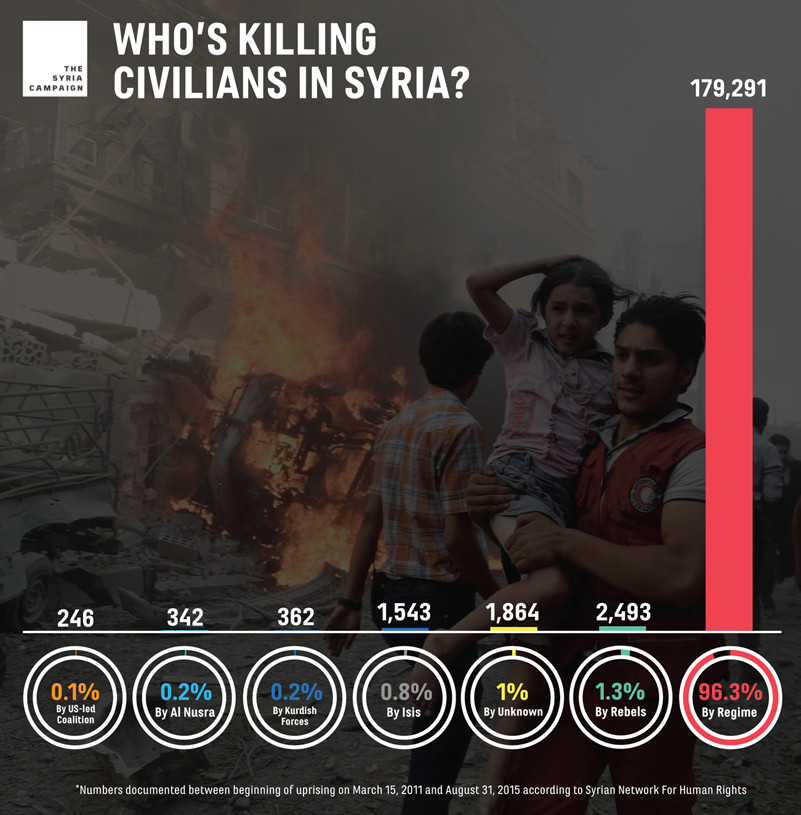
Who’s killing civilians in Syria?
Russian soldiers: Don’t send me to Syria
The Daily Beast reports: A group of Russian contract soldiers have refused to go on “an assignment,” as their army command referred to it in the papers they received about their secret deployment. The document did not have any return date. To their astonishment, the soldiers learned, nearly at the last minute, the country for their final destination was Syria. The scandalous case is now being investigated. The soldiers were threatened with severe punishment for their disobedience—a charge of state treason, their lawyer Ivan Pavlov told The Daily Beast, punishable by up to 20 years in prison in Russia.
“All the soldiers are asking for was a clear official order, so their widows would be paid compensations if they get killed abroad. Soldiers have a right to demand proper paperwork, they should always do that before they depart, otherwise their families would not receive a ruble,” Valentina Melnikova, head of the Committee of Soldiers’ Mothers, a Russian organization representing the troops’ families, told The Daily Beast.
But instead of providing the contract soldiers with the official paperwork, the army command reported them to investigators, according to the lawyer. Russian authorities have confirmed they provide weapons and military advisers to the Syrian government, as Moscow has for years, but deny Russian soldiers are being deployed into combat in Syria. [Continue reading…]
How Russia’s gambit in Syria changes the game
Michael Kofman writes: The Syrian refugee crisis has emerged as Europe’s paramount security problem this year and shows no signs of abating. Russia is looking to capitalize on this. More than likely, Vladimir Putin will seek to tie the issue of Ukraine-related sanctions to the common causes of fighting terrorism and stemming the tide of refugees into Europe. When the renewal of sanctions is discussed in December, Moscow will demonstrate that in contrast to “feckless” U.S. policies, it could have answers to the Syrian civil war. At the very least, Russia will pitch that its own plan to fight the Islamic State can’t be worse than whatever the Americans have been doing. This will serve as more of a diplomatic wedge than a realistic proposition to settle the Syrian conflict.
Coincidentally, the countries in Central and Southern Europe that appear least interested in accepting refugee and migrant flows, are also the ones who were unenthused about sanctioning Russia. There is a growing list of nations that Germany convinced to show European solidarity on the sanctions policy who wish to see it ended. With the war in Ukraine quieter, and Russia moving to address the conflict in Syria, it may provide good ammunition in December for those wishing to cancel sanctions. Either way, with the Russian economy suffering from low oil prices, it will be looking to incentivize the suspension of sanctions.
Assad should not be gleeful, as Moscow has come to save the Syrian Army but at the price of assuming direct control. He is dealing with a purely realist power, and if the plan changes, Russian tanks could find their way to his palace. Hafizullah Amin’s fate when the Soviet Union took over Afghanistan is a good historical lesson to ‘be careful what you wish for.’ Russia will try to reframe the Syrian Army as part of an anti-Islamic State coalition, seeking to take advantage of the empty space created by the U.S. policy in this conflict. If that should fail, Russia and Iran may agree to dispense with Assad as the price of maintaining their ability to influence Syria’s fate.
The United States faces a conundrum. Once Russia completes its deployment, it can completely undermine the U.S. effort in Syria, from no-fly zones to opposition proxies. The two sides are no closer to agreement on a framework for political settlement, but Russia and the United States are both backing the minority powers in this conflict now, while jihadists represent the dominant powers in Syria. That is a low bar for common cause, but it should give Washington pause. Meanwhile neighboring countries and Europeans are paying an increasingly high price in terms of refugees. Letting this bloody civil war continue is becoming increasingly intolerable for the West. Somewhere in the future, under the next administration, could be a large U.S. Army deployment to the Middle East as a result of how this war is being handled today. [Continue reading…]
Putin said to plan ISIS strike with or without U.S.
Bloomberg reports: President Vladimir Putin, determined to strengthen Russia’s only military outpost in the Middle East, is preparing to launch unilateral airstrikes against Islamic State from inside Syria if the U.S. rejects his proposal to join forces, two people familiar with the matter said.
Putin’s preferred course of action, though, is for America and its allies to agree to coordinate their campaign against the terrorist group with Russia, Iran and the Syrian army, which the Obama administration has so far resisted, according to a person close to the Kremlin and an adviser to the Defense Ministry in Moscow.
Russian diplomacy has shifted into overdrive as Putin seeks to avoid the collapse of the embattled regime of Bashar al-Assad, a longtime ally who’s locked in a 4 1/2 year civil war against opponents including Sunni extremists fighting under the banner of Islamic State. Israeli Prime Minister Benjamin Netanyahu flew to Moscow for talks with Putin this week, followed by Turkish President Recep Tayyip Erdogan.
Putin’s proposal, which Russia has communicated to the U.S., calls for a “parallel track” of joint military action accompanied by a political transition away from Assad, a key U.S. demand, according to a third person. The initiative will be the centerpiece of Putin’s one-day trip to New York for the United Nations General Assembly on Sept. 28, which will include a meeting with President Barack Obama, both the White House and Kremlin said Thursday. [Continue reading…]
Syrian Kurd offensive against ISIS has stalled
McClatchy reports: A Syrian Kurdish offensive described last week by U.S. officials as the most effective assault to date on the Islamic State has ground to a virtual halt because of Turkey’s opposition to the advance and Kurdish commanders’ reluctance to extend their frontlines beyond Kurdish areas, Syrian Kurdish and Arab militants say.
The stalling of the offensive, which was aided by U.S. airstrikes that were coordinated with Syrian Kurdish fighters on the ground, deals a new setback to the Obama administration’s efforts to build an anti-Islamic State coalition among Syrian opposition forces, and it comes amidst a buildup of Russian jet fighters, armored vehicles and personnel near Syria’s coast.
“The Kurdish forces are important because they are America’s boots on the ground in Syria and Iraq,” said Soner Cagaptay, an expert with the Washington Institute for Near East Policy, a think tank.
The slackening in the drive by the Peoples Protection Units, a Syrian Kurdish militia known as the YPG, can be traced through the dramatic drop in the rate of U.S. airstrikes launched against the Islamic State in areas inside and adjacent to the swath of territory along the border with Turkey from which the brutal Islamist movement was expelled by the YPG offensive. [Continue reading…]
To stem the flow of Syrian refugees, stop the barrel bombs
Kenneth Roth writes: Assad’s barrel bombs play a particularly big part in forcing millions of Syrians from their country. In most wars, civilians can find a modicum of safety by moving away from the front lines. But Assad’s indiscriminate use of barrel bombs deep in opposition-held territory means that many have no place to hide. The international community could probably take no more effective step to curtail the refugee flow than to stop Assad’s barrel bombs.
Yet little effort has been made. The two governments with the greatest potential to influence Assad — his principal backers, Russia and Iran — refuse to get him to stop and supply him with weapons. Western governments have been reluctant to exert strong public pressure, let alone sanctions, because of other priorities — Ukraine, in the case of Russia, and the nuclear deal, in the case of Iran. Even now, as Russia deploys its own military forces in Syria, Washington is pressing Moscow to coordinate with America’s anti-ISIS operation but isn’t mentioning the barrel bombs. As for the European Union, it talks about tackling the “root causes” of migration to Europe but has done little to address the atrocities that lead Syrians to flee. [Continue reading…]
Why Croatia is bucking the eastern European trend on migrants
By Mirna Solic, University of Glasgow
When Hungary put razor wire along its borders, Croatia took centre stage as the East European country most affected by the surge of refugees from conflict zones in the Middle East. An estimated 44,000 people have arrived on Croatian territory since its neighbouring countries began to reject arrivals.
Croatia’s immediate stance on the refugee crisis was that no walls would be built and no barbed wire would be erected, because “in the 21st century barbed wire is not a solution but a threat”. This was warmly welcomed by political circles in the West.
Despite claims in the press that Croatia has closed its borders, the government insists that they remain open. And while public figures have expressed concern about being able to cope with the numbers, there remains a strong desire to help.
This is in stark contrast to the vehemently hostile approach taken by leading figures in Hungary and Serbia. It was also potentially surprising given Croatia’s reputation as a fairly closed and xenophobic society. Only recently, it suffered international shame when a swastika was painted on a football field in Split prior to a game with Italy.
The difference may be because the sight of thousands of desperate people escaping misery is painfully familiar to them. It is not long since many Croatian nationals experienced the same.
How Syrians came to fear the sky
Martin Fletcher writes: For three years President Assad’s regime has relentlessly pounded the rebel-held tracts of the city with barrel bombs dropped from helicopters, missiles fired by fighter jets, ground-launched rockets called “elephant missiles” because of the noise they make and snipers’ bullets fired from the Citadel, the hilltop fortress in the heart of Aleppo.
It has hit some districts so heavily that they have been abandoned. It targets markets, hospitals, bakeries, mosques — anywhere that people gather. It often bombs a site twice in quick succession so rescuers are killed too. “They target every living thing, everything that moves,” [Zaina] Erhaim says.
Erhaim, 30, is a former BBC Arabic journalist who returned to her native Syria early in 2013 to help the revolution by training citizen journalists, especially women. She recently won a prestigious international prize for courageous journalism. She used to love the sky. She once hoped to use the Arabic word for sky as a name for a daughter, but not any more.
“My biggest dream is for the sky to stop being as horrific as it is, for the sky to be the sky again and not a source of fear, a source of inevitable and unavoidable death,” she says. Back in London this summer to see her employers, the Institute for War and Peace Reporting, she was walking down Tottenham Court Road when she saw some people staring upwards. They were merely inspecting a new building, but momentarily she panicked.
Erhaim is a tough young woman. She has been almost literally tempered by fire. Yet even she briefly crumples and cries as she names more than a dozen friends who have been killed — some by the regime, others by zealots of Islamic State who control territory surrounding Aleppo. Hamoudi died filming on the front line. Obaida was seized by IS and never seen again. Maen was killed by a bomb. Hassan was tortured to death by the regime. Bassel died in a shelling. She still posts messages on their Facebook pages, refuses to delete their names from her phone and leaves food on their graves. [Continue reading…]
Russian escalation in Syria — context and consequences
Paul Salem writes: Internationally, Putin has been seeking to roll back the West’s weakening and isolation of Russia that occurred after the end of the Cold War. The war in Georgia in 2008 and Crimea and Ukraine in 2014 flew in the face of the West’s attempts to bring NATO all the way to Russia’s doorstep. And the move to rebuild a strong military presence in Syria is a response to two and a half decades of U.S. monopolization of war and peace in the Middle East. Russia’s new presence in Syria indicates that it is not just a regional power in Eastern Europe and the Arctic but also a global player that is able and willing to project military power in areas well beyond the Russian motherland.
Regionally, Russia might also be in the process of rebuilding a regional alliance it lost decades ago. The conclusion of the P5 +1 deal removes the taboo of working with Iran and enables Russia to move forward with open strategic and military coordination with Iran, particularly in Syria. The deal might also have encouraged Russia’s move into Syria in that Russia, like Turkey and other countries in the Gulf, could not rule out an Iranian-American rapprochement after the deal that would again have left Russia sidelined in the Middle East. Russia’s move revives an old Soviet-Syrian strategic and military relationship that had lapsed over the past decades.
In Iraq, for the time being, the United States remains the main global military partner of the Iraqi armed forces, but with closer Iranian-Russian ties, it is possible that Iraq could drift steadily away from Washington and closer to Moscow. It is no coincidence that Iran used its influence in Iraq to weaken and sideline the Pentagon-trained national army, and Iran is uncomfortable with any major U.S. role in rebuilding the national army. So either the national army will remain weak, or it will have to find another global partner. Russia could step into that role. Indeed, the new Russian presence in Syria is a strong signal to Baghdad that Russia is back in the Middle East and willing to rebuild old alliances. [Continue reading…]
Russia, Iran seen coordinating on defense of Assad regime in Syria
The Wall Street Journal reports: Russia and Iran have stepped up coordination inside Syria as they move to safeguard President Bashar al-Assad’s control over his coastal stronghold, according to officials in the U.S. and Middle East, creating a new complication for Washington’s diplomatic goals.
Senior Russian and Iranian diplomats, generals and strategists have held a string of high-level talks in Moscow in recent months to discuss Mr. Assad’s defense and the Kremlin’s military buildup in Syria, according to these officials.
The buildup is continuing: On Monday, U.S. defense officials said Russian surveillance drones have started flying missions over Syria, and Moscow has sent two dozen more fighter jets to Syria. [Continue reading…]
Reuters reports: Rebels who have inflicted big losses on Syrian President Bashar al-Assad say Russia’s intervention in support of its ally will only lead to an escalation of the war and may encourage the rebels’ Gulf Arab backers to pour in more military aid.
Russia’s deployment is prompting a reassessment of the conflict among insurgents whose advances in western Syria in recent months may have been the catalyst for Russia’s decision. U.S. officials say Russian forces are already arriving.
Rebels interviewed by Reuters say they have already encountered stronger government resistance in those areas – notably the coastal heartland of Assad’s Alawite sect – and now predict an even tougher war with Russian involvement.
Some see an opportunity in the Russian deployment, predicting more military aid from states such as Saudi Arabia. That signals one of the risks of Russian involvement: a spiral of deepening foreign interference in a conflict already complicated by a regional struggle between Saudi Arabia and Iran. [Continue reading…]
Mother Angela: Merkel’s refugee policy divides Europe
Der Spiegel reports: We can do it. That’s the message Chancellor Angela Merkel has been giving her country ever since she pledged in late August to provide refuge to anyone coming from Syria in addition to others seeking protection from violence and warfare. The initial euphoria in the country was significant, with tens of thousands of everyday Germans joining the army of helpers to try and cope with the huge influx of needy refugees.
But there have since been signs that the initial elation is fading. The most obvious, of course, was Berlin’s reintroduction of border controls on the German frontier with Austria a little over a week ago. But there have been others as well: Frustration in German states about insufficient federal assistance; grumbling within Merkel’s party about her open door policy; and conflicts with the Social Democrats within Merkel’s governing coalition.
Indeed, Germany is struggling to maintain its composure and to ward off panic despite all the rising doubts.
Can it be done? [Continue reading…]
The New York Times reports: After weeks of indecision, the European Union voted on Tuesday to distribute 120,000 asylum seekers among member states, a plan meant to display unity in the face of the largest movement of refugees on the Continent since World War II.
Instead, the decision — forced through by a majority vote, over the bitter objections of four eastern members — did as much to underline the bloc’s widening divisions, even over a modest step that barely addresses the crisis.
Nearly half a million migrants and refugees have arrived in Europe this year, according to the United Nations High Commissioner for Refugees, a number that is only expected to rise. [Continue reading…]
The resignation and resilience of Syrian refugees stuck in Zaatari
The New York Times reports: As the West grapples with a new flood of asylum seekers bursting across Europe’s borders, the vast majority of Syrian refugees remain in the region: 1.9 million in Turkey, 1.2 million in Lebanon and 630,000 registered here in Jordan. Underfunded aid agencies and overburdened host countries have been struggling for years to support them.
With the World Food Program having cut vouchers this month to 229,000 Syrians living in Jordanian cities — where it is illegal for them to work — the once-reviled Zaatari (pronounced ZAHT-ah-ree) is increasingly seen as the most stable spot for refugees. While growing numbers yearn to join the exodus to Europe, many in the camp have all but surrendered to a life of limited possibilities.
Until recently, virtually every family imagined an imminent return to Syria as soon as President Bashar al-Assad fell. Now, many see their beloved homeland as lost, and grudgingly accept that Zaatari is somewhere they will be a while.
Refugees have planted vegetables, flowers, even trees that will not bear fruit for years in their compounds cobbled from corrugated tin and trailers. Unicef is spending $37.7 million to install water and sewage systems and Germany $20 million to build a solar field. A recent United Nations report estimated that residents run 2,500 shops — scores of new ones repair bicycles — generating $14 million a month.
“We’ve become used to a system here, and a way of life,” explained Ola Mahmeed, 26, a mother of five who was applying for a two-day “vacation” to visit relatives in nearby Irbid. “There’s order, in terms of security, in terms of services. Anything I can think of I can find now in the market.”
Zaatari’s occupants say they would still jump at any chance to leave. Complaints are rife about electricity, which since June has been available only at night; rationed water; and, especially, the dismal quality of the schools. Last year, classes in the camp were crammed with up to 90 children; of those who took Jordan’s 12th-grade exam, 3 percent passed. [Continue reading…]
Israel and Russia agree to coordinate military operations in Syria
Haaretz reports: The Israeli and Russian militaries will form a joint committee to coordinate their activities in Syria, Chief of Staff Lt. Gen. Gadi Eisenkot and his Russian counterpart Valery Gerasimov agreed in a meeting in Moscow on Monday evening.
The committee, which will be headed by the countries’ deputy chiefs of staff, would coordinate both naval and aerial activities, as well as electro-magnetic activities, to avoid interference in electronic warfare, a senior Israeli officer told reporters.
“There’s aerial activities to the north of the country that may or may not overlap with the Russians’ activities there,” the officer said.
The two deputy chiefs of staffs are set to meet in two weeks, though it has yet to be decided whether the meeting will take place in Israel or in Russia. The officer said the frequency of the meetings would be decided later on.
The officer refused to say whether the United States was briefed regarding the coordination between the two militaries. [Continue reading…]
In a commentary highlighted by the news editors for the UK’s Stop the War Coalition last week, Simon Jenkins wrote: “The only intervention likely to work in Syria just now is from Moscow.”
This is a sentiment which seems to resonate in those quarters of the anti-imperialist camp that still resolutely see the ills of the Middle East all rooted in Western interference.
Are we to now view Vladimir Putin as a peacemaker-in-waiting who will help resolve the worst conflict of the twenty-first century?
As Russia moves in advanced jets and deploys 2,000 military personnel to its new air base outside Latakia in the “first phase of the mission there,” what happened to the voices of anti-interventionism? As usual, the only interventions worth denouncing, must emanate from Western capitals.
The axis of foreign powers propping up the Assad regime — Russia, Iran, and Hezbollah — have a common interest, but evidently that won’t preclude Russia giving an occasional green light for Israel to bomb Hezbollah.
Still, I don’t imagine this turn of events will surprise anyone inside the so-called axis of resistance, because ultimately, each of its members has the same interest: self-preservation. Zionism — the nominal target of their resistance — merely provides a distraction behind which they each consolidate their own power.
In his meeting with Israel’s prime minister, Putin downplayed Netanyahu’s fears of a widening threat from Hezbollah by pointing out that Syria is in no position to expand the conflict.
“We know and understand that the Syrian army and the country in general are not in a condition to open a second front. The Syrians are busy fighting for their own statehood,” Putin said.
“Israel and Russia have common goals – to ensure stability in the Middle East,” Netanyahu noted, and as vacuous as that statement might sound, it seems true — depending on how you define stability.
In the eyes of many observers these days, the only reliable guarantors of stability in the region are its authoritarian regimes. Thus Israel welcomed General Sisi’s ascent to power in Egypt and likewise sees in Assad, a better known devil than the unknown or worst-feared alternative.
A region that has been ripped apart by the effects of decades of corrupt and brutal rule must now be protected by rulers cast in the same mold. But really: how’s that supposed to work?
Stephen Walt, whose anti-interventionism comes wrapped in some ritualistic self-criticism, remains convinced that a no-fly zone in Syria couldn’t accomplish much.
“Remember that the United States operated ‘no-fly zones’ over Iraq throughout the 1990s, and Saddam Hussein remained solidly in power until we invaded in 2003.”
True. But Walt neglects to note that the beneficiaries of one of those no-fly zones — Iraq’s Kurds — were, under its protection, able to establish what became and continues to be the most stable part of Iraq, notwithstanding the current threat posed by ISIS.
As much as the West has become afflicted by a loss of faith in democracy, a pervasive cynicism, and the sence of political impotence experienced by ordinary people as they witness unaccountable interests exercising power, the thing we mustn’t forget about our oftentimes sad system of governance is that within a predictable span of time, each of our elected leaders leaves office.
Consider, for instance, the battery-powered vice president whose destructive impact on the world is hard to overstate.
Dick Cheney might still meddle in politics, but having left office, he lost his power. No doubt it’s a shame that instead of getting thrown in jail, he’s still offered a podium to sound off as a talking head on cable networks. Even so, he and his neoconservative cohorts are mostly a spent force — as demonstrated with their failure to block the Iran nuclear deal.
The most problematic leaders in the world continue, without exception, to be those with an unyielding grip on power.
As much as U.S.-backed efforts at regime change have proved disastrous, that doesn’t mean everyone’s better off when such regimes are left in place.
If a remedy for cancer proves ineffective or counterproductive, the remedy gets ditched — not the fight against cancer.