Category Archives: United States

The happiest people

The happiest people

Hmmm. You think it’s a coincidence? Costa Rica is one of the very few countries to have abolished its army, and it’s also arguably the happiest nation on earth.

There are several ways of measuring happiness in countries, all inexact, but this pearl of Central America does stunningly well by whatever system is used. For example, the World Database of Happiness, compiled by a Dutch sociologist on the basis of answers to surveys by Gallup and others, lists Costa Rica in the top spot out of 148 nations.

That’s because Costa Ricans, asked to rate their own happiness on a 10-point scale, average 8.5. Denmark is next at 8.3, the United States ranks 20th at 7.4 and Togo and Tanzania bring up the caboose at 2.6. [continued…]

Facebooktwittermail

America is losing the free world

America is losing the free world

Ever since 1945, the US has regarded itself as the leader of the “free world”. But the Obama administration is facing an unexpected and unwelcome development in global politics. Four of the biggest and most strategically important democracies in the developing world – Brazil, India, South Africa and Turkey – are increasingly at odds with American foreign policy. Rather than siding with the US on the big international issues, they are just as likely to line up with authoritarian powers such as China and Iran.

The US has been slow to pick up on this development, perhaps because it seems so surprising and unnatural. Most Americans assume that fellow democracies will share their values and opinions on international affairs. During the last presidential election campaign, John McCain, the Republican candidate, called for the formation of a global alliance of democracies to push back against authoritarian powers. Some of President Barack Obama’s senior advisers have also written enthusiastically about an international league of democracies.

But the assumption that the world’s democracies will naturally stick together is proving unfounded. The latest example came during the Copenhagen climate summit. On the last day of the talks, the Americans tried to fix up one-to-one meetings between Mr Obama and the leaders of South Africa, Brazil and India – but failed each time. The Indians even said that their prime minister, Manmohan Singh, had already left for the airport. [continued…]

Facebooktwittermail

An American world of war

An American world of war

… let’s pause a moment as the New Year begins and take stock of ourselves as what we truly are: the preeminent war-making machine on planet Earth. Let’s peer into the future, and consider just what the American way of war might have in store for us in 2010. Here are 10 questions, the answers to which might offer reasonable hints as to just how much U.S. war efforts are likely to intensify in the Greater Middle East, as well as Central and South Asia, in the year to come.

1. How busted will the largest defense budget in history be in 2010?

Strange, isn’t it, that the debate about hundreds of billions of dollars in health-care costs in Congress can last almost a year, filled with turmoil and daily headlines, while a $636 billion defense budget can pass in a few days, as it did in late December, essentially without discussion and with nary a headline in sight? And in case you think that $636 billion is an honest figure, think again — and not just because funding for the U.S. nuclear arsenal and actual “homeland defense,” among other things most countries would chalk up as military costs, wasn’t included.

If you want to put a finger to the winds of war in 2010, keep your eye on something else not included in that budget: the Obama administration’s upcoming supplemental funding request for the Afghan surge. In his West Point speech announcing his surge decision, the president spoke of sending 30,000 new troops to Afghanistan in 2010 at a cost of $30 billion. In news reports, that figure quickly morphed into “$30-$40 billion,” none of it in the just-passed Pentagon budget. To fund his widening war, sometime in the first months of the New Year, the president will have to submit a supplemental budget to Congress — something the Bush administration did repeatedly to pay for George W.’s wars, and something this president, while still a candidate, swore he wouldn’t do. Nonetheless, it will happen. So keep your eye on that $30 billion figure. Even that distinctly low-ball number is going to cause discomfort and opposition in the president’s party — and yet there’s no way it will fully fund this year’s striking escalation of the war. The question is: How high will it go or, if the president doesn’t dare ask this Congress for more all at once, how will the extra funds be found? Keep your eye out, then, for hints of future supplemental budgets, because fighting the Afghan War (forget Iraq) over the next decade could prove a near trillion-dollar prospect. [continued…]

Facebooktwittermail

5 myths about keeping America safe from terrorism

5 myths about keeping America safe from terrorism

With President Obama declaring a “systemic failure” of our security system in the wake of the attempted Christmas bombing of a Detroit-bound airliner, familiar arguments about what can and should be done to reduce America’s vulnerabilities are again filling the airwaves, editorial pages and blogosphere. Several of these arguments are based on assumptions that guided the U.S. response to the Sept. 11, 2001, attacks — and unfortunately, they are as unfounded now as they were then. The biggest whopper of all? The paternalistic assertion that the government can keep us all safe without our help. [continued…]

Facebooktwittermail

Muslims say FBI tactics sow anger and fear

Muslims say FBI tactics sow anger and fear

The anxiety and anger have been building all year. In March, a national coalition of Islamic organizations warned that it would cease cooperating with the F.B.I. unless the agency stopped infiltrating mosques and using “agents provocateurs to trap unsuspecting Muslim youth.”

In September, a cleric in Bay Ridge, Brooklyn, sued the government, claiming that the F.B.I. had threatened to scuttle his application for a green card unless he agreed to spy on relatives overseas — echoing similar claims made in recent court cases in California, Florida and Massachusetts.

And last month, after an imam in Queens was charged with aiding what the authorities called a bomb-making plot, a group of South Asian Muslims there began compiling a database of complaints about their brushes with counterterrorism investigators.

Since the terror attacks of 2001, the F.B.I. and Muslim and Arab-American leaders across the country have worked to build a relationship of trust, sharing information both to fight terrorism and to protect the interests of mosques and communities.

But those relations have reached a low point in recent months, many Muslim leaders say. Several high-profile cases in which informers have infiltrated mosques and helped promote plots, they say, have sown a corrosive fear among their people that F.B.I. informers are everywhere, listening. [continued…]

Facebooktwittermail

U.S. imprisoned Iranian engineer secretly for two years before sentencing

U.S. imprisoned Iranian engineer secretly for two years before sentencing

In a case drawing criticism from outside lawyers, an Iranian engineer sentenced to prison Monday for violating arms control laws was lured to the nation of Georgia by American authorities for a fake arms deal, arrested, extradited to the U.S., and held in prison for two years — including months in solitary confinement before his guilty plea last year — all totally in secret, according to the Justice Department and media reports.

Export control lawyers told Politico’s Laura Rozen the politically-charged case of Amir Hossein Ardebili — which was under seal until this month — is troubling for two reasons: first, he was an Iranian who never left Iran, nonetheless lured out of the country and targeted by U.S. law enforcement; and, second, that he was sentenced after two years of secret imprisonment.

The Justice Department says the case was kept under seal for so long to protect ongoing investigations based on information obtained in the Ardebili probe. [continued…]

Facebooktwittermail

Relations with Turkey kindle hopes in Syria

Relations with Turkey kindle hopes in Syria

Ever since Syria and Turkey lifted their visa restrictions in September, Turkish visitors have poured into this picturesque northern city. Hawkers in Aleppo’s ancient souk now call out to shoppers in Turkish, and cross-border commerce has soared. The two countries have embarked on a very public honeymoon, with their leaders talking about each other like long-lost friends.

But this reconciliation is about far more than trade, or the collapse of old Turkish-Arab enmities. At a time of economic and political uncertainty here, the new warmth with Turkey has stirred hopes about Syria’s future direction, in areas that include religion, oil and gas, and peace with Israel.

For some here, the new closeness with secular, moderate Turkey represents a move away from Syria’s controversial alliance with Iran. For others, it suggests an embrace of Turkey’s more open, cosmopolitan society. And for many — including Syria’s president, Bashar al-Assad — it conjures different dreams of a revitalized regional economy, less vulnerable to Western sanctions or pressure.

“It’s much more than an economic relationship,” said Samir al-Taqi, director of the Orient Center for International Studies in Damascus. “It’s about regathering the region, and a feeling that the West is much weaker, less liable to do anything here. I think Syria has lots of ambitions to redefine its geopolitical position.” [continued…]

Facebooktwittermail

What the U.S. elite really thinks about Israel

What the U.S. elite really thinks about Israel

The Council on Foreign Relations is always near the top of the Left’s list of bogeymen that stand accused of pulling the strings of US foreign policy. It is right up there with the Bilderberg Group and the Trilateral Commission, right? Wrong. If that was the case, those arguing that US support for Israel is based on it being a “strategic asset” will have a hard time explaining a Pew Research Center survey on America’s Place in the World, taken of 642 CFR members between October 2 and November 16. The Pew poll not only reveals that the overwhelming majority, two-thirds of the members of this elite foreign policy institution, believes that the United States has gone overboard in favoring Israel, it doesn’t consider Israel to have have much importance to the US in the first place.

What can be concluded from the answers to questions that dealt with the Israel-Palestine conflict is that the general public forms its opinions from what it hears and reads in the mainstream media which are largely biased towards Israel while CFR members have greater access to as well as interest in obtaining more accurate information and are less susceptible to pro-Israel propaganda. That apparently not a single US newspaper saw fit to report on the opinions of CFR members, under those circumstances, is not surprising. [continued…]

Facebooktwittermail

America’s undying faith in war

Why more favor war in Iran while support for the Afghan effort is dropping

Recent polls reveal a curious contrast between the public’s current feelings about America’s ongoing war in Afghanistan and the possibility of the nation adding another front to its list of military engagements, this one in Iran.

Though most Americans aren’t ready to cut and run, an increasing number are having second thoughts about U.S. involvement in Afghanistan. A Pew Research Center November poll finds 56 percent endorsing the initial decision to use force, down 8 percentage points since January. Similarly, a late September Pew poll found support among Americans for keeping troops in Afghanistan until the country is stable stood at 50 percent—a hefty seven-point drop since June. This despite the fact that fully three-in-four Americans see a Taliban takeover in Afghanistan as a major threat to U.S. well-being.

Yet even as enthusiasm for involvement in Afghanistan faded, an October Pew Research survey, found that by a substantial 61 percent to 24 percent margin, Americans said that it is more important to prevent Iran from developing nuclear weapons than to avoid a military conflict with that country. True, the survey also found hefty support for direct negotiations—but most Americans just don’t think they’ll work. And when faced with the choice between a nuclear-armed Iran and military action, most Americans choose conflict. [continued…]

Editor’s Comment — In one of the well-known Sufi stories about Mullah Nasruddin, the mullah has just returned from the market with a basket of red hot chili peppers. He is sitting in a room eating one after another and his mouth swells and his lips bleed and a student finds him and asks in bewilderment why the mullah is punishing himself. Nasruddin replies: “I keep on thinking that the next pepper will be sweet.”

Such is America’s triumph of hope over experience when it comes to contemplating the next war — the war which will vindicate this nation for all its earlier misadventures. This is the pathological shadow of the American can-do, optimistic spirit: faith in a future uncolored by the past.

Happy Thanksgiving!

Facebooktwittermail

90,000 casualties, but who’s counting?

90,000 casualties, but who’s counting?

Veterans Day arrives tomorrow, and with it, the anticipated harvest of heartbreaking anecdotes driving the press coverage and our ever wandering attention back to less desirable realities: the disfigured but persevering hero, the homeless warrior, the unemployable sergeant, the father or son or daughter who came home a stranger and cannot be reached.

Usually, there is nothing more powerful than a personal story to pound home the cost of eight years of war overseas, but I think today there is something even more disturbing to bear.

It’s the number 89,457.

As of Nov. 9, that’s how many American casualties there were in Iraq and Afghanistan since Oct. 7, 2001, when the Afghan war officially began. That includes a tire-screeching 75,134 dead, wounded-in-action, and medically evacuated due to illness, disease, or injury in Operation Iraqi Freedom (OIF), and 14,323 and counting in Afghanistan, or Operation Enduring Freedom (OEF). [continued…]

Facebooktwittermail

Report: U.S. stopped Israel from attacking ‘Hezbollah arms ship’

Report: U.S. stopped Israel from attacking ‘Hezbollah arms ship’

The United States informed Israel of a ship carrying tons of weapons allegedly en route from Iran to Hezbollah, but vetoed Israel’s plans to attack, the A-Sharq Al-Awsat newspaper reported on Friday.

Israel raided the ship in the waters off the coast of Cyprus earlier this week and redirected it to the Ashdod port, where it unloaded 500 tons of weapons. The ship was released back onto its route to Turkey and Egypt late Wednesday, after Israel confirmed that the crew was not connected to the cargo found aboard.

In its report on Friday, A-Sharq Al-Awset cited Israeli sources as saying that Israel had intended to attack the ship but had refrained at the insistence of the U.S. No other source could confirm the report. Hezbollah has vehemently denied any link to the weapons and denounced “Israeli piracy” in international waters. [continued…]

Facebooktwittermail

America, stop sucking up to Israel

America, stop sucking up to Israel

Now is the time to say to the United States: Enough flattery. If you don’t change the tone, nothing will change. As long as Israel feels the United States is in its pocket, and that America’s automatic veto will save it from condemnations and sanctions, that it will receive massive aid unconditionally, and that it can continue waging punitive, lethal campaigns without a word from Washington, killing, destroying and imprisoning without the world’s policeman making a sound, it will continue in its ways.

Illegal acts like the occupation and settlement expansion, and offensives that may have involved war crimes, as in Gaza, deserve a different approach. If America and the world had issued condemnations after Operation Summer Rains in 2006 – which left 400 Palestinians dead and severe infrastructure damage in the first major operation in Gaza since the disengagement – then Operation Cast Lead never would have been launched.

It is true that unlike all the world’s other troublemakers, Israel is viewed as a Western democracy, but Israel of 2009 is a country whose language is force. Anwar Sadat may have been the last leader to win our hearts with optimistic, hope-igniting speeches. If he were to visit Israel today, he would be jeered off the stage. The Syrian president pleads for peace and Israel callously dismisses him, the United States begs for a settlement freeze and Israel turns up its nose. This is what happens when there are no consequences for Israel’s inaction. [continued…]

Justice Goldstone and the Jews

We Jews should be very proud of Richard Goldstone. In an ancient tradition of Jewish self-questioning and uncomfortable truth-telling, the author of the recent report from the UN Fact Finding Mission on the Gaza Conflict has braved personal vilification and institutional mendacity to describe the crimes committed by Israeli forces in the course of their invasion of Gaza in December 2008.

To be sure, the Goldstone Report also itemizes the crimes of Hamas, notably in its campaign of rocket-firing into Israel. But the scale of human rights abuses by Israel vastly outdoes anything Hamas could hope to have achieved: Israeli civilian victims of Hamas rocket attacks numbered less than ten. The attack on Gaza by the IDF resulted in at least 1,100 Palestinian civilian deaths. The major perpetrator of human rights abuses in this conflict is without question the State of Israel, and Justice Goldstone records as much.

That the Israel of Benjamin Netanyahu has chosen to conduct an international campaign against Justice Goldstone and his report need not surprise us. Israel refused to cooperate with the UN investigation; long before its conclusions were published, Netanyahu had set in motion a campaign to deny and denigrate them. More dispiriting, and of greater political consequence, is the pitiful and humiliating response of the Obama Administration. The “fierce urgency of now” apparently required that Washington join Tel Aviv in discrediting the Goldstone Report, and with it the UN inquiry. [continued…]

Israel wants to seek, not have, peace with Syria

It’s hard not to marvel at Defense Minister Ehud Barak’s rhetorical skills, how he constantly invents a new way – an original expression – to not say anything. Last week he described Syria as a “central brick in any stable peace agreement.” But there will be no peace with Syria because Israel, according to Barak, “has sought in the past and will continue to seek in the future ways to advance peace with Syria.”

Still, Syria will certainly earn a few more terms of endearment, maybe even move up from “central brick” to “cornerstone,” and if it behaves itself, “linchpin.” Who knows, Syria may even win the gold and become the “bedrock” of a stable peace agreement. But because Israel is so busy seeking ways to advance peace with Syria, there will be no peace. [continued…]

Gas from Gaza, mobile phones in Palestine and a $1m peace prize …Tony Blair and the Middle Eastern Eldorado

… a Mail on Sunday investigation reveals that [Tony Blair] has been mixing business with Middle East politics since the early years of his premiership and that, since becoming a part-time peace envoy on leaving office in 2007, he has exploited his superb contacts to pursue a multi-million-pound fortune.

Some of the most potentially lucrative of those relationships can be traced back to that BG Gaza gas deal – connections that helped pave the way to the opening up of the Arab world’s new Eldorado, the colossal and mostly untapped wealth of Colonel Gaddafi’s Libya.

‘In Arabic, there is a special word – “eghtina”,’ said Khadr Musleh, a political analyst in the Palestinian West Bank capital, Ramallah.

‘It means “self-enrichment through public office”. It doesn’t imply anything illegal and in the Middle East it’s considered totally normal. Yet it is a little surprising to see a former British Prime Minister and international peace envoy behaving in the same way.’

Blair’s Middle East-focused business career has been a triumph. The access to the region’s rulers conferred by his position as an ex-PM and peace envoy must have huge attraction for potential clients of Tony Blair Associates, the secretive ‘consultancy’ that does not publish accounts which he runs with Jonathan Powell, his former Downing Street chief of staff. Its first clients are two of the world’s richest families – the royals of Kuwait and Abu Dhabi.

Tony Blair Associates is modelled on Henry Kissinger Associates, an outfit led by President Nixon’s former Secretary of State. Fittingly, perhaps, Kissinger was on the jury that awarded Blair the $1million Dan David Prize earlier this year, the ‘Israeli Nobel Prize’. Like Blair, Kissinger is employed by American bank JP Morgan. The citation praised Blair’s ‘exceptional leadership’ and ‘moral courage’.

Blair has promised to give most of the prize to his Faith Foundation, a charity set up to promote religious understanding. Thanks to his lucrative contract to advise JP Morgan for a salary of £2million a year, he does not need the money. [continued…]

Prosecutor: top scientist Nozette admitted actual spying for Israel

Did a federal prosecutor just make the inflammatory accusation that top government scientist Stewart Nozette has admitted to giving classified information to the Israeli government?

By our reading of this AP story, that’s exactly what happened at a hearing in U.S. district court in Washington yesterday.

Nozette is accused of attempted espionage for allegedly selling classified information to an FBI employee posing as a Mossad agent. But the Feds have explicitly said that Israel is not accused of any wrongdoing. [continued…]

Facebooktwittermail

American preeminence is disappearing fifteen years early

American preeminence is disappearing fifteen years early

Memo to the CIA: You may not be prepared for time-travel, but welcome to 2025 anyway! Your rooms may be a little small, your ability to demand better accommodations may have gone out the window, and the amenities may not be to your taste, but get used to it. It’s going to be your reality from now on.

Okay, now for the serious version of the above: In November 2008, the National Intelligence Council (NIC), an affiliate of the Central Intelligence Agency, issued the latest in a series of futuristic publications intended to guide the incoming Obama administration. Peering into its analytic crystal ball in a report entitled Global Trends 2025, it predicted that America’s global preeminence would gradually disappear over the next 15 years — in conjunction with the rise of new global powerhouses, especially China and India. The report examined many facets of the future strategic environment, but its most startling, and news-making, finding concerned the projected long-term erosion of American dominance and the emergence of new global competitors. “Although the United States is likely to remain the single most powerful actor [in 2025],” it stated definitively, the country’s “relative strength — even in the military realm — will decline and U.S. leverage will become more constrained.”

That, of course, was then; this — some 11 months into the future — is now and how things have changed. Futuristic predictions will just have to catch up to the fast-shifting realities of the present moment. Although published after the onset of the global economic meltdown was underway, the report was written before the crisis reached its full proportions and so emphasized that the decline of American power would be gradual, extending over the assessment’s 15-year time horizon. But the economic crisis and attendant events have radically upset that timetable. As a result of the mammoth economic losses suffered by the United States over the past year and China’s stunning economic recovery, the global power shift the report predicted has accelerated. For all practical purposes, 2025 is here already. [continued…]

Facebooktwittermail

Why liberals kill

Why liberals kill

The left may be pressuring President Obama to exit Afghanistan. But their heroes—from FDR to JFK—promoted U.S. involvement in more wars than all modern GOP presidents combined.

Should President Barack Obama continue his escalation of the wars in Afghanistan and Pakistan, it will be the liberal thing to do.

What too few Americans realize—especially the president’s anti-war supporters, who accuse him of betraying liberal or “progressive” values—is that if he accedes to General Stanley McChrystal’s request for more troops in Afghanistan and intensifies the drone attacks in Pakistan, he will follow squarely in the footsteps of the great liberal statesmen he has cited as his role models. Though opponents of the wars in Iraq and Afghanistan cheered loudly when Obama spoke reverentially in his campaign speeches of Theodore Roosevelt, Woodrow Wilson, Franklin Roosevelt, Harry Truman, and John F. Kennedy, those heroes of the president promoted and oversaw U.S. involvement in wars that killed, by great magnitudes, more Americans and foreign civilians than all the modern Republican military operations combined. [continued…]

Facebooktwittermail

The myth of “America”

The myth of “America”

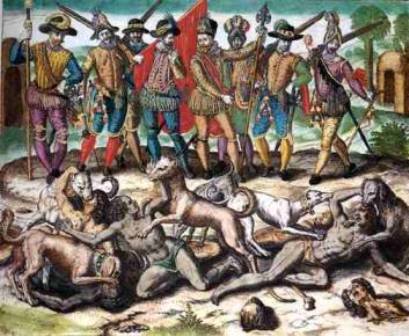
Catholic priest Bartolome de las Casas, in the multi-volume “History of the Indies” published in 1875, wrote, “… Slaves were the primary source of income for the Admiral (Columbus) with that income he intended to repay the money the Kings were spending in support of Spaniards on the Island. They provide profit and income to the Kings. (The Spaniards were driven by) insatiable greed … killing, terrorizing, afflicting, and torturing the native peoples … with the strangest and most varied new methods of cruelty.”

This systematic violence was aimed at preventing “Indians from daring to think of themselves as human beings. (The Spaniards) thought nothing of knifing Indians by tens and twenties and of cutting slices off them to test the sharpness of their blades…. My eyes have seen these acts so foreign to human nature, and now I tremble as I write.”

Father Fray Antonio de Montesino, a Dominican preacher, in December 1511 said this in a sermon that implicated Christopher Columbus and the colonists in the genocide of the native peoples:

“Tell me by what right of justice do you hold these Indians in such a cruel and horrible servitude? On what authority have you waged such detestable wars against these people who dealt quietly and peacefully on their own lands? Wars in which you have destroyed such an infinite number of them by homicides and slaughters never heard of before …”

In 1892, the National Council of Churches, the largest ecumenical body in the United States, is known to have exhorted Christians to refrain from celebrating the Columbus quincentennial, saying, “What represented newness of freedom, hope, and opportunity for some was the occasion for oppression, degradation and genocide for others.”

Yet America continues to celebrate “Columbus Day.” [continued…]

Facebooktwittermail

The demise of the dollar

The demise of the dollar

n the most profound financial change in recent Middle East history, Gulf Arabs are planning – along with China, Russia, Japan and France – to end dollar dealings for oil, moving instead to a basket of currencies including the Japanese yen and Chinese yuan, the euro, gold and a new, unified currency planned for nations in the Gulf Co-operation Council, including Saudi Arabia, Abu Dhabi, Kuwait and Qatar.

Secret meetings have already been held by finance ministers and central bank governors in Russia, China, Japan and Brazil to work on the scheme, which will mean that oil will no longer be priced in dollars.

The plans, confirmed to The Independent by both Gulf Arab and Chinese banking sources in Hong Kong, may help to explain the sudden rise in gold prices, but it also augurs an extraordinary transition from dollar markets within nine years.

The Americans, who are aware the meetings have taken place – although they have not discovered the details – are sure to fight this international cabal which will include hitherto loyal allies Japan and the Gulf Arabs. Against the background to these currency meetings, Sun Bigan, China’s former special envoy to the Middle East, has warned there is a risk of deepening divisions between China and the US over influence and oil in the Middle East. “Bilateral quarrels and clashes are unavoidable,” he told the Asia and Africa Review. “We cannot lower vigilance against hostility in the Middle East over energy interests and security.” [continued…]

Facebooktwittermail

Gore Vidal: ‘We’ll have a dictatorship soon in the US’

Gore Vidal: ‘We’ll have a dictatorship soon in the US’

Last year he famously switched allegiance from Hillary Clinton to Barack Obama during the Democratic nomination process for president. Now, he reveals, he regrets his change of heart. How’s Obama doing? “Dreadfully. I was hopeful. He was the most intelligent person we’ve had in that position for a long time. But he’s inexperienced. He has a total inability to understand military matters. He’s acting as if Afghanistan is the magic talisman: solve that and you solve terrorism.” America should leave Afghanistan, he says. “We’ve failed in every other aspect of our effort of conquering the Middle East or whatever you want to call it.” The “War on Terror” was “made up”, Vidal says. “The whole thing was PR, just like ‘weapons of mass destruction’. It has wrecked the airline business, which my father founded in the 1930s. He’d be cutting his wrists. Now when you fly you’re both scared to death and bored to death, a most disagreeable combination.”

His voice strengthens. “One thing I have hated all my life are LIARS [he says that with bristling anger] and I live in a nation of them. It was not always the case. I don’t demand honour, that can be lies too. I don’t say there was a golden age, but there was an age of general intelligence. We had a watchdog, the media.” The media is too supine? “Would that it was. They’re busy preparing us for an Iranian war.” He retains some optimism about Obama “because he doesn’t lie. We know the fool from Arizona [as he calls John McCain] is a liar. We never got the real story of how McCain crashed his plane [in 1967 near Hanoi, North Vietnam] and was held captive.”

Vidal originally became pro-Obama because he grew up in “a black city” (meaning Washington), as well as being impressed by Obama’s intelligence. “But he believes the generals. Even Bush knew the way to win a general was to give him another star. Obama believes the Republican Party is a party when in fact it’s a mindset, like Hitler Youth, based on hatred — religious hatred, racial hatred. When you foreigners hear the word ‘conservative’ you think of kindly old men hunting foxes. They’re not, they’re fascists.” [continued…]

Facebooktwittermail

Even Glenn Beck is right twice a day

Even Glenn Beck is right twice a day

If only it were just about the color of his skin.

With all due respect to Jimmy Carter, the racist component of Obama-hatred has been undeniable since the summer of 2008, when Sarah Palin rallied all-white mobs to the defense of the “real America.” Joe Wilson may or may not be in that camp, but, either way, that’s not the news. As we watched and rewatched the South Carolina congressman’s star turn, what grabbed us was the act itself.

What made the lone, piercing cry of “You lie!” shocking was that it breached a previously secure barrier. It was the first time that the violent rage surging in town-hall meetings all summer blasted into the same room as the president. Wilson’s televised shout was tantamount to yelling “Fire!” in a crowded theater. When he later explained that his behavior was “spontaneous” rather than premeditated, that was even more disturbing. It’s not good for the country that a lawmaker can’t control his anger at Barack Obama. It gives permission to crazy people. [continued…]

The death of a president

Eventually, [William] Manchester [author of The Death of a President, published in 1967] had to go to Dallas. Once there, he walked everywhere, including the entire five-mile motorcade route, from Love Field onto Main and then Houston and Elm Streets, past the Texas School Book Depository Building, searching for spectators and, in Dealey Plaza, possible snipers’ nests.

He discovered deep political enmities that had simmered at the time of the assassination, not just against the Kennedys but among the Democrats as well. Indeed, that’s what had compelled Kennedy’s trip to Dallas in the first place: John B. Connally, the conservative Democratic governor, was at war with the more liberal Democratic senator Ralph W. Yarborough. Even a formidable Texas politician like Vice President Johnson couldn’t put out the oil fire the two men had ignited. Kennedy didn’t want to lose the state in the upcoming ‘64 election, so he’d agreed to go to Dallas in an attempt to heal the rift.

Manchester also discovered that Dallas “had become the Mecca for medicine-show evangelists … the Minutemen, the John Birch and Patrick Henry Societies, and the headquarters of [ultra-conservative oil billionaire] H. L. Hunt and his activities.”

“In that third year of the Kennedy presidency,” Manchester wrote, “a kind of fever lay over Dallas country. Mad things happened. Huge billboards screamed, ‘Impeach Earl Warren.’ Jewish stores were smeared with crude swastikas.…Radical Right polemics were distributed in public schools; Kennedy’s name was booed in classrooms; corporate junior executives were required to attend radical seminars.” A retired major general ran the American flag upside down, deriding it as “the Democrat flag.” A wanted poster with J.F.K.’s face on it was circulated, announcing “this man is Wanted” for—among other things—“turning the sovereignty of the US over to the Communist controlled United Nations” and appointing “anti-Christians … aliens and known Communists” to federal offices. And a full-page advertisement had appeared the day of the assassination in The Dallas Morning News accusing Kennedy of making a secret deal with the Communist Party; when it was shown to the president, he was appalled. He turned to Jacqueline, who was visibly upset, and said, “Oh, you know, we’re heading into nut country today.”

Manchester discovered that in a wealthy Dallas suburb, when told that President Kennedy had been murdered in their city, the students in a fourth-grade class burst into applause. For Manchester, who revered Kennedy, such responses, encountered throughout Dallas, were deeply offensive and would influence the book he was about to write.

Manchester also learned that in 1963 there had been 110 murders in Dallas—“Big D”—in what he described as the city’s “dark streak of violence.” “Texas led the United States in homicide, and Big D led Texas,” he wrote. He would come to believe that Dallas’s charged political climate had been a factor in the assassination, helping to further unhinge the already unstable Lee Harvey Oswald. [continued…]

Facebooktwittermail