Category Archives: News

In effort to defeat ISIS, U.S. and Iran impede one another

The New York Times reports: Iraqi forces, backed by American airstrikes and advised by American officers, have been making strides in Anbar Province, slowly taking back territory from the Islamic State.

But in Falluja, a city in Sunni-dominated Anbar that has been in the hands of the Islamic State longer than any other in Iraq or Syria, civilians are starving as the Iraqi Army and militias lay siege to the city. And elsewhere in the province, Shiite militias supported by Iran are carrying out kidnappings and murders and restricting the movement of Sunni Arab civilians, according to American and Iraqi officials.

For seasoned observers of the American military involvement in Iraq — going back more than 25 years to the start of the Persian Gulf war — it is all part of a depressingly familiar pattern: battlefield gains that do not bring stability in their wake.

“Unfortunately, as has been a trademark of American involvement with Iraq at least since 2003 (and arguably since 1991), military success is not being matched with the commensurate political-economic efforts that will ultimately determine whether battlefield successes are translated into lasting achievements,” Kenneth M. Pollack, a senior fellow at the Brookings Institution and a longtime Iraq analyst, wrote recently in an online column.

A growing number of critics are warning that American-backed military victories need to be backed up with political reconciliation between Sunni and Shiite Arabs, something Iran is working against, and with determined efforts to rebuild cities so that civilians can return. In Anbar, they note, the situation is bleak: Shiite militias have worsened sectarian animosities, and hundreds of thousands of civilians have been unable to return home. [Continue reading…]


Facebooktwittermail

Many killed in Aleppo as fierce fighting shatters Syria’s fragile truce

The Guardian reports: Large-scale fighting has erupted in the Syrian city of Aleppo and the surrounding countryside, upending a fragile truce that was meant to pave the way for peace talks and threatening a siege of the opposition-held part of the city and a humanitarian catastrophe.

Government warplanes on Tuesday killed five civil defence workers in airstrikes on the emergency teams’ facilities, highlighting the growing ferocity of the conflict after the halt of the UN-mediated negotiations.

“The shells are everywhere, there are dead people on the ground, and they’re washing the blood from the streets,” said one resident in the government-controlled part of Aleppo.

The latest fighting comes days after a halt in peace talks in Geneva that were brokered by Washington and Moscow, and the deployment of Russian artillery last week in support of an offensive that Syrian government officials have long pledged to pursue. [Continue reading…]

Facebooktwittermail

Obama warns Europe of the dangers of withdrawing from the world in a challenging age

The Los Angeles Times reports: President Obama challenged European nations on Monday to resist the forces that would divide their increasingly fragile union, calling their cooperation with one another and the U.S. essential to combating a new wave of economic and security trials.

Speaking in Germany on the final day of a three-nation international trip, Obama revived a theme he first expounded on when he visited this country as a candidate eight years ago and spoke of a more collaborative approach to the world’s challenges that would rely on strong European partners. His vision has helped navigate the global economic collapse, forge an international climate agreement and launch a diplomatic approach toward curbing Iran’s nuclear ambitions, Obama said.

“None of those things could have happened if I, if the United States, did not have a partnership with a strong and united Europe,” he argued.

But in the wake of the recent attacks on European capitals by Islamic State, the continued instability of the Middle East that resulted in a refugee crisis that has hit Europe hardest and continued economic insecurity for many, Obama acknowledged a tendency “to withdraw” that was increasingly common on both sides of the Atlantic. Such detachment could only offer “false comfort,” Obama warned. [Continue reading…]

Facebooktwittermail

New Russian security force will answer to Vladimir Putin

The Wall Street Journal reports: The Kremlin is creating a new internal security force that answers directly to Russian President Vladimir Putin, ahead of parliamentary elections.

The Russian government says the new force, called the Russian Guard, will be headed by Viktor Zolotov, who served as Mr. Putin’s personal bodyguard for 13 years. Mr. Putin directed the creation of the force this month through an executive order now under review by the lower house of parliament.

Mr. Putin said the security force is intended to tighten control over the arms trade in the country and streamline counterterrorism efforts.

“We believe we can…reduce the cost of having various services,” he said in a televised question-and-answer session.

With parliamentary elections set for September, Russian security experts said the new force will be capable of putting down the kind of mass protests that arose following allegations of voting violations in the last such polls in 2011.

“This is really about upcoming elections and the possibility of mass unrest,” said Boris Volodarsky, a former Russian military intelligence officer. [Continue reading…]

Facebooktwittermail

UN urges U.S. and Russia to act quickly to save Syria peace talks

The New York Times reports: The United Nations special envoy for Syria on Friday called for urgent intervention by the United States, Russia and other powers to save fragile peace talks threatened by escalating hostilities and stalled negotiations.

The envoy, Staffan de Mistura, said a partial cease-fire that came into effect at the end of February was still in effect but “in great trouble if we don’t act quickly.” He added that a meeting of the International Syria Support Group led by Russia and the United States, which brokered the truce, was “urgently required.”

His comments came at the end of a week in which opposition negotiators pulled out of formal peace talks to protest mounting violations of the truce and the government’s refusal to allow deliveries of humanitarian aid to civilians trapped by fighting. [Continue reading…]

Facebooktwittermail

Fighting erupts in Iraq, and ISIS isn’t part of it

The Washington Post reports: Kurdish troops and Iraqi Shiite forces exchanged mortar and machine-gun fire Sunday in a flare-up that killed at least 12 people and raised concerns about the state’s ability to control an array of armed militia groups as areas are freed from the Islamic State.

The fighting broke out in Tuz Khurmatu, an ethnically and religiously mixed tinderbox town that is 120 miles north of Baghdad. Both sides blamed each other for the conflagration.

The Islamic State was pushed out of the surrounding area in 2014, but the armed groups here have since jostled for control and influence. Keeping militias under state control, and preventing them from turning on one another, is a major test for the Iraqi government as it slowly claws back territory from the Islamist militants. [Continue reading…]

Facebooktwittermail

A Syrian rebel’s slaying in Turkey points to the long, lethal reach of ISIS

The Washington Post reports from Nizip in Turkey: On a drizzly afternoon this month, they gathered in the tree-lined cemetery here to bid farewell to a charismatic rebel and outspoken enemy of the Islamic State.

The mourners wept as they hoisted his coffin, draped in the three-star flag of Syria’s opposition. They proudly recalled his valor in battles against government forces and his defiance of the religious extremists who have tried to overtake their rebellion.

But the way that Zaher al-Shurqat’s life ended filled those at his funeral with dread.

An apparent Islamic State militant followed the 36-year-old into an alley in the Turkish city of Gaziantep and fired a round into his head. He was the fourth prominent Syrian critic of the Islamic State to be assassinated in the past six months in southern Turkey, far beyond the militants’ stronghold in Syria.

“We’re not safe here in Turkey. ISIS is watching us,” said a 24-year-old former rebel who attended the funeral in Nizip, a town about 30 miles east of Gaziantep. As do many fellow Syrians who have taken refuge in the area, the man spoke on the condition of anonymity for fear of the militant group, also known as ISIS and ISIL. [Continue reading…]

Facebooktwittermail

The rise and deadly fall of ISIS’s oil tycoon

The Wall Street Journal reports: Islamic State oil man Abu Sayyaf was riding high a year ago. With little industry experience, he had built a network of traders and wholesalers of Syrian oil that at one point helped triple energy revenues for his terrorist bosses.

His days carried challenges familiar to all oil executives—increasing production, improving client relations and dodging directives from headquarters. He also had duties unique to the extremist group, including approving expenses to cover the upkeep of slaves, rebuilding oil facilities damaged by U.S. airstrikes and counting towers of cash.

Last May, U.S. Special Forces killed Abu Sayyaf, a nom de guerre, at his compound in Syria’s Deir Ezzour province. The raid also captured a trove of proprietary data that explains how Islamic State became the world’s wealthiest terror group.

Documents reviewed by The Wall Street Journal describe the terror group’s construction of a multinational oil operation with help from officious terror-group executives obsessed with maximizing profits. They show how the organization deals with the Syrian regime, handles corruption allegations among top officials, and, most critically, how international coalition strikes have dented but not destroyed Islamic State’s income.

Defense Secretary Ash Carter called the May 16, 2015, raid a “significant blow” against Islamic State and heralded the death of Abu Sayyaf, the terror group’s No. 2 oil executive.

In the 11 months since, U.S. and allied forces have launched hundreds more strikes against terrorist-controlled oil facilities and killed dozens of militants working in Islamic State’s oil and finance business. U.S. officials estimate that at least 30% of the group’s oil infrastructure has been destroyed, and taxes have replaced oil as the group’s largest profit center. [Continue reading…]

Facebooktwittermail

Missing Mexican students suffered a night of ‘terror,’ investigators say

The New York Times reports: Municipal police officers encircled the bus, detonated tear gas, punctured the tires and forced the college students who were onboard to get off.

“We’re going to kill all of you,” the officers warned, according to the bus driver. A policeman approached the driver and pointed a pistol at his chest. “You, too,” the officer said.

With a military intelligence official looking on and state and federal police officers in the immediate vicinity, witnesses said, the students were put into police vehicles and taken away. They have not been seen since.

They were among the 43 students who vanished in the city of Iguala one night in September 2014 amid violent, chaotic circumstances laid bare by an international panel of investigators who have been examining the matter for more than a year. The reason for the students’ abduction remains a mystery. [Continue reading…]

Facebooktwittermail

Obama ramps up special forces mission in Syria against ISIS

Reuters reports: President Barack Obama announced on Monday the biggest expansion of U.S. ground troops in Syria since the civil war there began, saying he would dispatch 250 special forces soldiers to help local militia to build on successes against Islamic State.

The new deployment increases U.S. forces in Syria six-fold to about 300. While the total U.S. ground force is still small by comparison to other American deployments, defense experts said it could help shift the momentum in Syria by giving more Syrian fighters on the ground access to U.S. close air support.

Obama said the move followed victories that clawed back territory from Islamic State.

“Given the success, I’ve approved the deployment of up to 250 additional U.S. personnel in Syria, including special forces, to keep up this momentum,” Obama said in a speech in the German city of Hanover, the last stop on a foreign tour that has taken him to Saudi Arabia and Britain. [Continue reading…]

The New York Times reports: The United States has opened a new line of combat against the Islamic State, directing the military’s six-year-old Cyber Command for the first time to mount computer-network attacks that are now being used alongside more traditional weapons.

The effort reflects President Obama’s desire to bring many of the secret American cyberweapons that have been aimed elsewhere, notably at Iran, into the fight against the Islamic State — which has proved effective in using modern communications and encryption to recruit and carry out operations.

The National Security Agency, which specializes in electronic surveillance, has for years listened intensely to the militants of the Islamic State, and those reports are often part of the president’s daily intelligence briefing. But the N.S.A.’s military counterpart, Cyber Command, was focused largely on Russia, China, Iran and North Korea — where cyberattacks on the United States most frequently originate — and had run virtually no operations against what has become the most dangerous terrorist organization in the world. [Continue reading…]

Reuters reports: Towering over his Kurdish partner at a checkpoint in northern Iraq, U.S. volunteer John Cole cuts an unusual figure on the road to the newest front in the war against Islamic State.

Seven feet (2.1 metres) tall and holding his assault rifle upside down, Cole is among a relatively small band of Westerners who have made their own way to Iraq to take up arms against the militant group – even though Kurdish authorities say they need foreign money and weapons more than men.

Exactly how much fighting Cole has done is unclear, but the 23-year-old said that – unlike most regular U.S. soldiers stationed nearby – he has participated in offensives against Islamic State that involved artillery fire and airstrikes. [Continue reading…]

Al Jazeera reports: Iraq’s military has warned civilians against returning to Ramadi after dozens were killed by mines apparently planted by the Islamic State of Iraq and the Levant (ISIL, also known as ISIS) group in the city’s streets and buildings.

Iraqi forces reclaimed Ramadi from ISIL fighters in December and tens of thousands of residents have moved back to Ramadi, the provincial capital of Anbar, in the past two months.

Most of them have returned from camps east of the city where they took refuge prior to the army’s advance late last year. [Continue reading…]

Facebooktwittermail

Bernie Sanders and allies aim to shape Democrats’ agenda after primaries

The New York Times reports: Even as his chances of winning the Democratic presidential nomination slip away, Senator Bernie Sanders and his allies are trying to use his popularity to expand his political influence, setting up an ideological struggle for the soul of the Democratic Party in the post-Obama era.

Aides to Mr. Sanders have been pressing party officials for a significant role in drafting the platform for the Democratic convention in July, aiming to lock in strong planks on issues like a $15-an-hour federal minimum wage, breaking up Wall Street banks and banning natural gas “fracking.”

Amid his unexpectedly strong showing in the Democratic primaries, Mr. Sanders has tapped his two-million-person donor list to raise money for liberal congressional candidates in New York, Nevada and Washington State. And in the waning months of Barack Obama’s presidency, Mr. Sanders’s allies are testing their muscle against the White House, mounting a public attack on the president’s housing secretary, Julián Castro, over his department’s sales of delinquent mortgages to banks and private equity firms.

“There is a greater goal here,” said Representative Raúl M. Grijalva of Arizona, a co-chairman of the Congressional Progressive Caucus, who sent a letter to Mr. Castro criticizing the mortgage sales. “The contribution of Bernie that will be lasting for us is that we will coalesce around an agenda.” [Continue reading…]

Robert Reich writes: Will Bernie Sanders’s supporters rally behind Hillary Clinton if she gets the nomination? Likewise, if Donald Trump is denied the Republican nomination, will his supporters back whoever gets the Republican nod?

If 2008 is any guide, the answer is unambiguously yes to both. About 90 percent of people who backed Hillary Clinton in the Democratic primaries that year ended up supporting Barack Obama in the general election. About the same percent of Mike Huckabee and Mitt Romney backers came around to supporting John McCain.

But 2008 may not be a good guide to the 2016 election, whose most conspicuous feature is furious antipathy to the political establishment.

Outsiders and mavericks are often attractive to an American electorate chronically suspicious of political insiders, but the anti-establishment sentiments unleashed this election year of a different magnitude. The Trump and Sanders candidacies are both dramatic repudiations of politics as usual. [Continue reading…]

Facebooktwittermail

30 years after Chernobyl disaster, containment nears completion but authorities turn a blind eye to logging

The Washington Post reports: An international effort to seal the destroyed remains of the nuclear reactor that exploded in Ukraine 30 years ago is finally close to completion, and remarkably, considering the political revolution and armed conflict that have rocked the country since 2014, it’s close to being on schedule.

The completion of the New Safe Confinement, often called the “arch,” could contain the radiation from mankind’s worst nuclear catastrophe for a century, says the European Bank for Reconstruction and Development, which has led the project. But it will also mark a handover to Ukraine’s fractious and underfunded authorities, who are expected to tackle future waste management at their own expense.

That may not reassure Nadiya Makyrevych.

For three decades, she has been living with the consequences of Chernobyl explosion. She can recall that morning in late April 1986, and the small signs that something was wrong in the workers’ town where she lived: the tinny, metallic taste in her mouth. The way her 6-month-old daughter slept so deeply after breast-feeding. [Continue reading…]

The New York Times reports: The road through the forest, abandoned, is at times barely discernible, covered with the debris of fallen tree limbs, vines, leaves and moss pushing up through cracks in the crumbling asphalt.

The moss is best avoided, says our guide, Artur N. Kalmykov, a young Ukrainian who has made a hobby of coming here to the exclusion zone surrounding the nuclear reactor at Chernobyl, set aside in perpetuity after the catastrophe in 1986. It can be radioactive, having carried buried radiation to the surface as it grew.

Above all, he says, watch out for windblown dust, which could well be laced with deadly plutonium.

Despite the dangers — which are actually minimal these days, except when the wind is howling — and the risk of arrest, Mr. Kalmykov is at home here. “In Kiev my head is full,” he said. “Here I can relax. I could hang out in Kiev. But this is more interesting.”

What Mr. Kalmykov and fellow unofficial explorers of the Chernobyl zone, members of a peculiar subculture who are in their 20s and call themselves “the stalkers,” have found is more interesting still: vast tracts of clear-cutting in the ostensibly protected forest. [Continue reading…]

Facebooktwittermail

World heading for catastrophe over natural disasters, risk expert warns

The Guardian reports: The world’s failure to prepare for natural disasters will have “inconceivably bad” consequences as climate change fuels a huge increase in catastrophic droughts and floods and the humanitarian crises that follow, the UN’s head of disaster planning has warned.

Last year, earthquakes, floods, heatwaves and landslides left 22,773 people dead, affected 98.6 million others and caused $66.5bn (£47bn) of economic damage (pdf). Yet the international community spends less than half of one per cent of the global aid budget on mitigating the risks posed by such hazards.

Robert Glasser, the special representative of the secretary general for disaster risk reduction, said that with the world already “falling short” in its response to humanitarian emergencies, things would only get worse as climate change adds to the pressure. [Continue reading…]

Facebooktwittermail

‘My soul is in Damascus’: Portraits of life on the refugee trail

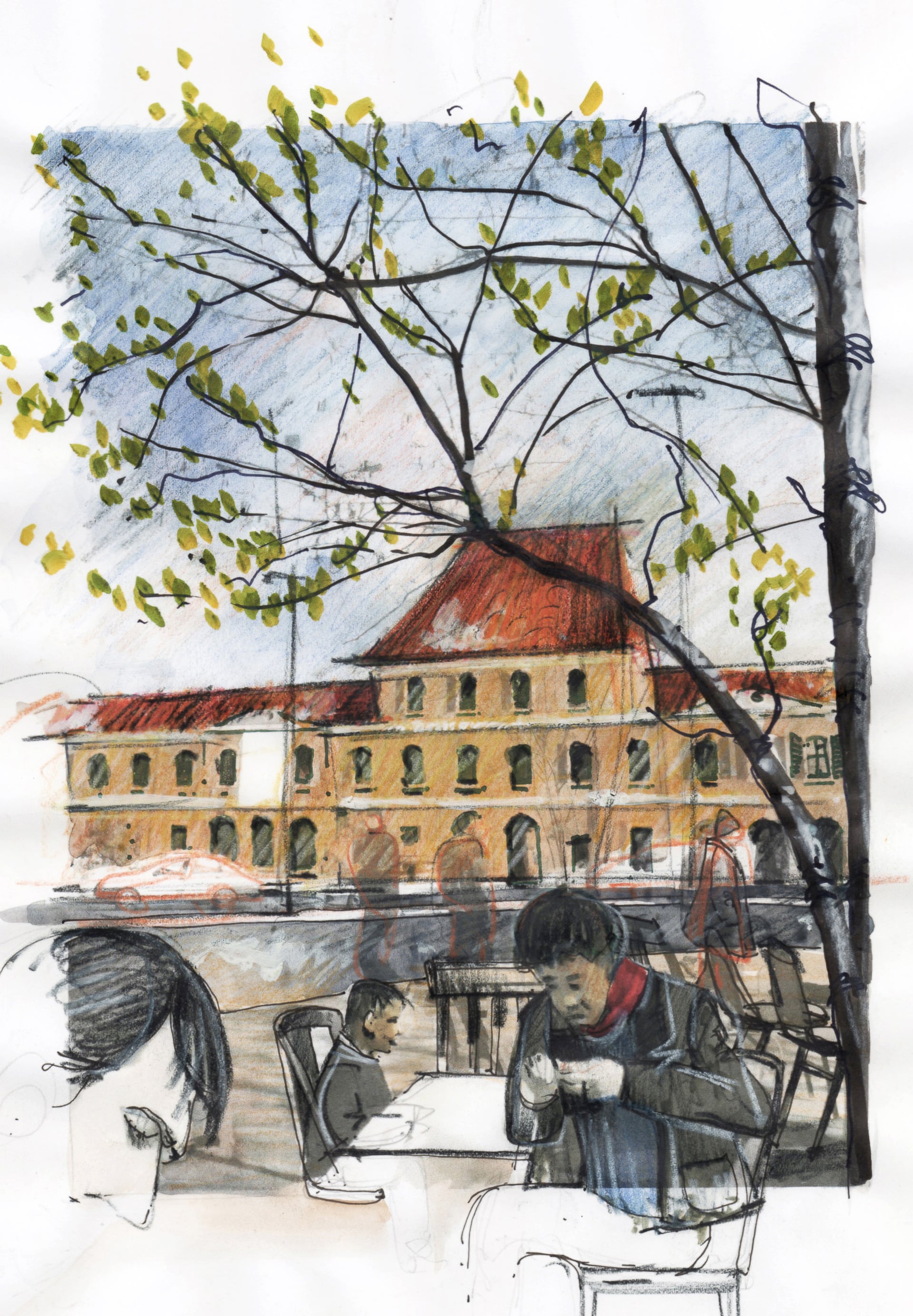
In a moving series of sketches, Ghaith Abdul-Ahad captures grueling journeys blighted by poverty and exploitation: Last summer, the Turkish port city of Izmir became the springboard for hundreds of thousands of refugees hoping to reach Greece. They came looking for smugglers to take them to sea – and lifejackets to keep them alive. Every third shop on Fevzi Pasha Boulevard, a wide shopping street that led to the smugglers’ quarter, was happy to oblige.

“Original Yamaha,” shopkeepers would shout to passing refugees. “Come in and try one.” Some shoe-sellers and tailors put their usual stock in the basements, and started selling crudely made lifejackets instead. Smugglers block-booked the rooms of nearby hotels for their clients. Greece lay just across the Aegean.

In 2015, if there was a ground zero for Europe’s migration crisis, it was here, on the western Turkish coast. But a few months on, a deal has been struck between the EU and Ankara which should see most migrants arriving in Greece being deported back to Turkey, and the picture is very different. The hotels are empty. And the shopkeepers on Fevzi Pasha Boulevard are largely back to their original stock.

Sitting in a cafe in front of the train station, a thick orange scarf wrapped around his neck, a Syrian tailor watches people timidly as his son makes castles out of sugar cubes. A few weeks ago this cafe and the square teemed with smugglers conducting their illicit trade in the open, and refugees negotiating prices. Today, two Turkish police officers stand on a street corner to scare away smugglers and their clients. [Continue reading…]

Facebooktwittermail

An amateur vs. ISIS (and the FBI): A car salesman investigates and ends up in prison

The New York Times reports: By his own account, Toby Lopez was a supremely ordinary guy. He sold Toyotas and lived with his mother in a tidy rancher here with a cherry tree out front. He was proud that he could connect with customers — anyone from a Superior Court judge to, as he put it, “Redneck Bill from down on the farm.” What passed for excitement was the time his young niece won a beauty contest and he chauffeured her in a red Corvette in a local parade.

Then a high school friend was killed in Afghanistan, and the Islamic State began beheading American journalists. Horrified, Mr. Lopez heard on CNN one day in the fall of 2014 that the Islamic State was active on Twitter, and he went online to see what he could find. “I was intrigued,” said Mr. Lopez, 42. “What could they possibly be saying on Twitter?”

What followed was a radical break from his humdrum life. He was pulled into the murky world of Internet jihadists, sparring with them from his office at the car dealership and late into the night at home. Before long, he was talking for hours on Skype with a man who claimed — falsely, as it would turn out — to be a top ISIS military commander, trying to negotiate the release of hostages. Mr. Lopez contacted the F.B.I. and began a testy relationship with counterterrorism agents who came to believe he might pose a danger. In the end, he landed in federal prison, where he was held for nearly 14 months without trial.

The story of one man’s deepening obsession with a terrorist group is a reminder of how the Internet provides easy portals to distant, sometimes dangerous worlds. It shows the complications for law enforcement agents who confront an overeager amateur encroaching on their turf. [Continue reading…]

Facebooktwittermail

The Defense Department made a big gaffe that helps Putin and Assad in Syria

Business Insider reports: The spokesman for the US military operation against ISIS made a comment in a Wednesday press briefing in Baghdad that helps justify Russia’s continued attacks on Syria’s largest city in the midst of a truce.

US Army Col. Steve Warren, the spokesman for Operation Inherent Resolve in Iraq, was asked whether Russian airstrikes on Aleppo, the current epicenter of the war, meant that Moscow was preparing to end the cessation of hostilities (CoH) agreement between government forces and the opposition signed on February 29.

Warren responded that it was “complicated” because al-Nusra “holds Aleppo” and is not party to the agreement.

Warren said of Russia:

I’m not going to predict what their intentions are. What I do know is that we have seen, you know, regime forces with some Russian support as well begin to mass and concentrate combat power around Aleppo. … That said, it’s primarily al-Nusra who holds Aleppo, and of course, al-Nusra is not part of the cessation of hostilities. So it’s complicated.

As Middle East analyst Kyle Orton noted on Twitter, Warren came “pretty close” to saying that the coalition supports Russia’s airstrikes in the city. Those strikes, however, are aimed at degrading any and all opposition to Bashar Assad — the embattled Syrian president who the Obama administration has repeatedly insisted “has to go.” [Continue reading…]

Facebooktwittermail

Bernie Sanders is aligned with mainstream America on Israel

Dina Smeltz writes: Rarely — if ever — has a presidential candidate been so publicly critical of Israeli policy toward the Palestinians as Sen. Bernie Sanders was last week during the CNN Democratic primary debate in Brooklyn. Media outlets seized the moment, with headlines such as “Bernie Sanders smashes the Israel status quo,” “Bernie Sanders just shattered an American taboo on Israel” and “Why Does Bernie Sanders hate Israel?”

Some writers have pitched this as a “watershed moment” in Democratic Party politics. For the political class, perhaps it is. But public opinion surveys show that Sanders’s views are representative of many Americans, and particularly Democrats, who are critical of some Israeli policies yet remain favorable toward Israel.

At the debate, the senator from Vermont stuck by a previous comment that the 2014 Israeli incursion into Gaza was “disproportionate.” Sanders further advocated a more balanced U.S. role in the Israel-Palestinian conflict, saying “there will never be peace in that region unless the United States plays a role, an even-handed role trying to bring people together and recognizing the serious problems that exist among the Palestinian people.”

Survey results from the past decade demonstrate that a majority of Americans has consistently favored an impartial role for the United States in the Israel-Palestinian conflict. A CNN-ORC poll from 2015 showed that two-thirds of Americans said the United States should refrain from taking either side, while 29 percent favored taking Israel’s side and 2 percent favored taking the Palestinians’ side. Although this sentiment is strongest among self-described Democrats (76 percent), a majority of independents (70 percent) and even a substantial number of Republicans (47 percent) agree. [Continue reading…]

Facebooktwittermail

The ‘nasty effect,’ and why Donald Trump supporters mistrust the media

Callum Borchers writes: Here’s a theory: Trump backers feel personally offended by coverage that suggests they must be stupid to support him. Insulted, they refuse to accept information presented by media outlets that disrespect them.

Think about it: When someone calls you an idiot, then tells you what to do (or not do), do you listen? Even if the instructions are sound, your wounded brain is inclined to tune them out and go the opposite direction.

A study published this week by the Associated Press-NORC Center for Public Affairs Research and the American Press Institute suggests that insulting news consumers is indeed a major problem. In a survey of more than 2,000 people, 38 percent said “yes” when asked, “Have you ever had an experience with a news and information source that made you trust it less for any reason?”

What were the reasons? Factual errors and perceived biases were the top answers. No surprise there. But the third-biggest cause of diminished trust — cited by 24 percent of those who have had a bad experience — was finding “something about the content personally offensive.” [Continue reading…]

Facebooktwittermail