The Washington Post reports: The purported theft of confidential Saudi documents that have been released by WikiLeaks bears the hallmarks of Iranian hackers linked to cyberattacks in more than a dozen countries, including the United States, according to cybersecurity experts and Middle East analysts.
Last week, WikiLeaks published about 70,000 of what it said were half a million documents obtained from Saudi Arabia’s Foreign Ministry. The transparency advocacy group promises more releases of the diplomatic cables, whose authenticity has not been independently verified.
Experts said that the cables, apparently stolen over the past year, paint an unflattering portrait of Saudi diplomacy as reliant on oil-wealth patronage and obsessed with Iran, the kingdom’s chief rival, but appeared to contain no shocking revelations. [Continue reading…]
Category Archives: News
Rainbow White House
This is how the White House celebrated the Supreme Court's gay marriage decision on Facebook http://t.co/iFLZksoh7S pic.twitter.com/j4B0Tu8g9G
— Quartz (@qz) June 26, 2015
Quartz: The White House was quick to celebrate today’s historic decision by the US Supreme Court that legalized gay marriage in all 50 states of the nation.
Soon after the Supreme Court announced its decision, the White House Facebook page changed its profile photo to a picture of the iconic building’s walls in the colors of the rainbow, the universal symbol of the gay rights movement.
At 11am, the President addressed a crowd in the Rose Garden behind the White House—whose walls, alas, remain white despite the Facebook change—heralding the Supreme Court’s decision as “justice that arrives like a thunderbolt.”
“This ruling is a victory for America,” Obama said. “This decision affirms what millions of Americans already believe in their hearts: When all Americans are treated as equal, we are all more free.”
ISIS just lost its Libya stronghold
Institute For The Study Of War reports: The Islamic State of Iraq and al-Sham (ISIS)’s affiliate in Libya lost control of its eastern stronghold of Derna after tensions with a local Islamist militia escalated into violent conflict on June 9, 2015. Gunmen from ISIS allegedly assassinated Abu Salim Martyrs Brigade (ASMB) leader Nasser al-Aker, who was a senior member of the al-Qaeda-associated Libyan Islamic Fighting Group (LIFG).
The Mujahedeen Shura Council of Derna (MSC Derna), an umbrella group controlled by ASMB, released a statement declaring jihad on ISIS in Derna soon after the assassination. Clashes erupted across the city. Anti-ISIS forces cleared ISIS from central Derna and captured ISIS’s headquarters on June 13, despite ISIS’s defensive deployment of multiple SVBIEDs [Suicide Vehicle-Borne Improvised Explosive Devices]. ISIS now holds no territory inside the city.
Social media reports from activists within Derna indicate strong local animosity towards ISIS. Derna’s residents organized demonstrations against ISIS on June 11 and 12, and according to unconfirmed rumors may have been armed by ASMB to participate in military operations against ISIS. [Continue reading…]
U.S. drops prohibition against talks with terrorists under revamped hostage policy
McClatchy reports: The execution of American captives by the Islamic State has driven the U.S. government to overhaul its handling of hostage cases, with President Barack Obama acknowledging Wednesday that longstanding policy was inadequate as “the terrorist threat is evolving.”
In somber remarks at the White House, Obama gave his most extensive public statement of contrition on the issue, acknowledging that his administration had let down the families of American hostages and pledging landmark reforms to make recovery efforts nimble enough to face increasingly sophisticated militant groups that use hostage-taking for profit and propaganda value.
The changes come after intense lobbying by the families and friends of American hostages, three of whom were beheaded in Syria by the Islamic State, including journalists Steven Sotloff, who grew up in Miami, and James Foley, the first of the hostages to be murdered. [Continue reading…]
Climate change judgement in the Hague could inspire a global civil movement
The Guardian reports: “You have been negotiating all my life”, cried out 21-year-old Anjali Appadurai from the lectern of a UN climate change conference four years ago. The activist, speaking on behalf of her nation’s youth, could have speaking for anyone who has taken a mild interest in more than two decades of international negotiations on climate change and stood aghast as world leaders have failed to protect the most basic of human rights – to exist.
But today, thanks to 886 Dutch citizens who decided to sue their government, all of that may change. We may not have to wait for the politicians to save us – the lawyers may step in instead. In the first successful case of its kind, a judge in the Hague has ruled that the Dutch government’s stance on climate change is illegal and has ordered them to take action to cut greenhouse gas emissions by a hefty 25% within five years.
Lawyers say the precedent it sets could trigger similar cases all around the world. Already, in Belgium, 8, 000 citizens are preparing for a similar court case, with others pointing to another possible lawsuit in Norway. Although the case is only binding within the Netherlands, lawyers say that it will inspire lawyers and judges considering similar cases in many other countries. [Continue reading…]
America’s embattled Christian majority?
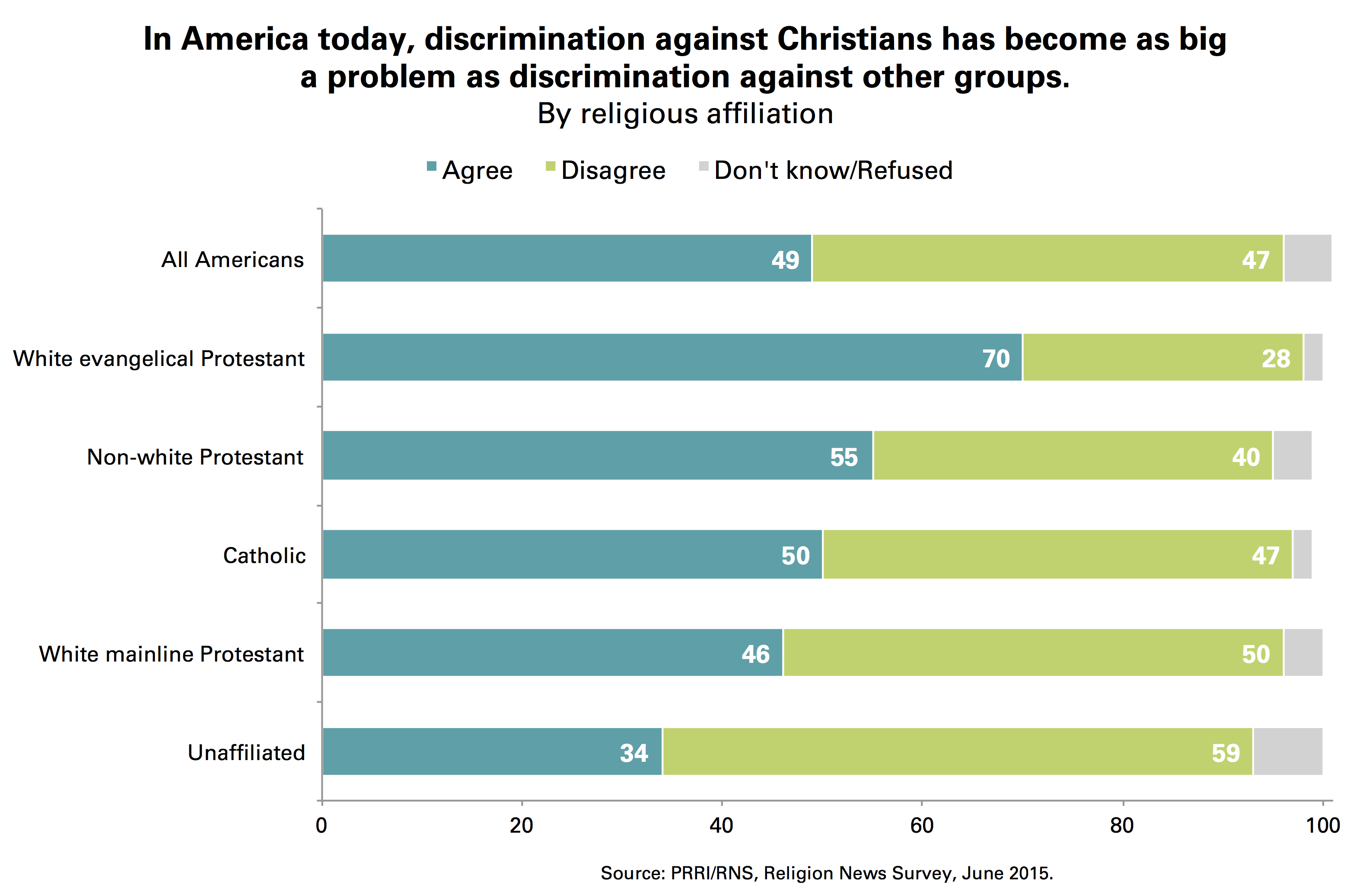
In America, 72% of the adult population identify themselves as Christian.
That, to my mind, makes this demographically (though of course not constitutionally) a Christian country.
And yet, among white evangelical Protestants, 70% believe that discrimination against Christians has become as big of a problem as discrimination against other groups!
The persecuted majority?
Do Christians get harassed by the police? Get discriminated against by landlords or employers? Get harsher jail sentences? Suffer any of the other forms of discrimination experienced by many minorities in this country?
Or, do some Christians simply resent living under a democratic constitution that separates Church and State?

How Iranian oil tankers keep Syria’s war machine alive
Bloomberg reports: It’s no secret that Iran provides critical support to Syrian President Bashar al-Assad. The trouble comes in trying to figure out how much Iran spends and what that support actually looks like.
Estimates of Iran’s largesse vary considerably depending on who you ask, as my Bloomberg View colleague Eli Lake reported earlier this month. The United Nations’ special envoy for Syria, Staffan de Mistura, believes Iran spends about $6 billion annually propping up the Assad regime. Others believe that when you factor in Iran’s support for Hezbollah, which provides fighters to Assad, the number gets closer to $15 billion or $20 billion a year.
No matter the monetary total, a key component of Iran’s support for Assad is crude oil shipments. Syria once had a surplus of crude and even exported small amounts from its oil fields in the east. The civil war that broke out in 2011 has ravaged Syria’s crude production, which fell from about 400,000 barrels a day to roughly 20,000 barrels, according to recent estimates from the U.S. Department of Energy. [Continue reading…]
ISIS is begging for your attention — by killing people with rocket launchers
Michael Weiss and Hassan Hassan write: ISIS’s latest snuff video was shot with characteristically high production value and edited to more resemble a Michael Bay summer blockbuster than terrorist agitprop.
Three men in orange jumpsuits are marched into a sedan by two ISIS jihadists dressed in desert digital camouflage. The camera then shoots over the shoulder of another jihadist, this one in a balaclava, as he aims his rocket launcher at the sedan. The RPG tears clean through the steel frame of the car—captured from three different angles—setting the vehicle and its occupants on fire. The screams of the men inside are heard as the car burns.
It’s one of a series of intricately-choreographed mass murders, designed to shock the viewer to attention—and distract from the terror army’s monstrous rule over its self-proclaimed Islamic State. [Continue reading…]
France denounces revelations of spying by NSA
The New York Times reports: The French government on Wednesday reacted angrily to revelations about extensive eavesdropping by the United States government on the private conversations of senior French leaders, including three presidents and dozens of senior government figures.
President François Hollande called an emergency meeting of the Defense Council on Wednesday morning to discuss the revelations published by the French news website Mediapart and the left-leaning newspaper Libération about spying by the National Security Agency.
He spoke with President Obama on Wednesday afternoon and made clear “the principles that must govern relations between allies on intelligence matters,” the Élysée Palace said in a statement, adding that senior French intelligence officials would soon travel to the United States for discussions. [Continue reading…]
Obama administration restates its commitment to shelter war criminals
UPI reports: The Obama administration opposes bringing a United Nations report on the 2014 war between Israel and Hamas in the Gaza Strip to the Security Council for a vote, the State Department said.
State Department spokesman John Kirby said Tuesday the United States continues to review the U.N. report that found evidence of war crimes on the part of both the Israeli and Hamas-led Palestinian forces. Kirby said the United States calls into question the U.N. Human Rights Council’s process of appointing the investigative committee because of a “very clear bias against Israel.”
“We challenge the very mechanism which created it. And so we’re not going to have a readout of this. We’re not going to have a rebuttal to it. We’re certainly going to read it, as we read all U.N. reports,” Kirby said. “But we challenge the very foundation upon which this report was written, and we don’t believe that there’s a call or a need for any further Security Council work on this.”
The 200-page report found, among other things, 1,462 Palestinian civilians were killed by Israeli fire, noting over one-third were children. It added a large number of families lost three or more members in airstrikes against residences. Six Israeli civilians died during the conflict. [Continue reading…]

Palestinians giving up on statehood, Israeli ex-security chief says
The Times of Israel reports: The death of the two-state solution among the Palestinians is no secret to the Israelis, nor is it mourned by government officials. To the political echelon, the threat of a binational state is not sufficiently tangible, and the possibility that radical Islam will take over the West Bank if there should be a peace agreement seems more real.
But things sound different in the defense establishment, and particularly among those who have left it. Quite a few former generals, Shin Bet directors and Mossad chiefs have warned any number of times that maintaining the status quo in the territories, which has become a kind of strategy in Netanyahu’s era, could change the face of the State of Israel.
“I’m hearing from various Palestinian officials with whom I am in contact that they have given up on the two-state solution as an option for resolving the conflict,” says former Shin Bet chief Yuval Diskin, 59, who now owns a hi-tech firm in Herzliya. [Continue reading…]
Former U.S. military personnel urge drone pilots to walk away from controls
The Guardian reports: Forty-five former US military personnel, including a retired army colonel, have issued a joint appeal to the pilots of aerial drones operating in Afghanistan, Iraq, Pakistan, Syria and elsewhere, calling on them to refuse to carry out the deadly missions.
In a joint letter, the retired and former military members call on air force pilots based at Creech air force base in Nevada and Beale air force base in California to refuse to carry out their duties. They say the missions, which have become an increasingly dominant feature of US military strategy in recent years, “profoundly violate domestic and international laws”.
“At least 6,000 lives have been unjustly taken by US drone attacks in Afghanistan, Pakistan, Yemen, Somalia, Iraq, the Philippines, Libya and Syria. These attacks are also undermining principles of international law and human rights,” the authors write. [Continue reading…]
Arming Iraq’s Sunni militias to fight ISIS might only add fuel to the fire
Benjamin Bahney, Patrick B. Johnston, and Patrick Ryan write: In the weeks since the Islamic State captured the Iraqi city of Ramadi, a loud and diverse chorus of voices, including the New York Times editorial board, has called for the Iraqi government and the United States to arm Sunni militias to fight the extremist group’s advance. The administration increased the number of U.S. trainers last week, adding an additional 450 as early as this summer to the 3,100 American troops already in Iraq. Regardless, current political and military dynamics on the ground may merit giving arms to Sunni fighters if the Islamic State can’t be pushed back soon.
But the decision to hand weapons over to the Sunni militias also poses risks. Before directly arming more ethnic- or sectarian-aligned militias, both U.S. policymakers and the public should have a deeper understanding of our potential allies’ past and their possible future interests. And what the unintended consequences of arming these Sunni militias might be.
Newly declassified documents from the Islamic State’s predecessor, captured during a U.S.-Iraqi raid in 2010 and published by the Combating Terrorism Center at West Point, suggest that some of Iraq’s most prominent Sunni politicians collaborated with the Islamic State’s predecessor in 2009, when the group faced its darkest hour. Some of these senior figures may have worked with the Islamic State to benefit themselves, some to benefit the Sunnis, and some to weaken the hand of the Kurds in Iraq’s ethnically mixed areas in the country’s north. While the threat of the Islamic State has moved these dynamics to the back burner today, they will likely reemerge if and when the security environment improves. And now some of these same politicians are lobbying the United States to send money and weapons to the militias from their territories.
While most of the U.S. public hadn’t heard of the Islamic State before its breakout last summer, the group declared an “Islamic State of Iraq” back in 2006 and maintained a presence in the northern city of Mosul through the U.S. military’s withdrawal in 2011. Conventional wisdom says that the Islamic State’s place in Iraq’s sectarian political strife rose out of the disarray that followed the U.S. withdrawal. It was at that moment that Iraq’s Sunnis were left to fend for themselves against the domineering, Shiite-oriented central government. The Islamic State’s resurgence in Iraq in 2013 and 2014 came at a time when the country’s Sunni minority was ripe to accept the group as a bulwark against political marginalization and crackdowns at the hands of then-Prime Minister Nouri al-Maliki’s government.
In this telling, which has dominated U.S. media and policy circles, Maliki and his Shiite allies in the Iraqi government bear the brunt of the blame for inciting the renewed sectarian tensions that enabled the Islamic State to reemerge and unleash the brutal campaign that has arrested the world’s attention.
The new documents published by the CTC suggest the need to approach this conventional wisdom with caution. They have important implications for understanding Iraq’s sectarian schism and for informing the ongoing policy debate on how to stabilize the war-torn country.
A key document sent to Abu Omar al-Baghdadi, who preceded Abu Bakr al-Baghdadi as the group’s leader, suggests that the Islamic State established cooperative relationships with key Sunni politicians by 2009 that gave it access to extortion opportunities, kickbacks, and other revenue-generating activities in and around Mosul. Assuming the document is authentic — for the moment, there is no evidence to suggest it is not — these revelations should give pause to those recommending that the Iraqis train and equip local Sunni forces under the auspices of the provincial governments in Nineveh and Anbar. Reporting from Mosul indicates that similar ties between Sunni government officials and the Islamic State likely continued after U.S. troops withdrew from Iraq, and Maliki’s government began to intensify its repression of Sunni political leaders.
It is impossible to know the specific motivations of these officials — Sunni politicians may simply have been buying themselves protection in an environment where no other party was able or willing to provide it. But what is clear is this: For the Islamic State, these relationships enabled the group to access tens of millions of dollars to finance its operations in 2009 and after, some of which may have been diverted from Western reconstruction aid through political favors and phony contracts. The Islamic State likely used these funds to expand its extortion and intimidation networks in Mosul even prior to the 2011 U.S. withdrawal. This would go far in explaining how it had become so rich, even before it seized over $400 million from Mosul’s bank vaults last June. [Continue reading…]

Taliban has a major northern Afghan city within its grasp for the first time since 2001
The Washington Post reports: Taliban forces were less than four miles from this strategic northern city Monday after seizing control of two key districts over the weekend, triggering fears that they could capture their first Afghan city since U.S.-backed forces toppled the hard-line Islamist regime in late 2001.
The government in Kabul has dispatched reinforcements, including Afghan special forces and their U.S. advisers and trainers, to try to repel the insurgents and rescue about 75 soldiers and police officers trapped inside their district base. But as of Monday evening, the Taliban remained in control of the districts, including one separated from Kunduz city only by a wide, brown river.
“It is a critical situation,” said Mohammad Omer Safi, the governor of Kunduz province.
Not since the Taliban’s collapse has the population of an Afghan metropolis faced such intimidation from the insurgency. Starting this spring, the Taliban has focused its efforts on gaining territory in Kunduz and other northern provinces, straying from its traditional battlefields in the south and east. Whoever controls Kunduz, a vast, rich agricultural region that was a former Taliban bastion, controls the roads to northeastern Afghanistan as well as smuggling and trade routes into neighboring Tajikistan and the rest of Central Asia. [Continue reading…]
Syrian Kurds, on offensive, seize military base from ISIS
Reuters reports: Kurdish-led forces said on Monday that they had captured a military base from Islamic State in Syria’s Raqqa province, advancing deeper into territory held by the group and showing new momentum after they seized a border crossing from the jihadists last week.
The Kurds, aided by U.S.-led air strikes and smaller Syrian rebel groups, pushed on Monday to within 7 km (4 miles) of Ain Issa, a town 50 km (30 miles) north of Islamic State’s de facto capital Raqqa city, said Redur Xelil, a spokesman for the Kurdish forces.
“They have been defeated,” YPG spokesman Redur Xelil told Reuters.
Islamic State had held the military base, Liwa 93, southwest of Ain Issa, since capturing it from the Syrian military last year. [Continue reading…]
How leaked Saudi documents might really matter
Marc Lynch writes: On Friday, WikiLeaks and the Lebanese newspaper al-Akhbar released just over 60,000 out of a half-million leaked diplomatic cables from the kingdom of Saudi Arabia. The immediate response to the announcement followed a predictable script. First, elites sympathetic to Saudi Arabia rushed to minimize the importance of the cables, declaring (remarkably quickly, given the number of documents to be perused) that there was nothing new or interesting to be found in the release. Then, a legion of online Arabs dug into the archive and posted titillating nuggets online, while media outlets began reporting the major finds. Now, those documents are circulating widely through social media, dominating public discourse and could continue to do so for quite some time, with more than 400,000 more documents slated for release over the course of the month of Ramadan.
It’s easy to be jaded by the routinized script of such leaks, by the pugnacious politics surrounding WikiLeaks itself, by the limited impact of previous leaks, or by the toxic public discourse surrounding the Middle East’s sectarian and partisan conflicts. What’s more, the leaks can have only a limited direct political effect in the current highly polarized and collectively repressive regional environment. Don’t expect the cables to cause uprisings in Riyadh or the expulsion of Saudi diplomats from Arab capitals anytime soon. However, it would be a mistake to dismiss the significance of these leaks. They are likely to matter more than many of the previous such leaks because of how they resonate with two of the most potent issues in today’s Middle East: the regional proxy wars between Saudi Arabia and Iran; and fierce Arab regime efforts to control an inexorably expanding Arab public sphere and erase the gains of the 2010-2011 uprisings. [Continue reading…]
U.S. military struggles to hide corruption among top officials
The Washington Post reports: A key Army commander in the U.S. war against the Islamic State has been reprimanded by the Pentagon for steering a defense contract to a firm run by two of his former classmates at West Point, becoming the latest high-ranking officer to land in trouble for personal misconduct.
Maj. Gen. Dana J.H. Pittard, who as the Army’s deputy commander for operations in the Middle East oversaw the training of Iraqi forces, was formally reprimanded in February after a three-year investigation by the Army’s inspector general, according to documents obtained by The Washington Post under the Freedom of Information Act.
An Army review board is considering whether to strip him of his rank as a two-star general before he is allowed to retire this year.
Pittard, long considered a rising star in the Army, returned to the United States in April from his headquarters in Kuwait. The Army has not previously disclosed Pittard’s departure, and an official Army Web site still lists him as its deputy commander in the Middle East. An Army spokeswoman said that he completed his assignment and that his return was not related to his misconduct.
The U.S. military has been tarred by a series of ethical breaches committed by generals and admirals in recent years. Although Pentagon officials have vowed to crack down, the armed forces often seek to keep such cases out of the limelight to protect the reputations of their top brass.
Last year, for example, military officials said the commander of Special Operations forces in Central and South America had retired for “health and personal reasons.” In fact, it was uncovered in June after a review of documents that the commander, Army Brig. Gen. Sean P. Mulholland, had been disciplined for repeatedly becoming intoxicated in public and getting into altercations.
Similarly, the Navy has withheld details of misconduct committed by admirals in a corruption and bribery scandal involving an Asian defense contractor. In February, the Navy announced that it had censured three admirals, but it has refused to release public records documenting their actions or to identify other officers who have been subjected to administrative action. [Continue reading…]
Google eavesdropping tool installed on computers without permission
The Guardian reports: Privacy campaigners and open source developers are up in arms over the secret installing of Google software which is capable of listening in on conversations held in front of a computer.
First spotted by open source developers, the Chromium browser – the open source basis for Google’s Chrome – began remotely installing audio-snooping code that was capable of listening to users.
It was designed to support Chrome’s new “OK, Google” hotword detection – which makes the computer respond when you talk to it – but was installed, and, some users have claimed, it is activated on computers without their permission. [Continue reading…]