The Washington Post reports: A surge of rebel advances in Syria is being fueled at least in part by an influx of heavy weaponry in a renewed effort by outside powers to arm moderates in the Free Syrian Army, according to Arab and rebel officials.
The new armaments, including anti-tank weapons and recoilless rifles, have been sent across the Jordanian border into the province of Daraa in recent weeks to counter the growing influence of Islamist extremist groups in the north of Syria by boosting more moderate groups fighting in the south, the officials say.
The arms are the first heavy weapons known to have been supplied by outside powers to the rebels battling to topple President Bashar al-Assad and his family’s four-decade-old regime since the Syrian uprising began two years ago.
The officials declined to identify the source of the newly provided weapons, but they noted that the countries most closely involved in supporting the rebels’ campaign to oust Assad have grown increasingly alarmed at the soaring influence of Islamists over the fragmented rebel movement. They include the United States and its major European allies, along with Turkey and the United Arab Emirates, and Saudi Arabia and Qatar, the two countries most directly involved in supplying the rebels. Security officials from those nations have formed a security coordination committee that consults regularly on events in Syria, they said.
Although the Obama administration continues to refuse to directly arm the rebels, the administration has provided intelligence assistance to those who are involved in the supplies, and it also helps vet opposition forces. U.S. officials declined to comment on the new armaments.
The goal of these renewed deliveries, Arab and rebel officials said, is to reverse the unintended effect of an effort last summer to supply small arms and ammunition to rebel forces in the north, which was halted after it became clear that radical Islamists were emerging as the chief beneficiaries.
“The idea was to get heavier stuff, intensify supply and make sure it goes to the good guys,” said an Arab official who spoke on the condition of anonymity because of the sensitivity of the operation. “If you want to weaken al-Nusra, you do it not by withholding [weapons] but by boosting the other groups.”
Louay al-Mokdad, the political and media coordinator for the Free Syrian Army, confirmed that the rebels have procured new weapons donated from outside Syria, rather than bought on the black market or seized during the capture of government facilities, the source of the vast majority of the arms that are in the hands of the rebels. But he declined to say who was behind the effort. [Continue reading…]
The language of Jesus, close to vanishing

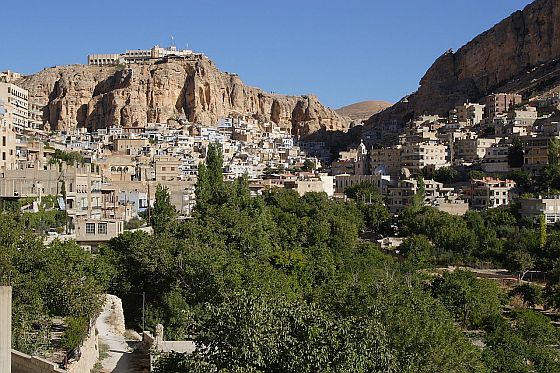
The Christian village of Maaloula, in the hills outside Damascus, Syria, the last remaining community where Aramaic is maintained as an everyday language.
Aramaic, once the common language of the entire Middle East, is one or two generations away from extinction. Ariel Sabar writes: It was a sunny morning in May, and I was in a car with a linguist and a tax preparer trolling the suburbs of Chicago for native speakers of Aramaic, the 3,000-year-old language of Jesus.
The linguist, Geoffrey Khan of the University of Cambridge, was nominally in town to give a speech at Northwestern University, in Evanston. But he had another agenda: Chicago’s northern suburbs are home to tens of thousands of Assyrians, Aramaic-speaking Christians driven from their Middle Eastern homelands by persecution and war. The Windy City is a heady place for one of the world’s foremost scholars of modern Aramaic, a man bent on documenting all of its dialects before the language — once the tongue of empires — follows its last speakers to the grave.
The tax preparer, Elias Bet-shmuel, a thickset man with a shiny pate, was a local Assyrian who had offered to be our sherpa. When he burst into the lobby of Khan’s hotel that morning, he announced the stops on our two-day trek in the confidential tone of a smuggler inventorying the contents of a shipment.
“I got Shaqlanaye, I have Bebednaye.” He was listing immigrant families by the names of the northern Iraqi villages whose dialects they spoke. Several of the families, it turned out, were Bet-shmuel’s clients.
As Bet-shmuel threaded his Infiniti sedan toward the nearby town of Niles, Illinois, Khan, a rangy 55-year-old, said he was on safari for speakers of “pure” dialects: Aramaic as preserved in villages, before speakers left for big, polyglot cities or, worse, new countries. This usually meant elderly folk who had lived the better part of their lives in mountain enclaves in Iraq, Syria, Iran or Turkey. “The less education the better,” Khan said. “When people come together in towns, even in Chicago, the dialects get mixed. When people get married, the husband’s and wife’s dialects converge.”
We turned onto a grid of neighborhood streets, and Bet-shmuel announced the day’s first stop: a 70-year-old widow from Bebede who had come to Chicago just a decade earlier. “She is a housewife with an elementary education. No English.”
Khan beamed. “I fall in love with these old ladies,” he said.
Aramaic, a Semitic language related to Hebrew and Arabic, was the common tongue of the entire Middle East when the Middle East was the crossroads of the world. People used it for commerce and government across territory stretching from Egypt and the Holy Land to India and China. Parts of the Bible and the Jewish Talmud were written in it; the original “writing on the wall,” presaging the fall of the Babylonians, was composed in it. As Jesus died on the cross, he cried in Aramaic, “Elahi, Elahi, lema shabaqtani?” (“My God, my God, why have you forsaken me?”)
But Aramaic is down now to its last generation or two of speakers, most of them scattered over the past century from homelands where their language once flourished. In their new lands, few children and even fewer grandchildren learn it. (My father, a Jew born in Kurdish Iraq, is a native speaker and scholar of Aramaic; I grew up in Los Angeles and know just a few words.) This generational rupture marks a language’s last days. For field linguists like Khan, recording native speakers — “informants,” in the lingo — is both an act of cultural preservation and an investigation into how ancient languages shift and splinter over time.
In a highly connected global age, languages are in die-off. Fifty to 90 percent of the roughly 7,000 languages spoken today are expected to go silent by century’s end. We live under an oligarchy of English and Mandarin and Spanish, in which 94 percent of the world’s population speaks 6 percent of its languages. Yet among threatened languages, Aramaic stands out. Arguably no other still-spoken language has fallen farther. [Continue reading…]
Music: Dhafer Youssef — ‘Sura’
Reflections by an Arab Jew
Ella Habiba Shohat writes: I am an Arab Jew. Or, more specifically, an Iraqi Israeli woman living, writing and teaching in the U.S. Most members of my family were born and raised in Baghdad, and now live in Iraq, Israel, the U.S., England, and Holland. When my grandmother first encountered Israeli society in the ’50s, she was convinced that the people who looked, spoke and ate so differently–the European Jews–were actually European Christians. Jewishness for her generation was inextricably associated with Middle Easterness. My grandmother, who still lives in Israel and still communicates largely in Arabic, had to be taught to speak of “us” as Jews and “them” as Arabs. For Middle Easterners, the operating distinction had always been “Muslim,” “Jew,” and “Christian,” not Arab versus Jew. The assumption was that “Arabness” referred to a common shared culture and language, albeit with religious differences.
Americans are often amazed to discover the existentially nauseating or charmingly exotic possibilities of such a syncretic identity. I recall a well-established colleague who despite my elaborate lessons on the history of Arab Jews, still had trouble understanding that I was not a tragic anomaly–for instance, the daughter of an Arab (Palestinian) and an Israeli (European Jew). Living in North America makes it even more difficult to communicate that we are Jews and yet entitled to our Middle Eastern difference. And that we are Arabs and yet entitled to our religious difference, like Arab Christians and Arab Muslims.
It was precisely the policing of cultural borders in Israel that led some of us to escape into the metropolises of syncretic identities. Yet, in an American context, we face again a hegemony that allows us to narrate a single Jewish memory, i.e., a European one. For those of us who don’t hide our Middle Easterness under one Jewish “we,” it becomes tougher and tougher to exist in an American context hostile to the very notion of Easterness.
As an Arab Jew, I am often obliged to explain the “mysteries” of this oxymoronic entity. That we have spoken Arabic, not Yiddish; that for millennia our cultural creativity, secular and religious, had been largely articulated in Arabic (Maimonides being one of the few intellectuals to “make it” into the consciousness of the West); and that even the most religious of our communities in the Middle East and North Africa never expressed themselves in Yiddish-accented Hebrew prayers, nor did they practice liturgical-gestural norms and sartorial codes favoring the dark colors of centuries-ago Poland. Middle Eastern women similarly never wore wigs; their hair covers, if worn, consisted of different variations on regional clothing (and in the wake of British and French imperialism, many wore Western-style clothes). If you go to our synagogues, even in New York, Montreal, Paris or London, you’ll be amazed to hear the winding quarter tones of our music which the uninitiated might imagine to be coming from a mosque. [Continue reading…]
Self-knowledge is required for human survival
E.O. Wilson writes: Evolutionary biologists have searched for the grandmaster of advanced social evolution, the combination of forces and environmental circumstances that bestowed greater longevity and more successful reproduction on the possession of high social intelligence. At present there are two competing theories of the principal force. The first is kin selection: individuals favor collateral kin (relatives other than offspring) making it easier for altruism to evolve among members of the same group. Altruism in turn engenders complex social organization, and, in the one case that involves big mammals, human-level intelligence.
The second, more recently argued theory (full disclosure: I am one of the modern version’s authors), the grandmaster is multilevel selection. This formulation recognizes two levels at which natural selection operates: individual selection based on competition and cooperation among members of the same group, and group selection, which arises from competition and cooperation between groups. Multilevel selection is gaining in favor among evolutionary biologists because of a recent mathematical proof that kin selection can arise only under special conditions that demonstrably do not exist, and the better fit of multilevel selection to all of the two dozen known animal cases of eusocial evolution.
The roles of both individual and group selection are indelibly stamped (to borrow a phrase from Charles Darwin) upon our social behavior. As expected, we are intensely interested in the minutiae of behavior of those around us. Gossip is a prevailing subject of conversation, everywhere from hunter-gatherer campsites to royal courts. The mind is a kaleidoscopically shifting map of others, each of whom is drawn emotionally in shades of trust, love, hatred, suspicion, admiration, envy and sociability. We are compulsively driven to create and belong to groups, variously nested, overlapping or separate, and large or small. Almost all groups compete with those of similar kind in some manner or other. We tend to think of our own as superior, and we find our identity within them.
The existence of competition and conflict, the latter often violent, has been a hallmark of societies as far back as archaeological evidence is able to offer. These and other traits we call human nature are so deeply resident in our emotions and habits of thought as to seem just part of some greater nature, like the air we all breathe, and the molecular machinery that drives all of life. But they are not. Instead, they are among the idiosyncratic hereditary traits that define our species.
The major features of the biological origins of our species are coming into focus, and with this clarification the potential of a more fruitful contact between science and the humanities. The convergence between these two great branches of learning will matter hugely when enough people have thought it through. On the science side, genetics, the brain sciences, evolutionary biology, and paleontology will be seen in a different light. Students will be taught prehistory as well as conventional history, the whole presented as the living world’s greatest epic.
We will also, I believe, take a more serious look at our place in nature. Exalted we are indeed, risen to be the mind of the biosphere without a doubt, our spirits capable of awe and ever more breathtaking leaps of imagination. But we are still part of earth’s fauna and flora. We are bound to it by emotion, physiology, and not least, deep history. It is dangerous to think of this planet as a way station to a better world, or continue to convert it into a literal, human-engineered spaceship. Contrary to general opinion, demons and gods do not vie for our allegiance. We are self-made, independent, alone and fragile. Self-understanding is what counts for long-term survival, both for individuals and for the species.
Global support grows for legalizing drugs
Der Spiegel reports: The global war on drugs has cost billions and taken countless lives — but achieved little. The scant results finally have politicians and experts joining calls for legalization. Following the journey of cocaine from a farm in Colombia to a user in Berlin sheds light on why.
“Pablo Escobar said to me: ‘One shot to the head isn’t enough. It has to be two shots, just above the eyes.'”
Jhon Velásquez, nicknamed “Popeye,” is sitting on a white plastic chair in the prison yard. “You can survive one shot, but never two. I cut up the bodies and threw them in the river. Or I just left them there. I often drove through Medellín, where I kidnapped and raped women. Then I shot them and threw them in the trash.”
Three guards are standing next to him. He is the only prisoner in the giant building. The watchtower, the security door systems, the surveillance cameras — it’s all for him. The warden of the Cómbita maximum-security prison, a three-hour drive northeast of the Colombian capital Bogotá, has given Popeye one hour to tell his story.
The experience is like opening a door into hell.
Popeye was the right-hand man of Pablo Escobar, head of Colombia’s Medellín cartel. Until his death in 1993, Escobar was the most powerful drug lord in the world. He industrialized cocaine production, controlled 80 percent of the global cocaine trade and became one of the richest people on the planet. The cartel ordered the killings of 30 judges, about 450 police officers and many more civilians. As Escobar’s head of security, Popeye was an expert at kidnapping, torture and murder.
Velásquez acquired the nickname Popeye while working as a cabin boy in the Colombian navy. He kidnapped Andrés Pastrana, the then-candidate for mayor of Bogotá and later president. He obtained the weapon that was used to fatally shoot Colombian presidential candidate Luis Carlos Galán in 1989. He was involved in a bombing attack that was intended to kill former Colombian President César Gaviria. Popeye, acting on the orders of Escobar, El Patrón, even had his beauty-queen girlfriend Wendy murdered.
“I’ve killed about 250 people, and I cut many of them into pieces. But I don’t know exactly how many,” Popeye says. “Only psychopaths count their kills.”
Popeye is a pale, 50-year-old man with a shrill voice — a psychopath who doesn’t count his kills.
The longer Popeye talks — about his murders, the drug war and the havoc he and Escobar wreaked and that is currently being repeated in Mexico — the less important my prepared questions about this war become. I realize that I might as well throw away my notepad, because it all boils down to one question: How can we stop people like you, Popeye?
He pauses for a moment before saying: “People like me can’t be stopped. It’s a war. They lose men, and we lose men. They lose their scruples, and we never had any. In the end, you’ll even blow up an aircraft because you believe the Colombian president is on board. I don’t know what you have to do. Maybe sell cocaine in pharmacies. I’ve been in prison for 20 years, but you will never win this war when there is so much money to me made. Never.”
I’m sitting face to face with a killer: Popeye, an evil product of hell. And I’m afraid that the killer could be right.
The drug war is the longest war in recent history, underway for more than 40 years. It is a never-ending struggle against a $500 billion (€378 billion) industry. [Continue reading…]
See infographic on the U.S. failed war on drugs. Continue reading
Understanding Mali’s ‘Tuareg problem’
Bruce Whitehouse writes: Last week I took part in a “teach-in” organized by Michigan State University devoted to the ongoing crisis in Mali. A half-dozen Africanist scholars joined a pair of retired U.S. ambassadors to discuss the origins and consequences of that country’s state collapse, ethnic tensions, the rebel takeover and French military intervention. The audience, mostly MSU students and faculty, included several Malians. One recurring subject was the Tuareg people and their place in the Malian nation. Various non-Malian participants spoke of the need to grant the Tuareg some kind of autonomy, while Malians in the room rejected such an arrangement. At one point a Malian graduate student in attendance stated flatly, “There is no ‘Tuareg problem’ in Mali.”
This remark reminded me that listening to Tuareg and non-Tuareg Malians talk about their intertwined history can be like listening to Israelis and Palestinians talk about theirs: the two groups’ respective visions of the past they share are fundamentally divergent, with each group casting itself as victim.
Plenty of analyses by Western officials and journalists these days are structured around simple binaries dividing Mali’s population into north and south, white and black, North African and sub-Saharan, good guys and bad guys. Such crude dualisms need to be dispensed with. Below are a few facts about northern Mali generally, and the Tuareg specifically, that can help in this regard. [Continue reading… and don’t miss a useful exchange in the comment thread between Bruce and Andy Morgan who offers a more Tuareg ‘aligned’ perspective.]
Video — Iraq to Mali: Has America’s calculus of war really changed?
A photographer’s return to Afghanistan after losing three limbs
A year ago, Giles Duley gave this TED talk:
In a magazine feature article for the New York Times published last May, Luke Mogelson described the medical care provided by Emergency, an Italian-based nonprofit that opened its first surgical center in Afghanistan in 1999. He also described the ‘criminal’ discharge policies being applied to Afghans who get treated at NATO hospitals.
In April, I traveled to Sayad, a town in Kapisa Province, to meet a 14-year-old boy named Zobair, who had recently been discharged from a hospital at Bagram Air Base, one of the largest American military installations in Afghanistan. Zobair’s uncle Nasir had taken him to Sayad in a borrowed Toyota hatchback, its rear seats folded forward to accommodate the green U.S. Army litter on which Zobair reclined. We were parked on the bank of a wide river with small wooden platforms extending over the water’s edge, where you could order lunch from local fishmongers. My interpreter and I arrived early and bought food for Zobair and Nasir — a gesture that felt ridiculous now, in light of Zobair’s condition.
Both of his legs were gone, and wounds covered his hands, arms and back. He was nauseated and fevered; every movement elicited a grimace. “Most of the pain is in my stomach,” Zobair told me as soon as we met. His eyes were half-shut, heavy with fatigue, and he spoke so softly that I had to lean close to catch his words. Without a wheelchair, Zobair had no way to reach the landing where we had set up the meal. When Nasir climbed into the back of the Toyota and raised Zobair’s shalwar kameez, he revealed a pouching system attached to a stoma and four pink tubes sticking out of Zobair’s sides. Fifty-two metal staples held together an incision running the length of his abdomen.
Zobair and Nasir were from Tagab District, where French troops have struggled for years to dislodge a deeply entrenched insurgency, without much success. In February, a French airstrike, mistaking them for insurgents, killed seven boys while they were herding sheep not far from Tagab. A few weeks later, according to Zobair and his family, Zobair was sitting outside his house with four cousins, watching the sun go down, when two low-flying helicopters approached from the distance. Helicopters have long been a daily occurrence in Tagab, but something about the way this pair hovered near the house made Zobair nervous. He said as much to his cousins, who mocked him for being overanxious.
Zobair stood up and began to walk away. He does not know what kind of ordnance or ammunition the helicopter fired. Given the damage, it was likely a Hellfire missile. Two cousins — ages 14 and 18 — were killed immediately. Zobair, who had taken about four steps before the explosion, was thrown into an irrigation ditch. Villagers rushed the survivors to the French military base in Tagab, where another of Zobair’s cousins soon died. In response to my questions about the helicopter strike, a representative for the French military told me that they had conducted an investigation, the conclusions of which were “full positive”: “On that day, after having checked there were no civilians in the area, one helicopter fired at a group of five insurgents with hostile intentions.”
The last thing Zobair remembers before losing consciousness was a foreigner sticking him with a needle. He woke up “in a white room with white walls,” he told me. “They wouldn’t tell us where we were.” Back in Tagab, no one from the base would inform Nasir where Zobair had been taken; it was generally known, however, that casualties from Kapisa were often airlifted to Bagram. “We came to Bagram several times to write our names and give them to the interpreter at the gate,” Nasir said. “Sometimes the interpreter told us, ‘Yes, he is here.’ Sometimes he told us, ‘No, he is not here.’ Zobair called us one time. He told us: ‘I am in a hospital, but I don’t know where. I’m not allowed to tell.’ ” When I asked NATO why Zobair was not allowed to speak with his family, a representative replied, “We know there is a policy on this and are seeking more information at this time.” I was later told that he should have been allowed to call home.
After 23 days, Nasir received a call from an interpreter at Bagram, who told him to come pick up his nephew. At the airfield, Zobair was carried out from the hospital and put into the ambulance, accompanied by an Afghan interpreter. The interpreter told Nasir that they should go to the Red Cross in Kabul so that Zobair’s amputated legs could be fitted for prostheses. She then handed Nasir some papers detailing, in English, the treatment that Zobair received.
If Nasir had been able to read the papers, he would have learned that American surgeons at Craig Joint Theater Hospital saved Zobair’s life with a battery of sophisticated procedures. The incision on Zobair’s abdomen was from a laparotomy that enabled the doctors to repair his lacerated spleen, colon and kidney; the pouching system was to collect feces from an ileostomy, where a section of damaged intestine had been removed; and the four tubes sticking out of his sides were internal compression sutures helping to hold his abdomen together. Curiously, the only future treatment recommended for Zobair was to “follow up with a surgeon in six months to have the ileostomy takedown” — that is, to have the intestine reattached and the temporary pouching system removed. According to Nasir, he was not given any guidance about what to do for the internal sutures and 52 metal staples, though both were meant to remain in place no longer than a week or two, after which they posed a risk of becoming infected. Continue reading
Afghanistan accuses U.S. Special Operations troops of murder, abduction, and torture
The New York Times reports: The Afghan government barred elite American forces from operating in a strategic province adjoining Kabul on Sunday, citing complaints that Afghans working for American Special Operations forces had tortured and killed villagers in the area.
The ban was scheduled to take effect in two weeks in the province, Maidan Wardak, which is seen as a crucial area in defending the capital against the Taliban. If enforced, it would effectively exclude the American military’s main source of offensive firepower from the area, which lies southwest of Kabul and is used by the Taliban as a staging ground for attacks on the city.
By announcing the ban, the government signaled its willingness to take a far harder line against abuses linked to foreign troops than it has in the past. The action also reflected a deep distrust of international forces that is now widespread in Afghanistan, and the view held by many Afghans, President Hamid Karzai among them, that the coalition shares responsibility with the Taliban for the violence that continues to afflict the country.
Coalition officials said they were talking to their Afghan counterparts to clarify the ban and the allegations that prompted it. They declined to comment further.
Afghan officials said the measure was taken as a last resort. They said they had tried for weeks to get the coalition to cooperate with an investigation into claims that civilians had been killed, abducted or tortured by Afghans working for American Special Operations forces in Maidan Wardak. But the coalition was not responsive, they said. [Continue reading…]
Michael Goldfarb: A McCarthyite liar who serves Netanyahu’s Israel
M.J. Rosenberg writes: Sunday’s New York Times features an important piece that will serve to alert progressives and Democrats to the latest brand of right-wing provocateur: young zealots who are not “movement” conservatives but who move from pro-Israel activism to the right at large.
Although they ally themselves with more traditional right-wingers, their central concern is Israel, and not so much Israel per se as supporting Prime Minister Binyamin Netanyahu and the Israeli right. Although they stridently adopt traditional right-wing stands on the usual litmus issues, those are just window dressing. Their driving issue is Israel.
The Times piece was occasioned by Goldfarb’s central role in promoting the line that Chuck Hagel is hostile to Israel. [Continue reading…]
After being accused of torturing prisoner to death, Israel demands PA restore calm in West Bank
Reuters reports: Palestinian officials said on Sunday a Palestinian detainee who died in an Israeli prison was tortured before his death, but Israel said autopsy findings were preliminary and inconclusive.
The death of 30-year-old Arafat Jaradat in an Israeli jail on Saturday and a hunger strike by four inmates have flared tension across the occupied West Bank, where stone-throwing protesters clashed with Israeli soldiers on Sunday.
The Palestinian autopsy findings could further fuel unrest that has surged in the Palestinian Territories weeks before U.S. President Barack Obama is due to visit the region. Israel demanded the Palestinian Authority restore calm to the area.
Palestinian Minister of Prisoners Issa Qaraqea said Jaradat died as result of torture. The Palestinian Authority state pathologist was present at the autopsy on Jaradat’s body, which was carried out in Israel.
“There were marks of torture on the back, marks of torture on the chest, a deep wound on the upper side of the shoulder, wounds alongside the spine and marks of torture underneath the skin,” Qaraqea said, based on the Palestinian doctor’s basic findings.
But Israel’s Health Ministry said the injuries found in the autopsy could have been caused by the medical emergency team’s efforts to resuscitate Jaradat.
Liberal racial hypocrisy
Falguni A. Sheth writes: Since the reelection of President Obama, liberals have made some bold admissions. Commentators like Touré Neblett of MSNBC’s The Cycle have enthusiastically and repeatedly defended the president’s authority to launch drones against anyone, including American citizens, if he suspects that they are “trying to kill us.”
At no point in his several defenses did Touré reconcile his position with once-popular Constitutional precepts that every person should be presumed innocent until proven guilty, and know the charges and evidence against him, and have the right to a fair trial. Neither did he explain why ordinary Americans should suspend their longstanding skepticism of politicians in power or withdraw the demand that the president and Congress be accountable for their actions, especially the taking of someone’s life.
Sadly, Touré isn’t alone in trusting the president’s complete discretion to decide which individuals are threats to American safety. Other liberals, from Michigan governor Jennifer Granholm, to Touré’s MSNBC colleague Krystal Ball, to liberal bloggers also admit to a higher level of comfort with President Obama’s overseeing of otherwise troubling policies such as secret kill lists, targeted killings, and preemptive detentions of suspected terrorists. They are joined by 54% of Americans, who agree that the Obama Administration should have the discretion to kill anyone alleged to be senior al-Qaeda members.
The hoopla has been described by other pundits, liberal and conservative, as hypocrisy or, more accurately, shameless political double standards. Why exculpate a Democratic president for the same troubling, and extrajudicial, policies once engaged in by a Republican president? They’re right, of course. But there’s another double standard to worry about: one that assumes brown/black foreigners shouldn’t receive the same benefit of the doubt about their guilt that is regularly given to other Americans. It can only be ascribed to a racial double standard, one consistent with an aggressive jingoism. [Continue reading…]
Dolphins may call each other by name

Wired: What might dolphins be saying with all those clicks and squeaks? Each other’s names, suggests a new study of the so-called signature whistles that dolphins use to identify themselves.
Whether the vocalizations should truly be considered names, and whether dolphins call to compatriots in a human-like manner, is contested among scientists, but the results reinforce the possibility. After all, to borrow the argot of animal behavior studies, people often greet friends by copying their individually distinctive vocal signatures.
“They use these when they want to reunite with a specific individual,” said biologist Stephanie King of Scotland’s University of St. Andrews. “It’s a friendly, affiliative sign.”
In their new study, published Feb. 19 in Proceedings of the Royal Society B, King and fellow St. Andrews biologist Vincent Janik investigate a phenomenon they first described in 2006: bottlenose dolphins recognizing the signature whistles of other dolphins they know.
Signature whistles are taught to dolphins by their mothers, and the results were soon popularized as evidence of dolphin names. Many questions remained, though, about the whistles’ function, and in particular about the tendency of dolphins to copy each others’ signatures.
Were they simply challenging each other, like birds matching each other’s songs in displays of territorial aggression? Or using the copied signals deceptively, perhaps allowing males to court females guarded by other males? Or was a more information-rich exchange occurring, a back-and-forth between animals who knew each other and were engaging in something like a dialog?
To investigate these possibilities, King and Janik’s team analyzed recordings made over several decades by the Sarasota Dolphin Research Program, a Florida-based monitoring project in which pairs of dolphins are captured and held in separate nets for a few hours as researchers photograph and study them.
During the captures, the dolphins can’t see each other, but can hear each other and continue to communicate. In their analysis, King and Janik showed that some of the communications are copies of captured compatriots’ signature whistles — and, crucially, that the dolphins most likely to make these were mothers and calves or closely allied males.
They seemed to be using the whistles to keep in touch with the dolphins they knew best, just as two friends might if suddenly and unexpectedly separated while walking down a street. Moreover, copying wasn’t exact, but involved modulations at the beginning and end of each call, perhaps allowing dolphins to communicate additional information, such as the copier’s own identity.
That possibility hints at what linguists call referential communication with learned signals, or the use of learned rather than instinctively understood sounds to mentally represent other objects and individuals. As of now, only humans are known to do this naturally. [Continue reading…]
The reluctance to posit human traits in animals — for fear that one might be anthropomorphizing what are intrinsically non-human behaviors — is itself the expression of a prevailing anthropocentric superstition: that human beings are fundamentally different from all other animals.
When it comes to discerning human-like communication in non-human species there is an additional bias: scientific researchers tend to over-emphasize the function language has as a system of symbolic representation and understate its importance as a means for engaging in emotional exchanges.
Even though our understanding of dolphin communication is very rudimentary, I’d be inclined to believe not only that dolphins do call each other by name, but that they are also keenly attuned and adept in the combination of name and tone.
After all, the utterance of an individual’s name generally signifies much less than the way the name is called — unless that is one is sitting in a waiting room and being hailed by a nameless official. Lucky for dolphins their exchanges never need to be straight-jacketed like that.
How flies fly and what makes flies smarter than people
Evolution, viewed as a process of progression (which it isn’t) leads to the notion that as the possessors of the most complex brains, we sit proudly at the top of the evolutionary pyramid. Even if one doesn’t question that it makes sense to assign ourselves this position, there’s no disputing that our tenure has thus far been very brief.
Flies on the other hand, have been around for about 200 million years and as Michael Dickinson explains, this has a lot to do with the sophistication of their neurology — which is to say, their ability to do much more with much less.
Video: Torture at Guantánamo
Flawed F-35 fighter too big to kill as Lockheed hooks 45 states
Bloomberg reports: The Pentagon envisioned the F-35 Joint Strike Fighter as an affordable, state-of-the-art stealth jet serving three military branches and U.S. allies.
Instead, the Lockheed Martin Corp. aircraft has been plagued by a costly redesign, bulkhead cracks, too much weight, and delays to essential software that have helped put it seven years behind schedule and 70 percent over its initial cost estimate. At almost $400 billion, it’s the most expensive weapons system in U.S. history.
It is also the defense project too big to kill. The F-35 funnels business to a global network of contractors that includes Northrop Grumman Corp. and Kongsberg Gruppen ASA of Norway. It counts 1,300 suppliers in 45 states supporting 133,000 jobs — and more in nine other countries, according to Lockheed. The F-35 is an example of how large weapons programs can plow ahead amid questions about their strategic necessity and their failure to arrive on time and on budget.
“It’s got a lot of political protection,” said Winslow Wheeler, a director at the Project on Government Oversight’s Center for Defense Information in Washington. “In that environment, very, very few members of Congress are willing to say this is an unaffordable dog and we need to get rid of it.”
The Pentagon said today it suspended all F-35 flights after a routine engine inspection of a test aircraft revealed a crack on a turbine blade. The jet is also facing scrutiny as the March 1 deadline to avert automatic U.S. budget cuts approaches. The across-the-board reductions would take as much as $45 billion this year from defense programs, including the F-35.
Among the contractors, Lockheed has the greatest exposure to the F-35, said Richard Aboulafia, a military analyst with Fairfax, Virginia-based Teal Group. The program made up 13 percent of the company’s $46.5 billion in revenue (LMT) in 2011, according to a regulatory filing.
“Unlike much of their subcontractor base, they have no commercial market” to protect against hits to the F-35, Aboulafia said in a phone interview. [Continue reading…]
Oscars message to Israel
Mairav Zonszein writes: “The Gatekeepers” and “5 Broken Cameras” have already succeeded in breaking one of Israel’s biggest taboos: airing out its dirty laundry on the big screen, for the whole world to see. Now the two films are both heading to the biggest stage of all: the Academy Awards.
If either one of the films from Israel/Palestine wins in the Best Documentary category, it will be a symbolic achievement for all those who believe Israeli government policies and the occupation are untenable and want to see it held accountable for the violent cycle Israelis and Palestinians continue to be in.
But there are salient and important differences between the films. Most obviously, “The Gatekeepers” provides the perspective of the privileged and powerful occupier, while “5 Broken Cameras” speaks for the powerless and debilitated occupied. While each film exposes Israel’s systematically unethical treatment of Palestinians, if one is chosen by the Academy as the winner, it will mean very different things.
“The Gatekeepers,” directed by Israeli filmmaker Dror Moreh, who previously made a movie about Ariel Sharon and his decision to withdraw from Gaza in 2005, brings together six former Shin Bet agents to expose the moral and tactical failures in the country’s secret internal security infrastructure. “5 Broken Cameras” is a documentary jointly directed by Palestinian Emad Burnat and Israeli Guy Davidi, chronicling the West Bank village Bil’in’s response to Israel’s construction of the separation wall and routine Israeli Defense Force harassment and raids.
To make the $1.5 million-film, Moreh had to gain access to some of Israel’s most elite and authoritative figures on national security. It was filmed in a polished studio, providing the six interviewees with impeccable make-up and lighting and includes highly sophisticated digitally recreated archive footage.
To make the $250,000 “5 Broken Cameras,” Burnat pretty much just had to get hold of a camera and turn it on. It shows rough and at times jumbled footage shot by Burnat with his five different cameras, all of which are an objective testament to the damage inflicted by IDF methods over the course of years of weekly protests in Bil’in.
While both films reflect a different piece of the harsh reality of the Israeli-Palestinian conflict, they exist in entirely separate political discourses. “The Gatekeepers” takes place within Israel’s national ethos, from a conscious place of privilege and power. Palestinians are not really present in “The Gatekeepers,” except as the legitimate enemy as well as the victimized “other.” [Continue reading…]