BBC News reports: The tribes of the mainly Sunni western Iraqi province of Anbar are furious at Prime Minister Nouri al-Maliki, and have picked an unusual spot to showcase their anger.
Along a stretch of the Iraqi international highway leading to Syria and Jordan, a tent city has sprung up, each tent bearing the banners of tribes and delegations from different cities.
The tent city, near the provincial capital of Ramadi, is the focal point of a wider protest movement which started after the army raided the office of a senior Sunni politician from the province, and arrested some of his bodyguards.
This comes more than a year after former Vice President Tariq al-Hashemi, another prominent Sunni leader, was charged with involvement in terrorism. He has since been handed three death sentences in absentia.
For the protesters, it all points to a campaign of revenge against the Sunnis of Iraq by a prime minister who they say is loyal to mainly Shia Iran.
They say the prime minister has unleashed a pliable judiciary on his political opponents in order to tame the opposition.
“We warn the sectarian government against dragging the country into sectarian war,” says the banner on the Fallujah Youth Council tent.
“Al-Boudiab tribe demands that the Maliki government release the Sunni men and women of Iraq from the government’s Persian jails,” reads the banner on another.
The most emotive issue is that of women prisoners the protesters say have been arrested instead of husbands or sons who are wanted on charges of terrorism.
“It’s now a question of honour,” said Sheikh Ali Hatem Suleiman, one of the most powerful tribal sheikhs in Anbar, to loud applause from the protesters.
“Not politics, not the constitution, not even the United Nations can resolve it. We want the women released here in the square.” [Continue reading…]
Bearing witness to gun violence in America

A lot of gun owners indulge in childish fantasies about the ways in which weapons protect life. That’s hardly surprising when as an icon in American culture a gun’s power is invested in the finger on the trigger, not the kinetic force of metal ripping apart flesh. Thus when witnessing gun violence on the screen, we are much more often intended to identify with the shooter than the person being shot.
Doctors in emergency rooms, however, have no illusions about what guns do. David H. Newman, director of clinical research in the department of emergency medicine at Mount Sinai School of Medicine and an Army veteran, describes their effects:
Here is just some of what I have seen over the years. In Baghdad, I saw a 5-year-old girl who was shot in the head while in her car seat. Her father, who knew she was dying before I said it, wept in my arms, as bits of her body clung to his shirt.
Much of the gun violence I have seen, though, I have seen on home soil, here in the United States. There was a 9-year-old girl, shot in the chest by an assault rifle during a “drive-by” gang shooting, in a botched retaliation for a shooting earlier that day. She was baffled, and in pain, with a gaping hole under her collarbone.
I have also seen an 8-year-old who found a shotgun in the closet while playing with a friend. The two boys pointed the weapon at each other a number of times before the gun accidentally discharged. The 8-year-old arrived in my emergency department with most of his face blown off. Miraculously, he survived.
Another child I will never forget was a 13-year-old who was shot twice in the abdomen by an older boy who mistook him for one of a group that had bullied and berated him a week earlier. Slick with sweat and barely conscious, he groaned and turned to look at me. Soon after, he died in the operating room. His mother arrived minutes later, wide-eyed and breathless.
I do not know exactly what measures should be taken to reduce gun violence like this. But I know that most homicides and suicides in America are carried out with guns. Research suggests that homes with a gun are two to three times more likely to experience a firearm death than homes without guns, and that members of the household are 18 times more likely to be the victim than intruders.
I know that in 2009, the most recent year for which data is available, nearly 400 American children (age 14 and under) were killed with a firearm and nearly 1,000 were injured. That means that this week we can expect 26 more children to be injured or killed with a firearm.
Who pays for the right to bear arms?
David Cole writes: In the days following the Newtown massacre the nation’s newspapers were filled with heart-wrenching pictures of the innocent victims. The slaughter was unimaginably shocking. But the broader tragedy of gun violence is felt mostly not in leafy suburbs, but in America’s inner cities.
The right to bear arms typically invokes the romantic image of a cowboy toting a rifle on the plains. In modern-day America, though, the more realistic picture is that of a young black man gunned down in his prime in a dark alley. When we celebrate gun rights, we all too often ignore their disproportionate racial burdens. Any effort to address gun violence must focus on the inner city.
Last year Chicago had some 500 homicides, 87 percent of them gun-related. In the city’s public schools, 319 students were shot in the 2011-12 school year, 24 of them fatally. African-Americans are 33 percent of the Chicago population, but about 70 percent of the murder victims.
The same is true in other cities. In 2011, 80 percent of the 324 people killed in Philadelphia were killed by guns, and three-quarters of the victims were black.
Racial disparities in gun violence far outstrip those in almost any other area of life. Black unemployment is double that for whites, as is black infant mortality. But young black men die of gun homicide at a rate eight times that of young white men. Could it be that the laxity of the nation’s gun laws is tolerated because its deadly costs are borne by the segregated black and Latino populations of North Philadelphia and Chicago’s South Side?
And is it any coincidence that the NRA is a club dominated by white men?
U.S. weapons global sales boom under Obama’s watch
Reuters reports: U.S. sales of warplanes, anti-missile systems and other costly weapons to China’s and North Korea’s neighbors appear set for significant growth amid regional security jitters.
Strengthening treaty allies and other security partners is central to the White House’s “pivot” toward a Pacific region jolted by maritime territorial disputes in China’s case, and missile and nuclear programs, in North Korea’s.
The pivot “will result in growing opportunities for our industry to help equip our friends,” said Fred Downey, vice president for national security at the Aerospace Industries Association, a trade group that includes top U.S. arms makers.
Demand for big-ticket U.S. weapons is expected to stay strong for at least the next few years, the trade group said in a 2012 year-end review and forecast released in December.
Fears resulting from China’s growing military spending should lead to enough U.S. sales in South and East Asia to more than offset a slowdown in European arms-buying, according to the forecast.
The trade group, whose members include Pentagon suppliers Lockheed Martin Corp, Boeing Co and Northrop Grumman Corp, did not put numbers to its 2013 forecast. Nor did the Pentagon’s Defense Security Cooperation Agency, which has overseen a boom in worldwide deals under President Barack Obama.
The security agency, in response to a Reuters request, said sales agreements with countries in the U.S. Pacific Command’s area of activity rose to $13.7 billion in fiscal 2012, up 5.4 percent from a year before. Such pacts represent orders for future delivery.
In 2012 there were about 65 notifications to Congress of proposed government-brokered foreign military sales with a combined potential value of more than $63 billion. In addition, the State Department office that regulates direct commercial sales was on track to receive more than 85,000 license requests in 2012, a new record.
Overall, the United States reached arms transfer agreements in 2011 totaling $66.3 billion, or nearly 78 percent of all such worldwide pacts, according to the nonpartisan Congressional Research Service. The 2011 total was swollen by a record $33.4 billion deal with Saudi Arabia. India ranked second with $6.9 billion in such agreements.
Pakistan’s new generation of ‘tactical’ nuclear weapons
Shashank Joshi writes: October of last year marked the fiftieth anniversary of the 1962 Cuban missile crisis. Many Asian policymakers will read the lessons of that harrowing episode with some self-satisfaction.
When India and Pakistan conducted their nuclear weapon tests in 1998, foreign analysts repeatedly told them that, as poor countries with weak institutions, they could not be entrusted with such awesome weaponry. Nascent nuclear powers were simply less reliable stewards than their Cold War counterparts. Over a decade on, and multiple crises later — Kargil in 1999, a military standoff in 2001-2, and the Mumbai attacks of 2008 — India and Pakistan have experienced nothing quite as perilous as the Cuban scare.
U.S. officials claim that Pakistan readied nuclear weapons during the Kargil conflict without the knowledge of then-Prime Minister Nawaz Sharif. But, even at the height of their crises neither India nor Pakistan have attempted, as the U.S. did in 1962, anything quite as foolish as depth-charging nuclear-armed submarines or scrambling aircraft equipped with nuclear air-to-air missiles towards hostile airspace. The dawn of Asia’s nuclear age has been calmer than that of Europe, and far calmer than the nuclear alarmists predicted.
But, as Paul Bracken and others have warned, we should not get complacent. When India tested its Agni-V missile in April, I and others raised a number of potential issues: Indian scientists were making cavalier statements of nuclear posture best left to political leaders, and the development of multiple warheads for each missile (known as MIRVs) and missile defense technology could all be destabilizing if not handled extremely carefully. India has legitimate deterrence requirements vis-a-vis China, but it would be counterproductive for this to become an open-ended expansion.
Pakistan’s nuclear trajectory is, however, altogether more worrying.
This issue is usually framed in terms of numbers. Pakistan possesses what is thought to be the fastest-growing nuclear arsenal in the world and if present trends continue, could equal or surpass Britain’s stockpile within a decade. So far, the Western world has viewed this expansion as a nonproliferation issue, not a security one. But, over the longer-term, that could change. As a recent report from the EU Non-Proliferation Consortium noted, “EU members might have military facilities within reach of Pakistani longer-range missiles … or temporary bases and personnel” and, “in the case of a deterioration in Pakistan’s relations with the West, this could be a subject of concern.” Pakistan is free to dismiss European and American anxieties, but this will only reinforce the country’s longer-term isolation.
There is also a second, more serious concern. Pakistan is developing a new generation of tactical nuclear weapons (TNWs) that target not Indian cities, but Indian military formations on the battlefield. The purpose of these, as former Pakistani Ambassador to the United States Maleeha Lodhi explained in November, is “to counterbalance India’s move to bring conventional military offensives to a tactical level.” The idea is that smaller nuclear weapons, used on Pakistani soil, would stop invading Indian forces in their tracks. [Continue reading…]
Why Russia won’t help on Syria
Samuel Charap writes: With all the high-level diplomatic visits to Moscow and accompanying news headlines, a casual observer might easily conclude that Russia holds the key to resolving the Syrian crisis. But as the latest round of failed talks this weekend — this time between Russia’s foreign minister, Sergey Lavrov, and Lakhdar Brahimi, the United Nations and Arab League envoy on Syria — conclusively demonstrate, Russia will not be part of the solution on Syria.
Senior Russian officials have made that clear for months, but some members of the international community, perhaps until recently, just didn’t believe them.
This confusion could stem from the frequent reporting on the ties that bound Russia to President Bashar al-Assad’s Syria — military, religious, intelligence-sharing and so on. These factors certainly play some role in Moscow’s approach. But they do not explain why the Kremlin has issued three U.N. Security Council vetoes, bent over backward to water down the Geneva Communiqué calling for a peaceful transition of authority, and fastidiously avoided joining the call for Assad to step down. Moscow did not take these steps because of its interests in Syria or because it backs Assad — indeed, as early as the summer of 2011, Russia’s president at the time, Dmitri Medvedev, warned that barring immediate reforms, “a sad fate awaits him.”
Rather, the tragedy in Syria has brought to the surface a fundamental divergence between Russia’s approach to international intervention and that of much of the rest of the international community, particularly the United States and the European Union. Moscow does not believe the U.N. Security Council should be in the business of endorsing the removal of a sitting government. [Continue reading…]
Egypt cracks down on satirists and media
Al Jazeera reports: An Egyptian satirist who has made fun of President Mohamed Morsi on television will be investigated by prosecutors following an accusation that he undermined the leader’s standing, a judicial source has said.
Bassem Youssef’s case will likely increase concerns over freedom of speech in the post-Hosni Mubarak era, especially when the country’s new constitution includes provisions criticised by rights activists for, among other things, said the source on Tuesday, forbidding insults.
In a separate case, one of Egypt’s leading independent newspapers said it was being investigated by the prosecutor following a complaint from the presidency, which accused it of publishing false news.
Youssef rose to fame following the uprising that swept Mubarak from power in February 2011 with a satirical online programme that has been compared to Jon Stewart’s Daily Show in the US.
He has since had his own show on Egyptian television and mocked Morsi’s repeated use of the word “love” in his speeches by starting one of his programmes with a love song, holding a red pillow with the president’s face printed on it.
The prosecutor general ordered an investigation into a formal complaint against Youssef by an Islamist lawyer. The complaint accuses him of “insulting” Morsi, an Islamist backed by the Muslim Brotherhood, and “undermining his standing”.
Human rights activists say it is the latest in a series of criminal defamation cases that bode ill for free speech as Egypt reshapes its institutions after Mubarak was toppled.
Israel’s ambassadors told they are ‘clerks’ who must obey the government
The Independent reports: Israeli ambassadors from around the world meeting in Jerusalem for their annual get-together have been told to support the government’s domestic and foriegn policies or resign.
Yaakov Amidror, the head of Israel’s National Security Council, lashed out at the 150 diplomats, telling them they were “clerks” whose job was to represent and advise the government.
“If this doesn’t suit you, quit or run for political office,” Mr Amidror told the ambassadors after they applauded a question from Israel’s ambassador to the United Nations, Ron Prosor, an ex-ambassador to London and former foreign ministry director-general.
Mr Prosor had queried the timing of a recent Israeli government decision announcing settlement construction in E1, an area of the West Bank east of Jerusalem that Palestinians say is vital for the geographical integrity of their future state. The undiplomatic bust-up, which occurred behind closed doors but was leaked to the press, reflected mounting frustration among Israeli diplomats who feel they are excluded from key areas of foreign policymaking. The two most important arenas of Israeli foreign policy – the peace process with the Palestinians and Israel-US relations – are handled directly by the Prime Minister, bypassing Israel’s regular diplomatic machinery.
Foreign ministry officials often complain in private that they have little or no input or knowledge about policy-making but are expected to defend controversial decisions once they are taken. Ambassadors said they had no advance warning of the E1 decision, which was taken in response to the UN General Assembly vote on 29 November recognising Palestine as a non-member observer state. Mr Prosor had led the doomed Israeli diplomatic effort to stymie the vote.
Israel’s ambassador in Prague wrote a scathing memo after the E1 decision, sarcastically congratulating the government on alienating the Czech government, perhaps Israel’s strongest supporter in Europe.
Video — Gaza uncut: Another year of war and siege
‘We were part of each other’s fabric’
Daniel Levitin writes: Tom was one of those people we all have in our lives — someone to go out to lunch with in a large group, but not someone I ever spent time with one-on-one. We had some classes together in college and even worked in the same cognitive psychology lab for a while. But I didn’t really know him. Even so, when I heard that he had brain cancer that would kill him in four months, it stopped me cold.
I was 19 when I first saw him — in a class taught by a famous neuropsychologist, Karl Pribram. I’d see Tom at the coffee house, the library, and around campus. He seemed perennially enthusiastic, and had an exaggerated way of moving that made him seem unusually focused. I found it uncomfortable to make eye contact with him, not because he seemed threatening, but because his gaze was so intense.
Once Tom and I were sitting next to each other when Pribram told the class about a colleague of his who had just died a few days earlier. Pribram paused to look out over the classroom and told us that his colleague had been one of the greatest neuropsychologists of all time. Pribram then lowered his head and stared at the floor for such a long time I thought he might have discovered something there. Without lifting his head, he told us that his colleague had been a close friend, and had telephoned a month earlier to say he had just been diagnosed with a brain tumor growing in his temporal lobe. The doctors said that he would gradually lose his memory — not his ability to form new memories, but his ability to retrieve old ones … in short, to understand who he was.
Tom’s hand shot up. To my amazement, he suggested that Pribram was overstating the connection between temporal-lobe memory and overall identity. Temporal lobe or not, you still like the same things, Tom argued — your sensory systems aren’t affected. If you’re patient and kind, or a jerk, he said, such personality traits aren’t governed by the temporal lobes.
Pribram was unruffled. Many of us don’t realize the connection between memory and self, he explained. Who you are is the sum total of all that you’ve experienced. Where you went to school, who your friends were, all the things you’ve done or — just as importantly — all the things you’ve always hoped to do. Whether you prefer chocolate ice cream or vanilla, action movies or comedies, is part of the story, but the ability to know those preferences through accumulated memory is what defines you as a person. This seemed right to me. I’m not just someone who likes chocolate ice cream, I’m someone who knows, who remembers that I like chocolate ice cream. And I remember my favorite places to eat it, and the people I’ve eaten it with.
Pribram walked up to the lectern and gripped it with both hands. When they had spoken last, his colleague seemed more sad than frightened. He was worried about the loss of self more than the loss of memory. He’d still have his intelligence, the doctors said, but no memories. “What good is one without the other?” his colleague had asked. That was the last time Pribram spoke to him.
From a friend, Pribram had learned that his colleague had decided to go to the Caribbean for a vacation with his wife. One day he just walked out into the ocean and never came back. He couldn’t swim; he must have gone out with the intention of not coming back — before the damage from the tumor could take hold, Pribram said. [Continue reading…]
I remember as a child of 11 or 12 — somewhere around that age — falling and getting concussion. While dazed and frightened about possible brain damage, I started running through multiplication tables. This was a strange choice of neurological self-examination since I was never particularly good at mathematics, but my performance was sufficiently good that I quickly assured myself that aside from the thumping pain on the side of my head there was no lasting damage. (Who knows whether that was true since that was in the days before MRIs — I didn’t even see a doctor.)
There are all sorts of ways when, in response to a novel situation, we conjure up some ad hoc method to go in search of ourselves. It’s a strange undertaking since if we were truly lost, who could embark on such a quest?
The self lost in the form of amnesia Levitin describes is less self and more story. It is the construct of our inner biographer — a storyteller who compulsively assesses the quality of our life on a scale of accomplishments and failings.
But what the story of Tom tells after his biographical memories have been stolen by a tumor, is that personal development is much richer than the accumulation of memories.
Levitin is embarrassed to tell Tom that they had never actually been friends, and yet Tom is acutely attuned to the predicament of his well-intending visitor. He says:
“It’s okay. There’s often this . . . gray area, I guess you’d call it, in human relationships, isn’t there? We meet people, we see them every day, we say hello, but we don’t really know them. We say they’re our friends, but really, you can’t be friends with the hundreds of people you meet, can you? It’s enough that we had a shared history together. We were in the same places for a time. We were part of each other’s fabric.”
If the details of Tom’s past are now for him shrouded in darkness, he clearly remembers and continues to experience in a very nuanced way, what it means to connect with other people.
The self present is intact.
And as he invites visitors to take away with them possessions for which he no longer has any use, he also appears to be at peace with his future.
We shall not cease from exploration
And the end of all our exploring
Will be to arrive where we started
And know the place for the first time. (T.S. Elliot)

The Emancipation Proclamation and the politics of self-liberation
Priyamvada Gopal writes: On a cold bright New Year’s Day 150 years ago, Abraham Lincoln finally signed the document which underlies his controversial reputation as “the Great Emancipator”. Although the Emancipation Proclamation did not, in fact, result in the overnight liberation of millions of enslaved people, it enabled black men to fight on the Union side and has long been seen as a milestone in the unconscionably slow attainment by African-Americans of full citizenship, social equality and meaningful freedom.
On New Year’s Eve, many African-American congregations will have commemorated the “Watch Night” services of the last night of 1862 when many gathered in churches to “watch” for the long-awaited issuance of the proclamation – which will also be read out at anniversary ceremonies across the United States today. Long queues of people are waiting to see the original document on rare and brief display at the National Archives in Washington DC.
Given that the proclamation was a largely symbolic gesture based on a canny military calculus that transformed the civil war into a war ostensibly about supporting or abolishing slavery, and that it would be two more years before the 13th Amendment would legally prohibit enslavement, why commemorate it? Does it, moreover, have relevance beyond the borders of the US and for a different global moment a century and a half later? The answer is yes, if the occasion functions as an opportunity to evaluate history more honestly.
It is possible to acknowledge, as one abolitionist did, that the Emancipation Proclamation gave “liberty a moral recognition” if there is also an understanding that no liberation, whether from colonialism or slavery, takes place without the participation of those who are at the receiving end of oppression. The former slave and great abolitionist Frederick Douglass, who was both critical of and worked alongside Lincoln, famously reminded his fellow blacks that “power concedes nothing without a struggle”. Tyranny’s limits, he noted, “are prescribed by the endurance of those whom they oppress”. [Continue reading…]
How many slaves work for you?
Louis P. Masur writes: In a speech delivered in September at the Clinton Global Initiative, President Obama declared that the time had come to call human trafficking by its rightful name: modern slavery. “The bitter truth is that trafficking also goes on right here, in the United States,” he declared. “It’s the migrant worker unable to pay off the debt to his trafficker. The man, lured here with the promise of a job, his documents then taken, and forced to work endless hours in a kitchen. The teenage girl, beaten, forced to walk the streets. This should not be happening in the United States of America.”
That same month the president signed an executive order that stated the United States would “lead by example” and take steps to ensure that federal contracts are not awarded to companies or nations implicated in trafficking. “We’re making clear that American tax dollars must never, ever be used to support the trafficking of human beings,” he said.
Still, the invisibility of modern slavery makes it all the more pernicious and difficult to eradicate. The organization Slavery Footprint asks on its Web site, “How many slaves work for you?” A survey poses a series of seemingly innocuous questions such as what do you eat, what do you wear, what medicine do you take, and what electronics do you use? Upon completion, a number is revealed: I discovered that 60 slaves work for me — cutting the tropical wood for my furniture, harvesting the Central Asian cotton in my shirts or mining the African precious metals used in my electronics.
Gaining a clearer view of the Syrian civil war
In an effort to correct some of the caricatures of the fighters in Syria, Christoph Reuter reports: These men with beards and Kalashnikovs, constantly shouting “Allahu akbar,” do fit with a certain framework, but that framework doesn’t exist anymore. Nor does the image of the ultra-warrior apply to all who adorn themselves with the al-Qaida logo. A group of jihad tourists kidnapped a British and a Dutch photographer in late July, and the British photographer, John Cantlie, later said their camp seemed “like an adventure course for disenchanted 20-year-olds.”
In the village of Atmeh, directly on the border with Turkey, we too met radicals with warlike garb, headbands and al-Qaida flags, their black garments and new SUV spotless. “They drive back and forth here all day,” said one perplexed FSA member. “They seem to like it.” And in Antakya, the sleepy provincial capital in Turkey where journalists, aid organizations and Syrian refugees meet, the jihad tourists can be found every evening on the patios of the nicer hotels, enjoying a Coca Cola and a water pipe.
That doesn’t stop Syria’s state-run media from spreading the story that the majority of those fighting on the rebels’ side are foreign al-Qaida terrorists. Ironically, that story finds willing ears in the West, including with Islam alarmists who think they detect al-Qaida behind every bearded man they see, and with left-wing conspiracy theorists who see the US as synonymous with interventionist imperialism.
The true danger, the one we sense growing with each trip we make to Syria, is the increasing brutality and barbarism on both sides. The question is no longer simply how this conflict will end, but also at what price. In any case, the fall of the house of Assad is inevitable.
Tens of thousands of people have died. They are civilians, soldiers and rebels. Gangs massacre their way through suburbs and villages. Half a million people have fled abroad, and far more are desperately on the move within their own country, afraid to stay where they are, but fearing death around every next corner.
A year ago, Homs, Aleppo, Rastan, Talbiseh, Douma, Zabadani, Deir el-Zour, Idlib and hundreds of other cities and villages did not yet look like small Mediterranean Stalingrads. The irresistible pull of revenge increases with each wave of killing, for both the Alawites and the Sunnis.
“If someone has lost a son, it’s still possible to stop him,” said a pharmacist in the village of Martin. “If he’s lost two, it’s very difficult. With three, it’s impossible. I’ve read about what Mahatma Gandhi achieved in India and I admire it. But what would have become of him here? In a week he would have been lying dead in a field.”
Syria’s citizen journalists
Mohammed Sergie reports: Omar, a former marketing student at a private university in Damascus, is living a life he never could have imagined. He’s originally from Idlib, one of Syria’s smaller cities in the heart of the northwest olive groves. Now he’s living in the line of fire as a media activist, documenting violence and escorting foreign journalists and human rights workers through Syrian terrain.
The role of media activist has bloomed in Syria. For scores of young revolutionaries, the most effective way to serve in the uprising is to essentially become an itinerant cameraman, capturing scenes in battle and uploading them to a global audience. Many become fixers for foreign news outlets as a source of income. Omar, for one, didn’t ask for money. He was just glad to have a professional journalist, especially one with Syrian roots, join him for the ride.
In Idlib province, where Omar does most of his work, the Assad regime has kept control of the major city, but lost the surrounding terrain. Its army, security forces and irregular militia members, or shabiha, have pulled back to the provincial capital. The city itself has swollen in number from 200,000 to 750,000, as rebels fighting for control of the towns and villages in Idlib have sent their families to relative safety. They can’t openly express themselves there, but they are free from the regime shelling and air strikes that pound the rebel held areas.
Omar, who goes by the nom de guerre Abu Al Huda, has memorized the topography of Idlib province, charting its farm roads and villages during the revolution. A lively tour guide, he points out the landmark battles for military bases in the countryside and highlights the aftermath of MiG strikes and barrel bombs.
“You are riding in a martyr’s car,” he said, explaining that the hole in the driver’s seat was made by the bullet that killed his 27-year-old brother Mouayad Al Ghafeer in June. [Continue reading…]
Video: Are trolls killing the internet?
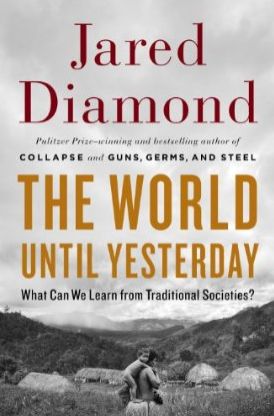
Jared Diamond: The World Until Yesterday
Jared Diamond: In Guns, Germs, and Steel, I set out to explain why, after the end of the last Ice Age, the most powerful and technologically advanced societies developed first in the Fertile Crescent and spread from there to Europe and North America. In Collapse, I asked why many societies disintegrated or vanished while others avoided that fate, and what lessons those varying outcomes hold for us today.
Since publication of Collapse, I have been attempting to understand the revolutionary changes in human societies and social relations brought about by the emergence of state government, after seven million years of simpler forms of organization. The differences are so profound, and we take state government as so completely natural, that I couldn’t even pose the differences as questions until I had experienced them first-hand through living in New Guinea, a window on our past.
I first went to New Guinea 41 years ago to study birds and to have adventures. I knew intellectually that New Guineans constituted most of the world’s last remaining “primitive” peoples, who until a few decades ago still used stone tools, little clothing, and no writing. That was what the whole world used to be like until 7,000 years ago, a mere blink of an eye in the history of the human species. Only in a couple of other parts of the world besides New Guinea did our original long-prevailing “primitive” ways survive into the 20th century.
Stone tools, little clothing, and no writing proved to be only the least of the differences between our past and our present. There were other differences that I noticed within my first year in New Guinea: murderous hostility towards any stranger, marriageable young people having no role in choosing their spouse, lack of awareness of the existence of an outside world, and routine multi-lingualism from childhood.
But there were also more profound features, which took me a long time even to notice, because they are so at odds with modem experience that neither New Guineans nor I could even articulate them. Each of us took some aspects of our lifestyle for granted and couldn’t conceive of an alternative. Those other New Guinea features included the non-existence of “friendship” (associating with someone just because you like them), a much greater awareness of rare hazards, war as an omnipresent reality, morality in a world without judicial recourse, and a vital role of very old people.
I’ve encountered myself some features of our primitive lifestyle among Inuits, Amazonian Indians, and Aboriginal Australians. Others have described such features among Kalahari Bushmen, African Pygmies, Ainus, California Indians, and other peoples. Of course, all these peoples differ from each other. New Guinea’s 1,000 tribes themselves are diverse: they constitute 1,000 radically different experiments in constructing a human society. But they all share (or shared) some basic features that used to characterize all human societies until the rise of state societies with laws and government, beginning around 5,500 years ago in the Fertile Crescent and now established over the entire world.
I am once again treating a huge question about human societies, and in using methods of long-term comparative history. In this case I am placing much heavier weight on one area of the world, New Guinea. Yes, I include other parts of the world: I’ve already been gathering material on the Mongols, Cherokees, Zulus, and many others. But New Guinea will play a central role, as the standard of comparison. That’s as it should be, because New Guinea’s 1,000 languages make up one 6th of all surviving languages, and because New Guinea contained by far the largest number of people and tribes still living under pre-state conditions in modem times.
The other difference is that my studies of New Guinea are based much more heavily on my personal experiences and observations, and less on publications by others. Many of my experiences in New Guinea have been intense — a sudden encounter at night with a wild man, the prolonged agony of a nearly-fatal boat accident, one broken little stick in the forest warning us that nomads might be about to catch us as trespassers … Those stories carry a bigger message than mere exciting adventures that have shaped my outlook. They give us a first-hand picture of the human past as it has been for millions of years — a past that has almost vanished within our lifetimes, and that no one will ever be able to experience again.
I’ve gone from wrestling with difficult abstract questions about the structure of societies—about their rise from agricultural origins in Guns, Germs, and Steel, and about their decline or maintenance in Collapse. The abstractness of those questions forced me to work hard to put human faces on them. The New Guinea work is more passionate, personal, and from the heart.
In conversation with John Brockman at Edge, Diamond recounts some of the stories from his new book, The World Until Yesterday.
Music: Lars Hollmer and Fanfare Pourpour — ‘Inte Quanta’
Happy New Year!
Some of the best best photos of 2012
Each of the photos below comes from a “best of…” collection. Click on each picture to see the source.

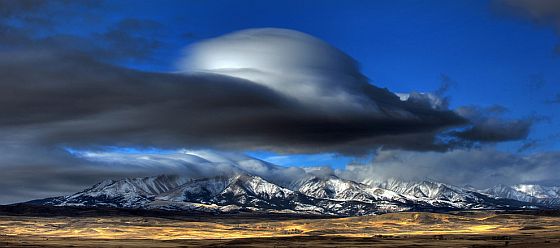
A lenticular cloud formed as high winds blew over the rugged Crazy Mountains in Montana. (James Woodcock, Billings Gazette via Associated Press.)

A Palestinian man kisses the hand of a dead relative in the morgue of Shifa Hospital in Gaza City. November 18, 2012. (Bernat Armangue, AP.)

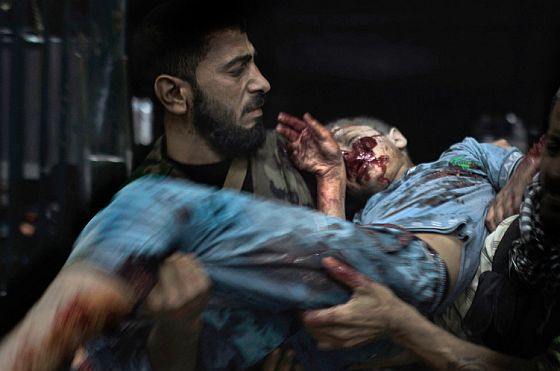
A child wounded by Syrian Army artillery shelling is carried at the entrance of the Al Shifa hospital in Aleppo. (Laurent Van der Stockt, Getty Images.)

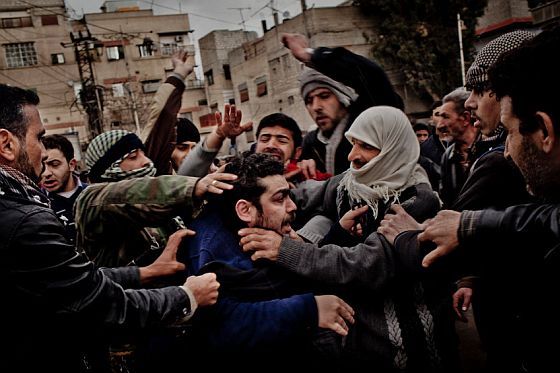
A crowd beat a Syrian security officer who infiltrated a funeral for a fighter from the Free Syrian Army, January 27. (Tomas Munita, New York Times.)

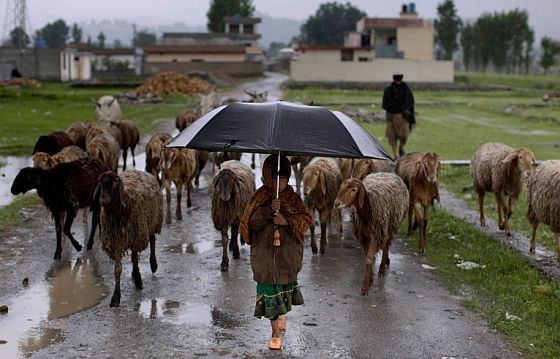
A Pakistani girl helps her father herd sheep near the demolished compound in Abbottabad, Pakistan that once housed Osama bin Laden. (Muhammed Muheisen, AP.)