Lost to history: Missing war records complicate benefit claims by Iraq, Afghanistan veterans (part two)

(Part one can be read here.)

‘They Couldn’t Find It’

Chris DeLara is not the type of soldier to wear his heart on his sleeve, but the 1st Cavalry Division’s shoulder patch is tattooed on his right forearm in a swirling piece of body art. Beneath it are the words: “Baghdad, Iraq.”

DeLara, 38, grew up in Albany, N.Y., never dreaming he might someday fight a war. Now, his tour in 2004 and 2005 haunts his every day. Since winning his appeal in March 2011, he is classified as fully disabled by post-traumatic stress and cannot work. He was awarded a stipend of about $30,000 a year and has moved near Knoxville, Tenn., where he recently bought a modest house.

Getting to a stable point wasn’t easy.

DeLara was an administrative specialist, essentially a personnel clerk. But he was repeatedly pulled out of his scrivener’s life for missions as a roof gunner on convoys. It was a time of insurgency and exploding factional violence in Baghdad.

“They told us, ‘This may be your job, but guess what? You’re going to be doing everything,'” he said. “We had many hats. You go to combat, your job is secondary. Combat is first.”

DeLara did not want to discuss his combat experiences, but they are described in part by a judge in the Board of Veterans’ Appeals ruling that approved his PTSD claim.

In the years after his deployment, DeLara told psychiatrists and others who treated him at various times that two of his friends were killed in an insurgent attack on his convoy, and that he was unable to stop one of them from bleeding to death from a ruptured artery.

He said that one his commanders was shot in the head in front of him by insurgents, and reported that he had killed an Iraqi youth who had tried to attack his convoy after it was stopped because of a roadside bomb, according to the judge’s summary.

After his return in 2005, DeLara was diagnosed several times with PTSD or its symptoms, according to VA exam records cited by the appeals judge. He drank and used drugs even though he’d abstained from them in the Army. In 2006, he overdosed on prescription drugs.

DeLara said he lived for a time in a shelter for troubled vets. He and his wife eventually divorced, but he credits her for helping him fight for his claim when he might have given up.


Continue reading

Facebooktwittermail

A global progressive agenda for Obama’s second term

Mark LeVine writes: Barack Obama’s re-election offers progressives a short window of opportunity to lay out a vision for his second term which, if deftly presented, could win broader public support, especially among the millions of young, women, and Latino voters who were crucial to his victory. Here are five issues that progressives, both in the United States and abroad, should push the President to address at the start of his second term in order to meet the so-far unfulfilled hopes for a transformative change in foreign and domestic policies that accompanied his historic political ascendance.

All five have the advantage of being issues which have the increasing attention and even support of important members of the Republican establishment in the US as well political leaders abroad and global civil society, increasing the possibility of their impacting administration policies if enough pressure can be deployed from a variety of angles in support of them.

1. Stop the drones. Drones have become Obama’s water boarding, only worse, and are the single biggest threat to US standing in the international community today. They have killed at least 176 children in Pakistan alone – that’s right, President Obama has killed sixteen times the number of children that Osama bin Laden killed on 9/11, including at least one American citizen. This number is a greater stain on the United States than the use of torture, secret renditions or Guantanamo. And the children represent only a small share of the many hundreds of civilians – perhaps as many as a thousand – who’ve been killed by US drones.

The President has directly supervised the programme, lauding its “surgical precision” even though a comprehensive report has revealed the number of high value al-Qaeda targets killed (the original purpose and still the primary justification for the programme) to be as low as two percent of the total killed. Moreover, the attacks have included patently illegal “double strikes” which have killed first responders who arrived to tend to the wounded only to themselves be blown to bits from the sky.

Even conservatives are worried about the legal and diplomatic ramifications of the drone programme, offering a unique opportunity to create a political and policy-making consensus drastically to curtail and perhaps even end their use. [Continue reading…]

Facebooktwittermail

Climate change: Lessons from Ronald Reagan

Cass R. Sunstein writes: The re-election of President Obama, preceded by the extraordinary damage done by Hurricane Sandy, raises a critical question: In the coming years, might it be possible for the United States to take significant steps to reduce the risks associated with climate change?

A crucial decision during Ronald Reagan’s second term suggests that the answer may well be yes. The Reagan administration was generally skeptical about costly environmental rules, but with respect to protection of the ozone layer, Reagan was an environmentalist hero. Under his leadership, the United States became the prime mover behind the Montreal Protocol, which required the phasing out of ozone-depleting chemicals.

There is a real irony here. Republicans and conservatives had ridiculed scientists who expressed concern about the destruction of the ozone layer. How did Ronald Reagan, of all people, come to favor aggressive regulatory steps and lead the world toward a strong and historic international agreement?

A large part of the answer lies in a tool disliked by many progressives but embraced by Reagan (and Mr. Obama): cost-benefit analysis. Reagan’s economists found that the costs of phasing out ozone-depleting chemicals were a lot lower than the costs of not doing so — largely measured in terms of avoiding cancers that would otherwise occur. Presented with that analysis, Reagan decided that the issue was pretty clear. [Continue reading…]

Facebooktwittermail

Obama faces expanding conflicts across the Middle East

Patrick Cockburn writes: President Obama is lucky in his opponents, particularly when it comes to explaining why America’s influence is waning in the Middle East. The issue was hardly mentioned in the election, aside from a botched attempt by Mitt Romney to blame the administration for the death of Chris Stevens, the US ambassador to Libya, and for the burning of the US consulate in Benghazi.

Romney soon steered away from his initial posture of attacking Obama for “apologising for America” and failing to assert US power. He recognised that the one thing the US electorate does not want is another war in the Middle East. By beating the patriotic drum too hard, Romney risked voters remembering that it was the Republicans who, not so long ago, led them into failed wars in Iraq and Afghanistan. On a more prosaic level, Romney may have sensed he would be vulnerable on topics he knew nothing about.

This near immunity from effective criticism during the campaign does not mean that Obama is not facing dangers across the region with which he has previously failed to grapple successfully.

Afghanistan is a good example. The “surge”, which preoccupied the White House when Obama first took office in 2009, led to an extra 33,000 soldiers being sent to Afghanistan, where they wholly failed to eliminate the Taliban. The remaining 112,000 Nato troops will be withdrawn by the end of 2014, bringing to an end one of the more disastrously unproductive wars in American history. The US and its allies are supposedly training up Afghan security forces to take their place, but so many American and British soldiers have been killed by Afghan soldiers and police that the transition is turning into a debacle. [Continue reading…]

Facebooktwittermail

Obama faces Latin America revolt over drugs, trade

Reuters reports: President Barack Obama will face an unprecedented revolt by Latin American countries against the U.S.-led drug war during his second term and he also may struggle to pass new trade deals as the region once known as “America’s backyard” flexes its muscles like never before.

Washington’s ability to influence events in Latin America has arguably never been lower. The new reality is as much a product of the United States’ economic struggles as a wave of democracy and greater prosperity that has swept much of the region of 580 million people in the past decade or so.

It’s not that the United States is reviled now – far from it. Although a few vocally anti-U.S. leaders like Venezuela’s Hugo Chavez tend to grab the media spotlight, Obama has warm or cordial relations with Brazil, Mexico and other big countries in the region.

Most Latin American leaders were rooting, either privately or publicly, for his re-election on Tuesday.

That said, even close allies are increasingly emboldened to act without worrying about what “Tio Sam” will say or do. Nowhere is that more evident than on anti-narcotics policy. [Continue reading…]

Facebooktwittermail

Syrian opposition strikes unity deal

Reuters reports: Syrian opposition leaders struck a hard-won deal on Sunday under intense international pressure to form a broad, new coalition to prepare for the fall of President Bashar al-Assad.

Delegates, who had struggled for days in the Qatari capital Doha to find the unity their Western and Arab backers have long urged, said the new body would ensure a voice for religious and ethnic minorities and for the rebels fighting on the ground, who have complained of being overlooked by exiled dissident groups.

Some details remain outstanding, including who will head the new Syrian National Coalition for Opposition and Revolutionary Forces and the final assent of some leaders not present in Doha.

Diplomats and officials from the United States and Qatar, the tiny Gulf emirate whose oil and gas wealth has helped fund the 20-month-old uprising, have particularly been pressing the Syrian National Council (SNC), whose leaders mostly live abroad, to drop fierce objections to joining a wider body.

“An initial deal has been signed. A final formulation has been agreed and signed,” Ali Sadreddine al-Bayanouni, a delegate for the Islamist group the Muslim Brotherhood, told reporters.

“The evening session will be for electing the president of the body and his deputy,” he added. The meeting was due to resume around 6 p.m. (1500 GMT).

Delegates said there would be specific representation for women and ethnic Kurds as well as for Christians and Alawites, the religious minority to which Assad belongs and from which he has drawn much of the leadership of his security forces.

It was not entirely clear whether full agreement had been reached, however. [Continue reading…]

Facebooktwittermail

Israel fires warning shot within Syria

The following Haaretz report doesn’t make clear exactly where the latest Syrian mortar fell or the position of the IDF when it fired warning shots, but it’s reasonable to assume that both locations were in the Israeli-occupied Golan Heights which legally remains part of Syria.

The Israel Defense Forces fired a warning shot at Syria on Sunday, after an errant mortar shell landed in Israeli territory. This was the first time Israel has directed weaponry at its northern neighbor since the Yom Kippur War in 1973.

The errant shell marked the fourth time in just over a week that the infighting from Syria has spilled into Israel.

An Israeli security source said the military fired in the direction of a Syrian army mortar crew that had launched a shell which overshot the Golan disengagement fence on Sunday, exploding near a northern Israeli community without causing casualties.

In a statement, the Israeli military said soldiers had “fired warning shots towards Syrian areas”.

“The IDF has filed a complaint through the UN forces operating in the area, stating that fire emanating from Syria into Israel will not be tolerated and shall be responded to with severity,” the statement said.

Defense Minister Ehud Barak earlier Sunday warned that Israel would respond should stray Syrian ordnance continue to strike the Golan Heights, highlighting international concerns that the civil war in Syria could ignite a wider regional conflict.

Facebooktwittermail

Northern Syria awash with advanced weapons

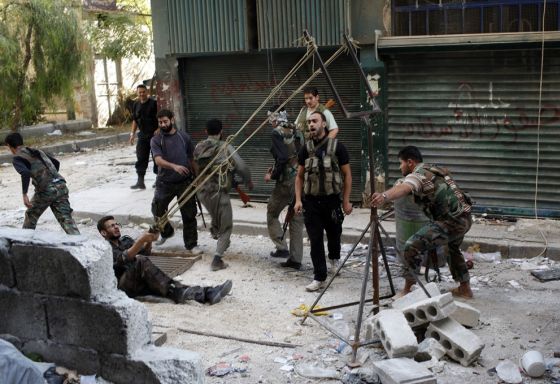
Members of the Free Syrian Army use a catapult to launch a homemade bomb during clashes with pro-government soldiers in the city of Aleppo, on October 15, 2012 - Reuters

“Northern Syria is awash with advanced antitank and antiaircraft weapons. The situation has changed very quickly,” said a Syrian involved in coordinating weapons procurement with regional states, the Wall Street Journal reported on October 17.

Facebooktwittermail

Talking to foreign media is forbidden: Saudi Grand Mufti

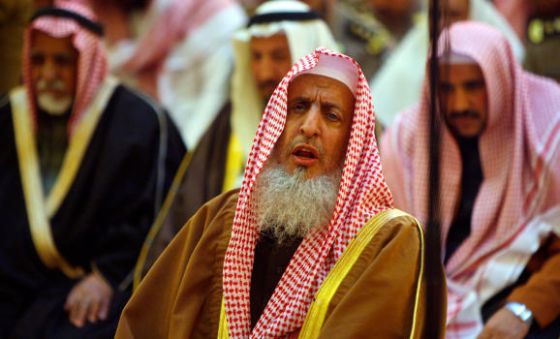
Saudi Arabia's Grand Mufti, Sheikh Abdul Aziz Al-Asheikh

Al Arabiya reports: Saudi Arabia’s Grand Mufti has issued a religious edict prohibiting contact and cooperation with foreign media outlets seeking to “spread chaos and strife in Muslim lands.”

He urged people instead to address their concerns through writing directly to responsible authorities.

Sheikh Abdul Aziz Al-Asheikh told worshipers during a Friday sermon held in a mosque in the capital Riyadh that people should not contact foreign media outlets to “divulge the country’s secrets or address various matters” because these outlets “are only concerned with dividing people and striking the unity of the nation.”

He said doing so was tantamount to “treason and major crime.”

Facebooktwittermail

I cry, therefore I am

Michael Trimble writes: In 2008, at a zoo in Münster, Germany, a gorilla named Gana gave birth to a male infant, who died after three months. Photographs of Gana, looking stricken and inconsolable, were ubiquitous. “Heartbroken gorilla cradles her dead baby,” Britain’s Daily Mail declared. Crowds thronged the zoo to see the grieving mother.

Sad as the scene was, the humans, not Gana, were the only ones crying. The notion that animals can weep — apologies to Dumbo, Bambi and Wilbur — has no scientific basis. Years of observations by the primatologists Dian Fossey, who observed gorillas, and Jane Goodall, who worked with chimpanzees, could not prove that animals cry tears from emotion.

In his book “The Emotional Lives of Animals,” the only tears the biologist Marc Bekoff were certain of were his own. Jeffrey Moussaieff Masson and Susan McCarthy, the authors of “When Elephants Weep,” admit that “most elephant watchers have never seen them weep.”

It’s true that many mammals shed tears, especially in response to pain. Tears protect the eye by keeping it moist, and they contain antimicrobial proteins. But crying as an embodiment of empathy is, I maintain, unique to humans and has played an essential role in human evolution and the development of human cultures.

Within two days an infant can imitate sad and happy faces. If a newborn mammal does not cry out (typically, in the first few weeks of life, without tears) it is unlikely to get the attention it needs to survive. Around three to four months, the relationship between the human infant and its environment takes on a more organized communicative role, and tearful crying begins to serve interpersonal purposes: the search for comfort and pacification. As we get older, crying becomes a tool of our social repertory: grief and joy, shame and pride, fear and manipulation.

Tears are as universal (but less culturally contingent) as laughter, and tragedy is more complex than joy — an insight Tolstoy and many others have offered. But although we all cry, we do so in different ways. [Continue reading…]

Facebooktwittermail

On the timing of Petraeus’ resignation

The Washington Post reports: The timing of the resignation has caused a controversy, with members of Congress and others questioning why the disclosure was not made until after Tuesday’s election. Some have also complained that the FBI did not notify the White House and senior members of Congress earlier that the CIA director was under investigation.

The law enforcement officials did not provide an exact timeline for the investigation, but they said that the inquiry started at least several weeks ago. They said investigators thought they were dealing with a routine harassment case until they discovered the e-mails were traced to a private e-mail account belonging to Petraeus.

The initial concern was that someone had broken into the CIA director’s e-mail account, leading to concerns about potential security breaches, according to the officials. As the investigation proceeded and more e-mails emerged, along with [Paula] Broadwell’s role, FBI investigators realized they had uncovered an affair between Petraeus and Broadwell, the officials said.

The investigators first interviewed Petraeus about two weeks ago, the officials said. Petraeus was told at the time that no criminal charges would be forthcoming and the idea of him resigning was not raised, the officials said.

One of the law enforcement officials said Justice Department officials were unclear on what steps to take next because they had determined that there had been no crime and no breach of security.

It was not until Tuesday that the Justice Department notified James Clapper, the director of national intelligence, that compromising material about Petraeus had been uncovered as part of an investigation, according to a senior intelligence official. Clapper then spoke with Petraeus and told him to resign.

“Director Clapper learned of the situation from the FBI on Tuesday evening around 5 p.m.,” the intelligence official said. “In subsequent conversations with Director Petraeus, Director Clapper advised Director Petraeus to resign.”

The official declined to say whether Petraeus had considered resigning at that point, but he said it was quickly clear to Clapper that stepping down was “the right thing to do” for Petraeus.

The official said that Clapper has been fully briefed on all aspects of the FBI investigation and has not called for the DNI or CIA to conduct a follow-on probe or damage assessment — indicating that Clapper does not see the case as a security threat.

Facebooktwittermail

Climate change report outlines perils for U.S. military

The New York Times reports: Climate change is accelerating, and it will place unparalleled strains on American military and intelligence agencies in coming years by causing ever more disruptive events around the globe, the nation’s top scientific research group said in a report issued Friday.

The group, the National Research Council, says in a study commissioned by the C.I.A. and other intelligence agencies that clusters of apparently unrelated events exacerbated by a warming climate will create more frequent but unpredictable crises in water supplies, food markets, energy supply chains and public health systems.

Hurricane Sandy provided a foretaste of what can be expected more often in the near future, the report’s lead author, John D. Steinbruner, said in an interview.

“This is the sort of thing we were talking about,” said Mr. Steinbruner, a longtime authority on national security. “You can debate the specific contribution of global warming to that storm. But we’re saying climate extremes are going to be more frequent, and this was an example of what they could mean. We’re also saying it could get a whole lot worse than that.”

Mr. Steinbruner, the director of the Center for International and Security Studies at the University of Maryland, said that humans are pouring carbon dioxide and other climate-altering gases into the atmosphere at a rate never before seen. “We know there will have to be major climatic adjustments — there’s no uncertainty about that — but we just don’t know the details,” he said. “We do know they will be big.”

The study was released 10 days late: its authors had been scheduled to brief intelligence officials on their findings the day Hurricane Sandy hit the East Coast, but the federal government was shut down because of the storm. [Continue reading…]

Facebooktwittermail

America’s new mandate on climate change

Richard Schiffman writes: For Americans concerned about the environment, disaster was avoided on Tuesday. President Obama – with his somewhat lackluster record, if decidedly more exalted rhetoric, on global warming – defeated the Republican challenger who had vowed to gut federal emissions standards, and kill loan programs and tax breaks for green energy companies.

But activists say that it would be wrong to read the election as a stamp of approval for four more years of business as usual. They argue that voters have sent a clear signal that they want more aggressive action on the environment during the president’s second term.

The League of Conservation Voters (LCV) cites the defeat of three members of their “Flat Earth Five” – Anne Marie Buerlke (Republican, New York), Francisco Canseco (Repub;lican, Texas) and Joe Walsh (Republican, Illinois) – Republican representatives who were outspoken for their anti-science stance on climate change. (One race remains too close to call.) And ten of the League’s “dirty dozen” candidates – targeted for “consistently voting against clean energy and conservation” – lost their election bids.

Meanwhile, 11 out of 12 of the office-seekers dubbed “climate heroes” by a coalition led by environmental activist Bill McKibben, prevailed in Tuesday’s vote. The 12th “hero”, Jay Inslee, a gubernatorial candidate in Washington state who wants to jump-start the state’s lagging economy by transforming it into a national green-tech hub, continues to hold a small lead over Republican Rob McKenna and looks poised to win that race.

The election results overturn the conventional wisdom that voters don’t care about green issues, according to LCV’s spokesperson Jeff Gohringer:

“We went into this election cycle and the notion was that environmental champions were going to be wiped off the map. We did $3m-worth of advertising on climate change in places like Texas, and we won.”

This sentiment was echoed by Frances Beinecke, the president of the Natural Resources Defense Council who wrote to her members on Wednesday that:

“By rejecting Big Oil’s candidates, voters sent a message loud and clear that they want more clean energy, less climate denial and an end to the $4bn in taxpayer subsidies for fossil fuels.”

Some environmentalists have characterized Obama’s very re-election as a mandate for strong action on climate change. This is a hard argument to make given that the topic scarcely came up during the presidential race. [Continue reading…]

Facebooktwittermail

Syrian National Council picks a Christian to be its new leader

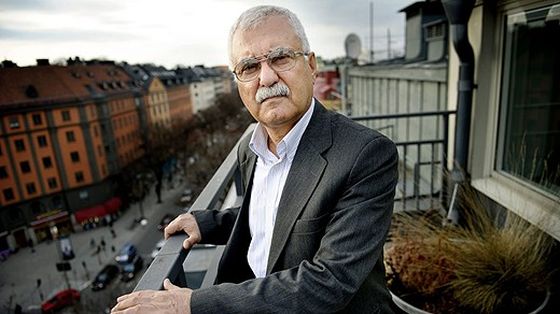
George Sabra, newly-elected president of the Syrian National Council.

McClatchy reports: Syria’s biggest political opposition bloc Friday elected a Christian, George Sabra, as president, a move Sabra said showed that the Muslim-majority nation will not allow its national uprising to descend into sectarian war.

Sabra, a geography teacher who once wrote for the Arabic version of “Sesame Street,” immediately demanded that the international community provide arms to the rebels so that they can protect Syrian civilians from regime attack.

Western nations, he told reporters after the vote by the Syrian National Council, should “support our right to survival.” He added, “To protect ourselves, we need weapons.”

Tens of thousands of Syrians have died in the uprising, which began as peaceful demonstrations against the government of President Bashar Assad. But it has become a bloody civil war pitting the Syrian army and air force against rebels who despite a lack of heavy weapons have seized large swaths of Syrian countryside and have fought loyalist forces to a standstill in Aleppo, the country’s largest city.

Sabra seemed stunned by his sudden elevation to the council’s top post. “It is an unbelievable moment in my life,” he told reporters. “I promise to become a representative for all the Syrian people.”

It was uncertain whether Sabra’s selection would rehabilitate the Syrian National Council in the eyes of the United States. Last week, Secretary of State Hillary Clinton announced that the U.S. no longer would recognize the council as the primary anti-Assad organization, saying too many of its members had lived in exile for decades and that a new opposition group should include more representation from people fighting inside Syria.

Sabra may help fit that requirement. A longtime member of Syria’s communist party, which renamed itself the Syrian Democratic People’s Party in 2005, Sabra went into exile only in October after serving two months in prison for inciting dissent. Previously, he had served eight years in prison during the regime of Bashar Assad’s father, Hafez Assad.

Sabra credited his election to the intervention of a conservative Islamist from Homs, a Sunni Muslim city that has been the scene of brutal fighting between rebels and pro-Assad forces for most of this year.

Until the Islamist, Wasal al Shamali, who was here representing the Supreme Council for Revolutionary Commands, a collection of rebel-held cities in Syria, spoke on Sabra’s behalf, Sabra wasn’t even a member of the group’s top governing committee, the general secretariat. The Syrian National Council has been criticized because its 41-member secretariat includes no women or Alawites, the religious offshoot of Shiite Islam to which Assad belongs.

Shamali, however, said that Sabra should have his place on the general secretariat.

“I didn’t even know his name,” Sabra told McClatchy. “He was in tears.”

Added Sabra: “After that, who can talk about sectarianism when a Muslim sacrifices his place for a Christian?”

The group later elected Sabra its president, 28-13, over Hisham Marwah, an Islamic legal scholar.

Sabra said his selection should signal to the international community: “Look at Syria. There is no sectarianism inside Syria. All the people here, Muslims, voted for Christians.”

He said the Syria that he and others are fighting for “doesn’t have minorities and majorities. We have citizenship. And as I am a citizen, my colleagues elected me.” [Continue reading…]

Facebooktwittermail