



CNN: Israel is signaling a major change in tone toward U.S. President Barack Obama now that he has won reelection.
In an interview with CNN’s Christiane Amanpour on Thursday, Israel’s Deputy Foreign Minister, Danny Ayalon, gave what could only be described as a ringing endorsement of the Obama administration’s handling of Iran’s nuclear program. It has been a very contentious issue between the two allies, with the U.S. fearing Israel might unilaterally strike Iran’s nuclear sites and drag the U.S. into an regional war.
But Ayalon told Amanpour that despite past differences with the Obama administration over Iran, “I think today we can safely say that we are very much on the same page and will continue to follow the lead of the U.S.”
Over the course of his first term in office, Obama and Israeli Prime Minister Benjamin Netanyahu have had a fraught relationship. They have disagreed on major issues, ranging from the Iranian nuclear program to a peace agreement with the Palestinians.
Netanyahu’s relationship with Obama’s challenger, Mitt Romney, dates back to the 1970s, when they worked at the same company in the United States – Netanyahu’s preference for a President Romney had been an open secret.
Ayalon admitted “there was a special kinship between Mr. Romney and Mr. Netanyahu,” but said Israel cannot afford to be meddling in U.S. politics.
Still, many Israelis are worried about payback against their leader for backing the wrong horse in the U.S. presidential sweepstakes. On Thursday, the leading Israeli newspaper Yedioth Ahronoth even carried the headline “Bibi gambled. We’ll pay.”
But Ayalon expressed no doubts that the relationship would get back on track. “I have full confidence knowing not only the president’s commitment, but also his team” he said. “In a way I see an advantage by the continuity of the administration being very seasoned, knowing very well the Iran file and portfolio, to continue and make sure Iran won’t become nuclear.”
The Guardian reports: A mid-air incident in which Iranian warplanes opened fire on a US surveillance drone high over the Persian Gulf has brought home how nuclear tensions and increased military hardware in a confined area can lead to a clash that could escalate out of control.
Western officials are concerned that minority elements on both sides of the confrontation in the region have a vested interest in triggering such a clash. Some Israeli leaders would like to see Washington drawn in so that superior US forces could strike a crippling blow to Iranian nuclear facilities, while a “war party” in Tehran sees a conflict as a means of rallying support for the regime and cracking down yet further on dissent, officials say.
They believe the risk of a “spoiler” incident will rise if a new diplomatic push aimed at reaching a peaceful settlement of the Iranian nuclear crisis appears to show progress.
The Pentagon said that on 1 November two Sukhoi 25 jet fighters flown by Iranian Revolutionary Guards, fired at the Predator drone carrying out a routine but “classified surveillance mission”, 16 miles off the Iranian shore – four miles outside its territorial waters. [Continue reading…]
David Wallace-Wells writes: “To talk of diseases is a sort of Arabian Nights entertainment,” ran the epigraph to The Man Who Mistook His Wife for a Hat, Oliver Sacks’s fourth book and his first best seller—the one that made him famous, in 1985, as a Scheherazade of brain disorder. A sensitive bedside-manner neurologist, he had previously written three books, none of which had attracted much notice at all. The Man Who Mistook would mark the beginning of another career, and a much more public one, as perhaps the unlikeliest ambassador for brain science—a melancholic, savantlike physician disinterested in grand theories and transfixed by those neurological curiosities they failed to explain. Sacks was 52 years old and cripplingly withdrawn, a British alien living a lonely aquatic life on City Island, and for about ten years had been dealing with something like what he’d later call “the Lewis Thomas crisis,” after the physician and biologist who decided, in his fifties, to devote himself to writing essays and poetry.
“In those days, he was a complete recluse. I mean, there was nobody,” recalls Lawrence Weschler, a friend and essayist who once planned to write a biography of Sacks. “He was in a kind of rictus of shyness.” Sacks was struggling with writer’s block, wrestling with accusations of confabulation as well as the public’s general indifference to his first books, and would spend hours every day swimming in Long Island Sound, near the Throgs Neck Bridge, miles each way and often at night. “I feel I belong in the water — I feel we all belong in the water,” he’s said, and later echoed: “I cease to be a sort of obsessed intellect and a shaky body, and I just become a porpoise.”
W. H. Auden had become a friend, too, after he’d reviewed Sacks’s first book, the Victorian-ish survey Migraine, in 1971. Auden had also admired his second book, Awakenings, which detailed the miraculous recovery, then tragic relapse, of the near-catatonic patients given the experimental drug L-dopa. The book sold only modestly when published and attracted, he says, no medical reviews. Auden thought Sacks was capable of more. “You’re going to have to go beyond the clinical,” he told him. “Be metaphorical, be mythical, be whatever you need.”
The uncanny case studies of The Man Who Mistook were the mythic course that Sacks has followed ever since (his new book, Hallucinations, is another mesmerizing casebook of neurological marvles). Histories of such unfamiliar or forgotten disorders, tales of damage told in such picaresque and nondiagnostic ways, the stories of The Man Who Mistook struck early readers as landing oddly between science and fairy tale. (A man so unable to distinguish between objects he tried to lift his wife onto his head; a 49-year-old whose memory stalled at 19; a patient who thought Sacks was a delicatessen customer one minute and looked like Sigmund Freud the next.) “They come together at the intersection of fact and fable,” Sacks wrote in its grand preface. “But what facts! What fables! To what shall we compare them? We may not have any existing models, metaphors, or myths. Has the time perhaps come for new symbols, new myths?” [Continue reading…]

Readers here might wonder why, up until now, I have posted nothing on the Petraeus affair. After all, it’s the story now gripping Washington.
The sudden departure of the director of the CIA in such ignominious circumstances marks not only the apparent end of a much celebrated career but likewise the end of speculation that Petraeus might be a latter-day Eisenhower and a future president.
In many ways the story appears utterly mundane. A middle-aged man succumbs to the irresistible attraction of a younger woman who apparently had an insatiable appetite for listening to the general talk about himself. Vanity heralds foolishness.
But there’s another story much more compelling yet which most likely will never be told. In the same week that Petraeus tendered his resignation and President Obama took 24 hours to respond, both men were involved in a decision of much greater magnitude: the issuing of orders to kill three Al Qaeda suspects. In a drone attack just outside the capital of Yemen on Wednesday morning, Adnan al-Qadhi, Rabeaa Lahib and Radwan al-Hashdhi were killed and others were injured including a boy.
It seems reasonable to assume that President Obama’s decision to authorize a drone strike in Yemen this week weighed much less heavily on his mind than the departure of the CIA chief. The incineration of Adnan al-Qadhi and his associates was simply of less consequence than the relationship between General Petraeus and Paula Broadwell.
Washington becomes ever more like The Sopranos, where casual killings provoke less anguish than fraught family relations.
The Washington Post reports:
Petraeus, who retired from the military last year, is still subject to the Uniform Code of Military Justice, which classifies adultery as a crime.
Practically speaking, however, the odds are extremely low that the military would prosecute a retired officer for having an affair, said Eugene R. Fidell, a prominent military law expert who teaches at Yale University.
“They’re as close to zero as you can get,” Fidell said. “It would have to be a grave matter before the executive branch would prosecute a retiree.”
Petraeus married Holly two months after graduating from West Point. His courtship was seen as audacious because of her father’s rank at the elite military academy. They have two children, Stephen, who became an Army officer, and Anne.
Petraeus has frequently praised his wife in public appearances for her sacrifices and contributions to his career, and he characterized his return to Washington as an opportunity for them to be closer after his years-long assignments overseas.
Gary Younge writes: As a community organiser in Chicago’s south side, Barack Obama once managed to secure an event with the city’s first and only black mayor, Harold Washington. He primed the women he was working with to press the mayor to attend their forthcoming rally to improve conditions in the run-down area.
But instead they fawned and got their picture taken with him. Afterwards he asked if they had extracted a promise about the rally. “What rally?” said one. Obama stormed off in frustration. “Here we are with a chance to show the mayor that we’re real players in the city,” he told a colleague. “A group he needs to take seriously. So what do we do? We act like a bunch of starstruck children.”
As a community organiser Obama was well aware that it was only by making demands on the powerful that the powerless could further their interests. As president he must be delighted to realise that all too few of his progressive supporters have grasped that reality.
The last week has felt very familiar. Just like four years ago, black people in Chicago have been swapping knowing smiles, liberals are watching Fox News to gloat and Democrats have been revelling in the charisma, eloquence and intelligence of their candidate. Their affection for him is rooted in politics but their assessment of him owes more to psychoanalysis. At the celebrations in Chicago on Tuesday most believed he would be more radical in the second term. Ask them what that expectation is based on and they shrug. Ask them what they will do to make sure he meets it and they shrug again. If the devotion is not blind then, at the very best, it is not clear-sighted. [Continue reading…]
An editorial in The Guardian says: In spring 2010, as Athens wrangled with the IMF and the rest of Europe for what would turn out to be a €110bn emergency loan, a revealing, chilling phrase slipped out. When Greece’s then-premier, George Papandreou, begged for easier borrowing terms, he was told by Angela Merkel that the deal had to hurt. According to a well-sourced report in the Wall Street Journal, the German chancellor said: “We want to make sure nobody else will want this.”
She certainly made good on her side of the deal: Greece has spent the past two years on a financial life-support that has kept its government ticking over, but which has destroyed its economy and pushed its entire democracy to the brink of collapse. This week, Athens re-enacted what has become a traditional ritual. Under duress from its troika of creditors (the IMF, the European commission and the European Central Bank), the government identified more areas for cuts and deregulation: another 8,000 civil servants to be sacked by next Christmas, yet more slashing of pensions and wages and of the minimum wage. Meanwhile, the country went on a general strike and petrol bombs were lobbed at the Vouli, the parliament, even as MPs voted through the package. If the government also passes its 2013 budget this Sunday, it will get another chunk of cash to keep paying salaries and other bills.
The price of the severest austerity programme ever imposed on postwar western Europe has been severe. Greece’s economy is in severe depression: this year its annual national income is projected to be 23% below what it was in 2009, that is to say that nearly a quarter of everything the economy used to produce has disappeared over three years. Partly as a result, the debt burden will soon be three times GDP. Unemployment has skyrocketed, with one in two young people out of work.
Extreme policies in; extremist politics out. From being a rump just three years ago, the neo-Nazi Golden Dawn now effectively polices parts of Athens and has infiltrated the official police force. The centre has collapsed: after acceding to Mrs Merkel’s terms, Mr Papandreou’s Pasok has gone from being a reliable centre-left party of government to a husk of its former self. Journalists who threaten to show any independence of mind, such as the admirable Kostas Vaxevanis are hounded by officials.
In the heart of Europe, a democracy now teeters on the edge. True, most of the blame for this is that of a corrupt Greek elite that has dominated politics, business and media for many decades. But the rest of the eurozone is also guilty: first for enforcing impossible austerity, then for turning a blind eye to the predictable results. Mrs Merkel was surely right: no other country – in Europe or elsewhere – would want this.
Reuters reports: Syria’s fractious opposition, under pressure from the United States and Qatar to unite, looked likely on Friday to agree to form an inclusive new opposition body that would serve as a unity government if Bashar al-Assad falls.
Qatar, which has bankrolled the opposition to Assad and played a leading role in Arab diplomacy against him, is hosting an opposition meeting, with senior U.S. diplomats hovering on the sidelines, prodding the opposition to make a deal.
Rebel advances on the ground and increasing economic and social disintegration within Syria have added to the pressure on the opposition to form a body that can rule after Assad.
A source inside meetings that lasted into the early hours of Friday morning said members of the Syrian National Council (SNC), a group made up mainly of exiled politicians, had shifted views and were coming to accept the need to form a wider body.
“We will not leave today without an agreement,” the source said. “The body will be the sole legitimate representative of the Syrian people. Once they get international recognition, there will be a fund for military support.”
The new body would mirror the Transitional National Council that united the opposition to Muammar Gaddafi in Libya last year and then took power after he was ousted, the source suggested.
“They will create a ‘temporary government’, which could take control of embassies around the world and take Syria’s seat at the U.N., because the regime would have lost its legitimacy.”
An outline agreement could see the SNC and other opposition figures agree on a 60-member political assembly, or congress, as well as a military and a judicial council.
The SNC, which has previously been the main opposition group on the international stage, may have around a third of the seats in the new body but would otherwise lose much of its influence.
Though it was not yet clear whether the groups meeting in Doha will name members to the new body or broach the thorny issue of its leadership, its creation would mark an advance long sought by the United States and Qatar.
Meanwhile, Reuters also reports: Thousands of Syrians fled their country on Friday in one of the biggest refugee exoduses of the 20 month war after rebels seized a border town.
Syria’s fractious opposition was meeting in Qatar, under increasing pressure from the United States and Qatar to unite and form a credible body capable of ruling the country effectively if President Bashar al-Assad falls.
The United Nations said 11,000 refugees had fled in 24 hours, most to Turkey. The exodus is testing the patience of Ankara, the most militarily capable of Syria’s neighbors and a strong opponent of Assad. Ankara has long said a full-blown refugee emergency would demand robust intervention.
Noam Chomsky writes: Even a single night in jail is enough to give a taste of what it means to be under the total control of some external force.
And it hardly takes more than a day in Gaza to appreciate what it must be like to try to survive in the world’s largest open-air prison, where some 1.5 million people on a roughly 140-square-mile strip of land are subject to random terror and arbitrary punishment, with no purpose other than to humiliate and degrade.
Such cruelty is to ensure that Palestinian hopes for a decent future will be crushed, and that the overwhelming global support for a diplomatic settlement granting basic human rights will be nullified. The Israeli political leadership has dramatically illustrated this commitment in the past few days, warning that they will “go crazy” if Palestinian rights are given even limited recognition by the U.N.
This threat to “go crazy” (“nishtagea”)–that is, launch a tough response–is deeply rooted, stretching back to the Labor governments of the 1950s, along with the related “Samson Complex”: If crossed, we will bring down the Temple walls around us.
Thirty years ago, Israeli political leaders, including some noted hawks, submitted to Prime Minister Menachem Begin a shocking report on how settlers on the West Bank regularly committed “terrorist acts” against Arabs there, with total impunity.
Disgusted, the prominent military-political analyst Yoram Peri wrote that the Israeli army’s task, it seemed, was not to defend the state, but “to demolish the rights of innocent people just because they are Araboushim (a harsh racial epithet) living in territories that God promised to us.”
Gazans have been singled out for particularly cruel punishment. Thirty years ago, in his memoir “The Third Way,” Raja Shehadeh, a lawyer, described the hopeless task of trying to protect fundamental human rights within a legal system designed to ensure failure, and his personal experience as a Samid, “a steadfast one,” who watched his home turned into a prison by brutal occupiers and could do nothing but somehow “endure.”
Since then, the situation has become much worse. The Oslo Accords, celebrated with much pomp in 1993, determined that Gaza and the West Bank are a single territorial entity. By that time, the U.S. and Israel had already initiated their program to separate Gaza and the West Bank, so as to block a diplomatic settlement and punish the Araboushim in both territories.
Punishment of Gazans became still more severe in January 2006, when they committed a major crime: They voted the “wrong way” in the first free election in the Arab world, electing Hamas. [Continue reading…]
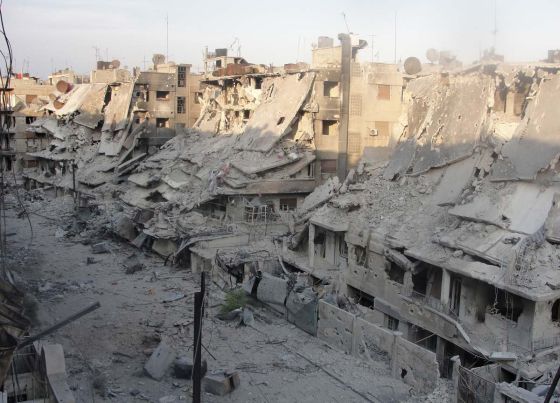
President Bashar al-Assad: 'The problem is that those terrorists are fighting from within the cities, and in the cities you have civilians. When you fight this kind of terrorists, you have to be aware that you should do the minimum damage to the infrastructure and minimum damage to the civilians because you have civilians and you have to fight, you cannot leave terrorists just killing and destroying. So, this is the difficulty in this kind of war. ' Photo: Homs, October 7, 2012
This is part of George Bush’s legacy: Bashar al-Assad’s war on terrorism.
“Terrorism” has become the glue that binds together global leaders of almost every political persuasion.
There is no civil war in Syria, no revolution or armed uprising — there are simply “terrorists” foreign and domestic who are serving as proxies for the powers the have ganged up against and demonized the Syrian president, a modest man who only holds power because this is the will of the people.
There might not be too many journalists willing to go along with this narrative, but Russia Today not only provided an interviewer willing to echo Assad’s claim that his enemy is terrorism — Sophie Shevardnadze wanted to know: “how much time do you need to crush the enemy?”

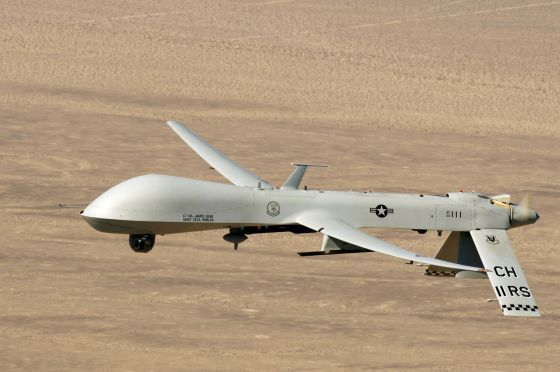
Suppose Iranian drones were spotted flying in international airspace close to New York City and U.S. air force jets were sent to intercept them. Would the drones simply be kept under surveillance so long as they remained outside U.S. territory? Or might warning shots be fired? Or might they simply be shot down?
Whichever of those outcomes transpired, no one would be in any doubt about who was being confrontational: the Iranians. And if shots were fired by Americans, their action would be described defensive.
Similarly, when U.S. drones operate just a few miles outside Iranian air space, it’s clear who is being confrontational — at least it’s clear unless you happen to be a reporter covering the Pentagon.
After two Iranian Su-25 fighter jets “fired on” an unmanned U.S. Air Force Predator drone in the Persian Gulf last week, U.S. military intelligence analysts were unsure whether the Iranian pilots missed their target or were simply firing warning shots.
CNN’s Barbara Starr, who treats the word of Pentagon officials as gospel, wrote: “But as one of the officials said, ‘it doesn’t matter, they fired on us.'”
Since the claim was that of an official, not the observation of the reporter herself, she should have described the official’s assertion as that: a claim that it makes no difference what the Iranian’s intended.
But since it’s neither the job of Pentagon spokesmen nor reporters to attempt to read the minds of Iranian pilots, then it’s better to stick with the facts.
U.S. drones were operating just outside Iranian air space and Iranian jets fired shots. The purpose of the shooting is unknown but we do know that the CIA has previously operated a fleet of surveillance drones inside Iran and famously lost one.
The New York Times reports:
The shooting, which the Pentagon said occurred Nov. 1 — five days before the American presidential election — was the first known instance of Iranian warplanes firing on an American surveillance drone.
George Little, the top Pentagon spokesman, attributed the weeklong silence on the incident to restrictions on discussing classified surveillance missions. But it doubtless will raise questions about whether that silence had been meant to forestall an international controversy before the election. Had a decision been made to officially disclose the shooting, it might have been viewed as a provocative or even partisan political act before the voting.
What none of the Pentagon reporters are willing to consider is that the operation of the drone was itself an act of provocation and that if the Iranians merely fired warning shots this indicated that they were not eager to rise to the bait.
The idea that the U.S. or Israel might actively attempt to trigger a war with Iran is not simply an obsession of those observers who persistently warn about “false flag” operations. It was one of the U.S. navy’s own top political advisers who in 2007 warned that Vice Adm. Kevin J. Cosgriff appeared to be intent on engineering a Tonkin Gulf type incident by sailing “three ‘big decks,’ as aircraft carriers are known, through the Strait of Hormuz — to put a virtual armada, unannounced, on Iran’s doorstep. No advance notice, even to Saudi Arabia and other gulf allies.”
It may indeed not matter whether the Iranians were firing warning shots or trying to bring down the unmanned aircraft; what matters more is why a drone was being flown in such a sensitive location right before the election.

Arturo Conde reports: In the aftermath of Superstorm Sandy, community-based volunteers led by Occupy Wall Street supporters have emerged to fill the void left by FEMA, and The American Red Cross. In less than a week, the Occupy Sandy grassroots movement has raised over $264,000 in relief for New York’s hardest hit neighborhoods, and have established a network of volunteers and materials that is empowering people to rebuild their communities.
Supporters of Occupy Wall Street credit their ability to respond quickly to the needs of people in the Lower East Side of Manhattan, Red Hook and Coney Island in Brooklyn, Astoria and Rockaway in Queens, and Staten Island, to the profound sense of solidarity that their community-based network has promoted for over a year, bringing people to work together from different places and social backgrounds. But for a group of activists who helped organize Occupy’s relief effort from a hub in Sunset Park, Brooklyn, this solidarity is also emblematic of their Latino identity and heritage.
When Occupy organizers approached the Mexican community leader Juan Carlos Ruiz, 43, a week ago to ask for permission to use the basement of St. Jacobi Church in Sunset Park as a distribution hub for dispensing water, food, clothing, and other materials to people in areas that were damaged by the storm, he saw it as a natural extension of the volunteer work that he carries out at the Lutheran temple, which was originally founded by German immigrants in 1889.
While churches are often perceived as conservative institutions, many temples have become refuges and meeting places throughout American history, where people could address economic, political, and social injustices. And for Ruiz, who was ordained as a Catholic priest, these parishes are much more than a destination where believers commute to feel closer to God. For Latinos, he explained in an interview with Univision News, they are also places where they can reaffirm their cultural and religious values, and channel the spirit of God to promote a greater sense of solidarity in their immigrant communities.
“If you do not find God out there,” he said referring to the immigrant communities in Sunset Park, “you will not find him in here. The spirit of God is present in your neighbors, when you live day to day in solidarity.” And this communal spirit, Ruiz upholds, is the essence, the soul, of both Latino immigrants and Occupy Wall Street. [Continue reading…]
Trita Parsi and Reza Marashi write: With the elections behind him, President Obama must quickly shift his focus to key foreign policy challenges that were put on pause due to election season paralysis. On Iran, the President should hit the ground running.
Obama has a unique opportunity to make headway on the diplomatic front between November 8 and March 20, when the Iranian New Year hits. After that, Iran enters its own election season and the paralysis that comes with it. This may be his last best shot to resolve the U.S.-Iran conflict peacefully.
While both sides believe they are in a position of strength, reality is that neither Washington nor Tehran holds a trump card. U.S.-led sanctions cannot force capitulation or regime change in Iran (See: Saddam Hussein’s Iraq), and America will not succumb to an Iranian nuclear fait accompli.
The only real solution is a negotiated one — but how can Obama make diplomacy succeed? Here are four recommendations. [Continue reading…]
Haaretz reports: The British government on Wednesday condemned the tenders recently issued by Israel’s Housing Ministry for the construction of new housing units across the Green Line in Jerusalem and in West Bank settlements.
In the statement, Foreign Office Minister for the Middle East, Alistair Burt, describes the new tenders as “provocative.” Burt said that Britain “has been consistently clear that Israeli settlements are illegal under international law and by altering the situation on the ground are making the two-state solution, with Jerusalem as a shared capital, increasingly hard to realise. It is deeply disappointing that the Government of Israel continues to ignore the appeals of the UK and other friends of Israel.”
The Housing and Construction Ministry issued on Tuesday tenders for the construction of 1,285 housing units, 1,213 in the northern Jerusalem neighborhoods of Pisgat Ze’ev and Ramot, located across the 1967 Green Line, and an additional 72 in the West Bank settlement of Ariel.