



Paul M. Barrett writes: Yes, yes, it’s unsophisticated to blame any given storm on climate change. Men and women in white lab coats tell us — and they’re right — that many factors contribute to each severe weather episode. Climate deniers exploit scientific complexity to avoid any discussion at all.
Clarity, however, is not beyond reach. Hurricane Sandy demands it: At least 40 U.S. deaths. Economic losses expected to climb as high as $50 billion. Eight million homes without power. Hundreds of thousands of people evacuated. More than 15,000 flights grounded. Factories, stores, and hospitals shut. Lower Manhattan dark, silent, and underwater.
An unscientific survey of the social networking literature on Sandy reveals an illuminating tweet (you read that correctly) from Jonathan Foley, director of the Institute on the Environment at the University of Minnesota. On Oct. 29, Foley thumbed thusly: “Would this kind of storm happen without climate change? Yes. Fueled by many factors. Is storm stronger because of climate change? Yes.” Eric Pooley, senior vice president of the Environmental Defense Fund (and former deputy editor of Bloomberg Businessweek), offers a baseball analogy: “We can’t say that steroids caused any one home run by Barry Bonds, but steroids sure helped him hit more and hit them farther. Now we have weather on steroids.”
In an Oct. 30 blog post, Mark Fischetti of Scientific American took a spin through Ph.D.-land and found more and more credentialed experts willing to shrug off the climate caveats. The broadening consensus: “Climate change amps up other basic factors that contribute to big storms. For example, the oceans have warmed, providing more energy for storms. And the Earth’s atmosphere has warmed, so it retains more moisture, which is drawn into storms and is then dumped on us.” Even those of us who are science-phobic can get the gist of that.
Sandy featured a scary extra twist implicating climate change. An Atlantic hurricane moving up the East Coast crashed into cold air dipping south from Canada. The collision supercharged the storm’s energy level and extended its geographical reach. Pushing that cold air south was an atmospheric pattern, known as a blocking high, above the Arctic Ocean. Climate scientists Charles Greene and Bruce Monger of Cornell University, writing earlier this year in Oceanography, provided evidence that Arctic icemelts linked to global warming contribute to the very atmospheric pattern that sent the frigid burst down across Canada and the eastern U.S..
The New York Times reports: In a surprise announcement, Mayor Michael R. Bloomberg said Thursday that Hurricane Sandy had reshaped his thinking about the presidential campaign and that as a result he was endorsing President Obama.
Mr. Bloomberg, a political independent in his third term leading New York City, has been sharply critical of both Mr. Obama, a Democrat, and Mitt Romney, the president’s Republican rival, saying that both men have failed to candidly confront the problems afflicting the nation. But he said he had decided over the past several days that Mr. Obama was the best candidate to tackle the global climate change that the mayor believes contributed to the violent storm, which took the lives of at least 38 New Yorkers and caused billions of dollars in damage.
“The devastation that Hurricane Sandy brought to New York City and much of the Northeast — in lost lives, lost homes and lost business — brought the stakes of next Tuesday’s presidential election into sharp relief,” Mr. Bloomberg wrote in an editorial for Bloomberg View.
“Our climate is changing,” he wrote. “And while the increase in extreme weather we have experienced in New York City and around the world may or may not be the result of it, the risk that it may be — given the devastation it is wreaking — should be enough to compel all elected leaders to take immediate action.”
Mr. Bloomberg’s announcement is another indication that Hurricane Sandy has influenced the presidential campaign. The storm, and the destruction it left in its wake, has dominated news coverage, transfixing the nation and prompting the candidates to halt their campaigning briefly. [Continue reading…]
Bill McKibben writes: Here’s a sentence I wish I hadn’t written – it rolled out of my Macbook in May, part of an article for Rolling Stone that quickly went viral:
“Say something so big finally happens (a giant hurricane swamps Manhattan, a megadrought wipes out Midwest agriculture) that even the political power of the industry is inadequate to restrain legislators, who manage to regulate carbon.”
I wish I hadn’t written it because the first half gives me entirely undeserved credit for prescience: I had no idea both would, in fact, happen in the next six months. And I wish I hadn’t written it because now that my bluff’s been called, I’m doubting that even Sandy, the largest storm ever, will be enough to make our political class serious about climate change.
Maybe I’m wrong, though. Maybe – just maybe – the arrival of a giant wall of water in the exact middle of the financial and media capital of our home planet will be enough to get this conversation unstuck. Maybe that obscene slick of ocean spreading unnaturally into the tubes and tunnels of the greatest city on earth will shock enough people to change the debate. New York Governor Andrew Cuomo, at a press conference Tuesday afternoon, allowed as how:
“There has been a series of extreme weather incidents. That is not a political statement, that is a factual statement … Anyone who says there’s not a dramatic change in weather patterns, I think, is denying reality.”
New York Mayor Michael Bloomberg added:
“What is clear is that the storms we’ve experienced in the last year or so around this country and around the world are much more severe than before.”
Truthfully, I think I’d just as soon see statements like that as carefully thought-out endorsements of climate science. It’s experience that changes people: the summer’s drought left more than half of American counties as federal disaster areas, and meteorologist Jeff Masters estimates Sandy hit 100 million Americans with “extreme weather”. Add in the largest forest fires in Colorado and New Mexico, the hottest month in US history, and the completely absurd summer-in-March heatwave that kicked off our year of living sweatily, and you can begin to understand why the percentage of Americans worrying about global warming has spiked sharply this year. Spiked high enough that even a few politicians are willing to speak out. [Continue reading…]
Wen Stephenson writes: On October 2, I led a climate protest inside the offices of the Boston Globe.
OK, it was really a meeting in a small conference room with editorial page editor Peter Canellos and members of his staff. But it was, in essence, a protest.
I used to be a card-carrying member of the mainstream media; just a few years ago, I was the editor of the Globe‘s Ideas section. Peter is a former colleague.
With me was Craig Altemose, founder and executive director of Better Future Project, a Cambridge-based non-profit dedicated to climate action, on whose working board I serve as a volunteer. We were joined by two members of BFP’s advisory board: MIT’s Kerry Emanuel, one of the country’s leading climate scientists (and, until recently, a Republican); and Boston College’s Juliet Schor, a sociologist and economist who is a respected thinker on climate and the economy. Last year, Altemose was arrested protesting the Keystone XL pipeline at the White House along with another advisory board member, Bill McKibben of 350.org, and 1251 other concerned citizens.
After a quick round of introductions, I explained to my former Globe colleagues that I wasn’t there to “save the planet” or to protect some abstraction called “the environment.” I’m really not an environmentalist, and never have been. No, I said, I was there for my kids: my son, who’s 12, and my daughter, who’s 8. And not only my kids — all of our kids, everywhere. Because on our current trajectory, it’s entirely possible that we’ll no longer have a livable climate — one that allows for stable, secure societies to survive — within the lifetimes of today’s children.
And I told them that I was there, in that room, because the national conversation we’re having about this situation, this emergency, is utterly inadequate — or, really, nonexistent. And I looked Peter in the eye, and told him that I’m sorry, but that’s completely unacceptable to me. If we can’t speak honestly about this crisis — if we can’t lay it on the line — then how can we look at ourselves in the mirror?
Since I had requested the meeting, I told Peter that I hoped to frame the discussion around two points:
First: We need to see a much greater sense of urgency in the media’s coverage of climate change, including in the Globe’s editorial and opinion pages. This is more than an environmental crisis: it’s an existential threat, and it should be treated like one, without fear of sounding alarmist, rather than covered as just another special interest, something only environmentalists care about. And it should be treated as a central issue in this election, regardless of whether the candidates or the political media are talking about it.
Second: Business-as-usual, politics-as-usual, and journalism-as-usual are failing us when it comes to addressing the climate threat. If there’s to be any hope for the kind of bold action we need, a great deal of pressure must be brought from outside the system, in the form of a broad-based grassroots movement, in order to break the stranglehold of the big-money fossil fuel lobby on our politics. And in fact, there is a movement emerging on campuses and in communities across the country — especially here in New England — and the Globe should be paying attention to it.
But that wasn’t the conversation Peter was prepared to have — and we never got around to having it.
Canellos, the paper’s former Washington bureau chief, was more interested in the short-term politics of the Keystone pipeline debate, and the economic impact of natural gas expansion in Massachusetts, and what raising renewable energy standards would mean for regional jobs. Smart, sensible questions. Balanced. Analytical. Above the fray. In short, what counts as serious on the opinion pages of mainstream American newspapers.
And, it has to be said, they were questions that revealed precisely the kind of narrow, incremental, politically straitjacketed mindset that’s leading us off the climate cliff. Indeed, they were the kind of questions that make you wonder whether the speaker is even aware of the cliff we’re racing toward — or what planet we’re living on. [Continue reading…]
The Associated Press reports: There’s nothing like a natural disaster to test the depth of politicians’ preference for small government.
And so it turns out that after superstorm Sandy battered the East Coast, Mitt Romney is far more supportive of the government agency in charge of coordinating disaster relief. Only last year, as Romney hewed to the right while battling for the GOP nomination, he seemed to downplay the federal government’s role in disaster response.
“Every time you have an occasion to take something from the federal government and send it back to the states, that’s the right direction,” Romney said at a debate last June. “And if you can go even further, and send it back to the private sector, that’s even better.”
Asked by moderator John King of CNN whether that would include disaster relief, Romney said: “We cannot afford to do those things without jeopardizing the future for our kids. It is simply immoral, in my view, for us to continue to rack up larger and larger debts and pass them on to our kids.”
Now, a week before Election Day, after of a massive disaster, Romney’s campaign is reassuring voters that his administration wouldn’t leave disaster victims in the lurch. The public’s attention is locked on the devastation caused by Sandy at a time when Romney and President Barack Obama are locked in a close presidential campaign. With Obama heavily involved in getting federal funds to those in trouble, the Romney campaign moved quickly to reassure the public it supports a strong program of storm relief.
“I believe that FEMA plays a key role in working with states and localities to prepare for and respond to natural disasters,” Romney said in a statement supplied by his campaign Wednesday. “As president, I will ensure FEMA has the funding it needs to fulfill its mission, while directing maximum resources to the first responders who work tirelessly to help those in need, because states and localities are in the best position to get aid to the individuals and communities affected by natural disasters.”
Wednesday’s statement came after the candidate ducked a spate of opportunities Tuesday to personally clarify his position and the statement essentially endorsed the current disaster aid system.
But what the campaign wouldn’t do is say whether a President Romney would insist that help for disaster victims be funded by cutting other programs in the federal budget, as many conservative Republicans insist. [Continue reading…]
Reuters reports: Syrian rebels said on Wednesday they had begun arming sympathetic Palestinians to fight a pro-Assad faction in a Palestinian enclave in Damascus – a move which could fuel spiraling intra-Palestinian violence.
Two rebel commanders told Reuters they expected their Palestinian allies to fight the Popular Front for the Liberation of Palestine General Command (PFLP-GC) which dominates the Yarmouk enclave – a one-time refugee camp turned sprawl of apartment blocks which is run by the Palestinians themselves.
“We’ve been arming Palestinians who are willing to fight…We have formed the Liwa al-Asifah (the Storm Brigade)which is made up of Palestinian fighters only,” a rebel commander from the Suqour al-Golan (Golan Falcons) brigade said.
“Its task is to be in charge of the Yarmouk camp. We all support it and back it,” he told Reuters.
Earlier, AFP reported: Fierce clashes broke out before dawn Tuesday in a major Palestinian refugee camp south of Syria’s capital, pitting rebels against troops backed by pro-regime Palestinian fighters, activists and a watchdog said.
The fresh violence came after the feast of Eid al-Adha came to a close on Monday, with 560 people, including 235 civilians, reported killed during a failed ceasefire attempt over the four-day Muslim holiday.
“Clashes broke out overnight in al-Hajar al-Aswad district between rebels and the army, spreading into the adjacent Yarmuk Palestinian camp. The Popular Front for the Liberation of Palestine-General Command joined on the side of the army,” the director of the Syrian Observatory for Human Rights watchdog, Rami Abdul Rahman, told AFP.
Meanwhile, Reuters reports: After a week of clashes between anti-government rebels and Kurdish militants in Syria’s Aleppo province, the two sides are observing a tenuous truce.
It is a war within a war which neither side wants.
“We want to fight the regime and instead we are fighting a new front that we don’t need or have time for,” said a fighter of the rebel Free Syria Army, warming himself over a fire on a on a mountain overlooking olive groves and stone villages.
“We should be in Aleppo fighting, instead we are camping.”
The situation exemplifies the tangle of alliances, loyalties and rivalries – local and international – complicating the uprising against Syrian President Bashar al-Assad.
The FSA counts on the backing of Turkey, which gives it sanctuary over its border and is in the forefront of the diplomatic campaign against Assad.
The Syrian Kurdish militants are allied to the PKK (Kurdistan Workers Party), which is locked in a long struggle against the Turkish army to carve out an autonomous Kurdish region in southeast Turkey.
The Syrian Kurds have maintained their own unaligned militias and administer Kurdish areas in Aleppo province – scene of heavy fighting in the civil war. They are believed to be cutting deals with both the government and the opposition in order to maintain their autonomy.
The side conflict risks weakening the mostly-Arab rebels fighting Assad’s better-armed forces.
Dozens of rebels and Kurdish fighters of the separatist Democratic Union Party (PYD) were killed in the past week in clashes that began in Aleppo city and have now spread to the countryside, just a few kilometers away from Turkey.
On the mountain dividing rebel-held areas from Kurdish towns to the northwest of Aleppo city, heavy clashes raged for days.
“We are not against all Kurdish groups, but these PKK-linked groups are helping the regime by attacking us, we had no choice but to act,” says Mohammed Hamadeh, head of a rebel unit on the mountain.
The Associated Press reports: China on Thursday called for a phased-in cease-fire and negotiations on a gradual political transition to end the ongoing bloodshed in Syria.
A four-point proposal issued by the Foreign Ministry stopped short of calling for the ouster of President Bashar Assad and omitted mention of any measures to compel compliance. Alongside Russia, China has steadfastly blocked any outside intervention that could force Assad from power, much to the consternation of the U.S. and other countries seeking a swift end to the 19-month-old conflict, which has killed more than 35,000 people.
The proposal called on the international community to support the work of the U.N.-Arab League envoy to Syria, Lakhdar Brahimi, and other mediation efforts. Assistance should be provided to refugees, but humanitarian work should not be politicized or militarized, it said.
The ministry’s proposal was an elaboration of remarks made Wednesday by Foreign Minister Yang Jiechi to Brahimi during a meeting in Beijing, and echoed China’s position since the start of the conflict, ministry spokesman Hong Lei told reporters at a regularly scheduled news conference.
Nabeel Shaath writes: Over the past few weeks, British diplomats have stated that they are doing all they can to discourage Palestine’s bid for “observer state” status in the UN General Assembly. If this is an official British position, then it is reprehensible, yet not all that surprising.
Ninety-five years ago tomorrow, on November 2, 1917, British imperialism in Palestine began when Lord Balfour, the then British foreign secretary and former prime minister, sent a letter to Baron Rothschild, one of the leaders of the Zionist movement. This letter became known as the “Balfour Declaration”.
In that letter, Balfour promised British support for the Zionist programme of establishing a “national home for the Jewish people” in Palestine. This pledge of support was made without consulting the indigenous Christian and Muslim inhabitants of Palestine, the Palestinian people. And it was made before British troops had even conquered the land.
Balfour, on behalf of Britain, promised Palestine – over which Britain had no legal right – to a people who did not even live there (of the very small community of Palestinian Jews in Palestine in 1917, very few were Zionists). And he did so with the worst of intentions: to discourage Jewish immigration to Britain. No wonder Lord Montagu, the only Jewish member of the Cabinet, opposed the declaration.
And yet, just two years earlier, Britain had committed herself to assisting the Arab nations in achieving their independence from the Ottoman Empire. Arab fighters all over the region, including thousands of Palestinians, fought for their freedom, allowing Britain to establish her mandate in Palestine.
From that moment, Palestine became the victim of colonial conspiracies. The Balfour Declaration helped to encourage Zionist immigration into Palestine and away from America and Western Europe. Concomitantly, Britain repressed Palestinian nationalism, which was exemplified by its crushing of the Arab revolt of 1936-1939 and the denial of the right of the Palestinian people to express their will through their own representation. In fact, Britain suppressed Palestinian political representation through a policy of systematic denial of Palestinian political rights.
The dying days of Britain’s rule in Palestine were marked by destruction, blood, and the start of the Palestinian exile, meaning the expulsion of the majority of the Palestinian people against the backdrop of Zionist terrorism. It was not the Palestinians who blew up the King David Hotel, who blew up the British Embassy in Rome, who tried to assassinate Ernest Bevin, Britain’s foreign secretary, and who succeeded in assassinating Lord Moyne, British minister of state in the Middle East. That was the Irgun, an ideological Right-wing group – and the predecessor to Israel’s ruling Likud Party. [Continue reading…]
October 28, 2012 Tel Aviv, Jewish protesters demanding the expulsion of all non-Jewish African asylum-seekers.
Haaretz reports: An Israeli strike against Iran’s nuclear facilities won’t destabilize the Middle East, Prime Minister Benjamin Netanyahu said in an interview to a French magazine on Tuesday, adding, moreover, that such a move would only serve to restore security in the region.
“Five minutes after [an attack], contrary to what the skeptics say, I think a feeling of relief will spread across the region,” Netanyahu told Paris Match, adding: “Iran isn’t popular in the Arab world, far from it. Some governments in the region, as well as their citizens, have understood that a nuclear-armed Iran would be dangerous for them, not just for Israel.”
The premier’s interview, one to which he gave much importance, was geared at influencing public opinion in France ahead of his visit to the country on Wednesday.

Laura Rozen writes: In a sign of Iranian interest in streamlining back channel contacts and reducing mixed messages ahead of anticipated, resumed nuclear negotiations next month, Iran was said to appoint a central point of contact for approaches from outside-government Americans, two Iran nuclear experts told Al-Monitor this week.
Mostafa Dolatyar, a career Iranian diplomat who heads the Iranian think tank, the Institute for Political and International Studies (IPIS), which has close ties to Iran’s foreign ministry, was tapped by Iran’s leadership to coordinate contacts with American outside-government policy experts, including those with former senior US officials involved unofficially in relaying ideas for shaping a possible nuclear compromise, the analysts told Al-Monitor in interviews this week. The IPIS channel is for coordinating non-official US contacts, which in the absence of formal diplomatic ties, have formed an important, if not unproblematic, part of Iran’s diplomatic scouting and Washington’s and Tehran’s imperfect efforts to understand and influence each others’ policy positions.
The appointment is the result of a desire “on the Iranian side for a more structured approach to dealing with America,” Mark Fitzpatrick, an Iran nuclear expert at the Institute for International and Strategic Studies (IISS) in London, told Al-Monitor in an interview Monday, adding that he now doubts that there are agreed plans for direct US-Iran talks after the elections.
“I was told … that Iran had appointed one person to be the channel for all approaches from the Americans,” specifically for former officials and non-governmental experts, Fitzpatrick continued. “And Iran wants to structure that so that Iran is speaking from one voice.” [Continue reading…]
Steve Kornacki writes: That Chris Christie is providing a serious political assist to President Obama less than a week before the election is indisputable. The question is why he’s doing it.
Christie, who was the keynote speaker at the Republican convention and has been one of Mitt Romney’s top campaign surrogates, will survey the post-Sandy wreckage in New Jersey with the president today. This comes after Christie went out of his way to praise Obama at the height of the storm and after Christie angrily shot down a Fox News host’s query about whether Romney might tour New Jersey with him too.
“I have a job to do,” he said. “If you think right now I give a damn about presidential politics, then you don’t know me.”
Needless to say, this is all music to the ears of Democrats. Christie is one of the most prominent Republicans in the country, and one of the better-liked ones too. This is exactly the sort of cross-partisan boost that candidates dream of receiving in a race’s final days, especially a race as close as this one. So what’s Christie up to?
The simplest explanation is that this is just Christie being Christie. [Continue reading…]
The Washington Post reports: Among the many global reactions to Hurricane Sandy’s impact on the U.S. East Coast, this one might be the most amusing. Syrian Army News, a pro-regime Facebook page, announced that anti-Western “resistance” forces working under President Bashar al-Assad and under the Iranian government secretly engineered the natural disaster using “highly advanced technology.” It describes the hurricane as a punishment for threatening Assad’s Syria.
Here’s the English translation:
Sources confirm that hurricane Sandy, now buffeting the U.S., was carried out by highly advanced technology developed by the heroic Iranian regime, in coordination with our resistant regime. These sources have also confirmed that experts from Syria have contributed in carrying out this work. This is the consequence of attacking Assad’s Syria and threatening its security.
Meanwhile, the New York Times reports: Iranian rescuers and aid workers are on standby to fly to New York City to provide assistance to those affected by Hurricane Sandy, the head of Iran’s Red Crescent Organization said on Wednesday.
“We are ready to help the flood-stricken people of America,” Mahmud Mozaffar, who leads the organization, told the semiofficial Fars News Agency.
His men stand ready to board planes and fly to the United States to help out, assuming the American government accepts Iran’s offer, he said.
“If American authorities agree, we can send our rescuers with equipment and tools to American cities in the shortest period of time,” Mr. Mozaffar said.
Dealing regularly with floods and earthquakes, Iran’s Red Crescent Organization is experienced in providing immediate assistance following disasters.
The Libya Herald reports: The head of the Libyan armed forces, General Yousef Mangoush, has no control over Bani Walid and civilians are being prevented from returning home by vigilante “gunmen”, Defence Minister Osama Juwaili has said.
In a scathing broadside, almost certain to be his last as defence minister ahead of Prime Minister-elect Ali Zidan’s expected announcement of a new government later today, Juwaili said the hilltop town was near-deserted as a result of the fighting and that the small number of people who remain are living in terrible conditions.
“The chief of staff has no control over the town and therefore armed men are able to prevent families from coming back”, the minister was quoted as saying by AFP, following a televised speech on Monday.
“The town is completely empty except for a small number of people who are living in tragic conditions; there is no activity; the impact of shelling is visible everywhere”.
He went on to describe soldiers controlling the checkpoint leading into the town as “gunmen”.
In his first public statement on Bani Walid, Juwaili claimed that as many as 40,000 people had been displaced by the conflict out of a town reckoned to be home to some 80,000 residents. As at 22 October, the International Committee of the Red Cross said that some 25,000 people had fled into the Urban area, to the northwest of Bani Walid, alone. The Libya Herald saw little sign of life on the morning of 25 October during a visit.
The remarks are deeply at odds with the statement made last Friday by army spokesman Ali Al-Sheikhi, who said that refugees were being allowed to return to the town and that no reports of any “violations” against them had been received. He added that should any such incidents take place, then an immediate investigation into them would be launched. [Continue reading…]
School of Industrial and Labor Relations at Cornell University: The world’s most well-known climate scientist, James Hansen of NASA’s Goddard Institute, addressed 75 union leaders and allies at a global trade union roundtable in New York City this month.
Entitled “Energy Emergency, Energy Transition,” the event was convened by ILR’s Global Labor Institute (GLI), part of the new Worker Institute at Cornell. The Rosa Luxemburg Foundation’s New York City office partnered with GLI in organizing the Oct. 10-12 event.
“The truth is, we have a planetary emergency,” Hansen said. Union representatives from 18 countries listened in silence as Hansen described what is happening to the earth’s climate, ice sheets, oceans and weather patterns.
“The volume of Arctic sea ice has been reduced by 75 percent in just 30 years. Greenland’s ice sheet is losing mass at about 300 cubic kilometers per year. Sea levels are going up, and there is a danger that the ice sheets will begin to collapse and we could get several meters (of rising sea levels) in one year – which would be disastrous,” Hansen said.
“The frequency of extreme weather events is changing because the planet is getting warmer. It was exceedingly hot this past summer, and the frequency and area covered by these events are both increasing.”
“We have only burned a small fraction of the fossil fuels, but we can not burn all of them. And yet the governments are going right ahead, encouraging even more use of fossil fuels through mountain top removal, tar sands, tar shale, drilling in the Arctic. We can’t do that if we want to be fair to our children.”
Solutions for the climate problem and for our children’s futures are really going to depend on workers understanding the situation, he said.
“It’s hard to communicate with people if they feel their job is threatened, but the jobs associated with clean energy technologies would be good jobs. Workers will get much better opportunities. We need to have cooperation and understanding between labor and environmental organizations and people who are concerned about the future of their children.”
In an interview following the presentation, Hansen said, “Unions are an important force globally. They represent hundreds of millions of workers and their families. The thought of having them joining in the effort to bring about an energy revolution to fight climate change is very exciting. Stabilizing the climate is a battle for survival that needs everyone involved.”
More information about the roundtable, including participants, presentations and trade union statements on climate change and energy, is available at http://energyemergencyenergytransition.org/
The New York Times reports: The warnings came, again and again.
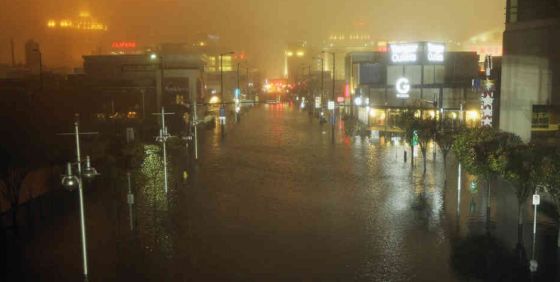
For nearly a decade, scientists have told city and state officials that New York faces certain peril: rising sea levels, more frequent flooding and extreme weather patterns. The alarm bells grew louder after Tropical Storm Irene last year, when the city shut down its subway system and water rushed into the Rockaways and Lower Manhattan.
On Tuesday, as New Yorkers woke up to submerged neighborhoods and water-soaked electrical equipment, officials took their first tentative steps toward considering major infrastructure changes that could protect the city’s fragile shores and eight million residents from repeated disastrous damage.
Gov. Andrew M. Cuomo said the state should consider a levee system or storm surge barriers and face up to the inadequacy of the existing protections.
“The construction of this city did not anticipate these kinds of situations. We are only a few feet above sea level,” Mr. Cuomo said during a radio interview. “As soon as you breach the sides of Manhattan, you now have a whole infrastructure under the city that fills — the subway system, the foundations for buildings,” and the World Trade Center site.
The Cuomo administration plans talks with city and federal officials about how to proceed. The task could be daunting, given fiscal realities: storm surge barriers, the huge sea gates that some scientists say would be the best protection against floods, could cost as much as $10 billion.
But many experts say, given what happened with the latest storm, that inertia could be more expensive.
After rising roughly an inch per decade in the last century, coastal waters in New York are expected to climb as fast as six inches per decade, or two feet by midcentury, according to a city-appointed scientific panel. That much more water means the city’s flood risk zones could expand in size.
“Look, the city is extremely vulnerable to damaging storm surges just for its geography, and climate change is increasing that risk,” said Ben Strauss, director of the sea level rise program at the research group Climate Central in Princeton, N.J. “Three of the top 10 highest floods at the Battery since 1900 happened in the last two and a half years. If that’s not a wake-up call to take this seriously, I don’t know what is.” [Continue reading…]

Is American diplomacy an oxymoron?
The Syrian opposition has been notoriously fractured, so the goal of forging unity among what have hitherto been disparate groups clearly makes sense. What makes no sense but should be no surprise is Washington’s typical heavy-handedness in trying to achieve this goal.
An upcoming Qatar meeting “will include dozens of opposition leaders from inside Syria, including from the provincial revolutionary councils, the local ‘coordination committees’ of activists, and select people from the newly established local administrative councils.” So far so good. But then comes this message from a senior Obama administration official:
“We need to be clear: This is what the Americans support, and if you want to work with us you are going to work with this plan and you’re going to do this now,” the official said. “We aren’t going to waste anymore time. The situation is worsening. We need to do this now.”
Stand to attention and follow our instructions because America is running out of patience.
Is that the kind of admonition that’s going to smooth out all the discord? I don’t think so. What it is, is the imperial American way.
Foreign Policy‘s blog, The Cable, reports: Syrian opposition leaders of all stripes will convene in Qatar next week to form a new leadership body to subsume the opposition Syrian National Council, which is widely viewed as ineffective, consumed by infighting, and little respected on the ground, The Cable has learned.
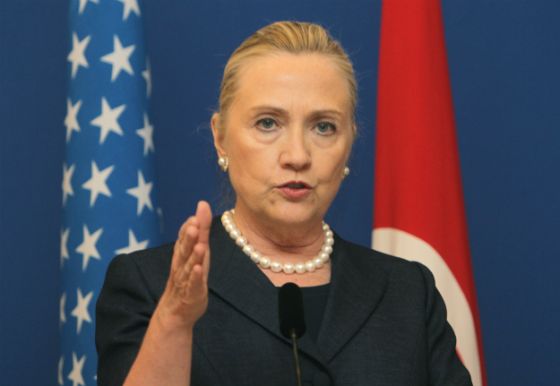
The State Department has been heavily involved in crafting the new council as part of its effort oust Syrian President Bashar al-Assad and build a more viable and unified opposition. In September, for instance, Secretary of State Hillary Clinton met with a group of Syrian activists who were flown in to New York for a high-level meeting that has not been reported until now.
During the third and final presidential debate, Republican nominee Mitt Romney criticized President Barack Obama’s Syria policy as a failure to show “leadership” in laying the groundwork for the post-Assad era and called for “a form of council that can take the lead in Syria.”
In fact, over the last several months, according to U.S. officials and Syrian opposition figures, the State Department has worked to broaden its contacts inside the country, meeting with military commanders and representatives of local governance councils in a bid to bypass the fractious SNC.
Many in the SNC are accordingly frustrated with the level of support they’ve gotten in Washington. “The Obama administration is trying to systematically undermine the SNC. It’s very unfortunate,” one SNC leader said told The Cable.
But U.S. officials are equally frustrated with an SNC they say has failed to attract broad support, particularly from the Alawite and Kurdish minorities. The new council is an attempt to change that dynamic. Dozens of Syrian leaders will meet in the Qatari capital, Doha, on Nov. 3 and hope to announce the new council as the legitimate representative of all the major Syrian opposition factions on Nov. 7, one day after the U.S. presidential election.
The Obama administration sees the new council as a potential interim government that could negotiate with both the international community and – down the line – perhaps also the Syrian regime. The SNC will have a minority stake in the new body, but some opposition leaders are still skeptical that the effort will succeed.
