Olivier Roy writes: The murderous attack on a Jewish school, and before that on French soldiers, has brought a strong emotional reaction in France. Once again, the specter of disenfranchised and radicalized young French Muslims hovers over the destitute neighborhoods of France’s cities. Fifty years after the end of the war in Algeria, a new kind of civil war seems to be raging.
A closer look, however, shows that the picture is rather different.
First, the 23-year-old perpetrator of these acts of terror, Mohammed Merah, was a loner and a loser. Far from embodying a growing radicalization among the youth, he stood at the margins not only of French society but also of the Muslim community.
Merah was not known for his piety: He did not belong to any religious congregation; he did not belong to any radical group or even to a local Islamic movement. A petty delinquent, psychologically fragile, he tried to enlist in the French Foreign Legion and then left for Afghanistan and Pakistan.
Merah found in Al Qaeda a narrative of solitary heroism and a way, after months of watching videos on the Internet, to achieve short-term notoriety and find a place in the real world. In this sense, he was far closer to Anders Behring Breivik, who went on a killing spree in Norway last July in the name of a hatred of Muslims. People like these are difficult to spot precisely because they do not belong to a network of militant cells.
Yet the crimes of such men are often misconstrued as symbolizing different problems. Whereas non-Muslim lone terrorists like Breivik tend to be called mentally ill, Muslim lone terrorists like Merah are seen as embodying “Muslim wrath.” This is to miss an essential point.
Consider Merah’s attack on the French soldiers. If his killings at the Jewish school in Toulouse were a terrible reflection of the kind of anti-Semitism typically promoted by Al Qaeda, his attack on French soldiers — specifically Muslim ones — was novel and revealing of something else. He saw the soldiers as traitors: French Muslims fighting the Taliban in Afghanistan. The gap he perceived between himself and them reveals the gap between the few Muslims who become so marginalized as to murder and the many more who find ways to integrate. [Continue reading…]
Mohamed Merah and the folly of the war on terror
Following the dramatic killing of Mohamed Merah in Toulouse yesterday, there has been plenty of finger-pointing by those who believe the young gunman should have been stopped before anyone had been shot, or that the operation during which he was held under siege could have been handled better.
There is perhaps only one lesson to be drawn, but it’s a truth everyone knows but no one fully digests: we can’t predict the future.
Only once it becomes the past is the future turned into something seemingly obvious. But the idea that Merah should or could have been stopped presupposes that he knew where he was going — it turns out he didn’t.
As the Wall Street Journal reports:
Merah… initially had no plans to attack the Jewish school where he allegedly gunned down three children and a teacher, and instead had planned to target another soldier, said the head of France’s intelligence agency.
Mr. Merah spoke to police negotiators during a 33-hour standoff that ended with his death on Thursday from a police gunshot to the head. During the siege he claimed responsibility for killing seven people, including three French paratroopers, prosecutors said.
In an interview with French newspaper Le Monde to be published Saturday, French intelligence chief Bernard Squarcini said Mr. Merah told police the school attack early Monday morning was improvised.
“According to what he said during the siege, he wanted to kill another military man, but got there too late,” said Bernard Squarcini, the head of the Central Directorate of Interior Intelligence. “Since he knew the area well, he improvised and attacked the Ozar Hatorah school.”
Who knows why Merah was late. Maybe he overslept. Whatever the reason, it seems his attack on the Jewish school was capricious. That he justified his brutality with the explanation that he was avenging the deaths of Palestinian children might reveal less about his ideological focus than it says about a desire to mask his violent impulsiveness.
Israeli security experts on Friday heaped scathing criticism on the French police’s handling of a 32-hour siege involving a gunman who killed seven people, three of them Jewish children.
“Operational failure” was the title of an analysis in the top-selling Yediot Aharonot daily written by former special forces officer Lior Lotan, who now heads a counter-terrorism think-tank.
“The French security forces failed in their mission,” he wrote of their attempt to capture self-proclaimed Al-Qaeda gunman Mohamed Merah at an apartment in the southwestern French city of Toulouse.
Police from the elite RAID unit failed to make proper use of “deception and concealment” thereby letting the suspect take the initiative, he wrote of the operation which ended when Merah jumped out of a window and was shot dead as he tried to fire on police.
“This is not how a professional unit to combat terror behaves,” former commando officer Uri Bar-Lev wrote in the rival Maariv newspaper.
“But it’s not fair for us to level criticism at them. They don’t have the professionalism and the experience that we’ve accumulated in combating terror.”
Perhaps these Israelis would have been a little more cautious about trumpeting Israeli expertise had they known that Israel actually had an opportunity to stop Merah: he was arrested in Jerusalem in 2010 and then released.
The head of the French intelligence agency DCRI said in an interview on Friday that the Toulouse shooter was arrested by Israel Police in Jerusalem in 2010, after he was found in possession of a knife.
Bernard Squarcini told the French newspaper Le Monde that Mohamed Merah… was held by police in Jerusalem during his visit to Israel in 2010, but was released shortly after his detainment.
Squarcini said that Merah visited several other Middle Eastern countries during that trip, including Turkey, Syria, Lebanon, Jordan, and Afghanistan. He said that French intelligence tracked him and investigated to see if he is suspicious, but found that he had not been engaging in any ideological activism or religious activity.
Squarcini responded to allegations about the French intelligence services’ failures during the hunt after Merah.
When asked about French Interior Minister Claude Guean’s statements about a possible intelligence failure, Squarcini said that the minister’s words were misinterpreted. “People, including children, died in a cruel way,” he said, “and we inevitably ask the question – could we have done something different? Did we miss something? Were we fast enough?”
On Thursday, Le Monde reported that Merah was not a member of any well-known Islamic terrorist organization, but did undergo a process of radicalization. He was also added to a “no fly” list maintained by U.S. authorities some time ago, two American officials told Reuters. The officials would not disclose precisely when Merah was placed on the list.
Although someone of this name is apparently on a no-fly list, it remains to be seen whether this was the gunman. It would seem likely that the Mohamed Merah on the list was the same as the one who had escaped from a prison outside Kandahar in 2008, but Afghan authorities say this man was not French.
The New York Times reported:
The Afghan authorities said that a Mohammad Merah was arrested on Dec. 19, 2007, and convicted of planting bombs in and around the southern city of Kandahar, which is the area where the Taliban movement began.
“All I can say is that we have this guy Mohammed Merah in our records, but he’s an Afghan citizen,” said Brig. Gen. Abdul Raziq, the police chief of Kandahar Province. “He’s certainly not French.”
He was sent to serve his three-year sentence at the city’s Saraposa prison, said Ghulam Faruq, the chief of the detention facility, citing prison records. That is a high-security prison on Kandahar’s southern outskirts.
“We have this name in our book,” Mr. Faruq said. “He was registered in 2007 and he was brought to the prison and he was convicted for planting bombs and I.E.D.’s inside and outside Kandahar city.”
A spokesman for the government of Kandahar Province, Zalmai Ayoubi, said that the man was from Kandahar and that officials even knew his father’s name — Ahmad Shah, also a citizen of Afghanistan.
And to confuse matters even more, The Independent reports that Merah was arrested by U.S. in Afghanistan in 2008 and then sent home to France. Keep in mind that by that time Merah was only 19.
The Washington Post reports:
The French Defense Ministry said that before his jihad-related travels, Merah had tried once to enlist in the regular French army and once in the Foreign Legion. Both times he was turned down, the ministry said, because of a long record of juvenile offenses such as purse snatching and dealing in stolen goods.
Might these rejections have been instrumental in turning the teenager in a radical direction?
Francois Molins, the chief Paris prosecutor heading the investigation into Merah’s actions has an obvious question: how could the unemployed Merah afford his rented car, his two automatic rifles, his several pistols and his trips to Afghanistan?
The one person who might be able to answer these and other important questions is his 29-year-old brother, Abdelkader Merah, who was arrested on Wednesday and can be held without charge for 96 hours.
Abdelkader has already told the police that he is proud of how his brother died, that he approved of his actions and that he has no regrets.
A woman from the same neighborhood as Merah in Toulouse, told Le Télégramme that the “true mind” behind the suspect was his brother Abdelkader.
As the French police and security services continue their investigation, there might be new revelations about mistakes made and warning signs ignored, yet what will most likely remain outside scrutiny is the culpability of the political leaders on both sides of the Atlantic who over the last decade effectively empowered terrorists and would-be terrorists by promoting the idea that such individuals, through an audacious violent action, could bring a nation to its knees.
Too much attention has been given to the threat of terrorism and far too little to the ways we react.

Sgt. Bales burned one child alive, father says
The Wall Street Journal reports: Mohammed Wazir says he was having breakfast with his brother in the town of Spin Boldak when he received the phone call from his village three hours away. “All your family members are martyred,” a neighbor told him.Mohammed Wazir
When Mr. Wazir, a 33-year-old farmer with a sun-creased face and graying beard, reached his small mud home in the Panjway district of Kandahar province, he says he discovered that 11 relatives had been killed and set on fire, victims of a predawn rampage allegedly perpetrated by U.S. Army Staff Sgt. Robert Bales.
Mr. Wazir and other villagers shared with The Wall Street Journal in Kandahar their accounts of the March 11 tragedy that has inflamed anti-American sentiment here and poisoned U.S.-Afghan relations, possibly affecting the course of the war.
Panjway and the neighboring districts have been a battlefield between the Taliban and U.S.-led coalition forces for years. Many houses in the area remain in ruins and explosion craters dot the fields.
The U.S. special-operations forces base where Sgt. Bales served was set up under a strategy to protect the local population. Instead, the arrival of U.S. troops provoked Taliban attacks—and prompted more villagers to flee the already sparsely populated area.
“The only people who have remained are those who couldn’t afford the expense of moving their families to the city,” says Mullah Baran, a 38-year-old whose brother, Mohammad Dawood, was the first victim of the March 11 rampage, according to witnesses to the shooting, and other villagers. “The Americans said they came here to bring peace and security, but the opposite happened. Now, this village is a nest of ghosts.”
Mr. Baran, who says he had to scrape his brother’s brain and pieces of skull from the floor of their home, lost only one relative. His brother’s wife started screaming at the intruder, he says, and the gunman spared her and her six children.
In the Wazirs’ mud compound a few hundred yards away—a dwelling so poor that a piece of cloth served as a front door—no one was spared.
Mr. Wazir—judging by bloodstains, the layout of his home, and his knowledge of where his family sleeps—says his 60-year-old mother, Shah Tarina, was shot first as she greeted the intruder. In his bare bedroom, his wife Bibi Zohra was shot together with their daughters, 4-year-old Nabiya, 6-year-old Farida and 9-year-old Masooma.
In another room, Mr. Wazir’s sons Faizullah, 12, and Ismatullah, 13, were shot dead in their beds. Then, in a third room, Mr. Wazir’s brother, Akhtar Mohammed, 20, his brother’s new bride, 18-year-old Bibi Nazia, and a nephew, Essa Mohammed, 15, were killed.
All of the bodies were found afterward, after being dragged into the front room, blankets and clothes piled on top, and then torched, Mr. Wazir and other witnesses say.
Mr. Wazir says the corpse of his 2-year-old daughter Palwasha was amid the charred bodies. He believes she was burned alive. “I checked her body, and there were no bullet marks.”
The intruder faced no resistance because the locals were used to U.S. night raids. There was one in the same cluster of houses just five days earlier, Mr. Wazir says, after a roadside bomb hit a U.S. armored vehicle nearby.
He says U.S. troops threatened village elders after the bombing, warning them the village will pay a price if such attacks occur again.
A U.S.-led coalition spokesman in Kabul, U.S. Army Col. Gary Kolb, said the military “won’t speak to any specifics of what some of the villagers are saying.” He said he had no information about the bombing described by Mr. Wazir because not every such incident is reported to Kabul.
Like other villagers — and Afghan President Hamid Karzai — Messrs. Wazir and Baran say they believe more than one shooter was involved, if only because of the effort needed to move and burn 11 bodies. U.S. officials say they believe there was a single assailant.
Mr. Wazir says he is haunted by guilt. “It hurts me a lot when I remember occasions when I shouted at my sons because I asked them to do something and they ignored it,” he says. “I feel so very sorry now.” [Continue reading…]
CNN spoke to Bales’ lawyer, John Henry Browne: Browne predicted the case — whenever it comes to trial — is going to be “extremely difficult” for the prosecution.
“They have no murder scene, no forensics,” the lawyer said Thursday night from outside his Seattle office. “I’m going to make them prove every claim.”
U.S. officials have alleged that Bales carried out the killings alone in two neighboring villages in the Panjwai district of Kandahar province, in southern Afghanistan. Bales was flown out of Afghanistan last week and is being held at Fort Leavenworth, Kansas.
Afghans are insisting that the suspect be returned to Afghanistan to face trial, with villagers and lawmakers questioning the U.S. military’s account of what happened. But a military official said in Afghanistan on Sunday that Bales will be tried in the United States.
The rampage has strained already tense U.S.-Afghan relations and intensified a debate about whether to pull American troops ahead of their planned 2014 withdrawal. Afghan President Hamid Karzai has demanded that troops withdraw from villages in his nation and return to their bases, saying relations between the two countries were “at the end of their rope.”
On Wednesday, Afghanistan’s foreign minister called for a “swift and transparent investigation” into the killings of 16 men, women and children. But CNN legal contributor and defense attorney Paul Callan told CNN’s “Erin Burnett OutFront” that the case against the lone suspect in their deaths, Bales, may be largely circumstantial.
“There were admissions allegedly made by Sgt. Bales to some of his fellow soldiers, in which he claimed at least that he wasn’t shooting women and children, (and rather) was shooting men of military age,” Callan said. “Now, that would be an admission by him that would link him to the crime scene. If they then link his gun to the specific victims, then they easily make a connection and they can prove their case.”
Callan said he believed prosecutors would seek the death penalty against Bales,”because this is one of the biggest alleged massacres in memory.”
“You have the diplomatic and political problems that are being caused by this crime,” Callan said. “Afghan citizens will be looking, saying, ‘Is the U.S. seeking justice in this case?’ “
U.S. to keep intelligence data on Americans with no terror ties
The Associated Press reports: The U.S. intelligence community will now be able to store information about Americans with no ties to terrorism for up to five years under new Obama administration guidelines.
Until now, the National Counterterrorism Center had to immediately destroy information about Americans that was already stored in other government databases when there were no clear ties to terrorism.
Giving the NCTC expanded record-retention authority had been called for by members of Congress who said the intelligence community did not connect strands of intelligence held by multiple agencies leading up to the failed bombing attempt on a Detroit-bound airliner on Christmas 2009.
“Following the failed terrorist attack in December 2009, representatives of the counterterrorism community concluded it is vital for NCTC to be provided with a variety of datasets from various agencies that contain terrorism information,” Director of National Intelligence James Clapper said in a statement late Thursday. “The ability to search against these datasets for up to five years on a continuing basis as these updated guidelines permit will enable NCTC to accomplish its mission more practically and effectively.”
The new rules replace guidelines issued in 2008 and have privacy advocates concerned about the potential for data-mining information on innocent Americans.
“It is a vast expansion of the government’s surveillance authority,” Marc Rotenberg, executive director of the Electronic Privacy Information Center, said of the five-year retention period.
The government put in strong safeguards at the NCTC for the data that would be collected on U.S. citizens for intelligence purposes, Rotenberg said. These new guidelines undercut the Federal Privacy Act, he said.
“The fact that this data can be retained for five years on U.S. citizens for whom there’s no evidence of criminal conduct is very disturbing,” Rotenberg said.
“Total Information Awareness appears to be reconstructing itself,” Rotenberg said, referring to the Defense Department’s post-9/11 data-mining research program that was killed in 2003 because of privacy concerns.
NSA chief denies domestic spying but whistleblowers say otherwise
James Bamford writes: In a rare break from the NSA’s tradition of listening but not speaking, NSA chief General Keith Alexander was grilled Tuesday on the topic of eavesdropping on Americans in front of a House subcommittee.
The questioning from Rep. Hank Johnson (D-Georgia) was prompted by Wired’s cover story this month on the NSA’s growing reach and capabilities, but leaves Americans with as many questions about the reach of spy agency’s powers as they had before Alexander spoke.
Alexander denied, in carefully parsed words, that the NSA has the power to monitor Americans’ communications without getting a court warrant.
But Alexander’s comments fly in the face of people who actually helped create the agency’s eavesdropping and data mining infrastructure. Few people know that system as well as William Binney, who served as the technical director for the agency’s M Group, which stood for World Geopolitical Military Analysis and Reporting, the giant 6,000-person organization responsible for eavesdropping on most of the world.
He was also the founder and co-director of the agency’s Signals Intelligence Automation Research Center, which helped automate that eavesdropping network. Binney decided to leave after a long career rather than be involved in the agency warrantless eavesdropping program, a program he said involves secret monitoring facilities in ten to twenty large telecom switches around the country, such as the one discovered in San Francisco’s AT&T installation a few years ago.
Historically, the NSA’s initial response has always been to either deny or evade when confronted with issues involving eavesdropping on Americans. For decades the agency secretly hid from Congress the fact that it was copying, without a warrant, virtually every telegram traveling through the United States, a program known as Project Shamrock. Then it hid from Congress the fact that it was illegally targeting the phone calls of anti-war protesters during the Vietnam War, known as Project Minaret.
More recently, President Bush said falsely that no American had been wiretapped without a warrant at the same time the agency was eavesdropping on thousands of Americans without a warrant as part of the later revealed Operation Stellar Wind. The Congress then passed a bill granting immunity from prosecution and law suits to the telecom companies involved in the illegal program.
Also, in the same way that General Alexander carefully parsed his words, the agency has always maintained its own secret definition of words in a document known as United States Signals Intelligence Directive 18, a document classified above top secret.
For example, NSA can intercept millions of domestic communications and store them in a data center like Bluffdale and still be able to say it has not “intercepted” any domestic communications. This is because of its definition of the word. “Intercept,” in NSA’s lexicon, only takes place when the communications are “processed” “into an intelligible form intended for human inspection,” not as they pass through NSA listening posts and transferred to data warehouses. [Continue reading…]
Syria’s refugees remind us of the price of revolution

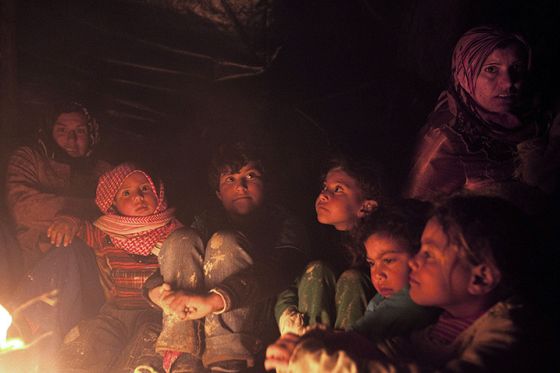
A Syrian refugee family wait for rebels to help them across the Turkish border. Photograph: Giorgos Moutafis/AFP/Getty Images
Jonathan Jones writes: Here is the truth about revolution, war, dictatorship and resistance. It is a simple truth and it is crushing: people suffer. In this powerful picture by Greek photojournalist Giorgos Moutafis a refugee family in Janoudia in north-western Syria wait for rebels to help them across the border into Turkey. In the bold rhetoric of our time, this might be described as a picture of defeat, an indictment of Bashar al-Assad’s crackdown on opposition to his rule, a call to arms for western democracies that are so much less eager to help in Syria now than they were in Libya a year ago. Perhaps it is all those things, and anything else politics wants it to be. But first, it is a human document.
Five children sit in a pool of light amid the dark, their faces patient and resilient, their confusion and fear obvious. Each has a different expression but none are smiling. One child gazes downward while the youngest-looking boy stares at the camera. The adults in the picture, knowing more, look back at the photographer as they gather close to the children. Everyone’s eyes seem to be searching, puzzling. The glow that warms their faces reveals a moment of contemplation before the next arduous stage of a journey.
Painters have known for centuries how to use nocturnal light to intensify our recognition of vulnerability. In his painting The Nativity at Night, which dates from about 1490, Geertgen tot Sint Jans shows the Madonna and child by candlelight against the dark. In this photograph, the shiny wall of the tent or canopy behind them creates a starless black night. Against this eeriness, Moutafis is able to give this family a profound dignity as the human instinct for light in the shadowed hours heightens their meditative companionship.
Democrats press Obama over U.S. complicity with Honduras’ dirty war
Mark Weisbrot writes: Hondurans are still suffering from the effects of the June 2009 military coup that overthrew the democratically elected government of President Manuel Zelaya. The coup has unleashed a wave of violence against political opposition, journalists, small farmers and others, with impunity for the security forces that have been implicated in these killings. This is exactly what those who opposed the coup regime – and its consolidation of power with marred “elections” in November 2009 – feared would happen.
On the wrong side of this fight was the Obama administration, which – after some hesitation – made some statements against the coup but went on do quite a bit to help the coup government succeed. Nearly three years and hundreds of political murders later, it seems that this administration is still on the side of repression and denial of Hondurans’ basic human rights.
Nothing has made this clearer than the attempts of Democratic members of the US Congress to pressure the administration to change course. On 9 March, 94 members of the US House of Representatives sent a letter to Secretary of State Hillary Clinton asking her “to suspend US assistance to the Honduran military and police given the credible allegations of widespread, serious violations of human rights attributed to the security forces”.
The members of Congress note a “pattern of human rights violations in which human rights defenders, journalists, community leaders and opposition activists are the subject of death threats, attacks, and extrajudicial executions”. They call particular attention to the situation in the Bajo Aguan region, about 350 miles north-east of the capital, where “45 people associated with peasant organizations have been killed.” This violence, which is committed by landowners’ gunmen and security forces against peasants struggling for land rights, is a direct result of the coup; under the Zelaya administration, there were negotiations taking place to resolve the disputes peacefully.
The letter from members of Congress is politically striking because it is signed by close to half of all the Democrats in the House, including some in leadership positions. This is an election year, and these people are not eager to fight with their president over an issue that is not likely to be a key concern in their districts. So they must have been quite convinced that these are outrageous violations of human rights – on which our government has a responsibility to act.
But the major media in the US did not seem to notice this letter or its political significance. And there were no reports at all on a similar letter to Secretary Clinton four days earlier, from a number of US senators who expressed their concern over “credible reports of killings and violent attacks that allegedly involve police and military agents”, and “the failure of [Honduran] state authorities to prosecute violators and protect the rights of victims and their families”.
These omissions are even more striking as Vice-President Biden travelled to Honduras on 6 March, putting the country in the news cycle. The major media serve as enabler in this circumstance by not reporting this congressional action by so many members of President Obama’s own party. The administration looks to the press and, seeing nothing, reasons that if nobody heard this big tree falling in the forest, then it didn’t happen. [Continue reading…]
Video: ‘Emo’ youth targeted in Iraq
Occupy and the Arab spring will continue to revitalise political protest
Simon Critchley writes: The Arab spring, notably in Egypt and Syria, seems to be running out of steam. The vivacious drive of the Occupy movement has faltered and it is not clear what new life will appear. Can popular protest regain its energy and inspiration, or is that it?
Rather than retreating into the comfort of despair or cynicism, perhaps this is a moment in which we can try and gain a broader view of matters.
Power is the ability to get things done. Politics is the means to get those things done. Democracy is the name for regimes that believe that power and politics coincide and that power lies with the people. The problem, as Zygmunt Bauman has reminded us, is that power and politics have become divorced. What we call democracy has become a sham. Power has evaporated into the supra-national spaces of finance, trade and information platforms, but also the spaces of drug trafficking, human trafficking and immigration – the many boats that cross the Mediterranean and other seas.
But the space of politics has remained the same as it has for centuries, localised in the nation state with its prosaic variations of representative, liberal democracy. Politics still feels local – we might feel British or Greek or whatever – but it isn’t. Normal state politics simply serves the interests of supra-national power. Sovereignty has been outsourced.
The premise of western representative democracy is the following: citizens exercise political power through voting; representatives are elected; governments are formed and these governments have power to get things done, a power identical to the will of the people.
The belief that many of us had (or perhaps still have) is that if we work for a certain party, then we can win an election, form a government, and have the power to change things. But every day this is proven to be wrong. [Continue reading…]
Video: Is harmful rhetoric on the rise in Europe?
Toulouse killings: making political capital out of Mohammed Merah
Nabila Ramdani writes: When young children are murdered by point-blank shots to the head, it is very difficult to draw conclusions about anything, let alone religion. The crimes Mohammed Merah has apparently confessed to are unimaginably wicked. French president, Nicolas Sarkozy, summed them up with the blunt relish of a newspaper headline writer, describing the 23-year-old killer as a “monster” who represented nothing and nobody.
However, such interpretations of what has happened in the Toulouse area over the past 10 days won’t last long. Far-right politicians have already seized on the image of the lethal young Muslim from an Algerian immigrant background. The National Front leader Marine Le Pen, who is on course to win up to 20% of the popular vote in the presidential elections beginning next month, said it was time to “launch a war” against a “fundamentalist risk which has been underestimated in our country”.
Le Pen has highlighted the fact that Merah had a French passport and was born and brought up at the expense of the republic. Even after he escaped from an Afghan prison where he was held for planting Taliban bombs, he was able to return to a council flat in Toulouse. “Homegrown” Islamic terrorists are the ultimate bogeymen for rabble-rousing politicians, and there is absolutely no doubt that the National Front’s share of the vote will increase because of this outrage.
Why a UN Syria peace plan poses a challenge to rebels
Tony Karon writes: The Kofi Annan peace plan unanimously endorsed Wednesday by the U.N. Security Council may pose an even greater dilemma for the Syrian opposition than it does for the regime of President Bashar al-Assad. That’s because while it demands a halt to the regime’s military operations against opposition strongholds, it also retreats from the previous insistence by Western and Arab countries — and the Syrian opposition — that Assad immediately step down and hand power to a unity government as the starting point of a political solution to the year-long uprising. Instead, the Security Council statement calls for
- both the regime’s forces and armed opposition groups to accept a U.N.-supervised cease-fire;
- daily pauses for humanitarian assistance;
- the regime to release prisoners;
- freedom of access for journalists;
- freedom of assembly for peaceful protest; and for
- “the Syrian government and opposition to work in good faith with the Envoy [Annan] towards a peaceful settlement of the Syrian crisis” by engaging “in an inclusive Syrian-led political process to address the legitimate aspirations and concerns of the Syrian people”.
It remains to be seen whether the regime will honor its stated willingness to engage in a political dialogue if the opposition puts down its weapons. It would certainly face massive peaceful protests if it honored Annan’s terms, and it has no intention of ceding power even if it talks of constitutional reform while shelling opposition strongholds. But the Council statement carries considerable weigh by the fact that it was endorsed by Russia and China, which had vetoed previous resolutions precisely because they demanded that Assad step down. The new resolution, and Assad’s mission, appears to reflect an acceptance that he’ll be at the table in any political dialogue to resolve the conflict.
But the demand that the opposition negotiate with the regime on the terms laid down by Annan poses a dilemma for the fractured Syrian rebellion, some of whose leaders are set to convene in Turkey on Thursday and Friday: What is won at the negotiating table typically reflects the balance of power on the ground. And the reality, there, is that the Assad regime has proven far more resilient than its domestic and foreign opponents had assumed it would be.
The lost stars: Why civil wars happen in Syria and Lebanon
Malik Al-Abdeh writes: How do we explain the de facto civil war unfolding in Syria today? How do we predict what course it will take? How do we come up with a viable and long-term solution?
A good starting point is to compare Syria with a country that bears a striking resemblance: Lebanon. This may seem surprising because the two countries (and two peoples) appear to be somewhat different.
Syrians regard themselves as being superior to Lebanese because their country suppresses confessional and ethnic identities in favour of a secular and all-embracing Arabism.
The Lebanese on the other hand look at the Syrians and they pity. Fortress Damascus is not a good place if you value creativity and free expression. It is the GDR of the Levant.
Broadly speaking, Syria is about unity, Lebanon is about freedom.
In reality, these differences developed recently and are superficial. What Syria and Lebanon have in common is grounded in shared experience: for centuries they were part of the Byzantine empire, they were conquered by the Muslim Arabs at the same time, both were later ruled by the Ottoman Turks for 400 years, and both fell under French mandate after the end of the First World War.
Something else they had in common were significant groups of non-Sunni Muslim minorities who chafed under Ottoman Turkish rule and vowed never to fall under Sunni overlordship again.
It was during the formative Mandate years (1920-46) that non-Sunni Muslim minorities (Christians, Alawites, Druze, Ismai’lis) began to develop survival strategies to adapt to the reality of living in newly-created nation states. It is by recognizing and analyzing these survival strategies and their long-term consequences that one can trace the historic roots of the Lebanese civil war (1975-90) and the Syrian civil war (2011-present).
The modern history of Syria and Lebanon is the story of how religious minorities turned the tables to become political masters, and how that often brought them into conflict with the Sunni Muslim majority. [Continue reading…]
New phase in Syria crisis: dealmaking toward an exit
Sharmine Narwani writes: In recent weeks, there has been a notable shuffle in the positions of key external players in the Syrian crisis. Momentum has quite suddenly shifted from an all-out onslaught against the Assad government to a quiet investigation of exit strategies.
The clashes between government forces and opposition militias in Baba Amr were a clear tipping point for these players – much hinged on the outcome of that battle. Today, the retreat of armed groups from the Homs neighborhood means one thing: the strategy of militarizing the conflict from within is no longer a plausible option on which to hang this geopolitical battle. Especially not in an American or French election year, when anything less than regime change in Syria will look like abject failure.
And so the external players are shifting gears – the more outspoken ones, quietly seeking alternative options. There are two de facto groups that have formed. Group A is looking for a face-saving exit from the promised escalation in Syria. It consists of the United States, European Union and Turkey. Group B, on the other hand, is heavily invested in regime-change at any cost, and includes Saudi Arabia, Qatar, and some elements of the French, US, British, and Libyan establishments.
Before Baba Amr, these two groups were unified in maximizing their every resource to force regime change in Syria. When the UN Security Council option was blocked by Russia and China, they coalesced around the General Assembly and ad-hoc “Friends of Syria” to build coalitions, tried unsuccessfully to bring a disparate opposition fighting force (Free Syrian Army) under central leadership, pushed to recognize the disunited Syrian National Council (SNC), and eked out weekly “events” like embassy closures and political condemnations to maintain a “perception momentum.”
But those efforts have largely come to a standstill after Baba Amr. A reliable source close to the Syrian regime said to me recently: “The regime eliminated the biggest and most difficult obstacle – Baba Amr. Elsewhere, it [eliminating armed militias] is easier and less costly at all levels. Now both political and military steps can continue.” [Continue reading…]
A discovery that might destroy the foundation of modern linguistics?
Tom Bartlett writes: A Christian missionary sets out to convert a remote Amazonian tribe. He lives with them for years in primitive conditions, learns their extremely difficult language, risks his life battling malaria, giant anacondas, and sometimes the tribe itself. In a plot twist, instead of converting them he loses his faith, morphing from an evangelist trying to translate the Bible into an academic determined to understand the people he’s come to respect and love.
Along the way, the former missionary discovers that the language these people speak doesn’t follow one of the fundamental tenets of linguistics, a finding that would seem to turn the field on its head, undermine basic assumptions about how children learn to communicate, and dethrone the discipline’s long-reigning king, who also happens to be among the most well-known and influential intellectuals of the 20th century.
It feels like a movie, and it may in fact turn into one—there’s a script and producers on board. It’s already a documentary that will air in May on the Smithsonian Channel. A play is in the works in London. And the man who lived the story, Daniel Everett, has written two books about it. His 2008 memoir Don’t Sleep, There Are Snakes, is filled with Joseph Conrad-esque drama. The new book, Language: The Cultural Tool, which is lighter on jungle anecdotes, instead takes square aim at Noam Chomsky, who has remained the pre-eminent figure in linguistics since the 1960s, thanks to the brilliance of his ideas and the force of his personality.
But before any Hollywood premiere, it’s worth asking whether Everett actually has it right. Answering that question is not straightforward, in part because it hinges on a bit of grammar that no one except linguists ever thinks about. It’s also made tricky by the fact that Everett is the foremost expert on this language, called Pirahã, and one of only a handful of outsiders who can speak it, making it tough for others to weigh in and leading his critics to wonder aloud if he has somehow rigged the results.
More than any of that, though, his claim is difficult to verify because linguistics is populated by a deeply factionalized group of scholars who can’t agree on what they’re arguing about and who tend to dismiss their opponents as morons or frauds or both. Such divisions exist, to varying degrees, in all disciplines, but linguists seem uncommonly hostile. The word “brutal” comes up again and again, as do “spiteful,” “ridiculous,” and “childish.”
With that in mind, why should anyone care about the answer? Because it might hold the key to understanding what separates us from the rest of the animals. [Continue reading…]
Video: This is the Occupation Spring
Video: A history of Occupy Wall Street
Federalism and fragmentation in Libya? Not so fast…
Sean Kane writes: Benghazi is back in the headlines. On March 6, the capital of Libya’s 2011 uprising hosted a reported 3,000 tribal figures and leaders from the eastern half of the country. Seeking to marry eastern Libya’s status as the historical seat of the country’s pre-Qaddafi federal monarchy with local post-revolutionary anxiety, the conference provocatively announced the creation of the federal region of Barqa.
The reaction both within and outside of Libya has been swift. The ruling National Transitional Council (NTC) sharply criticized the declaration. Protests extolling national unity were held across the country and Libya’s leading mufti issued a fatwa against federalism. Meanwhile, Egypt, Tunisia, and the Organization of the Islamic Conference issued statements expressing support for a unified Libya and rejecting federalism. An editorial in the London-based pan-Arab daily al-Quds al-Arabi even opined that Qaddafi and his family must feel “vindicated” in their predictions that the country would fragment without them.
The reality is more nuanced than the excited commentary would suggest. The gulf between the “federalism” called for by some easterners and the administrative decentralization broadly favored across Libya is most likely relatively narrow. And even in eastern Libya, support for the federal model advocated for by the self-appointed Interim Council of Barqa appears mixed.