



Ben White writes: This is Israel in 2012 according to a top UN body. Using unprecedented strong language, the UN Committee on the Elimination of Racial Discrimination (CERD) criticised Israeli policies in terms of “apartheid”, as part of their published [PDF] observations following a regular review.
Affirming the kind of analysis that Israel’s advocates try to dismiss as lies or rhetorical excess, the Committee slammed Israel for violating the right to equality in numerous policy areas. CERD described “segregation between Jewish and non-Jewish communities”, a lack of “equal access to land and property”, and “the ongoing policy of home demolitions and forced displacement of the indigenous Bedouin communities” in the Negev.
The lack of a “prohibition of racial discrimination” in Israel’s Basic Law was highlighted, and more recent developments, such as the restrictions on family unification affecting Palestinian citizens were also part of CERD’s wide-ranging criticisms.
The Committee’s observations also covered Israel’s policies in the Occupied Territories, showing how the same discriminatory patterns are found on both sides of the Green Line. Israeli settlements in the West Bank form part of a regime of “de facto segregation” severe enough to cause the Committee to remind Israel of the “prohibition” of policies of “apartheid”.
According to Dr David Keane, senior lecturer in law at Middlesex University and author of ‘Caste-based Discrimination in International Human Rights Law’, this is “the most cutting CERD recognition and condemnation of a legal system of segregation since apartheid South Africa”.
Haaretz reports: A local French newspaper published on Thursday an in-depth testimony of a woman claiming that she had warned authorities multiple times that the suspect in the Toulouse killings, Mohamed Merah, was a danger to the public.
The woman, who did not provide her real name, told Le Télégramme that upon discovering the suspect’s identity, she felt as though her “legs were cut off.” According to her, the fact that it was necessary for the deaths to occur in order to finally arrest Merah was a “huge misstep.” She further claimed that she had filed two complaints against the suspect, and returned and warned authorities several times to no avail.
The woman, who lives in the same neighborhood as Merah in Toulouse, told Le Télégramme that in the summer of 2010, the suspect attempted to recruit her son to jihad. The son, who at the time was 15 years old, was taken to the suspect’s car where he listened to a disc of preaching for holy war. He then drove her son to his apartment, where he presented him with a Koran and a large sword, and forced him to watch gruesome Al-Qaida videos in which women were shot and hostages in Afghanistan were beheaded.
“My son called me and we were finally able to get him out of there. He was there from 5 P.M. until midnight,” the woman said.
The mother filed a complaint with the police, which according to her caused Merah to become upset. “He came to the front of our home, threatened me and hit me. He said that I was an atheist and that I must pay like all the rest of France’s citizens,” she said.
She further stated that Merah claimed he would “wipe out all those who kill Muslims.” She stated that two days after the incident, Merah struck her son and daughter in the presence of eyewitnesses. However, no one intervened. The mother still has a copy of the complaint that was filed, as well as her daughter’s medical documents.
The woman also stated that the “true mind” behind the suspect was his brother Abdelkader, who is currently in police custody. “It is he who brainwashed [Merah] and often flew out of France,” she said.
Reuters reports: A 23-year-old gunman suspected of killing seven people in southwestern France in the name of al Qaeda, jumped from a window to his death in a hail of bullets after police stormed his apartment on Thursday.
“At the moment when a video probe was sent into the bathroom, the killer came out of the bathroom, firing with extreme violence,” Interior Minister Claude Gueant said, adding that Merah was firing several guns at once.
“In the end, Mohamed Merah jumped from the window with his gun in his hand, continuing to fire. He was found dead on the ground,” he told reporters at the scene. Two police commandos were wounded.
The New York Times reports: A top editor at the news channel France 24 said in a televised interview that she had spoken by telephone to a man who claimed to be the shooter in the hours before the police surrounded Mr. Merah’s building. “He was calm, was speaking in very good French and punctuated by Arabic expressions,” said the editor, Ebba Kalondo. She also said he spoke of planning more attacks and of intending to post video of his killings online.
“This man wanted to bring the Republic to its knees,” President Nicolas Sarkozy of France said on Wednesday, but “the Republic did not yield.” He spoke in nearby Montauban at a funeral service for three soldiers that Mr. Merah said he had killed in the days leading up to Monday’s killings of a rabbi and three children at a religious school here.
No doubt Sarkozy, in the middle of an election campaign, can be expected to frame this story in melodramatic terms, but just because Merah boasted that he had brought France to its knees, is no reason to treat that claim seriously by acting as though it demanded to be refuted.
If Merah had instead claimed that he was about to take over the world, would Sarkozy be saying that France stopped that from happening?
Yesterday, the French defense minister seemed to have a more sober assessment of the situation.
“This will not last for days, because of physical and mental fatigue. All the experience with crazed gunmen like this is that they stop at some point,” defence minister Gerard Longuet said on TF1 television.
“What we want is to capture him alive, so that we can bring him to justice, know his motivations and hopefully find out who were his accomplices, if there were any,” he added.
Unless it turns out Merah was a secret blogger or kept some other kind of journal, it seems unlikely that we’ll ever know much more about his motives or methods.
If there is one salutary lesson for American observers to take away from this, it is that just as was already shown in the 2008 Mumbai attacks and the 2011 Norway attacks, terrorism does not require access to high explosives or complex bomb-making skills. All that is necessary is easy access to guns and yet in the United States the relationship between gun control and counter-terrorism can’t even be discussed.
As much as the loss of innocent life universally provokes grief, horror, and rage, never is this more so than when the victims are children killed in cold calculation by adults.
Even before Mohamed Merah had been tracked down to an apartment in Toulouse, the names and images of some of his victims had been widely publicized.
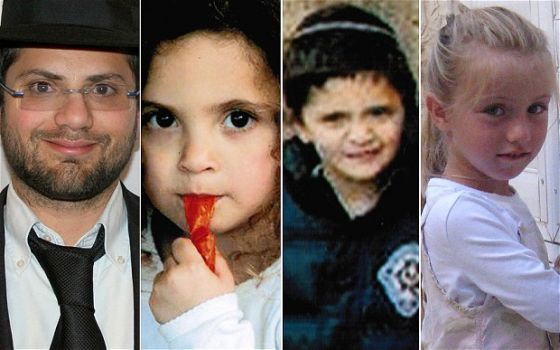
Rabbi Jonathan Sandler, 30, his two sons, Gabriel, 3, Arye, 6, and Miriam Monsonego, 8.
Such are the typical records of lives cut short — faces with bright shining eyes looking into a future they never reached.
In the first few days after Robert Bales gunned down his sixteen victims, we knew neither his name nor theirs. All we saw was a glimpse of a child’s charred body — a detail from an AFP photograph which showed victims in the back of a pickup truck surrounded by those in grief. The larger photograph was widely published, but few if any outlets drew attention to this gruesome element — a glimpse of a life lost but no record whatsoever of the lives lived.
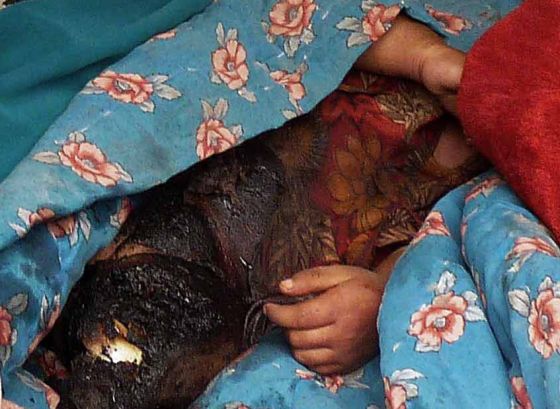
The charred body of Shatarina, Zahra, Nazia, Masooma, Farida, Palwasha, Nabia, Esmatullah, or Faizullah? We'll never know.
When it comes to Bales’ victims all we have is a list of names without ages.
But are Robert Bales and Mohamed Merah as radically different as is the coverage of their crimes?
Reuters reports:
Merah’s profile is typical of hundreds of second- or third-generation French immigrants from North Africa who have travelled to Afghanistan or Pakistan over the last two decades attracted by militant Islamist groups, security officials say.
Many were radicalised by the Israeli-Palestinian conflict, which triggered a wave of attacks on Jewish targets in France in the early 2000s, including arson attacks on synagogues. The number of anti-Semitic attacks declined last year, figures published by the Jewish community showed.
But this profile of radicalization does not diverge so far from the portrait of Sergeant Bales since both men were seen by those who knew them as regular guys.
Cedric Lambert, 46, father of an upstairs neighbour, said Merah was friendly and had helped them about 10 months ago to carry a heavy sofa upstairs.
“He was extremely normal,” Lambert said.
A group of four 24-year-old men of similar ethnic background who said they were friends of Merah tried to go to his apartment block on Wednesday to persuade him to surrender but were stopped at a police roadblock.
All told a Reuters reporter he had never talked to them about religion and they had no idea he had been to Afghanistan.
One friend who gave his name as Kamal, a financial adviser at La Banque Postale, said he had known Merah at school and they had done soccer training together after meeting again two years ago.
“He is someone who is very discreet. He is not someone who would brag and go around and say ‘Oh look at my new girlfriend, look how great I am.’ He is very polite and always well-behaved,” Kamal said.
“He never spoke about Islam but he did pray. But we all pray five times a day. There’s nothing strange about that.”
Another friend of Moroccan origin, who gave the pseudonym Danny Dem, said Merah had tried to enlist in the French army but had been rejected. He said he had seen Merah in a city centre nightclub just last week.
Merah did not drink “but I don’t think he is any more religious than I am. I think he has just lost the plot,” Danny Dem said.
A third contemporary, who declined to give his name, said he went to primary school with Merah and they had remained friends.
“He likes football and motor-bikes like any other guy his age,” said the man, dressed in a blue French national soccer shirt. “I didn’t even know he prayed.”
Pamela Geller, from her perch in Manhattan, made this comment while French police attempted to negotiate Merah’s surrender: “Negotiations? He should be shot in the head.”
She also offers this advice: “Jews. please. leave. Europe.”
I wonder whether President Obama would share Geller’s view, given that no one seems to be in any doubt that Merah is the killer? Even if he does, the problem with the administration of instant “justice,” is not simply that it might be of dubious legality but that it undermines a crucial element of criminal investigation: to better understand the motives of the perpetrator.
This isn’t a matter merely of academic interest.
When Merah claims that he was trying to avenge the deaths of Palestinian children killed by Israelis, is he merely parroting the views of radicals by whom he was indoctrinated, or was the Israeli-Palestinian conflict the primary cause of his radicalization? It’s worth knowing the answer and if he gets shot in the head we’ll probably never find out.
As for the idea that the death of four Jews in France — indisputably targets of an anti-semitic attack given that Merah knew perfectly well that these individuals had no role in the killing of Palestinian children — the idea that these deaths should prompt other Jews to flee Europe, begs this question:
If this would be sufficient cause for Jews to flee Europe, haven’t Jews in Israel already been given thousands of similar reasons to flee the Jewish state?
Neither flight nor vengeance offer an intelligent answer to this violence.

On September 11, 2001, after 3,000 people had been killed, Benjamin Netanyahu said the attacks would be “very good,” having the effect of strengthening the bond between America and Israel.
Seven years later the then-leader of Likud held to the same conclusion as U.S. forces struggled to contain the civil war in Iraq.
“We are benefiting from one thing, and that is the attack on the Twin Towers and Pentagon, and the American struggle in Iraq,” the Israeli newspaper Ma’ariv quoted Netanyahu as saying in April, 2008. He added, these events “swung American public opinion in our favor.”
While the Israeli prime minister has been forthright in talking about how he sees the killing of Americans as serving Israel’s interests, there are limits to his candor. No one would expect him to declare that the shooting of Rabbi Jonathan Sandler, his two sons, Gabriel and Arieh, and seven-year-old Miriam Monsonego in Toulouse on Monday, was “very good.”
Even though I don’t believe Netanyahu is a ghoul who celebrates death, as a political opportunist he undoubtedly recognizes when tragedy serves his own political agenda.
The Guardian spoke to their reporter, Phoebe Greenwood, who has been at the funeral of Rabbi Sandler and the other victims in Jerusalem today.
One mourner told Phoebe that although the school [in Toulouse] was “a very safe place”, the murders would make many Jews worried about security in Europe consider moving to Israel. She said: “Many of the people who are thinking about moving to Israel now certainly will.”
Whether that’s true, there’s little doubt that Netanyahu and many of Israel’s other leaders would welcome a growing sense among the Jewish diaspora that Israel is the only safe place for Jews to live — even as these same leaders push for another war in the Middle East and thereby increase the chances that the Jewish “safe haven” will come under attack.
The alleged gunman in France, Mohammad Merah, a 24-year-old Frenchman of Algerian descent, is said to have wanted to avenge the deaths of Palestinian children. He also claims to have ties to al Qaeda.
Documents seized from Osama bin Laden’s compound in Abbottabad confirm that the al Qaeda leader strongly believed that the movement he had spawned should be focused on Palestine. As Paul Pillar writes:
The one issue that bin Laden evidently stressed to his associates should be emphasized publicly above all others was Palestine. He criticized affiliates and followers for justifying their actions as responses to local matters rather than being performed on behalf of the preeminent cause for all Muslims, which was Palestine. In making such admonitions, bin Laden was recognizing the enormous salience the Palestinian issue continues to have for for Muslims generally. It has all the ingredients for a cause well suited for exploitation by extremists. At its core is the injustice of indefinite occupation by a conquering power of land that is home to Muslims. On top of that is a added religious dimension to the conflict and the perception of the occupying power as a kind of Western, Judeo-Christian imposition on the Middle East.
That bin Laden was issuing such instruction is a further indication of the power of Palestine as an extremist cause célèbre. Bin Laden’s first wish probably would have been to overthrow the House of Saud in Arabia. His strategy of going after the far enemy in the form of the United States as a way of defeating the near enemies in Arab capitals was never more than a minority view in jihadist circles. In this respect he did not see eye-to-eye with his onetime mentor Abdullah Azzam, who believed the first priority of jihad ought to be the liberation of Muslim lands from non-Muslim occupiers. That is why Azzam was a leader in supporting the Afghan jihad against Soviet occupation, and why he—himself a Palestinian—believed liberation of Palestinian land from Israeli occupation needed to be given foremost priority. The Palestinian issue has the power it does not because individual terrorist leaders like bin Laden necessarily make it their first personal priority but instead because it has tremendous resonance among the Muslim populations to which they appeal. The reason that supporters and rank-and-file practitioners of anti-U.S. terrorism cite most frequently for their hatred of the United States is U.S. condoning of Israeli occupation of Palestinian-inhabited land and of other Israeli actions that involve the killing or subjugation of Muslims.
There are many good reasons not to let the Israeli-Palestinian issue fester. Its role as a readily exploitable extremist cause is one of them.
The problem is, as much as the conflict is an exploitable cause for extremists, extremist acts of violence are themselves events that can easily be exploited by those who want to claim that the life of every Jew is at risk and that an undercurrent of antisemitism still pervades the world.
In other words, for those Jews inside and outside Israel who react to terrorism targeting Jews by saying, “I told you so,” such attacks validate their view of the world. This violence is less a problem to be remedied, than a confirmation that part of what it means to be Jewish is to be hated and that the only way of surviving in such a world is through the segregation provided by a Jewish state.
From the mindset of eternal victim-hood, it makes no difference what you do, since it is your fate to always be judged because of who you are.
Julian Borger writes: In May 2003, when the Bush administration’s might was at its zenith, a Swiss diplomat called Tim Guldimann arrived in Washington carrying an extraordinary message.
As Switzerland’s ambassador in Tehran, Guldimann’s job was to represent the interests of the United States, which had no embassy, and that was he thought he was doing. The letter he was carrying was an offer of comprehensive negotiations from the Iranian government. In return for a lifting of US sanctions and the handing over of members of a US-designated Iranian terrorist group, Tehran was willing to place its nuclear programme under an intrusive monitoring and inspection regime, end armed support for Hamas and Hizbullah, and accept a Saudi plan for Israeli-Palestinian peace.
In short, Iran was ticking just about every box on the American diplomatic wish-list. So what happened? Dick Cheney and Donald Rumsfeld rejected the offer out of hand. “We don’t speak to evil,” was the official line. Not only was Guldimann sent packing, the Bush administration actually reprimanded the Swiss for over-stepping their diplomatic mandate.
The depressing fiasco is the opening scene of a perfectly-timed new book, A Single Roll of the Dice, by Trita Parsi, a carefully balanced and thoroughly researched account of the tortured US-Iranian relationship in recent years.
Yousef Munayyer writes: Peter Beinart’s New York Times op-ed, “To Save Israel, Boycott the Settlements,” is an example of the increased volume voices described as ‘Liberal Zionists’ have garnered in the discourse on Israel/Palestine. But liberal Zionism is a contradiction is terms.
Peter’s piece expemplifies the “Liberal Zionist” narrative; “Liberal Zionists” cling to three central illusions to avoid confronting the reality that they are walking contradictions.
First, “Liberal Zionists” construct an artificial dichotomy between the state and the settlements; they pretend that the Israeli State and its settlements are somehow separate or separable. Beinart typifies this when he suggests renaming the West Bank ‘undemocratic Israel’ to distinguish from 1948 Israel. In reality, one cannot, in any serious way, separate Israel from its settlement enterprise.
The settlements were developed, continue to exist and grow precisely because of Israeli state policies. These policies are formulated by the government of Israel (all of it, not just the settlements). The settlement enterprise is not directed from the hilltops of the West Bank which it dominates, but rather from the central corridors of Israeli power which allocates resources to them, builds settlement infrastructure (and destroys Palestinian infrastructure) in and around them, supports the usurpation of Palestinian land and natural resources for them, and deploys Israeli military for support in this effort. This is why there is a strategic imperative for BDS to target the state, not just the settlements.
Further, as part of this self-inflicted deception, “Liberal Zionists” often attempt to mitigate the problem presented by settlers and settlements by dishonestly diminishing their numbers. Beinart excludes the residents of occupied Jerusalem (which the Israeli government has annexed), and cites 300,000 settlers in the West Bank. But as even the Israeli Prime Minister told Congress, 650,000 Israelis live beyond the green line.
Second, “Liberal Zionists” talk about an always-approaching-yet-non-existent deadline for two states. Beinart writes that Israel is “erasing” the green line; he worries what will happen “if Israel makes the occupation permanent…” and says that “we are closer to that day” than many may admit. But that day never seems to come for “Liberal Zionists,” it is always somewhere off in the undefined distance, although, we are told, it is approaching.
But by never defining a deadline, by never demarcating a point of no return, that day never has to come and “Liberal Zionists” never have to confront the contradiction inherent in their views. Rather, by failing to draw a line (which in reality we have probably long passed) and by failing to make a serious effort against the Israeli state for its colonialist policies, what “Liberal Zionists” are effectively saying is that there is no Palestinian minimum (or Zionist maximum) they would not accept – there is nothing “liberal” about that! [Continue reading…]
Akiva Eldar writes: The murderer who shot students in a Jewish school in Toulouse yesterday, like the one who shot black-skinned French paratroopers a few days earlier, required no motive other than hatred of foreigners and those who are different. Chronic sufferers from anti-Semitism and xenophobia need no special pretexts for their racism.
Nevertheless, an Israeli attack on Iran that sent gas prices soaring would be seized by by right-wing extremists like those who support Marine Le Pen. Thanks to Prime Minister Benjamin Netanyahu’s babble in Washington, even if the United States is the one that ultimately attacks Iran’s nuclear reactors, the bill will (also) be submitted to Jewish communities abroad. The State of Israel, which was established as a haven for Jews from those who hate it, may instead wind up becoming a threat to Jews.
What do you do when the polls show that a solid majority of Israelis refuse to risk being among the 500 casualties of retaliatory Iranian missile strikes on which Defense Minister Ehud Barak is prepared to gamble? The Prime Minister’s Office takes comfort in polls showing increasing American support for military action against Iran. Netanyahu’s spokesmen managed to sell this dramatic headline to several important media outlets as a personal accomplishment by their boss.
Indeed, a Wall Street Journal/CNN poll published the day after Netanyahu’s address to the pro-Israel lobby AIPAC showed that 52 percent of Americans favored a military strike on Iran if the only other option were standing idly by. But when the respondents were presented with a larger range of options, a completely different picture emerged.
The Guardian reports: Mohammed Atari heaved the rock into position, its painted red and white sign marking a seven-mile trail across wheat fields, olive groves and gentle stony hills in the north of the West Bank. “When we started marking walking trails, people were suspicious,” he said. They feared the markers signified a new Israeli settlement or military zone.”
Walking for pleasure is a concept unfamiliar to most Palestinians. But over the past five years, hikers – mainly foreign diplomats, aid workers and journalists, but also locals – have become a more common sight in the West Bank. Their hikes range from the rolling lush hills and valleys of the north to the dramatic arid desert landscape of the south.
This week sees the publication of Walking Palestine, a guide to 25 walks, the fruits of a four-year project by a Dutch diplomat, Stefan Szepesi. It details tracks, paths and dirt roads; supplies maps and information on historical sites, wildlife and natural attractions; and provides practical details on local guides, parking, public transport, restaurants and places to stay.
Map – Walking in Palestine, Jenin Walking in Jenin.Szepesi began walking in the West Bank soon after arriving to work for the EU; he later moved over to the Middle East Quartet. The outings were born of a need to escape the intensity of Jerusalem, but also a desire to get to know Palestinians and their land in a more intimate way than he could from the confines of a diplomatic mission headquarters.

Human Rights Watch addresses an “Open Letter to the Leaders of the Syrian Opposition”: We are writing to express our concern about increasing evidence, as described below, of kidnappings, the use of torture, and executions by armed Syrian opposition members and strongly urge you to work to ensure that all opposition members refrain from engaging in these unlawful practices.
Human Rights Watch has repeatedly documented and condemned widespread violations by Syrian government security forces and officials, including disappearances, use of torture and forced televised confessions, arbitrary detentions, indiscriminate shelling of neighborhoods, and deaths in custody under torture. Now, in the face of evidence of human rights abuses by armed opposition members, Human Rights Watch calls on the leadership of leading opposition groups including the Syrian National Council (SNC) and its Military Bureau to condemn such practices by the armed opposition and to work to prevent such unlawful practices.
While the protest movement in Syria was overwhelmingly peaceful until September 2011, since then Human Rights Watch has documented apparent crimes and other abuses committed by armed opposition elements. These crimes and abuses include the kidnapping and detention of security force members, individuals identified as members of government-supported militias (referred to locally as shabeeha), and individuals identified as government allies or supporters. They also include the use of torture and the execution of security force members and civilians. Some of the attacks targeting Shias and Alawites appear to be motivated by sectarianism.
The New York Times reports: Armed Syrian defectors took their uprising into the heart of a heavily guarded and wealthy district of Damascus on Monday, clashing with security forces in what activists and residents called the most intense fighting in such a strategic area since the protests against President Bashar al-Assad began a year ago.
The flaring of violence in the Syrian capital followed a weekend in which bombers struck at government targets in both Damascus and Aleppo, Syria’s largest cities, raising concerns that the scope of the armed uprising was expanding into places that had been largely spared from violence.
The clashes in Damascus also coincided with the arrival of a monitoring team sent by Kofi Annan, the special representative on Syria for the United Nations and the Arab League. Mr. Annan is trying to advance his effort to start a dialogue between the antagonists in the Syria conflict and open the way for humanitarian aid.
There were also signs that Russia, Mr. Assad’s most important foreign supporter, was exerting some pressure on him to allow a daily pause in the fighting and to permit outside aid to victims of the conflict, which the United Nations has estimated has left more than 8,000 dead and thousands more displaced.
Al-Akhbar reports: Top Google execs, including the company’s CEO and one of Barack Obama’s major presidential campaign donors Eric Schmidt, informed the intelligence agency Stratfor about Google’s activities and internal communication regarding “regime change” in the Middle East, according to Stratfor emails released by WikiLeaks and obtained by Al-Akhbar. The other source cited was Google’s director for security and safety Marty Lev.
The briefings mainly focused on the movements of Jared Cohen, currently the director of Google Ideas, a “think/do-tank” billed as a vehicle for spreading American-style liberal democracy. Cohen was also a former member of US Secretary of State’s Policy Planning Staff and former advisor to Condoleezza Rice and Hillary Clinton.
Email exchanges, starting February 2011, suggest that Google execs were suspicious that Cohen was coordinating his moves with the White House and cut Cohen’s mission short at times for fear he was taking too many risks. Stratfor’s vice-president of counter-terrorism Fred Burton, who seemed opposed to Google’s alleged covert role in “foaming” uprisings, describes Cohen as a “loose Cannon” whose killing or kidnapping “might be the best thing to happen” to expose Google.
The Associated Press reports: The lawyer for the Army staff sergeant accused of slaughtering 16 Afghan civilians in a nighttime shooting rampage met his client for the first time Monday and said the solider has a sketchy memory of the massacre.
Lawyer John Henry Browne said Robert Bales remembers some details from before and after the killings, but very little during the time the military believes on a killing spree through two Afghan villages.
“He has some memory of some things that happened that night. He has some memories of before the incident and he has some memories of after the incident. In between, very little,” Browne told The Associated Press by telephone from Fort Leavenworth, where Bales is being held.
Pressed on whether Bales can remember anything at all about the shooting, Browne said, “I haven’t gotten that far with him yet.”
The Washington Post reports: The attacks of Sept. 11, 2001, figure prominently in the still-evolving portrait of Robert Bales, the Army staff sergeant being held in a massacre of 16 villagers in southern Afghanistan. Like many others, Bales enlisted out of a sense of civic responsibility, his friends and attorney have said.
But Bales’s decision to join the Army also came at a pivotal point in his pre-military career — a career as a stock trader that appears to have ended months after he was accused of engaging in financial fraud while handling the retirement account of an elderly client in Ohio, according to financial records.
An arbitrator later ordered Bales and the owner of the firm that employed him to pay $1.4 million — about half for compensation and half in punitive damages — for taking part in “fraud” and “unauthorized trading,” according to a ruling from the Financial Industry Regulatory Authority, the independent disciplinary board for brokers and brokerage houses.
A review of the investor’s account statements, obtained by The Washington Post, shows that valuable stocks were sold off in favor of penny stocks as part of what the arbitrator called “churning” by Bales to pump up commissions.
The client, Gary Liebschner, a 74-year-old retired engineer for AT&T, said Sunday that he “never got paid a penny” of the award.
The Associated Press reports: A torrent of bombings and shootings ripped across eight Iraqi cities on Tuesday, targeting police and Shiite pilgrims and killing 46 people. The deadly wave undermined the government’s hopes for stability ahead of next week’s meeting of the Arab world’s top leaders.
There was no immediate claim of responsibility for the attacks, which also wounded more than 200 people. But authorities have feared al-Qaida or its Sunni sympathizers would try to thwart this year’s Arab League summit.
The gathering is to be held in Iraq for the first time in a generation. Plans for Baghdad to host the meeting last year were postponed, in part because of concerns about Iraq’s security.
In all, eight cities were hit Tuesday in what appeared to be coordinated attacks against police and government officials. One of the deadliest strikes came in the Shiite holy city of Karbala, where officials said two car bombs exploded in a crowded shopping and restaurant area.
Jack Goldsmith writes: When Michael Ratner argued in a February 2002 lawsuit that British citizen Shafiq Rasul had a legal right to challenge his detention at Guantanamo Bay, there was little reason to believe he and his colleagues at the Center for Constitutional Rights (CCR) would play any role in shaping America’s national security landscape. The country was still seething with anger over the attacks of 9/11, and longing for revenge. The few legal precedents that existed were not very encouraging. (“Never in American history had the [Supreme] Court tried in any way to interfere with a war in progress,” noted Arthur Schlesinger Jr. in The Imperial Presidency.) And the Ratner-led CCR was a far-left legal advocacy organization—the group had previously represented the Attica rioters, the Chicago Eight, Nicaraguan contras, and assorted other “violent radicals, Communist front-groups, cop-killers, and sworn enemies of the United States,” in the words of conservative critic Marc Thiessen—that had few friends in the Washington, D.C. establishment.
And yet, a decade later, it’s now clear that Ratner and progressive activists like him have had an outsized impact on national security policy—though not exactly the one they would have wished. CCR would win landmark Supreme Court cases that challenged executive authority. But those achievements came at an unexpected price: They ultimately helped cement the political and legal consensus in support of the counterterrorism policies that emerged at the end of the George W. Bush administration, and they enabled Barack Obama to continue those policies. By successfully challenging the government’s authority, Ratner and his friends mostly ended up strengthening it. In that irony lies the most important constitutional lesson of the last decade.
By June, 2004, Ratner’s hail-mary lawsuit had produced a famous Supreme Court victory. That month the Court set off on a new course in American history by holding that Rasul and every other detainee at GTMO could challenge in court “the legality of the Executive’s potentially indefinite detention.” The Rasul litigation led the Bush administration to tighten its detention standards and contributed to the discharge of 308 detainees from GTMO. More broadly, as Justice Antonin Scalia predicted in his dissent, the decision precipitated the projection of “the cumbersome machinery of our domestic courts into military affairs.”
It was a high-profile win, and the antiestablishment activists at CCR were soon bombarded by pro bono offers from hundreds of attorneys, including many from America’s most elite law firms. These lawyers—who came to be known as “the GTMO Bar”—quickly flooded federal courts with habeas corpus petitions from detainees seeking release. That initiated a series of convoluted legal and political battles that ultimately seemed to affirm their efforts. Congress enacted laws in 2005 and 2006 that extinguished habeas corpus rights and replaced them with a system of military and judicial review. But the Supreme Court, in the summer of 2008 in a case called Boumediene, declared that habeas corpus must apply to GTMO as a matter of constitutional law. It was the first time that the Court had invalidated a wartime measure that had the support of Congress and the President.
In the heady days after Boumediene, Ratner and his colleagues, the momentum on their side, assumed that the GTMO detentions would not survive judicial review. They grew more confident when former constitutional law professor Barack Obama—who as a candidate had campaigned against George W. Bush’s counterterrorism policies, and who had received an endorsement from 70 members of the GTMO Bar—was elected president. Some at CCR predicted that the Guantanamo Bay facility would be closed within the year. “Rule of law, baby!” they shouted on Obama’s inauguration night.
We now know that things would not turn out as the GTMO Bar hoped. Ratner and his colleagues overestimated the civil libertarian commitments of Barack Obama and misunderstood how the burdens of the presidency would affect his judgment. They also underestimated the breadth and depth of the legal consensus in favor of executive authority.
