



After it became known a few days ago that Iran had captured a CIA RQ-170 surveillance drone, this was the assessment of one of Washington’s most frequently quoted defense technology experts:
Loren Thompson
Even now that Iran has released video of the captured drone, the Los Angeles Times isn’t ready to assert that it’s the real thing. “Iran shows off alleged captured U.S. drone,” (my emphasis) says their headline.
Alleged? I think it’s already fair to assume that this is the real thing — and we’re getting a much closer view of it than the CIA ever wished.
U.S. officials (and journalists dutifully repeating what they have been told) have insisted that this unmanned aircraft “crashed”.
All I can say is this: however this thing came down it had a pretty soft landing. It doesn’t look like it was shot down — as Iran originally claimed. But neither does it look like it completely lost control.
Did it gently glide down onto the perfectly smooth surface of a conveniently located dry salt lake? Maybe. Or — even though all the experts insist this is highly improbable — did the Iranians somehow manage to conduct a remote hijacking?

The Forward reports: In the battle for the Republican pro-Israel vote, Newt Gingrich lacks Mitt Romney’s broad base of prominent Jewish donors. But he has something potentially more powerful: the support of one of Benjamin Netanyahu’s most significant American backers, and a relationship with the Israeli prime minister himself that stretches back decades.
Billionaire casino mogul Sheldon Adelson, one of the wealthiest men in the world and a major donor to Jewish and conservative causes, is widely known as a Netanyahu stalwart. Less well known are his equally close ties to Gingrich, to whom he has been a major giver in recent years.
Adelson’s faith in Gingrich hasn’t been particularly contagious. High-profile Jewish supporters of Gingrich remain tough to find, even as Gingrich has rocketed into the GOP lead in national polling. Still, the former House speaker’s ties to Adelson, his relationship with Netanyahu and a foreign policy team packed with neoconservatives leave him well situated in the competition for pro-Israel voters.
Neither a spokesman for Adelson nor for the Gingrich campaign responded to repeated requests for comment for this story. But the alliance of Adelson and Gingrich is famous in Jewish Republican circles.
“They have been tremendous fans and supporters of Newt from day one,” Fred Zeidman, a Texas oil executive and prominent Republican Jewish supporter of Romney, said of Adelson and his wife, Miriam.
Adelson, who ranked eighth in Forbes’s 2011 list of the richest Americans, is chairman and CEO of the Las Vegas Sands Corp., which owns casinos in Las Vegas and Macau, China. He has been a major funder of Taglit-Birthright Israel, which sends young Diaspora Jews on free trips to Israel, and has been among the most significant American supporters of Netanyahu.
The New York Times reports: Egypt’s military rulers said Wednesday that they would control the process of writing a constitution and maintain authority over the interim government to check the power of Islamists who have taken a commanding lead in parliamentary elections.
In an unusual briefing evidently aimed at Washington, Gen. Mukhtar al-Mulla of the ruling council asserted that the initial results of elections for the People’s Assembly do not represent the full Egyptian public, in part because well-organized factions of Islamists were dominating the voting. The comments, to foreign reporters and not the Egyptian public, may have been intended to persuade Washington to back off its call for civilian rule.
“So whatever the majority in the People’s Assembly, they are very welcome, because they won’t have the ability to impose anything that the people don’t want,” General Mulla said, explaining that the makeup of Parliament will not matter because it will not have power over the constitution.
He appeared to say that the vote results could not be representative because the Egyptian public could not possibly support the Islamists, especially the faction of ultraconservative Salafis who have taken a quarter of the early voting.
“Do you think that the Egyptians elected someone to threaten his interest and economy and security and relations with international community?” General Mulla asked. “Of course not.”
The military’s insistence on controlling the constitutional process was the latest twist in a struggle between the generals’ council and a chorus of liberal and Islamist critics who want the elected officials to preside over the writing of a new constitution.
The Associated Press reports: In northern Bucharest, in a busy residential neighborhood minutes from the center of Romania’s capital city, is a secret that the Romanian government has tried for years to protect.
For years, the CIA used a government building — codenamed Bright Light — as a makeshift prison for its most valuable detainees. There, it held al-Qaida operatives Khalid Sheik Mohammad, the mastermind of 9/11, and others in a basement prison before they were ultimately transferred to Guantanamo Bay in 2006, according to former U.S. intelligence officials familiar with the location and inner workings of the prison.
The existence of a CIA prison in Romania has been widely reported but its location has never been made public until a joint investigation by The Associated Press and German public television, ARD Panorama. The news organizations located the former prison and learned details of the facility where harsh interrogation tactics were used. ARD’s program on the CIA prison will air Dec 8.
The Romanian prison was part of a network of so-called black sites that the CIA operated and controlled overseas in Thailand, Lithuania and Poland. All the prisons were closed by May 2006, and the CIA’s detention and interrogation program ended in 2009.
Unlike the CIA’s facility in Lithuania’s countryside or the one hidden in a Polish military installation, the CIA’s prison in Romania was not in a remote location. It was hidden in plain sight, a couple blocks off a major boulevard on a street lined with trees and homes, along busy train tracks.
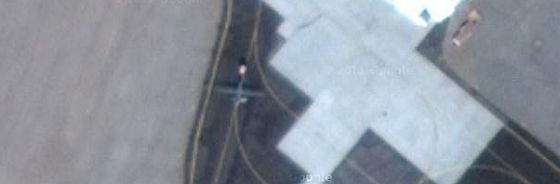
What appears to be a General Atomics MQ-1 Predator or MQ-9 Reaper UAV being towed on the parking ramp, Yucca Lake, Nevada.
Flightglobal reports: A new satellite image of an isolated airstrip in Nevada shows a secret but operational unmanned air vehicle (UAV) test facility. The Yucca Lake airfield, deep inside the heavily restricted Tonopah Test Range, is on land owned by the National Nuclear Security Administration (NNSA), a division of the Department of Energy (DoE), but was constructed and operated by an undisclosed government customer.
The satellite image, taken in early 2011 and available on Google Maps, appears to show a roughly 5,200 ft (1,580m) asphalt runway and what appears to be a General Atomics MQ-1 Predator or MQ-9 Reaper UAV being towed on the parking ramp. The airfield has four hangers of varying sizes, including a hanger with clamshell doors that is characteristic of US UAV operations. Details of the airfield, including a parking lot, security perimeter and ongoing construction are clearly visible.
The hangers could accommodate a total of between 10-15 MQ-9 Reaper aircraft, according to Tim Brown, an imagery analyst with Globalsecurity.org.

Seumas Milne writes: They don’t give up. After a decade of blood-drenched failure in Afghanistan and Iraq, violent destabilisation of Pakistan and Yemen, the devastation of Lebanon and slaughter in Libya, you might hope the US and its friends had had their fill of invasion and intervention in the Muslim world.
It seems not. For months the evidence has been growing that a US-Israeli stealth war against Iran has already begun, backed by Britain and France. Covert support for armed opposition groups has spread into a campaign of assassinations of Iranian scientists, cyber warfare, attacks on military and missile installations, and the killing of an Iranian general, among others.
The attacks are not directly acknowledged, but accompanied by intelligence-steered nods and winks as the media are fed a stream of hostile tales – the most outlandish so far being an alleged Iranian plot to kill the Saudi ambassador to the US – and the western powers ratchet up pressure for yet more sanctions over Iran’s nuclear programme.
The British government’s decision to take the lead in imposing sanctions on all Iranian banks and pressing for an EU boycott of Iranian oil triggered the trashing of its embassy in Tehran by demonstrators last week and subsequent expulsion of Iranian diplomats from London.
It’s a taste of how the conflict can quickly escalate, as was the downing of a US spyplane over Iranian territory at the weekend. What one Israeli official has called a “new kind of war” has the potential to become a much more old-fashioned one that would threaten us all.
The Guardian reports: Republican presidential candidates made a prolonged pitch for the pro-Israel vote on Wednesday with calls for regime change in Iran and even hints at military action.
Newt Gingrich, the leading Republican contender who holds a double digit lead in three of the first four states to hold nomination contests, backed his hawkish position by announcing that if he wins the election he wants his secretary of state to be John Bolton, the abrasive neoconservative and former ambassador to the UN who has derided Palestinian claims to a state as a “ploy”.
Gingrich was speaking to the Republican Jewish Coalition (RJC) in Washington along with other presidential candidates, except Ron Paul who was barred for his views on Israel. Mitt Romney, Rick Perry and Michele Bachmann joined Gingrich in stinging attacks on Barack Obama’s Middle East policy, accusing him of weakness in the face of the Jewish state’s enemies and failing to be sufficiently supportive of Israel.
They also sided with Israel in demanding a much tougher stand against Iran over its nuclear programme.
Gingrich said his aim would be to “overtly sabotage (Iran) every day”.
“The only rational long-time policy is regime replacement,” he said.
Romney demanded “crippling sanctions” against Tehran and suggested the US could resort to force against the nuclear programme.
“Ultimately regime change is necessary. We should make it very clear we are developing and have developed military options,” he said.
The calls were met enthusiastically by the Jewish coalition’s audience but were also aimed at a wider consumption of strongly pro-Israel voters.
The Republican Jewish Coalition has barred Ron Paul, one of the party’s leading presidential contenders, from its forum for the candidates on Wednesday because of his “misguided and extreme views” on Israel.
Paul, who consistently ranks among the favourites in polls of Republican primary voters despite strong libertarian views that have alienated many in his own party, has rankled Israel’s supporters by advocating an end to US aid to the Jewish state. He is also strongly opposed to military action against Iran’s nuclear programme and has drawn attention to Israel’s own atomic weapons which it does not officially acknowledge.
The RJC director, Matt Brooks, said Paul was excluded for those and other views.
“He’s just so far outside of the mainstream of the Republican party and this organisation,” he told CBS.
The Wall Street Journal reports: U.S. officials considered conducting a covert mission inside Iran to retrieve or destroy a stealth drone that crashed late last week, but ultimately concluded such a secret operation wasn’t worth the risk of provoking a more explosive clash with Tehran, a U.S. official said…
The officials considered various options for retrieving the wreckage of the RQ-170 drone.
Under one plan, a team would be sent to retrieve the aircraft. U.S. officials considered both sending in a team of American commandos based in Afghanistan as well as using allied agents inside Iran to hunt down the downed aircraft.
Another option would have had a team sneak in to blow up the remaining pieces of the drone. A third option would have been to destroy the wreckage with an airstrike.
However, the officials worried that any option for retrieving or destroying the drone would have risked discovery by Iran.
“No one warmed up to the option of recovering it or destroying it because of the potential it could become a larger incident,” the U.S. official said.
If an assault team entered the country to recover or destroy the drone, the official said, the U.S. “could be accused of an act of war” by the Iranian government.
The New York Times adds: The stealth C.I.A. drone that crashed deep inside Iranian territory last week was part of a stepped-up surveillance program that has frequently sent the United States’ most hard-to-detect drone into the country to map suspected nuclear sites, according to foreign officials and American experts who have been briefed on the effort.
Until this week, the high-altitude flights from bases in Afghanistan were among the most secret of many intelligence-collection efforts against Iran, and American officials refuse to discuss it. But the crash of the vehicle, which Iranian officials said occurred more than 140 miles from the border with Afghanistan, blew the program’s cover.
The overflights by the bat-winged RQ-170 Sentinel, built by Lockheed Martin and first glimpsed on an airfield in Kandahar, Afghanistan, in 2009, are part of an increasingly aggressive intelligence collection program aimed at Iran, current and former officials say.
The Independent reports: The sharp pop of gunfire draws little reaction. The soldiers of the Free Syrian Army (FSA) point to a multi-storey house just across the wide valley from their base above the village of Ain al-Baida, about a mile from the Turkish border. “That is where the military is,” says commander Abo Mohammad, who wears a camouflage jacket over civilian clothes and cradles an AK-47.
Unlike many of the 150 fighters he claims are positioned in Ain al-Baida, Mr Mohammad has not defected from the Syrian army. Originally from a village not far from this complex of abandoned buildings that houses the FSA fighters, Mr Mohammad says he spent April and May organising peaceful protests against President Bashar al-Assad’s regime.
In June, when the Syrian military’s infamous 4th Brigade came north, leaving a path of destruction in its wake, Mr Mohammad fled to Turkey, spending two months in a refugee camp near the border. But he grew tired of waiting, and returned to Syria to fight.
“People are dying in Syria,” he said. “No one came to help us. I did not accept what is happening. I can’t be patient, I prefer to die here.”
He is one of a growing number of civilians leaving their homes and joining the military defectors who make up the bulk of the FSA, a symbol of both the powerful hatred many ordinary Syrians feel towards the Assad regime and of how far the country has slid towards civil war.
J.A. Myerson writes: Yesterday, no one had lived in 702 Vermont Street for three years. Vermont Street sits in East New York, the Brooklyn neighborhood where foreclosures are five times more frequent than in the rest of the state. Today, Alfredo and Tasha and their son and daughter moved in, with the help of a number of friends whom they’d never met. Some were from the advocacy groups Picture the Homeless and Vocal New York, others were clergy or members of the city council. They had been organized and brought together by Occupy Wall Street for a national day of action to promote foreclosure resistance, an event kicking off a project they call Occupy Our Homes.
Alfredo, Tasha and the kids, way back yesterday, were homeless, having been foreclosed upon by a bank and hundreds upon hundreds of people who had never heard of them came to East New York today to get them a home. Occupy Wall Street is itself somewhat homeless these days, having been evicted from Zuccotti Park on the orders of the 12th-richest man in the United States. A few weeks ago, the media tycoon in question deployed what he openly calls his “army” to dispossess the occupation, including, naturally, everyone who called it their home. Much wondering has been going on in the press about what Occupy Wall Street would do now that it was homeless. Today’s answer seems to have been: get other people homes.
Mehdi Hasan writes: On Friday 11 February, thousands of Arabs spilled on to the streets of the Middle East’s capitals, from Rabat to Amman, to celebrate the downfall of the Egyptian dictator Hosni Mubarak. Doha, in the sleepy Gulf emirate of Qatar, was no different: hundreds of youths brought traffic to a standstill on the coastal Corniche Road. Shortly before midnight, some of them recognised one of the drivers stuck in the jam: the then Al Jazeera director general, Wadah Khanfar, who was on his way home from the network’s headquarters to grab a few hours sleep. After pulling him out of his car, dozens of Qataris queued up to hug and kiss him and thank him for his channel’s unrelenting, round-the-clock coverage of the uprisings in Cairo and Tunis.
“I wept,” recalls Khanfar, seven months later, when I meet him in the café of a central-London hotel. “I was very emotional.” He pauses. “In the Arab world, journalism really is an issue of life and death.”
He isn’t exaggerating. So far this year, Al Jazeera’s correspondents and producers across the Middle East have been harassed, arrested, beaten and, in the case of the cameraman Ali Hassan al-Jaber, killed (by pro-Gaddafi fighters in Libya). As Arab governments toppled from Tunisia to Egypt to Libya – and, last month, Yemen – Al Jazeera has been on hand to beam the pictures of ecstatic protesters, revolutionaries and rebels into the living rooms of ordinary Arabs across the region – and beyond. In Tunisia, the network picked up camera-phone footage from Facebook and other social-networking sites of the riots and protests that took place in the wake of the fruit-seller Mohamed Bouazizi’s self-immolation in December 2010, and gave them a regional prominence they otherwise would not have achieved.
In Egypt, for 18 days straight, Al Jazeera’s cameras broadcast live from Cairo’s Tahrir Square, giving a platform to the demonstrators, while documenting the violence of the Mubarak regime and its supporters.
“The protests rocking the Arab world this week have one thread uniting them: Al Jazeera,” the New York Times observed on 27 January, as it reported on how the channel’s coverage had “helped propel insurgent emotions from one capital to the next”. “They did not cause these events,” argued Marc Lynch, a professor of Middle East studies at George Washington University, “but it’s almost impossible to imagine all this happening without Al Jazeera.” Or, as a spokesman for WikiLeaks tweeted: “Yes, we may have helped Tunisia, Egypt. But let us not forget the elephant in the room: Al Jazeera + sat dishes.”
Al Jazeera reports: Teachers, professors, politicians, doctors, athletes, students and others have all appeared in Bahrain’s military courts. In just two weeks, 208 people were sentenced or lost appeals, leading to a cumulative total of just less than 2,500 years in prison.
Many of those imprisoned took part in massive pro-democracy protests earlier this year. Others, families say, were in the wrong place at the wrong time and were targeted by virtue of their religious sect.
One lawyer, who represents dozens of the convicted and who asked not to be named, told Al Jazeera the total number of how many have stood in front of military courts is not clear – but he estimates at least 600. “Well over 1,000 people have been arrested since the crackdown began,” he said.
In an attempt to quell the uprising, the island’s rulers invited Saudi and other Gulf troops to Bahrain in March and called for a three-month state of emergency, or what it called the “National Safety Law”.
With the emergency law, came the military trials of hundreds of people in “National Safety Courts”. According to the lawyer, the courts were basically military courts, since both judge and general prosecutor were drawn from the military judicial system.
Death sentences were given out from trials that lasted less than two weeks. Many hearings lasted only a matter of minutes before verdicts were handed out. According to lawyers and defendants’ families, the main form of evidence in most cases were the confessions of the accused.
Haaretz reports: Arsonists attempted to set fire to a Palestinian mosque, Israeli police and residents of a West Bank village near the settlement of Ariel said on Wednesday.
Residents of the Palestinian village of Burkina discovered that two vehicles were torched overnight, and that there had been attempt to burn the local mosque as well, succeeding only in burning its entrance.
The mosque itself was sprayed with graffiti denouncing the head of the Shin Bet’s Jewish division, responsible for tracking extremist activity.
Mayor of Burkina village Accra Samara says a flaming tire was thrown into the entrance of the mosque.
Israeli police spokeswoman Cuba Samurai says they are investigating the incident.
Hard-line Jewish youths are suspected to be behind a series of attacks against Palestinians and their property, including several mosques.
Two months ago, the mosque in the Bedouin village of Tuba-Zangariyya was set on fire in a suspected “price tag” attack by settlers angry at Israeli policy.
Haaretz also reported: Israel Defense Forces spokesman said on Tuesday that three soldier had been arrested Monday on suspicion of involvement in the recent ‘price tag’ attacks in the West Bank, with two other soldiers arrested as well.
The suspect is a known West Bank activist, who was also recently investigated for forging an official document, in an unrelated case. He is linked to sabotaging IDF vehicles in the West Bank base of the Benyamin brigade, where he served up until two months prior to a price tag attack of the facility.
At Commentary (this may be the one and only time I link there), Jonathan Tubin writes:
In the immediate aftermath of the news about the appalling statements of Howard Gutman, the U.S. ambassador to Belgium, about Israel being to blame for anti-Semitism, there were those who assumed the envoy would soon be packing his bags for home. But a statement issued today by the State Department indicates that Gutman, who purchased his post by bundling more than half a million dollars in campaign contributions for President Obama, has nothing to worry about. State Department spokesman Mark Toner said Monday Gutman would remain in his post and asserted that although Gutman’s appearance was in his official capacity, the views he expressed were his own. He also declined to say if the administration disagreed with those views.
To grip the meaning of many a commonplace word, it’s often useful to look at its etymology.
The political arena is filled with people who say they are appalled about this and that and nothing generates appall more swiftly than a hint of antisemitism.
But did anyone faint yet? Because that’s what it means — to be appalled is to grow pale as one is about to faint.
Maybe at the next GOP presidential debate the moderator should be ready to pass around the sniffing salts just in case the name Gutman comes up and several of the candidates start to keel over.
The immediate audience that heard Gutman’s remarks in Belgium was apparently made of sterner stuff. None of them fainted but Ynet reports they were stunned.
The conference was attended by Jewish lawyers from across Europe. The legal experts at the event were visibly stunned by Gutman’s words, and the next speaker offered a scathing rebuttal to the envoy’s remarks.
“The modern Anti-Semite formally condemns Anti-Semitism and the Holocaust and expresses upmost sympathy with the Jewish people. He simply has created a new species, the “Anti-Zionist” or – even more sophisticated – the so-called ‘Israel critic,’” Germany attorney Nathan Gelbart said.
“The ‘Israel critic’ will never state ‘Jews go home’ but is questioning the legality of the incorporation of the State of Israel and therefore the right for the Jewish people to settle in their homeland. He will not say the Jews are the evil of the world but claim that the State of Israel is a major cause for instability and war in the region,” he said. “There is no other country, no other people on this planet the ‘Israel critic’ would dedicate so much time and devotion as to the case of Israel.”
“For no other country he would criticize or ask to boycott its goods or academics. And this for one simple reason: Because Israel is the state of the Jewish people, not more and not less,” Gelbart said.
I imagine a lot of people coming to this site would perceive me as an “Israel critic”, but apparently no such thing really exists. Israel critics, Gelbart and others insist, are really secret Jew haters.
If Gelbart is right and Israel provides the last remaining pretext for the perpetuation of antisemitism, then rational antisemites should really be defending Israel because if the hatred that dare not speak its name could not channel itself through animosity towards Israel, where would it be able to turn? I guess hatred by its nature is always irrational.
Of course there are quite a few thoroughly rational antisemites who say Israel is the only place on the planet in which Jews should live. What’s confusing to the rest of us is that this group of antisemites rarely get tarred with that name. Instead, they’re usually referred to as Zionists.
But returning to the ‘Israel critic’ for whom this identity is nothing more than a convenient disguise, are we to infer that Israel cannot in fact have any genuine critics and thus infer from that that any criticism of Israel is baseless?
Oh no! Israel’s defenders loudly protest. It’s OK to criticize Israel, but…
Really? Tell me the ways, because from those who claim it’s OK to criticize Israel I don’t actually hear any criticism of Israel. I hear the defense of a victimized little nation that has no other interest than to mind its own business; a victimized people who desire nothing more than to live at peace with their neighbors. I hear the tireless promotion of a model democracy with the most moral army in the world.
The nakba? How dare you use that word! Gaza under siege — no such thing. A whole population living under military rule — we just want peace.
Forever the return to the perfectly armored defense: they do not criticize us because of what we do; they attack us because of who we are.
And anyone convinced of that will forever remain deaf to their critics.