Anthony Shadid reports: The Syrian government has launched a bloody assault to retake Homs, the country’s third-largest city, facing armed defectors who have prevented the government’s forces from seizing it as they did other restive locales this summer, in what may stand as one of the most violent episodes in an eight-month uprising.
The specter of civil war has long hung over Homs, the most tenacious and determined of cities opposed to President Bashar al-Assad’s rule, where the city’s Sunni Muslim majority has closed ranks behind the revolt. This month, parts of the city have become an urban battlefield, with activists saying government forces have killed 111 people in just five days, opposition groups warning of dire shortages forced by the siege and residents complaining of lawlessness by marauding soldiers and paramilitary fighters.
The strife comes as mediation by the Arab League has apparently collapsed in one of the latest efforts to end what is among the most ferocious crackdowns on the revolts sweeping the Arab world this year. The government has increasingly demonstrated it will continue to try to stanch dissent by force, ignoring the relatively muted protests of the international community.
As important, in a country fraught with fears of a broader civil war, Homs may be emerging as an example to the rest of Syria of the relative success of fighting back against a military that, while still unified, has suffered more defections as fighting persists and more than 3,000 civilians have been killed.
“Homs is a turning point for now,” said an analyst based in Damascus who spoke on the condition of anonymity. “It’s a successful model of self-defense, if you will, at a time when you really can’t expect people to take any more. They’ve seen too many corpses come back, too many people arrested, disappeared or returned after abominable treatment. It’s too much. And everybody seems to be losing control of the street.”
Gender apartheid on the rise in Israel

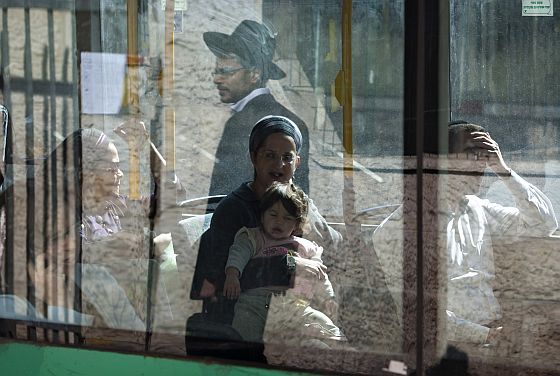
Women required to sit out of men's sight, at the back of the bus.
The Associated Press reports: Posters depicting women have become rare in the streets of Israel’s capital. In some areas women have been shunted onto separate sidewalks, and buses and health clinics have been gender-segregated. The military has considered reassigning some female combat soldiers because religious men don’t want to serve with them.
This is the new reality in parts of 21st-century Israel, where ultra-Orthodox rabbis are trying to contain the encroachment of secular values on their cloistered society through a fierce backlash against the mixing of the sexes in public.
On the surface, Israel’s gender equality bona fides seem strong, with the late Golda Meir as a former prime minister, Tzipi Livni as the current opposition leader, and its women soldiers famed around the world.
Reality is not so shiny. The World Economic Forum recently released an unfavorable image of women’s earning power in Israel, and in 2009, the last year for which data are available, Israeli women earned two-thirds what men did.
The newly enforced separation is felt most strongly in Jerusalem, where ultra-Orthodox Jews are growing in numbers and strength. The phenomenon is starting to be seen elsewhere, though in the Tel Aviv region, Israel’s largest metropolis, secular Jews are the vast majority, and life there resembles most Western cities.
Still, secular Jews there and elsewhere in Israel worry that their lifestyles could be targeted, too, because the ultra-Orthodox population, while still relatively small, is growing significantly. Their high birthrate of about seven children per family is forecast to send their proportion of the population, now estimated at 9 percent, to 15 percent by 2025.
The flotilla and the siege of Gaza
Sarkozy tells truth about Netanyahu but press decide it’s too sensitive to report

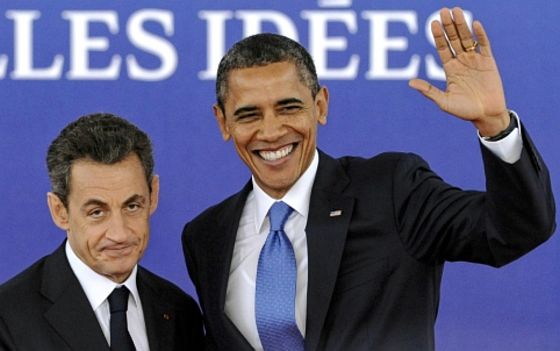
Sarkozy tells Obama, Netanyahu's a liar. Journalists blush.
“Who the fuck does he think he is? Who’s the fucking superpower here?” Bill Clinton said in exasperation about Benjamin Netanyahu after one of the Israeli prime minister’s characteristic displays of arrogance in 1996.
Now we learn that last Thursday at the G20 summit in Cannes, France’s President Nicolas Sarkozy privately described Netanyahu as a “liar” and said “I cannot stand him,” to which President Obama gave the fairly tepid response: “You’re fed up with him, but I have to deal with him every day!”
The exchange was picked up on an open microphone but the press in Cannes who overheard the presidential tête-à-tête agreed that it was too sensitive to report.
Are these journalists or presidential courtiers?
The surprising lack of coverage may be explained by a report alleging that journalists present at the event were requested to sign an agreement to keep mum on the embarrassing comments. A Reuters reporter was among the journalists present and can confirm the veracity of the comments.
A member of the media confirmed Monday that “there were discussions between journalists and they agreed not to publish the comments due to the sensitivity of the issue.”
He added that while it was annoying to have to refrain from publishing the information, the journalists are subject to precise rules of conduct.
Like when they are supposed to curtsy, make full bows, or discreetly look the other way?
Even now, now that the Sarkozy-Obama indiscretion has leaked out, there are several variations of translation of what Obama said.
“You may be sick of him, but me, I have to deal with him every day.” “You’ve had enough of him? I have to deal with him every day!”
These are different ways of translating “Tu en as marre de lui, mais moi, je dois traiter avec lui tous les jours !” That’s how Obama’s words were rendered on ArretSurImages.net.
So even though the press has broken its four day silence, instead of reporting the exact wording — words surely spoken in English — the press is merely repeating what has been reported on the French website — and even though the contents of that report have been confirmed by Reuters.
Watch out for the word sensitivity in any news report. Chances are, what it really refers to is complicity.
Europe’s rising Facebook fascism
The Guardian reports: The far right is on the rise across Europe as a new generation of young, web-based supporters embrace hardline nationalist and anti-immigrant groups, a study [PDF] has revealed ahead of a meeting of politicians and academics in Brussels to examine the phenomenon.
Research by the British thinktank Demos for the first time examines attitudes among supporters of the far right online. Using advertisements on Facebook group pages, they persuaded more than 10,000 followers of 14 parties and street organisations in 11 countries to fill in detailed questionnaires.
The study reveals a continent-wide spread of hardline nationalist sentiment among the young, mainly men. Deeply cynical about their own governments and the EU, their generalised fear about the future is focused on cultural identity, with immigration – particularly a perceived spread of Islamic influence – a concern.
“We’re at a crossroads in European history,” said Emine Bozkurt, a Dutch MEP who heads the anti-racism lobby at the European parliament. “In five years’ time we will either see an increase in the forces of hatred and division in society, including ultra-nationalism, xenophobia, Islamophobia and antisemitism, or we will be able to fight this horrific tendency.”
The report comes just over three months after Anders Breivik, a supporter of hard right groups, shot dead 69 people at youth camp near Oslo. While he was disowned by the parties, police examination of his contacts highlighted the Europe-wide online discussion of anti-immigrant and nationalist ideas.
Data in the study was mainly collected in July and August, before the worsening of the eurozone crisis. The report highlights the prevalence of anti-immigrant feeling, especially suspicion of Muslims. “As antisemitism was a unifying factor for far-right parties in the 1910s, 20s and 30s, Islamophobia has become the unifying factor in the early decades of the 21st century,” said Thomas Klau from the European Council on Foreign Relations, who will speak at Monday’s conference.
How the U.S. is blending law enforcement with warfare
The New York Times reports: Late on a moonless night last March, a plane smuggling nearly half a ton of cocaine touched down at a remote airstrip in Honduras. A heavily armed ground crew was waiting for it — as were Honduran security forces. After a 20-minute firefight, a Honduran officer was wounded and two drug traffickers lay dead.
Several news outlets briefly reported the episode, mentioning that a Honduran official said the United States Drug Enforcement Administration had provided support. But none of the reports included a striking detail: that support consisted of an elite detachment of military-trained D.E.A. special agents who joined in the shootout, according to a person familiar with the episode.
The D.E.A. now has five commando-style squads it has been quietly deploying for the past several years to Western Hemisphere nations — including Haiti, Honduras, the Dominican Republic, Guatemala and Belize — that are battling drug cartels, according to documents and interviews with law enforcement officials.
The program — called FAST, for Foreign-deployed Advisory Support Team — was created during the George W. Bush administration to investigate Taliban-linked drug traffickers in Afghanistan. Beginning in 2008 and continuing under President Obama, it has expanded far beyond the war zone.
“You have got to have special skills and equipment to be able to operate effectively and safely in environments like this,” said Michael A. Braun, a former head of operations for the drug agency who helped design the program. “The D.E.A. is working shoulder-to-shoulder in harm’s way with host-nation counterparts.”
The evolution of the program into a global enforcement arm reflects the United States’ growing reach in combating drug cartels and how policy makers increasingly are blurring the line between law enforcement and military activities, fusing elements of the “war on drugs” with the “war on terrorism.”
Here comes the sun
Paul Krugman writes: These days, mention solar power and you’ll probably hear cries of “Solyndra!” Republicans have tried to make the failed solar panel company both a symbol of government waste — although claims of a major scandal are nonsense — and a stick with which to beat renewable energy.
But Solyndra’s failure was actually caused by technological success: the price of solar panels is dropping fast, and Solyndra couldn’t keep up with the competition. In fact, progress in solar panels has been so dramatic and sustained that, as a blog post at Scientific American put it, “there’s now frequent talk of a ‘Moore’s law’ in solar energy,” with prices adjusted for inflation falling around 7 percent a year.
This has already led to rapid growth in solar installations, but even more change may be just around the corner. If the downward trend continues — and if anything it seems to be accelerating — we’re just a few years from the point at which electricity from solar panels becomes cheaper than electricity generated by burning coal.
And if we priced coal-fired power right, taking into account the huge health and other costs it imposes, it’s likely that we would already have passed that tipping point.
But will our political system delay the energy transformation now within reach?
Let’s face it: a large part of our political class, including essentially the entire G.O.P., is deeply invested in an energy sector dominated by fossil fuels, and actively hostile to alternatives. This political class will do everything it can to ensure subsidies for the extraction and use of fossil fuels, directly with taxpayers’ money and indirectly by letting the industry off the hook for environmental costs, while ridiculing technologies like solar.
So what you need to know is that nothing you hear from these people is true. Fracking is not a dream come true; solar is now cost-effective. Here comes the sun, if we’re willing to let it in.
11-11-11 — Night of a thousand masks
The politics of austerity
Thomas B. Edsall writes: The conservative agenda, in a climate of scarcity, racializes policy making, calling for deep cuts in programs for the poor. The beneficiaries of these programs are disproportionately black and Hispanic. In 2009, according to census data, 50.9 percent of black households, 53.3 percent of Hispanic households and 20.5 percent of white households received some form of means-tested government assistance, including food stamps, Medicaid and public housing.
Less obviously, but just as racially charged, is the assault on public employees. “We can no longer live in a society where the public employees are the haves and taxpayers who foot the bills are the have-nots,” declared Scott Walker, the governor of Wisconsin.
For black Americans, government employment is a crucial means of upward mobility. The federal work force is 18.6 percent African-American, compared with 10.9 percent in the private sector. The percentages of African-Americans are highest in just those agencies that are most actively targeted for cuts by Republicans: the Department of Housing and Urban Development, 38.3 percent; the Equal Employment Opportunity Commission, 42.4 percent; and the Education Department, 36.6 percent.
The politics of austerity are inherently favorable to conservatives and inhospitable to liberals. Congressional trench warfare rewards those most willing to risk all. Republicans demonstrated this in last summer’s debt ceiling fight, deploying the threat of a default on Treasury obligations to force spending cuts.
Conservatives are more willing to inflict harm on adversaries and more readily see conflicts in zero-sum terms — the basic framework of the contemporary debate. Once austerity dominates the agenda, the only question is where the ax falls.
Syrian troops crush opposition in key Homs neighborhood
The Washington Post reports: Syrian troops on Monday routed government opponents in a neighborhood of Homs that had emerged in recent weeks as a center of armed resistance to the regime led by President Bashar al-Assad, dealing what appeared to be a serious setback to the protest movement and to an Arab League peace initiative designed to end the violence.
Homs residents and human rights groups said security forces stormed the Bab al-Amr neighborhood in the small hours of the morning, concluding a six-day assault in which dozens were killed and scores injured, many of them in tank bombardments.
Defected soldiers who had been defending the protest hot spot either fled to the surrounding countryside or were captured or killed, said residents and activists. Syrian troops combed through the neighborhood Monday detaining all the young men they encountered, and government supporters staged a noisy demonstration through the deserted streets.
The assault came as Assad’s government braced for the potential fallout from its failure to abide by the terms of an Arab League-sponsored peace initiative agreed to last Wednesday. Under the deal, Syria was to withdraw troops from cities, allow peaceful protests and release detainees.
Instead, the army launched an offensive in Homs, surrounding Bab al-Amr on the eve of the league’s announcement of the deal in Cairo and bombarding it with tank fire.
The offensive was accompanied by a surge in retaliatory sectarian killings in which hospital workers and human rights groups have said at least 70 people died, illustrating the potential for this religiously mixed city in the heart of Syria to serve as a crucible for a civil war many have feared since the uprising erupted in March.
The Arab world’s intifada
Phyllis Bennis writes: The “Arab spring” may have started in early 2011 when a young Tunisian fruit seller, in a desperate response to disempowerment and despair, immolated himself in the streets of a small town. But its origins link directly to the first Palestinian intifada, the non-violent, society-wide mobilization that transformed Palestine’s national struggle beginning in the late 1980s. Palestinian activists chose “uprising” as the logical English equivalent, but Arabic speakers were clear that intifada didn’t really mean that. It meant something closer to “shake up” or “shaking out”–exactly what Occupy Wall Street has done to the US body politic, and what the Arab spring has set loose in a region long trapped in the morass of US-backed military dictatorships, absolute monarchies, and repressive nationalists.
So when US analysts or European journalists or World Bank bureaucrats ruminate about “when will there be a Palestinian spring?”, it’s generally because they have no historical context, no idea that Palestine’s first intifada spring in many ways set the stage for this Arab spring more than two decades later. For Palestine and Palestinians, the shaking up of the region has provided one of the most comprehensive–and positive–changes in a generation: the end (or at least the beginning of the end) of the era of US-dependent Arab regimes whose commitments to Palestinian liberation were limited to a few dollars and the rhetoric useful for distracting their own populations from state repression, lack of rights and inadequacies of their own lives.
Civil society has risen to become the most important component of the Palestinian national movement–and not only because of the 20 years of failure of the US-controlled “peace process”. It’s also because the most creative and strategic ideas for achieving Palestinian human rights have come from civil society, not from the leadership recognized (or not) by the world’s governments. Beginning with the 2005 call for a global mobilization for BDS (boycott, divestment and sanctions), Palestine’s civil society organizations have been at the centerpiece of the growing international movement to bring non-violent economic pressure to bear on Israel until it ends its violations of international law: ending the occupation of the 1967 territories, ending the legal discrimination against Palestinian citizens of Israel, and recognizing the right of return of Palestinian refugees.
Why are we being readied for war with Iran?
If you want to start a war with Iran, apparently the lesson from Iraq is not that war is a dumb idea; it’s that the war charge cannot be led by the U.S. administration or a ragtag band of expatriates.
The pretext for war needs to be presented by an international body that is perceived as independent and objective. So, if you want to start a war with Iran, who could present a more compelling justification for war than the International Atomic Energy Agency?
But can the U.S. government rely on the IAEA to fulfill its covertly designated role?
Now that the irritatingly independent Mohamed ElBaradei is out of the way, we know — thanks to Wikileaks — that Washington is much more comfortable with the agency’s new director general, Yukiya Amano, who is “solidly in the U.S. court on every key strategic decision, from high-level personnel appointments to the handling of Iran’s alleged nuclear weapons program.”
The Obama administration, as well as being able to rely on the IAEA to align itself with U.S. goals, can of course always rely on the New York Times to fulfill its role as an informal ministry of information. Just as Izvestia functioned as the “delivered message” of the Soviet government, reporters like David Sanger gladly parrot their administration sources rather than question what they are being told.
[T]he Obama administration, acutely aware of how what happened in Iraq undercut American credibility, is deliberately taking a back seat, eager to make the conclusions entirely the I.A.E.A.’s, even as it continues to press for more international sanctions against Iran. When the director of the agency, Yukia Amano, came to the White House 11 days ago to meet top officials of the National Security Council about the coming report, the administration declined to even confirm he had ever walked into the building.
The final touches are still being put on the report and its critical annex, where some of the investigative details will be laid out, which may be released as early as Wednesday. But already Russia and China have sent a diplomatic protest to Mr. Amano, urging him to not to make details of the evidence public.
“Russia and China are of the opinion that such kind of report will only drive Iran into a corner,” they wrote in the note, which was obtained by The New York Times and is a rare instance of those countries commenting jointly.
Obtained by the New York Times — but from who?
Knowing how a piece of information enters the public domain can be as important as the information itself. If these reporters gave some indication about where the note came from, they would thereby provide a clearer indication about whose agenda is being served by its revelation.
Sources do of course often need to be concealed and over at Arms Control Wonk, Jeffrey Lewis obliges “an observer” by allowing him to remain nameless. Regular readers of ACW will know, however, that this is a blog not only with stellar contributors but also a highly informed readership. This observer writes:
For some reason, everyone and his cousin are suddenly seized the idea that there must be an urgent need to (at a minimum) contemplate whether to bomb Iran. No one can quite say why now, though. As Ari Shavit writes in Ha’aretz, with an impressive combination of eloquence and lack of substance:
For the past decade it has been clear that we are facing an Iranian deadline. Time after time the deadline has been put off. But it is real and it is imminent. Unless an international miracle, or an interior-Iranian miracle takes place, we will reach the crossroads.
‘When we stand at the crossroads we will have two options – prevention or deterrence. To launch a military offensive or to emerge from nuclear ambiguity. One way or another, all chaos will break loose in the Middle East. One way or another, all chaos will break loose in Israel. What was will be no more. A new era will begin.’
But just what technical or political fact has brought the deadline to the crossroads?
Why, exactly, is there an insistence that Iran is racing up to some undefined sharply defined point where its adversaries, Israel included, must either strike preventively or accept an uneasy relationship of mutual (nuclear) deterrence? If Iran is racing, so were Achilles and the Tortoise. It’s more like tiptoeing.
Shavit is now the umpty-teenth commentator, Israeli or otherwise, who apparently cannot imagine that nuclear opacity or ambiguity could apply to states other than Israel.
The drumbeat for war against Iran suggests that not only do Iran’s enemies regard the Islamic state’s acquisition of nuclear weapons as intolerable, but Tehran must be punished simply for its lack of transparency.

Escalating Israeli settler violence in the West Bank

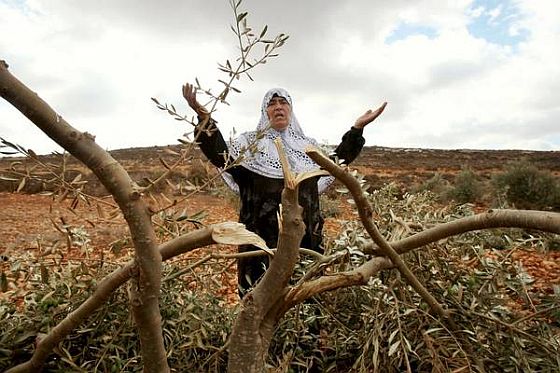
A Palestinian woman gestures next to a damaged olive tree in the village of Qusra in the northern West Bank, Thursday, Oct . 6, 2011
The United Nations Office for the Coordination of Humanitarian Affairs occupied Palestinian territory, says in its latest report [PDF]:
- The weekly average of settler attacks resulting in Palestinian casualties and property damage has increased by 40% in 2011 compared to 2010, and by over 165% compared to 2009.
- In 2011, three Palestinians have been killed and 167 injured by Israeli settlers. In addition, one Palestinian has been killed, and 101 others injured, by Israeli soldiers during clashes between Israeli settlers and Palestinians.
- Eight Israeli settlers have been killed and 30 others injured by Palestinians in 2011, compared to five killed and 43 injured, during the same period in 2010.
- In 2011, nearly 10,000 Palestinian-owned trees, primarily olive trees, have been damaged or destroyed by Israeli settlers, significantly undermining the livelihoods of hundreds of families.
- In July 2011, a community of 127 people was displaced en masse due to repeated settler attacks, with some affected families re-locating to Areas A and B.
- Over 90% of monitored complaints regarding settler violence filed by Palestinians with the Israeli police in recent years have been closed without indictment.
- OCHA has identified over 80 communities with a combined population of nearly 250,000 Palestinians vulnerable to settler violence, including 76,000 who are at high-risk.
(H/t 972mag.com)
Inside Story – Syria and the Arab League
Unholy alliance: Israel’s right and Europe’s anti-Semites

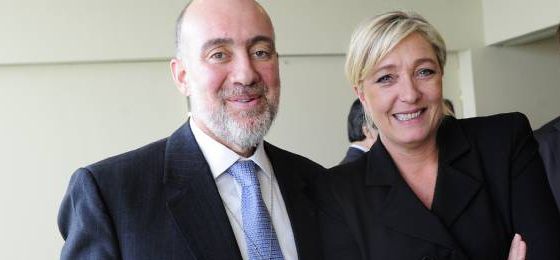
Israel's ambassador to the UN Ron Prosor accidentally smiles while rubbing shoulders with French ultra-right leader Marine Le Pen.
Adar Primor writes: Marine Le Pen hit the jackpot. She invited about 100 diplomats to a luncheon last week during a visit to UN Headquarters in New York. Four accepted: There were the envoys from Trinidad and Tobago, Armenia and Uruguay, who obviously are of no concern to her at all. But the entrance of the fourth guest, Israeli UN Ambassador Ron Prosor, made the event a sensation and worth her whole trip.
No official American representative agreed to meet with France’s extreme-right leader. Neither did any leader of the Jewish community. She failed in her attempt to stage a photo op at the Holocaust Museum, and skipped the visit. The French ambassador to the UN sent a sharp message that she is persona non grata in the United Nations building. But the Israeli envoy? He shook her hand and spoke of the importance that must be accorded to a wide variety of opinions.
“We flourish on the diversity of ideas,” Prosor said. “We talked about Europe, about other issues and I enjoyed the conversation very much,” Prosor was quoted as saying. Even before he went into the hall where the luncheon was being held, he told shocked reporters that he was a “free man.”
The Foreign Ministry now claims there was a misunderstanding; the ambassador “thought he was attending an event hosted by the French UN delegation. When he realized his error, he skipped the meal and left.” User comments on leading French news websites over the weekend were derisive, including all the French equivalents of LOL and ROFL in response to the explanation.
No one believes it was a coincidence. Prosor is a proven professional. He would certainly want to forget the fact that he became the first representative of the Jewish state to meet with a leader of the National Front. He would probably be happy to smash the camera that documented the smiling encounter. But his mistake did not happen in a vacuum. It has the odor of a symptom. The odor of a very unholy alliance being formed between members of the Israeli right-wing and a number of the most nationalistic and anti-Semitic figures in Europe. Over the past year, among visitors to Israel were the populist Dutch leader Geert Wilders, the Belgian racist Filip Dewinter and the Austrian successor to Jorg Haider, Heinz-Christian Strache.
These politicians, like Le Pen, have exchanged the Jewish demon-enemy for the criminal-immigrant Muslim. But they have not really discarded their ideological DNA. The Israeli seal of approval they seek to get is intended to bring them closer to power. Le Pen herself has decided to leave behind the anti-Semitic scandals of her father, Jean-Marie. She wants to make the National Front a popular and legitimate party.
She is already popular (19 percent in the polls). Legitimate? In two interviews she gave to Haaretz in the past, she attacked President Jacques Chirac for his historic 1995 declaration in which he took, in the name of France, responsibility for Vichy war crimes. She adamantly refused to denounce French fascist crimes and showed that she cannot really disengage from her father, his heritage and her party’s Vichy and anti-Semitic hard core.
It is easy to guess what would happen to an Israeli ambassador if he found himself at an event hosted by the “disgraced” Palestinian Authority President Mahmoud Abbas – or, perish the thought, at a Hamas or Hezbollah event. The earth would tremble. Even tar and feathers would not be enough under such circumstances. But Le Pen is blonde and she has blue eyes. Oh, and she hates Muslims.
Let us hope the incident at the United Nations will not give her votes that will allow her to repeat her father’s sensational results in the 2002 French presidential elections, and go on to a second round in the upcoming French elections.
We must see a complete and public disavowal by Israel to prevent an ostensibly minor incident from becoming an accident of history.
Israeli security websites crash after Anonymous threat
On Friday, Anonymous accused Israel of engaging in “piracy on the high seas” after the Israeli navy intercepted the latest flotilla heading for Gaza and warned that it would “strike back”.
Today the following Israeli government websites crashed: Shin Bet, Mossad, IDF, IDF Spokesperson’s Unit, Health Ministry, Justice Ministry, Construction and Housing Ministry, Science and Sport’s Ministry, the President’s Residence, Immigration Authority, the Israel Land Administration and Israel Atomic Energy Commission.
The Deputy Director of the Israeli government’s Information Technology Unit, Ziv Slater, said: “It has nothing to do with an attack, no threat and no hacking. It’s just a systems malfunction.”
“If you continue blocking humanitarian vessels to Gaza or repeat the dreadful actions of May 31st, 2010 against any Gaza Freedom Flotillas then you will leave us no choice but to strike back. Again and again, until you stop,” Anonymous has warned.
Is today’s “system’s malfunction” the first of what will become many?
Welcome to the “augmented revolution”
Nathan Jurgenson writes: Earlier this year, there was a spat that was both silly and superficial over the terms “Twitter” and “Facebook Revolution” to capture protests in the Arab World. On the one hand, those terms offensively reduced a vast political movement to a social networking site. On the other, Malcolm Gladwell’s response — that there was protest before social media, therefore social media had no role — was equally unfulfilling.
Neither view captured the way technology has been utilized in this global wave of dissent. We are witnessing political mobilizations across much of the globe, including the Middle East, North Africa, Asia and South America. Riots and “flash mobs” are increasingly making the news. In the United States the emergence of the Occupy movement shows that technology and our global atmosphere of dissent is the effective merging of the on- and offline worlds. We cannot only focus on one and ignore the other.
It is no historical coincidence that the rise of social media will be forever linked with the global spread of mass mobilizations of people in physical space that we are witnessing right now. Social media is not some space separate from the offline, physical world. Instead, social media should be understood as the effective merging of the digital and physical, the on- and offline, atoms and bits. And the consequences of this are erupting around us.
Occupy Wall Street and the subsequent occupation movements around the United States and increasingly the globe might best be called an augmented revolution. By “augmented,” I am referring to a larger conceptual perspective that views our reality as the byproduct of the enmeshing of the on- and offline. This is opposed to the view that the digital and physical are separate spheres, what I have called “digital dualism.” Research has demonstrated that sites like Facebook have everything to do with the offline. Our offline lives drive whom we are Facebook-friends with and what we post about. And what happens on Facebook influences how we experience life when we are not logged in and staring at some glowing screen (e.g., we are being trained to experience the world always as a potential photo, tweet, status update). Facebook augments our offline lives rather than replaces them. And this is why research shows that Facebook users have more offline contacts, are more civically engaged, and so on.
The Robin Hood tax — turning a global crisis into a global opportunity
Learn more about the Robin Hood tax.
Robin Hood tax backed by more than 1,000 economists. (Telegraph)
Bill Gates backs Robin Hood tax on bank trades. (Guardian)
IMF report [PDF] says: “In principle, an FTT is no more difficult and, in some respects easier, to administer than other taxes.”