David Rose writes: One morning in June 2001, three months before the 9/11 attacks on the United States, I happened to be interviewing a senior official from the British Secret Intelligence Service, M.I.6. His current focus was the war on drugs, not international terrorism, but he shared a piece of information that united the two subjects.
A short time earlier, the official told me, the U.S. National Security Agency had intercepted a call between two satellite-telephone users in Afghanistan—the al-Qaeda leader Osama bin Laden and the Taliban leader Mullah Mohammed Omar. They had been discussing the Taliban’s ban on growing opium poppies, imposed the previous summer—a remarkably effective edict that had shrunk production in areas they controlled almost to zero.
According to the M.I.6 official, bin Laden sounded unhappy. “Why stop growing opium?” he asked. “Heroin only weakens our enemies.” There was no need to worry, Mullah Omar replied. The ban was merely a tactic. “There has been a glut, and the price is too low. Once the world price has risen, the farmers can start growing it again.”
The real lesson of this overheard conversation was not its specific content but the fact that it could be heard at all. Electronic eavesdropping clearly had potential in Taliban-controlled Afghanistan. But in the years before 9/11, when bin Laden’s terror plot was first being discussed, that potential remained limited. The reason was simple: Afghanistan had no cell phones, no Internet, and only a rudimentary landline network, which did not work at all outside the country’s largest cities. This could be remedied, however. Indeed, by the end of 1999, the Taliban government had embraced a full-fledged American scheme to install a modern cell-phone-and-Internet system in Afghanistan. It could have been up and running within months. The Taliban had already granted an exclusive license to a U.S.-owned firm, the Afghan Wireless Communications Company.
More to the point, electronic modifications concealed within the circuitry would have allowed every call and every e-mail emanating from Afghanistan to be relayed without interference to N.S.A. headquarters in Fort Meade, Maryland. “This project was a dream,” says one former senior F.B.I. counterterrorism specialist who knew about the scheme at the time. “To be able to wire up a country from ground level up—you don’t get too many opportunities like that.” No, you don’t. But at the critical moment, the Clinton administration put the project on hold, while rival U.S. agencies—the F.B.I., the N.S.A., and the C.I.A.—bickered over who should control it.
In the decade since 9/11, investigations by journalists and government commissions have explored the many missed opportunities to prevent bin Laden’s attacks. Overall, it is the story of a catastrophic failure to connect the dots. One can argue—and many have—that the connections emerge more visibly in retrospect than they ever did as events themselves unfolded. But the affair of the Afghan cell-phone network—put on hold until time ran out—falls into a category by itself. It was a course of action whose value and urgency were acknowledged by everyone, but it was impeded nonetheless. The cell-phone plan “was one tool we could have put in Afghanistan that could have made a difference,” a former C.I.A. official says. “Why didn’t we put it in? Because we couldn’t fucking agree.”
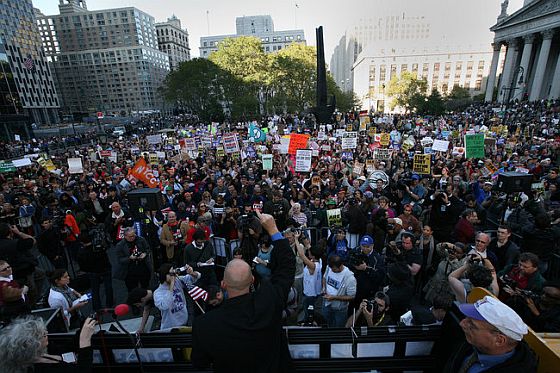
Dylan Ratigan writes: It was late Saturday night at Zuccotti Park, the heart of the Occupy Wall Street protests in New York. “Why are you here?” I asked one of the occupiers. “We are here to defend the American people against an occupying global financial oligarchy!”
“I am choosing to no longer participate in what I perceive to be an abusive relationship,” said Occupier Lopi, a 47-year-old who last year went to Haiti and housed 100 orphans in geodesic domes.
“Our goal to create a massive independent weapon of mass help! We are not intent on destruction. We are intent on confronting and fixing what we all know is a bought government.” another occupier told me. “This is our shared moment to seize prosperity.”
As each occupier bounced around like a water molecule, seeking alignment with those around them, the energy at the park was palpable. Watching the scene around me, one thing became clear to me: that a massive wave of energy is rebelling against the American government, unified in its intention to reject a system that refuses to defend 99% of its citizens.
Glenn Greenwald writes: Here is what the Democratic President has created and implemented, and what many party loyalists explicitly endorse (when there’s a Democrat in the White House) — from Reuters:
American militants like Anwar al-Awlaki are placed on a kill or capture list by a secretive panel of senior government officials, which then informs the president of its decisions . . . . There is no public record of the operations or decisions of the panel, which is a subset of the White House’s National Security Council . . . . Neither is there any law establishing its existence or setting out the rules by which it is supposed to operate. . . . The role of the president in ordering or ratifying a decision to target a citizen is fuzzy. White House spokesman Tommy Vietor declined to discuss anything about the process. . . .
Representative Dutch Ruppersberger, was asked by reporters about the killing. The process involves “going through the National Security Council, then it eventually goes to the president” . . . .Other officials said the role of the president in the process was murkier than what Ruppersberger described. They said targeting recommendations are drawn up by a committee of mid-level National Security Council and agency officials. Their recommendations are then sent to the panel of NSC “principals,” meaning Cabinet secretaries and intelligence unit chiefs, for approval . . . But one official said Obama would be notified of the principals’ decision. If he objected, the decision would be nullified, the official said.
So a panel operating out of the White House — that meets in total secrecy, with no known law or rules governing what it can do or how it operates — is empowered to place American citizens on a list to be killed by the CIA, which (by some process nobody knows) eventually makes its way to the President, who is the final Decider. It is difficult to describe the level of warped authoritarianism necessary to cause someone to lend their support to a twisted Star Chamber like that; I genuinely wonder whether the Good Democrats doing so actually first convince themselves that if this were the Bush White House’s hit list, or if it becomes Rick Perry’s, they would be supportive just the same. Seriously: if you’re willing to endorse having White House functionaries meet in secret — with no known guidelines, no oversight, no transparency — and compile lists of American citizens to be killed by the CIA without due process, what aren’t you willing to support?
There is an illusion of autonomy that allows Israeli governments to defy the United States even while they remain dependent on American military aid and diplomatic protection. Likewise, Jewish settlers living in the West Bank operate as a law unto themselves and defy the state of Israel even while remaining utterly dependent on that state for their security and economic support. In each case, the lesser power manipulates the greater power by threatening to unleash chaos — and these are not empty threats.
After settlers attacked Israeli soldiers yesterday, a senior IDF commander said a red line had been crossed, but has it? Can Israel’s security services reign in lawless settlers when the ranks and officers of those forces are increasingly made up of settlers?
Haaretz reports: Dozens of Jewish settlers surrounded an IDF patrol vehicle on Wednesday evening near the Shilo settlement, setting up roadblocks and physically assaulting IDF soldiers.
The incident began after rumors circulated that the Gal Yosef illegal outpost is about to be evacuated. At approximately 9 P.M. the settlers erected roadblocks and blocked the entrance to the outpost with their cars.
An IDF patrol vehicle that arrived on the scene was blocked by settlers. The soldiers tried to turn back, but were stopped by more roadblocks.
The vehicle was then surrounded by a few dozen youth from nearby settlements. When the soldiers asked them to let the vehicle pass, one of the soldiers was punched in the face, prompting a violent clash between the two sides. Soldiers who were called to the scene were able to detain one of the attackers, but he managed to escape.
A senior IDF commander said that “the army sees this incident as crossing a red line, and the settlers who were involved in violence against the soldiers will be arrested soon by the police.”
Officers serving in the West Bank have reported recently that tensions between security forces and settlers are on the rise. According to one senior office, “the security forces spend more time dealing with incidents involving Israeli citizens than confronting Palestinian terrorism.”
The Gush Shilo area has recently become one of the main friction points between Israeli security forces and settlers. Over the past few weeks, settlers have been attacking Palestinian farmers’ property in the nearby village of Qusra, almost on a daily basis. On Thursday morning, villagers discovered some 200 olive and fig trees were uprooted or damaged throughout the night.
According to a recent Shin Bet security service report, right-wing extremists no longer appear to need a “trigger” to take action, while the targets of the violence are also widening – military vehicles at an IDF base near Ramallah have been vandalized, and threatening graffiti was sprayed onto the apartment door of a left-wing activist. Attacks on Arabs and their property are carried out when the opportunity arises, the Shin Bet officials add.
The Shin Bet also warned that the delegitimization campaign that extreme right-wing activists are conducting against civil servants could end in serious violence.
Matt Stoller writes: What do the people at #OccupyWallStreet actually want? What are their demands? For many people, this is THE question.
So let me answer it. What they want… is to do exactly what they are doing. They want to occupy Wall Street. They have built a campsite full of life, where power is exercised according to their voices. It’s a small space, it’s a relatively modest group of people at any one time, and the resources they command are few. But they are practicing the politics of place, the politics of building a truly public space. They are explicitly rejecting the politics of narrow media, the politics of the shopping mall. To understand #OccupyWallStreet, you have to get that it is not a media object or a march. It is first and foremost, a church of dissent, a space made sacred by a community. But like Medieval churches, it is also now the physical center of that community. It has become many things. Public square. Carnival. Place to get news. Daycare center. Health care center. Concert venue. Library. Performance space. School.
Few people, though an increasing number daily, have actually taken the time to go through a general assembly, to listen to what the people at #OccupyWallStreet actually want. General assemblies are the consensus-oriented group conversations at the heart of the occupations, where endlessly repeating the speaking of others is the painstaking and frustrating way that the group comes to make decisions. I spoke with a very experienced older DC hand who told me that he hasn’t been because he doesn’t have the patience of the young. This is as different a way of doing politics as distributed computing was to the old world of mainframes. So it isn’t surprising that the traditionalists are reacting as perplexed and dismissive of this new style of politics as the big iron types were with the rise of PCs.
Lee Fang reports: A few years go, a media firestorm erupted over the urban “Stop Snitchin” campaign promoted by gangs and a few hip hop icons. Stop Snitchin refers to the effort to intimidate informants to prevent them from cooperating with police about gang violence or drug trafficking schemes. Rapper Cam’ron received heavy scrutiny for endorsing the trend during an interview on the issue for CBS’s 60 Minutes.
A new Stop Snitchin campaign to deter would-be informants, in this case against people speaking up against crimes on Wall Street, is quietly taking shape, this time far from the media’s eye.
Financial experts and academics agree that strong whistleblower regulations could have prevented the Bernie Madoff Ponzi scheme and indeed much of the financial crisis if employees at firms engaged in fraudulent activity had spoken up early or had reported complex crimes to the appropriate authorities. Employees at firms at the center for the financial crisis, including troubled lender Countrywide, have cited intimidation and other illicit tactics as the reason few people spoke up as whistleblowers. Since the old whistleblower laws provided for weak legal protections for informants and relatively rare rewards, the Dodd-Frank financial reform law passed last year revamped the system with new rights for informants blowing the whistle on financial crimes.
Bank lobbyists and Fox News, however, have made such protections enemy number one.
Jason Leopold reports: In 2002, not long after he was subjected to so-called “enhanced interrogation techniques” by Bruce Jessen and James Mitchell, psychologists under contract to the CIA, high-value detainee Abu Zubaydah made about ten drawings depicting the torture he endured while in custody of the agency.
One of the drawings Zubaydah had sketched captured in incredible detail the waterboarding sessions he underwent. Another drawing showed him being chained by his wrists to the ceiling of a CIA black site prison where he was held and another showed him strapped to a chair and being doused with water as part of a sleep deprivation program, according to two counterterrorism officials who have seen Zubaydah’s drawings.
Zubaydah drew the pictures of the torture techniques he was subjected to on a sheet of paper measuring about 8 x 11 inches and on pieces of paper about the size of an index card. In some instances, Zubaydah drew several of the torture techniques on a single piece of paper.
Zubaydah’s “artwork is very detailed right down to the straps that were used when he was on the waterboard and almost looks like a photograph,” said one of the counterterrorism officials, who requested anonymity in order to discuss classified material.
Brent Mickum, Zubaydah’s attorney, previously told Truthout that in the absence of the 92 interrogation videotapes, which the agency destroyed, the drawings Zubaydah made contain the best description of the torture techniques used against him while he was being held at the agency’s black site prison facilities.
“These are a good group of drawings and he is a pretty good artist,” Mickum told Truthout last year. Mickum said he is prohibited from discussing the contents of Zubaydah’s drawings because it remains classified. However, he said, “the depictions would be of interest” and agreed that Zubaydah “can draw and with great detail.”
Additionally, Zubaydah wrote poetry, short stories, and articles while in CIA custody. The content of his writing, however, is not known.
But the CIA refuses to release any of his drawings or writings and won’t even acknowledge that those materials actually exist. If Zubaydah’s drawings and writings do exist, the CIA said, it would be part of the agency’s “operational files,” which means “records and files detailing the actual conduct of [CIA’s] intelligence activities.”
If Bashar Al Assad is going to survive the current unrest he will need, in the first place, new media advisors. On Sunday, August 21, as Libyan revolutionaries were pouring into Tripoli, they put him in a living room with two interviewers from state TV. The quietness of the setting brought out his lisp, his too-small chair brought out his school-boy awkwardness, and the subservience of the interviewers somehow encouraged his habit of trying too hard to be the self-composed sovereign, the cause of all causes in Syria. Let no one assume that I was not born to lead in a time of crisis, he tried to say with his demeanor of ultra-calm self-confidence.
Early in the interview, he spoke of Syria’s geographical “position,” by which he meant its proximity to Israel. If NATO were to attack Syria, he would bring out Syria’s weaponry, “some of which they [NATO] don’t know about,” and this would produce a “result” which they (the West? Israel? who?) could not bear. His tone of voice was soft, almost sleepy. He was invoking a potential apocalypse. Did he have any notion of what he was suggesting? It seemed he hadn’t given much thought to the issue.
Performances like this tend to remind audiences in Syria of what Bashar Al Assad wanted to be when he had the choice: There was an ophthalmologist’s career in London in the offing, a pretty English wife, and a string of healthy Anglophone children.
The balance of the interview couldn’t have been good for Assad’s career. For five months now, the elite military units have been fanning out across Syria, roaming the countryside, entering cities at will, killing the inhabitants, and, by the way, filming themselves doing so. Ten thousand of the most unspeakable videos on YouTube accuse him, as do Obama, Merkel, Cameron, Sarkozy, and King Abdullah in Saudi Arabia (who never accuses anyone). The people he most needs to speak with, the demonstrators, no longer have any interest in talking to him. Their latest chant: “Not a word! No discussion! Get away from us, o Bashar!”
“We are at a transitional stage,” said the president in his interview. He spoke for 45 minutes about the reviews he planned for the constitution. Would Article 8 be reviewed on its own or would the review of this plank, which ensures single party rule, be part of a more comprehensive review?
He hadn’t decided. He had, however, committed to “a path of political reform” from “the first weeks of the demonstrations.” As the chief politician, he was leading the nation along this path. Yes, there were armed gangs who were trying to assert their own agenda. He had delegated the task of dealing with them, he said, to the appropriate institutions. “The political solution,” he repeated several times, “is the only one for Syria.”
As the president spoke, the interviewers didn’t bat an eye, but everyone in Syria knows that the snipers on the rooftops are themselves the political solution. Their commanders decide which cities to attack; they themselves decide who lives and who dies. The more they shoot, the more they drive Syria into the abyss.
If the president had been willing to speak about the doings of these troops—which mosque will they surround tomorrow? which cities will they attack?—the larger public in Syria might have watched this interview. But as everyone there knows, the institutions to which the president referred are not quite his own. They operate under the control of the president’s younger brother, Maher, and a coterie of ultra-loyal generals who have served the Assad family since the current president was a child. The president controls politics; these people control the nation.
By discoursing on constitutional reviews and committee processes, the president made it seem as though he didn’t understand that these have no relevance any longer. By refusing to acknowledge the power the snipers exercise over the nation, he made it seem as though he didn’t care or didn’t know what was happening in the streets.
The truth is that in each of Bashar Al Assad’s four public appearances since the beginning of the uprising in March, he has exhibited exactly this cluelessness. By now, the public has accepted it. The president inhabits another planet. Who cares?
A nation teetering on the edge of civil war does not need or want a weakened, irrelevant president. Maher and the generals of 40 years tenure surely know this. When Assad falters on national TV, the country looks leaderless. When it looks leaderless, the demonstrators are encouraged. This prompts Maher and the generals to grasp after greater control of the cities. When they grasp, the president must appear on TV to say that it is he, after all, who stands at the head of the political system. The more he makes irrelevant points like this, the more the country’s confidence in him deteriorates. This isn’t just a media advisor problem. There is something of the death spiral in the current scenario. Maher awaits.
Pro-democracy protests which swept the Arab world earlier in the year have erupted in eastern Saudi Arabia over the past three days, with police opening fire with live rounds and many people injured, opposition activists say.
Saudi Arabia last night confirmed there had been fighting in the region and that 11 security personnel and three civilians had been injured in al-Qatif, a large Shia city on the coast of Saudi Arabia’s oil-rich Eastern Province. The opposition say that 24 men and three women were wounded on Monday night and taken to al-Qatif hospital.
The Independent has been given exclusive details of how the protests developed by local activists. They say unrest began on Sunday in al-Awamiyah, a Shia town of about 25,000 people, when Saudi security forces arrested a 60-year-old man to force his son – an activist – to give himself up.
Ahmad Al-Rayah, a spokesman for the Society for Development and Change, which is based in the area, said that most of the civilians hit were wounded in heavy firing by the security forces after 8pm on Monday. “A crowd was throwing stones at a police station and when a local human rights activist named Fadel al-Mansaf went into the station to talk to them and was arrested,” he said.
Mr Rayah added that “there have been protests for democracy and civil rights since February, but in the past the police fired into the air. This is the first time they have fired live rounds directly into a crowd.” He could not confirm if anybody had been killed.
Palestinians moved a step closer to full membership of the U.N. cultural agency on Wednesday when its board decided to let 193 member countries vote on admission this month.
The latest move in a Palestinian quest for statehood recognition drew a swift rebuke from the United States and Israel, which both argue that the way to create Palestine is through negotiations, and a cool response from France.
In September, Palestinian President Mahmoud Abbas applied to the Security Council for full membership of the United Nations, ignoring a U.S. warning that it would veto the move, as well as threats from members of the U.S. Congress to restrict American aid to the Palestinians.
At UNESCO, the U.N. Educational, Scientific and Cultural Organization, 40 representatives of the 58-member board voted in favor of putting the matter to a vote, with four — the United States, Germany, Romania and Latvia — voting against and 14 abstaining, a source at the agency told Reuters.
That set the scene for a membership vote at UNESCO’s General Conference, a meeting that runs from October 25 to November 10 and involves all 193 members of the agency, based in Paris.
It also raised questions about whether Washington might be required by U.S. law to cut off funding for the agency if it were to accept the Palestinians as a member. The United States pays 22 percent of UNESCO’s dues, the State Department said.
A small crowd of Palestinian protesters accosted an American diplomatic delegation visiting the West Bank Tuesday, blocking a convoy of vehicles, chanting “shame on you” and hurling a shoe — a deeply insulting gesture in Arab culture.
The Americans, including employees of the consulate in Jerusalem, were on their way to a U.S. reception in town of Ramallah meant to reaffirm cultural and educational ties with the Palestinians.
But relations have grown strained recently, with Palestinians disappointed over President Barack Obama’s handling of Mideast peace efforts. They say he is not tough enough on Israel and are also upset over U.S. vows to block their attempt to receive full membership at the United Nations.
Members of Congress have already put a hold on $200 million in economic assistance to the Palestinians to dissuade them from pushing forward with the U.N. request. Officials have also hinted that aid could be cut altogether if the Palestinians proceed with their plans. The U.S. provides some $500 million a year to the Palestinians.
The activists involved in the demonstration, which was organized on Facebook, called for a boycott of the U.S. reception. They held banners reading, “No for the American funds,” ”Veto America” and “Obama, your vision is shortsighted.”
Right-wing violence in Israel is always provoked by something, we’ve been told. The murders of Palestinian laborers and Israeli Arab bus passengers by two settlers during the disengagement from Gaza was provoked, of course, by the disengagement from Gaza. The drive-by murders of Palestinians during the second intifada were provoked by the second intifada. The Rabin assassination and the two-year hate campaign that preceded it were provoked by the Oslo accord and Palestinian terror attacks. The Hebron massacre by Baruch Goldstein was provoked by the Oslo accord and Palestinan terror attacks. The Jewish terror underground of the early 1980s, involving shootings of Palestinian mayors and college students, as well as an attempt to bomb a Palestinian bus and a plot to blow up the Temple Mount, was provoked by the pullout from Sinai following the peace treaty with Egypt.
There’s always a reason, supposedly. Jewish blood is being spilled by terrorists, the Left is giving the country away to the enemy, the settlers and their allies are being driven to extremes, they’re being backed against the wall, so they’re lashing out in desperation.
This is a popular notion in this country. So why has settler violence been going through the roof again, most recently in Sunday night’s “price tag” torching of a mosque in the Galilee Bedouin village of Tuba Zangaria? Life for Jews in Israel and the West Bank has never been safer than it’s been for the last few years. Palestinian security forces have been working with the Shin Bet and Israeli army to shut down terror, to throw Hamasniks in jail, to even keep big protest rallies from taking place.
Meanwhile, the peace process couldn’t be deader. The Israeli government could hardly be more right-wing. The administration in Washington could hardly be more craven, while Congress has become indistinguishable from the Yesha Council.
Settler violence has continued to increase in recent months, mostly within the West Bank but inside Israel as well. Attacks on Palestinian property—notably olive trees, agricultural land and mosques—and physical attacks have intensified.
Tensions in the run up to the Palestinian bid for statehood at the UN and the demolition of the illegal settler outpost of Migron are the most recent reasons for the spike in settler violence.
A settler car hit two nursing students, 19-year-old Ahlam Bilal Hamad and her 18-year-old sister, Saja, on the road from Ramallah to Nablus on 4 October. The car hit the girls as they were crossing the street, the girls said. They have both been hospitalized.
A Jewish settler ran over a Palestinian man this morning near Frush Beit Dajan, a village east of Nablus in the northern West Bank, local sources said.
On Monday morning Jewish extremists burnt down a mosque in the Bedouin village of Tuba Zangariya in the northern Galilee. The building was completely gutted and most of the Korans inside destroyed. The attackers left a message on the wall reading, “Price tag. Palmer. Revenge,” in reference to the death of a Jewish settler named Palmer who was killed in a car crash near Hebron recently. The Israeli police declared the crash was caused by youth throwing stones at the car.
Last month, settlers from the illegal Esh Kodesh outpost set fire to a mosque in Kusra, a village near the West Bank city of Nablus, also labeled as a “price tagging attack.”
In June, Jewish extremists attacked a mosque in the Bedouin village of Ibtin, near the mixed Palestinian-Jewish city of Haifa, on Israel’s northern coastline.
In addition to arson attack on mosques, settlers routinely destroy Palestinians’ olive trees, uprooting or burning them. In the first week of September, for example, OCHA reported the destruction of 390 olive and grape trees, bringing the number of destroyed trees to 6,680 since the start of 2011.
Over 500 olive trees were burned in Ramallah and Hebron on Saturday night, Maan news reported.
83 dunams of land has been burned and 40 dunams of agricultural land flooded in the month of September, Maan also reported.
The Shin Bet, Israel’s security and intelligence body, has discovered evidence of the formation of terrorist cells among settler communities, whose primary objective is the targeting of Palestinians and Israeli peace activists, the Independent reported in September.
Sources from the Shin Bet have said extreme right wing activists are attempting to deter defense officials and civil servants by using intimidation and smear campaigns against them, Haaretz reported on Monday.
According to Haaretz, defense officials have said that well known far right activists have been involved in the attack on mosques in the West Bank, 12 of whom have been banned from entering the Palestinian territories.
Dr. Mustapha Barghouti commented, “What we are witnessing now is organized terrorist settler groups that are attacking Palestinian civilians. These attacks are planned and organized, their goal to terrorize Palestinian communities.”
“Their aim is to frighten civilians, especially people in villages, to force them to leave their land and frighten them into not returning,” he added.
The Occupy Wall Street protest got reinforcements on Wednesday, when several major unions joined in a march and a rally.
If the idea of camping out on Wall Street doesn’t have mass appeal, “we are the 99%” that has been shortchanged by bankers and corporate power and an unrepresentative political system, is a message of solidarity that resonates across America.
New York Times: Stuart Appelbaum, an influential union leader in New York City, was in Tunisia last month, advising the fledgling labor movement there, when he received a flurry of phone calls and e-mails alerting him to the rumblings of something back home. Protesters united under a provocative name, Occupy Wall Street, were gathering in a Lower Manhattan park and raising issues long dear to organized labor.
And gaining attention for it.
Mr. Appelbaum recalled asking a colleague over the phone to find out who was behind Occupy Wall Street — a bunch of hippies or perhaps troublemakers? — and whether the movement might quickly fade.
So far, at least, it has not, and on Wednesday, several prominent unions, struggling to gain traction on their own, made their first effort to join forces with Occupy Wall Street. Thousands of union members marched with the protesters from Foley Square to their encampment in nearby Zuccotti Park.
“The labor movement needs to tap into the energy and learn from them,” Mr. Appelbaum, president of the Retail, Wholesale and Department Store Union, said. “They are reaching a lot of people and exciting a lot of people that the labor movement has been struggling to reach for years.”
Ezra Klein: Right now, the protests are at a tipping point. The unions and MoveOn.org are mounting a sympathy march this afternoon. Van Jones’s Rebuild the Dream and Russ Feingold’s Progressives United are blasting messages of support. Prominent elected Democrats such as Rep. John Larson, Chairman of the House Democratic Caucus; Rep. Louise Slaughter, ranking member on the House Rules Committee; and Sen. Jeff Merkley have all applauded the movement.
What these Democrats and liberal-activist groups are looking for is something similar to what conservatives found in the tea party: an opportunity to recharge and rebrand. Governance exhausts a movement. The compromises sap it of its purity; the institutional ties rob it of its authenticity; and in times when the American people are unhappy, the consequences undermine its agenda. In 2009, that’s where the Republicans were. The Bush administration had left them identified with an unpopular president, yoked to a terrible economy and discredited as a governing force. So they stopped being Bush Republicans and became Tea Party Republicans.
In 2011, elected Democrats and activist groups affiliated with the Democratic Party are in a similar situation. They’ve compromised on their agenda. They’re yoked to a terrible economy and an unpopular president. They’ve watched the grass-roots energy migrate to the tea party right. They no longer hold the mantle of change. And here, all of a sudden, comes Occupy Wall Street, which seems to have tapped into the zeitgeist, and the slogan “We are the 99 percent,” which is something every liberal message man in town wishes he had come up with. You can see the appeal.
That isn’t to say these groups are trying to co-opt Occupy Wall Street. They’re not. Or, at least, they don’t think they are. They just want some of that grass-roots magic, too. They see a space opening up for aggressive, populist organizing, and they want in on it.
The Plum Line: “I’m really encouraged by what I’m seeing. People around the country are finally organizing to stand up to the huge influence of corporations on government and our lives. This kind of citizen reaction to corporate power and corporate greed is long overdue.”
That’s Russ Feingold, who spoke with me yesterday in order to voice his strong support for Occupy Wall Street, making him one of the most prominent liberal Democrats in the country to endorse the protests. Feingold’s strong backing will be seen as significant by the movment’s supporters, because thus far few elected Dems have publicly voiced support for it.
Feingold’s career has been all about fighting the influence of corporate money over politics — he championed campaign finance reform, opposed deregulation and voted against Obama’s Wall Street reform bill because it didn’t go far enough — so he has an interesting perspective on the budding movement.
Feingold rejected the argument — made even by some of Occupy Wall Street’s sympathizers — that it has failed to articulate a clear message or agenda, arguing that the coalescing of outrage itself is the story and the message here, even if it seems incohate at times.
“The guys who are protesting are not filing legal briefs,” he said. “They are expressing the populist, genuine view that people have been ripped off. It’s a fundamental identification of the fact that people are getting taken for a ride by powerful interests who are getting away with murder.”
Washington Post: Prominent House Democrats are embracing the Occupy Wall Street protests as demonstrations are spreading across the country and gaining support from traditional progressive institutions. Democratic leaders in Congress say that there’s a lot to like about movement’s central message that corporate greed is fueling a growing income gap. And the enthusiasm from Democrats in Washington suggests that they think this sentiment will resonant across the country.
Describing the protests as “serious” and “encouraging,” Rep. Peter Welch (D-Vt.) praised the sentiment motivating Occupy Wall Street and called for Congress to take heed. “It’s got a clear message, and that is frustration with the way that business is being done, the way that wealth is tilting towards the high end and the middle class is shrinking. And that message needs to be given,” Welch, a member of the Congressional Progressive Caucus, told me on Wednesday. What’s more he added, “it’s a real grassroots, citizens-led initiative. It’s not a top-down effort, it’s bottom up. In that sense, I think it’s very similar to the tea party.”
Other progressive Democrats are even more enthusiastic. “I’m so proud to see the Occupy Wall Street movement standing up to this rampant corporate greed and peacefully participating in our democracy,” said Rep. Louise Slaughter (D-NY). The co-chairs of the Progressive Caucus, Reps. Keith Ellison and Raul Grijalva, issued a joint statement to express “solidarity” with the movement, describing themselves as inspired by the mass movement. “We join the calls for corporate accountability and expanded middle-class opportunity,” they wrote. “The silent masses aren’t so silent anymore. They are fighting to give voice to the struggles that everyday Americans are going through,” added Rep. John Larson in his own statement supporting Occupy Wall Street.
Time: As the momentum surrounding the Occupy Wall Street protest grows, so too has the urge to frame it in the context of other struggles around the world. Already, Zuccotti Park, the patch of Lower Manhattan taken over for weeks now by the protesters, has been hailed as an American Tahrir Square, a font for a “U.S. autumn” as that plaza in Cairo was for the Arab Spring. Days of action and protest have been dubbed “days of rage,” a gesture to recent, far bloodier episodes of dissent on the streets of Syria, Yemen, Bahrain and elsewhere in the Middle East. When some 700 activists were detained while marching across the Brooklyn Bridge over the weekend, they were, according to some reports, “kettled” — a tactic used by London’s Metropolitan Police against student demonstrators frequently over this past year. And a colleague of mine asked whether the protesters were the left’s answer to the far-right U.S. Tea Party.
Yet no parallel seems more apt than what’s been taking place immediately across the Atlantic in Spain. The indignados, the outraged, have massed in Madrid and other cities across the country since May, furious at the debt-ridden nation’s turn toward austerity measures at a time of over 20% unemployment and enraged by the haplessness and incapacity of political leaders and prevailing global economic institutions to stave off catastrophe. The occupations of iconic squares like Madrid’s Puerta del Sol are in some sense the template followed now by American protesters in a growing number of cities — around 148, according to organizers in Lower Manhattan — across the United States.
“We see ourselves as the continuation of this global movement,” says Patrick Bruner, who, at the time of writing, was the designated press secretary of Occupy Wall Street. “And it’s now springing up in a place where most of the world’s problems originated — Wall Street.” Not surprisingly, sensing the importance of what’s transpiring in Manhattan, organizers in Spain have already called for Oct. 15 to be a global day of action.
Who are we? Well, who are you? If you’re reading this, there’s a 99 percent chance that you’re one of us.
You’re someone who doesn’t know whether there’s going to be enough money to make this month’s rent. You’re someone who gets sick and toughs it out because you’ll never afford the hospital bills. You’re someone who’s trying to move a mountain of debt that never seems to get any smaller no matter how hard you try. You do all the things you’re supposed to do. You buy store brands. You get a second job. You take classes to improve your skills. But it’s not enough. It’s never enough. The anxiety, the frustration, the powerlessness is still there, hovering like a storm crow. Every month you make it is a victory, but a Pyrrhic one — once you’re over the hump, all you can do is think about the next one and how much harder it’s all going to be.
They say it’s because you’re lazy. They say it’s because you make poor choices. They say it’s because you’re spoiled. If you’d only apply yourself a little more, worked a little harder, planned a little better, things would go well for you. Why do you need more help? Haven’t they helped you enough? They say you have no one to blame but yourself. They say it’s all your fault.
They are the 1 percent. They are the banks, the mortgage industry, the insurance industry. They are the important ones. They need help and get bailed out and are praised as job creators. We need help and get nothing and are called entitled. We live in a society made for them, not for us. It’s their world, not ours. If we’re lucky, they’ll let us work in it so long as we don’t question the extent of their charity.
We are the 99 percent. We are everyone else. And we will no longer be silent. It’s time the 1 percent got to know us a little better.
Were you ever at a lynching? Were you ever someplace where an unbridled mob was beating you and your friends and then chasing you to beat you again? Were you ever the victim of wild violence before the blind eyes of policemen who ignored your desperate calls for help? Have you ever felt abandoned? The following story begins with blood, but its point is the abandonment.
What happened Friday afternoon at the entrance to the settlement of Anatot was a pogrom, a lynching. There’s no other way to describe an event in which hundreds of large men are wildly beating and pursuing a nonviolent group of male and female activists for an extended period of time. There’s no way to convey to those who weren’t there the threatening sense of the approaching dark – not in words, not in pictures, not even in video.
They came to destroy, to break, perhaps even to kill. They used their hands, their fists and their teeth, along with stones, pipes and knives. They aimed for the photographers, the women, for the young and the old alike. They brought individuals down to the ground and assaulted them as they lay there, surrounded. They pounced on the hindmost of those trying to flee as they pursued their battered victims.
And all this was taking place before the very eyes of the police, who didn’t do a thing to prevent people from being hurt. It all passed, as usual, in a thunderous silence.
Assaf Sharon, from Sheikh Jarrah Solidarity, provides more background.
For decades, the Israeli government and police force have passively allowed settlers to act violently against Palestinians and Israelis who protest the occupation. Last Friday, when a mob of settlers attacked a group of Palestinian farmers and Israeli solidarity activists outside the settlement of Anatot, a new level of collusion was reached: not only did the police not act to stop the mob of settlers, but indeed many of the settlers in the mob were themselves out-of-uniform policemen and state employees. The press was silent. The occupation has found a new way to silence non-violent resistance and dissent.
At first glance, Anatot is a pastoral gated community close to Jerusalem, inhabited by law-abiding citizens, many of whom are employed by the Civil Administration and the police.
But despite its benign appearance, Anatot is a settlement, located in Palestinian territory occupied in 1967. Anatot was built in 1982 on land allocated by the Israeli government, and inexpensive housing was offered to police officers and other government employees in order to encourage them to live and work in the otherwise unattractive area known by the Israeli government and settlers as “Judea and Samaria,” and by the rest of the world as the West Bank.
Like many other settlements, Anatot is surrounded by a separation fence that envelops acres of privately-owned Palestinian land. Six years ago, the residents of Anatot decided to expand their settlement southward. They neither requested nor received government permits to expand. They simply rerouted the settlement’s fence to encompass additional private Palestinian land, including land owned by a farmer named Yassin el-Rafa’i and his family, who are citizens of Israel.
For years, settlers from Anatot have regularly harassed el-Rafa’i. On multiple occasions, settlers have uprooted el-Rafa’i’s trees and otherwise damaged his property, including poisoning his well with animal carcasses. El-Rafa’i has filed numerous complaints with the local police, but to no avail. The police have consistently refused to address el-Rafa’i’s complaints, or to take any action whatsoever to restrain the settlers’ continued harassment.
Last Friday (9/30/2011), a group of a dozen Israeli activists from The Sheikh Jarrah Solidarity Movement, Ta’ayush, and other groups, went to visit Yassin el-Rafa’i and his wife Iman, in order to hear their story and to express friendship and solidarity. While the activists were getting ready to go home, a crowd of nearly a hundred settlers from Anatot surrounded the el-Rafa’i family and the Israeli activists. The mob of settlers quickly grew violent, and began to attack Iman, Yassin and the Israeli activists with fists, rocks and clubs. Three people were hospitalized, including Yassin and Iman, and several activists were detained for interrogation.
During the entire incident, uniformed police officers were present, and did nothing to stop or restrain the mob, despite the activists’ repeated pleas for intervention. Not a single settler was detained or arrested. No journalists were present, and the majority of the evidence was destroyed by the attackers, who specifically targeted cameras, breaking or stealing them and beating the photographers.
That evening, a group of about 40 Israeli activists returned to Anatot, to protest the brutalities committed earlier that day. The activists held a nonviolent demonstration in front of the settlement’s locked gate, while hundreds of settlers amassed on the other side. Some had participated in the afternoon’s violent attack, and some were soldiers and police officers in civilian dress: a horde of men seething with hatred and hungry for violence.
The settlers demanded that the gates be opened, and charged at the activists, again with fists, rocks, and clubs. The police officers in uniform that were present did nothing to restrain the crowd. One of the attackers tried a number of times to stab activists with a knife. When we tried to get away from the place, the attackers chased us, chanting “Death to Arabs!” and “Death to leftists!” They were accompanied by a group of uniformed police officers. About 10 demonstrators were injured, three of whom were evacuated for medical treatment. Six cars were seriously damaged or destroyed. On one of them a Jewish star, a Magen David, was incised.
Despite the attack, which was caught in stills and in video, the police did not arrest a single rioter.
Quartet envoy Tony Blair has been the target of stinging criticism of late from officials close to Palestinian Authority leader Mahmoud Abbas. There have even been murmurs that Abbas’ officials may formally request Blair’s removal.
While Blair’s Quartet role, which he took up the day he left office as UK prime minister in 2007, has undoubtedly been harmful to the Palestinian people and to any semblance of international law, it would not be enough to call for Blair to go.
It is the Quartet itself – an ad hoc committee of US, EU and Russian officials, and the UN Secretary General, that monopolises the so-called “peace process” – that has destroyed what little credibility the United Nations has left on the question of Palestine.
It functions as a front that launders Israeli and American demands as UN and “international” positions, sidelining international law and countless resolutions declaring myriad Israeli actions to be grave breaches of the Geneva Conventions.
To begin to restore UN credibility, Secretary General Ban Ki-moon should end UN membership, funding and support for the Quartet. If he doesn’t, UN member states should demand that he do so.
This website or its third-party tools use cookies, which are necessary to its functioning. By closing this banner, you agree to the use of cookies.