The fall of Gaddafi

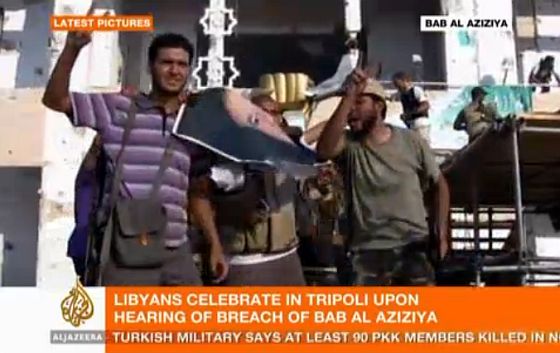
With the fall of the mighty comes the dispersal of the baubles of power. And just as Gaddafi was clownish in his rule, we witness another Libyan comedy as his golf cart gets unceremoniously towed away by one group of rebels while another rebel claims the trophies of Gaddafi’s hat, gold chain and fly-whisk.

At The Arabist, Steve Negus lists a few points now in Libya’s favor:

  • The combination of foreign airstrikes — which rebels realize saved them, albeit without foreign ground forces which would inevitably antagonize people — gives the West leverage without creating a backlash. Foreign interference is not a dirty word here: one katiba member I met in Ajdabiya said that the first thing he wanted to do after victory was buy a sheep, and bring it to Sarkozy to slaughter in Sarkozy’s honor. This means that proposals like bringing in the UN to help with the transitional process, as some Libyan politicians have proposed, is probably going to be broadly acceptable. Also, when NTC member Mahmoud Jibreel says that fighters should not loot or commit reprisals because the “eyes of the world are upon us”, his logic is actually appreciated by fighters on the ground.
  • Libya has no ruling party like the Baath. In Iraq, you had to join the party to rise high in your career, and to some degree the entire middle class was tainted by association with the Baath. This meant that technocrats got turfed out of their jobs by religious Shia parties, and in some cases terrorized by radical Shia militias. In Libya, the NTC has been fairly successful in keeping professionals in their posts, and only a few fairly organizations — ie, Qaddafi’s “Revolutionary Committees” — are really tainted by their relationship to the regime.
  • There seem to be few divisive differences over the identity of the country — Libya is tribally and ethnically diverse, but pretty homogenously Sunni and conservative. In order to whip up radical Islamist populism, it really helps to have some kind of Other — be they crony capitalists, nefarious secularists who want to sneakily impose atheism through supraconstitutional principles, Baathists, Shia or others who practice scandalous rituals, or other “heretics”, Tartar military dictators, etc. There aren’t any of these in Libya, yet. There also aren’t any liquor stores to smash. Maybe this will change if a militant Berber movement emerges, or if luxury hotels start going up in which an ex-NTC member has a silent partner.
Facebooktwittermail

The voice of democracy frightens Israel

The creation of a Jewish state, right from the moment of its conception, was never compatible with the development of democracy.

Democracy rests on the recognition of the political rights and power of dēmos, the people, and in as much as it allows for any kind of discrimination it does so by empowering the under-privileged. The idea that there could be such as thing as a Jewish democracy which helps preserve the Jewish character of the state at the expense of the interests of non-Jewish minorities is an insult to the idea of democracy.

Even so, since this is a contradiction that doesn’t seem to trouble most Jewish Israelis the most immediate democratic threat to Israel does not come from inside its borders — it comes from Egypt.

A year ago, if in response to an attack emanating from inside Egypt’s borders Israel had “retaliated” by launching attacks on Gaza, it would have been confident that it’s military action would have received a fairly muted response from the Mubarak regime. Demonstrations on the streets of Cairo would have done little to damage Egypt’s cordial relations with Israel.

Now everything has changed. Thus on Monday, even while rockets were still be fired at Israel from Gaza the Netanyahu cabinet voted to refrain from any action that could lead to an all-out war against Hamas. Gone is some of the hubris that fueled Israel’s 2009 war on Gaza, Operation Cast Lead.

Why? Israel can no longer be guided by its confidence that it can punish the population of Gaza with total impunity. Now its calculus must take into consideration the mood of 80 million Egyptians who can do much more than just shout on the streets — they can influence the policies of their own government. That power is still muted by military rule, but everything Israel does to alienate Egypt now has much greater potential to define and sour future Israeli-Egyptian relations.

After the Eilat attacks last week, Israel was swift to launch what Netanyahu described as retaliatory air strikes against the leaders of the Popular Resistance Committees in Gaza, even though the Israeli Defense Forces’ spokesperson later denied that the IDF believes the PRC was responsible.

One way of interpreting Israel’s strikes on Gaza is to see them as opportunistic and providing a timely distraction from Israel’s own protest movement.

At the same time, Netanyahu’s choice to hit Gaza may have had as much to do with Israel’s wariness about challenging Egypt.

One of the assumptions enshrined in the Camp David Accords was that the demilitarization of Sinai was in Israel’s security interests, but that is no longer the case. Since the fall of Mubarak, militants in the peninsula have taken advantage of the security vacuum, launching multiple rocket attacks, and now, evidence suggests, attacking Israelis outside Eilat.

Before he then pointed the finger at Gaza, Israeli minister of defense Ehud Barak last week acknowledged: “The attacks demonstrate the weakening of Egypt’s control over the Sinai peninsula and the expansion of terrorist activity there.”

Even so, Israel’s political leaders share the same fear of acts of terrorism that politicians do everywhere — that such acts risk making the state look impotent. To have responded to the attacks by saying that Israel would engage in intense diplomatic dialogue with Egypt in order to improve security would not have been enough, yet neither could Israel afford to disregard Egyptian sovereignty by pursuing militants across the border.

The only muscle-flexing alternative was to strike Gaza. But even with its show of force, Israel now feels constrained.

What emerged most clearly from Netanyahu’s and Barak’s statements to the cabinet was that Israel lacks the international legitimacy needed for a large-scale operation in Gaza. The diplomatic crisis with Egypt [following the deaths of three Egyptian policemen killed by Israelis during the Eilat attacks] further constrains Israel’s freedom of action.

“The prime minister thinks it would be wrong to race into a total war in Gaza right now,” one of Netanyahu’s advisors said. “We are preparing to respond if the fire continues, but Israel will not be dragged into places it doesn’t want to be.”

Several Netanyahu aides detailed the constraints on Israeli military action, most of which are diplomatic.

“There’s a sensitive situation in the Middle East, which is one big boiling pot; there’s the international arena; there’s the Palestinian move in the Untied Nations in September,” when the Palestinians hope to obtain UN recognition as a state, one advisor enumerated. “We have to pick our way carefully.”

For Israel, the regional expansion of democracy is clearly problematic. No longer can it take comfort in the deals it once made with a small handful of autocratic allies. Arab populations whose views could all too easily be ignored in the past, now have new power to make themselves heard and the voice of democracy frightens Israel.

Facebooktwittermail

A new hero for the Arab Street

Nicholas Noe and Walid Raad write:

The Arab Street has a new hero. Dubbed Flagman or the Egyptian Spiderman on Facebook and Twitter, young Ahmad Ash-Shahat scaled Israel‘s embassy in Cairo and replaced its flag with Egypt‘s.

This was in response to the death of three Egyptian policemen last week during clashes that followed a series of attacks by gunmen who killed eight Israelis near the Israeli resort city of Eilat. Egypt blames the Israeli military for killing the policemen in its pursuit of the gunmen, who fled into Egypt’s Sinai peninsula. Israel says the gunmen infiltrated Israel from the Sinai. Israel has expressed regret for the death of the policemen and has said it is investigating whether its forces may have been inadvertently to blame.

For most of the commentators who took up the matter in the Arabic media, Israel’s culpability is a given, the issue of whether the deaths were accidental an irrelevance. For them, Ahmad Ash-Shahat’s mounting of the Israeli embassy, during mass protests after the death of the Egyptian policemen, was an expression of triumph over a country that is a source of resentment. Wrote Abdel-Beri Atwan, the editor in chief of the Palestinian owned, London-based Al-Quds al-Arabi:

This young Egyptian man embodies the strong patriotic feelings of the Egyptians. This young man represents more than 80 million Egyptians, the Egyptian revolution at its best and even one and a half billion Arabs and Muslims spread throughout the five continents, since he conveyed the anger felt toward this violating state.

Under the rule of former Egyptian president Hosni Mubarak, a close ally of the U.S., popular criticism of Israel was muted in Egypt. But those days are over, as Makram Mohammad Ahmad noted in his column in the semi-official Egyptian daily Al-Ahram. Israelis, he wrote, have “failed to understand that Egypt has changed and that, in spite of its current keenness on preserving the peace in the region, it is now even keener on preserving the dignity of the nation.”

Facebooktwittermail

The first true Arab revolution

Inside Bab al-Aiziya, Gaddafi's Tripoli compound.

Shadi Hamid writes:

Euphoria, as it almost always is, is premature, fleeting, or both. This was the case on Feb. 11, when Egyptians celebrated after President Hosni Mubarak stepped down. They soon realized, however, that democratic transitions, even in the best of times, are messy, uncertain and occasionally bloody. As Adam Michnik memorably said: “The worst thing about Communism is what comes after.”

Unlike Egypt, Libya doesn’t have the benefit of established political parties, a largely independent judiciary, and a whole host of other weak but intermittently vibrant institutions. But, for these same reasons, Libya isn’t as weighed down by the past. The Transitional National Council does not have to contend with an old constitution or worry about hundreds of thousands of ruling party members. This, then, is the Arab world’s first true revolution; the old regime will soon find itself erased.

Libyans will go about creating a state more or less from scratch. Quite a lot is at stake. The T.N.C., a capable, impressive body, is neither cohesive nor unified. Qaddafi, as hated as he was, succeeded in uniting his own opposition. Without Qaddafi, though, the various elements within the T.N.C. will turn its attention elsewhere, and perhaps toward each other. The council includes every faction imaginable – liberals, mild-mannered technocrats, socialists, salafis and, of course, the Muslim Brotherhood. Islamists, a relatively unknown quantity in Libya but by all accounts strong and well organized, will make their real presence known for the first time. The potential for factionalization is compounded by the fact that each of these groups have guns.

Libyans will have to decide what role they want religion to play in public life. They will have to decide how much retribution to inflict on their former tormenters. Considering the thorniness of such questions, the international community’s role will be critical. This does not mean boots on the ground or a stabilization force, as some have prematurely suggested. But it can, and should, mean funding, consensus-building, technical assistance and help in organizing free elections, most likely within a year.

Unlike nearly everywhere else in the region, Libyans are grateful to the West for intervening when it did. Aug. 21 would not have happened otherwise. Accordingly, the United States and Europe can play a more constructive, less contentious role in Libya than they have in, say, Egypt, where anti-Americanism is at an all-time high. According to Steve Negus, at least one Libyan rebel is hoping to slaughter a sheep in Sarkozy’s honor. This is inconceivable anywhere else. But so many things about Libya are inconceivable anywhere else. And herein lies both the promise and peril of what is to come.

Facebooktwittermail

Evidence that Israel fabicated the link between the Eilat attacks and Gaza

Yossi Gurvitz examines the evidence around last weeks attacks in southern Israel and the claims made by Israeli officials that the gunmen came from Gaza.

Israel has never supplied any proof that the attack has indeed originated in the Gaza Strip. The PRC [Popular Resistance Committees] have denied involvement in the attack. An Israeli propaganda apparatus, the Intelligence and Terrorism Information Center, also claimed (Hebrew) the PRC was behind the attacks, but had to tautologically write “no terror organizations has publicly claimed responsibility for the attack and the Popular Resistance Committee has denied any involvement. However, the Israeli prime minister and other Israeli officials have pointed to the Popular Resistance Committee as the organization who carried out the attack. So, according to the ITIC, the fact that Netanyahu is proof enough, even if the other side completely denies it.

During the weekend, the news website Real News interviewed a senior IDF Spokesman officer, Lt. Col. Avital Leibovitz, who’s in charge of the IDF Spokesman with the international media. Leibowitz denied that the IDF connects the PRC to the attacks, said she was not responsible for that the prime minister said, but claimed that the attackers did come from Gaza, citing as proof the fact they were using Kalashnikov assault rifies (Sic! 2:28 and onwards in the video). I dunno how to put it to Col. Leibovitz, but Kalashnikovs are the most common light assault rifle in the world – a gift that keeps on giving from the defunct Soviet Union – and are rather easy to get all over the Middle East.

In a phone conversation with Leibovitz yesterday, she said “senior officials have already expressed themselves on the issue”, and declined to provide more information on the attackers, aside from insisting on them being Gazans. I asked her if she could provide me with the identity of the attackers killed by the IDF, which was until recently standard procedure, carried out within hours of an attack. She said this is unfortunately impossible, and repeatedly insisted they were Gazans. B’Tselem researchers in the Strip, contacted via B’Tselem today, were unaware of the identity of the attackers. Again, usually they are quickly identified and a mourners’ hut is rapidly constructed. They were killed on Thursday; if they resided in the Strip, their families would have heard of their deaths by now.

Yesterday evening the Egyptian newspaper Al Masry Al Youm reported that Egyptian security forces have identified three of the dead attackers. Egypt has a strong interest to claim the attackers were Gazans, since this would lessen its responsibility for the attacks; nevertheless, they say at least two of the attackers were known terrorists in the Sinai Peninsula. As far as I could find out, the rest of the bodies are in the hands of the IDF – which, again, does not reveal their identity.

Al-Masry Al-Youm reports:

Egyptian authorities have identified three of the people responsible for carrying out a terrorist attack in Israel, just north of Eilat, on Thursday, in which seven Israelis were killed, according to an Egyptian security source.

The same source added that one of the men identified is a leader of terrorist cells in Sinai, while another is a fugitive who owns an ammunition factory.

Al-Masry Al-Youm also reports:

Bin Laden’s doctor, Ramzy Moafy, who escaped from prison during the revolution, held military exercises south of Arish in Sinai, informed sources have said.

They said Moafy led the exercises for 40 armed men under the protection of 13 four-wheel-drive vehicles, of which four carried anti-aircraft guns.

An eyewitness has said he saw 15 of the gunmen carrying machine guns and sophisticated binoculars.

Security sources said a large number of extremist groups in and outside of Sinai have been identified and would be arrested soon, adding that those groups were joined by hundreds of gunmen coming form different governorates to carry out an order given to them in March to turn Sinai into an Islamic emirate.

They have arrived there with their families settled in different areas.

While a security source admitted that there are seven main camps to train militants in Sinai, he denied that Moafy was there, accusing Israel of spreading rumors.

Facebooktwittermail

On the ground in Tripoli

The New York Times reports:

With rebels on the verge of ending Col. Muammar el-Qaddafi’s long reign, the character of their movement is facing its first real test: Can they build a new government of unity and reconciliation, or will their own internal rivalries mean divisions in the new Libya?

Six months after their revolt broke out, the day-to-day leadership of the anti-Qaddafi movement remains an unanswered question, with no figure emerging as the rebellion’s undisputed leader. Even the common struggle against Colonel Qaddafi never masked latent divisions between east and west, between political leaders and fractious militias, and, some say, between liberal public faces and Islamists in the rebel ranks.

The rebels from the western mountains who stormed into Tripoli on Sunday night often roll their eyes at their ostensible political leadership, the Transitional National Council, which is based in the eastern city of Benghazi. Many complained that their national leaders did not give them enough support, even after Western governments began allowing them access to the frozen assets of the Qaddafi government.

“The N.T.C. did not work so hard to bridge the gap” between what western rebels forces had and what they needed to subdue Tripoli, said Youssef Mohamed, a management consultant working as an adviser to one of the rebel units charged with securing the capital.

American and European officials said on Monday that they have been working for weeks to foster cohesion in the rebel ranks and to avoid a repeat of the sectarian strife that gripped Iraq in 2003 after the American invasion. Officials said they thought that one reason Tripoli fell as quickly as it did was that important rebel groups closed ranks and came up with a coherent strategy to invade Colonel Qaddafi’s last stronghold.

Even so, rivalries began emerging on Monday well before Tripoli was fully subdued, along with questions about the rebels’ credibility. Officials of the Transitional National Council in Benghazi said Sunday that their forces had captured Colonel Qaddafi’s son and would-be successor, Seif al-Islam el-Qaddafi. But then on Tuesday he appeared at a Tripoli hotel housing foreign journalists — moving freely around the city — and even before then some in Tripoli appeared not to trust their Benghazi leadership to handle him.

Emhemmed Ghula, a leader of the Tripoli rebel underground stationed at a newly established military headquarters on Monday, said he worried that the Benghazi leadership had wrongly agreed to turn Seif al-Islam el-Qaddafi over to the International Criminal Court in The Hague, where he is wanted on war crimes charges.

“It was not us,” Mr. Ghula said, referring to the Tripoli rebels. “If we caught him, we are not going to give him to anyone. We would just take him to trial — a fair trial — under Libyan laws.”

Pressed on his relationship with the movement’s national leadership, he acknowledged: “We belong to them, politically. They did help us with the plan for this revolution.” But he added: “The general plan, I should say. Not with the local plan.”

Tensions were also on display Monday after the rebels captured a prominent broadcaster from Libyan state television, Hala Misrati. She was spotted driving in the city and was arrested, several rebels said, in connection with her role as Qaddafi propagandist. She was taken to a local office building for questioning, and through a cracked door a heavyset man could be seen leaning over her seat as she screamed, “I am innocent!”

A mob of rebels, many armed, tried to storm the office. They were pushed back when a rebel officer emerged from the interrogation room and fired his gun through the ceiling. He fired another shot to scare off the press.

Ultimately, however, order appeared to win out: an older officer made his way through the mob counseling patience, and the crowd dissipated. Ms. Misrati was quietly whisked away.

Facebooktwittermail

Saif al-Islam not captured by rebels

The New York Times reports:

The euphoria that followed the rebels’ triumphant march in Tripoli gave way to confusion and wariness on Monday, as Col. Muammar el-Qaddafi remained at large, his son Seif al-Islam made a surprise appearance at a hotel with foreign journalists, and pockets of loyalist forces stubbornly resisted rebel efforts to take control of the capital.

While rebel leaders professed to be making progress in securing Tripoli and planning for a post-Qaddafi government, and international leaders hailed the beginnings of a new era in Libya, the immediate aftermath of the lightning invasion was a vacuum of power, with no cohesive rebel government in place and remnants of the Qaddafi government still in evidence.

Seif Qaddafi, who was brandished as a trophy capture by the rebels on Sunday and through much of Monday, presented himself to foreign journalists confined to the Qaddafi-controlled luxury Rixos Hotel in the center of Tripoli early Tuesday, boasting that his father’s government was still “in control” and had lured the rebels into a trap, the BBC and news services reported. His appearance raised significant questions about the credibility of rebel leaders.

It was not clear whether he had been in rebel custody and escaped, or was never held at all. Another Qaddafi son, Muhammed, escaped from house arrest on Monday.

Fighters hostile to the rebels still battled on the streets and rooftops of Tripoli, injuring or killing at least a dozen people. And Colonel Qaddafi’s green flag still flew in parts of Tripoli and over at least two major cities considered strongholds of his tribe, Sabha to the south and Surt on the coast roughly midway between Tripoli and Benghazi. The Pentagon reported late Monday that its warplanes had shot down a Scud missile fired from Surt.

Reuters adds:

Saif told journalists that Tripoli, which has been largely overrun in the past 24 hours by rebel forces seeking to topple his father, was in fact in government hands and that Muammar Gaddafi was safe.

Earlier, armed pro-Gaddafi security men guarding the hotel took a small group of journalists to Gaddafi’s Bab al Aziziyah compound, where they had a meeting with Saif.

They returned to the hotel accompanied by Saif, who then spoke to journalists in the lobby before taking some of them back to the compound a short distance away for a brief visit.

Facebooktwittermail

Syrians taunt Assad: ‘Gadhafi is gone, now it’s your turn’

The Associated Press reports:

Taking inspiration from the rapid unraveling of the regime in Libya, thousands of Syrians poured into the streets Monday and taunted President Bashar Assad with shouts that his family’s 40-year dynasty will be the next dictatorship to crumble.

Mr. Assad, who has tried in vain to crush the 5-month-old revolt, appears increasingly out of touch as he refuses to acknowledge the hundreds of thousands of people demanding his ouster, analysts say. Instead, he blames the unrest on Islamic extremists and thugs.

But many observers say Mr. Assad should heed the lessons of Libya.

“Gadhafi is gone; now it’s your turn, Bashar!” protesters shouted in several cities across the country hours after Assad dismissed calls to step down during an interview on state TV. Security forces opened fire in the central city of Homs, killing at least one person.

Facebooktwittermail

Gaddafi is gone. Long live unity, democracy and the rule of law

Hisham Matar writes:

We got rid of Muammar Gaddafi. I never thought I would be able to write these words. I thought it might have to be something like: “Gaddafi has died of old age”; a terrible sentence, not only because of what it means but also the sort of bleak and passive future it promises. Now rebel forces have reached Tripoli, we can say we have snatched freedom with our own hands, paid for it with blood. No one now will be more eager to guard it than us.

This is a tremendously important victory for Libyans and for any nation wanting to control its future. Gaddafi tried to give a masterclass to men like the Syrian dictator, Bashar al-Assad, on how to crush a civilian uprising. Assad’s violent crimes in recent days show not only the stupidity of that regime but also how it was darkly inspired by the Libyan example. Just as the people of the Arab world have gained strength and confidence from one another’s victories, Arabic dictatorships too have been looking to each other.

Libya is critical because it is where the Tunisian and Egyptian domino effect might have stopped. The Syrian people are now stronger, and although I hope they will not need to sacrifice what we have had to sacrifice, I know that their hearts are bolder today than they were yesterday. There are moments in history when brotherhood between people no longer seems an abstract idea. Libya’s revolution has undermined every totalitarian rule and every oppressive individual. It has inspired that most profound ingredient in any uprising – a nation’s ability to imagine a better reality.

Facebooktwittermail

Gaddafi’s fall unlikely to alarm Arab leaders

Brian Whitaker writes:

Just a few days before completing his 42nd year in power, Muammar Gaddafi appears to have become the third Arab dictator to fall in the past eight months.

Tunisian president Zine el Abidine Ben Ali was the first to go, hounded out of the country in January after 23 years in power. In February it was the turn of Hosni Mubarak, when a popular uprising by the Egyptian masses ended his 29-year rule.

In the wake of that, hopes of political change swept across the region as protests broke out in Yemen, Bahrain and Syria, plus others on a smaller scale in Morocco, Jordan, Algeria and Oman.

But then came a hiatus, prompting speculation that the Arab spring was running out of steam. The opposition in Bahrain was brutally crushed, the Yemeni youth movement was sidelined by tribal warlords and military chiefs jockeying for position, while protests in Syria brought deadly reprisals and failed to make much of a dent on the Ba’athist regime.

The question now is whether the events in Tripoli will change the picture once again. While they may prove inspirational to opposition activists across the region, the Libyans’ own achievements in battling against Gaddafi are also overshadowed by their dependence on Nato support.

As for Arab leaders, it is unlikely they will lose much sleep. In Syria, President Bashar al-Assad may reasonably conclude he is safe so long as Nato does not intervene and the Libyan experience has little relevance to Yemen where President Ali Abdullah Saleh, still recovering in Saudi Arabia after being injured in a bomb attack on his own palace last June, flatly refuses to resign.

Arab rulers in the Gulf are also unlikely to draw lessons from Gaddafi’s fall, viewing him as an ill-behaved and troublesome eccentric who insulted almost all of them at some point, and whose comeuppance is no less than he deserved.

In terms of Arab geopolitics, Libya – unlike Iraq or Egypt, for example – is one of the less important states, and perhaps even more inconsequential in the future without Gaddafi’s unpredictable antics to place it in the spotlight.

It is in north Africa, rather than the wider Middle East, that the effects of the Libyan revolution will mostly be felt. Together, Egypt, Libya and Tunisia form a contiguous bloc of post-revolutionary states, which ought to prompt some soul-searching further west, in Algeria and Morocco. Algeria’s government faced riots earlier this year and fended them off by spending money, a palliative that cannot work indefinitely.

In Morocco too, where King Mohammed recently introduced a mildly reformist constitution in response to demonstrations, events in Libya can be expected to maintain or increase the pressure for more comprehensive change.

Facebooktwittermail

Libya rebels have won the war but biggest battle will be uniting factions

Martin Chulov writes:

The lessons of what becomes of a Middle East state that suddenly loses its strongman are recent and raw. More than eight years after Baghdad fell with the same ignominious haste as Tripoli, it remains a basket case of competing agendas, a disengaged political class and citizens left with the reality that the state neither has the capacity or the will to look after them.

Benghazi’s NTC seems to know that the same torpor in Libya will quickly dissolve their claim to authority and have pledged to do everything they can to effectively represent all of Libya. They will relocate to Tripoli as soon as Gaddafi has gone and have already drafted a constitution. On Monday they said it would take up to 20 months to create the framework for a new Libyan government.

But they may not have that long. Libya shares another trait with Iraq – it is fiercely tribal, and the country’s 140 tribes and clans have flagged a stake in whatever emerges from the rubble of the Gaddafi regime.

The spectre of the tribes waging war against one another was often raised by Gaddafi’s son, Saif al-Islam, and other members of the regime who said they would either hold the state together, or rip it to shreds.

The tribes will be decisive, especially those who feel they did not enjoy the benefits of Gaddafi’s patronage. Overlaying the tribal structure are others that have competing stakes in Libya, a group of exiles that have returned en masse in recent months and will probably be lured in greater numbers when Tripoli finally falls.

Also raising their heads are Islamists in the east, who were kept under control by Gaddafi, except when they wanted to travel to Iraq, or Afghanistan, which villagers from the east chose to do in large numbers.

The Nato intervention led to the unlikely reality of jihadists who had fought the US military in Iraq fighting Gaddafi under the cover of US warplanes within the space of five years. Their allegiance for now is to the NTC and its ambition to turn a state run under an entrenched cult of identity into a pluralist democracy that represents an array of competing interests.

There are real fears that such a task may be beyond the competence of the 33-member NTC, which has been recognised by the international community more on promise than merit.

With one eye to Egypt in the east and the other to Tunisia in the west, neither of which have surged ahead since their dictators fell in January, NTC leader Mustafa Abdel Jalil will quickly need to convince Libyans that he can do better. At a press conference in Benghazi on Monday, he appeared to acknowledge as much. “My role after the fall of Gaddafi will continue, unless I lose control of the goals I aim for,” he said, before warning rebels that the world was watching for any sign of vendettas against Gaddafi’s men. “I hope that Gaddafi can be taken alive so he gets a fair trial,” he added. He will also be hoping for a just hearing for the NTC. If it can’t deliver as a governing authority, post-Gaddafi Libya will be in trouble.

Facebooktwittermail

How NATO helped Libya’s rebels

The New York Times reports:

As rebel forces in Libya converged on Tripoli on Sunday, American and NATO officials cited an intensification of American aerial surveillance in and around the capital city as a major factor in helping to tilt the balance after months of steady erosion of Col. Muammar el-Qaddafi’s military.

The officials also said that coordination between NATO and the rebels, and among the loosely organized rebel groups themselves, had become more sophisticated and lethal in recent weeks, even though NATO’s mandate has been merely to protect civilians, not to take sides in the conflict.

NATO’s targeting grew increasingly precise, one senior NATO diplomat said, as the United States established around-the-clock surveillance over the dwindling areas that Libyan military forces still controlled, using armed Predator drones to detect, track and occasionally fire at those forces.

At the same time, Britain, France and other nations deployed special forces on the ground inside Libya to help train and arm the rebels, the diplomat and another official said.

The Guardian reports:

While most of the world’s attention had focused throughout the conflict on the continual attempts by Benghazi-based rebels to secure the oil town of Brega, and simultaneous efforts to break out of the opposition enclave of Misrata, a pivotal breakthrough took place in what had hitherto been considered a sideshow in the Libyan war – the western mountains.

The Nafusa highlands, as the range is called, stretches south-west of Tripoli and forms a natural barrier between the capital and Libya’s interior. Its Berber inhabitants, the Amazigh community, had turned against Gaddafi early on but had been bottled up in their home villages since the spring by government forces. Every attempt to break through government lines into the coastal plains to the north had been rebuffed.

During the spring and early summer, however, Amazigh fighters were joined by dissidents streaming out of Tripoli and the oil refining port of Zawiya, fleeing Gaddafi’s brutal suppression of the uprising there. In the Nafusa highlands a more effective fighting force was fused from these disparate elements with the help of Nato trainers and French air-drops of arms and equipment.

By early August, these fighters began to push out from their bases. They moved village by village at first, and the offensive was little noticed outside the region. But it quickly grew and by the beginning of last week the mountain rebels had arrived at Gharyan, a heavily fortified city 60 miles south of Tripoli, and were beginning to infiltrate Zawiya as well.

Previous attempts to take Zawiya had been pushed back by Gaddafi forces, exposing the over-ambition and tenuous supply lines of the rebel attacks. This time, the rebels took central Zawiya and stayed. By Friday they had seized the coastal oil refinery. They had not only cut the road between Tripoli and the Tunisian border, along which the regime imported most of its food and basic supplies, but had turned off the last trickle of refined fuel going into the capital. “The fall of Zawiya was the pivotal moment in hindsight. It not only had practical effects, severing road links and so on, it was also an enormous psychological blow [for Gaddafi forces],” said Shashank Joshi, a military analyst at the Royal United Services Institute in London. “The death of Younes had not been as bleak for the rebels as we had thought. The battle had already shifted its centre of gravity to the Nafusa range. The rebels adapted and learned. They realised that their reckless advances without consolidating their positions weren’t working. They began to move methodically, and took orders, waiting for Nato soften up the defences before moving in.”

Evidence of greater discipline and better co-ordination with Nato air strikes was apparent on every front. Rebel commanders were told not to stray over “red lines” marked out by Nato liaison officers as “free fire zones”. Rebel forces had attempted to mark their vehicles to avoid friendly fire from alliance jets, painting them black or painting a white “N” on them, but the markings were not universally applied and quickly copied by government forces.

When Misrata-based forces finally broke through government lines at Zlitan on Friday, however, the bonnets of their vehicles were clearly draped with red and yellow flags, provided by Nato and kept under wraps until the offensive.

Special forces played a key role in that close relationship, though UK government officials declined to comment on whether serving SAS personnel were involved, including acting as forward air controllers – directing pilots to targets on the ground. Reports that France deployed special forces to Libya have also not been convincingly denied. In addition, Qatari and Jordanian special forces also played a role, the Guardian has been told, while Qatar is believed to have paid for former SAS and western employees of private security companies.

Radar, cameras and listening devices on Nato planes, including RAF Sentry and Sentinel surveillance aircraft, based in Sicily and Cyprus, and US Predator drones, could identify clear military targets such as tanks, armoured vehicles, as well as known command and control centres.

Facebooktwittermail

Top ten myths about the Libya War

Juan Cole writes:

1. Qaddafi was a progressive in his domestic policies. While back in the 1970s, Qaddafi was probably more generous in sharing around the oil wealth with the population, buying tractors for farmers, etc., in the past couple of decades that policy changed. He became vindictive against tribes in the east and in the southwest that had crossed him politically, depriving them of their fair share in the country’s resources. And in the past decade and a half, extreme corruption and the rise of post-Soviet-style oligarchs, including Qaddafi and his sons, have discouraged investment and blighted the economy. Workers were strictly controlled and unable to collectively bargain for improvements in their conditions. There was much more poverty and poor infrastructure in Libya than there should have been in an oil state.

2. Qaddafi was a progressive in his foreign policy. Again, he traded for decades on positions, or postures, he took in the 1970s. In contrast, in recent years he played a sinister role in Africa, bankrolling brutal dictators and helping foment ruinous wars. In 1996 the supposed champion of the Palestinian cause expelled 30,000 stateless Palestinians from the country. After he came in from the cold, ending European and US sanctions, he began buddying around with George W. Bush, Silvio Berlusconi and other right wing figures. Berlusconi has even said that he considered resigning as Italian prime minister once NATO began its intervention, given his close personal relationship to Qaddafi. Such a progressive.

3. It was only natural that Qaddafi sent his military against the protesters and revolutionaries; any country would have done the same. No, it wouldn’t, and this is the argument of a moral cretin. In fact, the Tunisian officer corps refused to fire on Tunisian crowds for dictator Zine El Abidine Ben Ali, and the Egyptian officer corps refused to fire on Egyptian crowds for Hosni Mubarak. The willingness of the Libyan officer corps to visit macabre violence on protesting crowds derived from the centrality of the Qaddafi sons and cronies at the top of the military hierarchy and from the lack of connection between the people and the professional soldiers and mercenaries. Deploying the military against non-combatants was a war crime, and doing so in a widespread and systematic way was a crime against humanity. Qaddafi and his sons will be tried for this crime, which is not “perfectly natural.”

4. There was a long stalemate in the fighting between the revolutionaries and the Qaddafi military. There was not. This idea was fostered by the vantage point of many Western observers, in Benghazi. It is true that there was a long stalemate at Brega, which ended yesterday when the pro-Qaddafi troops there surrendered. But the two most active fronts in the war were Misrata and its environs, and the Western Mountain region. Misrata fought an epic, Stalingrad-style, struggle of self-defense against attacking Qaddafi armor and troops, finally proving victorious with NATO help, and then they gradually fought to the west toward Tripoli. The most dramatic battles and advances were in the largely Berber Western Mountain region, where, again, Qaddafi armored units relentlessly shelled small towns and villages but were fought off (with less help from NATO initially, which I think did not recognize the importance of this theater). It was the revolutionary volunteers from this region who eventually took Zawiya, with the help of the people of Zawiya, last Friday and who thereby cut Tripoli off from fuel and ammunition coming from Tunisia and made the fall of the capital possible. Any close observer of the war since April has seen constant movement, first at Misrata and then in the Western Mountains, and there was never an over-all stalemate.

5. The Libyan Revolution was a civil war. It was not, if by that is meant a fight between two big groups within the body politic. There was nothing like the vicious sectarian civilian-on-civilian fighting in Baghdad in 2006. The revolution began as peaceful public protests, and only when the urban crowds were subjected to artillery, tank, mortar and cluster bomb barrages did the revolutionaries begin arming themselves. When fighting began, it was volunteer combatants representing their city quarters taking on trained regular army troops and mercenaries. That is a revolution, not a civil war. Only in a few small pockets of territory, such as Sirte and its environs, did pro-Qaddafi civilians oppose the revolutionaries, but it would be wrong to magnify a handful of skirmishes of that sort into a civil war. Qaddafi’s support was too limited, too thin, and too centered in the professional military, to allow us to speak of a civil war. [Continue reading…]

I applaud Cole for attempting to push back against the war skeptics but I expect that most of his arguments will fall on deaf ears. The issue of Libya has become some sort of perverse ideological litmus test through which many individuals want to polish their anti-imperialist and anti-Western credentials.

Those of us who see a positive development in Libya are dismissed as naive by others who profess an unshakable conviction about Libya’s destiny. Strangely, few of these individuals who think they can see Libya’s future so clearly, happen to be Libyan.

Facebooktwittermail

After Gaddafi, let’s hope for the best in Libya

Brian Whitaker writes:

As recently as last Friday, Kathleen McFarland, a security analyst at Fox News, was lecturing President Obama on America’s “missteps” in Libya.

“Libya and Syria are the textbook examples of why it’s important to pick your battles, and then make sure you win the one you pick,” she wrote. “President Obama picked the wrong fight by going to war against Libya, and so far is not succeeding.”

Just three days later, the Gaddafi regime is almost gone and it’s looking as if Obama picked the right battle after all. The real test, though, is further down the line. One year from now, will Libyans be living under a government that is significantly better than the one that tyrannised them for almost 42 years? Will they be able to speak their minds freely and engage in the country’s politics without fearing the consequences?

The next few months in Libya are not going to be easy – only a fool would imagine that – but nor are the grimmest predictions likely to be fulfilled. Libya is unlikely to turn into another Iraq, let alone another Afghanistan.

The first encouraging sign is that the National Transitional Council – a diverse alliance forged out of necessity – has begun making the right noises. Its interim constitution, published last week, acknowledges the need for give and take. It recognises the rights of the Berber minority and, while accepting a role for Islamic law, also sets some limits to it.

As far as retribution is concerned, initial indications are that it intends to go by the book. Gaddafi’s most prominent son, Saif al-Islam, has reportedly been captured alive so that he can be put on trial.

Like Iraq (and many other Arab countries, for that matter), Libya has its social faultlines. Tribal, ethnic and religious rivalries that were swept under the carpet by the Gaddafi regime will now emerge into the open. Allowing them to do so is the only way to address them in the long term, though in the short term they could easily become an obstacle to democratic processes.

On the plus side, however, many Libyans insist that the social divisions are nowhere near as deep as in Iraq (we shall soon know if they are right) but, perhaps more importantly, in Libya they are less likely to become a proxy battleground for foreign powers.

Facebooktwittermail

Fighting rages near Gaddafi’s compound

Al Jazeera reports:

Heavy fighting and gun battles have broken out in areas of Tripoli after opposition fighters gained control overnight of much of the Libyan capital in their battle to end Muammar Gaddafi’s decades-long rule.

Clashes erupted on Monday after tanks left Bab Azaziya, Gaddafi’s compound in Tripoli, to confront the rebel assault

Many of the streets in the centre of the city, where anti-government supporters had celebrated hours earlier, were abandoned as pockets of pro-Gaddafi resistance and the presence of snipers and artillery fire made the area dangerous.

Al Jazeera’s Zeina Khodr, who advanced into the city with rebel fighters overnight, said the security situation in the city was “tenuous.”

Facebooktwittermail

Watch Al Jazeera broadcasting live from the center of Tripoli

Dennis Kucinich gets the prize for the worst-timed op-ed of the year: “Time to end Nato’s war in Libya” appearing today in The Guardian.

As the war enters its sixth month, it is time for the US president and secretary of state to clean up the mess they’ve created with this needless military intervention, and to work to seriously to bring about a negotiated end to this war.

Negotiated with who?

Kucinich warned: “Libyan rebels are now advancing on the capital city of Tripoli with the aid of Nato strikes; this is sure to result in a real bloodbath, as opposed to the one that was conjured in Benghazi this past winter.”

Well, Al Jazeera is already in Tripoli’s Green Square witnessing mass celebrations and no word of a bloodbath.

Watch events unfold live.

Facebooktwittermail

Libya — the first real victory in the Arab Awakening?

Visit msnbc.com for breaking news, world news, and news about the economy

To all those who argued that NATO’s involvement would irredeemably taint the Libyan revolution, here’s an idea that could be too much to wrap your mind around.

Look at the ongoing struggle in Syria, the brutally crushed revolution in Bahrain, the unfinished revolution in Egypt and then consider this possibility: Libya may turn out to be the first Arab country that really gets a fresh start.

No doubt it will be messy and who’s to say where it might lead, but Libya now appears to be on the brink of getting a chance to rebuild itself not only free from a dictatorial hand but also free from the regime through which that hand extended its power.

It might not quite all be over — Gaddafi’s death, departure or capture will be the final act — but the idea that Gaddafi’s supporters formed one side in a civil war looks flimsier than ever. MSNBC reports:

Libyan rebels moved into the capital Tripoli on Sunday and came within two miles of the city center, as Moammar Gadhafi’s defenders melted away. The rebel leadership said Gadhafi’s son and one-time heir apparent Seif al-Islam has been arrested.

Associated Press reporters with the rebels said they met little resistance as they moved from the western outskirts into the capital in a dramatic turning of the tides in the 6-month-old Libyan civil war. The rebels took control of one neighborhood, Ghot Shaal, on the western edge of the city. They set up checkpoints as rebel trucks rolled into Tripoli.

One of the rebels, Mohammed al-Zawi, 30, said he was in a convoy of more than 10 trucks that entered Ghot Shaal. He said they progressed as far as the neighborhood of Girgash, about a mile and a half from Green Square, where Gadhafi supporters have gathered nightly throughout the uprising to rally for their leader of more than 40 years.

He said the rebels came under fire from a sniper on a rooftop in the neighborhood.

“They will enter Green Square tonight, God willing,” al-Zawi said.

Sidiq al-Kibir, the rebel leadership council’s representative for the capital Tripoli, confirmed the arrest of Seif al-Islam to the AP but did not give any further details.

Earlier, Gadhafi said he will stay in Tripoli “until the end” and called on his supporters around the country to help liberate the capital from a rebel offensive.

He said in an audio message played over state television he was “afraid that Tripoli will burn” and he said he would provide weapons to supporters to fight off the rebels.

Associated Press reporters with the rebels said they reached the Tripoli suburb of Janzour around nightfall Sunday. They were greeted by civilians lining the streets and waving rebel flags. Hours earlier, the same rebel force of hundreds drove out elite forces led by Gadhafi’s son Khamis in a brief gunbattle.

The elated fighters danced and cheered, hauling off truckloads of weapons and advanced full speed toward the capital in pickup trucks. Ahmed al-Ajdal, 27, a fighter from Tripoli, was loading up a truck with ammunition.

“This is the wealth of the Libyan people that he was using against us,” he said, pointing to his haul. “Now we will use it against him and any other dictator who goes against the Libyan people.”

NATO called the situation in Libya “very fluid” on Sunday as rebel fighters streamed into the capital Tripoli, and said the rule of Gadhafi was “crumbling.”

How could the rebels make such a rapid advance? Because Gaddafi loyalists eventually realized they were supporting a lost cause. They have nothing to fight for.

What now? Are Libyans about to create a Western-friendly liberal democracy? No one in Washington or the other NATO capitals has the faintest idea. And that’s the point.

All those who see the heavy hand of Western imperialism shaping events have a distorted perception of how much power the US and the West are really able to exert. Sure, there’s no limit on how much power they want to exert, but at the end of the day their power has very real limits and as we will see, Libya’s future will be determined by the people on the ground — not those in the sky.

Facebooktwittermail

Israel’s security strategy — when in doubt, hit Gaza

Three days after the attacks by gunmen outside Eilat in southern Israel, what do we know about the identities of the gunmen? Almost nothing.

In the mainstream media they are blithely referred to as “Palestinian gunmen” yet so far the only basis for this description is the unsubstantiated word of Israeli officials. Those officials have provided no real evidence to back up their claims.

Prime Minister Benjamin Netanyahu was quick to assign responsibility for the attacks with the Gaza-based Popular Resistance Committees yet both they and Hamas denied any involvement.

Generally speaking, Palestinian militant groups are not shy about claiming responsibility for attacks against Israelis — especially those that can be described as military operations where Israeli soldiers are killed or injured. Indeed, the problem is more often that too many groups — not too few — want to claim the honor.

This suggests a rather obvious explanation about why no Palestinian group announced that it directed the attacks: it wasn’t a Palestinian operation.

The Israeli Defense Forces spokesperson refused to endorse Netanyahu’s assertion about the PRC role and the only “proof” of Palestinian involvement the IDF presented was the use of Kalashnikovs — as though 100 million Kalashnikovs, 20% of the firearms available on the planet, are now stockpiled in Gaza!

What other evidence is there about the gunmen? They were wearing Egyptian military uniforms.

Just before the Eilat attacks, Egyptian security forces declared Operation Eagle — an effort to bring security to the lawless Sinai — a success.

Deputy Interior Minister Ahmad Gamal Eddin said at a press conference last week that the campaign has so far managed to arrest members of al-Takfeer wal-Hijra and to collect arms and illegally acquired military uniforms.

Militant Salafists based in the Sinai are believed to have been periodically blowing up the Egypt-Israel gas pipeline this year. They are well-armed and possess Egyptian military uniforms. Were they behind the Eilat attacks? It seems a bit more plausible than the IDF’s Kalashnikov-based analysis.

Meanwhile, Hamas has once again agreed to take the lead in enforcing a ceasefire with Israel.

A Hamas official in Gaza says that all of Gaza’s militant groups have agreed to a cease-fire aimed at ending a three-day round of violence with Israel.

The official says Egypt helped broker the cease-fire, which will go into effect this evening. He says Egypt told the groups that Israel would halt its airstrikes only if the Palestinian groups stopped shooting first, and that Hamas security personnel would enforce the agreement.

He spoke on condition of anonymity Sunday because the agreement had not officially been made public.

Earlier on Sunday, AP reported that Israeli officials arrived in Cairo. Moreover, Israeli sources confirmed that the reduced IDF strikes on Gaza in the last 24 hours was an intentional move aimed at allowing Egypt to mediate a cease-fire, as well as out of fear for the defense and diplomatic relationship with Egypt.

Meanwhile, Defense Minister Ehud Barak issued a harsh warning to those responsible for the latest rocket fire on southern Israel, saying those who act against Israel “will have their heads separated from their bodies.”

Thus speaks Israel’s own Salafist military commander.

Facebooktwittermail