Revolt without revolution

Slavoj Žižek writes:

Repetition, according to Hegel, plays a crucial role in history: when something happens just once, it may be dismissed as an accident, something that might have been avoided if the situation had been handled differently; but when the same event repeats itself, it is a sign that a deeper historical process is unfolding. When Napoleon lost at Leipzig in 1813, it looked like bad luck; when he lost again at Waterloo, it was clear that his time was over. The same holds for the continuing financial crisis. In September 2008, it was presented by some as an anomaly that could be corrected through better regulations etc; now that signs of a repeated financial meltdown are gathering it is clear that we are dealing with a structural phenomenon.

We are told again and again that we are living through a debt crisis, and that we all have to share the burden and tighten our belts. All, that is, except the (very) rich. The idea of taxing them more is taboo: if we did, the argument runs, the rich would have no incentive to invest, fewer jobs would be created and we would all suffer. The only way to save ourselves from hard times is for the poor to get poorer and the rich to get richer. What should the poor do? What can they do?

Although the riots in the UK were triggered by the suspicious shooting of Mark Duggan, everyone agrees that they express a deeper unease – but of what kind? As with the car burnings in the Paris banlieues in 2005, the UK rioters had no message to deliver. (There is a clear contrast with the massive student demonstrations in November 2010, which also turned to violence. The students were making clear that they rejected the proposed reforms to higher education.) This is why it is difficult to conceive of the UK rioters in Marxist terms, as an instance of the emergence of the revolutionary subject; they fit much better the Hegelian notion of the ‘rabble’, those outside organised social space, who can express their discontent only through ‘irrational’ outbursts of destructive violence – what Hegel called ‘abstract negativity’.

There is an old story about a worker suspected of stealing: every evening, as he leaves the factory, the wheelbarrow he pushes in front of him is carefully inspected. The guards find nothing; it is always empty. Finally, the penny drops: what the worker is stealing are the wheelbarrows themselves. The guards were missing the obvious truth, just as the commentators on the riots have done. We are told that the disintegration of the Communist regimes in the early 1990s signalled the end of ideology: the time of large-scale ideological projects culminating in totalitarian catastrophe was over; we had entered a new era of rational, pragmatic politics. If the commonplace that we live in a post-ideological era is true in any sense, it can be seen in this recent outburst of violence. This was zero-degree protest, a violent action demanding nothing. In their desperate attempt to find meaning in the riots, the sociologists and editorial-writers obfuscated the enigma the riots presented.

The protesters, though underprivileged and de facto socially excluded, weren’t living on the edge of starvation. People in much worse material straits, let alone conditions of physical and ideological oppression, have been able to organise themselves into political forces with clear agendas. The fact that the rioters have no programme is therefore itself a fact to be interpreted: it tells us a great deal about our ideological-political predicament and about the kind of society we inhabit, a society which celebrates choice but in which the only available alternative to enforced democratic consensus is a blind acting out. Opposition to the system can no longer articulate itself in the form of a realistic alternative, or even as a utopian project, but can only take the shape of a meaningless outburst. What is the point of our celebrated freedom of choice when the only choice is between playing by the rules and (self-)destructive violence?


Facebooktwittermail

The Arab Awakening

Rami G. Khouri writes:

When Mohamed Bouazizi set himself on fire in rural Tunisia on December 17, 2010, he set in motion a dynamic that goes far beyond the overthrow of individual dictators. We are witnessing nothing less than the awakening, throughout the Arab world, of several phenomena that are critical for stable statehood: the citizen, the citizenry, legitimacy of authority, a commitment to social justice, genuine politics, national self-determination and, ultimately, true sovereignty. It took hundreds of years for the United States and Western Europe to develop governance and civil society systems that affirmed those principles, even if incompletely or erratically, so we should be realistic in our expectations of how long it will take Arab societies to do so.

The countries where citizens are more actively agitating or fighting for their rights—Libya, Tunisia, Egypt, Syria, Bahrain and Yemen are the most advanced to date—have very different local conditions and forms of governance, with ruling elites displaying a wide range of legitimacy in the eyes of their people. Governments have responded to the challenge in a variety of ways, from the flight of the Tunisian and Egyptian leaderships to violent military repression in Syria, Libya and Bahrain, to the attempt to negotiate limited constitutional transformations in Jordan, Morocco and Oman. A few countries that have not experienced major demonstrations—Algeria and Sudan are the most significant—are likely to experience domestic effervescence in due course. Only the handful of wealthy oil producers (like Saudi Arabia, Kuwait, Qatar and the United Arab Emirates) seem largely exempt, for now, from this wave of citizen demands.

Two words capture every important dimension of the Arab Awakening: “humiliation” and “legitimacy.” They explain why the Arab region is erupting, and what needs to be done to satisfy popular demands. The typical Arab citizen, with few exceptions, has felt humiliated in recent decades by his or her government. Hundreds of millions of Arabs feel they have been denied both their human rights and their citizenship rights, the result of decades of socioeconomic stresses and political deprivations. These include petty and large-scale corruption; police brutality; abuse of power; favoritism; unemployment; poor wages; unequal opportunities; inefficient or nonexistent public services; lack of freedom of expression and association; state control of media, culture and education; and many other dimensions of the modern Arab security state. At the same time, ordinary men and women in countries across the region have seen small groups of families in the ruling elite grow fabulously rich simply because of their connections.

Facebooktwittermail

The dead end of globalisation looms before our youth

Pankaj Mishra writes:

In India, tens of thousands of middle-class people respond to a quasi-Gandhian activist’s call for a second freedom struggle – this time, against the country’s venal “brown masters”, as one protester told the Wall Street Journal. Middle-class Israelis demanding “social justice” turn out for their country’s first major demonstrations in years. In China, the state broadcaster CCTV unprecedentedly joins millions of cyber-critics in blaming a government that placed wealth creation above social welfare for the fatal high-speed train crash in Wenzhou last month.

Add to this the uprisings against kleptocracies in Egypt and Tunisia, the street protests in Greece and Spain earlier this year, and you are looking at a fresh political awakening. The specific contexts may seem very different, ranging from authoritarian China to democratic America (where Warren Buffett, the world’s richest man, publicly denounced a “billionaire-friendly Congress” last fortnight). And the grievances may be diversely phrased. But public anger derives from the same source: extreme and seemingly insurmountable inequality.

As Forbes magazine, that well-known socialist tool, describes it, protesters everywhere are driven by “the conviction that the power structure, corporate and government, work together to screw the broad middle class” (and the working class too, whose distress is not usually examined in Forbes).

Certainly, the strident promoters of globalisation – politicians, big businessmen, and journalists – will have to work much harder now to bamboozle their audiences.

For years now, the mantra of “economic growth” justified government interventions on behalf of big business and investors with generous tax breaks (and, in the west, the rescue of criminally reckless investors and speculators with massive bailouts at the taxpayer’s expense). The fact that a few people get very rich while a majority remains poor seemed of little importance as long as the GDP figures looked impressive.

In heavily populated countries like India, even a small number of people moving into the middle class made for an awe-inspiring spectacle. Helped by an entertainment-obsessed and “patriotic” corporate media, you could easily ignore the bad news – the suicides, for instance, of hundreds of thousands of farmers in the last decade. However, the carefully maintained illusions of globalisation shattered when even its putative beneficiaries – the educated and aspiring classes – began to hurt from high inflation, decreasing access to education and other opportunities for upward mobility.

Facebooktwittermail

Libya conflict: Evidence emerges of executions by both sides

The Guardian reports:

Dozens of bodies have been found in Tripoli with signs of executions carried out by both sides in the civil war.

Reuters news agency reported discovering 30 bullet-riddled bodies of fighters loyal to Muammar Gaddafi, of which two had been bound with plastic handcuffs, and one was on an ambulance stretcher with an intravenous drip still in his arms. They were in the remains of a pro-Gaddafi encampment strewn with caps and pictures of the ousted leader.

Elsewhere in the city, a medical aid worker at a Tripoli hospital said she had seen 17 bodies, believed to be civilians killed by government forces, which had been found when rebel fighters stormed the Gaddafi stronghold of Bab al-Aziziya.

“Yesterday a truck arrived at the hospital with 17 dead bodies,” Kirsty Campbell of the International Medical Corps told Reuters at Mitiga hospital. “These guys were rounded up 10 days ago. They were found in Bab al-Aziziya when the guys went in. These guys were shot in an execution there,” she said.

The wounds were not battlefield injuries, she said. She added there had been reports of more bodies.

Facebooktwittermail

Israel agrees to joint investigation with Egypt on Eilat attacks

An Israel Army Radio report said that Israel’s domestic intelligence service, Shin Bet, recommended a preemptive attack against members of the Popular Resistance Committees in Gaza, prior to the attacks by gunmen near Eilat in southern Israel last week. The report said that the request was turned down by senior defense officials and political leaders.

In response, the IDF Spokesman’s Office said that “the report suffers from substantive factual inaccuracies, and due to operational and intelligence reasons we cannot elaborate on the matter.”

The Shin Bet declined to comment on the report.

Meanwhile, Haaretz reports:

[T]wo days after telling Army Radio that Israeli and Egyptian officers would not carry out a joint investigation into the attack in the south [near Eilat last week], National Security Adviser Ya’akov Amidror has changed his stance. In a special announcement Thursday afternoon, he said a joint investigation would indeed take place.

The reason for the change probably stems from the anger that his statements to Army Radio have stirred in Egypt’s Supreme Military Council. During the Tuesday morning interview, Amidror said no joint probe involving Israeli and Egyptian officers would take place into the incident near Eilat. But he said the two sides would carry out separate investigations and then compare their findings.

Amidror made the statement even though Barak had announced on Saturday that Israel sought to hold a joint investigation with Egypt into the incident. Earlier this week, the head of the Planning Directorate at the Israel Defense Forces, Maj. Gen. Amir Eshel, traveled to Cairo to discuss with the Egyptians ways of carrying out the joint probe.

The statements by the national security adviser were followed by a report Wednesday in the Egyptian daily Al-Masri Al-Yaum, which was highly critical.

“The Israeli side has not responded so far to our demand for a joint investigation and did not announce a timetable for the completion of the investigation,” the daily quoted a senior Egyptian government official as saying.

“If there is no joint investigation we will recall our ambassador from Tel Aviv.”

Thursday afternoon the Prime Minister’s Bureau issued an unusual statement in Amidror’s name. The national security adviser stressed that “Israel agrees to hold a joint investigation with Egypt on the events of the terrorist incident on the way to Eilat that took place last week.”

Amidror added that the details would be determined between the militaries of the two countries.

Explaining the reason for the two versions, the Prime Minister’s Bureau said that only during the past 24 hours had a final decision been made on a joint investigation.

Facebooktwittermail

How Israelis (and many others) shirk moral responsibility for their actions

It’s a clever maneuver and it’s used again and again.

They are attacking me not because of what I did. They are attacking me because of who I am.

Not only does this put the self-declared victim in an invulnerable position — no one can change or should need defend their simple identity — but this also deflects criticism by insinuating that it springs from bigotry or blind hatred.

A few months after the Israeli Defense Forces had slaughtered hundreds of Palestinian civilians — men, women and children — in Gaza in 2009, Israel’s ambassador to Turkey, Gaby Levy, spoke to the US ambassador to Turkey, James Jeffrey, and expressed his concern about deteriorating Israeli-Turkish relations.

Levy’s explanation, with which Jeffrey concurred, was that Turkish Prime Minister Recep Tayyip Erdoğan hates Israel. “He’s a fundamentalist. He hates us religiously,” Levy claimed.

Jeffrey commented: “Our discussions with contacts both inside and outside of the Turkish government on Turkey’s deteriorating relations with Israel tend to confirm Levy’s thesis that Erdogan simply hates Israel.”

In other words, Erdoğan’s attitude towards Israel had nothing to do with his reaction to Israel’s barbaric treatment of Palestinians. It was the product of simple hatred — the implication thus being that there would be nothing that poor little Israel could do in order to make amends.

Erdoğan has been in office since 2003. In early 2006, Israel’s Ministry of Foreign Affairs described relations with Turkey as “perfect.” In 2007, Israel’s President Shimon Peres was honored by being invited to address the Turkish parliament — it was the first time an Israeli president had addressed the parliament of a Muslim-majority country.

In 2008, right up until Israel launched the war on Gaza, Turkey was helping mediate indirect peace talks between Israel and Syria.

Turkey mediated five rounds of talks between Israeli and Syrian officials. Toward the end of Olmert’s term the two sides were on the verge of resuming direct negotiations.

At the last meeting between Olmert and Prime Minister Recep Tayyip Erdoğan, the Turkish leader called Syrian President Bashar al-Assad and relayed messages to and from Olmert. But after Operation Cast Lead began in December 2008 and the freeze in negotiations with Syria, Erdoğan said Olmert had stabbed him in the back.

In 2010, while Israel was refusing to allow Turkey to serve as a mediator with Syria, former Israeli prime minister, Ehud Omert said during a conference at Tel Aviv University:

We can reach an understanding with the Syrians which would change the map in the Middle East. A decision on this issue must be made. It’s too easy being angry at Erdogan, but it would be wise to reconcile with him. He is a fair mediator. We need negotiations with Turkish mediation.

Now we learn from Wikileaks that during this period in which Turkey, under Erdogan’s leadership, had made unprecedented efforts to serve as a peace-broker between Israel and its neighbors, key Israeli and American diplomats were in collusion with each other, reinforcing their shared and counter-productive view of Turkey’s prime minister.

Levy and Jeffrey were not looking at a real obstacle to diplomacy. They were revealing their own incompetence as diplomats by playing the game: it’s not what we do; it’s who we are.

This is the cable:

C O N F I D E N T I A L ANKARA 001549

SIPDIS

DEPARTMENT FOR EUR/SE

E.O. 12958: DECL: 10/26/2019
TAGS: PREL PGOV TU IS
SUBJECT: ISRAELI AMBASSADOR TRACES HIS PROBLEMS TO ERDOGAN

REF: ANKARA 1532

Classified By: AMB James F. Jeffrey, for reasons 1.4(b,d)

¶1. (C) During an October 26 call on the Ambassador, Israeli Ambassador Gabby Levy registered concern over the recent deterioration in his country’s bilateral relations with Turkey and the conviction that the relationship’s decline is attributable exclusively to Prime Minister Erdogan. Levy said Foreign Minister Davutoglu had relayed a message to him through the visiting Czech foreign minister that “things will get better.” He had also fielded messages from senior civil servants, xxxxx urging him to weather quietly Erdogan’s harsh public criticisms of Israel. The latter claimed Erdogan’s repeated angry references to the humanitarian situation in Gaza are for “domestic political consumption” only.

¶2. (C) Levy dismissed political calculation as a motivator for Erdogan’s hostility, arguing the prime minister’s party had not gained a single point in the polls from his bashing of Israel. Instead, Levy attributed Erdogan’s harshness to deep-seated emotion: “He’s a fundamentalist. He hates us religiously” and his hatred is spreading. Levy cited a perceived anti-Israeli shift in Turkish foreign policy, including the GoT’s recent elevation of its relations with Syria and its quest for observer status in the Arab League.

¶3. (C) Comment: Our discussions with contacts both inside and outside of the Turkish government on Turkey’s deteriorating relations with Israel tend to confirm Levy’s thesis that Erdogan simply hates Israel. xxxxx discusses contributing reasons for Erdogan’s tilt on Iran/Middle East isues, but antipathy towards Israel is a factor.

JEFFREY

Facebooktwittermail

173 Israeli investigations in the wake of the killing of 5,518 Palestinians

Gideon Levy writes:

Firas Qasqas was a gardener. Thirty-two years old and the father of three daughters, he came from his village with his family to visit his brother-in-law, who had moved to a new home in Ramallah. After an especially rainy, stormy night they woke up to a glorious sunny day and decided to go for a hike in the gorgeous valley of olives opposite the house. Yes, there are also Palestinians who love nature.

They were three hikers – Firas and his two brothers-in-law – when they saw a herd of deer fleeing down the slope. They knew that behind the herd there would also be people coming but it did not occur to them that on the heels of the deer would come hunters – in this case, people hunters. Very soon they saw a group of soldiers coming down to the valley. A few minutes later the soldiers started firing two or three rounds at them, from a very long range. Firas fell, bleeding to death. He managed to reassure his brothers in law and tell them everything was fine, they shouldn’t worry. But not long after that he started to gurgle and foam covered his mouth. At the hospital in Ramallah the young gardener expired.

That was in the winter of 2007, a relatively quiet winter. A few days after the killing I came to the valley of olive trees with his brother-in-law Jamil Mator, who was with Firas when he died. Hundreds of meters had separated the shooters and their victim. Far from there, at the dead man’s home in the village of Battir, I met the black-garbed young widow Majida and the three little orphaned girls. As her daughters blew soap bubbles inside the small room, Majida asked simply: “I want to know why he was killed because I don’t know.” And the bubbles (and the tears ) filled the room.

I too wanted to know why Firas was killed. The Israel Defense Forces Spokesman, as usual, said everything was in order. The soldiers discerned “suspicious behavior,” the three Palestinians were seen “doing something with the ground,” before the shooting they were “properly warned,” the incident was investigated “at all levels,” the conclusions have been “implemented” and the material has been sent “for review by the military prosecution.”

Four years have elapsed since then and Firas’ death has been forgotten. Since then I have reported on dozens more cases of killing in the West Bank, nearly all of which of course were sent for review by the military prosecution, which is usually the decisive phase on the way to burying the material of investigation of the truth in the IDF.

And now my colleague Haim Levinson published an astonishing piece of news in yesterday’s Haaretz. The military prosecution has decided to try the commander of a company in the reserves, Shahar Mor, “a well-known educator in the religious Zionist community,” who shot Firas in the back from a great distance and killed him.

It took the prosecution nearly four years to investigate such a clear case, the details of which cried out from the soil of the valley where the shooting of an unarmed person from an illegal distance occurred, without any danger to the soldiers, without any justification. Even this indictment would not have happened had not B’Tselem – The Israeli Information Center for Human Rights in the Occupied Territories intervened again and again, demanding the shooter be brought to trial. And this is such a rare occurrence. Data from Yesh Din – Volunteers for Human Rights show that only 8 percent of the investigations that were opened in the dark years of 2002-2009 culminated in an indictment. Only 14 people have been tried and there have been only 173 investigations in the wake of the killing of 5,518 individuals.

This is how the law enforcement mechanism of the IDF looks, with its army of investigators, prosecutors and judges, which is nothing but a ridiculous simulacrum of a justice system. In the four years that have elapsed dozens more Palestinians have been killed in the West Bank, not counting the Gaza Strip, some of them not guilty of anything. In Haaretz I documented the death of a paralyzed bean seller in Nablus, a 71-year-old accountant in Balata, a 19-year-old student in Tekoa, a woman demonstrator in Bil’in, a Palestinian policeman from Bethlehem, a laborer from the Far’a refugee camp, a laborer from the village of Sa’ir and a driver from Jerusalem who was going to pick up his family for a vacation in Eilat and was killed by scandalous shooting at his car. All of them were guilty of nothing and were killed for no reason. All of these cases are under investigation by the military prosecution, strenuous investigation that will be completed four years from now, or maybe in 40. During this time the educator, Company Commander Mor, went about teaching his students. No doubt he taught them “values,” love of the land and Jewish morality, as only religious Zionism can do. At the same time, one can guess, his conscience did not bother him much about the criminal killing of Qasqas the gardener.

Facebooktwittermail

Cheney reveals he was right about everything

The New York Times reports:

Former Vice President Dick Cheney says in a new memoir that he urged President George W. Bush to bomb a suspected Syrian nuclear reactor site in June 2007. But, he wrote, Mr. Bush opted for a diplomatic approach after other advisers — still stinging over “the bad intelligence we had received about Iraq’s stockpiles of weapons of mass destruction” — expressed misgivings.

“I again made the case for U.S. military action against the reactor,” Mr. Cheney wrote about a meeting on the issue. “But I was a lone voice. After I finished, the president asked, ‘Does anyone here agree with the vice president?’ Not a single hand went up around the room.”

Mr. Bush chose to try diplomatic pressure to force the Syrians to abandon the secret program, but the Israelis bombed the site in September 2007. Mr. Cheney’s account of the discussion appears in his autobiography, “In My Time: A Personal and Political Memoir,” which is to be published by Simon & Schuster next week. A copy was obtained by The New York Times.

Mr. Cheney’s book — which is often pugnacious in tone and in which he expresses little regret about many of the most controversial decisions of the Bush administration — casts him as something of an outlier among top advisers who increasingly took what he saw as a misguided course on national security issues. While he praises Mr. Bush as “an outstanding leader,” Mr. Cheney, who made guarding the secrecy of internal deliberations a hallmark of his time in office, divulges a number of conflicts with others in the inner circle.

Facebooktwittermail

Pastor Beck preaches in Jerusalem

The Guardian reports:

The temperature may have dropped a little in Jerusalem on Wednesday night, but it was more than compensated for by the heat produced by Glenn Beck as he brought his “Restoring Courage” rally to the Old City.

The former Fox News presenter and devout Mormon stood at a podium beneath the gunmetal grey of the dome of the al-Aqsa mosque to direct a tirade of invective at governments, human rights organisations, the United Nations, Europe and Arab states – and sometimes just “them”, whoever they are.

Despite a strangely subdued start, the rightwing polemicist finally roused his audience to whoops and cheers after a strangely subdued initial response with his trademark preacher’s inflection. But all the while, the distant noise of anti-Beck protests provided a backdrop to a 90-minute programme of declamation, music and presentations.

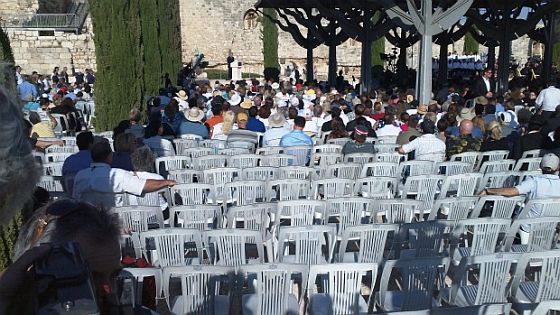
Dressed as though attending a funeral, Beck stood in sharp contrast to the casual attire of his overwhelmingly white American Christian audience, many of whose baseball caps and T-shirts denoted their state of origin, their church or their adherence to the US Tea Party movement.

But the surprising number of empty seats belied the organisers’ claims that demand for tickets had outstripped availability at the 2,000-capacity Davidson Centre.

Ami Kaufman writes:

After months of preparations, hours of television and radio talk all geared up for the big day, tons of merchandise manufactured, Glenn Beck could just about muster over a thousand people at his “Restoring Courage” last night in Jerusalem.

I can’t help but think that this flop might be a lethal blow for this guy. After getting kicked out of FOX and then his decision to veer even farther to the right by partnering up with the likes of Pastor John Hagee, Beck seems to have lost any chance whatsoever to get back into mainstream America like he was just months ago.

Even the event a few days earlier in Caesarea had more umph in it than this one. In fact, he barely even cried in this one. I think he might have been shedding the real tears back stage.

Facebooktwittermail

Egypt’s #Flagman is honored

Al-Masry Al-Youm reports:

The governor of Zagazig on Tuesday honored Ahmed al-Shahat, the young man who pulled down the Israeli flag from the Israel Embassy and replaced it with the Egyptian flag during anti-Israel protests on Saturday.

Protesters have been staging demonstrations before the Israeli Embassy in Giza since last week, following the death of five Egyptian soldiers at the hands of Israeli forces.

Residents of the city cheered Shahat upon his arrival and held a big celebration for him.

“I did it to please millions of Egyptians and Arabs,” Shahat said.

Facebooktwittermail

How the rebels took Tripoli

Associated Press reports:

They called it Operation Mermaid Dawn, a stealth plan coordinated by sleeper cells, Libyan rebels, and NATO to snatch the capital from the Moammar Gadhafi’s regime’s hands.

It began three months ago when groups of young men left their homes in Tripoli and traveled to train in Benghazi with ex-military soldiers.

After training in Benghazi, the men would return to Tripoli either through the sea disguised as fishermen or through the western mountains.

“They went back to Tripoli and waited; they became sleeper cells,” said military spokesman Fadlallah Haroun, who helped organize the operation.

He said that many of the trained fighters also stayed in the cities west of Tripoli, including Zintan and Zawiya, and waited for the day to come to push into the capital.

Operation Mermaid Dawn began on the night of August 21 and took the world by surprise as the rebels sped into the capital and celebrated in Green Square with almost no resistance from pro-Gadhafi forces.

Haroun said about 150 men rose up from inside Tripoli, blocking streets, engaging in armed street fights with Gadhafi brigades, and taking over their streets with check points.

He said another 200 men from Misrata.

But why did the armed Gadhafi troops melt away when the rebels drove through?

Fathi Baja, head of the rebel leadership’s political committee, said it was all thanks to a deal cut with the head of the batallion in charge of protecting Tripoli’s gates, the Mohammed Megrayef Brigade.

His name was Mohammed Eshkal and he was very close to Gadhafi and his family. Baja said Gadhafi had ordered the death of his cousin twenty years ago.

“Eshkal carried a grudge in his heart against Gadhafi for 20 years, and he made a deal with the NTC — when the zero hour approached he would hand the city over to the rebels,” said Haroun.

“Eshkal didn’t care much about the revolution,” said Haroun. “He wanted to take a personal revenge from Gadhafi and when he saw a chance that he will fall, he just let it happen.”

But Haroun said he still didn’t trust Eshkal or the men who defected so late in the game.

Haroun said that he didn’t trust any of the defectors who left Gadhafi’s side so close to August 20.

“They lived knew his days were numbered so they defected, but in their hearts they will always fear Gadhafi and give him a regard,” he said.

Haroun said NATO was in contact with the rebel leadership in Benghazi and were aware of the date of Operation Mermaid Dawn.

“Honestly, NATO played a very big role in liberating Tripoli — they bombed all the main locations that we couldn’t handle with our light weapons,” said Harouin.

Facebooktwittermail

As one group of journalists is released, another four are abducted

Reuters reports:

Four Italian journalists were abducted by gunmen near Zawiyah in western Libya as they traveled toward Tripoli on Wednesday, Italian officials said.

The four, who worked for Italian newspapers Corriere della Sera, La Stampa and Avvenire, are being held in an apartment in Tripoli, said Guido de Sanctis, the Italian consul in Benghazi, who was able to speak to one of the journalists by phone.

“They are fine, even if everything happened in a very difficult atmosphere,” de Sanctis told Reuters.

“They have been allowed to call Italy and they have been allowed to get calls from us. They were given food to eat when the Ramadan fast was broken.”

The four were seized near Zawiyah, on the coastal highway 50 km (30 miles) west of Tripoli by armed men who killed their driver, de Sanctis said. The journalists were then handed to others, presumably Muammar Gaddafi loyalists, he said.

The journalists believe the apartment they are being held in Tripoli is close to the Rixos hotel where foreign journalists who were trapped for five days left unharmed earlier on Wednesday, de Sanctis said.

The journalist at Avvenire, the Italian bishops’ newspaper, was also allowed to call the newspaper and said they were well, Italian media said.

Italy’s government said it was closely monitoring the situation.

Facebooktwittermail

Obama, Libya and triumphalism in Washington

Joe Cirincione writes:

This week, in Libya, thousands of people celebrated carrying posters of “The Fantastic Four”: Obama, Rice, French President Nicolas Sarkozy and UK Prime Minister David Cameron. All four played a leading role in supporting the people of Libya in their overthrow of a tyrant. But it was America that played the crucial role. It was America that decided at a key moment to “invest in protecting the lives of others” and to join with NATO not to overthrow a regime, but to help the people of Libya make the regime change that only they could effect.

That is leadership. That is smart. And this is what victory feels like.

Joel Rubin writes:

President Obama’s critics are on the verge of witnessing a third major Obama success in the Arab world in 2011.

First, longtime Egyptian strongman Hosni Mubarak was deposed after Obama refused to support him against the Egyptian people at the moment of truth. Second, Osama bin Laden, America’s archenemy #1, was killed by Navy SEALS on direct orders from Obama in a risky cross-border raid into Pakistan. And now, Muammar Gaddafi — a man whose presence on the international stage has mocked any reasonable definition of sanity for more than four decades — is about to be knocked out of power by an international coalition in which Obama ensured that the U.S. played a leading team role.

Fareed Zacharia, heralding a new era in U.S. foreign policy, writes:

The United States decided that it was only going to intervene in Libya if it could establish several conditions:

1) A local group that was willing to fight and die for change; in other words, “indigenous capacity”.

2) Locally recognized legitimacy in the form of the Arab League’s request for intervention.

3) International legitimacy in the form of United Nations Security Council Resolution 1973.

4) Genuine burden sharing with the British and French spelling out precisely how many sorties they would be willing to man and precisely what level of commitment they would be willing to provide.

It was only when all those conditions were fulfilled that the Obama Administration agreed to play a pivotal but supporting role in the Libya operation.

Perhaps if Obama gets re-elected (though I wouldn’t place large bets on that yet), he’ll invite a few Libyans to Washington so that they can celebrate the pivotal role they played in securing his second term.

Needless to say, I jest. Even Obama’s most loyal boosters would be forced to concede that hardly any votes in the 2012 presidential election will end up being swayed by the outcome of the Libyan revolution.

So let’s assume that Zacharia and Rubin and Cirincione are simply celebrating what they regard as a foreign policy success (and are not driven just by some idea that the outcome in Libya is good for Obama), what should we make of their analysis?

As usual it comes weighted down by the conceit that Washington is the center of the world.

Libyans who spent the last six months fighting for their country — they are just supporting actors with the honor of rolling out a red carpet along which America can now stride on its way to glory.

Has everyone forgotten? The idea that on Libya, Obama “led from behind” was a facetious way of spinning the fact that in this intervention, he really was the reluctant partner. US involvement was agreed to on the strict condition that American soldiers could maintain a comfortable distance from Libya, while their commander in chief kept his distance from Congress and the media.

America’s arm-length involvement in Libya was indeed a success, but not in the sense that success is now being paraded. It was a success in as much as it is clear to most people (at least outside Washington) that victory in Libya belongs to the people of Libya. They know they couldn’t have succeeded without Western support, but it is Libyans who died in their thousands while their allies shed not a single drop of blood.

Sarkozy, Cameron, Obama, and Rice — these were the supporting actors. NATO’s involvement was much more reluctant than it was opportunistic and it was driven by fears about the potential price of non-involvement.

Those who now want to construct out of this a model for other interventions seem to have no more imagination than those who not long ago employed the simplistic argument that what “worked” in Iraq should work in Afghanistan.

Washington was able to help out a bunch of Arabs in Libya when they got in trouble — should be able to do the same in Syria. Right?

The lesson to take away from Libya is that in the Arab Awakening no two uprisings are the same and no idea is more dangerous than that a successful intervention can be replicated.

Facebooktwittermail

Libya is no Iraq – this revolution is the real deal

Mohamed Salem writes:

Muammar Gaddafi and his sons are now on the run, fleeing from the Libyan people, yet already the doomsayers and prophets of disaster have lined up to tell the world it isn’t worth it, that Libya is destined to go down the route of chaos and fragmentation. Libya will be another Iraq and Afghanistan, we are told.

They are wrong, because the post-conflict scenario in Libya differs from those two examples of failed western intervention in several crucial aspects. Indeed if you study the indicators, Libya is poised to be the most complete and potentially most successful of any the Arab uprisings so far.

The roots of Iraq and Afghanistan’s tragedy lie in the abrupt and imposed nature of change. It’s easy to forget that Libya’s organic and intense popular uprising preceded any international intervention. UN security council resolution 1973, which authorised the use of force to protect civilians, was only passed when it became clear that a massacre in the east was imminent. This is not Nato’s revolution, not by a long way. The Libyan revolution remains very much the real deal.

The reason this matters is because it means no foreign power can now assert a moral right to meddle in Libya’s future. Libya’s destiny is now rightfully in the hands of its people, having been hijacked by Gaddafi and his cronies for almost 42 years. It also means the west must to a degree absolve itself of direct responsibility for what happens next in Libya and leave the planning to Libyans themselves.

The worst idea of all would be to send in foreign ground troops now, even under the peacekeeping banner. Not only would this be met with fierce opposition by the Libyan people, it would send the message that the west still feels that Arabs cannot be trusted to look after themselves.

Facebooktwittermail

The situation in Sinai and Egypt-Israel relations

Issandr El Amrani writes:

The events of the last week or so in Sinai have been overshadowed by the current diplomatic rift and public outrage over Israel’s shooting of at least three Egyptian border guards a few days ago. The question of security and state legitimacy in the Sinai, the attack that killed 17 Israelis in Eilat, Israel’s latest bombing campaign in Gaza (and the Palestinian rocket fire that came in response), the border incident and the future of the the Egyptian-Israel relationship has interwoven in complex ways. But there are also distinct issues worth separating to get a better understanding of the whole.

  1. The situation in Sinai: The raid on July 29 by some 100 gunmen of the al-Arish police station was a wake-up signal to the Egyptian government about how dire the situation is in North and Central Sinai. So were media reports and calls for a “Islamic Republic of Sinai” that Salafist Jihadist organizations — most notably Takfir wal Hijra, a group calling itself after the more famous group of the 1970s but that had hitherto been a low-intensity nuisance for the authorities. The security situation in Sinai is a mixture of tribal grievances and score-settling, banditry and violent ideological activity by Jihadists. Sometimes the interaction between these is uncertain.
    The military’s unleashing of Operation Eagle, aimed at breaking up violent groups, confiscating weapons and pacifying the region, is absolutely necessary. The Egyptian state has too long tolerated tribal bending of the law in Sinai, an ambiguity it used to replace legitimacy. The price it is paying is the current chaos. The question now is how to forcefully intervene (as it should, at times using force when necessary to disarm armeg groups) while repairing relations with locals. That Sami Enan, the chief of staff of the Armed Forces, is holding meetings with tribal leaders is a good first step, as is the creation of a new law for Sinai and an administrative body that will focus on its development.
    For a thorough look at this complicated situation in Sinai, including the presence of Palestinians affiliated with Muhammad Dahlan’s factions and the possibility of armed groups being manipulated by regional powers, you could do no better than to read this investigation by Lina Attalah in al-Masri al-Youm.

  2. The Eilat attack: Israel both immediately claimed that the perpetrators of the Eilat had come in from Gaza through Egypt and that Hamas were responsible for them, although Hamas denies this and Israel presented scant evidence. The Netanyahu government also used them as a diversion from protests against their economic policy, and used them to justify a new bombing campaign in Gaza that has already killed at least 15. It might very well be the case that the Eilat attackers came from Gaza into Egypt and then into Israel — but much of the coverage of the issue suggests this is a new phenomenon due to the situation in Sinai post-revolution. In fact, previous attacks in Israel’s south-west were probably also conducted via Sinai. So unlike Barry Rubin1 argues, this is not just “the bitter fruit of the U.S-backed downfall of the government of President Husni Mubarak in Egypt, opening the Egypt-Israel border as a new front in the war.”
    Of course, that it’s not the first time is little consolation to Israelis. But it means that has relatively little to do with the post-revolutionary situation. Egypt has a long border with Israel that has been porous to human and drug trafficking for a long time. It has a limited ability to deploy military personnel and helicopters. And it has a situation with smuggling and other illegal activities in Eastern Sinai that has been exarcebated by the blockade on Gaza. In other words, the core problem is not a temporary reduction in Egyptian control of Sinai. It’s the Israeli-Palestinian conflict, the pressures on neighbors created by the blockade on Gaza, and the international community’s endorsement of of it.

  3. The bombing campaign in Gaza: This brings us the point that, although it has scant evidence of who was behind the Eilat attacks, Israel bombarded Gaza, killing 15 so far, including at least five civilians, three of them children. In retaliation, Hamas fired rockets into southern Israel. But the truth is there would have probably been more rockets were it not for Israeli concern over the public mood in Egypt. This is one of the positive outcomes of the revolution: Israel will think twice about whether antagonizing Egyptian public opinion is worth it now that Mubarak is no longer around to deflect it.

Adam Shatz writes:

On Sunday night, Binyamin Netanyahu and Ehud Barak called a cabinet meeting to argue against going to war in Gaza. The meeting lasted four hours, as these unlikely doves made the case for ‘restraint’. They were, in a sense, arguing against themselves. After the attack in Eilat last Thursday, in which eight Israelis, five of them civilians, were killed, Netanyahu and Barak had immediately blamed the Popular Resistance Committee in Gaza, an armed movement of militants from different factions. If they had any evidence of PRC involvement, they didn’t share it: the best an IDF spokeswoman interviewed on the Real News could manage was that the attackers used Kalashnikovs. The PRC denied responsibility; Hamas was even more sheepish: the last thing it needed was another Operation Cast Lead.

A more likely story was that the attacks were carried out by Islamic militants in the Sinai, where relations between Bedouins and the Egyptian government have deteriorated, and where the pipeline that carries natural gas to Israel and Jordan has been blown up five times since February (as it happens, one of the charges against Mubarak is that he sold gas to Israel at below market prices). Earlier this month, more than a thousand Egyptian troops launched a ‘pacification’ campaign in the Sinai after Islamist insurgents attacked a police station, killing five people.

But Israel insisted that Gazan militants were to blame for Eilat, and carried out air strikes in Gaza that killed at least 14 people, including two children. The usual round of rocket attacks by armed groups in Gaza (though not by Hamas) followed, and the usual calls inside Israel for more blood. War looked imminent. As some left-wing Israelis noted, it looked like just what Netanyahu needed to distract attention from – and perhaps even crush – the tent protests against his economic policies. Who would dare to demonstrate against the government – or raise inconvenient questions about the recent announcement to build 1600 new homes in occupied East Jerusalem – if the nation went to war?

Yet here were Netanyahu and Barak, pleading with their cabinet for ‘restraint’ until the early hours of Monday morning. They were joined by defence officials who pointed out that Hamas hadn’t joined in the rocket attacks but had imposed a ceasefire on other militant groups. According to Haaretz, Netanyahu and Barak argued that Israel was too isolated internationally to go to war, and that its rocket interception system wasn’t fully prepared. But the decisive argument was that the price of war in Gaza could be the peace treaty with Egypt. Relations had already been jeopardised by Israel’s killing of at least three Egyptian security officers (five, according to Egypt) during its cross-border raid in search of the attackers in Eilat. The Egyptians were furious, and grew even more so when Israel chastised them for losing control of the Sinai.

Haaretz reports:

Chief of Staff Benny Gantz ordered on Wednesday that the Israel Defense Forces increase defensive measures along Israel’s border with Egypt due to intelligence that terrorist groups are planning attacks similar to the ones last Thursday in which eight Israelis were killed.

The new measures include putting in place additional means of electronic and visual intelligence gathering as well bolstering the Navy Command Center in the southern city of Eilat.

Also on Wednesday, security officials said that the Islamic Jihad operative who was killed in an IAF airstrike early Wednesday morning was responsible for transfer of funds used in last Thursday’s attacks.

The operative was identified as 34-year-old Ismael al-Asmar.

Security officials said that the decision was made to target al-Asmar due to intelligence that he was planning to initiate another attack from Sinai in the coming days.

Facebooktwittermail

NTC leader: ‘Free elections in eight months’

Al Jazeera reports:

The leader of Libya’s National Transitional Council (NTC) has said the new government will hold free elections within eight months and pledged to put Muammar Gaddafi on trial in the country rather than an international court.

In comments published on Wednesday in Italy’s La Repubblica newspaper, rebel leader Mustafa Abdel Jalil also promised to open Libya up to the outside world and build “strong relations with other countries”.

“In eight months we will hold legislative and presidential elections,” said Jalil, chairman of the NTC which now
controls all but isolated pockets of the oil-rich state.

“We want a democratic government and a just constitution. Above all we do not wish to continue to be isolated in the world as we have been up to now,” he told the newspaper.

Facebooktwittermail

Libya conflict: journalists trapped in Tripoli’s Rixos hotel

The Guardian reports:

Conditions have deteriorated sharply at the Rixos hotel in the Libyan capital, Tripoli, where more than 30 foreign journalists are trapped by fighting in the surrounding streets.

The BBC’s Matthew Price gave a graphic account of life inside the five-star hotel close to Muammar Gaddafi’s compound of Bab al-Aziziya taken by rebels on Tuesday, describing it as “the siege of the Rixos”.

“It’s a desperate situation,” Price told Radio 4’s Today programme. “The situation deteriorated massively overnight when it became clear we were unable to leave the hotel of our own free will … Gunmen were roaming around the corridors … Snipers were on the roof.”

The 35 foreigners at the hotel are mainly British and American journalists from the BBC, Sky, CNN, Fox, Reuters, Associated Press and Chinese television. Price said a US congressmen and an Indian parliamentarian were among the group.

The New York Times reports:

Rebel fighters sought to consolidate their hold on Tripoli on Wednesday and continued to hunt down an elusive and defiant Col. Muammar el-Qaddafi, a day after they crashed through the gates of his fortresslike compound, ransacking its barracks for weapons and carting off mementos of his 42-year dictatorship.

As a reminder that he remained on the loose, Colonel Qaddafi, in an address broadcast early Wednesday on a local Tripoli radio station, called his retreat from the compound “tactical,” several news reports said.

He blamed months of NATO airstrikes for bringing down his compound and vowed “martyrdom” or victory in his battle against the alliance. Urging Libyan tribes across the land to march on the capital, he said: “I call on all Tripoli residents, with all its young, old and armed brigades, to defend the city, to cleanse it, to put an end to the traitors and kick them out of our city.”

“These gangs seek to destroy Tripoli,” he said, referring to the rebels, who began taking control of Tripoli late on Sunday. “They are evil incarnate. We should fight them.”

Facebooktwittermail