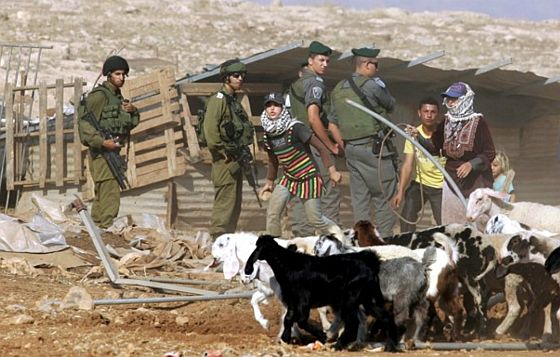
Want to visit the Palestinian prison camp (the West Bank)? Israel says you can’t — it’s a provocation.

Haaretz reports:

Security forces detained 30 pro-Palestinian activists attempting to enter Israel on board easyJet and Alitalia flights on Friday as part of an attempt to stymie an influx of activists into the country.

Ten of the activists were on board the easyJet flight, while the remaining 20 were flying with Italian airline Alitalia. Earlier in the day, police arrested six Israelis who arrived at the airport with signs reading “Free Gaza”.

The flights landed at Ben-Gurion International Airport Friday afternoon, however when it became clear that there were activists on board the planes were diverted to a runway further away from the airport and the activists were detained by police.

Israel has thus far been successful in preventing the entry of 200 passengers wishing to come to Israel as part of the Welcome to Palestine campaign, which had organized a “fly-in” to the Middle East this weekend for solidarity visits in the Palestinian territories.

The 200 activists were on a list of 342 blacklisted passengers scheduled to arrive in Israel later Thursday and early Friday, submitted by the Transportation Ministry to foreign airlines on Thursday.

Earlier Friday, two American citizens planning to take part in the pro-Palestinian “fly-in”, were refused entrance to Israel after landing at Ben-Gurion Airport, and were sent on an outbound flight back to Greece.

The women, wearing “fly-in” T-shirts, flew in from Athens and were stopped by the Israeli police, who decided to decrease security presence at the airport on Thursday evening, saying it no longer expects mass fly-in activists, because most of them had been already stopped abroad.

The women were questioned and after stating the reason for their visit, Israel Police sent them on an outbound flight due to their intention to create provocations and disrupt the peace.

Facebooktwittermail

In Israel, a tsunami warning

Noam Chomsky writes:

In May, in a closed meeting of many of Israel’s business leaders, Idan Ofer, a holding-company magnate, warned, “We are quickly turning into South Africa. The economic blow of sanctions will be felt by every family in Israel.”

The business leaders’ particular concern was the U.N. General Assembly session this September, where the Palestinian Authority is planning to call for recognition of a Palestinian state.

Dan Gillerman, Israel’s former ambassador to the United Nations, warned participants that “the morning after the anticipated announcement of recognition of a Palestinian state, a painful and dramatic process of Southafricanization will begin” – meaning that Israel would become a pariah state, subject to international sanctions.

In this and subsequent meetings, the oligarchs urged the government to initiate efforts modeled on the Saudi (Arab League) proposals and the unofficial Geneva Accord of 2003, in which high-level Palestinian and Israeli negotiators detailed a two-state settlement that was welcomed by most of the world, dismissed by Israel and ignored by Washington.

In March, Israel’s Defense Minister Ehud Barak warned of the prospective U.N. action as a “tsunami.” The fear is that the world will condemn Israel not only for violating international law but also for carrying out its criminal acts in an occupied state recognized by the U.N.

The U.S. and Israel are waging intensive diplomatic campaigns to head off the tsunami. If they fail, recognition of a Palestinian state is likely.

Facebooktwittermail

On YouTube, glimpses of Syrian crackdown

Robert Mackey writes:

While restrictions on independent reporting inside Syria make it difficult to say for certain what is going on in Hama, video posted online in recent weeks appears to show that Hama, Syria’s fourth-largest city, has emerged as a center of the current uprising against President Bashar al-Assad.

A generation ago, in 1982, before YouTube and ubiquitous camera phones, Mr. Assad’s father, Hafez, also used military force to crush an uprising in Hama, away from the world’s eyes. Before journalists were eventually allowed into Hama that year, after the bombardment was complete, at least 10,000 people are thought to have been killed.

That history makes every video clip showing tens of thousands of protesters packed into Hama’s central Assi Square somewhat remarkable. Among those clips is this video, said to have been filmed in the square two weeks ago, as a singer named Ibrahim Kashoush led the crowd in a rendition of his protest anthem, “Yalla Erhal Ya Bashar,” or, “It’s Time to Leave, Bashar.”

Facebooktwittermail

Pro-Palestinian activists ‘at large’ inside Israel

In the days before hundreds of pro-Palestinian activists tried invade Israel on board an Air Flotilla, five managed to get past security and are on the loose inside Israel. The future of the Jewish state could be in jeopardy.

Noam Sheizaf reports:

Panic. There is no other way to describe the Israeli reaction to a plan organized by a few activists—no more than a thousand, according to the most generous estimates—to try and travel to the West Bank via Ben Gurion International Airport. A handful of those visitors arrived (five of them have already been deported), and it seems that the whole country has gone mad.

Haaretz has reported a special deployment of hundreds of police officers and special units both inside and outside the terminals, “in case one of the arrivals tries to set himself on fire.” The Petach Tikva court, in charge of the airport area, is to have more arrest judges on alert, and the minister for Hasbara (propaganda) Yuli Edelstein demanded that the government take no chances, “because we should remember what happened on 9/11.”

All this, lets not forget, in order to welcome between a few dozen to a few hundred Westerners (most of them quite old, according to reports), who would arrive on separate flights and on different hours, who went through extensive security checks before boarding their planes, and who openly declared their intentions to visit the Palestinian territories. This is the national threat that has captured all the headlines for some days now in a country armed with one of the strongest armies in the world as well as an extensive arsenal of nuclear bombs.

Gideon Levy writes:

The danger is tangible. It is approaching our shores at alarming speed. It is approaching us from the air, from the sea and from the land and nobody can stop it. Someone must do something, quickly. Warning, danger! Israel is losing its senses.

We had not yet finished celebrating our victories – killing those who sought to cross the border on Nakba Day, thwarting the flotilla to Gaza, not handing bodies over to the Palestinians and saving Amir Peretz from a British prison – when we were already forced to prepare for the next existential threat: activists flying in from Europe.

Here’s a safe bet: We’re going to win another sweeping victory. The public security minister said “hooligans,” the police commissioner promised that “we won’t treat them gently.” The prime minister held a special “security” consultation before taking off for Romania and hundreds of policemen and security guards, both uniformed and plainclothes, as well as Shin Bet and Mossad agents deployed in Ben-Gurion Airport.

Our next great victory is already assured. Early yesterday afternoon, our forces scored their first triumph on the battlefield: Five activists were expelled.

If it weren’t so sad, it would be funny. Israel is becoming grotesque. Nonviolent demonstrators, some of them well-wishers, who pose no threat to Israel’s security, wish to go to Gaza, some by sea and some by air. Yet they are being portrayed as enemies of the state and of the people, not to mention of all humanity. Israel is employing its entire arsenal of tricks to prevent them from carrying out their legitimate protest.

First Israel magnifies the danger, then it legitimizes all means against it. And finally, it glorifies the achievement of destroying it.

Meanwhile, a high profile panel of experts which recently met in Jerusalem debated whether President Obama is showing enough love for Israel.

Elliott Abrams, former senior White House adviser in the George W. Bush administration, asserted: “There is no great love in his heart for Israel.” At the same time, Abrams felt assured that America as a nation has enough love for Israel thanks to tens of millions of right-wing Christians who will only vote for pro-Israel candidates.

Members of the panel connected to the current administration countered that it too is overflowing with the devotion that Israelis have come to expect from Washington.

“The notion that Obama does not have the requisite love, or cares in his kishkas [guts], defies the facts,” said [former Florida Democratic Congressman Robert] Wexler, today the president of the S. Daniel Abraham Center for Middle East Peace in Washington.

Former IDF spokesman Ruth Yaron countered that even with all that, Israelis want to feel the love, not just hear that the president has done a great deal for security cooperation.

“I’m not questioning his love,” she said. “I would say please make sure this love is not only felt, but also seen by countries around us.”

Without feeling secure in this love and a feeling that Israel will never be left to “walk alone,” the country would be less willing to take risks, Yaron said.

This dimension of the Israeli psyche – of wanting to feel, and not only hear, about the love – was dismissed as “neurosis” by [Martin] Indyk, who today is vice president of the Brookings Institution.

Saying that Obama is not a “warm and cuddly guy,” and calling him “no drama Obama,” Indyk said that the only intimate relationship Obama has with any foreign leader is with Russian President Dmitry Medvedev.

Calling Yaron’s description of Israel’s psyche the picture of a “neurotic nation,” Indyk said, “It’s time to grow up. We should get over the question of whether he loves me or he loves me not, and focus on question of finding a solution to conflict with the Palestinians.

“When Israel decides by itself to solve that problem, it will have the overwhelmingly cuddly support of the US president.”

Facebooktwittermail

Is Palestine next?

Adam Shatz writes:

No one in the Arab world was watching the news more closely than the Palestinians during the revolutions in Tunisia and Egypt. The first emotion they experienced was disbelief; the second – particularly when they saw Palestinian flags being raised in Tahrir Square – was relief that they were no longer alone. Arab lethargy has been a virtual article of faith among Palestinians, who felt that their neighbours had betrayed them in 1948 and had done nothing to help them since. The Palestinian national movement, which rose to prominence under Yasir Arafat’s leadership in the late 1960s, was defined in large part by its belief that Palestinians had to rely on themselves. Mahmoud Darwish was not the only one to note that during the siege of Beirut in 1982, when Israel invaded Lebanon in an attempt to crush the PLO, tens of thousands of Israelis protested in Tel Aviv but the Arabs were too busy watching the World Cup Final to take to the streets.

The old Arab order was buried in Tahrir Square. Young revolutionaries rose up against a regime which for three decades had stood in the way of Palestinian aspirations. It seemed too good to be true and some pundits in Palestine wondered whether it wasn’t an American conspiracy. But it wasn’t, and Palestinians began to re-examine what had been one of their most disabling convictions: the belief that the US controls the Middle Eastern chessboard, and that the Arab world is powerless against America and Israel. ‘There has been a kind of epistemic break,’ a young Palestinian said to me. The excitement among Palestinians sometimes seems to be mixed with unease, even envy: the spotlight has been stolen from them. As a Hamas councilwoman in Nablus put it, ‘For 60 years they were watching us. Now we are watching them.’ But Palestinians have prided themselves on being the vanguard of protest in the Arab world and they will not be content to remain spectators for long.

In the absence of a state and an army, Darwish wrote in one of his best-known poems, Palestinians live in a ‘country of words’. The conversation that they are having is only beginning to translate into action. What was clear to me during the three weeks I spent recently in the West Bank is that the Arab revolutions have emboldened them to ask for more, both from Israel and from themselves, even if that means preparing for a much longer struggle.

Facebooktwittermail

Obama under fire over detention of terror suspect on US navy ship

The Guardian reports:

The Obama administration approved the secret detention of a Somali terror suspect on board a US navy ship, where for two months he was subjected to military interrogation in the absence of a lawyer and without charge.

The capture and treatment of Ahmed Abdulkadir Warsame has rekindled the debate within the US about the appropriate handling of terror suspects. Republicans in Congress have objected to Warsame being brought to New York this week to be tried in a criminal court – an attempt by the Obama administration to avoid sending the prisoner to Guantánamo Bay, which it has promised to close.

From the opposite viewpoint, civil rights groups have objected to the secret questioning of Warsame on board a navy vessel, an innovation that they fear could see a new form of the CIA’s widely discredited “black site” detention centres around the world.

There is some evidence that the US government is turning to detention at sea as a way of avoiding legal and political impediments in the treatment of terror suspects, both domestically and on the international stage.

Facebooktwittermail

Hacking scandal rocks Murdoch empire

If there was any doubt that Rupert Murdoch realizes his media empire is under threat, his latest move at damage control is unprecedented: the News of the World is about to be shut down.

The News of the World, a British tabloid with which most Americans will be unfamiliar, is not as powerful as Fox News, but it is just as representative of Murdoch’s ruthless approach to media sensationalism and journalism as cut-throat commerce.

The latest phone hacking story that The Guardian broke on Monday revealed that there seem to be no ethical boundaries that News Corp is unwilling to cross.

After schoolgirl Milly Dowler went missing in March 2002, “News of the World journalists reacted by engaging in what was standard practice in their newsroom: they hired private investigators to get them a story.”

Scotland Yard is now investigating evidence that the paper hacked directly into the voicemail of the missing girl’s own phone. As her friends and parents called and left messages imploring Milly to get in touch with them, the News of the World was listening and recording their every private word.

But the journalists at the News of the World then encountered a problem. Milly’s voicemail box filled up and would accept no more messages. Apparently thirsty for more information from more voicemails, the paper intervened – and deleted the messages that had been left in the first few days after her disappearance. According to one source, this had a devastating effect: when her friends and family called again and discovered that her voicemail had been cleared, they concluded that this must have been done by Milly herself and, therefore, that she must still be alive. But she was not. The interference created false hope and extra agony for those who were misled by it.

The Dowler family then granted an exclusive interview to the News of the World in which they talked about their hope, quite unaware that it had been falsely kindled by the newspaper’s own intervention. Sally Dowler told the paper: “If Milly walked through the door, I don’t think we’d be able to speak. We’d just weep tears of joy and give her a great big hug.”

The deletion of the messages also caused difficulties for the police by confusing the picture when they had few leads to pursue. It also potentially destroyed valuable evidence.

Today, The Guardian reports:

The senior detective leading the phone hacking inquiry said on Thursday that there were 4,000 possible victims of phone hacking listed in the pages of private eye Glenn Muclaire’s notebooks and they were being contacted “as quickly as possible”.

Deputy assistant commissioner Sue Akers, who is running Operation Weeting, broke her silence to give more details on her operation as the number of victims being publicly identified continued to grow.

Her words are the first official confirmation of what the Guardian reported two years ago – that thousands of people were listed as possible victims in the notebooks of Mulcaire, who was hired by the News of the World. These individuals were not contacted by detectives investigating phone hacking in the first inquiry, known as the Goodman inquiry. The Guardian’s original story in 2009 suggested that between 2,000 and 3,000 individuals might have been the victims of phone hacking.

The fallout from the hacking scandal also extends to London’s police force:

Investigators inside Scotland Yard are trying to identify up to five officers who were paid between them a total of at least £100,000 in cash from the News of the World, the Guardian understands.

Documents sent to the police by News International did not name those involved but contained pseudonyms which investigators within the Yard are trying to match with individual officers.

The revelation comes a day after Sir Paul Stephenson, commissioner of the Metropolitan police, said that the amounts involved had been paid to a small number of officers.

News that officers were allegedly paid so much in bribes has caused shock and concern within Scotland Yard, where the directorate of professional standards is now investigating the matter. There have been calls for an external force to be brought in to investigate the scandal – Boris Johnson, the mayor of London, has said someone else should wash the Met’s dirty linen in public.

Facebooktwittermail

Russian-speaking immigrants push Israel further right

Haaretz reports:

Immigrants from the former Soviet Union who came to Israel in the 1990s are moving further to the right of the political spectrum, even as they increasingly feel part of Israeli society, according to a new poll.

According to the study, only 13 percent of immigrants polled said they were prepared to concede any territory at all in exchange for peace with the Palestinians, down from 37 percent in 1999.

The report also found that 84 percent of immigrants say they feel “at home” in Israel, up from 53 percent in a survey conducted 12 years ago. Nevertheless, only 62 percent said they are sure they will stay here, virtually unchanged from 60 percent in 1999.

Dr. Zeev Khanin, the Immigrant Absorption Ministry’s chief scientist, dismissed the significance of this finding, saying that similarly high percentages of veteran Israelis describe themselves as being unsure they will stay here. This ambivalence is due mainly to the challenges of life in Israel, “and isn’t necessarily connected to absorption difficulties,” he argued.

Central Bureau of Statistics data seems to contradict this claim, showing that of Israelis who left the country in 2008 and stayed away for more than a year, almost one-third were immigrants from the former Soviet Union. But the ministry said the number of people leaving the country permanently has dropped since 2004, and today, only some 97,000 immigrants from the former Soviet Union live overseas.

The study also surveyed the immigrants’ attitudes toward Israeli Arabs and the Israeli-Arab conflict. It found that while immigrants from the former Soviet Union had negative attitudes toward Arabs back in the 1990s as well, this trend has strengthened in the intervening decade. According to Prof. Majid Al-Haj, Haifa University’s vice president and dean of research, who served as lead researcher on the study, the immigrants’ views are more extreme than those of veteran Israelis.

For instance, the study found, 55 percent of the immigrants said Israel should work to reduce the number of Arabs in the country, compared to only 41 percent of veteran Israelis. About two-thirds said Israeli Arabs constitute a national security risk, compared with 59 percent of veteran Israelis. And only 4 percent would accept their child marrying a Muslim Arab, compared to 9 percent of veteran Israelis.

Facebooktwittermail

U.N. slams Israel for lethal reply to protesters along Lebanese border

The Wall Street Journal reports:

The United Nations sharply criticized Israel for using live ammunition in May against Palestinian protesters who tried to scale an Israeli security fence on the Lebanese border, according to a U.N. report reviewed by The Wall Street Journal.

The confidential report to the U.N. Security Council, dated Friday, also accuses Israel of violating the 2006 cease-fire agreement that ended the six-week conflict between Israel and Hezbollah, the Lebanese Shiite group. The May 15 incident near Maroun al-Ras, Lebanon, led to seven deaths and 111 injuries.

The report also accuses about 1,000 protesters of a group of 10,000 that day of violating the cease-fire by carrying out a “provocative and violent act.”

The report appears to have further strained relations between the U.N. and Israel and is likely to increase Israel’s isolation amid an international campaign to challenge its policies on the occupied territories.

The U.N. blamed Israel for turning too quickly to live ammunition to stop the protesters advancing on the Israeli border. “Other than firing initial warning shots, the Israel Defense Forces did not use conventional crowd-control methods or any other method than lethal weapons against the demonstrators,” the report said. It added that the act “constituted a violation of [the cease-fire] resolution and was not commensurate to the threat to Israeli soldiers.”

Facebooktwittermail

Journalists barred from flight to Israel

Al Jazeera reports:

Two Dutch journalists were not allowed to board a flight from Amsterdam to Tel Aviv late yesterday.

Security Correspondent Bud Wichers and Photographer Ettora Hesseling, who are both working for an International news agency, recently covered the preparation of the Dutch Flotilla activists from Greece.

They intended to sail with flotilla, but backed out after a disagreement between the Dutch organizers and Dutch journalists.
They were told by a staff member of El Al Airlines, an Israeli company, that that they would pose a serious flight risk, and for that reason could not board the plane.

“We wanted to tell both sides of the Flotilla story and scheduled interviews with Israelis who oppose the action of the activists,” said Wichers.

“Later on we wanted to go to Gaza to see how Israel is bringing aid to the people there. Israel denied us the opportunity to tell their side of the story. Instead we are labeled terrorists now, even though Netanyahu’s office specifically said they would not target journalists who covered the Freedom Flotilla 2.”

Wichers has worked numerous times in the Israel and the Palestinian areas and covered the Middle East for over 10 years.

Facebooktwittermail

Libyan rebels gain inches toward link to Tripoli

The New York Times reports:

Rebels opposed to Col. Muammar el-Qaddafi seized control of this village in the mountains on Wednesday, extending their hold in western Libya and inching toward a supply route to the capital that they hope to sever.

After a half-day gun battle, Colonel Qaddafi’s soldiers yielded the town in the early afternoon, firing rockets and mortars to cover their withdrawal. The ordnance exploded on the hillsides around the town with reverberating booms and plumes of dust and smoke that briefly kept the rebels away.

But the rebels flowed in behind the fleeing troops, capturing more than a dozen of them and collecting the departed soldiers’ abandoned ammunition and equipment. Soon they were refueling their cars and pickup trucks at the gas station they now held.

Qawalish changed hands while rebels elsewhere reported making progress outside of Misurata, east of the capital, Tripoli. They said they were advancing toward the city of Zlitan. Those reports could not be independently confirmed.

In the mountains, the rebels said they hoped their day signaled new momentum for a fight in western Libya that had been deadlocked for more than a week. “We are doing well,” said Sofian Alhaj, a fighter who said he was a former employee of an investment company run by Seif al-Islam el-Qaddafi, one of the Libyan leader’s sons. “Now we will keep going, until we are in Tripoli.”

That ambition, if realized, would most likely occur in increments. Geographically, the seizure of Qawalish marked a minor shift in the front lines. But it moved the rebels within about 35 miles of Gharyan, a small city astride a strategic highway running south from Tripoli.

Facebooktwittermail

Juliano ship heads for Gaza

Ynet reports:

The Gaza-bound Juliano ship left Greece Wednesday afternoon, after suffering huge delays due in part to a ban set by Athens on the departure of flotilla ships from its ports.

On board the ship are 20 activists. Last week flotilla organizers claimed that Israel had sabotaged the ship in an attempt to prevent it from sailing.

“We are at sea,” former Israeli Dror Feiler, one of the organizers, told Ynet. “All roads lead to Gaza. It will be a small but high-quality flotilla.”

Greta Berlin, a spokeswoman for the Free Gaza movement, told Ynet that the Juliano will rendezvous, in international waters, with a French boat already at sea before heading towards the Strip. She gave no details on the location of the meeting.

Feiler also refused to provide details on the progress planned for the boats. “At this point I can only say that after a lengthy battle we finally succeeded in departing. The Greeks gave us a lot of trouble, but we met all of their conditions and they couldn’t hold us any longer,” he said. “It was like David versus Goliath.”

The former Israeli also lamented the fact that a Greek company had reneged on a deal to provide cement for the people of Gaza.

“They gave us our money back, said they had been pressured and that they could not hold up their end of the deal,” he said, adding that the flotilla organizers plan to sue the company.

The Juliano had previously attempted to set sail on Tuesday, but the Greek coast guard surrounded the ship and quashed the attempt. Now, Feiler believes, the only thing standing between them and Gaza is the IDF.

Facebooktwittermail

‘Sexy Israel’ getting treatment for flotilla nightmares – updated

Dimi Reider writes:

I’m somewhat of a fool for excruciatingly bad Hasbara videos, but this one surely takes the cake:

From this video, we learn “Israel” is massively paranoid, even somewhat hysterical, believing edited second-hand evidence from biased sources (IDF spokesman’s video from the flotilla), suspicious of people trying to help her and storming out of treatment – so far so true. Apart from making rather poorly judged use of the experience of real women with real trauma, the July 1st video is also ridiculously sexist; beginning with the cheap camera-pan up the actress’s legs and ending with the fact it was first posted on Youtube a day earlier, under the title “Sex with the Psychologist”.

Is this for real? Your guess is as good as mine. This is so embarrassingly counterproductive one feels it simply has to be satire. But then again, so is our foreign policy.

Update: The actress is Tel Aviv based Aimee Niestat. Niestat confirmed to +972 it was her in the video, but declined to say who was behind it. However, +972 was able to confirm through a source with knowledge of the actress’ engagement that the gig was indeed a Hasbara video commissioned by the government. It’s unclear whether this was specifically the Information Ministry – we’ll confirm as soon as we get their response.

Update: Max Blumenthal adds:

A source who works inside Haaretz told me that Neistat is a Haaretz employee who translates Hebrew content into English (occasionally staffers at the translation desk produce original journalist content and editorials). Of course, everyone at Haaretz is entitled to their opinion, but Neistat’s involvement in a government-sponsored propaganda campaign seems like an ethical breach. As appallingly bad as the video was, the fact that an apparent staffer for one of Israel’s major newspapers played a starring role is far worse.

Facebooktwittermail

Challenging Israeli apartheid — by plane

Mazin Qumsiyeh writes:

This week, hundreds of activists plan on challenging Israel’s apartheid apartheid by flying in to Ben Gurion airport near Tel Aviv as part of the “Welcome to Palestine” initiative. Heraclitis once stated that “There is nothing permanent except change,” and indeed human history is a chronicle of change — and the Welcome to Palestine project follows that tradition.

No change happens without challenging the status quo. Few people reflect even on modern history to understand how we achieved things like civil rights in the US, enlightenment in Europe, ending slavery, giving women the right to vote and establishing democracies around the world. All these changes from an unjust situation (the status quo) required the agency of mass movement.

On our horizon today is of course the mass movement of Arab people yearning for freedom from decades of dictatorships — many of those structures created and supported by the West.

Rebellion against injustice of course is also a hallmark of the struggle against apartheid in Palestine, a struggle that can be traced back to the first Zionist colony built 131 years ago and that took a giant leap forward by the 1948 founding of the racist state of Israel as a culmination and embodiment of this colonial venture, and the subsequent expansion of this state in 1967 to occupy the rest of Palestine.

Now 7 of the 11 million Palestinians in the world are refugees or displaced people. Palestinian refugees constitute one-third of all refugees worldwide, according to UN statistics. Yet, we are optimistic and we believe change is on the way.

Noam Sheizaf adds:

Though the intention of the international activists to visit the West Bank has been known for sometime, it was only picked up by the Hebrew media in the last couple of days. Citing security officials, Israeli papers have reported on special deployment of police forces at Ben-Gurion international airport to take place from Thursday.

A police source told the daily Maariv that an effort will be made to locate the activists before they board their flights to Israel. “Those who will try to disturb public order will be dealt with,” a spokesperson for the Foreign Office told the site Walla.co.il.

Prime Minister Netanyahu’s office has released a statement declaring that the arrival of the protesters “is a continuation of the efforts to undermine Israel’s right to exist.” Netanyahu ordered the Internal Security Minister Yitzhak Aharomowitz (Israel Beitenu) to handle the preparation of all security agencies to the arrival of the activists. Aharonowitz will conduct a joint session of senior police officials tomorrow, the Army Radio reported.

“We will block those Hooligans from entering the state,” Aharonowitz told the press today.

The local media has labeled the event as “the air flotilla.”

The Israeli warning doesn’t seem to deter the activists from coming, though it is nor clear how many of them did buy tickets to Tel Aviv, and how many of those will be able to pass through the security questionings at the gate and board their flights.

Facebooktwittermail

The ethnic cleansing of Palestinians along Greater Israel’s eastern frontier

The Washington Post reports:

The Israeli troops and bulldozers arrived in the early morning and quickly got to work, tearing down shelters made of plastic netting and poles that had served as homes for about 100 people in this impoverished Bedouin community in the parched Jordan Valley.

The aftermath of the sweep last month against what Israeli authorities said were illegally built structures was still visible on a recent afternoon. Battered appliances, broken furniture, tattered clothing and other belongings that residents said they were prevented from removing were strewn in the dirt piled on the collapsed dwellings.

People took cover from the baking sun in makeshift tents constructed from the remains of their former homes and in others supplied by the Palestinian Red Crescent Society. Mobile tanks and electricity cables temporarily strung across the ground were the only sources of water and power.

“We have nowhere else to go,” said Talib Abayat, sitting in the shade of a lone tree.

The desolate scene reflected the state of the neglected Palestinian communities of the Jordan Valley, an area that amounts to more than a quarter of the West Bank but remains largely under Israeli control, with wide gaps between the resources allocated to Palestinians and Israeli settlers.

Running along the West Bank’s border with Jordan, the Jordan Valley has long been considered an area of strategic importance by Israel, and Prime Minister Binyamin Netanyahu has demanded a long-term military presence there as part of any future peace deal with the Palestinians.

Israeli settlements housing about 9,400 people line the road through the valley, scattered among ramshackle villages and encampments where about 80,000 Palestinians live. Nowhere in the West Bank is the contrast more stark between the settlements, with their intensively irrigated farmland, red-roofed homes and streets shaded by shrubs and trees, and the dusty Palestinian communities and their fields, dependent on limited water supplies.

A series of demolition operations last month underlined Israel’s claim to the area, which a recent poll showed most Israelis believe is part of Israel, not occupied territory, and populated mostly by Israelis. The poll was commissioned by the Association for Civil Rights in Israel.

Palestinian Prime Minister Salam Fayyad has asserted that there can be no Palestinian state without the Jordan Valley, which he called the Palestinian breadbasket. Yet with more than 70 percent of the area under Israeli control — designated as state land, military firing zones or nature reserves — the Palestinian Authority has little influence over the region’s development and the use of its resources.

Facebooktwittermail

Egypt to Gaza: The road begins here

An editorial in Egypt’s Al-Masry Al-Youm says:

Egypt owes its unique history prior Mubarak to its pro-activeness in the region. A revolutionary Egypt must now reclaim its former prominence.

Perhaps the re-opening of Rafah border crossing and the success of the Palestinian reconciliation in Cairo are living proof that the Arab World’s national dignity following Egypt’s freedom from the grasp of the former regime, which succeeded in ripping the people of their sense of solidarity and responsibility for regional causes.

These positive changes come on the heels of years of the Egyptian state sponsoring the Gaza blockade under the Mubarak regime.

Today, the international community is tested – yet again – on its stance toward the Palestinian cause. The Freedom Flotilla II, a convoy of ships aiming to bring supplies and express support to the besieged people of Gaza, is now stuck in Greek waters following Israel’s pressure on Greece to prevent flotilla vessels from departing the port.

Following discovery that propeller shafts of two ships have been damaged, there are speculations that the Mossad may have sabotaged the boats.

Arab governments remain silent in the face of vehement international criticism of Israeli policy vis-à-vis the Palestinian people. Once more, we revert back to people – to our people – for only they can initiate an act of resistance.

As part of Egypt’s conscience and its rising revolutionary fabric, we at Al-Masry Al-Youm call for a public campaign to invite the Freedom Flotilla II to sail to the Gaza Strip from one of Egypt’s ports.

While we believe the Freedom Flotilla II is better off sailing from Egypt for logistical reasons, we also think the decision gives a strong political message. This is the political message of enacting popular solidarity with the Palestinian cause and challenging the incumbent naval blockade. This is also our chance to rewrite a shameful political history of Egypt sponsoring the blockade, especially during Israel’s war on the strip during the 2009 Cast Lead operation, when over 1000 Palestinians – mostly civilians – lost their lives.

Facebooktwittermail