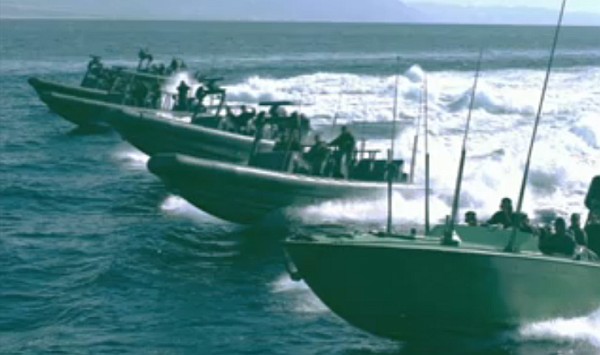
Turkish police blocked dozens of stone-throwing protesters who tried to storm the Israeli Consulate in Istanbul over reports of an Israeli attack on at least one aid ship in international waters on Monday, news channels reported.
CNN-Turk and NTV showed dozens of angry protesters scuffling with Turkish police guarding the consulate in downtown Istanbul.
“Damn Israel,” the protesters shouted.
Two TV networks reported earlier that Israeli warships attacked the six ships carrying pro-Palestinian activists and aid for blockaded Gaza, killing at least 10 and wounding an unknown number of people on board.
“We were not expecting such an operation in international waters,” Omer Faruk Korkmaz, an official of the pro-Islamic aid group, IHH, that led the aid shipment said in Turkey. “Israel has been caught redhanded and the international community will not forgive it.”
Korkmaz said the ship was being escorted to Haifa.
Turkey’s foreign ministry called the reported attack “unacceptable” and summoned the Israeli ambassador to to discuss the incident – bringing already tense relations between Turkey and Israel to new levels.
“I was expecting an intervention,” said Murat Mercan, a lawmaker from Prime Minister Recep Tayyip Erdogan’s ruling party. “I was not expecting bloodshed, the use of arms and bullets.”
“Israel is engaged in activity that will extremely hurt its image,” he said.
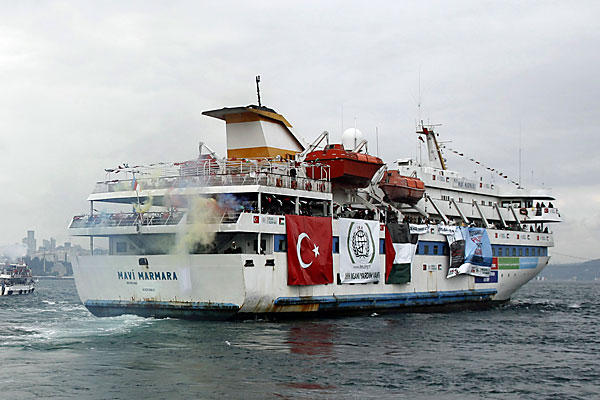
Israeli forces have attacked a flotilla of aid-carrying ships aiming to break the country’s siege on Gaza.
Up to 16 people were killed and more than 30 people injured when troops stormed the Freedom Flotilla early on Monday, the Israeli Army Radio said.
The flotilla was attacked in international waters, 65km off the Gaza coast.
Footage from the flotilla’s lead vessel, the Mavi Marmara, showed armed Israeli soldiers boarding the ship and helicopters flying overhead.
Al Jazeera’s Jamal Elshayyal, on board the Mavi Marmara, said Israeli troops had used live ammunition during the operation.
The Israeli Army Radio said soldiers opened fire “after confronting those on board carrying sharp objects”.
Free Gaza Movement, the organisers of the flotilla, however, said the troops opened fire as soon as they stormed the ships.
They also said the ships were now being towed to the Israeli town of Haifa, instead of Ashdod to avoid waiting journalists.
Earlier, the Israeli navy had contacted the captain of the Mavi Marmara, asking him to identify himself and say where the ship was headed.
Shortly after, two Israeli naval vessels had flanked the flotilla on either side, but at a distance.
Organisers of the flotilla carrying 10,000 tonnes of humanitarian aid then diverted their ships and slowed down to avoid a confrontation during the night.
They also issued all passengers life jackets and asked them to remain below deck.
Al Jazeera’s Ayman Mohyeldin, reporting from Jerusalem, said the Israeli action was surprising.
“All the images being shown from the activists on board those ships show clearly that they were civilians and peaceful in nature, with medical supplies on board. So it will surprise many in the international community to learn what could have possibly led to this type of confrontation,” he said.
Condemnation has been quick to pour in after the Israeli action.
Thousands of Turkish protesters tried to storm the Israeli consulate in Istanbul soon after the news of the operation broke. The protesters shouted “Damn Israel” as police blocked them.
Turkey is also reported to have summoned the Israeli ambassador to lodge a protest.
Meanwhile, Ismail Haniya, the Hamas leader in Gaza, has dubbed the Israeli action as “barbaric”.
Hundreds of pro-Palestinian activists, including a Nobel laureate and several European legislators, are with the flotilla, aiming to reach Gaza in defiance of an Israeli embargo.
But Israel has said it will not allow the flotilla to reach the Gaza Strip and vowed to stop the six ships from reaching the coastal Palestinian territory.
The flotilla had set sail from a port in Cyprus on Sunday and aimed to reach Gaza by Monday morning.
Israel said the boats were embarking on “an act of provocation” against the Israeli military, rather than providing aid, and that it had issued warrants to prohibit their entrance to Gaza.
It asserted that the flotilla would be breaking international law by landing in Gaza, a claim the organisers rejected.
Israel Navy troops opened fire on pro-Palestinian activists aboard a six-ship aid flotilla sailing for the Gaza Strip, killing two of them and wounding several others, after the activists ignored Israeli orders to turn back, Turkey’s NTV reported early Monday.
The Israeli naval vessels reportedly made contact earlier with the six-ship flotilla, which is carrying 10,000 tons of humanitarian aid and supplies to Gaza.
The Israeli navy was operating under the assumption that the activists manning the boats would not heed their calls to turn around, and Israeli troops were prepared to board the ships and steer them away from the Gaza shores and toward the Israeli port city of Ashdod.
Huwaida Arraf, one of the flotilla organizers, said the six-ship flotilla began the journey from international waters off the coast of Cyprus Sunday afternoon after two days of delays. According to organizers, the flotilla was expected to reach Gaza, about 250 miles (400 kilometers) away, on Monday afternoon, and two more ships would follow in a second wave.
The flotilla was fully prepared for the different scenarios that might arise, and organizers were hopeful that Israeli authorities would do what’s right and not stop the convoy, one of the organizers said.
“We fully intend to go to Gaza regardless of any intimidation or threats of violence against us,” Arraf said. “They are going to have to forcefully stop us.”
After nightfall, three Israeli navy missile boats left their base in Haifa, steaming out to sea to confront the activists’ ships.
Two hours later, Israel Radio broadcast a recording of one of the missile boats warning the flotilla not to approach Gaza.
“If you ignore this order and enter the blockaded area, the Israeli navy will be forced to take all the necessary measures in order to enforce this blockade,” the radio message continued.
The flotilla, which includes three cargo ships and three passenger ships, is trying to draw attention to Israel’s three-year blockade of the Gaza Strip. The boats are carrying items that Israel bars from reaching Gaza, like cement and other building materials.
The activists said they also were carrying hundreds of electric-powered wheelchairs, prefabricated homes and water purifiers.
Israeli Foreign Ministry spokesman Yigal Palmor said that after a security check, permitted humanitarian aid confiscated from the boats will be transferred to Gaza through authorized channels. However, Israel would not transfer items it has banned from Gaza under its blockade rules. Palmor said that for example, cement would be allowed only if it is tied to a specific project.
This is the ninth time that the Free Gaza movement has tried to ship in humanitarian aid to Gaza since August 2008.
Israel has let ships through five times, but has blocked them from entering Gaza waters since a three-week military offensive against Gaza’s Hamas rulers in January 2009. The flotilla bound for Gaza is the largest to date.
Some 700 pro-Palestinian activists are on the boats, including 1976 Nobel Peace Prize laureate Mairead Corrigan Maguire of Northern Ireland, European legislators and an elderly Holocaust survivor.
The mission has experienced repeated delays, both due to mechanical problems and a decision by Cyprus to bar any boat from sailing from its shore to Gaza. The ban forced a group of European lawmakers to depart from the breakaway Turkish Cypriot northern part of the island late Saturday.
Israel and Egypt imposed the blockade on Gaza after Hamas militants violently seized control of the seaside territory in June 2007.
Israel says the measures are needed to prevent Hamas, which has fired thousands of rockets at Israel, from building up its arsenal. But United Nations officials and international aid groups say the blockade has been counterproductive, failing to weaken the Islamic militant group while devastating the local economy.
Israel rejects claims of a humanitarian crisis in Gaza, saying it allows more than enough food and medicine into the territory. The Israelis also point to the bustling smuggling industry along Gaza’s southern border with Egypt, which has managed to bring consumer goods, gasoline and livestock into the seaside strip.
Israel has condemned the flotilla as a provocation and vowed to block it from reaching Gaza.
Israeli military officials said they hope to resolve the situation peacefully but are prepared for all scenarios. Naval commandos have been training for days in anticipation of the standoff. Military officials, speaking on condition of anonymity under official guidelines, said the forces would likely take over the boats under the cover of darkness.
Palmor said foreigners on the ships would be sent back to their countries. Activists who did not willingly agree to be deported would be detained. A special detention facility has been set up in Ashdod.
Al Jazeera, reporting live from the Freedom Flotilla at 6.30PM Eastern (1.30AM local Monday) said that after having been approached by Israeli navy ships several hours earlier, the flotilla has changed course in order to avoid a confrontation during the hours of darkness. The flotilla’s movements are being monitored by warships and aircraft — observers from the flotilla were not able to tell whether the distant aircraft was a helicopter of a drone.
Activists on Freedom Flotilla ships have put on life jackets as Israeli navy approaches at around 4PM Eastern. The flotilla remains in international waters outside an exclusion zone which Israel has already extended from 20 to 68 miles. The flotilla is still 120 miles from Gaza.
The Israeli commentator, Nahum Barnea, notes: “Netanyahu must certainly be disturbed by the unpleasant photos of the clash between IDF forces and the protestors. Yet what should concern him to a much greater degree is the ongoing deterioration in our ties with Turkey. This is not a public relations problem: It’s a strategic problem.”
The largest contingent of activists on board the Freedom Flotilla comes from Turkey.
Turkish Prime Minister Recep Tayyip Erdogan said that the convoy of ships, including Turkish ships, carrying aid to Gaza was just a move of non-governmental organizations and had nothing to do with Turkish government.
“It is also an international move of the civil society. It is completely a step taken with humanitarian purposes,” Erdogan told reporters in Brazil.
When Israeli officials are pressed to justify the fact that Israel has prevented the reconstruction of thousands of homes it destroyed during the war on Gaza, they say that if construction materials were allowed into Gaza, these would be commandeered by Hamas and used to fortify its bunkers.
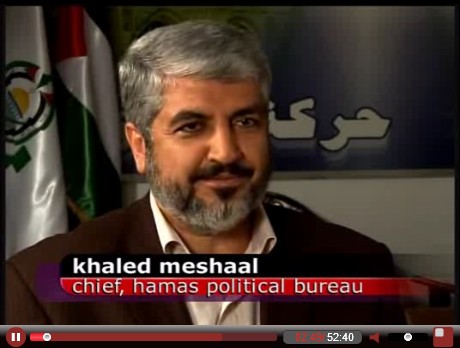
Meshaal’s message to the Obama administration and to the American people was this:
It’s time to end this embargo on Gaza, because it’s immoral, unethical and it failed in achieving its political objectives. And it is the right of the Palestinian people in Gaza to live like all other people without any embargo, because Gaza today is the biggest prison in the world and in history.
You know that Israel in the last war destroyed tens of thousands of houses, hospitals and universities, and it is the responsibility of the international community and especially of the United States of America to reconstruct what [has] been destroyed by Israel in Gaza. And we do not have it as a condition that this construction operation to be done through Hamas. No. As I told [Russia’s] President Medvedev, the international community can develop an international mechanism that is independent to introduce the construction materials into Gaza and to supervise the rebuilding, reconstruction of the houses and schools destroyed by Israel. Because our mission is to service our people. We want the Palestinian people in Gaza to live simply in houses in winter and in summer. And this is the responsibility of the international community. Unfortunately, some Palestinian leaderships lie to the Americans and to the Europeans when saying that Hamas has it as a condition to supervise the reconstruction. We do not have this as a condition. We tell the whole world, come to Gaza. Reconstruct the destroyed houses.
The Navy and the Israel Air Force’s observation jets are following the various vessels en route to Gaza and are prepared to first deploy the Navy’s missile ships which are docked in Haifa, and then, the rest of the forces.
Navy to sail boats to Ashdod The Navy hopes it will not have to use its extensive force and that the flotilla will retreat once its ships’ captains are warned. If this does not happen, Shayetet 13 officers are ready to take over the ships by force. Naval officers will board the ships and sail them according to the Navy commander’s orders.
A similar force of Dvorah patrol boats and Shayetet 13 vessels will be awaiting the ships at the Ashdod Port where they will assist in the final interception and in unloading the passengers and the cargo at the port. An Israel Police force will also be waiting on the shore, in order to prevent provocations and riots by the flotilla’s passengers.
The Navy’s decision to deploy such a large force for a relatively simple mission follows a decision by the prime minister, defense minister, and forum of seven top cabinet ministers not to allow the ships to arrive in Gaza under any circumstances, even if Israel is forced to pay a hefty price in the PR arena and in the international community’s eyes.
The Israeli propaganda machine has reached new highs its hopeless frenzy. It has distributed menus from Gaza restaurants, along with false information. It embarrassed itself by entering a futile public relations battle, which it might have been better off never starting. They want to maintain the ineffective, illegal and unethical siege on Gaza and not let the “peace flotilla” dock off the Gaza coast? There is nothing to explain, certainly not to a world that will never buy the web of explanations, lies and tactics.
Only in Israel do people still accept these tainted goods. Reminiscent of a pre-battle ritual from ancient times, the chorus cheered without asking questions. White uniformed soldiers got ready in our name. Spokesmen delivered their deceptive explanations in our name. The grotesque scene is at our expense. And virtually none of us have disturbed the performance.
The chorus has been singing songs of falsehood and lies. We are all in the chorus saying there is no humanitarian crisis in Gaza. We are all part of the chorus claiming the occupation of Gaza has ended, and that the flotilla is a violent attack on Israeli sovereignty – the cement is for building bunkers and the convoy is being funded by the Turkish Muslim Brotherhood. The Israeli siege of Gaza will topple Hamas and free Gilad Shalit. Foreign Ministry spokesman Yossi Levy, one of the most ridiculous of the propagandists, outdid himself when he unblinkingly proclaimed that the aid convoy headed toward Gaza was a violation of international law. Right. Exactly.
It’s not the siege that is illegal, but rather the flotilla. It wasn’t enough to distribute menus from Gaza restaurants through the Prime Minister’s Office, (including the highly recommended beef Stroganoff and cream of spinach soup ) and flaunt the quantities of fuel that the Israeli army spokesman says Israel is shipping in. The propaganda operation has tried to sell us and the world the idea that the occupation of Gaza is over, but in any case, Israel has legal authority to bar humanitarian aid. All one pack of lies.
Only one voice spoiled the illusory celebration a little: an Amnesty International report on the situation in Gaza [PDF]. Four out of five Gaza residents need humanitarian assistance. Hundreds are waiting to the point of embarrassment to be allowed out for medical treatment, and 28 already have died. This is despite all the Israeli army spokesman’s briefings on the absence of a siege and the presence of assistance, but who cares?
And the preparations for the operation are also reminiscent of a particularly amusing farce: the feverish debate among the septet of ministers; the deployment of the Masada unit, the prison service’s commando unit that specializes in penetrating prison cells; naval commando fighters with backup from the special police anti-terror unit and the army’s Oketz canine unit; a special detention facility set up at the Ashdod port; and the electronic shield that was supposed to block broadcast of the ship’s capture and the detention of those on board.
And all of this in the face of what? A few hundred international activists, mostly people of conscience whose reputation Israeli propaganda has sought to besmirch. They are really mostly people who care, which is their right and obligation, even if the siege doesn’t concern us at all. Yes, this flotilla is indeed a political provocation, and what is protest action if not political provocation?
And facing them on the seas has been the Israeli ship of fools, floating but not knowing where or why. Why detain people? That’s how it is. Why a siege? That’s how it is. It’s like the Noam Chomsky affair all over again, but big time this time. Of course the peace flotilla will not bring peace, and it won’t even manage to reach the Gaza shore. The action plan has included dragging the ships to Ashdod port, but it has again dragged us to the shores of stupidity and wrongdoing. Again we will be portrayed not only as the ones that have blocked assistance, but also as fools who do everything to even further undermine our own standing. If that was one of the goals of the peace flotilla’s organizers, they won big yesterday.
Five years ago, the noted Peruvian writer Mario Vargas Llosa, who is a Jerusalem Prize laureate, after concluding his visit to Israel, said the Israeli occupation was approaching its grotesque phase. Over the weekend Vargas Llosa, who considers himself a friend of Israel, was present to see that that phase has since reached new heights of absurdity.
“The continued policy of closure is unacceptable and politically counterproductive,” she said in a statement.
“We would like to reiterate the EU’s call for an immediate, sustained and unconditional opening of crossings for the flow of humanitarian aid, commercial goods and persons to and from Gaza.”
In spite of this appeal, the government of Cyprus has taken the extraordinary step of preventing members of the European parliament from joining the Freedom Flotilla.
Cypriot authorities prevented pro-Palestinian activists, including 30 MPs from nine European countries, from leaving the island yesterday to join a flotilla in international waters, which is on its way to blockaded Gaza.
In addition to issuing an edict banning ships headed for Gaza to set sail from the island’s ports, or dock on the island on their way back, the authorities yesterday forbade any small vessels from leaving Cyprus in case they were on their way to the flotilla of eight ships carrying around 700 peace activists, and 10,000 tonnes of humanitarian aid.
The government denied it bowed to pressure from Israel to put the ban in place.
The Hamas leader in Gaza Ismail Haniyeh said Saturday that if Israel behaved like pirates and attacked the international Freedom Flotilla carrying 10,000 tons of aid meant for Gaza, then the Palestinians will have won.
“The flotilla’s message is clear and it will reach the entire world,” Haniyeh said Saturday morning during a press conference held at the Gaza port where the ships were expected to dock.
“The meaning of the flotilla is that the entire world opposes the siege on the Gaza Strip, and if Israel behaves like pirates and sea-terrorists – we will win,” he added.
This video begins with a speech made by Rachel Corrie — who was killed by the IDF in 2003 when protesting non-violently in Gaza — speaking as a youngster in defense of human rights. One of the cargo ships heading to Gaza as part of the Freedom Flotilla is the MV Rachel Corrie. This speech is followed by Michael Heart‘s “We will not go down.”
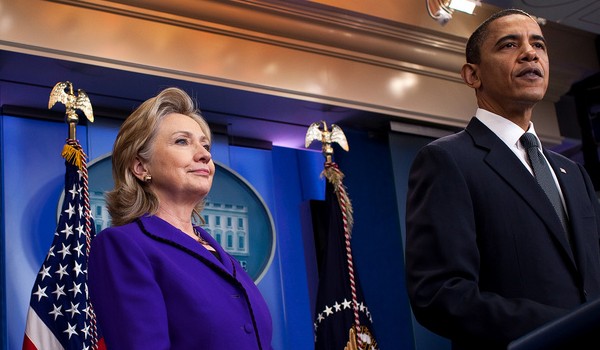
President Obama is either a liar or he has lost control of his own administration.
In a letter he sent to the president of Brazil in late April, Obama spelled out the terms on which the US would support a diplomatic initiative by Brazil and Turkey who hoped to revive a nuclear swap agreement that Iran had rejected last fall. Obama expressed his skepticism that Iran would make the necessary concessions. He was proved wrong, but then instead of welcoming Lula and Erdogan’s diplomatic accomplishment, Secretary Clinton dismissed it out of hand. If she did so with Obama’s consent, he has shown his word is worthless. If she did so on her own initiative, this president has lost his authority as chief executive.
His Excellency
Luiz Inácio Lula da Silva
President of the Federative Republic of Brazil
Brasilia
Dear Mr. President:
I want to thank you for our meeting with Turkish PrinIe Miuister Erdogan during the Nuclear Security Summit. We spent some time focused on Iran, the issue of the provision of nuclear fuel for the Tehran Research Reactor (TRR), and the intent of Brazil and Turkey to work toward finding an acceptable solution. I promised to respond in detail to your ideas. I have carefully considered our discussion, and I would like to offer a detailed explanation of my perspective and suggest a way ahead.
I agree with you that the TRR is an opportunity to pave the way for a broader dialogue in dealing with the more fundamental concerns of the intemational community regarding Iran’s overall nuclear program. From the beginning, I have viewed Iran’ s request as a clear and tangible opportunity to begin to build mutual trust and confidence, and thereby create time and space for a constructive diplomatic process. That is why the United States so strongly supported the proposal put forth by former International Atomic Energy Agency (IAEA) Director General EIBaradei.
The IAEA’s proposal was crafted to be fair and balanced, and for both sides to gain trust and confidence. For us, Iran’s agreement to transfer 1,200 kg of Iran’s low enriched uranium (LEU) out of the country would build confidence and reduce regional tensions by substantially reducing Iran’s LEU stockpile. I want to underscore that this element is of fundamental importance for the United States. For Iran, it would receive the nuclear fuel requested to ensure continued operation of the TRR to produce needed medical isotopes and, by using its own material, Iran would begin to demonstrate peaceful nuclear intent. Notwithstanding Iran’s continuing defiance of five United Nations Security Council resolutions mandating that it cease its enrichment of uranium, we were prepared to support and facilitate action on a proposal that would provide Iran nuclear fuel using uranium enriched by Iran — a demonstration of our willingness to be creative in pursuing a way to build mutual confidence.
During the course of the consultations, we also recognized Iran’s desire for assurances. As a result, my team focused on ensuring that the lAEA’s proposal contained several built-in measures, including a U.S. national declaration of support, to send a clear signal from my government of our willingness to become a direct signatory and potentially even play a more direct role in the fuel production process, a central role for Russia, and the IAEA’s assumption of full custody of the nuclear material throughout the fuel production process. In effect, the IAEA’s proposal offered Iran significant and substantial assurances and commitments from the IAEA, the United States, and Russia. Dr. EI Baradei stated publicly last year that the United States would be assuming the vast majority of the risk in the IAEA’s proposal.
As we discussed, Iran appears to be pursuing a strategy that is designed to create the impression of flexibility without agreeing to actions that can begin to build mutual trust and confidence. We have observed Iran convey hints of flexibility to you and others, but formally reiterate an unacceptable position through official channels to the IAEA. Iran has continued to reject the IAEA’s proposal and insist that Iran retain its low-enriched uranium on its territory until delivery of nuclear fuel. This is the position that Iran formally conveyed to the IABA in January 2010 and again in February.
We understand from you, Turkey and others that Iran continues to propose that Iran would retain its LEU on its territory until there is a simultaneous exchange of its LEU for nuclear fuel. As General Jones noted during our meeting, it will require one year for any amount of nuclear fuel to be produced. Thus, the confidence-building strength of the IAEA’s proposal would be completely eliminated for the United States and several risks would emerge. First, Iran would be able to continue to stockpile LEU throughout this time, which would enable them to acquire an LEU stockpile equivalent to the amount needed for two or three nuclear weapons in a year’ s time. Second, there would be no guarantee that Iran would ultimately agree to the final exchange. Third, IAEA “custody” of lran’s LEU inside of Iran would provide us no measurable improvement over the current situation, and the IAEA cannot prevent Iran from re-assuming control of its uranium at any time.
There is a potentially important compromise that has already been offered. Last November, the IAEA conveyed to Iran our offer to allow Iran to ship its 1,200 kg of LEU to a third country — specifically Turkey — at the outset of the process to be held “in escrow” as a guarantee during the fuel production process that Iran would get back its uranium if we failed to deliver the fuel. Iran has never pursued the “escrow” compromise and has provided no credible explanation for its rejection. I believe that this raises real questions about Iran’s nuclear intentions, if Iran is unwilling to accept an offer to demonstrate that its LEU is for peaceful, civilian purposes. I would urge Brazil to impress upon Iran the opportunity presented by this offer to “escrow” its uranium in Turkey while the nuclear fuel is being produced.
Throughout this process, instead of building confidence Iran has undermined confidence in the way it has approached this opportunity. That is why I question whether Iran is prepared to engage Brazil in good faith, and why I cautioned you during our meeting. To begin a constructive diplomatic process, Iran has to convey to the IAEA a constructive commitment to engagement through official channels — something it has failed to do. Meanwhile, we will pursue sanctions on the timeline that I have outlined. I have also made clear that I will leave the door open to engagement with Iran. As you know, Iran has thus far failed to accept my offer of comprehensive and unconditional dialogue.
I look forward to the next opportunity to see you and discuss these issues as we consider the challenge of Iran’s nuclear program to the security of the international community, including in the U.N. Security Council.
Sincerely,
Barack Obama
So what did Brazil and Turkey accomplish? An agreement by Iran to do exactly what Obama claimed he was seeking: that Iran would transfer 1200kg of LEU to be held in escrow by Turkey and in return for which, one year later, Iran would receive fuel rods for the TRR.
The US response? Secretary Clinton claimed there were “discrepancies” in the offer. These included that:
There is a recognition on the part of the international community that the agreement that was reached in Tehran a week ago between Iran and Brazil and Turkey only occurred because the Security Council was on the brink of publicly releasing the text of the resolution that we have been negotiating for many weeks. It was a transparent ploy to avoid Security Council action.
That is a truly Kafkaesque statement!
The US and its allies have been mounting diplomatic and economic pressure on Iran to force it to make concessions on the nuclear issue. As soon as Iran makes concessions, the US turns around and says the concessions are a “ploy” to avoid sanctions.
The Challenger 1, is a Free Gaza passenger boat among the Freedom Flotilla that has members of the European parliament on board. While holding for the other boats to join, close to Cyprus waters, the boat has been contacted via radio by a Cipriot Police Helicopter. This video is recording the converstation, May 28th, 2010.
Shane Dillon (Mate on Challenger 1 commented: “It is rather shocking that an EU Country refused to let members of another EU Country’s Parliament into its port on a humanitarian mission.”
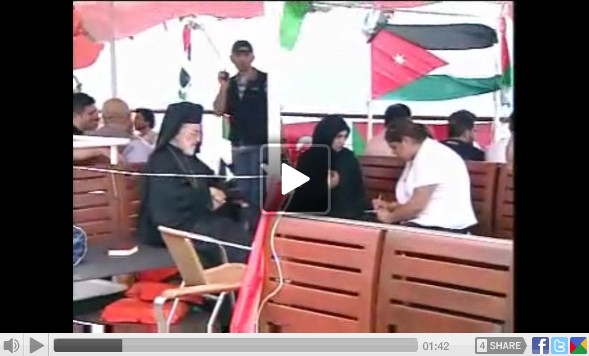
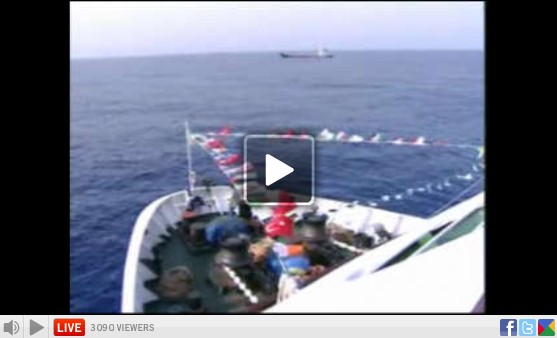
This is the camera being used by international news television broadcasters on board the Mavi Marmara Turkish passenger ship sailing to Gaza. Accompanying ships can also be seen during periods while news reports are not being broadcast. Most of the reporters appear to be Turkish, though there is also an Al Jazeera crew reporting in English.
Every disaster gets a name — Katrina, Exxon Valdez, The Tsunami — and now The Spill?
Even after the Gulf of Mexico oil spill has officially become the worst oil spill in US history, this is a disaster whose generic and mundane name has contributed to an underestimation of its significance. After all, how bad can something called a “spill” really be?
At the same time, the image of a president and his administration as passive observers of events over which they can exert little control, is now becoming the signature of the Obama presidency itself.
“Obama has appeared almost scarily unengaged from what the public increasingly recognizes is a genuine national emergency,” writes Dan Froomkin.
Obama’s effort on Thursday to show that he is engaged will have been far too technocratic in tone to satisfy many Americans, leaving serious doubts about his ability to operate effectively as a crisis manager.
Indeed, doubts about Obama’s approach now seem to spring up wherever his attention is demanded.
Stephen Walt points to the glaring disparity between Obama’s earlier promises to engage with Iran and the threatening posture that US has increasingly assumed.
[T]he U.S. approach to Tehran is deeply inconsistent. Obama has made a big play of extending an “open hand” to Tehran, and he reacted in a fairly measured way to the crackdown on the Greens last summer. But at the same time, the administration has been ratcheting up sanctions and engaging in very public attempt to strengthen security ties in the Gulf region. And earlier this week, we learned that Centcom commander General David Petraeus has authorized more extensive special operations in a number of countries in the region, almost certainly including covert activities in Iran.
Just imagine how this looks to the Iranian government. They may be paranoid, but sometimes paranoids have real (and powerful) enemies, and we are doing our best to look like one. How would we feel if some other country announced that it was infiltrating special operations forces into the United States, in order to gather intelligence, collect targeting information, or maybe even build networks of disgruntled Americans who wanted to overthrow our government or maybe just sabotage a few government installations? We’d definitely view it as a threat or even an act of war, and we’d certainly react harshly against whomever we thought was responsible. So when you wonder why oil- and gas-rich Iran might be interested in some sort of nuclear deterrent (even if only a latent capability), think about what you’d do if you were in their shoes.
But not only must Iran be suspicious of US intentions, likewise Turkey and Brazil have reason to wonder — as does Walt — who is actually steering US policy on Iran?
Robert Naiman points out that preceding last week’s announcement of a nuclear swap initiative — a bold piece of emerging powers’ diplomacy that the administration was nevertheless quick to dismiss — Obama had actually given clear support for their approach.
[I]f you get your information from major U.S. media, here’s something that you almost certainly don’t know: Brazil and Turkey say that before they reached the deal, they understood that they had the backing of the Obama Administration for their efforts. The available evidence suggests that Brazil and Turkey had good reason to believe that they had U.S. support, and that the Obama Administration has taken a 180 degree turn in its position in the last few weeks, and is now trying to cover its tracks, with the active collaboration of major U.S. media.
Reuters reports from Brasilia – in an article you won’t find on the web sites of the New York Times or the Washington Post:
Brazil argues Washington and other Western powers had prodded Brazil to try to revive the U.N. fuel swap deal proposed last October.
“We were encouraged directly or indirectly … to implement the October proposal without any leeway and that’s what we did,” said Amorim.
In a letter to Brazilian President Luiz Inacio Lula da Silva two weeks ago, U.S. president Barack Obama said an Iranian uranium shipment abroad would generate confidence.
“From our point of view, a decision by Iran to send 1,200 kilograms of low-enriched uranium abroad, would generate confidence and reduce regional tensions by cutting Iran’s stockpile,” Obama said, according to excerpts from the letter translated into Portuguese and seen by Reuters.
I haven’t seen any reference to this letter from President Obama to President Lula in the U.S. press – have you? But in Brazil, this letter from Obama to Lula was front-page news on Saturday morning – I saw it on the front-page of O Estado de S. Paulo, above the fold.
Note that the Reuters story, dated May 22, says Obama sent this letter two weeks ago. The deal was announced Monday, May 17. So, about a week before the deal was announced, Obama told Lula that from the U.S. point of view a decision by Iran to send 1,200 kilograms of low-enriched uranium abroad would generate confidence and reduce regional tensions. Note furthermore that Obama’s words – according to Reuters, this is a direct quote from Obama’s letter – actually specify an exact amount of transfer that would “generate confidence”: 1,200 kilograms, exactly what was agreed a week later. So the U.S. officials and media stenographers (like Glenn Kessler in the Washington Post – “Iran creates illusion of progress in nuclear negotiations“) saying a 1,200 kilogram transfer would have been great in October but would be worthless now are directly contradicting what President Obama himself wrote to President Lula one week before the deal was announced. But if course you wouldn’t know about that direct contradiction from the U.S. media, because in the U.S. media, the letter from Obama to Lula apparently doesn’t exist.
As Naiman wistfully suggests: “It’s a shame we don’t have a leader in the White House right now who is ready to lead on this issue. If only we had elected this guy:
Irrespective of their politics, flawed leaders share a common trait. They generally remain remarkably oblivious to the harm they do to the nation they lead. George W. Bush is a salient recent example, as is former British Prime Minister Tony Blair. When it comes to foreign policy, we are now witnessing a similar phenomenon at the Obama White House.
Here is the Obama pattern: Choose a foreign leader to pressure. Threaten him with dire consequences if he does not bend to Washington’s will. When he refuses to submit and instead responds vigorously, back off quickly and overcompensate for failure by switching into a placatory mode.
In his first year-plus in office, Barack Obama has provided us with enough examples to summarize his leadership style. The American president fails to objectively evaluate the strength of the cards that a targeted leader holds and his resolve to play them.
Obama’s propensity to retreat at the first sign of resistance shows that he lacks both guts and the strong convictions that are essential elements distinguishing statesmen from politicians.
When candidate Obama spoke of the fierce urgency of now, he might have been employing hollow rhetoric, but I’m more inclined to believe that he used this expression with a genuine awareness of the historical moment. But that isn’t to suggest that he had much idea about how his rhetoric would translate into action.
Now as we witness the performance of what appears to be an inconsistent, unimaginative, unengaged president, we may in fact simply be seeing the results of the failing efforts of a man who can’t do enough because he is trying to do too much.
America’s greatness is not assured — each generation’s place in history is a question unanswered. But even as we are tested by new challenges, the question of our future is not one that will be answered for us, it is one that will be answered by us. And in a young century whose trajectory is uncertain, America is ready to lead once more.
Sorry, but neither the world nor America itself needs to hear more clichés about the revival of American leadership. We’re much less interested in what kind of high-minded declarations this president can make than in what he can actually do.
Israeli foreign ministry spokesmen Yigal Palmor told the Wall Street Journal that in dealing with the Freedom Flotilla, Israel faces the choice of either looking stupid or like brutes — or like pirates!
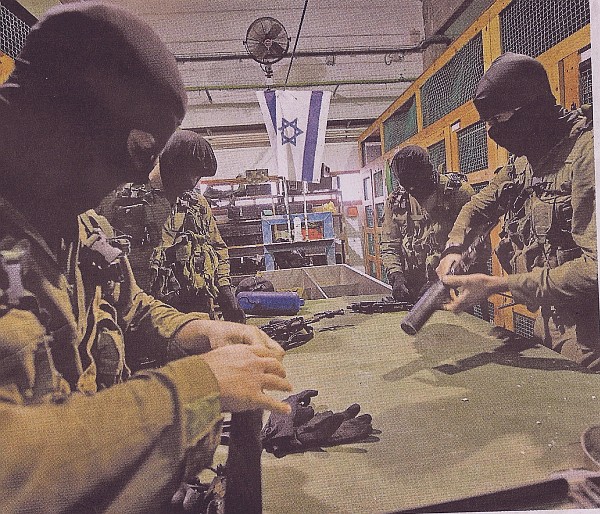
Masked Israeli commandos — with daggers clenched between their teeth? — will soon likely take control of the ships.
Israel on Thursday unveiled a massive makeshift detention center in the country’s main southern port and announced the end of days of intense naval maneuvers, vowing to stop a flotilla of hundreds of pro-Palestinian activists trying to break a 3-year blockade of the Gaza Strip this weekend.
Military authorities said that masked naval commandos would greet the eight ships deep out at sea, escort the vessels to port and give each of the activists a stark choice: leave the country or go to jail.
But the tough response threatened to backfire by breathing new life into the activists’ mission and drawing new attention to the oft-criticized blockade of Gaza.
“We know that we are sailing for a good cause,” said Dror Feiler, 68, an Israeli-born Swedish activist who was on board a cargo ship headed from Greece to Gaza. “If the Israelis want us to pay a price, we will pay a price, but we will come again and again.”
Some 750 activists, including a Nobel peace laureate and former U.S. congresswoman, have set sail for the Gaza coast in recent days, carrying 10,000 tons of humanitarian supplies. They are expected to reach the Israeli coast on Saturday.
Israeli Defense Minister Ehud Barak named a team of public-relations experts and military officers to come up with ideas for how to blunt the public-relations blow from the aid fleet, according to members of the Labour Party that Mr. Barak leads. The Israeli military has launched an aggressive public-outreach effort. At an unusual, last-minute news conference on Gaza’s border Wednesday morning, officers emphasized that Israel was already allowing generous quantities of aid into Gaza and dismissed claims by organizers of the aid flotilla that Gaza is facing a humanitarian crisis.
“This is nothing more than media provocation and has nothing to do with actually providing aid to residents of the Gaza Strip,” said military spokeswoman Lt. Col. Avital Leibovitch. “They have everything they need.”
As Larry Derfner writes, mocking such claims: “I only wish somebody would treat us Israelis like we treat people in Gaza.”
The IDF, which seems to have adopted a scattershot approach in its messaging, tells the Christian Science Monitor that it fears the flotilla may attempt to smuggle militants and weapons into Gaza — two of the few resources in which the Strip is, by most accounts, already amply supplied.
As if to demonstrate that Israel’s officials have a talent for making the Jewish state look brutish and stupid, the one thing that seems to have escaped their attention is this: Western news organizations have a meager amount of interest in activist endeavors such as the Freedom Flotilla. The only thing that really grabs the mainstream media’s attention is Israel’s heavy-handed way of responding to such activism.
Yigal Palmor says: “If we let them throw egg at us, we appear stupid with egg on our face.” But here’s a thought: Israel doesn’t have to look stupid or brutish. It could lift the siege — a siege which by Israel’s own account clearly isn’t working — and show the world that there still are a few signs of intelligent life inside Israel.
This website or its third-party tools use cookies, which are necessary to its functioning. By closing this banner, you agree to the use of cookies.




 Activists on Freedom Flotilla ships have put on life jackets as Israeli navy approaches at around 4PM Eastern. The flotilla remains in international waters outside an exclusion zone which Israel has already extended from 20 to 68 miles. The flotilla is still 120 miles from Gaza.





 Every disaster gets a name — Katrina, Exxon Valdez, The Tsunami — and now The Spill?