Al Jazeera reports on Israel’s propaganda campaign whose aim is to promote the message that the residents of Gaza, even while living under a severe economic blockade, “have everything they need.” As part of that effort, Israel distributed video footage of a guests enjoying fine cuisine in a gourmet restaurant in Gaza — guests including Mahmoud Abbas who hasn’t set foot in Gaza since the siege began!
At a time when Israel’s security officials should probably be focused on this week’s extensive home front security drill, it seems that that most of their attention is being paid to the flotilla of ships on its way to the Gaza Strip, laden with humanitarian supplies. Frantic consultations between officials and the prime minister’s top military chiefs of staff have taken place, an urgent meeting of a forum of senior government ministers was held, and the Ministry of Foreign Affairs has engaged in extensive activities, and an urgent press conference was held at the Erez border crossing. In particular, the Israeli government’s public relations machine has been mobilized with the intent of persuading the public that there is no need for the flotilla, due to the fact that the humanitarian situation in Gaza is fine, the Strip’s markets are abundant, and its gourmet restaurants are thriving.
Sheikh Raed Salah, from the Islamic Movement in Israel, tells Al Jazeera:
The official Arab role in this campaign is missing but that of the Arab people is not. We have campaigners coming from Kuwait, Jordan and Mauritania, Yemen and Algeria and that is a message we sent to the leaders. How beautiful it would be if you would reconcile with the stance of your people in their support of the cause of the Palestinians.
The niceties of America’s often straight-laced political discourse generally preclude the use of a phrase as provocative as this: Jewish revenge. One of the virtues of the Israeli press, however, is that it can be refreshingly blunt.
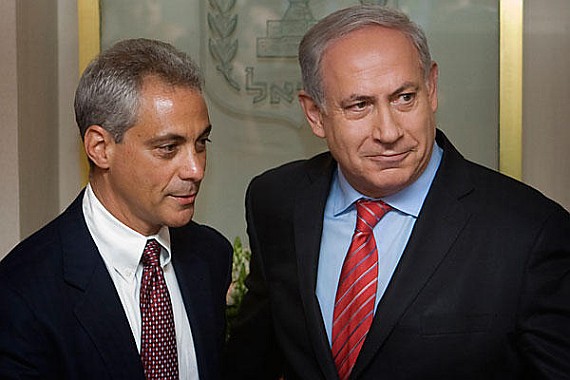
“Officials in the Democratic Party are afraid that the Jews will take revenge in the midterm elections, which is the reason for the vigorous courting of Israel,” reports Yedioth Ahronoth today. Some of the courting the paper refers to just came from White House chief of staff, Rahm Emanuel, whose recent trip to Israel was ostensibly a family affair — he was there to attend his son’s Bar Mitzvah — but it turned out that he also had important and very public business to take care of: a kiss-and-make-up session with Benjamin Netanyahu.
According to reports that reached Jerusalem, it is no coincidence that Obama and his staff have suddenly begun to speak warmly about Israel, to compliment it for the good will gestures it extended to the Palestinians and mainly to admit that they had erred by treating Israel unfairly in Obama’s first year. It appears that the Obama administration’s attack on Netanyahu after the publication of the tender to build 1,6000 new housing units in Ramat Shlomo backfired.
Information that was received by Israeli sources would seem to indicate that the principal reason for the change in approach to Israel is pressure from Democrat lawmakers who are running for election and are finding themselves hard put to enlist Jewish donors to their campaigns. There is a great deal of anger at Obama within the Jewish community and disappointment over his policy toward Israel. Officials in the Democratic Party are afraid that the Jews will take revenge in the midterm elections, which is the reason for the vigorous courting of Israel. In other words, the fear is that the Jewish vote will gravitate away from Democratic candidates to Republicans.
The report concludes by saying that the Obama administration is afraid of another clash with Netanyahu when the settlement “freeze” expires in September. “The hope is that Obama will be able to persuade Netanyahu to extend the construction freeze by means of a friendly request and thereby avoid a damaging confrontation.” Right!
The brief lull in West Bank colonization construction operations was surely timed to expire exactly when Obama could effectively be bound and gagged by the Israel lobby, right before the elections.
When ministers in the Israeli government triumphantly break ground on new settlement projects this fall, we shouldn’t expect to hear even a squeak of disapproval come out of Washington.
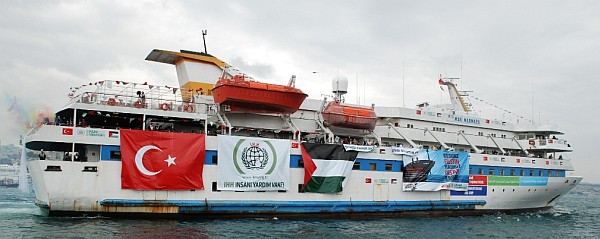
As the Freedom Flotilla sails towards Gaza, the Israeli propaganda machine is working at full bore. In its frenzied effort, message discipline seems to have gone out of the window.
10,000 tons of supplies being carried in the nine-ship flotilla are, the Israelis suggest, superfluous to Gaza’s needs when Israel itself is delivering 15,000 tons a week. Still, if the human rights activists insist on completing their mission, Israel’s Ministry of Foreign Affairs says it would be more “efficient” if the flotilla, instead of docking at Gaza City, docks at an Israeli port where everything can be transferred to Israeli trucks. Then everyone can say a prayer as they wait to see how much gets confiscated at the land crossing into Gaza. Why take a direct route when you can take a longer less certain indirect route?
Not surprisingly, The Freedom Flotilla organizers have declined Israel’s “offer.” Israel’s police and prisons service are now on standby, ready to deal with the potential arrest of hundreds of activists in the event that the Netanyahu government decides to block the flotilla’s passage. I imagine some kind of internment camp may need to be set up for holding and interrogating the peaceful activists prior to their deportation.
Meanwhile, Israeli officials are citing a Financial Times report that the 200 to 300 smuggling tunnels from Egypt into Gaza “have become so efficient that shops all over Gaza are bursting with goods.”
In effect, the Israelis seem to be saying that the combination of supplies that it delivers, along with those coming through tunnels, means that for all practical purposes Gaza is no longer under siege.
The siege isn’t working — don’t break the siege!
Strange message.
While Israeli officials selectively cite reporting by the Financial Times, here is part of the same report which makes it clear that under siege, Gaza’s economy has effectively been crippled — in spite of the availability of goods coming through the tunnels.
“Everything I demand, I can get,” says Abu Amar al-Kahlout, who sells household goods out of a warehouse big enough to accommodate a passenger jet.
However, Mr al-Kahlout regards his suppliers in Rafah with distaste. “The tunnel business is not real business. They [the tunnel operators] are not respectable: if they were able to cut off your skin and sell it, they would do so,” he says.
His criticism is echoed by other business leaders in Gaza, who insist that the smugglers are creating a false sense of economic improvement while damaging the territory’s battered private sector.
They concede that the tunnels are providing essential goods, yet the smugglers are also bringing in precisely the simple consumer items that could be manufactured in Gaza, especially if sanctions were eased.
“We are just replacing legitimate businessmen with illegitimate businessmen” says Amr Hammad, a Gaza-based entrepreneur and deputy head of the Palestinian Federation of Industries. Flush with cash, the tunnel operators will soon “govern the whole economy of the Gaza Strip”, Mr Hammad predicts.
For most Gazans, the period since the end of Israel’s three-week offensive in January last year has brought little improvement. According to the United Nations Relief and Works Agency, the number of “abject poor”, who depend on food aid, trebled to 300,000 – or one in five of all Gazans – in 2009.
One western official says the tunnels act like a “humanitarian safety valve”, but cautions that they offer no solution to economic decline. As Mr Hammad says: “An economy cannot just depend on tunnels.”
Over 60 percent of Gaza households are food insecure as a result of the ongoing blockade Israel imposed on the coastal enclave, leading to a collapse of its formal economy, the Association of International Development Agencies (AIDA) said Tuesday.
AIDA, which represents over 80 NGOs, called on Israel for “full and unfettered access into and out of the Gaza Strip for materials and exports necessary for the revival of the agriculture and fishing sectors.”
As Gaza’s population becomes increasingly dependent on aid, the organizations urged Israel to implement immediate measures which include the entry of agricultural input materials such as plastic irrigation piping, quality seeds/seedlings and veterinary drugs into Gaza “needed to jumpstart the agricultural sector and allow the export of produce” and the lifting of access restrictions on farming and fishing areas.
In the name of “security” — the catchall phrase used so often to justify brutality — through its siege on Gaza, Israel has engaged in a systematic campaign not merely to deprive a society of its physical needs but in order corrode, undermine and ultimately destroy the society itself.
Israel has vandalized Gaza in every possible way in a calculated effort to try and drive this society rip itself apart — to disarm Hamas by making Gaza implode. Gestures of solidarity and support for the people of Gaza from the Freedom Flotilla and elsewhere around the world are a way of saying that we can speak out even while our governments remain silent.
“We recommend the world send ships to the shores of Gaza, and we believe that Israel would not stop these vessels because the sea is open, and many human rights organizations have been successful in previous similar steps, and proved that breaking the siege on Gaza is possible.” John Ging, Head of United Nation’s Relief and Works Agency in the Gaza Strip.
A global coalition of Palestinian support groups is taking protest to a dangerous new point of brinkmanship this week, with an attempt to crash through Israel’s naval blockade of the Gaza Strip in a flotilla of cargo and passenger boats now assembling in the eastern Mediterranean.
Converging at an undisclosed rendezvous in international waters, the four small cargo boats and four passenger vessels – ranging from cruisers carrying 20 to a Turkish passenger ferry for 600 – are a multimillion-dollar bid to shame the international community to use ships to circumvent Israel’s tight control on humanitarian supplies reaching war-ravaged Gaza.
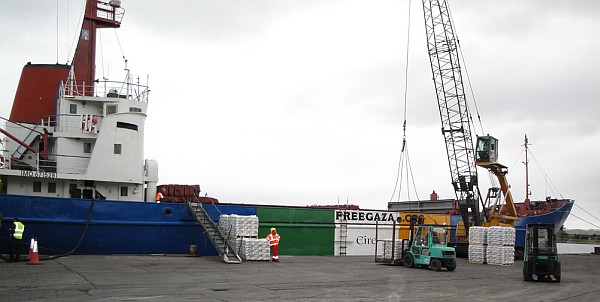
As the first boat in the flotilla sailed from Dundalk, Ireland, to link up with others being readied at ports in Turkey and in Greece, Israel announced that it would bar the boats from landing.
A senior foreign ministry official described the flotilla as a ”provocation and a breach of Israeli law”.
Israeli media reports say that the Defence Minister, Ehud Barak, has formally ordered that waters off Gaza become a closed zone to a distance of 20 nautical miles.
Israel already has a ”large naval force” on manoeuvre in the area; and as a confrontation at sea looms, suspicion was taking hold in both camps.
Mechanical difficulties in the boat bound from Ireland – the 1200-tonne MV Rachel Corrie, named after an American who was crushed to death by an Israeli army bulldozer in Gaza in 2003 – prompted claims that the boat had been sabotaged. Unnamed Israeli officials have claimed elements in the flotilla would attempt to garner media attention by seeking to provoke Israeli violence.
Further complicating a tense scenario were reports of a welcome fleet of small boats attempting to put to sea from Gaza, and of an Israeli ”counter flotilla” that had assembled near Tel Aviv as a “civil initiative … not connected to any political group”.
Israel has rejected pleas by several ambassadors, most vocally by Dublin’s envoy to Tel Aviv, that their nationals on the flotilla be given safe passage to Gaza.
In the port of Agios Nikolaos, here on the Greek island of Crete, one of the lead organisers of the flotilla is the Free Gaza Movement’s Renee Jaouadi – a 34-year-old schoolteacher, formerly from Newcastle, NSW. Under the banner of the Freedom Flotilla, the protest is a $US3 million-plus ($3.6 million) operation. Apart from 10,000 tonnes of building, medical, educational and other supplies, on board are dozens of parliamentarians from around the world and professionals planning to offer their services in Gaza.
Celebrity names include the Swedish crime writer Henning Mankell and Denis Halliday, a former United Nations humanitarian co-ordinator who in 1998 resigned, protesting that economic sanctions on Iraq amounted to genocide.
On Saturday evening, attempts were under way to find a berth on the over-subscribed manifest for the activist American philosopher Noam Chomsky, who Israeli authorities last week barred from entering the West Bank where he had been invited to speak at a Palestinian university.
Five of eight previous protest boats have managed to land in Gaza. But most recently one was rammed at sea by an Israeli navy ship, and another was captured, with all on board being held in Israeli jails for up to a week before they were deported.
This is deliberately their biggest operation. Ms Jaouadi said the number of vessels and passengers in this week’s flotilla was intended to overstretch the capacity of Israel’s navy and, in the event of mass arrests, the capacity of its prisons.
“It is perfectly logical to go in by sea when entry by land and air is closed,” she said. “We are ordinary civilians doing what governments and big NGOs are refusing to do. The UN is always complaining that it can’t get supplies through: why is it not sending ships?”
A delegation from the California-based Free Palestine Movement includes Joe Meadors, a decorated Navy veteran and one of the survivors of the 1967 attack on the U.S.S. Liberty, in which Israeli fighter planes and ships killed 34 Americans and wounded 173, and Ambassador Edward L. Peck, who spent 32 years in the Foreign Service, including stints as Chief of Mission in Iraq and Mauritania, and was Deputy Director of the Cabinet Task Force on Terrorism in the Reagan administration.
“It’ll be like old home week,” said Meadors, recalling the Israeli attack he survived 43 years ago. “I’m determined to land with this internationally coordinated effort on the shores of Gaza to deliver relief to the 1.5 million inhabitants suffering under the Israeli-led illegal blockade.”
John Ging, the Director of Operations of the United Nations Relief and Works Agency for Palestine Refugees (UNRWA) in Gaza, recently called upon the international community to break the siege on the Gaza Strip by sending ships loaded with desperately needed supplies .”We believe that Israel will not intercept these vessels because the sea is open, and human rights organizations have been successful in similar previous operations proving that breaking the siege of Gaza is possible.”
Explaining his decision to participate in the convoy, Ambassador Peck said many Americans oppose Israeli’s oppressive policies in Palestine and especially Gaza, and believe that they are not in anyone’s interests, especially Israel’s. “All the peoples of the Middle East will live in peace and security”, he said, “only when, and if, all of them live in peace and security.”
Explaining his decision to participate in the convoy, Ambassador Peck said he wants to show that many Americans oppose Israeli policy and believe that it is in U.S. interests to hold Israel to accountable to international law and human rights standards. “All the peoples of the Middle East will live in peace and security only when and if all of them live in peace and security,” he said.
Ismael Patel, from Friends of Al Aqsa in Britain, describes the flotilla’s mission:
The State of Israel has no interest in flooding television screens all over the world with footage of its navy violently assaulting against peace activists at sea. It is time to remove the suffocating siege and allow residents of Gaza to have free contact with the outside world, freely operate sea and air ports of their own like any country in the world.
The Gush Shalom movement calls upon the government to allow the eight-boat aid flotilla from all over the world to reach the shores of Gaza, where they are scheduled to arrive next week, and unload the humanitarian cargo which is urgently needed by the residents of Gaza. In a letter to Defense Minister Barak, Gush Shalom calls upon him to cancel immediately the instructions given to Israeli Navy ships off the Gaza shore to intercept the aid flotilla.
“The whole world is looking. The State of Israel has no interest in flooding the international television screens with images of Israeli sailors and naval commandos violently assaulting hundreds of peace activists and humanitarian aid workers, many of them well-known in their countries. Whose interest will it serve when hours long dramatic live reports arrive from the Mediteranean, with the world’s sympathy given to hundreds of non-violent activists, on board eight boats, assaulted by the strongest military power in the Middle East?” were the words of a letter to the Defense Minister.
No harm whatsoever will be caused to Israel from the aid flotilla reaching Gaza Port and unloading a cargo of medical supplies and medicines, school supplies and construction materials to rebuild the houses destroyed by the Israeli Air Force a year and half ago and not yet been restored. On the contrary, it would be in Israel’s best interest to declare without delay that as a humanitarian gesture, the boats’ way will not be blocked. And in general, it is time to end once and for all the suffocating siege imposed on the Gaza Strip and causing terrible suffering to its million and a half inhabitants.
The siege on Gaza utterly failed in all the goals set for it by the government of Israel. The siege was supposed to result in toppling the Hamas government – and on the contrary strengthened this government, which relied on the support of a significant part of the Palestinian People. The siege was supposed to help in gaining the release of captured soldier Gilad Shalit – but on the contrary, the siege just delays that release, which could have been achieved long ago had the government of Israel agreed to the prisoner exchange deal, on which most of the details have been decided long ago. It’s time to end this cruel and pointless siege.
The residents of the Gaza Strip, like the citizens of Israel and of any other country in the world, have the right to maintain direct contacts with the outside world – to leave their country and return to it, to develop their economy, to import the products they need and export their own produce to anyone who wants to buy it, without asking or needing for permission from Israel, Egypt or any other country. Just as Israel needs no permit from any other country to operate daily the sea ports of Ashdod and Haifa and Eilat and the Ben Gurion International Airport, so are the Palestinians and their state to be entitled to run their own sea port and airport in the Gaza Strip. Let the flotilla of humanitarian aid from all over the world be given the honour of inaugurating the sovereign Palestinian Port of Gaza!
We’ve all caught the fever, every one of us who works to send boats to Gaza. From August 2006, when a handful of us started the Free Gaza Movement, every one who has joined us has been stricken with a bad case of the disease. It is chronic. It sometimes causes afflicted patients to insist that if just one more voyage can be planned to this small slice of the Mediterranean, we’ll all be in remission. There is no real cure in sight… yet.
Gaza Fever has now attacked thousands of us who have a passionate sense of justice.
The disease began shortly after Israel invaded Lebanon in 2006, as a group of us were in despair that the Palestinians, once again, were the forgotten symptom of Israel’s grand designs. As the world watched the defeat of Israel by a small band of guerrilla fighters in Lebanon, Israel decided it would take its wrath out on the Palestinians, specifically the Palestinians of Gaza. We watched as Israel, in January 2009, deliberately bombed 1.5 million Palestinians into abject poverty, a man-made catastrophe bordering on genocide.
One man in Australia suggested we sail a boat from New York to Gaza in protest of the closures there. That small idea has grown into a flotilla that leaves at the end of May with 700 people on board nine ships.
We, who have traveled by boat to Gaza, come back changed, blisters of outrage forever marking us. Those who have supported us through donations, letters, outraged picketing in front of Israeli Embassies demanding Israel stop its war crimes against a civilian population are also changed, as they watched our small boats sail into Gaza five times, cheering us on our way. Then, when our last three missions were violently stopped by Israel, thousands stepped up and donated to help us buy new boats.
In July 2009, Tun Dr.Mahathir bin Mohamad, former Prime Minister of Malaysia, and his wife, Tun Dr. Siti Hasmah bin Mohamad visited the Free Gaza Movement in Cyprus. They had heard about the voyages to Gaza and what Israel had done to the last three, ramming the Dignity, turning one back under threat of fire and hijacking the Spirit of Humanity, kidnapping the 21 human rights observers and throwing them into detention for a week.
He wanted to come and see for himself the small fishing boat that had been, in August 2008, Free Gaza’s first vessel to enter the port of Gaza in 41 years. When he and his wife stepped on this small vessel, he was shocked. “You went all the way to Gaza on this small boat? You braved the sea in a boat that was barely seaworthy?”
When we replied that, indeed, we had crossed the sea in not only this small boat, but one even smaller, 44 of us challenging Israel’s blockade on the 1.5 million Palestinians of Gaza, he caught Gaza Fever.
“You need a proper boat,” he said. “I’m going back to my people in Malaysia and see how we can help you raise money to send more boats back to Gaza.”
And that’s exactly what he and his wife did.
Follow the progress of the Freedom Flotilla on Twitter and at WitnessGAZA.
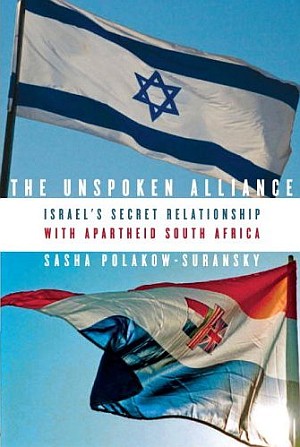
In the early days of the arms supply pact, Israel could argue that many Western countries, including the United States, had similar surreptitious relationships with the apartheid regime. But by 1980 Israel was the last major violator of the arms embargo. It stuck with South Africa throughout the 1980s when the regime clung to power in the face of international condemnation and intense rounds of political unrest in the black townships.
By 1987 the apartheid regime was struggling to cope with the combination of internal unrest and international condemnation to the point where even Israel was forced to take notice. A key motivator was Section 508, an amendment to the anti-apartheid sanctions bill that passed the U.S. Congress in 1986 and survived President Ronald Reagan’s veto. It required the State Department to produce an annual report on countries violating the arms embargo. The first one, issued in April 1987, reported that Israel had violated the international ban on arm sales “on a regular basis.” The report gave South Africa’s opponents within the Israeli government and their American Jewish allies ammunition to force Israel to adapt a mild set of sanctions against South Africa. I was in Jerusalem when Israel admitted publicly for the first time that it had significant military ties with South Africa and pledged not to enter into any new agreements — which meant, of course, that existing agreements would be maintained. It was, writes Polakow-Suransky, “little more than a cosmetic gesture.”
From the start, spokesmen for American Jewish organizations acted as apologists or dupes for Israel’s arms sales. Moshe Decter, a respected director of research for the American Jewish Committee, wrote in the New York Times in 1976 that Israel’s arms trade with South Africa was “dwarfed into insignificance” compared to that of other countries and said that to claim otherwise was “rank cynicism, rampant hypocrisy and anti-Semitic prejudice.” In a March 1986 debate televised on PBS, Rabbi David Saperstein, a leader of the Reform Jewish movement and outspoken opponent of apartheid, claimed Israeli involvement with South Africa was negligible. He conceded that there may have been arms sales during the rightist Likud years in power from 1977 to 1984, but stated that under Shimon Peres, who served as prime minister between 1984 and 1986, “there have been no new arms sales.” In fact, some of the biggest military contracts and cooperative ventures were signed during Peres’s watch.
The Anti-Defamation League participated in a blatant propaganda campaign against Nelson Mandela and the ANC in the mid 1980s and employed an alleged “fact-finder” named Roy Bullock to spy on the anti-apartheid campaign in the United States — a service he was simultaneously performing for the South African government. The ADL defended the white regime’s purported constitutional reforms while denouncing the ANC as “totalitarian, anti-humane, anti-democratic, anti-Israel, and anti-American.” (In fairness, the ADL later changed its tune. After his release in 1990, Mandela met in Geneva with a number of American Jewish leaders, including ADL president Abe Foxman, who emerged to call the ANC leader “a great hero of freedom.”)
Polakow-Suransky is no knee-jerk critic of Israel, and he tells his story more in sorrow than anger. He grants that the secret alliance had its uses. To the extent it enhanced Israel’s security and comfort zone, it may have helped pave the path to peace efforts. Elazar Granot, a certified dove who is a former left-wing Knesset member and ambassador to the new South Africa, says as much. “I had to take into consideration that maybe Rabin and Peres were able to go to the Oslo agreements because they believed that Israel was strong enough to defend itself,” he tells the author. “Most of the work that was done — I’m talking about the new kinds of weapons — was done in South Africa.”
Polakow-Suransky sees in the excoriation of Jimmy Carter’s 2006 book, Palestine: Peace Not Apartheid by American Jewish leaders an echo of their reflexive defense of Israel vis á vis South Africa in the 1970s and 1980s. The author himself draws uncomfortable parallels between apartheid and Israel’s occupation of the West Bank and Gaza, noting that both involved the creation of a system that stifled freedom of movement and labor, denied citizenship and produced homelessness, separation, and disenfranchisement. As the Palestinian population continues to grow and eventually becomes the majority — and Jews the minority — in the land between the Jordan River and the Mediterranean, the parallels with apartheid may become increasingly uncomfortable. Even Prime Minister Ehud Olmert agreed, observing in 2007 that if Israel failed to negotiate a two-state solution with the Palestinians, it would inevitably “face a South African-style struggle for equal voting rights.”
“The apartheid analogy may be inexact today,” Polakow-Suransky warns, “but it won’t be forever.”
Chris McGreal, in a series of reports triggered by the publication of Sasha Polakow-Suransky’s new book, The Unspoken Alliance, writes:
For years after its birth, Israel was publicly critical of apartheid and sought to build alliances with the newly independent African states through the 1960s.
But after the 1973 Yom Kippur war, African governments increasingly came to look on the Jewish state as another colonialist power. The government in Jerusalem cast around for new allies and found one in Pretoria. For a start, South Africa was already providing the yellowcake essential for building a nuclear weapon.
By 1976, the relationship had changed so profoundly that South Africa’s prime minister, John Vorster, could not only make a visit to Jerusalem but accompany Israel’s two most important leaders, Yitzhak Rabin and Shimon Peres, to the city’s Holocaust memorial to mourn the six million Jews murdered by the Nazis.
Neither Israeli appears to have been disturbed by the fact that Vorster had been an open supporter of Hitler, a member of South Africa’s fascist and violently antisemitic Ossewabrandwag and that he was interned during the war as a Nazi sympathiser.
Rabin hailed Vorster as a force for freedom and at a banquet toasted “the ideals shared by Israel and South Africa: the hopes for justice and peaceful coexistence”.
Secret South African documents reveal that Israel offered to sell nuclear warheads to the apartheid regime, providing the first official documentary evidence of the state’s possession of nuclear weapons.
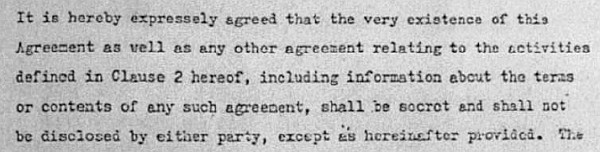
The “top secret” minutes of meetings between senior officials from the two countries in 1975 show that South Africa’s defence minister, PW Botha, asked for the warheads and Shimon Peres, then Israel’s defence minister and now its president, responded by offering them “in three sizes”. The two men also signed a broad-ranging agreement governing military ties between the two countries that included a clause declaring that “the very existence of this agreement” was to remain secret.
The documents, uncovered by an American academic, Sasha Polakow-Suransky, in research for a book on the close relationship between the two countries, provide evidence that Israel has nuclear weapons despite its policy of “ambiguity” in neither confirming nor denying their existence.
The Israeli authorities tried to stop South Africa’s post-apartheid government declassifying the documents at Polakow-Suransky’s request and the revelations will be an embarrassment, particularly as this week’s nuclear non-proliferation talks in New York focus on the Middle East.
They will also undermine Israel’s attempts to suggest that, if it has nuclear weapons, it is a “responsible” power that would not misuse them, whereas countries such as Iran cannot be trusted.
South African documents show that the apartheid-era military wanted the missiles as a deterrent and for potential strikes against neighbouring states.
The documents show both sides met on 31 March 1975. Polakow-Suransky writes in his book published in the US this week, The Unspoken Alliance: Israel’s secret alliance with apartheid South Africa. At the talks Israeli officials “formally offered to sell South Africa some of the nuclear-capable Jericho missiles in its arsenal”.
Among those attending the meeting was the South African military chief of staff, Lieutenant General RF Armstrong. He immediately drew up a memo in which he laid out the benefits of South Africa obtaining the Jericho missiles but only if they were fitted with nuclear weapons.
In a speech delivered at West Point on Saturday, President Obama previewed his new security doctrine. This was a key passage:
Now even as we fight the wars in front of us, we also have to see the horizon beyond these wars — because unlike a terrorist whose goal is to destroy, our future will be defined by what we build. We have to see that horizon, and to get there we must pursue a strategy of national renewal and global leadership. We have to build the sources of America’s strength and influence, and shape a world that’s more peaceful and more prosperous.
Time and again, Americans have risen to meet and to shape moments of change. This is one of those moments — an era of economic transformation and individual empowerment; of ancient hatreds and new dangers; of emerging powers and new global challenges. And we’re going to need all of you to help meet these challenges. You’ve answered the call. You, and all who wear America’s uniform, remain the cornerstone of our national defense, the anchor of global security. And through a period when too many of our institutions have acted irresponsibly, the American military has set a standard of service and sacrifice that is as great as any in this nation’s history.
Now the rest of us — the rest of us must do our part. And to do so, we must first recognize that our strength and influence abroad begins with steps we take at home. We must educate our children to compete in an age where knowledge is capital, and the marketplace is global. We must develop clean energy that can power new industry and unbound us from foreign oil and preserve our planet. We have to pursue science and research that unlocks wonders as unforeseen to us today as the microchip and the surface of the moon were a century ago.
Simply put, American innovation must be the foundation of American power — because at no time in human history has a nation of diminished economic vitality maintained its military and political primacy.
The sub-text here seems to be a neo-Clintonism: when it comes to national security, it’s the economy stupid!
David Ignatius, who often acts as an unofficial spokesman for the administration, pursues the same theme:
One of the strongest voices arguing for fiscal responsibility as a national security issue has been Defense Secretary Bob Gates. He gave a landmark speech in Kansas on May 8, invoking President Dwight Eisenhower’s warnings about the dangers of an imbalanced military-industrial state.
“Eisenhower was wary of seeing his beloved republic turn into a muscle-bound, garrison state — militarily strong, but economically stagnant and strategically insolvent,” Gates said. He warned that America was in a “parlous fiscal condition” and that the “gusher” of military spending that followed Sept. 11, 2001, must be capped. “We can’t have a strong military if we have a weak economy,” Gates told reporters who covered the Kansas speech.
On Thursday the defense secretary reiterated his pitch that Congress must stop shoveling money at the military, telling Pentagon reporters: “The defense budget process should no longer be characterized by ‘business as usual’ within this building — or outside of it.”
Adm. Mike Mullen, chairman of the Joint Chiefs of Staff, has also argued for a rethinking of the strategic mind-set that encouraged two expeditionary wars in the past decade at immense cost. “U.S. foreign policy is still too dominated by the military,” he said in a March 3 speech. He cautioned that the military should use its power “in a precise and principled manner,” rather than always insisting on overwhelming force.
Let’s return to the class exercise of the military and civilian logisticians who were asked to prepare a national security strategy. They focused on America’s domestic challenges, which included “unsustainable budget,” “finite foreign energy” and “failing education,” and proposed this rubric: “Credibility abroad begins with credibility at home.” In a multipolar world, they said, the “U.S. cannot be the sole guarantor of international security.”
What’s interesting about this focus on domestic economic security is that it probably would be endorsed by Republicans and Democrats, Tea Party conservatives and antiwar liberals. In a country that doesn’t agree on much, it could be a unifying theme.
At the pro-Israeli Washington Institute for Near East Policy, David Schenker writes:
On Monday, Lebanese prime minister Saad Hariri will visit Washington for a meeting with President Obama. In announcing the meeting, White House press secretary Robert Gibbs called it “a symbol of the close and historic relationship between Lebanon and the United States.” Indeed, between 2005 and 2009, bilateral ties were never closer or more consequential, with the Cedar Revolution ending nearly three decades of Syrian suzerainty in the country. Over the past year, however, Hariri has had to govern in coalition with Hizballah. The Iranian-Syrian backed Shiite militia will be the elephant in the Oval Office during Monday’s meeting.
Prior to becoming prime minister, Hariri was a frequent visitor to the Bush White House as head of Lebanon’s ruling March 14 coalition. This will be his first visit as premier, his first meeting with Obama, and his first trip to the White House since last year’s seeming reversal of the Cedar Revolution. Although Syria no longer has troops stationed across the border, President Bashar al-Asad’s allies in Lebanon have retrenched in recent months and once again wield preponderant political influence. Meanwhile, the March 14 coalition has been dramatically weakened by attrition and defections at home and abroad that have led the movement to moderate its pro-Western stance and embrace — at least rhetorically — Hizballah’s “resistance” doctrine.
Syria and Lebanon have agreed they will present a united front of opposition to Israel and support for Hizbollah, when the Lebanese prime minister, Saad Hariri, travels to Washington next week.
Syria’s president, Bashar Assad, held talks with the Lebanese leader in Damascus on Tuesday. In contrast to Mr Hariri’s first prime ministerial visit to Syria in December, when he was joined by a large government delegation, this time only senior aides accompanied the two.
Bussaina Shaaban, a Syrian presidential adviser, said the meeting was designed to “co-ordinate policy” ahead of Mr Hariri’s trip to the United States, expected to take place on Monday.
There’s little question that like all other Lebanese politicians, Saad Hariri depends for his survival on a good measure of expediency and pragmatism, but even so, are we really to believe that he is tightening his bonds with the people who killed his father? Or is it time to acknowledge that whoever was benefited by the assassination of Rafic Hariri, it wasn’t Syria.
If one asks the question, “Who benefits?” the answer is clear. The destabilization of Lebanon, the mobilization of the US-backed opposition to the pro-Syrian government in Beirut, and the vilification of Damascus all serve to advance US and Israeli strategic plans long in the making.
It is not just a question of motive, however. Israel has a long history of utilizing assassination as an instrument of state policy. The Israeli regime has not infrequently carried out acts of terror and blamed them on its enemies.
And that was written before the assassinations of the Hezbollah commander Imad Mughniyah in Damascus in 2008 and of the Hamas commander Mahmoud al-Mabhouh in Dubai in January this year, both of which killings were attributed to Mossad.
The first principle is the balance between security and democracy. The legitimacy of any political regime comes from its ability to provide security and freedom together to its citizens; this security should not be at the expense of freedoms and human rights in the country. Since 2002, Turkey has attempted to promote civil liberties without undermining security. This is an ambitious yet worthy aim — particularly in the post-Sept. 11 environment, under the threat of terrorism, in which the general tendency has been to restrict liberties for the sake of security.
Turkey has made great strides in protecting civil liberties despite serious domestic political challenges to such freedoms over the past seven years. This required vigorously carrying out the struggle against terrorism without narrowing the sphere of civil liberties — a challenge Turkey successfully overcame. In the process, we’ve found that Turkish soft power has only increased as our democracy has matured.
Second, the principle of zero problems towards neighbors has been successfully implemented for the past seven years. Turkey’s relations with its neighbors now follow a more cooperative track. There is a developing economic interdependence between Turkey and its neighboring countries. In 2009, for example, we achieved considerable diplomatic progress with Armenia, which nevertheless remains the most problematic relationship in Turkey’s neighborhood policy.
Turkey’s considerable achievements in its regional relationships have led policymakers to take this principle a step further and aim for maximum cooperation with our neighbors. Since the second half of 2009, Turkey established high-level strategic council meetings with Iraq, Syria, Greece and Russia. These are joint cabinet meetings where bilateral political, economic, and security issues are discussed in detail. There are also preparations to establish similar mechanisms with Bulgaria, Azerbaijan and Ukraine as well as other neighboring countries. Turkey abolished visa requirements with, among others, Syria, Tajikistan, Albania, Lebanon, Jordan, Libya and Russia. Turkey’s trade with its neighbors and nearby regions has substantially increased in recent years.
The third operative principle is proactive and pre-emptive peace diplomacy, which aims to take measures before crises emerge and escalate to a critical level. Turkey’s regional policy is based on security for all, high-level political dialogue, economic integration and interdependence, and multicultural coexistence. Consider Turkey’s mediation between Israel and Syria, a role that was not assigned to Turkey by any outside actor. Other examples of pre-emptive diplomacy include Turkey’s efforts to achieve Sunni-Shiite reconciliation in Iraq, reconciliation efforts in Lebanon and Palestine, the Serbia-Bosnia reconciliation in the Balkans, dialogue between Afghanistan and Pakistan, and the reconstruction of Darfur and Somalia.
The fourth principle is adherence to a multi-dimensional foreign policy. Turkey’s relations with other global actors aim to be complementary, not in competition. Such a policy views Turkey’s strategic relationship with the United States through the two countries’ bilateral strategic ties and through NATO. It considers its EU membership process, its good neighborhood policy with Russia, and its synchronization policy in Eurasia as integral parts of a consistent policy that serves to complement each other. This means that good relations with Russia are not an alternative to relations with the EU. Nor is the model partnership with the United States a rival partnership against Russia.
The fifth principle in this framework is rhythmic diplomacy, which aspires to provide Turkey with a more active role in international relations. This principle implies active involvement in all international organizations and on all issues of global and international importance. Turkey became a non-permanent member of the U.N. Security Council and is chairing three critical commissions concerning Afghanistan, North Korea, and the fight against terror. Turkey undertook the chairmanship-in-office of the South-East European Cooperation Process, a forum for dialogue among Balkan states and their immediate neighbors, for 2009 and 2010. Turkey is also a member of G-20, maintains observer status in the African Union, has a strategic dialogue mechanism with the Gulf Cooperation Council, and actively participates in the Arab League. Turkey has also launched new diplomatic initiatives by opening 15 new embassies in Africa and two in Latin America, and is a signatory to the Kyoto Protocol. These developments show a new perspective of Turkey, one that is based on vision, soft power, a universal language, and implementation of consistent foreign policies in different parts of the world.
Let us imagine the dream-country of most Israelis – without criticism, neither from within nor from without. It speaks in one voice and is eternally united, with devotion and cohesion; all-Jewish, that goes without saying. It stands unanimously behind its government, every government, and also, of course, behind its army, the Shin Bet security service and the Mossad espionage agency – Israel’s heroes.
There is not even a single “snitch,” no human rights organizations or peace movements, no nonprofit associations and no critical reports that are published here, or, heaven forbid, abroad. Its press never criticizes, never exposes, never investigates, publishing nothing but praise and admiration for the government and the state. It recites official statements and quotes from government and security briefings.
Every war that this dream-country wages is met immediately by nothing but cheers of approval. Any atrocity it commits in the occupied territories automatically earns across-the-board support – the most moral, the most just, the most security-oriented, in harmony. All residents must swear their allegiance, all those who wish to visit, too. Those who are faithful to Israel are welcome. All the rest must take the first plane (or truck ) out. In short, the country of one’s dreams.
But now let’s answer truthfully. Is that really the country we wound want to live in? Moreover, would the world that is always-against-us appreciate and like Israel better if that was how we looked and spoke, uniform and devoid of all self-criticism?
The benchmark upon which all psychological health and pathology can be assessed is the relationship between self and other. The breakdown of this relationship at its extreme results in psychosis: a condition in which an unbridgeable chasm has opened between the individual and the world he inhabits.
Is this where Israel is heading? A nation so deranged that the only source of comfort it finds is in a conversation that it mutters to itself? A nation that lashes out at anyone who ventures to close? A nation whose existence rests on a foundation of fear?
This week the Obama administration made what may come to be seen as a blunder of historic proportions. At a moment when tactical agility was a must, it stayed on course because it lacked the diplomatic finesse to show or perhaps even recognize the difference between being resolute and being inflexible.
The sanctions juggernaut plowed into the Iran diplomatic initiative masterminded by Brazil and Turkey and on the basis that these are “lesser” powers, Washington imagined its own agenda must be unstoppable. Or at least the administration felt compelled to bow in obedience to a fear that shackles every Democratic leader: the fear that flexibility will be seen as a sign of weakness.
Common sense and prudence made it clear that the smart way of responding to the new opening from Iran would have been with a cautious opening in return. Instead, Iran, Turkey and Brazil got the door slammed in their face. The calculation in Washington, no doubt, was that Iran, in its usual tempestuous style would swiftly reject the swap deal in the face of the continued threat of sanctions, and the diplomatic upstarts, Lula and Erdogan, would defer to the old world order.
Instead, it seems that Iran remains intent on seizing the initiative, will stick to the deal it signed and thereby demonstrate to the world that in the long-running nuclear dispute it is the United States that is now the intransigent party.
Turkey’s prime minister is seeking international support for a deal under which Iran would ship much of its low-enriched uranium to Turkey.
Recep Tayyip Erdogan’s office said Saturday he had written to the leaders of 26 countries saying the deal would resolve the nuclear standoff with Iran by way of diplomacy and negotiation. The countries included all permanent and non-permanent members of the UN Security Council.
Iran will submit an official letter to the IAEA on Monday morning conveying its acceptance of the uranium enrichment deal brokered by Turkey and Iran, state-run news agency IRNA reported on Friday, citing a statement by the country’s National Security Council.
“Following the joint declaration by Iran, Turkey and Brazil, permanent representative of the Islamic Republic of Iran at the IAEA officially announced its readiness to submit our country’s letter to the IAEA Chief per paragraph six of the Teheran Declaration,” the statement reportedly read.
Also on Friday, IRNA quoted a top Iranian cleric as saying that the deal was a “powerful response” that “put the ball in the West’s court.” He reportedly stated that far from being a ploy meant to facilitate enrichment for military use, the deal should be seen as a confidence-building measure.
Meanwhile in Turkey, UN Secretary-General Ban Ki-moon expressed hope that the deal reached last week would “open the door to a negotiated settlement” between Iran and Western nations, according to a Reuters report.
Ban reportedly called the enrichment agreement “an important initiative in resolving international tensions over Iran’s nuclear program by peaceful means.” He went on to praise Turkey’s role and cooperation with Brazil in negotiating the deal, stressing that the International Atomic Energy Agency (IAEA) would have to make its own assessment concerning the issue at hand.
At this point, it looks like Hillary Clinton has driven the United States into a diplomatic ditch.
The American mindset now as always fixes its attention on power and while the US remains the pre-eminent global power it assumes that it must have its way. But this fixation on power blinds Washington to a more important issue — one that provides the foundation for effective diplomacy, namely, trust.
This issue of trust, I believe, is the key to not just the Iranian nuclear crisis, but also other conflicts in the region, including the Arab-Israeli one. On all these issues, America has all the eye-catching instruments that give her full confidence: The world’s most powerful military, the largest diplomatic corps, and the most sophisticated brain power with plentitude of universities, institutes and think-tanks.
Yet, I am sorry to say, she terribly lacks the trust of the peoples of the Middle East. So, it would be only wise for her to rely more on the regional actors that do have that trust – such as the new Turkey of the 21st century.
The agreement on Iran’s nuclear fuel announced on Monday after mediation by the Turkish and Brazilian governments should be good news for those who seek to use the rule of law to prevent nuclear weapons proliferation. From both the American and Iranian perspectives the political dimension of the current dynamics is more important than the technical one. The accord should remind us that the style and tone in diplomatic processes is as important as substance.
Iran and its international negotiating partners have not reached agreement on Iran’s nuclear programs in the past half-decade, to a large extent because American- and Israeli-led concerns have been translated into an aggressive, accusatory, sanctions-and-threats-based style of diplomacy that Iran in turn has responded to with defiance.
Iran’s crime, in the eyes of its main critics in Washington and Tel Aviv (they are the two that matter most, as other Western powers play only supporting roles), is not primarily that it enriches uranium, but that it defies American-Israeli orders to stop doing so. (The Iranian response, rather reasonable in my view, is that it suspended uranium enrichment half a decade ago and did not receive the promises it expected from the United States and its allies on continuing with its plans for the peaceful use of nuclear technology. So why suspend enrichment again?)
The Iranians are saying, in effect, that this issue is about two things for them, one technical and one political: The technical issue is about the rule of law on nuclear nonproliferation and the right of all countries to use nuclear technology peacefully. The political issue is about treating Iran with respect, and negotiating with it on the basis of two critical phenomena: First, addressing issues of importance to Iran as well as those that matter for the American-Israeli-led states; and, second, actually negotiating with Iran rather than condescendingly and consistently threatening it, accusing it of all sorts of unproven aims, and assuming its guilt before it is given a fair hearing.
The age in which the non-Western world could be expected to show deference to the dictates of the dominant global powers is over. Western leaders must either humbly adapt to a world that has changed or suffer the humiliations that arrogance now invite.
No one knows fascism better than Israelis. They are schooled, drilled in the history, the mechanics, the horrendous potential of fascist regimes. Israelis know fascism when they see it. In others.
They might well have expected when fascism began taking root here, it would arise at a time of a national leadership of galvanizing charisma and sweeping, powerfully orchestrated modes of action.
But that would have been much too obvious to deny. And it would take denial, inertia, selective memory, a sense that things – bad as they are – can go on like this indefinitely, for fascism to be able gain its foothold in a country founded in its very blood trail.
In fact, it has taken the most dysfunctional, the most rudderless government Israel has ever known, to make moderates uncomfortably aware of the countless but largely cosmetized ways in which the right in Israel and its supporters abroad have come to plant and nurture the seeds of fascism.
Later this month, ships from all over the world will converge in the Mediterranean and set sail for the occupied and besieged Gaza Strip. This international coalition is called the Freedom Flotilla.
The Free Gaza Movement has sailed eight missions to Gaza in the past three years, five of them successful. The last three were violently stopped by the Israeli Navy; the boat Dignity was rammed three times and the Spirit of Humanity turned back in January 2009, then seized and all aboard arrested.
This time the Freedom Flotilla is upping the ante and instead of one- and two-vessel challenges, will be breaking Israel’s siege with an eight-boat front.
In the past, the Israel Navy could pick us off as individual boats. Now, including Free Gaza’s four ships, 700 passengers and some 5,000 tons of reconstruction materials and medical equipment. This includes Free Gaza’s MV Rachel Corrie, which was purchased through generous donations from Malaysia’s Perdana Global Peace Foundation.
The Israeli government has responded to the “sea intifada” coming its way with saber rattling and accusations of serving Hamas. Israel has proscribed the Turkish human rights and relief group Insani Vardim Vakafi (IHH). IHH is responsible for sending a cargo ship and passenger ship in the Freedom Flotilla. Israel has accused it and Free Gaza of “supporting terrorism.” Half the Israeli navy is set to challenge the mission, with Israeli Defense Minister Ehud Barak at the helm commanding the operation in person. The air force is on standby and “diplomatic pressure” is being applied behind the scenes. The message is clear from Israel: “We will stop you and we will use force to stop you.”
At no point does the Freedom Flotilla enter Israeli territorial waters. The journey starts in local European or Turkish waters, courses through international waters and ends in Gaza’s territorial waters. No checkpoints interrupt us. No walls daunt our sight. We’ve proven that it’s possible to sail a clear line with no borders, as we want the world to be, until we get to Gaza.
This could mark a significant tipping point in the BDS movement — not just the support from big name artists such as Elvis Costello, but the fact that others who might not voice support are simply deciding that it is not in their commercial interests to perform in Israel.
Costello’s action [cancelling his planned concerts in Israel] is the first open endorsement of the boycott movement by an A-list artist in protest of Israel’s policies in the occupied West Bank and of its siege of Gaza. In a detailed statement, the performer argued that he could not perform in Israel because by doing so, “it may be assumed that one has no mind for the suffering of the innocent.
“One lives in hope that music is more than mere noise, filling up idle time, whether intending to elate or lament,” Costello wrote in his statement.
He suggested that his decision had been complex and difficult. “I must believe that the audience for the coming concerts would have contained many people who question the policies of their government on settlement and deplore conditions that visit intimidation, humiliation or much worse on Palestinian civilians in the name of national security,” he wrote. “I am also keenly aware of the sensitivity of these themes in the wake of so many despicable acts of violence perpetrated in the name of liberation.
“I offer my sincere apologies for any disappointment to the advance ticket holders as well as to the organizers.”
In reaction, a music industry insider confirmed that the winds could be shifting. The music executive, who spoke on condition of anonymity in light of his ongoing business ties with artists, said that in recent months he had approached more than 15 performing artists with proposals to give concerts in Israel. None had agreed. The contracts offered high levels of compensation. He called them “extreme, big numbers that could match any other gig.”
Yonatan Touval, one of the Israelis behind the Geneva Initiative, clearly articulates the degree and ways in which Israel has suffered as a result of its special relationship with the United States. His hope is that Obama might correct the imbalance in the relationship and make it one based on genuine mutual interests, yet the quirk in Touval’s analysis is his claim that Israel is a victim in a relationship thrust upon the Jewish state — that America has indulged Israel “to the point of abuse.”
“Take the money,” insisted Uncle Sam. Little Israel was powerless to refuse. And now look what this over-indulgent uncle has done to its helpless nephew.
I guess this can be seen as a version of the “friends don’t let friends…” sentiment. Even so, the fact that Israelis still feel they can push their Little Israel image seems itself to be an expression of the way Israel has been over-indulged.
Put simply, the relationship has damaged Israel by turning it into an adolescent state that doesn’t take responsibility for its own actions. And why should it take responsibility, when America’s uncritical embrace allows it to behave with the certainty that no action would ever be too costly – America would always save it from military, economic or diplomatic ruin.
To the extent, moreover, that this certainty has weakened Israel’s resolve to settle its conflict with its neighbors, the country has been further damaged by the loss of faith that the conflict could ever end. Hence the powerlessness to stop the occupation. This has had a terribly corrosive effect on Israeli life – from the high level of stress in everyday living, to the distorted allocation of national resources (Israel’s 2010 state budget allocates $14.4 billion for defense, a figure equal to 6.7 percent of the country’s GDP – the highest of any developed nation ), to the psychological adjustments that Israelis must make in the face of the deepening erosion of democratic values and growing doubts about the future prospects of the country as such.
Israelis have become accustomed to living under such anomalous conditions because, in many respects, the cushion of the special relations with the United States allows them to. But being habituated is a mixed blessing – which is also to say, a mixed curse.
Indeed, rather than habituation, Israel needs rehabilitation. And to those on the other side of the ocean who would disclaim responsibility, by placing the onus on Israel alone, we Israelis can only respond: “Where have you been all this time? It is you, America, that has turned us into what we are.”
This website or its third-party tools use cookies, which are necessary to its functioning. By closing this banner, you agree to the use of cookies.