This is no ripping yarn, but a murder to fan more conflict

Seumas Milne writes:

… since launching its war on terror, the US has also adopted Israel’s practice, stretching back decades, of carrying out killings far from the theatre of war. First, Israel’s attacks were targeted against PLO leaders; more recently against the ­Islamists. But since the fiasco of the Mish’al plot [in Jordan in 1997], its assassinations have mostly been confined to the West Bank and Gaza Strip, where Israel made a determined attempt over the past ­decade to decapitate Hamas of its entire leadership.

Now that focus has again widened. Under the direction of Mossad director Meir Dagan, Israel is running a region-wide underground war against the leaders of Hezbollah and Hamas – which have both maintained an effective ceasefire for more than a year – and their Syrian and Iranian backers. Since the ­killing of ­veteran Hezbollah leader Imad ­Mughniyeh in Damascus in 2008, Israeli-hallmarked assassinations have ­multiplied in Lebanon, Syria and Iran.

But coldblooded ­killing isn’t only a morally ­repugnant crime. The lesson of ­colonial ­history is that ­decapitation ­campaigns against ­national ­resistance movements don’t work. In the short term they can disrupt and demoralise, but if the ­movement is socially rooted, other ­leaders or even organisations will take their place. That was Israel’s ­experience when it killed the Hezbollah leader ­Abbas al-Musawi and his family in the early 1990s, only for him to be succeeded by the more effective and ­charismatic Hassan Nasrallah.

Such campaigns also tend to spread the war. Unlike the historic PLO ­factions, Hamas has always confined its armed attacks to Israel and the Palestinian territories. Writing in The Guardian in 2007, Mish’al confirmed the “principle that the resistance should only be fought in Palestine”. But in the aftermath of the Dubai assassination, Hamas leaders have started to hint strongly that policy could now change, and that they could respond to Israel’s attacks in “the ­international arena”.

Facebooktwittermail

The Dahlan connection – Updated

Update – Ayman Taha, a Hamas spokesman in Gaza, was reported saying: “These statements concerning PA [Palestinian Authority] involvement [in Mahmoud al-Mabhouh’s murder] are too hasty. This is not the official position of the movement, that the PA was involved. When the investigation is finished, we will announce who is behind the killing.” His statement followed reports such as the one below from Ynet identifying two Palestinians detained in Dubai and a report in The Guardian claiming that a Hamas operative Nahro Massoud was being questioned in Damascus about the Dubai killing.

Asharq Alawsat adds:

In Jordan, an informed Palestinian source said that it was likely that the two Palestinians who were handed over to the UAE authorities by Jordan were in possession of Palestinian passports specifically used by Gaza Strip residents. He said that the two Palestinians were most likely residing in the UAE, and fled the country via the Queen Alia International Airport in Amman aboard a Royal Jordanian Airlines flight but without first securing the proper visas, and were therefore not allowed to enter Jordanian territory.

The source, who preferred to remain anonymous, said that any Palestinian living abroad or in the Gaza Strip needs a visa from the Jordanian Ministry of Interior and the consent of the security services prior to entering Jordan, whereas West Bank citizens are able to enter Jordan via the King Hussein Bridge and are not required to obtain all of these documents. He said that the two Palestinians were arrested in the airports transit lounge after the security services received information from UAE authorities that the two wanted figures had boarded a plane to Jordan.

The source also confirmed that the two Palestinians were held until a Royal Jordanian Airlines flight could take them back to Dubai the next day. The Palestinian ambassador to Jordan, Atallah Khairy denied that the two individuals have any ties to the Palestinian Authority, and he also confirmed to Asharq Al-Awsat that the Palestinian Authority does not have anything to do with this assassination. Khairy also pointed out that senior Hamas official Ayman Taha, who originally leveled these accusations at the Palestinian Authority had retracted his statement.

Whatever the role of the two Palestinians detained by the Dubai police, one fact is striking: all the other operatives belonging to the team that they were supposedly collaborating with made a clean getaway. So how come these two guys didn’t have suitable travel documents? It makes you wonder whether they were recruited simply as a means to try and so division among Palestinians.

While the diplomatic fallout from the Dubai murder continues to expand, there are several new twists in the story.

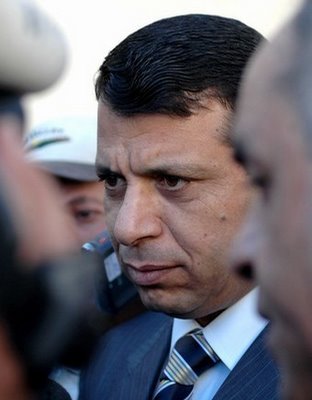
Though the real identities of the murder suspects whose passport photographs have been released are unknown, two Palestinian suspects under arrest in Dubai have been linked to Mohammed Dahlan, the Fatah security chief who was ousted from Gaza in June 2007. Dahlan has been accused in the past of collaborating with Israel and being a CIA agent.

A senior Hamas official told Ynet on Thursday that Anwar Shheibar and Ahmad Hasnain, two officers in the Palestinian General Security Services suspected of being involved in the assassination of Hamas’ Mahmoud al-Mabhouh, fled the Gaza Strip after Hamas took power. The suspects were arrested in Jordan and handed over to the Dubai police following the hit.

Shheibar is a resident of the Sabra neighborhood, west of Gaza City, and Hasnain is a member of one of the large families in the Sajaiya neighborhood. The two, both in their 30s, were members in what was known until a few years ago as “the death cells” led by Nabil Tamus, who claimed he was an associate of senior Fatah member Mohammad Dahlan.

These cells, according to Fatah rivals and Dahlan’s rivals, regularly suppressed Palestinian Authority opponents, especially among Hamas members.

Tamus, who led the cells, also left the Gaza Strip around the time Hamas took power. According to Palestinian reports and according to the senior Hamas official, the three were employed by Mohammad Dahlan’s real estate and investment firms in Dubai.

In the past, Dahlan, for his part, vehemently denied conducting any such activities in the United Arab Emirates. “I don’t have the towers people say I have in Dubai,” he used to say in interviews with the media.

Both Shheibar and Hasnain recently received their salaries from the Palestinian Authority in Ramallah. Hamas claims that their arrest proves beyond any doubt that the PA had direct collaboration and deep operational involvement in every detail of the assassination.

Hamas also claims that the Mossad enjoyed logistical support from the two men, who lived in Dubai in recent years, and thus were deeply familiar with the UAE. Hamas said publicly in the past few days that the two are associated with Dahlan’s camp.

Robert Fisk, based on the observations of an “impeccable” source in Abu Dhabi, says that Israel’s intelligence service is suspected by the UAE of having received European assistance.

Collusion. That’s what it’s all about. The United Arab Emirates suspect – only suspect, mark you – that Europe’s “security collaboration” with Israel has crossed a line into illegality, where British passports (and those of other other EU nations) can now be used to send Israeli agents into the Gulf to kill Israel’s enemies. At 3.49pm yesterday afternoon (Beirut time, 1.49pm in London), my Lebanese phone rang. It was a source – impeccable, I know him, he spoke with the authority I know he has in Abu Dhabi – to say that “the British passports are real. They are hologram pictures with the biometric stamp. They are not forged or fake. The names were really there. If you can fake a hologram or biometric stamp, what does this mean?”

The voice – I know the man and his origins well – wants to talk. “There are 18 people involved in the killing of Mahmoud al-Mabhouh. Besides the 11 already named, there are two Palestinians who are being interrogated and five others, including a woman. She was part of the team that staked out the hotel lobby.” Two hours later, an SMS arrives on my Beirut phone from Abu Dhabi, the capital of the United Arab Emirates. It is the same source.

“ONE MORE THING,” it says in capital letters, then continues in lower case. “The command room of the operation was in Austria (sic, in fact, all things are “sic” in this report)… meaning the suspects when here did not talk to each other but thru the command room on separate lines to avoid detection or linking themselves to one another… but it was detected and identified OK??” OK? I ask myself.

My source is both angry and insistent. “We have sent out details of the 11 named people to Interpol. Interpol has circulated them to 188 countries – but why hasn’t Britain warned foreign nations that these people are using passports in these names?” There was more to come.

“We have identified five credit cards belonging to these people, all issued in the United States.” The man will not give the EU nationalities of the extra five – this would make two women involved in Mr Mabhouh’s murder. He said that EU countries were cooperating with the UAE, including the UK. But “not one of the countries we have been speaking to has notified Interpol of the passports used in their name. Why not?”

The intrigue will not stop there.

Facebooktwittermail

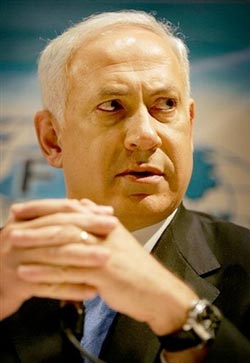
Will Dubai issue an arrest warrant for Netanyahu?

Update below
Dubai’s police chief has now fingered Mossad, the Israeli intelligence agency, as being responsible for the murder of , on January 19, Lt Gen Dahi Khalfan Tamim told The National:

“Our investigations reveal that Mossad is involved in the murder of al Mabhouh. It is 99 per cent, if not 100 per cent that Mossad is standing behind the murder,” said Gen Tamim.

The evidence that Dubai Police have shows a clear link between the suspects and people with a close connection to Israel, according to Gen Tamim. However, he did not disclose what the evidences were.

Earlier Gen Tamim had said if it is proven that Mossad is responsible for the killing of al Mabhouh “Benjamin Netanyahu, the Israeli prime minister, will be the first to be wanted for justice as he would have been the one who signed the decision to kill [Mahmoud] al Mabhouh in Dubai’ and that an arrest warrant will be issued against him.

However, today Gen Tamim declined to comment on whether the UAE authorities is to issue an arrest warrant for Mr Netanyahu.

Dubai’s Gulf News has compiled a video of the CCTV footage that shows the assassins tracking their target. (There is no audio with this presentation.)

The Times provides an account of the movements of the assassins in the hours before and after al-Mahbouh’s murder.

The Daily Telegraph reports that Britain’s Foreign Secretary David Miliband said that it was an “outrage” that the Dubai assassins had used British passports and the British government has launched an investigation.

Mr Miliband spoke out after the Israeli ambassador to London, Ron Prosor, was called to the Foreign Office to discuss the affair, which is rapidly escalating into a major diplomatic crisis.

“We wanted to give Israel every opportunity to share with us what it knows about this incident,” Mr Miliband said.

“We hope and expect that they will co-operate fully with the investigation that has been launched by the Prime Minister and will be undertaken by the Serious Organised Crime Agency.”

Mr Miliband denied that the UK Government was merely “going through the motions” of asking questions about the incident.

It is too soon to say how great the diplomatic fallout will be but since all the countries whose passports were used illegally — Britain, Ireland, France and Germany — are EU members, it seems likely that the matter will rise to the level of European Union involvement.
The BBC‘s Paul Reynolds writes:

At this stage, it is a matter of Britain asking questions, not making protests and taking retaliatory action (such as demanding an apology, restricting official contacts or even expelling the ambassador for a time).

During his meeting with Mr Prosor, the permanent under-secretary Sir Peter Ricketts asked for full Israeli cooperation with the British inquiry. This is likely to prove problematic if Mossad was involved. Israel would not want to reveal too much. So a lot depends on how the word “cooperation” is defined. A total failure to cooperate would trigger a British response.

One complicating factor is that in 1987, the Israelis promised Britain that it would not use British passports in secret operations again.

On that occasion, eight British passports reckoned to be for Mossad agents were found in a bag in a West German telephone booth.

The then Israeli ambassador in London Yehuda Avner did find himself on the receiving end of a British protest.

If it turns out that the assurance given then has been broken the British diplomatic reaction will be the more severe.

Updated: It sounds as though Dubai’s police chief is now backing off from his earlier threat to issue an arrest warrant for Netanyahu. Reuters reports:

Interpol should issue a warrant to help locate and arrest the head of Israel’s spy agency Mossad if the organization was responsible for the killing of a Hamas militant in Dubai, the emirate’s police chief said Thursday.

Facebooktwittermail

British relations with Israel in ‘deep freeze’ as Dubai killing row escalates

The Guardian reports:

Britain last night fired the first shot in a potentially explosive diplomatic row with Israel by calling in the country’s ambassador to explain the use of faked British passports by a hit squad who targeted a Hamas official in Dubai.

The Israeli ambassador has been summoned to the Foreign Office to “share information” about the assassins’ use of identities stolen from six British citizens living in Israel, as part of the meticulously orchestrated assassination of Mahmoud al-Mabhouh.

Britain has stopped short of accusing Israel of involvement, but to signal its displeasure, the Foreign Office ignored an Israeli plea to keep the summons secret. “Relations were in the freezer before this. They are in the deep freeze now,” an official told the Guardian.

In an editorial, The Guardian said:

British passports are the property of the British government. When that government says and does nothing for six days after it was given evidence that Mossad agents stole the identity of six British citizens to assassinate a Hamas commander in Dubai, it starts to seem as if Israel was right to think it could get away with it. The Israeli foreign minister, Avigdor Lieberman, yesterday predicted the incident would have no effect on British relations.

The decision last night to call in the Israeli ambassador to “share information” does not change this basic position. If Britain were less supine in its dealings, it would realise it is not in its interests to let Israel wage its war with Hamas under a British flag. What happened was a breach of trust between two nations who are ostensibly allies. The identity theft endangers not just the lives of six passport holders and their families, but potentially anyone carrying a British passport in the Arab world. Faced by a growing political clamour, Gordon Brown was forced to call for a full investigation into how fraudulent British passports were used. We all, alas, know the prime minister’s predilection for investigations that fizzle out. The Serious Organised Crime Agency (Soca), led by Sir Ian Andrews, formerly at the Ministry of Defence, will work with the Dubai authorities.

Dubai has already issued its own arrest warrants, but at the very least, the evidence that Soca gathers should be presented to Israel with a demand for an explanation. Britain is not the only country involved in this affair. Dubai believed that 11 agents with European passports were involved in the murder. If Israel disregards Soca, matters should be taken up at EU level. Mossad agents routinely use false identities and forged western passports, and each time they are caught doing it Israel gives assurances they will not do it again. It did so to Britain when the issue came up in 1987. Ten years later it gave the same assurances to Canada, after Mossad agents entered Jordan on doctored Canadian passports and bungled an attempt to kill the Hamas leader Khaled Meshal with poison. Two suspected Israeli agents were jailed in New Zealand for obtaining the country’s passports illegally. These diplomatic assurances are evidently worthless.

The only thing that will give Mossad pause for thought the next time it eyes a target for assassination is if its political masters are made to feel the consequences of its actions. There are at any given moment a plethora of tools at the disposal of Britain and the EU, from bilateral diplomatic contacts and military contacts to arms and trade agreements. London is a key diplomatic listening post for the Middle East, and Britain is a vital interlocutor with the Palestinians. There are any number of ways of getting the message across, not least the question of whether to change the law to make it harder for British courts to issue arrest warrants, under the principle of universal jurisdiction, for former Israeli ministers accused of war crimes. The enduring mystery is why Britain has been so reluctant to pull the levers at its disposal.

The Mossad operation was described in Israel yesterday as a tactical operational success. There was relief that the right target was killed, and all Israel’s operatives got out safely. Israel is not the only country to carry out targeted assassinations. The US pursue the same policy with drones against the Taliban and al-Qaida in North Waziristan. The charge of hypocrisy is swiftly levelled at those who condemn Israel’s strikes while carrying on the same policy in other theatres of war. But assassinations rarely achieve their advertised effect. If the purpose here was to stop Hamas acquiring arms from Iran in Dubai, it will not prevent Tehran from providing weapons through another channel, and the Hamas commander will be quickly replaced. Assassinations such as these might, however, give Arab states even less reason than they already have to normalise relations with Israel. Is that a tactical success or a strategic failure?

Facebooktwittermail

Five Israelis had their identities stolen – apparently by Mossad!

Anyone who is Jewish but doesn’t have a Jewish sounding name and who has been considering emigrating to Israel might soon be having second thoughts.

To the extent that Israel provides a safe haven to Jews, it turns out your religious identity might count for less than your name.

The Israeli government has yet to acknowledge that the murder of the Hamas commander, Mahmoud al-Mabhouh, in Dubai last month was carried out by Mossad, but the evidence is now overwhelming.

But the fact that Mossad carried out the killing may turn out to concern Israelis (and Jews elsewhere) less than the apparent willingness of the Israeli intelligence agency to put the lives and liberty of Israeli citizens in jeopardy by stealing their identities.

It now turns out that five Israeli dual nationals claim their identities were stolen in order to provide the Dubai killers with fake passports. (Update – Israel’s Hebrew Ma’ariv now reports that seven Israelis had their identities stolen.)

Haaretz reports:

At least five Israelis awoke Tuesday morning to find their names tied to the assassination of senior Hamas operative Mahmoud al-Mabhouh in his Dubai hotel room last month. All were stunned to find their names displayed on passports that police in the emirate said were used by the assailants.

However, the people pictured in the photos released by police looked nothing like them. All denied involvement in the affair.

“I’m in shock – I just don’t understand how something like this could happen,” said Paul John Keeley, a British-born repairman who lives on Kibbutz Nahsholim, near Zichron Yaakov. Keeley’s name appeared on the British passport Dubai authorities said belonged to one of the hit men.

“From the moment I heard about it I was very worried. I’m worried for my family,” said Keeley, who immigrated to Israel more than a decade ago. “The fact that it was my name that was published in this context makes me worry that someone will try to harm us.”

Keeley, 43 and a father of three, said Tuesday his passport was in his possession before, on and after January 20, the day Mabhouh was assassinated.

“I don’t know who a person calls when his identity is stolen,” he said. “I’m waiting for someone from the British or Israeli government to contact me and give me answers. I don’t understand how something like this could happen.”

Amir Oren adds:

Using the identities of real, living, innocent Israelis for operational documentation is against the law. This kind of abuse also causes innocent civilians to suffer the evil that already plagues ministers and officers: being prevented from traveling abroad for fear of being arrested by Interpol on suspicion of being the Dubai assassins.

Former Mossad chief Efraim Halevy pushed for a Mossad Law to be legislated that would enshrine the state’s obligation to defend its agents caught breaking laws abroad. The initiative never got off the ground: A state can’t legitimize illegality. But neither can it allow one of its institutions to arbitrarily harm civilians — not the police, not the tax authority, not the Shin Bet security service and not the Mossad.

Attorney General Yehuda Weinstein was asked yesterday whether an investigation will be opened following the public complaints of those whose identities were stolen from them, and whose lives and liberty are therefore now threatened. Weinstein has not yet had time to study the issue.

Oren is calling for Mossad chief Meir Dagan to be fired. But why stop there? Who can be so naive as to doubt that this operation was conducted with the authorization and at the behest of the Israeli prime minister himself.

Imagine a parallel in the United States. Richard Nixon couldn’t get away with ordering a burglary – can Netanyahu put his own citizens in jeopardy while ordering a murder?

This may end up not merely undermining public confidence in government officials; it might even shake Jewish confidence in Zionism.

Facebooktwittermail

Was the arrest of the Taliban’s second-in-command a strategic blunder?

Updated below
The capture of the Taliban’s second in command, Mullah Abdul Ghani Baradar, has been hailed as a huge blow to the Taliban but it may turn out to deliver an even bigger blow to President Obama’s hopes for an early withdrawal of US troops from Afghanistan.

Hajji Agha Lalai, former head of the Afghan government-led reconciliation process in Kandahar, who has dealt with members of the Taliban leadership council for several years, said Mullah Baradar was “the only person intent on or willing for peace negotiations.”

Last month Baradar facilitated an inconclusive meeting in Dubai between midlevel Taliban commanders and Kai Eide, the departing top UN official in Kabul, according to McClatchy newspapers.

Saeed Shah reported:

According to Vahid Mojdeh, a former Afghan official who worked under the Taliban, Baradar was instrumental in reining in insurgent violence, by banning sectarian killings and indiscriminate bombings.

“Baradar was an obstacle against al-Qaida, who wanted to make an operation in Afghanistan like they did in Iraq,” Mojdeh said. “But Baradar would not allow them to kill Shias” – the minority Muslim sect – “or set off explosions in crowded places.”

Pakistani analysts said Baradar’s capture suggested either that Islamabad had abandoned its attempt to promote peace talks or the Taliban number two had fallen afoul of the Pakistani authorities. Analysts said Baradar was the most likely point of contact for any future talks.

“This is inexplicable. Pakistan has destroyed its own credentials as a mediator between Taliban and Americans. And the trust that might have existed between Taliban and Pakistan is shattered completely,” said Rustam Shah Mohmand, a former Pakistani ambassador to Kabul after the overthrow of the Taliban.

The capture of Mullah Baradar has been widely reported as the result of a coordinated operation between the US and Pakistan, but so far the story seems very murky.

On Tuesday, February 9, the New York Times reported:

Pakistan has told the United States it wants a central role in resolving the Afghan war and has offered to mediate with Taliban factions who use its territory and have long served as its allies, American and Pakistani officials said.

The offer, aimed at preserving Pakistan’s influence in Afghanistan once the Americans leave, could both help and hurt American interests as Washington debates reconciling with the Taliban.

Pakistan’s army chief, Gen. Ashfaq Parvez Kayani, made clear Pakistan’s willingness to mediate at a meeting late last month at NATO headquarters with top American military officials, a senior American military official familiar with the meeting said.

The report said that General Kayani rebuffed US pressure to expand operations against the Taliban in North Waziristan because “the Pakistani Army still regarded India as its primary enemy and was stretched too thin to open a new front.”

Within days we learn of Mullah Baradar’s arrest in Karachi, Pakistan. His capture could cripple the Taliban’s military operations, at least in the short term, says Bruce Riedel, an adviser to the Obama administration. Others in Washington describe this as a huge blow to the Taliban.

But the New York Times now reports:

The arrest followed weeks of signals by Pakistan’s military chief, Gen. Ashfaq Parvez Kayani — to NATO officials, Western journalists and military analysts — that Pakistan wanted to be included in any attempts to mediate with the Taliban.

Even before the arrest of the Taliban commander, Mullah Abdul Ghani Baradar, a senior Pakistani intelligence official expressed irritation that Pakistan had been excluded from what he described as American and Afghan approaches to the Taliban.

“On the one hand, the Americans don’t want us to negotiate directly with the Taliban, but then we hear that they are doing it themselves without telling us,” the official said in an interview. “You don’t treat your partners like this.”

Mullah Baradar had been a important contact for the Afghans for years, Afghan officials said. But Obama administration officials denied that they had made any contact with him.

Whatever the case, with the arrest of Mullah Baradar, Pakistan has effectively isolated a key link to the Taliban leadership, making itself the main channel instead.

While Washington denied prior negotiations with Baradar, a US intelligence official in Europe claimed otherwise:

“I know that our people had been in touch with people around him and were negotiating with him,” the official said, speaking on the condition of anonymity because he was not authorized to discuss the issue.

“So it doesn’t make sense why we bite the hand that is feeding us,” the official added. “And now the Taliban will have no reason to negotiate with us; they will not believe anything we will offer or say.”

Update: In an interview on NPR Ahmed Rashid speculated that now that Baradar is in custody he could be in a better position to negotiate. Why? Because he’s not going anywhere?

Much more plausible is that the Pakistanis pulled him in — Rashid acknowledges that Baradar’s whereabouts have never been unknown to the ISI — because they didn’t want to be cut out of the negotiating loop by Americans negotiating directly with the Taliban. In other words, Pakistan is not willing to see a deal agreed to end this war without being able to dictate some of the terms.

If that is the case, no wonder The White House asked its news outlet (the New York Times) to sit on the story for a few days while they decided how it should be told.

Facebooktwittermail

British officials say Mossad murdered Hamas commander

If the investigation into the murder of the Hamas commander Mahmoud al-Mabhouh in Dubai on January 20, establishes that it was carried out by the Israeli intelligence service, Mossad, Dubai police have said they will issue an arrest warrant for the Israeli Prime Minister Benjamin Netanyahu.

While this would not be the first time an Israeli leader faced the risk of arrest, unlike previous instances which have involved alleged war crimes, in this instance Netanyahu would presumably be treated as a co-conspirator to pre-meditated murder in a case that already involves Interpol.

Following the announcement by Dubai police that six of the murder suspects were carrying British passports and another three Irish passports, The Daily Telegraph reports:

British government sources told The Daily Telegraph there was no “corroboration” within Whitehall of any British involvement in the assassination plot.

Government sources also said that officials do not believe any Irish nationals were involved but were Mossad agents using Irish passports.

Ten days ago The National reported:

The Israeli prime minister, Benjamin Netanyahu, will be at the top of Dubai’s wanted list if the Israeli foreign intelligence service Mossad is proven to be behind the killing of a senior Hamas official, the Dubai Police chief said yesterday.

Lt Gen Dahi Khalfan Tamim told The National that “Benjamin Netanyahu, the Israeli prime minister, will be the first to be wanted for justice as he would have been the one who signed the decision to kill [Mahmoud] al Mabhouh in Dubai. We will issue an arrest warrant against him.”

The BBC reports:

The British and Irish governments have said that passports belonging to the alleged killers of a top Hamas official are fake.

Ireland said the names Gail Folliard, Evan Dennings and Kevin Daveron, and their passport numbers, did not match anything issued by its officials.

Britain said it believed six British passports were also fakes.

The Times reports:

Ehud Olmert, the former Israeli Prime Minister, in a speech at the weekend, alluded to a report in The Times on Saturday that Mossad was waging a covert war of assassinations across the Middle East, targeting Hamas and Iranian officials.

“There are a huge range of options between a full military attack and accepting a nuclear Iran,” Mr Olmert said. “There are other means that, together with other things happening, and they are happening, can create a result that would not allow the Iranians to reach what they are trying to reach.”

One former Mossad agent confirmed that the organisation regularly used foreign passports for travel abroad on secret missions.

“Sometimes these were legitimate passports of people who held dual citizenship, other times they were acquired,” he said. “An Israeli passport raises red flags and is best avoided.”

Assuming that this was indeed a Mossad operation, in a suprising twist, it appears that the Israeli agents stole the identity of a British-Israeli who is now trying to clear his name.

Dubai has identified Melvyn Adam Mildiner as one of six British passport holders believed to have been involved in the death of al-Mabhouh in a luxury hotel.

Speaking from his home near Jerusalem, Mr Mildiner said: “The details of the passport are not all wrong. My name is spelt correctly and the number is correct, but the date of birth was wrong. The picture with it is not me. Whoever took my identity took parts of it but not everything.

“I have my own real passport stored properly here at home. It has not, as far as I am aware, been away. It has no Dubai stamps. I have never been to Dubai.”

Mr Mildiner, who was born in London and made aliyah in 2001, added: “I went to bed with pneumonia and woke up accused of murder on an international scale.”

He said no British or Israeli officials had yet contacted him to discuss the situation.

He has hired a lawyer and is awaiting advice on how to clear his name.

Facebooktwittermail

Is Obama’s national security adviser out of the loop?

It could simply be Gen James Jones’ unassuming manner, but President Obama’s national security adviser certainly sounds and looks disengaged. He’s like a retired executive who got called up to fill-in during a protracted search for a permanent replacement.

A week ago, Peter Feaver noted that a Financial Times article on Obama’s core team of advisers made no mention of Jones. To have been included would have been no honor, yet to be left out of the picture reinforces the impression that Jones has a voice that simply doesn’t get heard and when you hear what he has to say it often seems like he’s not worth listening to.

Bloomberg reported:

Tighter international sanctions on Iran will increase pressure on the government there and could end up causing regime change, U.S. National Security Adviser James Jones said.

“We are about to add to that regime’s difficulties, by engineering, participating in very tough sanctions,” Jones said in an interview on “Fox News Sunday.” Combined with internal dissent, the sanctions “could trigger regime change,” he said.

At Foreign Policy, Blake Hounshell dismisses Jones’ prediction:

First, let’s get one thing straight: There will be no tough sanctions. As FP’s Colum Lynch has reported, China doesn’t even have a go-to Iran hand right now, and has shown little interest in damaging relations with a country that supplies 11 percent of its oil imports. Beijing will see to it that whatever sanctions do pass the U.N. Security Council are toothless, as the Chinese have done on all previous occasions. They’ll give just enough to allow the Obama administration to say it passed something, while wringing concessions out of Washington that we may never know about.

As for the likelihood of regime change, Hillary Clinton certainly didn’t give a hint that she sees that prospect. On the contrary, she sees the regime’s power concentrating in the hands of the military.

The New York Times reported:

Secretary of State Hillary Rodham Clinton said on Monday that the United States feared Iran was drifting toward a military dictatorship, with the Islamic Revolutionary Guards Corps seizing control of large swaths of Iran’s political, military, and economic establishment.

“That is how we see it,” Mrs. Clinton said in a televised town hall meeting of students at the Doha campus of Carnegie Mellon University. “We see that the government in Iran, the supreme leader, the president, the Parliament, is being supplanted and that Iran is moving towards a military dictatorship.”

The United States, she said, was tailoring a new set of tougher United Nations sanctions to target the Revolutionary Guards Corps, which controls Iran’s nuclear program and which she said had increasingly marginalized the country’s clerical and political leadership.

Mrs. Clinton’s remarks were remarkably blunt, given her audience in Qatar, a Persian Gulf emirate with close ties to Iran. But they build on the administration’s recent strategy of branding the corps as an “entitled class” that is the principal menace in Iran.

Even if Clinton doesn’t belong to Obama’s inner power circle, there’s much more reason to think that she reflects the views of the administration than does Jones.

That view has hardened to one which sees neither the possibility of productively engaging with Iran’s current leadership nor the prospect for sweeping political change inside the Islamic republic.

The language of engagement is now being replaced by the language of containment.

As the Times reported:

The United States, Mrs. Clinton said, would protect its allies in the gulf from Iranian aggression — a pledge that echoed the idea of a “security umbrella” that she advanced last summer in Asia. She noted that the United States already supplied defensive weapons to several of these countries, and was prepared to bolster its military assistance if necessary.

“We will always defend ourselves, and we will always defend our friends and allies, and we will certainly defend countries who are in the Gulf who face the greatest immediate nearby threat from Iran,” she said. “We also are talking at length with a lot of our friends in the Gulf about what they need defensively in the event that Iran pursues its nuclear ambitions.”

Pressed repeatedly by an audience of mainly Muslim students, Mrs. Clinton said the United States had no plans to carry out a military strike against Iran.

The Pentagon likewise echoes Clinton’s lack of appetite for military action, as Ynet reported:

Admiral Mike Mullen, chairman of the US Joint Chiefs of Staff, told reporters in Israel on Sunday that the US administration is very serious regarding its plans to impose harsh sanctions on Iran and expressed hope that such a step would ‘not end in violence.”

During a press briefing held at the US embassy in Tel Aviv, Mullen hinted that the US could attack Iran if negotiations failed and that such action could have “unintended consequences” throughout the volatile Middle East.

And if the US is unwilling to use force, that should not be taken to imply that Israel will take on the task.

As Reuters reported on Saturday:

Israel may lack the military means for successful pre-emptive strikes against Iranian nuclear facilities, its former top general said on Saturday.

While endorsing international efforts to pressure Tehran into curbing sensitive nuclear technologies, Israel has hinted it could resort to force. But some analysts say Israeli jets would be stymied by the distance to Iran and by its defences. Asked in a television interview about Israeli leaders’ vows to “take care” of the perceived threat, ex-general Dan Halutz, who stepped down as armed forces chief in 2007, said: “We are taking upon ourselves a task that is bigger than us.”

“I think that the State of Israel should not take it upon itself to be the flag-bearer of the entire Western world in the face of the Iranian threat,” Halutz, whose previous military post was as air force commander, told Channel Two.

If the Obama administration’s approach to Iran is uninspired, maybe we can at least be thankful that Washington now wants to invoke images of umbrellas rather than mushroom clouds.

As for talk of regime change, that just comes from a retired general content to merely dream that one day he might advise the president.

Facebooktwittermail

Dubai murder increasingly looks like intel operation

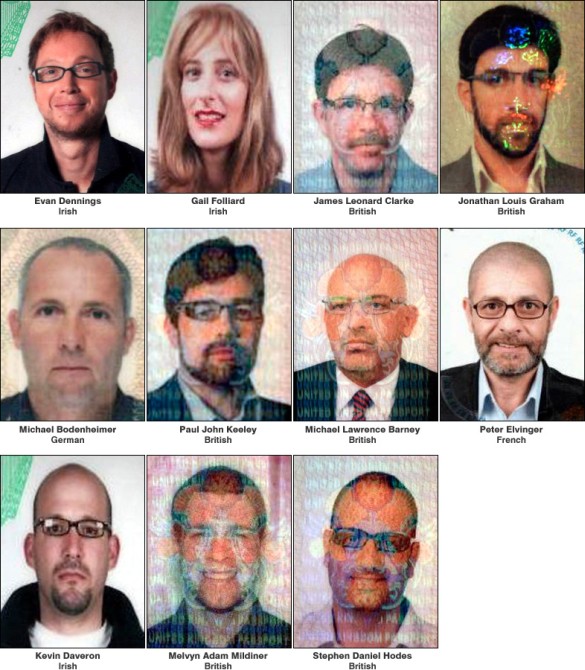
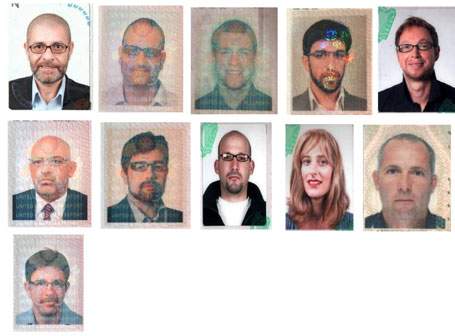
Dubai police have released the passport photographs of 11 suspects linked to the murder of Mahmoud al Mabhouh, a Hamas leader who was found dead in his hotel room in Dubai on January 20. All the suspects carried European passports. There’s no conclusive proof yet that this was a Mossad operation but the images above do at least carry suggestions that the individuals involved had taken measures to conceal their identities.

For instance, this crew all seem to go to an optician who specializes in retro-frames – hunky ugly ones that stand out until the operative stops wearing them or switches to an everyday designer frame. The woman, minus blond wig and ruby lipstick would also lose her signature look. Six shaved/croped heads – again, a few months of hair growth and they’ll be harder to pick out.

As Dubai police indicated in their briefing, this team even went to the lengths of avoiding using cell phones. Add all this up and this looks like an operation meticulously designed to be clandestine. The killers didn’t simply want to eliminate their target — they wanted to create the appearance that he had died of natural causes. It’s hard to ascribe that objective to a criminal motive or to imagine that a criminal organization would have the luxury of deploying eleven people to kill one man.

Haaretz reports:

Dubai will issue arrest warrants soon for 11 Europeans suspected in the killing of a senior Hamas official, but its police chief said Monday that he was still not ruling out Israeli involvement.

“We do not rule out Mossad, but when we arrest those suspects we will know who masterminded it. [We have not] issued arrest warrants yet, but will do soon,” police chief Dahi Khalfan Tamim told reporters.

Dubai Police Chief Lt. Gen. Dhahi Khalfan Tamim told reporters that the alleged assassination team comprised six British passport holders, three Irish and one each from France and Germany.

A leading suspect, who carried a French passport, had left Dubai for Munich via Qatar after the killing, Tamim added.

“We do not rule out (the Israeli intelligence agency) Mossad, but when we arrest those suspects we will know who masterminded it. [We have not] issued arrest warrants yet, but will do soon,” he said.

“Israel carries out a lot of assassinations in many countries, even in countries that it is allied to,” Tamim said, adding that Mabhouh may have been killed by electrocution.

Tamim said two Palestinians suspected of providing logistical support in Mabhouh’s killing were being held by police. Al Arabiya television said the pair had been handed over by Jordan.

Tamim said the 11 still wanted had rented a hotel room opposite Mabhouh’s around the time of his death. All are believed to have left Dubai.

The mercenaries were apparently dressed in tennis gear and visited several hotels on the day of the assasination in order to remain inconspicuous.

Tamim also said forensic tests indicate al-Mabhouh died of suffocation, but lab analyses are still under way.

Violent crime is rare in Dubai, part of the UAE and a regional trading and tourism hub.

Like most Arab countries, the UAE has no diplomatic ties with Israel and Israelis are routinely denied entry.

It refused a visa for Israeli tennis player Shahar Peer to take part in a e2 million tournament in Dubai last year, although she was able to enter for this year’s championship.

Last week the a Paris-based journal dedicated to tracking intelligence activity worldwide, Intelligence Online, reported that ten agents, including three women, participated in the assassination in January.

The journal published what it termed “new details” about the operation, which has been widely attributed to Israel’s Mossad intelligence service. It said that one of the female agents dressed herself in the uniform of a reception clerk at Al Bustan Rotana, the hotel where Mabhouh was staying, and then knocked on his door.

When he opened it her fellow operatives rushed him and stunned him with an electric device, the journal said, then they injected poison into his veins, in order to disguise the cause of death.

Previous reports spoke of seven agents, all carrying Irish passports.

The journal added that Dubai’s secret service had requested assistance in the investigation from its counterparts in Egypt and Jordan and from Interpol. Yet it seems unlikely that Egypt or Jordan could provide much help as both are hostile to Hamas. Indeed, both country’s secret services are engaged in their own war against Hamas operatives.

The journal said that Dubai’s government had ordered that Hamas itself be kept out of the probe, but Hamas is conducting its own investigation headed by the organization’s number two, Moussa Abu Marzook, with help from Iran and Syria.

Top Hamas figures have denied that al-Mabhouh was en route to Iran, a major Hamas backer.

Facebooktwittermail

Goldman Sachs poses a threat to the world’s financial system

A couple of weeks ago I noted that Lloyd Blankfein, the CEO of Goldman Sachs, seems to meet the CIA’s requirements when it selects targets for drone attacks. If it is determined on the basis of current intelligence that such an individual poses “a continuing threat to US persons or interests” then the CIA has, under a presidential order, the legal authority to kill him.

This is not an argument for aiming drones at Wall Street but simply a way of drawing attention to the way America identifies its national security threats.

I’m no economist but it turns out that in terms of identifying the threat posed by Goldman Sachs I was seriously understating the threat posed by Wall Street’s most successful merchant bank. Simon Johnson, former chief economist of the International Monetary Fund, a professor at the MIT Sloan School of Management, and a senior fellow at the Peterson Institute for International Economics, says that in its dealings with the Greek government, Goldman Sachs has acted in a way that is “fundamentally destabilizing to the global financial system.”

Johnson writes:

A single rogue trader can bring down a bank – remember the case of Barings. But a single rogue bank can bring down the world’s financial system.

Goldman will dismiss this as “business as usual” and, to be sure, a few phone calls around Washington will help ensure that Goldman’s primary supervisor – now the Fed – looks the other way.

But the affair is now out of Ben Bernanke’s hands, and quite far from people who are easily swayed by the White House. It goes immediately to the European Commission, which has jurisdiction over eurozone budget issues. Faced with enormous pressure from those eurozone countries now on the hook for saving Greece, the Commission will surely launch a special audit of Goldman and all its European clients.

Facebooktwittermail

This is not a national emergency

Tom Engelhardt writes:

Let me put American life in the Age of Terror into some kind of context, and then tell me you’re not ready to get on the nearest plane heading anywhere, even toward Yemen.

In 2008, 14,180 Americans were murdered, according to the FBI. In that year, there were 34,017 fatal vehicle crashes in the U.S. and, so the U.S. Fire Administration tells us, 3,320 deaths by fire. More than 11,000 Americans died of the swine flu between April and mid-December 2009, according to the Centers for Disease Control and Prevention; on average, a staggering 443,600 Americans die yearly of illnesses related to tobacco use, reports the American Cancer Society; 5,000 Americans die annually from food-borne diseases; an estimated 1,760 children died from abuse or neglect in 2007; and the next year, 560 Americans died of weather-related conditions, according to the National Weather Service, including 126 from tornadoes, 67 from rip tides, 58 from flash floods, 27 from lightning, 27 from avalanches, and 1 from a dust devil.

As for airplane fatalities, no American died in a crash of a U.S. carrier in either 2007 or 2008, despite 1.5 billion passengers transported. In 2009, planes certainly went down and people died. In June, for instance, a French flight on its way from Rio de Janeiro to Paris disappeared in bad weather over the Atlantic, killing 226. Continental Connection Flight 3407, a regional commuter flight, crashed into a house near Buffalo, New York, that February killing 50, the first fatal crash of a U.S. commercial flight since August 2006. And in January 2009, US Airways Flight 1549, assaulted by a flock of birds, managed a brilliant landing in New York’s Hudson River when disaster might have ensued. In none of these years did an airplane go down anywhere due to terrorism, though in 2007 two terrorists smashed a Jeep Cherokee loaded with propane tanks into the terminal of Glasgow International Airport. (No one was killed.)

Facebooktwittermail

Goldman Sachs helped to mask debt fueling Europe’s crisis

The New York Times reports:

Wall Street tactics akin to the ones that fostered subprime mortgages in America have worsened the financial crisis shaking Greece and undermining the euro by enabling European governments to hide their mounting debts.

As worries over Greece rattle world markets, records and interviews show that with Wall Street’s help, the nation engaged in a decade-long effort to skirt European debt limits. One deal created by Goldman Sachs helped obscure billions in debt from the budget overseers in Brussels.

Even as the crisis was nearing the flashpoint, banks were searching for ways to help Greece forestall the day of reckoning. In early November — three months before Athens became the epicenter of global financial anxiety — a team from Goldman Sachs arrived in the ancient city with a very modern proposition for a government struggling to pay its bills, according to two people who were briefed on the meeting.

The bankers, led by Goldman’s president, Gary D. Cohn, held out a financing instrument that would have pushed debt from Greece’s health care system far into the future, much as when strapped homeowners take out second mortgages to pay off their credit cards.

It had worked before. In 2001, just after Greece was admitted to Europe’s monetary union, Goldman helped the government quietly borrow billions, people familiar with the transaction said. That deal, hidden from public view because it was treated as a currency trade rather than a loan, helped Athens to meet Europe’s deficit rules while continuing to spend beyond its means.

Facebooktwittermail

Iran’s failed Facebook revolution

In Foreign Policy, Cameron Abadi writes:

A group of Iran’s green movement activists had a grand and detailed vision for what was supposed to happen on Feb. 11. They called it a “Trojan Horse” strategy: Backers of opposition leader Mir-Hossein Mousavi, camouflaged in unassuming attire, would attend the official regime-backed rally commemorating the 31st anniversary of the Islamic Revolution. Then, at a pre-arranged time, they would assemble in front of the cameras of the foreign news media, reveal themselves as enthusiasts of the green movement, and denounce the brutality of the government for all the world to see.

As we all know, however, there was no great reveal at the official rally: The plan didn’t work, and Feb. 11 will be remembered by Iran’s activists not as a triumph, but as a disappointment. And the scale of the setback, which has placed a significant damper on the movement’s spirits, is closely tied to the specificity and grandiosity of the visions that were being cultivated in the preceding weeks via blogs, forwarded emails, and social networking sites.

Iranian activists have long reaped the benefits of Internet communication, but especially in the months since the June 12 election, they have also fallen prey to its pitfalls. Reassured by their own online echo chambers, activists and participants allowed their optimism to grow like a market bubble — a bubble that, many say, was popped on Thursday.

The Los Angeles Times describes the way protesters were treated in the notorious Kahrizak prison last summer:

Over the five days, beatings came regularly — when someone complained or whenever the guards felt like it. To make an example of an inmate who protested about the conditions, guards hung him by his ankles and beat him with plastic pipes.

Amir Javadifar, a young filmmaker and actor, had been badly beaten even before he got to Kahrizak, and his condition worsened.

“From the first night in Kahrizak, he lost sight of one of his eyes due to being battered by a hard object, as later we would see in the report of forensic doctors examining his dead body,” Nikbakht said. At night, the soldiers stomped on the tin roof, or smashed the walls with their batons or the butts of their rifles. “The noise drove us crazy,” Hatef said.

One morning early in the detention they awoke to find Mohammad Kamrani, a nephew of an official working in Ahmadinejad’s office, in dire condition.

“He was unconscious,” Hatef said.

They also found that they couldn’t revive Mohsen Ruholamini, the son of a political advisor to one of Iran’s top conservative politicians. The guards had been pounding on him.

“He was suffering from a broken head due to being hit by a plastic pipe,” Hatef said.

The guards showed no mercy to those who were already badly injured.

Facebooktwittermail

New blow to Iraq election credibility

The National reports:

Any lingering hope that Iraq can hold a credible and peaceful election suffered a further blow yesterday when the leading secular nationalist bloc suspended its participation.

The Iraqiya list, led by the former president Ayad Allawi, announced a three-day halt to its campaign after an appeals court upheld an exclusion order preventing Saleh al Mutlaq and Dhafer al Ani, two of its senior candidates, from standing on the grounds that they were pro-Baathist.

Iraqiya leaders called for an urgent meeting with the president, Jalal Talabani, the prime minister, Nouri al Maliki, and the parliament speaker, Ayad al Samarrae, to “examine the means of creating the best climate for the elections”.

Facebooktwittermail

Our human rights vs. The others

Glenn Greenwald writes:

Ten American Baptists were arrested two weeks ago in Haiti on charges that they exploited the chaos in that country by attempting to smuggle 33 young Haitian children across the border without permission — either to bring them to a life of Christianity or (as some evidence suggests) to filter them into a child trafficking ring. National Review‘s Kathryn Jean Lopez is deeply upset by the plight of at least one of the detained Americans, Jim Allen, whom she contends (based exclusively on his family’s claims) is innocent. Lopez demands that the State Department do more to “insist” upon Allen’s release, and — most amazingly of all — complains about the conditions of his detention. She has the audacity to cite a Human Rights Watch description of prison conditions in Haiti as “inhumane.” Lopez complains that Allen was waterboarded, stripped, frozen and beaten has “hypertension,” was shipped thousands of miles away to a secret black site beyond the reach of the ICRC and then rendered to Jordan allowed to speak to his wife only once in the first ten days of his confinement, and was consigned to years in an island-prison cage with no charges denied his choice of counsel for a few days (though he is now duly represented in Haitian courts by a large team of American lawyers).

Facebooktwittermail

Rep. Bachmann: America ‘cursed’ by God ‘if we reject Israel’

The Minnesota Independent drew attention to remarks made by Rep. Michele Bachmann when she addressed the Republican Jewish Coalition in Los Angeles this month. Bachmann said:

I am convinced in my heart and in my mind that if the United States fails to stand with Israel, that is the end of the United States . . . [W]e have to show that we are inextricably entwined, that as a nation we have been blessed because of our relationship with Israel, and if we reject Israel, then there is a curse that comes into play. And my husband and I are both Christians, and we believe very strongly the verse from Genesis [Genesis 12:3], we believe very strongly that nations also receive blessings as they bless Israel. It is a strong and beautiful principle.

Right now in my own private Bible time, I am working through Isaiah . . . and there is continually a coming back to what God gave to Israel initially, which was the Torah and the Ten Commandments, and I have a wonderful quote from John Adams that if you will indulge me [while I find it] . . . [from his February 16, 1809 letter to François Adriaan van der Kemp]:

I will insist that the Hebrews have done more to civilize men than any other nation. If I were an atheist, and believed in blind eternal fate, I should still believe that fate had ordained the Jews to be the most essential instrument for civilizing the nations. If I were an atheist of the other sect, who believe or pretend to believe that all is ordered by chance, I should believe that chance had ordered the Jews to preserve and propagate to all mankind the doctrine of a supreme, intelligent, wise, almighty sovereign of the universe, which I believe to be the great essential principle of all morality, and consequently of all civilization.

… So that is a very long way to answer your question, but I believe that an explicit statement from us about our support for Israel as tied to American security, we would do well to do that.

Facebooktwittermail

Obama’s take-no-prisoners approach

A year ago, when President Obama signed his executive order to close Guantanamo he said: “the message we are sending around the world is that the United States intends to prosecute the ongoing struggle against violence and terrorism, and we are going to do so vigilantly; we are going to do so effectively; and we are going to do so in a manner that is consistent with our values and our ideals.”

It is now plain that Obama’s solution to the dilemma of how to interrogate and incarcerate suspected terrorists is chillingly simple: kill them.

The Obama administration’s kill-first policy relies first and foremost on this fact: the United States can act with impunity. Indeed, a president who was welcomed by the world largely because he was seen as the antithesis of his predecessor, appears in fact to believe that under the protection of a cool and sophisticated persona he has latitude to go further than Bush — as though the former president’s greatest failing was his style.

The Washington Post reports:

When a window of opportunity opened to strike the leader of al-Qaeda in East Africa last September, U.S. Special Operations forces prepared several options. They could obliterate his vehicle with an airstrike as he drove through southern Somalia. Or they could fire from helicopters that could land at the scene to confirm the kill. Or they could try to take him alive.

The White House authorized the second option. On the morning of Sept. 14, helicopters flying from a U.S. ship off the Somali coast blew up a car carrying Saleh Ali Nabhan. While several hovered overhead, one set down long enough for troops to scoop up enough of the remains for DNA verification. Moments later, the helicopters were headed back to the ship.

The strike was considered a major success, according to senior administration and military officials who spoke on the condition of anonymity to discuss the classified operation and other sensitive matters. But the opportunity to interrogate one of the most wanted U.S. terrorism targets was gone forever.

The Nabhan decision was one of a number of similar choices the administration has faced over the past year as President Obama has escalated U.S. attacks on the leadership of al-Qaeda and its allies around the globe. The result has been dozens of targeted killings and no reports of high-value detentions.

Facebooktwittermail

Keep chewing that qat Mr Friedman — but spare us the visions

Tom Friedman, refreshed and inspired by his recent jaunt to Yemen, writes:

I believe the only way the forces of 1979 can be rolled back would be with another equally big bang — a new popular movement that is truly reformist, democratizing, open to the world, yet anchored in Muslim culture, not disconnected. Our best hopes are the fragile democratizing trends in Iraq, the tentative green revolution in Iran, plus the young reformers now coming of age in every Arab country. But it will not be easy.

The young reformers today “do not have a compelling story to tell,” remarked Lahcen Haddad, a political scientist at Rabat University in Morocco. “And they face a meta-narrative” — first developed by Nasser and later adopted by the Islamists — “that mobilizes millions and millions. That narrative says: ‘The Arabs and Muslims are victims of an imperialist-Zionist conspiracy aided by reactionary regimes in the Arab world. It has as its goal keeping the Arabs and Muslims backward in order to exploit their oil riches and prevent them from becoming as strong as they used to be in the Middle Ages — because that is dangerous for Israel and Western interests.’ ”

Today that meta-narrative is embraced across the Arab-Muslim political spectrum, from the secular left to the Islamic right. Deconstructing that story, and rebuilding a post-1979 alternative story based on responsibility, modernization, Islamic reformation and cross-cultural dialogue, is this generation’s challenge. I think it can happen, but it will require the success of the democratizing self-government movements in Iran and Iraq. That would spawn a whole new story.

I know it’s a long shot, but I’ll continue to hope for it. I’ve been chewing a lot of qat lately, and it makes me dreamy.

The problem with viewing the Middle East in terms of competing narratives is that it leads to exactly what Friedman does: present the region’s problems in terms of defective story telling. It discounts the possibility that the most obvious explanation for the iron grip of the so-called meta-narrative is that it provides a fairly good approximation of the truth.

The hold of this story is not a reflection of a weak Arab mind or of limited access to good education but on the contrary the facts that the region is indeed mired by autocratic rule, the West is indeed hugely invested in controlling the region’s carbon resources and the only country in the region towards which the West and especially the United States displays an unswerving loyalty is indeed Israel.

Call that an imperialist-Zionist conspiracy if you like, but the name is really just a distraction — a way for Friedman to say: “no truth here… please move along. Come check out my dream of modernity — it could be your dream too. (If only I could figure why you think the way you do… More qat please.)”

Facebooktwittermail